Market Snapshot
Key Takeaways
Market Overview & Analysis
Report Summary
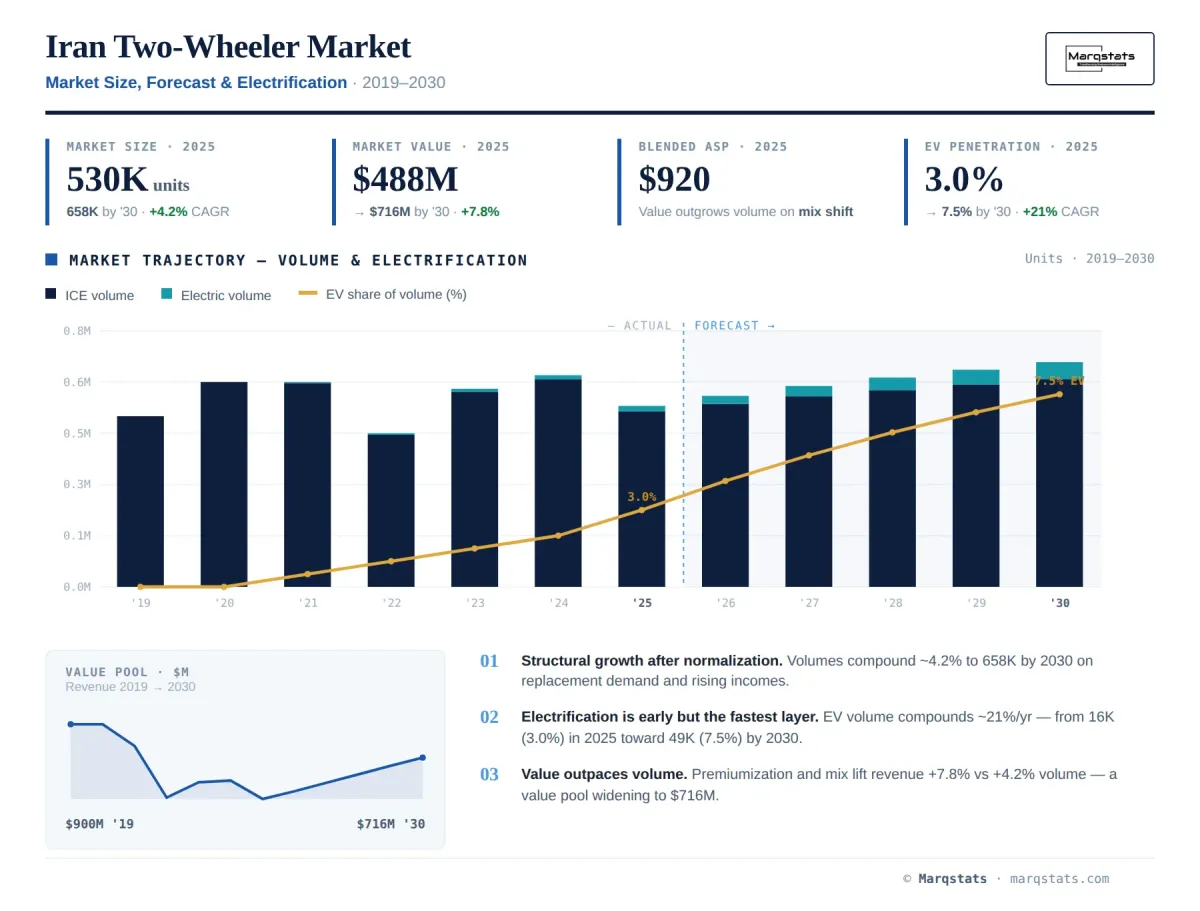
The Iran two-wheeler market is a large, domestically supplied motorcycle market with a structure unlike its regional peers. Where markets elsewhere are led by imported or foreign-brand machines, Iran is served overwhelmingly by domestic assemblers, a consequence of import constraints and decades of local manufacturing. The market generated USD 487.6 million in revenue in 2025 on about 530,000 units, and it sits on a very large installed base of roughly 12 million motorcycles that sustains steady replacement demand. This installed base, among the largest in the region, means demand is driven as much by replacement of ageing machines as by new ownership, and a substantial share of older motorcycles is nearing the end of its service life. The scale of the fleet also underpins the government interest in electrification, since replacing old combustion machines is central to urban air-quality goals.
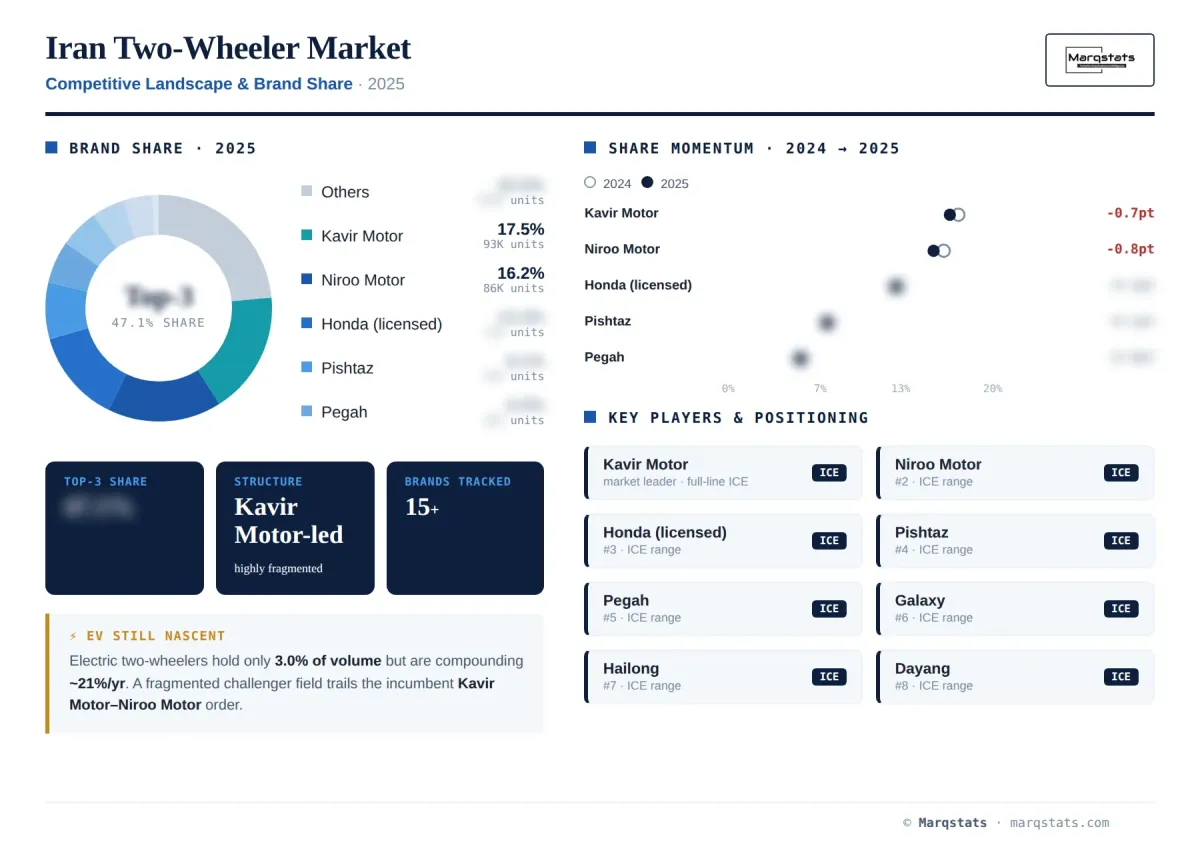
Market structure is fragmented and domestic. Kavir Motor leads at about 18% of revenue and Niroo Motor follows at about 16%, together forming the core of a locally assembled market. Licensed assembly of Honda machines holds about 13%, and domestic brands Pishtaz, Pegah, Galaxy, and Hailong hold further positions. Local producers build machines under licensed technologies and adapt them to Iranian conditions and pricing, though components, especially from China, remain largely imported. The prominence of domestic assemblers distinguishes Iran from every other market in the region. This structure has developed over decades of local manufacturing under import constraints, and it has produced a dense network of assemblers, component suppliers, and dealers oriented toward the domestic market. Local production keeps machines affordable and widely available across the country, and it gives domestic brands a durable advantage in reach and pricing that foreign machines find hard to match. It also means the health of the market is closely tied to domestic production capacity and the availability of imported components.
Air quality is a central force in the market. Motorcycles are a major source of urban air pollution, an issue examined in World Bank analysis of Tehran, and the government has introduced incentives to promote electric machines, including subsidies and production requirements. Delivery and logistics form the dominant commercial use, reflecting a large app-based courier sector, and these forces together shape demand across a market that is moving gradually toward electrification while remaining firmly anchored in affordable combustion machines built at home.
Market Dynamics
Key Drivers
- A very large installed base of about 12 million motorcycles sustains steady replacement demand across the country.
- Growth of app-based delivery and courier services raises demand for motorcycles as goods-movement vehicles in cities.
- Domestic assembly under import constraints keeps affordable, locally built machines available across the market.
- Government incentives for electric machines, including subsidies and production requirements, support electrification.
Key Restraints
- Import constraints and currency pressure raise the cost of components and imported machines and parts.
- Air-quality regulation and emission standards raise compliance requirements for ageing combustion machines.
- Limited charging and swap infrastructure slows the shift toward electric two-wheelers beyond early adoption.
Key Trends
- Electric two-wheelers grow fastest at a 25.21% CAGR, supported by subsidies and city-level incentives in Tehran.
- Domestic assemblers sustain the majority of supply under import constraints, adapting licensed technologies locally.
- Online retail expands fastest among channels at a 20.65% CAGR, though physical dealers still handle most value.
- App-based delivery demand reinforces the commercial base and supports interest in lower-running-cost electric machines.
Market Segmentation
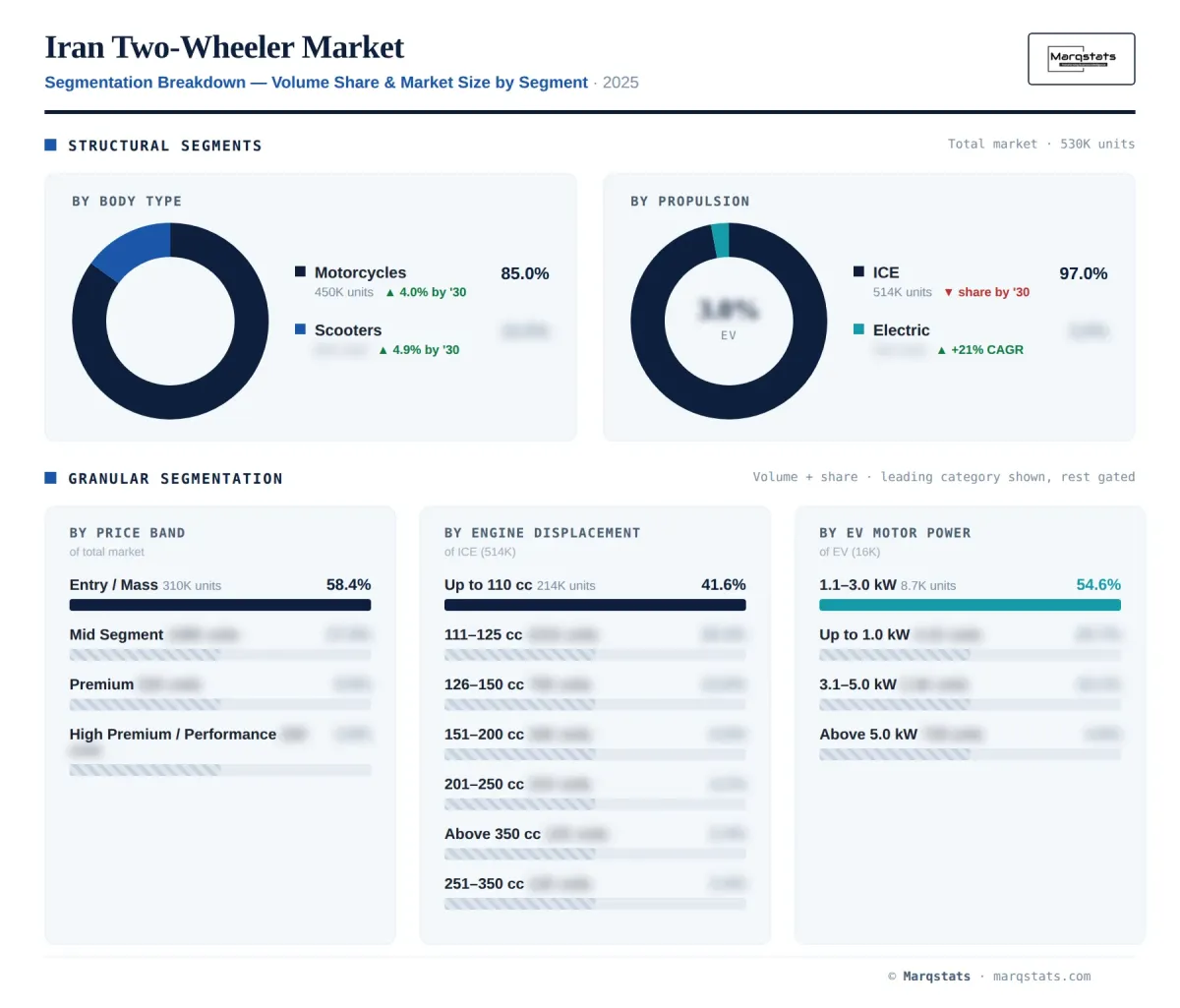
Motorcycles dominate the vehicle-type segment, generating USD 414.5 million in 2025, about 85% of market revenue, and rising to USD 604.6 million by 2030 at a 7.64% CAGR. The segment is built on affordable commuter, utility, and delivery machines suited to Iranian urban and rural conditions. Domestic assemblers led by Kavir Motor and Niroo Motor supply most of this segment, with entry and mid-displacement machines forming the core of demand for commuting and the large delivery and courier sector. Affordability, fuel efficiency, and the availability of local parts and service determine buying decisions, and machines are expected to serve daily commuting and income-earning roles over long operating lives. Replacement demand from a large, ageing fleet adds a steady, recurring layer of sales.
Scooters and mopeds generated USD 73.1 million in 2025, about 15% of revenue, a larger share than in most regional markets, and grow to USD 111.4 million by 2030 at an 8.55% CAGR. The higher scooter share reflects Iranian urban commuting patterns and the popularity of licensed cub and scooter models. The segment serves city commuting and lighter delivery use, and it grows faster than motorcycles in percentage terms, though motorcycles remain the large majority of the market by value and volume. Scooter demand is concentrated in dense urban centres, where light, easy-to-ride machines suit short commutes and delivery runs across congested streets.
Internal combustion engine models dominate the market, generating USD 473.0 million in 2025, about 97% of revenue, and growing to USD 662.0 million by 2030 at a 6.82% CAGR. Combustion demand is anchored in affordable, low-displacement commuter and delivery machines built by domestic assemblers. The combustion share edges down over the forecast period as electric machines gain support, though it remains the overwhelming majority of demand throughout, sustained by the large installed base and established local supply.
Electric is the fastest-growing propulsion category, expanding from USD 14.6 million in 2025 to USD 53.8 million by 2030 at a 25.21% CAGR. Adoption is supported by government subsidies, city-level incentives, and air-quality goals, and it mirrors the momentum visible in other electric two-wheeler markets tracked by Marqstats. Domestic producers and Chinese brands such as Yadea supply the segment. Growth is driven by running-cost savings and pollution policy, though electric remains a small share of the market through the forecast period, constrained by charging infrastructure and machine cost. Policy support is unusually strong for the region, with national subsidies, city-level loans, and plans to restrict combustion machines in parts of Tehran, and delivery fleets are an early focus given their high daily mileage and predictable routes. The pace of subsidy delivery, charging build-out, and machine affordability will determine how quickly electric adoption moves from early buyers into the mainstream.
Within combustion models, entry displacements dominate. The up-to-110 cc band is the largest tier by revenue at USD 197.0 million in 2025, followed by the 111 to 125 cc band at USD 138.7 million; together these entry classes represent about 71% of combustion revenue, consistent with a market centred on affordable commuter, delivery, and utility machines. The 126 to 150 cc band adds USD 64.1 million, while larger displacements above 250 cc remain small, reflecting limited demand for premium or high-displacement machines relative to the mass base. The concentration in low-displacement classes reflects the economics of the market, where affordability, fuel efficiency, and local parts availability outweigh power for the majority of buyers.
Within electric models, demand is led by the 1.1 to 3.0 kW band at USD 8.0 million in 2025, the typical power class for commercial and commuter electric motorcycles, followed by the up-to-1.0 kW band at USD 3.8 million. The higher-power bands are smaller yet expand fastest, with the above-5.0 kW band growing at a 32.98% CAGR as more capable machines enter service. The electric motor-power mix reflects commuting and delivery use, where range and reliability matter for daily riders.
The entry and mass price band dominates the market, generating USD 284.8 million in 2025, about 58% of revenue, followed by the mid segment at USD 136.0 million; together the two lower tiers account for roughly 86% of the market, underscoring its affordability-driven character. The premium and high-premium bands are smaller yet grow faster, at 8.98% and 11.96% CAGR respectively, as a segment of buyers trades up. The high-premium and performance band, at USD 18.5 million in 2025, is the fastest-expanding price tier, though it remains a minor share of overall demand.
B2C demand leads the Iran two-wheeler market at USD 314.2 million in 2025, about 64% of revenue, growing at a 7.59% CAGR, while B2B and fleet demand accounted for USD 173.4 million. Within commercial demand, delivery and logistics form the dominant use at USD 127.3 million, reflecting a large app-based courier and food-delivery sector centred on Tehran and other cities, followed by ride-hail and passenger services at USD 29.3 million and government and institutional demand at USD 16.8 million. The scale of delivery demand, unusually large by regional standards, is a defining feature of the market, and it supports interest in lower-running-cost electric machines among commercial riders whose earnings depend on daily operating costs. The prominence of delivery reflects the growth of app-based courier and food-delivery platforms, which rely on fleets of motorcycles for last-mile service in dense cities. B2C demand, at about 64% of revenue, spans commuters, traders, and households for whom motorcycles are an affordable, flexible means of everyday transport.
Offline dealers overwhelmingly dominate the channel mix, handling USD 462.2 million of revenue in 2025 and growing at a 6.74% CAGR, owing to the service, financing, and after-sales functions that motorcycle purchases require. Online sales, however, expand fastest at a 20.65% CAGR, rising from USD 25.4 million as e-commerce and marketplace listings gain share, supported by high smartphone and internet penetration. The channel shift is gradual, and physical dealers retain the large majority of value through the forecast period, supported by the role of after-sales service and spare-parts access in ownership. Online channels are most active in Tehran and other large cities, where digital adoption and delivery-linked demand are highest.
By Geography
Tehran
Tehran, the capital and largest city, is the core of the market. Its dense population, congestion, and large app-based delivery sector make motorcycles essential for commuting and goods movement. Tehran is also the focus of electrification, where air-quality pressure has prompted municipal loans for electric motorcycles, traffic incentives, and plans to restrict non-electric machines in parts of the city, making the capital both the largest demand centre and the testing ground for electric adoption. The concentration of delivery platforms, dealers, and assemblers in and around Tehran reinforces its central role in both demand and supply.
Isfahan, Mashhad, and Major Cities
Isfahan, Mashhad, Shiraz, and other major cities form further demand centres, where motorcycles are central to urban commuting and delivery. These cities host dealer networks and share the air-quality concerns and electrification incentives seen in Tehran, and demand reflects both everyday commuting and the growth of app-based delivery, complementing the concentration of activity in the capital. As secondary cities grow, they add incremental demand and broaden the geographic base of the market beyond Tehran.
Smaller Cities and Rural Areas
Across smaller cities and rural areas, motorcycles serve as essential, affordable transport for commuting, trade, and goods movement. Demand in these areas reflects utility and personal use, and it underpins durable, low-cost machines built by domestic assemblers, sustaining steady replacement activity across a large and geographically dispersed installed base. As roads and incomes develop, these areas add incremental demand and widen the geographic base of the market.
How Competition Is Evolving
The Iran two-wheeler market is fragmented and led by domestic assemblers. Kavir Motor holds the top position at about 18% of revenue in 2025, and Niroo Motor follows at about 16%, together forming the core of the market. Licensed assembly of Honda machines holds about 13%, and domestic brands Pishtaz, Pegah, Galaxy, Hailong, and Dayang hold further positions, with a large tail of domestic and imported brands completing the market. The dominance of local producers is the defining feature of the Iranian market, and it rests on decades of local assembly, adapted machines, and dealer reach that foreign brands find hard to replicate under current conditions.
Competition centres on price, local availability, and adaptation to Iranian conditions. Domestic assemblers compete on affordability, machines built under licensed technologies, and extensive local dealer and service networks, an advantage in a market shaped by import constraints. Component supply, especially from China, is a key input, and the ability to maintain production and parts availability under import constraints is central to competitive positioning and market resilience. Licensed assembly of established foreign designs supports quality and brand familiarity, and it allows domestic producers to offer trusted models at locally affordable prices.
Electrification is beginning to reshape the competitive field. Government incentives, city-level measures, and the air-quality concerns documented in assessments of Tehran are drawing domestic producers and Chinese brands such as Yadea into electric machines. Electric competitors compete on running-cost savings and policy support, and the pace of infrastructure build-out, subsidy delivery, and machine affordability will determine how quickly the electric segment scales from its small base.
The competitive field is likely to remain fragmented and domestically led through the forecast period, with local assemblers competing across price tiers and use cases, and electric producers expanding from a small base. Production capacity, component supply, dealer-network reach, and the ability to serve commuting and the large delivery sector reliably will increasingly determine which brands gain and hold share in the Iranian market. Brands that combine affordable local production with dependable parts and service, and that move early on electrification, are well positioned to lead as the market evolves.
Companies Covered
The report profiles 16+ companies with full strategy and financials analysis, including:
Recent Market Activity
Table of Contents
Coverage & Segmentation
This report provides a comprehensive analysis of the Iran two-wheeler market for the 2021 to 2025 historical period and the 2026 to 2030 forecast period, with 2025 as the base year. The study quantifies market size in revenue terms and in unit volume, and segments the market by vehicle type, propulsion type, engine displacement and motor power, price band, end user, sales channel, and brand. It examines the drivers, restraints, and trends shaping demand, and profiles the competitive structure of the market.
The study focuses on registered two-wheelers, spanning motorcycles, scooters, mopeds, and electric light vehicles. Coverage addresses the distinctive domestic-assembler structure of the market, the large installed base, the scale of app-based delivery demand, air-quality pressure and government electrification incentives, the early stage of electric adoption, and the composition of demand across commuting, delivery, and commercial use. Values are reported in USD MN, and regional demand is examined across Tehran, the major cities of Isfahan, Mashhad, and Shiraz, and smaller cities and rural areas.