Market Snapshot
Key Takeaways
Market Overview & Analysis
Report Summary
The Spain two-wheeler market comprises motorcycles, scooters, and mopeds sold for personal and commercial use across internal combustion and electric propulsion. This study segments demand by vehicle type, propulsion type, engine displacement and motor power, price band, end user, sales channel, and brand, with a 2025 base year, historical coverage from 2021 to 2025, and forecasts to 2030. Spain is now among Europe's largest two-wheeler markets, built on urban commuting in Madrid, Barcelona, and the Mediterranean cities.
Spain's 2025 performance separates it from every other major European market. Where the Euro 5+ emissions standard, effective January 2025, prompted a pre-buy surge in late 2024 followed by a sharp correction elsewhere, Spanish registrations continued to rise, and data compiled by the European Association of Motorcycle Manufacturers shows Spain growing through the first half of 2025 while Germany, France, Italy, and the United Kingdom all declined. Strong economic growth, rising urban commuting demand, and the practicality of two-wheelers in congested cities underpinned the result.
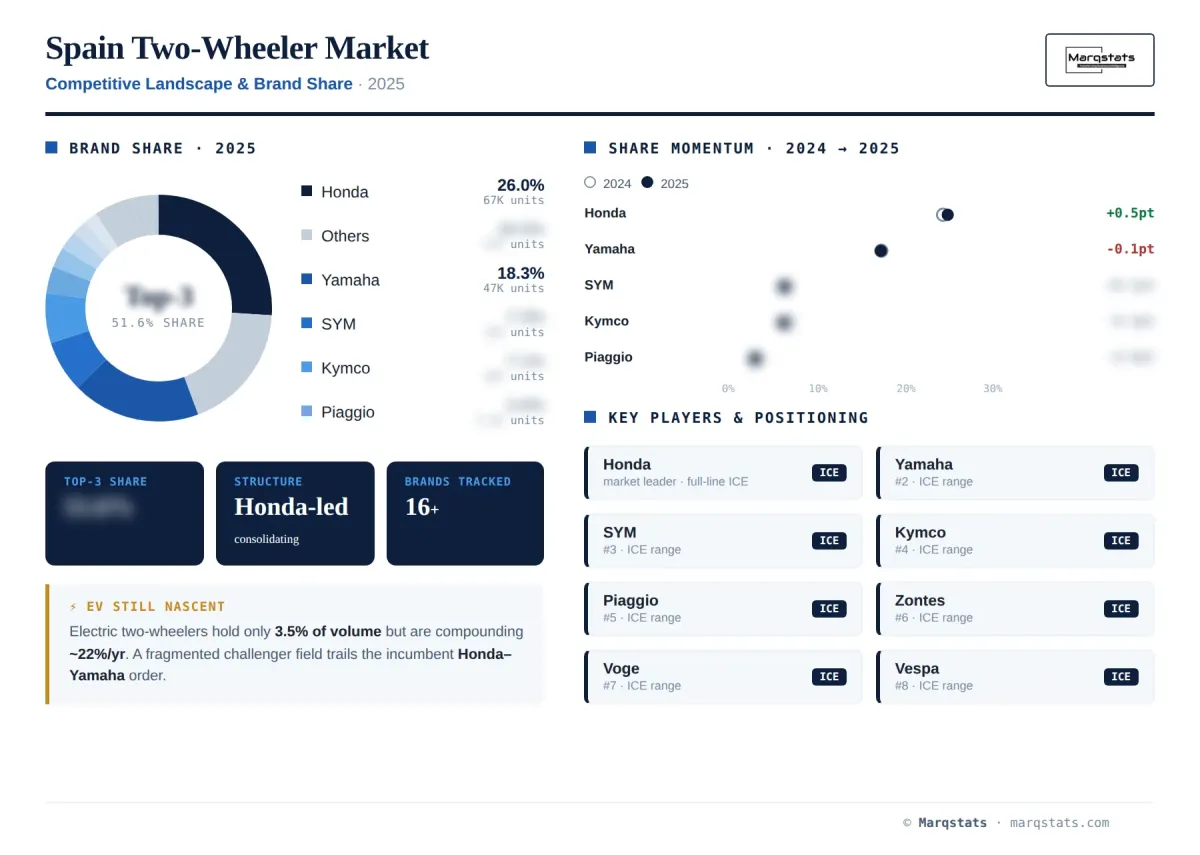
Supply is led by Honda, whose PCX 125 and Forza 125 scooters are the market's top-selling models, followed by Yamaha. The Taiwanese scooter brands SYM and Kymco hold strong positions in the commuter segment, and Piaggio, Vespa, Aprilia, and Peugeot Scooters compete across scooters and light motorcycles. BMW, Kawasaki, and Ducati anchor premium demand, while Chinese brands Zontes and Voge have expanded sharply. KTM registrations halved during its parent Pierer Mobility's financial restructuring. Electric two-wheelers hold a small share concentrated in scooters and light machines.
The market's structure traces to a single policy decision. From October 2004, holders of a standard car licence with three years of experience were permitted to ride 125cc machines, and Spanish cities filled with 125cc scooters and small motorcycles over the following two decades. That access rule created the deepest 125cc concentration in Europe and made two-wheelers a mainstream commuting tool rather than an enthusiast purchase. The consequence is visible throughout the segmentation: the 125cc class dominates displacement, scooters dominate the vehicle mix in practice, and the mid price band is the market's largest by volume.
Market Dynamics
Key Drivers
- Urban commuting demand drives the market, as two-wheelers ease congestion and parking pressure in Madrid, Barcelona, and the coastal cities of the Mediterranean.
- Licensing rules support volume, as car-licence holders with three years of experience may ride 125cc machines, sustaining the dominant displacement class.
- A strong national economy underpins demand, with Spanish growth outpacing European peers and supporting discretionary vehicle purchases across the country.
- Premiumisation lifts value, as the premium and high-premium bands grow faster than the market and raise average selling prices.
Key Restraints
- Saturation in the 125cc class limits volume growth, as the dominant segment is broadly flat through the forecast period despite its scale.
- Pre-registration activity in late 2024 pulled some demand forward, moderating the pace of growth in early 2025.
- Volatile electric adoption slows the transition, as the electric segment declined for several years before recovering from a small base.
Key Trends
- Electrification accelerates from a small base, concentrated in scooters and urban machines; the Thailand electric two-wheeler market offers a comparison for scooter-led electric adoption.
- Chinese brands surge, as Zontes and Voge more than doubled volumes into 2025 with competitively priced, well-equipped machines.
- Online retail expands rapidly at a 19% CAGR, reaching about 28% of sales as offline dealership volumes decline.
- Premium and performance machines grow fastest by price band, as riders trade up from commuter models.
Market Segmentation
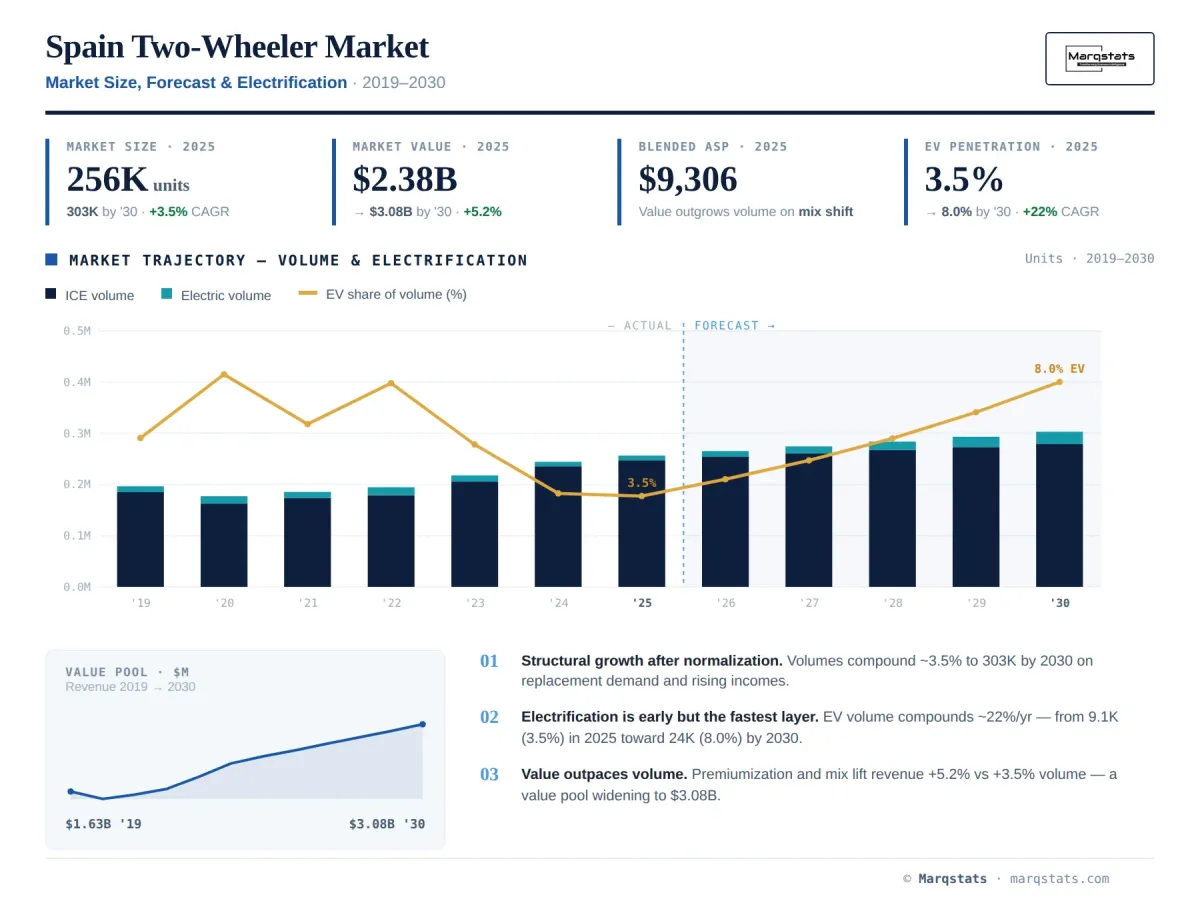
In this study's taxonomy, motorcycles account for about 95% of 2025 volume, roughly 243,000 units, growing at a 2.79% CAGR. The figure includes the scooters grouped within the category, and on a real-world basis scooters represent roughly half of Spanish registrations. The category spans 125cc scooters and commuter motorcycles, mid-displacement machines, and premium models, and it concentrates heavily in the 125cc class that defines urban mobility. Registration data shows scooters growing faster than road motorcycles through 2025, so the headline category masks a mix shift toward urban commuting machines.
The standalone scooter and moped line, largely mopeds under 50cc, accounts for about 14,000 units in 2025, roughly 5% of volume, growing fastest at a 14.72% CAGR from a low base. Moped registrations declined structurally through the historical period before stabilising, while the scooters counted within the motorcycle category above remain the market's real engine of growth, central to urban commuting and delivery.
Combustion models hold about 96% of 2025 volume, roughly 247,000 units, growing at a 2.37% CAGR. Combustion remains dominant across scooter, commuter, mid, and premium classes, now built to the Euro 5+ standard, and it continues to define the 125cc machines and larger motorcycles at the heart of the market. Growth is steady rather than rapid, reflecting the maturity of the dominant commuter segments. Combustion is set to retain an overwhelming share throughout the forecast period, though its growth rate lags the market as electric scooters take an increasing portion of incremental urban demand.
Electric two-wheelers hold about 4% of 2025 volume, roughly 9,000 units, growing fastest at a 21.59% CAGR to reach about 24,000 units by 2030. Adoption is concentrated in scooters and light urban machines, and the higher-power above-5.0 kW class grows fastest within electric. The segment declined for several years before recovering in 2025, so momentum depends on urban low-emission requirements, purchase incentives, and the pricing of new electric scooter models over the forecast period. Spain's dense urban commuting base is well suited to electrification, and the low-emission zones of Madrid and Barcelona provide a structural pull that supports adoption independent of subsidy cycles.
The 111–125cc class is overwhelmingly dominant at about 54% of 2025 volume, roughly 139,000 units, the deepest concentration in any market in this series. Licensing rules allowing experienced car-licence holders to ride 125cc machines have made this class the backbone of Spanish urban mobility since the mid-2000s, and Honda's PCX 125 and Forza 125 are its emblematic models. The class is broadly flat through the forecast period, reflecting saturation at high penetration. Growth therefore comes from riders trading up into larger displacements rather than from expansion of the 125cc base itself, a structural shift that lifts market value even as the dominant volume class holds steady.
Machines above 350cc account for about 22% of volume and generate the largest share of value, growing at about a 5% CAGR on premium and touring demand. The 251–350cc class adds about 13%, reflecting demand for maxi-scooters and mid-large machines, while the 201–250cc and smaller mid displacements grow faster from small bases as riders step up from 125cc machines.
The mid segment is the largest price band by volume at about 45%, driven by 125cc scooters and commuter machines, though it declines slightly through the forecast period as buyers trade up. The entry and mass band adds about 26% and grows steadily, anchoring affordable urban mobility across the market.
Premium and high-premium performance bands together account for about 30% of volume and a disproportionate share of value. The high-premium and performance band grows fastest at about 9%, and premium at about 7%, both outpacing the market as riders trade up from commuter models. This premiumisation is why market value grows faster than unit volumes through 2030. The pattern reflects a maturing rider base in which commuters who entered on 125cc machines progress to larger displacements over time, sustaining demand for premium and performance models even as the entry classes flatten.
Private consumers account for about 84% of 2025 volume, the core of a market weighted toward personal urban mobility. Ownership spans commuters on 125cc scooters, riders stepping up to mid and premium machines, and enthusiasts, and private demand grew strongly through 2025.
Commercial demand is meaningful and led by delivery. Delivery and logistics accounts for about 12% of volume, supported by urban food-delivery platforms, while rental and tourism grows fastest among commercial users at about 8%, supported by Spain's substantial tourism sector. This delivery base is an early adopter of electric scooters. Spain's position as one of the world's most visited countries sustains a large scooter rental market across coastal and island destinations, adding a distinctive seasonal layer of commercial demand on top of the resident commuter base.
The online channel reaches about 28% of 2025 sales and grows fastest at a 19% CAGR. Buyers research, configure, finance, and increasingly transact online, and the channel is central to how younger and value-focused buyers engage with the market, particularly when comparing the growing range of Chinese and value models.
Franchised dealerships remain central to premium sales and after-sales service, though offline volumes decline at about 8% annually as digital retail expands. Dealers retain their role in test rides, servicing, financing, and the community around premium ownership, and the channel is shifting toward a hybrid model. Dealers that pair a strong online presence with in-person service have weathered the transition most successfully, while those reliant on walk-in commuter traffic have faced the sharpest pressure.
By Geography
Catalonia
Catalonia, centred on Barcelona, records the highest two-wheeler registrations in Spain. Barcelona has one of Europe's highest two-wheeler densities, and its congestion, narrow streets, and low-emission zone make scooters and 125cc machines a mainstream mobility choice, sustaining strong year-round demand across commuter and premium segments. The region combines a large affluent urban population with a mild climate that permits riding through the winter, and its dealer network and delivery economy are among the deepest in the country.
Andalusia
Andalusia is the second-largest regional market, combining large urban centres such as Seville and Málaga with warm weather that supports year-round riding. Demand concentrates in scooters and 125cc machines for commuting, and the region's tourism sector sustains rental and leisure demand along the coast. Its size and climate make it one of the country's most consistent markets, with two-wheeler use extending across the winter months in a way northern European markets cannot match.
Madrid & Central Spain
Madrid and central Spain form a major market, where the capital's congestion, low-emission zone, and dense commuting patterns support strong scooter and 125cc demand. The region also concentrates premium and touring demand, supported by high incomes and access to riding roads beyond the city. Madrid's restrictions on older combustion vehicles have made compact two-wheelers an increasingly practical alternative for daily commuting, and the region combines mass urban demand with one of the country's strongest premium customer bases.
Valencia & the Mediterranean Coast
The Valencian Community and the wider Mediterranean coast form the third-largest market, where mild weather, coastal cities, and tourism sustain year-round two-wheeler use. Demand spans commuter scooters, delivery machines, and a substantial rental and leisure segment serving visitors. The corridor of coastal cities from Valencia southward combines dense urban populations with tourism flows, producing steady demand across both the commuter and rental categories throughout the year.
How Competition Is Evolving
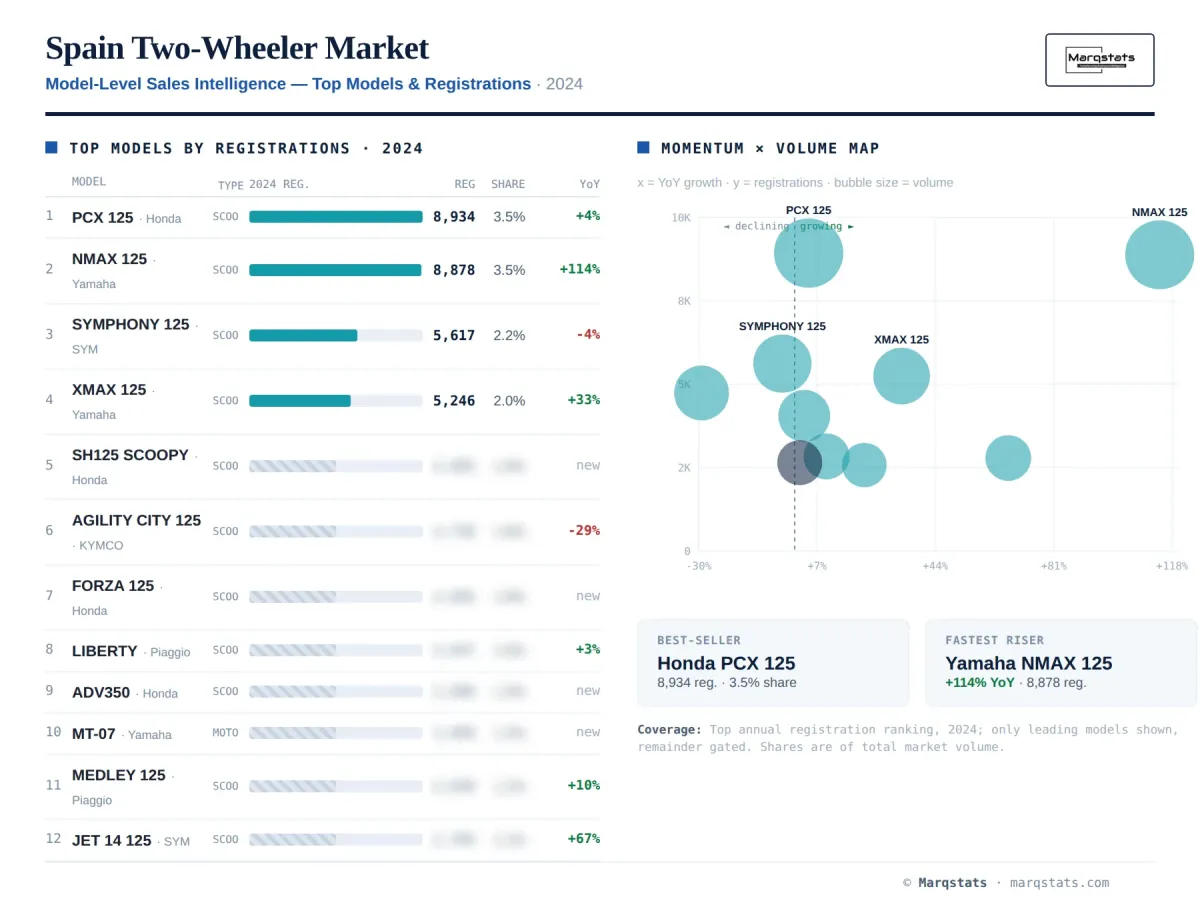
The Spain two-wheeler market is moderately concentrated, more so than any other major European market in this series. Honda leads decisively with about 26% of volume, built on the PCX 125 and Forza 125 scooters that dominate urban commuting, followed by Yamaha at about 18%. Together the two hold over 44% of the market. The Taiwanese scooter brands SYM and Kymco each hold about 7%, and the four together account for close to 59% of volume, leaving a moderate tail of specialist and premium marques.
The competitive field is shifting rapidly beneath the stable leadership. Chinese brands Zontes and Voge more than doubled their volumes into 2025, with Zontes rising on the strength of its mid-displacement models, while KTM registrations halved during its parent Pierer Mobility's financial restructuring. Royal Enfield has gained on the modern-classic trend, BMW and Ducati grow steadily in premium and performance segments, and the European scooter marques Piaggio, Vespa, Aprilia, and Peugeot Scooters compete in the urban categories. Electric competition is small and concentrated in scooters.
The advance of the Chinese challengers is the most striking recent development. Zontes and Voge each expanded from marginal positions to meaningful share within a few years, offering well-equipped mid-displacement machines at prices below established rivals, and they appeal directly to riders stepping up from the 125cc class. Their momentum has pressured incumbents on pricing and equipment levels in exactly the segments where trading up occurs, and the combination of their growth and KTM's contraction has reordered the middle of the brand table within a single year.
Competition centres on scooter product breadth and value in the dominant 125cc class, and on brand and capability at the premium end. Growth is attributed to brands that combine strong 125cc scooter portfolios with disciplined pricing, moreover rewarding those that capture riders trading up to larger machines. Honda's commanding scooter position, Yamaha's breadth, the surge of Chinese challengers, and the steady expansion of premium marques together define a market in which the 125cc segment sets the competitive baseline.
Companies Covered
The report profiles 16+ companies with full strategy and financials analysis, including:
Recent Market Activity
Table of Contents
Coverage & Segmentation
This report provides a comprehensive assessment of the Spain two-wheeler market across a 2025 base year, historical data from 2021 to 2025, and forecasts spanning 2026 to 2030. Market sizing is presented in unit-volume terms and complemented by value analysis in United States dollars, with segmentation by vehicle type, propulsion type, engine displacement and motor power, price band, end user, sales channel, and brand. Brand-level shares, segment growth rates, and competitive positioning are quantified to support commercial and investment decisions in Europe's fastest-growing major two-wheeler market.
The scope covers demand drivers, restraints, and structural trends, with particular focus on Spain's divergence from the European correction, the dominant 125cc class and its licensing foundations, premiumisation and trading up, the surge of Chinese brands, high online penetration, and the electric transition. An extended forecast to 2035 is available under customization for subscribers requiring a longer planning horizon, alongside deeper cuts by region, brand, or channel on request.