Market Snapshot
Key Takeaways
Market Overview & Analysis
Report Summary
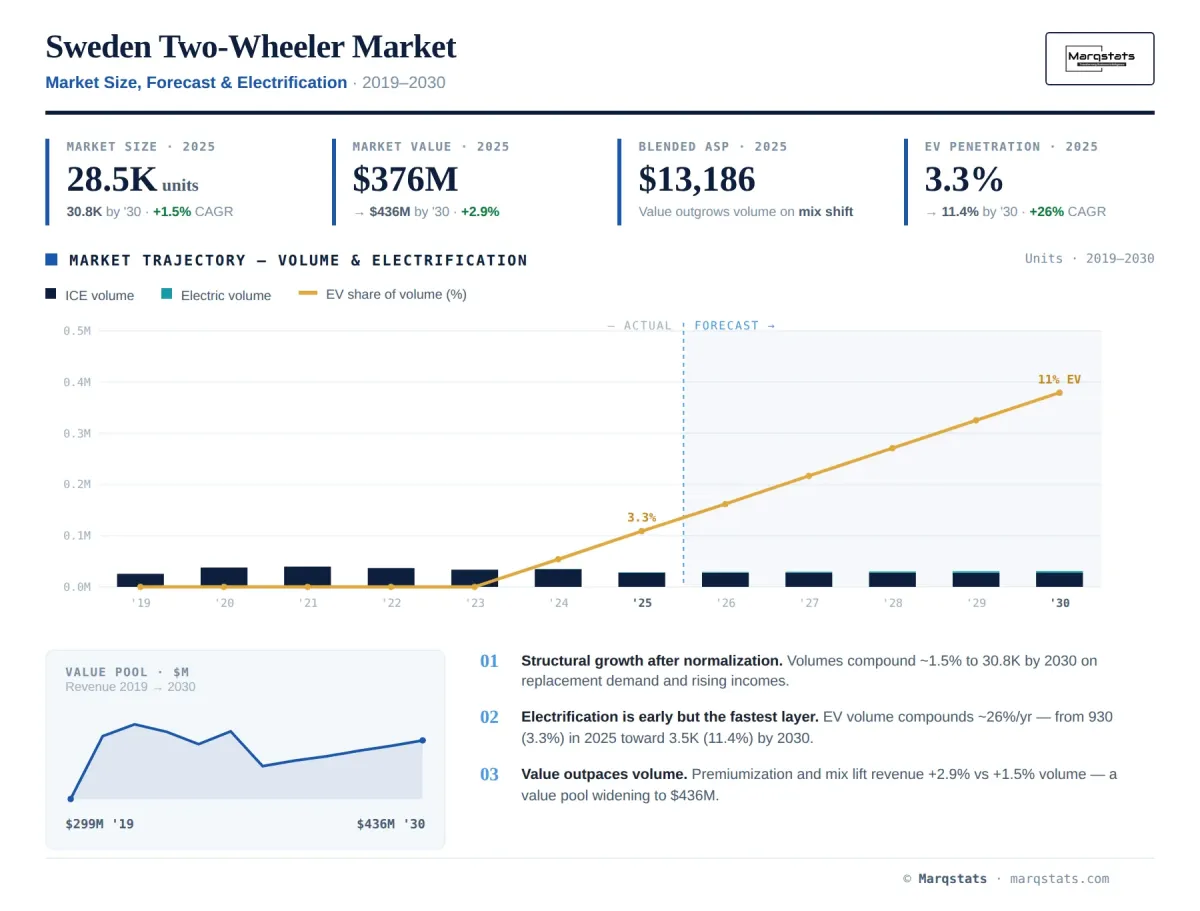
The Sweden two-wheeler market comprises motorcycles, scooters, and mopeds sold for personal and commercial use across internal combustion and electric propulsion. This study segments demand by vehicle type, propulsion type, engine displacement and motor power, price band, end user, sales channel, and brand, with a 2025 base year, historical coverage from 2021 to 2025, and forecasts to 2030. Sweden is a small, affluent, premium market defined by recreational riding across a short, intense summer season.
The 2025 result reflects a regulatory transition distinct from the rest of Europe. Emissions requirements had already applied to most Swedish motorcycles and mopeds from 2021, and from January 2025 they extended to the remaining categories, including enduro motorcycles, trial motorcycles, and cargo mopeds, while onboard diagnostics requirements began applying to all two-wheeled motorcycles. End-of-series exemptions were available only for machines manufactured up to the end of 2024, which concentrated registrations into that year and depressed 2025. The Swedish motorcycle and moped industry association tracks the resulting registration pattern.
Supply is premium-weighted and concentrated in large machines. BMW leads on the strength of its adventure and touring range, followed by Honda and Yamaha. KTM and Husqvarna, both part of Pierer Mobility, historically held strong positions in a market with deep off-road and enduro traditions, and both saw registrations halve. Harley-Davidson, Triumph, Ducati, Kawasaki, and Indian Motorcycle compete across cruiser, performance, and touring categories. Electric adoption is small and concentrated in higher-power machines.
Sweden's structure is the mirror image of the Southern European markets. Where Spain, Italy, and France are built on 125cc commuter machines accessible to car-licence holders, Sweden restricts that access, and the commuter tier never developed. What remains is an almost purely recreational market: large machines, private buyers, high prices, and a riding season compressed into a few months. The consequence is a market that is small in units yet substantial in value, with an average selling price roughly forty percent above that of the largest European markets in this series.
Market Dynamics
Key Drivers
- Affluence and high disposable incomes sustain premium demand, with an average selling price of roughly USD 13,200 per machine, the highest in this series.
- A deep touring and off-road riding culture underpins demand across forests, gravel roads, and the long summer daylight hours of the north.
- Digital retail expands rapidly, reaching about 45% of volume as buyers research, compare, finance, and purchase entirely online.
- Electrification and smaller displacements grow from low bases, broadening a market long concentrated in large premium machines.
Key Restraints
- A compressed riding season limits usage, as long winters restrict riding across much of the country for several months of each year.
- Licensing rules restrict entry, as car-licence holders may not ride 125cc machines in Sweden without obtaining a separate motorcycle licence.
- The dominant above-350cc band contracts through the forecast, as demand shifts toward smaller and electric machines.
Key Trends
- Electrification advances from a small base, concentrated in machines above 5.0 kW; the global electric ATV and UTV market reflects the wider electrification of powered leisure vehicles.
- The market rebalances toward smaller displacements, as the 125cc class grows at about 20% annually from a very low base.
- Offline dealership volumes contract at about 12% annually, the sharpest channel shift among the markets in this series.
- The industry association has proposed licence reform allowing car-licence holders to ride 125cc machines after mandatory training.
Market Segmentation
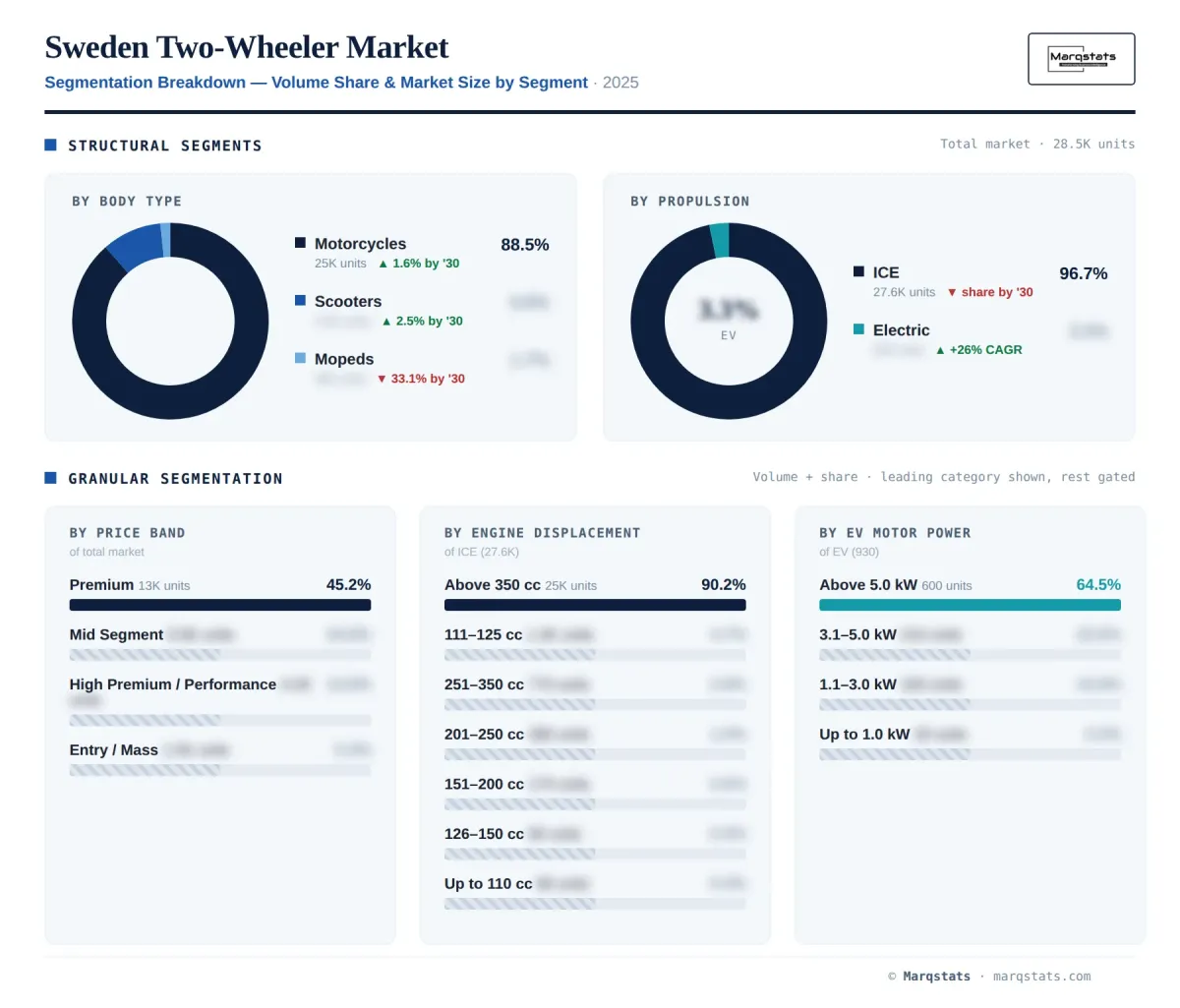
Motorcycles account for about 88% of 2025 volume, roughly 25,200 units, growing at a 1.64% CAGR. The category is weighted decisively toward large touring, adventure, cruiser, and off-road machines. Sweden's terrain, with extensive forests and gravel roads, supports a strong enduro and adventure tradition, and these machines generate the overwhelming majority of market value. The absence of a commuter tier means the category functions almost entirely as a leisure market, with purchases concentrated ahead of the spring riding season.
Scooters account for about 2,800 units in 2025, roughly 10% of volume, growing at a 2.51% CAGR, while mopeds contract sharply at about 33% annually to near-negligible volumes by 2030. Moped demand has been displaced by alternative light vehicles popular among younger riders, and the category's regulatory treatment tightened further in 2025. Light four-wheeled vehicles accessible to fifteen-year-olds have absorbed much of the demand that mopeds once served, drawing younger buyers away from two wheels entirely.
Combustion models hold about 97% of 2025 volume, roughly 27,600 units, and remain broadly flat through the forecast period. Combustion dominates the large touring, adventure, and cruiser classes that define the market, and it continues to define the premium machines that generate most of the market's value. Electric-only vehicles are exempt from the emissions requirements that reshaped the combustion segment. The flat combustion forecast, against a growing overall market, means effectively all net growth through 2030 comes from electric machines and the smaller displacement classes.
Electric two-wheelers hold about 3% of 2025 volume, roughly 900 units, growing fastest at a 25.52% CAGR to reach about 3,500 units by 2030. Adoption is concentrated in machines above 5.0 kW, which account for most electric volume and grow at about 30%. Electric registrations are reported from 2024 onward in the underlying data, so historical comparisons before that year are unavailable, and the segment's early growth reflects both new model availability and exemption from emissions requirements. Sweden's high electricity access, cold-weather engineering expertise, and established acceptance of electric passenger vehicles provide structural support for adoption as model ranges broaden.
Large-displacement machines above 350cc are overwhelmingly dominant at about 87% of 2025 volume, roughly 24,900 units, the highest concentration among the markets in this series. Touring, adventure, cruiser, and enduro machines fall here. The band contracts at about 5% annually through the forecast as demand rebalances toward smaller and electric machines, though it retains a decisive majority of both volume and value in 2030. This gradual erosion of the dominant band, unusual in a growing market, reflects an ageing rider base at the premium end alongside new entrants arriving on smaller and electric machines.
The 111–125cc class holds about 5% of volume, far below its share in most European markets, because Swedish rules do not allow car-licence holders to ride 125cc machines without a separate motorcycle licence. The class grows fastest among combustion segments at about 20% annually from this low base, and the industry association has proposed licence reform that would broaden access to light motorcycles and scooter-type machines. Were such reform adopted, the commuter tier would expand well beyond the pace assumed in this forecast, given the size of the car-licensed population.
Premium is the largest price band at about 45% of volume, though it contracts at about 5% annually as the market rebalances. The high-premium performance band holds about 15% and grows at about 8%, the strongest of the established tiers, driven by large touring, adventure, and cruiser machines. Together the premium tiers contribute the clear majority of market value. The pattern shows a market polarising upward and downward simultaneously, as high-premium and entry machines both outgrow the core premium band that has long defined Swedish demand.
The mid segment accounts for about 35% of volume and remains broadly flat. The entry and mass band, though only about 5% of volume, grows fastest at about 24% annually, reflecting the arrival of smaller and electric machines that broaden a market long concentrated at the premium end.
Private consumers account for about 92% of 2025 volume, among the highest business-to-consumer shares in this series. Ownership is discretionary and leisure-driven, weighted toward touring riders, adventure and enduro enthusiasts, and cruiser owners, and demand is therefore sensitive to consumer confidence and disposable income. The market's exposure to discretionary spending explains the depth of the decline from the pandemic-era peak, when constrained travel budgets were redirected toward recreational vehicles.
Commercial demand is small. Fleet and business users account for about 8% of volume, delivery and logistics for roughly 6%, and rental and tourism grows fastest among commercial users at about 7%. The near-absence of large delivery fleets distinguishes Sweden from the platform-driven markets of Southern Europe, and rental demand concentrates in the summer touring season across the south and the mountain regions.
The online channel reaches about 45% of 2025 volume, the highest digital share among the markets in this series, growing at about 11% annually. Sweden's mature e-commerce culture and dispersed population make digital retail practical for buyers far from dealer networks, and the channel now handles a substantial portion of complete machine purchases. The distances involved across a sparsely populated country make travelling to a physical dealer costly, and buyers have adapted accordingly, researching, configuring, financing, and increasingly transacting online for machines that often exceed ten thousand dollars in value.
Offline dealership volumes contract at about 12% annually, the sharpest channel shift in this series. Dealers retain their role in test rides, servicing, and financing for premium machines, and the surviving network is consolidating around larger operators that combine physical presence with strong digital platforms. Smaller independent dealers have been the most exposed, particularly those reliant on the off-road brands whose registrations halved in 2025.
By Geography
Stockholm & Eastern Sweden
Stockholm and the surrounding eastern counties form the largest regional market, combining the highest incomes in the country with a dense population. The region concentrates premium and touring demand alongside the country's largest scooter and commuter segment, and it hosts the densest dealer and service network. Congestion and parking pressure in the capital support what limited scooter commuting exists, and the region leads early electric adoption.
Västra Götaland & Gothenburg
Västra Götaland, centred on Gothenburg, is a major market where industrial employment and coastal geography support both leisure riding and commuting. The region sustains strong demand across touring, adventure, and cruiser categories, and its proximity to Denmark and Norway supports cross-border touring. Gothenburg's dealer network is the second-densest in the country, and the region's engineering base gives it a strong enthusiast and modification culture.
Skåne & Southern Sweden
Skåne, centred on Malmö, benefits from the mildest climate in the country and the longest riding season. Demand concentrates in touring and premium machines, and the region's connection to Denmark and continental Europe supports touring, rental, and enthusiast activity through the warmer months. The Öresund crossing places Copenhagen and the continental road network within easy reach, and riders in the region enjoy several additional weeks of usable season each year compared with the north.
Northern Sweden
Northern Sweden sustains a distinctive market shaped by extensive forests, gravel roads, and a short, intense riding season. Off-road, enduro, and adventure machines dominate demand, and long summer daylight hours support concentrated seasonal riding across a sparsely populated geography. The region relies heavily on digital retail, as dealer networks are thin across large distances, and it was among the most exposed to the contraction of the off-road specialist brands.
How Competition Is Evolving
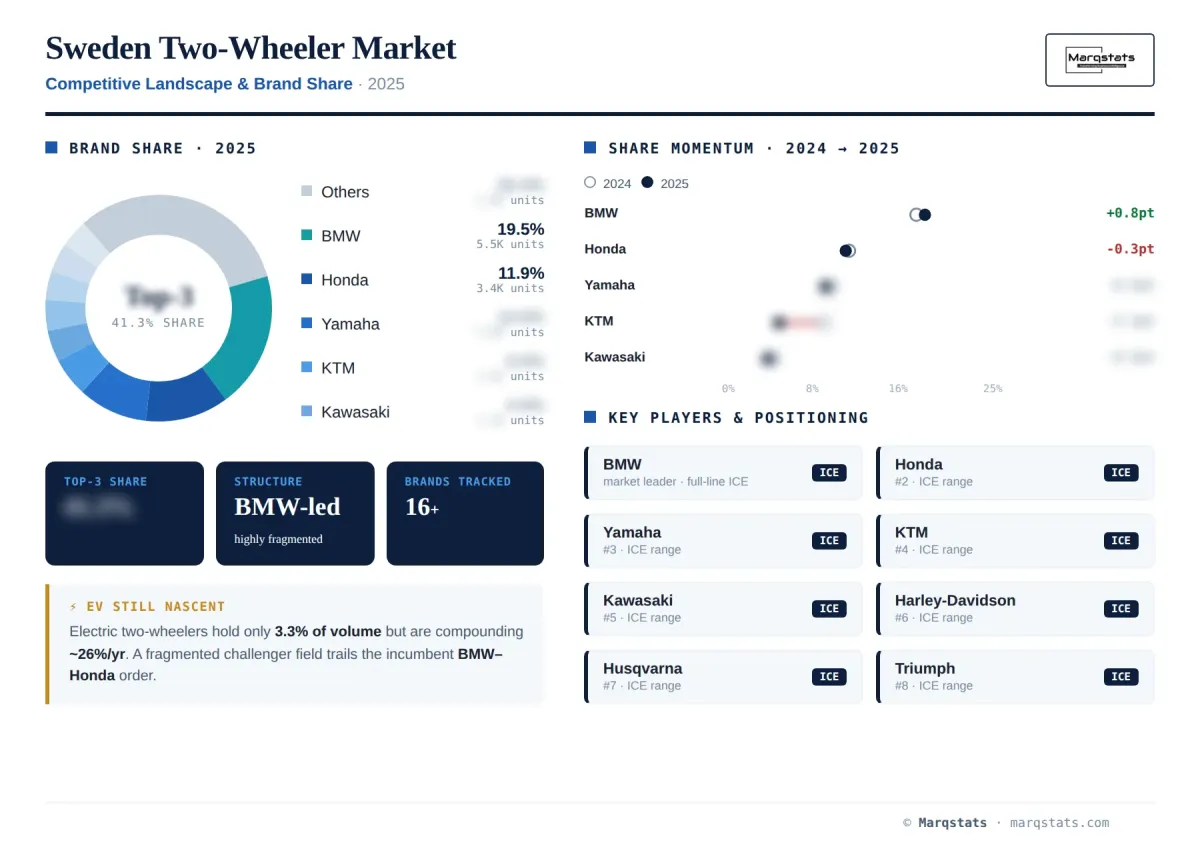
The Sweden two-wheeler market is moderately fragmented, and a premium marque leads it. BMW holds about 20% of volume on the strength of its adventure and touring range, ahead of Honda at about 12% and Yamaha at about 10%. The top four brands account for roughly 47% of volume, and a substantial tail of premium, cruiser, and specialist marques competes across the remainder, including Harley-Davidson, Triumph, Ducati, Kawasaki, Suzuki, and Indian Motorcycle.
The competitive field was reshaped decisively in 2025. KTM and Husqvarna, both part of Pierer Mobility, saw registrations halve, a steeper fall than in any other European market in this series. Two forces compounded: the parent's financial restructuring, and emissions requirements that from January 2025 newly captured enduro and trial machines, precisely the categories in which both brands are strongest. The outcome carries particular resonance, as Husqvarna's motorcycle heritage originates in Sweden, in the town from which the marque takes its name, though the brand has been Austrian-owned for decades.
The retreat of the two off-road specialists opened space across a segment central to Swedish riding. Enduro and adventure machines suit the country's forests and gravel roads, and the categories had long been dominated by the Pierer brands. Their combined share fell from roughly seventeen percent of the market to under ten percent within a single year, and competitors with adventure and dual-sport portfolios captured much of the difference. Both brands recover gradually across the forecast period, though neither regains its former position by 2030.
Competition centres on brand and capability at the premium end, where the great majority of volume sits, rather than on price. Growth is attributed to brands that combine strong adventure and touring portfolios with disciplined pricing, moreover rewarding those that adapt to the shift toward digital retail. BMW's premium leadership, the Japanese marques' breadth, the retreat of the Pierer brands, and the gradual arrival of smaller and electric machines together define a market in which brand strength and channel capability increasingly determine competitive position.
Companies Covered
The report profiles 16+ companies with full strategy and financials analysis, including:
Recent Market Activity
Table of Contents
Coverage & Segmentation
This report provides a comprehensive assessment of the Sweden two-wheeler market across a 2025 base year, historical data from 2021 to 2025, and forecasts spanning 2026 to 2030. Market sizing is presented in unit-volume terms and complemented by value analysis in United States dollars, with segmentation by vehicle type, propulsion type, engine displacement and motor power, price band, end user, sales channel, and brand. Brand-level shares, segment growth rates, and competitive positioning are quantified to support commercial and investment decisions.
The scope covers demand drivers, restraints, and structural trends, with particular focus on the January 2025 emissions and diagnostics transition, the dominance of large-displacement leisure machines, the collapse of the off-road specialist brands, the highest digital retail share in this series, licence reform proposals, and the early electrification transition. An extended forecast to 2035 is available under customization for subscribers requiring a longer planning horizon, alongside deeper cuts by region, brand, or channel on request.