Market Snapshot
Middle bar: base-year value × (1 + CAGR), rounded to two decimals. This is a calculated illustration, not a separately researched annual estimate.
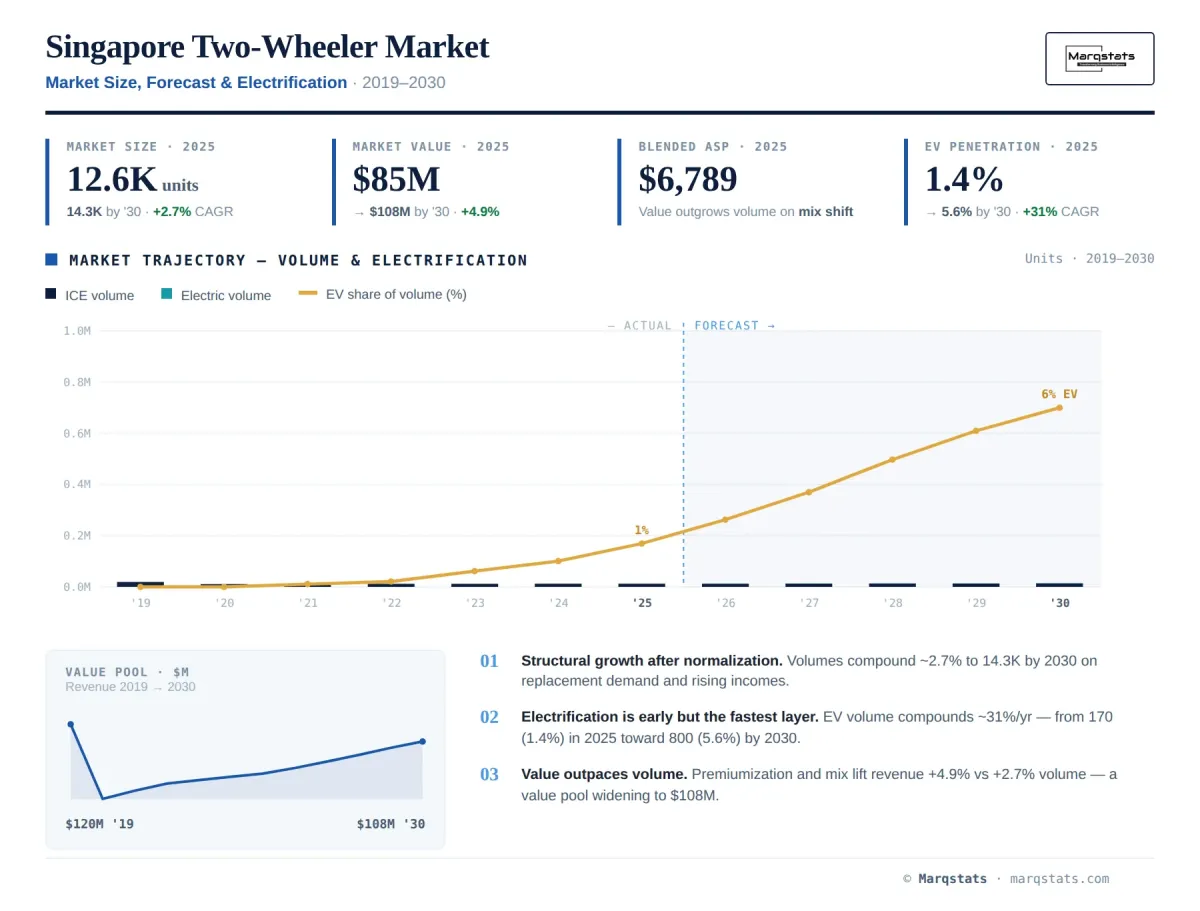
The Singapore two-wheeler market reached 12,550 units in 2025 and is projected to reach 14,300 units by 2030, expanding at a 2.71% CAGR across the 2026–2030 forecast period; in value terms the market rises from USD 85.2 million to USD 107.9 million. Singapore is among the world's smallest and most tightly regulated two-wheeler markets, its size governed less by demand than by the Certificate of Entitlement quota system, which caps vehicle-population growth at zero and requires buyers to secure a costly ten-year licence before registration.
The result is a small, premium, and slow-growing market dominated by scooters, which account for 88.4% of 2025 volume, while conventional motorcycles decline. Demand splits between private commuters and a sizeable delivery and fleet segment, reflecting the central role of two-wheelers in last-mile food delivery across a dense city-state. Yamaha leads decisively, holding about 56% of unit sales, ahead of Honda, in one of the most concentrated markets in the region.
Electrification is early and fleet-driven. Electric models hold about 1.4% of 2025 volume, advancing through delivery-focused battery-swap pilots aligned with the Green Plan 2030 target of 100% cleaner-energy vehicles by 2040. Growth is shaped by regulation and quota supply rather than underlying demand, producing a stable, high-value market where premiumisation and delivery-led electrification, not volume expansion, define the opportunity.
Key Takeaways
Market Overview & Analysis
Report Summary
The Singapore two-wheeler market comprises motorcycles, scooters, and mopeds sold for personal and commercial use across internal combustion and electric propulsion. This study segments demand by vehicle type, propulsion type, engine displacement and motor power, price band, end user, sales channel, and brand, with a 2025 base year, historical coverage from 2021 to 2025, and forecasts to 2030. In value terms the market is expressed in United States dollars, reflecting a small annual volume yet a high average selling price driven by licensing costs and a premium product mix.
The defining feature is regulation. Under the Vehicle Quota System introduced in 1990, every new two-wheeler requires a Category D Certificate of Entitlement, a ten-year licence auctioned in limited quantity, with premiums that recently ranged around S$8,000 to S$9,000 and previously exceeded S$11,000. With vehicle-population growth held at zero, new registrations largely replace de-registered machines, so the market's size is set by quota policy rather than consumer appetite, and volumes have stabilised well below the levels of the previous decade.
Within this constrained envelope, demand is premium and commuter-led. Scooters dominate, serving both private riders and a substantial food-delivery fleet, while conventional motorcycles and small-displacement machines slowly decline. Yamaha and Honda anchor supply, joined by European premium marques and a rising cohort of Chinese brands. Electric adoption remains small, concentrated in delivery fleets where high daily mileage strengthens the economic case for battery swapping, and supported by national decarbonisation policy rather than direct two-wheeler subsidies.
The market's recent history illustrates its policy sensitivity. Annual volumes fell sharply from about 19,400 units in 2019 to roughly 10,700 in 2020, and have since recovered only gradually to the mid-12,000s, well below the prior peak. This pattern reflects quota tightening, a sustained zero-growth vehicle policy, and the broader car-lite strategy that channels everyday mobility toward an extensive public-transport network of rail and buses. For manufacturers and distributors, the implication is a market defined by stability and value rather than growth, where success depends on capturing a fixed pool of committed buyers and the expanding delivery-fleet segment rather than on riding demographic or income-driven expansion.
Market Dynamics
Key Drivers
- Growth is driven by replacement demand, as the ten-year Certificate of Entitlement cycle and an aging fleet sustain steady renewal within a fixed quota rather than net expansion.
- The food-delivery economy underpins commercial demand, with platforms such as Grab, foodpanda, and Deliveroo sustaining fleet and delivery use that grows faster than private ownership.
- Premiumisation lifts value, as rising incomes and enthusiast demand expand premium and big-bike segments even where unit volumes are capped, raising the market's value faster than its volume.
- Quota adjustments influence demand, with the Land Transport Authority injecting about 20,000 additional certificates across categories from 2025 to smooth supply and pricing.
Key Restraints
- High entry cost constrains volume, as Certificate of Entitlement premiums add thousands of dollars to every purchase, limiting the market to committed and higher-income buyers.
- A car-lite policy and world-class public transport reduce reliance on private two-wheelers, capping structural demand across the population and channelling everyday journeys onto rail and bus networks.
- Land and charging constraints slow electrification, as dense high-rise housing complicates home charging and limits the rollout of two-wheeler charging infrastructure.
Key Trends
- Delivery-fleet electrification leads adoption, advancing through battery-swap pilots; the Thailand electric two-wheeler market offers a regional benchmark for swap-based models.
- Chinese brands gain share, as Zontes and CFMOTO expand steadily in the mid and premium scooter and motorcycle segments alongside established Japanese and European marques.
- Digital retail grows rapidly, with the online channel expanding at a 16.94% CAGR from a small base as buyers research and transact online.
- Premium and big-bike demand rises, with high-premium and performance models growing fastest by value in an enthusiast-oriented market.
Market Segmentation
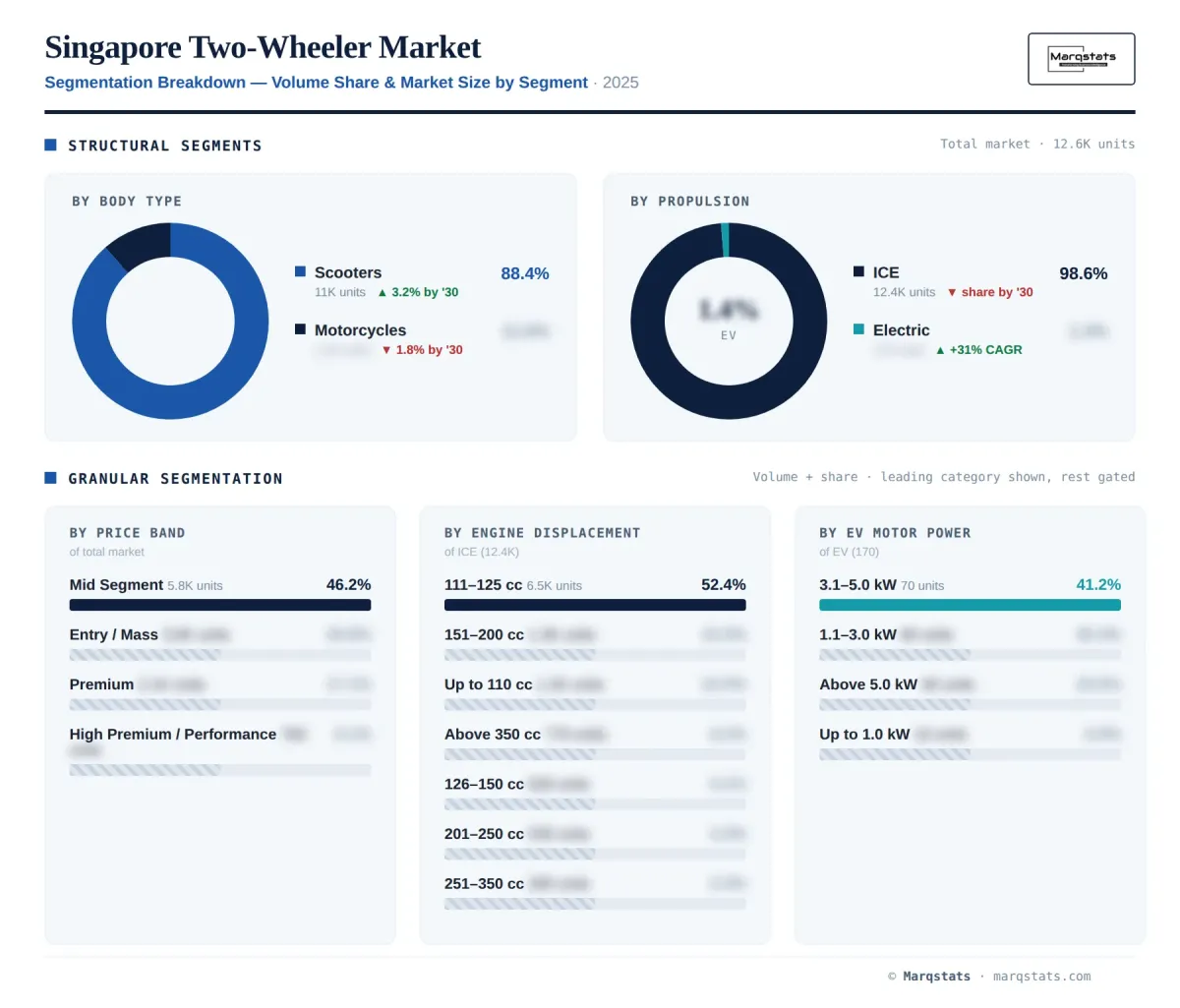
Scooters dominate at 88.4% of 2025 volume, about 11,100 units, growing at a 3.23% CAGR. Automatic scooters suit Singapore's short urban trips, commuting, and last-mile delivery, and they host nearly all electric two-wheeler activity. The category's steady growth, against a declining motorcycle segment, reflects the practical, utility-first character of demand. In a city-state of short distances, dense parking constraints, and heavy delivery activity, the automatic scooter is the default two-wheeler form, and its share has risen steadily as manual motorcycles have fallen out of favour with commuters and delivery operators alike.
Conventional motorcycles account for about 1,450 units in 2025, roughly 12% of volume, and decline at a 1.81% CAGR. Demand persists among enthusiasts and for larger-displacement machines, yet the segment contracts as scooters absorb commuter and delivery use and as the rider base ages. The decline is structural rather than cyclical, driven by the practical advantages of automatic scooters for short urban journeys and by a shrinking pool of younger riders entering an expensive, tightly regulated market.
Mopeds register negligible sales across the study period and do not form a material commercial segment in Singapore, where the automatic scooter fills the affordable-commuter role that mopeds occupy in some other markets, leaving the market effectively a two-category structure of scooters and larger motorcycles under a single licensing regime.
Combustion models hold about 98.6% of 2025 volume, roughly 12,380 units, growing at close to a 2% CAGR. Combustion remains dominant given the small scale of electric supply, the maturity of petrol-scooter distribution, and the licensing economics that reward long vehicle lifespans, keeping absolute volumes broadly stable through 2030. Because a Certificate of Entitlement fixes the cost of road access for a full decade regardless of powertrain, buyers have limited financial incentive to switch to electric on running-cost grounds alone, which slows private electrification and keeps petrol scooters the default choice for most consumers well into the forecast period.
Electric two-wheelers hold about 1.4% of 2025 volume, roughly 170 units, growing at a 31.17% CAGR to reach about 800 units by 2030. Adoption is fleet-led, concentrated in food delivery where high daily mileage favours battery swapping, and supported by national decarbonisation policy. Growth is rapid in percentage terms yet small in absolute units, reflecting the market's overall scale.
The clearest expression of this shift is the battery-swap pilot awarded by the Land Transport Authority to Gogoro and local distributor Cycle & Carriage, later joined by food-delivery platform foodpanda. The arrangement leases swap-capable electric scooters to delivery riders and provides six-second battery exchange at dedicated stations, giving operating costs comparable to petrol machines without refuelling downtime. Because delivery riders cover several times the distance of private users, the fleet segment offers the strongest early economics for electrification, and it is likely to remain the primary channel through which electric two-wheelers scale in Singapore over the forecast period, ahead of private adoption constrained by high-rise charging challenges.
The mid segment is the largest price band at about 5,800 units in 2025, roughly 46% of volume, growing at a 2.99% CAGR, while the entry and mass band holds about 3,860 units and stays broadly flat. The mix reflects a market where licensing costs push buyers toward better-specified machines rather than the cheapest options. With a fixed entitlement premium applied to every purchase, the marginal saving from choosing an entry model over a mid-tier one is modest relative to total ownership cost, which structurally supports the mid and premium bands and steadily erodes the entry tier.
Premium volumes grow at a 5.6% CAGR, while the high-premium and performance band, though small in units, grows fastest and contributes a disproportionate share of value on the strength of big-bike and imported models. Enthusiast demand for large-displacement machines is a defining feature of the high end of the market. Marques such as BMW Motorrad, Ducati, Harley-Davidson, and KTM sustain elevated average selling prices, so that a small number of premium units generates an outsized share of market value, reinforcing Singapore's character as a low-volume, high-value market.
Private consumers account for about 68% of 2025 volume, sustaining commuter and premium demand within the quota constraints. Ownership is a considered, higher-cost decision, weighted toward committed riders and enthusiasts rather than first-time mass buyers.
Commercial, fleet, and delivery users together form an unusually large share of demand for a high-income market. Delivery and logistics grows at a 6.3% CAGR as food-delivery platforms scale, and this segment leads electric adoption, since high-mileage riders benefit most from lower running costs and battery swapping. The economics are distinctive: a delivery rider covering long daily distances recovers the higher upfront cost of an electric two-wheeler far faster than a private commuter, so fleets and gig-delivery operators are both the most active buyers and the natural entry point for new propulsion technology, making commercial demand strategically more important than its volume share alone would suggest.
Physical dealerships dominate, handling the large majority of sales and managing the licensing, financing, and registration process central to Singapore purchases. Established distributors provide the after-sales service that sustains long vehicle lifespans under the quota system.
The online channel is the fastest-growing route to market at a 16.94% CAGR from a small base, as buyers increasingly research models, compare licensing costs, and begin purchases digitally. Online activity complements rather than replaces the dealer network, particularly for accessories and pre-owned machines. Digital platforms are also central to how delivery operators source and lease electric two-wheelers, embedding online channels into the fleet-electrification process even where final transactions still complete through established distributors.
By Geography
Central Business District & Urban Core
The central business district and surrounding urban core concentrate delivery and commuter demand, where congestion, parking scarcity, and short trip distances make scooters the most practical vehicle. This zone anchors food-delivery fleet activity and early electric two-wheeler adoption. Its high density of restaurants, offices, and residential towers generates continuous last-mile delivery demand, and it is where battery-swap stations and electric-fleet pilots are first concentrated, making the core the clearest indicator for the market's electrification path.
Heartland Residential Estates
Singapore's public-housing heartlands account for the bulk of private ownership, where residents use scooters for commuting and errands. High-rise living and shared parking shape both demand patterns and the challenges of home charging that slow private electric adoption. Because most residents live in high-density housing without dedicated parking or charging, private electrification depends on shared or public charging solutions that are still emerging, keeping heartland demand firmly combustion-led even as the delivery segment electrifies.
Industrial & Logistics Zones
Industrial districts and logistics hubs sustain fleet and commercial demand, including delivery, courier, and service two-wheelers. These areas host the battery-swap and service infrastructure that underpins commercial electrification pilots, and their concentration of logistics operators makes them the practical staging ground for scaling electric delivery fleets ahead of the wider consumer market.
Singapore within ASEAN
Singapore is by far the smallest two-wheeler market in Southeast Asia by volume, yet among the highest by value per unit and the most advanced in policy and infrastructure. It functions as a testbed for delivery-fleet electrification and battery-swapping models that larger regional markets may later scale. Where neighbours such as Indonesia, Vietnam, and Thailand measure demand in the millions, Singapore's value lies in its role as a high-income, high-regulation reference point, where premium products, delivery-fleet electrification, and swap-based business models can be trialled under controlled conditions before wider regional deployment.
How Competition Is Evolving
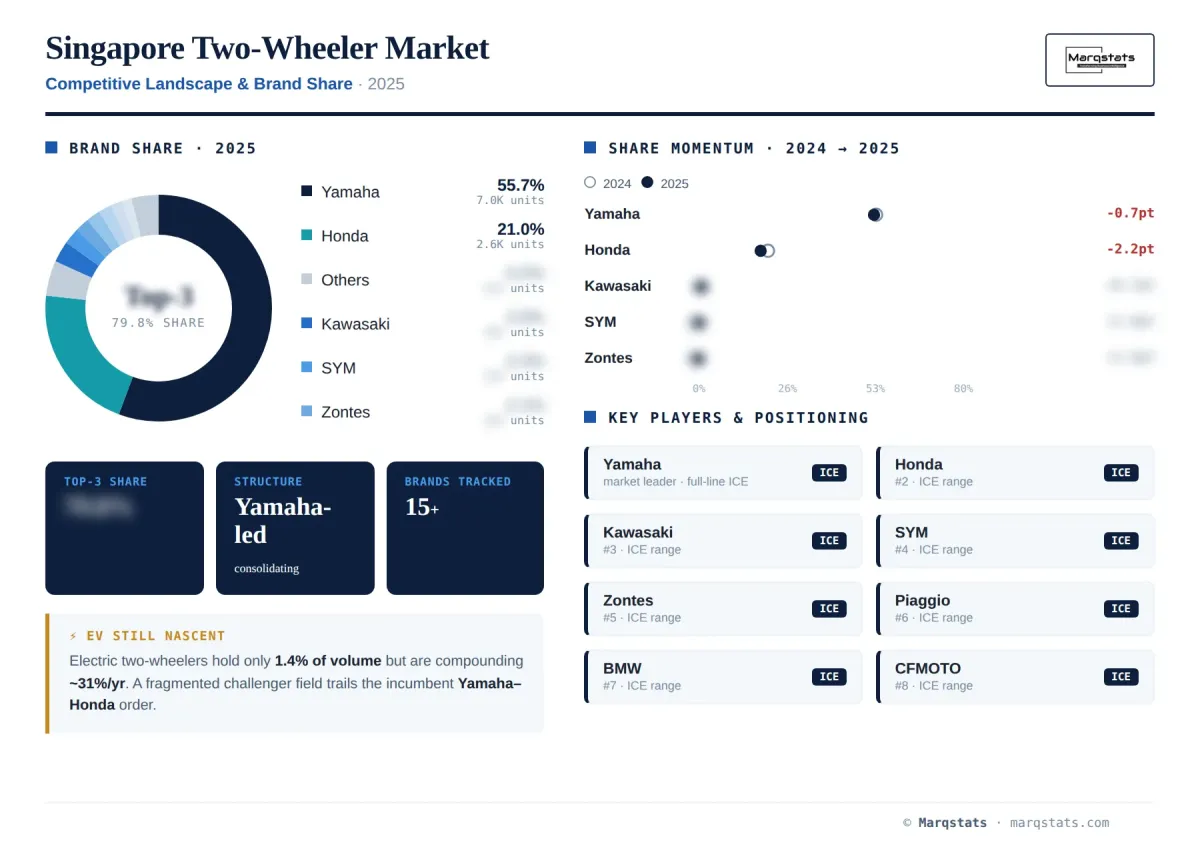
The Singapore two-wheeler market is highly concentrated. Yamaha leads with about 56% of 2025 unit sales, a dominant position built on scooter strength, brand trust, and distribution depth, while Honda follows at roughly 21%. Together the two Japanese brands account for more than three-quarters of the market, giving Singapore one of the most concentrated competitive structures in the region.
Beyond the leaders, the field is premium and diverse relative to the market's size. Kawasaki and Suzuki hold established positions, European marques including Piaggio, BMW Motorrad, KTM, Ducati, and Harley-Davidson serve the premium and big-bike tiers, and Chinese brands such as Zontes and CFMOTO have gained share quickly with competitive pricing and modern styling. Gogoro, working with local distributor Cycle & Carriage, anchors electric two-wheeler and battery-swap activity in the delivery segment. The presence of so many premium and enthusiast marques in a market of barely 12,000 annual units underscores how licensing costs shift the mix upmarket: once a buyer commits to a costly ten-year entitlement, the incremental cost of a better-specified or premium machine is proportionally smaller, supporting a disproportionately rich brand field.
Competition centres on brand, distribution, and total ownership cost, since licensing dominates the purchase decision. Growth is attributed to brands that combine strong scooter portfolios with premium and electric options, moreover rewarding distributors able to manage the licensing, financing, and service demands unique to Singapore. The scale of the market limits the number of viable players, reinforcing the incumbents' advantage.
Companies Covered
Companies covered in the report include:
Recent Market Activity
Table of Contents
Coverage & Segmentation
This report provides a comprehensive assessment of the Singapore two-wheeler market across a 2025 base year, historical data from 2021 to 2025, and forecasts spanning 2026 to 2030. Market sizing is presented in unit-volume terms and complemented by value analysis in United States dollars, with segmentation by vehicle type, propulsion type, engine displacement and motor power, price band, end user, sales channel, and brand. Brand-level shares, segment growth rates, and competitive positioning are quantified to support commercial and investment decisions in a policy-shaped market.
The scope covers demand drivers, restraints, and structural trends, with particular focus on the Certificate of Entitlement quota system, the delivery-fleet role, the premium and big-bike mix, and the early, fleet-led electrification transition. Competitive analysis quantifies brand shares and profiles combustion and electric players, while segment forecasts identify where the limited volume and value growth concentrate through 2030. Particular attention is paid to how quota policy and licensing economics shape both the size and the premium character of the market. An extended forecast to 2035 is available under customization for subscribers requiring a longer planning horizon, alongside deeper cuts by segment, brand, or channel on request.