Market Snapshot
Key Takeaways
Market Overview & Analysis
Report Summary
The Argentina two-wheeler market comprises motorcycles, scooters, and mopeds sold for personal and commercial use across internal combustion and electric propulsion. This study segments demand by vehicle type, propulsion type, engine displacement and motor power, price band, end user, sales channel, and brand, with a 2025 base year, historical coverage from 2021 to 2025, and forecasts to 2030. Argentina is a high-volume, low-price commuter market in which affordability and credit access govern demand more than product preference.
Credit is the decisive variable. The market's strong close to 2025 followed the return of micro-credit after a period of electoral uncertainty, and the association representing dealers has described financing as playing a preponderant role, with buyers entering the market on the most basic machines available. Demand growth therefore tracks interest rates and lending conditions more closely than incomes. Sustained rate reductions would extend the expansion, and the same association has noted the opportunity to grow the larger-displacement segments that carry higher dealer margins.
The sensitivity is visible in the monthly data. December is normally the weakest month for vehicle sales in Argentina, yet December 2025 produced a 20% year-on-year increase and a 15% gain over November, reversing the pattern precisely as micro-credit returned. The surge was large enough to lift motorcycles past automobiles for the full year, after cars had outsold them through the preceding eleven months. Few markets in this series respond so directly to a single financial variable.
Supply is overwhelmingly domestic. Roughly 97% of machines registered are produced in Argentina, and the brand table reflects this: alongside Honda, which leads the market, sit the domestic marques Motomel, Gilera, Zanella, Corven, Keller, Brava, Guerrero, and Mondial. Indian manufacturers Bajaj, TVS, Hero, and Royal Enfield have expanded, and Yamaha and Suzuki hold established positions. Competition concentrates in the 110cc commuter class, where the top-selling models are separated by narrow margins.
That local-content share, the highest among the markets in this series, is a structural consequence of decades of import restriction and currency instability. Assembly capacity was built domestically because importing finished machines was unreliable and expensive, and the resulting network of local marques has proved durable even as trade conditions eased. It insulates supply from exchange-rate shocks and import controls, and it means the market's competitive dynamics are set inside the country rather than by global product cycles.
Market Dynamics
Key Drivers
- Consumer credit and micro-financing drive demand, as most buyers purchase basic machines on instalment terms sensitive to interest rates.
- Work-related use expands the market, as motorcycles serve as tools for delivery, services, and independent commerce across urban and peri-urban areas of the country.
- Domestic manufacturing supplies about 97% of registrations, insulating supply from import restrictions and currency volatility.
- Wider model availability broadens choice, as more brands and variants reach dealer networks right across the provinces.
Key Restraints
- Macroeconomic volatility constrains demand, as inflation, interest rates, and consumption levels directly govern household purchasing capacity.
- The dominant sub-110cc class is saturating, growing at about 1% annually through the forecast despite its scale.
- Low average selling prices limit dealer margins, concentrating profitability in the smaller larger-displacement segments.
Key Trends
- Electrification advances from a very small base, concentrated in light urban machines; the Thailand electric two-wheeler market offers a comparison for commuter-led electric adoption.
- Demand accelerated through 2026, with first-half registrations rising about 44% and the sector projecting approach toward one million annual units.
- Online retail grows at about 22% annually, reaching about 18% of volume as offline dealership volumes contract.
- Larger displacements grow fastest, as machines above 350cc expand at about 18% annually and premium demand recovers.
Market Segmentation
Motorcycles account for about 96% of 2025 volume, roughly 622,000 units, growing at a 4.97% CAGR. The category is dominated by 110cc commuter machines built for low purchase price, minimal running cost, and simple repair. The Gilera Smash, Honda Wave 110, Keller KN 110-8, Motomel B110, and Corven Energy 110 were the market's top-selling models in 2025, all drawn from this class. Larger motorcycles remain a small share, though they grow faster and carry substantially higher value per unit.
Scooters account for about 23,000 units in 2025, roughly 4% of volume, growing fastest among vehicle types at a 12.89% CAGR. Demand concentrates in Buenos Aires and other large cities. Mopeds contract at about 30% annually toward negligible volumes by 2030, displaced by 110cc motorcycles that offer greater capability at comparable cost. The scooter share remains far below that of comparable Latin American and European markets, reflecting the dominance of the underbone commuter format.
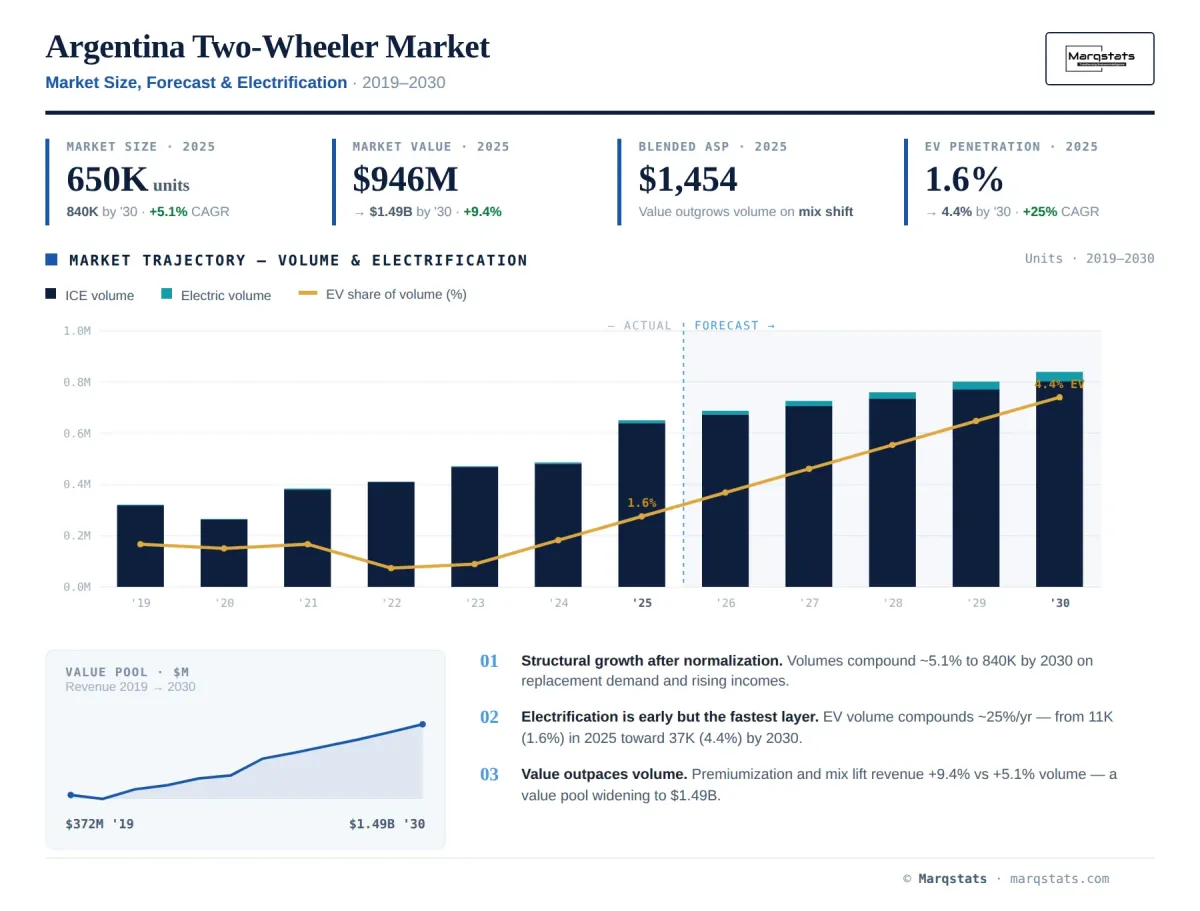
Combustion models hold about 98% of 2025 volume, roughly 640,000 units, growing at about 5% annually. Combustion dominates the commuter classes that define the market, where purchase price, fuel availability, and repairability outweigh other considerations. Domestic assembly is built almost entirely around combustion platforms, reinforcing their position through the forecast period. Local parts supply and a dense network of independent workshops make combustion machines cheap to keep running across decades of use.
Electric two-wheelers hold under 2% of 2025 volume, roughly 11,000 units, growing fastest at a 25.19% CAGR to reach about 37,000 units by 2030. Adoption concentrates in the 1.1–3.0 kW class, with higher-power machines growing faster. The segment declined in 2022 before recovering, and its expansion depends on import conditions, financing access, and the pricing of electric models against the very low cost of the dominant 110cc combustion machines. That price comparison is the binding constraint: an electric machine must compete against a new combustion motorcycle costing little more than a thousand dollars.
Sub-110cc machines are overwhelmingly dominant at about 70% of 2025 volume, roughly 455,000 units. This class contains the commuter and work machines that define the Argentine market, and every top-selling model of 2025 fell within it. The class grows at only about 1% annually through the forecast, reflecting saturation at high penetration, so growth comes from buyers moving upward rather than from expansion of the base itself. The machines are simple, single-cylinder, and inexpensive to repair, and their appeal rests on the arithmetic of daily cost rather than on capability.
The 126–150cc class holds about 12% of volume and grows at about 7% annually, while the 111–125cc class holds about 9% and grows at about 13%. Machines above 350cc represent under 1% of volume yet grow fastest at about 18%. This upward dispersion carries higher margins for dealers, and it is the principal source of value growth through the forecast period.
The entry and mass band accounts for about 73% of 2025 volume, roughly 473,000 units, growing at about 6% annually. Machines in this band sell at prices accessible on instalment credit to buyers earning modest formal wages, and their affordability relative to public transport costs has drawn substantial numbers of new riders into the market. In cities where bus fares have risen faster than fuel, the running cost of a small motorcycle compares favourably with a handful of daily journeys, and infrequent public transport service reinforces the calculation.
The mid segment holds about 20% of volume and grows at about 3% annually. Premium accounts for about 3% and grows fastest among the established bands at about 15%, while the high-premium performance band holds about 5% and contracts. The premium and high-premium series reflect a reclassification in the underlying data from 2022 onward. Growth in the premium tiers matters disproportionately, as these machines carry the margins that sustain the dealer network serving the far larger entry segment.
Private consumers account for about 96% of 2025 volume. As in comparable markets, the classification understates commercial intent, since many private buyers acquire machines as tools for delivery, services, and independent commerce rather than solely for personal transport. Demand therefore responds to earning opportunity and credit terms rather than to discretionary confidence. The dealers association has explicitly identified the motorcycle's growing role as a working tool across urban and peri-urban areas as a driver of the market's expansion.
Formally recorded delivery and logistics demand accounts for about 3% of volume and grows at about 10% annually, while business and fleet users add about 5%. Ride-hail, rental, and tourism grow at about 13%. These categories capture registered commercial fleets and sit alongside a far larger population of individually owned working machines.
Offline dealerships account for about 82% of 2025 volume, though the channel contracts at about 2% annually. Dealers remain central to the market because they originate the instalment credit that most purchases require, and because after-sales service across the provinces depends on the physical network. The dealer's role as credit intermediary, rather than as retailer alone, explains why the channel retains such a dominant share in a market where digital comparison is otherwise straightforward.
The online channel reaches about 18% of 2025 volume and grows fastest at about 22% annually. Digital platforms serve buyers comparing models and financing terms across a widening field of brands, and their growth concentrates in the metropolitan areas where formal credit access is strongest. Their role remains largely one of research and comparison, with the transaction itself typically completed at a dealership where credit is arranged.
By Geography
Buenos Aires Province & the Capital
Buenos Aires Province, together with the federal capital, is by far the largest regional market, accounting for close to a third of national registrations. Dense urban commuting, extensive delivery activity, and the country's largest dealer and credit network concentrate demand across both commuter and premium categories. The province alone registered more than 19,200 machines in December 2025, and its scale means national monthly figures move largely with conditions in the metropolitan area.
Santa Fe & Córdoba
Santa Fe and Córdoba are the next largest markets, combining substantial urban populations with agricultural and industrial hinterlands. In cities such as Rosario, the low purchase and running cost of a 110cc machine relative to public transport fares has drawn large numbers of commuters onto two wheels. Infrequent bus service across these cities strengthens the case further, and motorcycle density in their central districts has risen sharply over recent years.
The Northern Provinces
Chaco, Tucumán, and the wider north recorded some of the strongest year-on-year growth of 2025. Lower incomes, limited public transport, and warm climates make the small commuter motorcycle the practical mobility choice, and expanding credit availability has brought ownership within reach of new buyers. These provinces represent the market's principal source of incremental volume, as penetration remains well below that of the metropolitan areas.
Patagonia & the South
Patagonia and the southern provinces form smaller, more seasonal markets. Colder weather and long distances limit commuter use, and demand weights toward larger-displacement and utility machines relative to the national pattern. Dealer coverage is thinner across these provinces, and buyers rely more heavily on regional service centres and on digital channels for model comparison.
How Competition Is Evolving
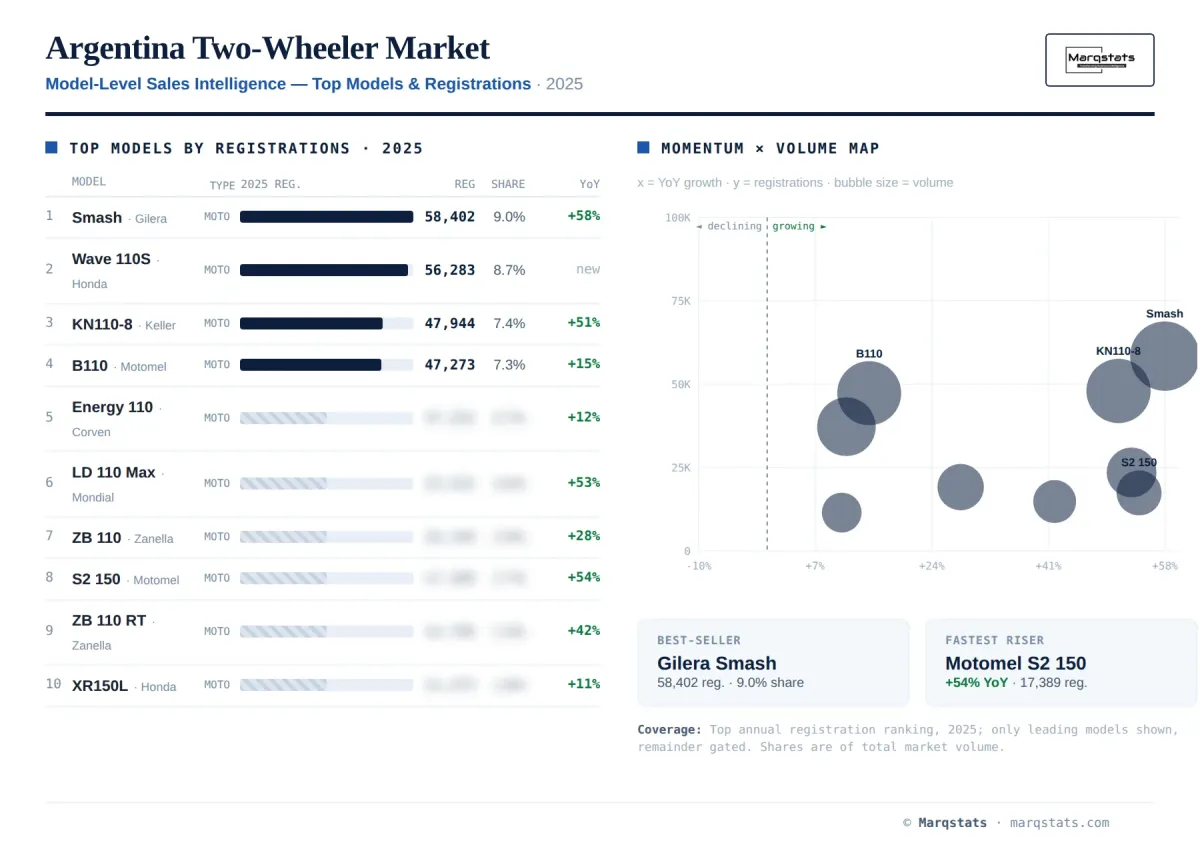
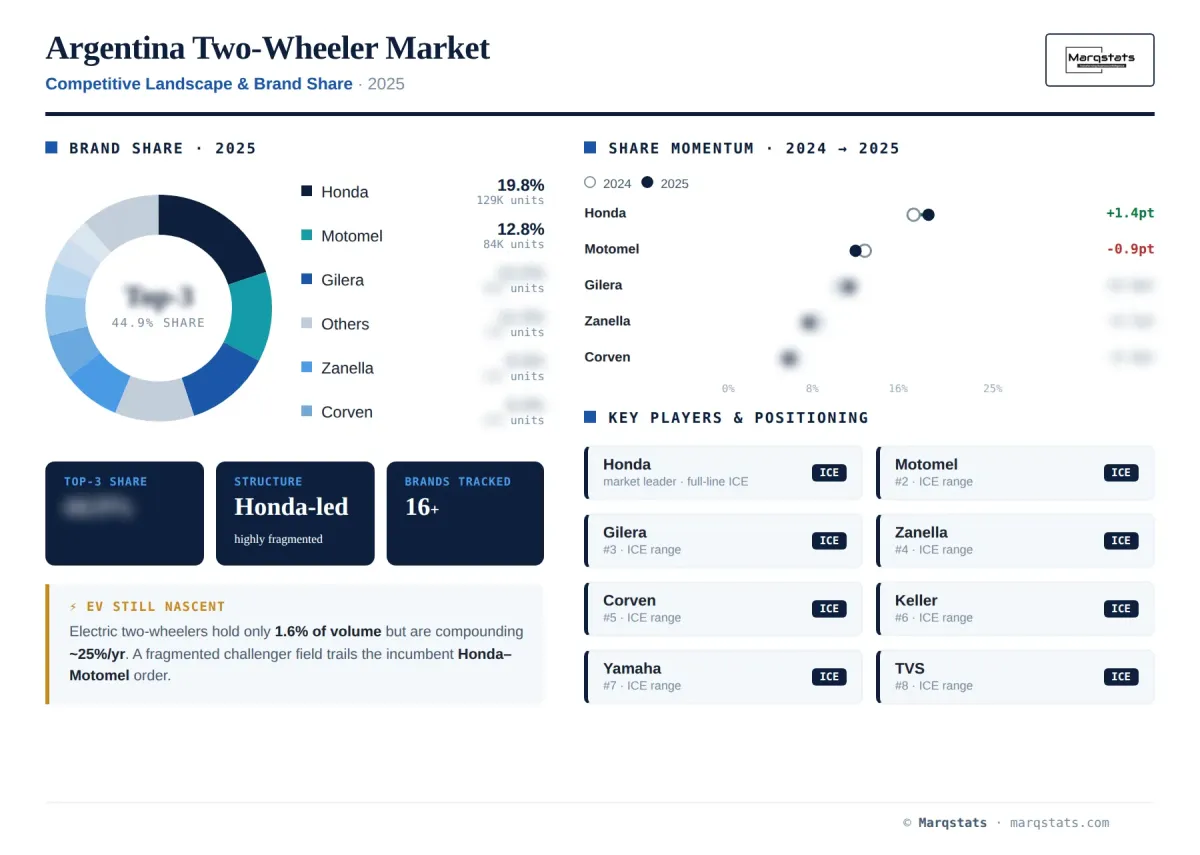
The Argentina two-wheeler market is moderately concentrated. Honda led brand registrations in 2025 with 119,004 units, followed by the domestic marque Motomel with 87,290 units, holding about 13.4% of the market, and Gilera with 81,778 units and about 12.6%. Zanella, Corven, and Keller follow, and the top four brands together account for roughly half of registrations. A wide field of domestic and imported marques competes across the remainder.
Model competition is exceptionally tight in the dominant 110cc class. The Gilera Smash finished 2025 as the most registered motorcycle in the country at 58,402 units, narrowly ahead of the Honda Wave 110 at 56,283 units, with the Keller KN 110-8, Motomel B110, and Corven Energy 110 close behind. Leadership among these models changed hands repeatedly across the year, and the ranking has continued to shift through 2026. Honda has retained brand leadership throughout, even in months when it ceded the top model position.
The narrowness of these margins reveals how the market actually works. Buyers choosing between a Smash, a Wave, a KN 110-8, and a B110 are comparing machines of near-identical specification at near-identical prices, so the decision turns on the instalment terms a dealer can offer and on the proximity of after-sales service. Brand loyalty exerts less influence here than in any premium market, and share moves month to month as financing promotions and stock availability change. This is why credit conditions, rather than product cycles, set the rhythm of the market.
Competition centres on price, financing terms, and dealer coverage rather than on product differentiation. Growth is attributed to brands that combine domestic assembly with broad credit access and provincial service networks, moreover rewarding those expanding into the larger displacements where dealer margins are higher. The dominance of domestic production, the narrow margins in the 110cc class, and the steady expansion of Indian manufacturers together define a market in which distribution and credit determine competitive position.
Companies Covered
The report profiles 16+ companies with full strategy and financials analysis, including:
Recent Market Activity
Table of Contents
Coverage & Segmentation
This report provides a comprehensive assessment of the Argentina two-wheeler market across a 2025 base year, historical data from 2021 to 2025, and forecasts spanning 2026 to 2030. Market sizing is presented in unit-volume terms and complemented by value analysis in United States dollars, with segmentation by vehicle type, propulsion type, engine displacement and motor power, price band, end user, sales channel, and brand. Brand-level shares, segment growth rates, and competitive positioning are quantified to support commercial and investment decisions.
The scope covers demand drivers, restraints, and structural trends, with particular focus on the credit-driven recovery of 2025 and its acceleration through 2026, the dominance of the sub-110cc commuter class, the exceptionally high share of domestic production, the tight model competition among domestic marques, and the early electric transition. Forecasts in this study are stated conservatively relative to sector projections that anticipate approach toward one million annual units by 2030. An extended forecast to 2035 is available under customization, alongside deeper cuts by province, brand, or channel on request.