Market Snapshot
Key Takeaways
Market Overview & Analysis
Report Summary
The Paraguay two-wheeler market comprises motorcycles, scooters and mopeds sold for personal and commercial use across internal combustion and electric propulsion. Paraguay is a landlocked South American nation of about 7 million people, and its two-wheeler demand reflects a developing economy with one of the region's lowest per-capita incomes, limited public transport, and an overwhelmingly commuting-oriented rider base. Motorcycles are the primary personal transport device for many households, valued for affordability and practicality, and demand concentrates around Asuncion, the Central department and Ciudad del Este.
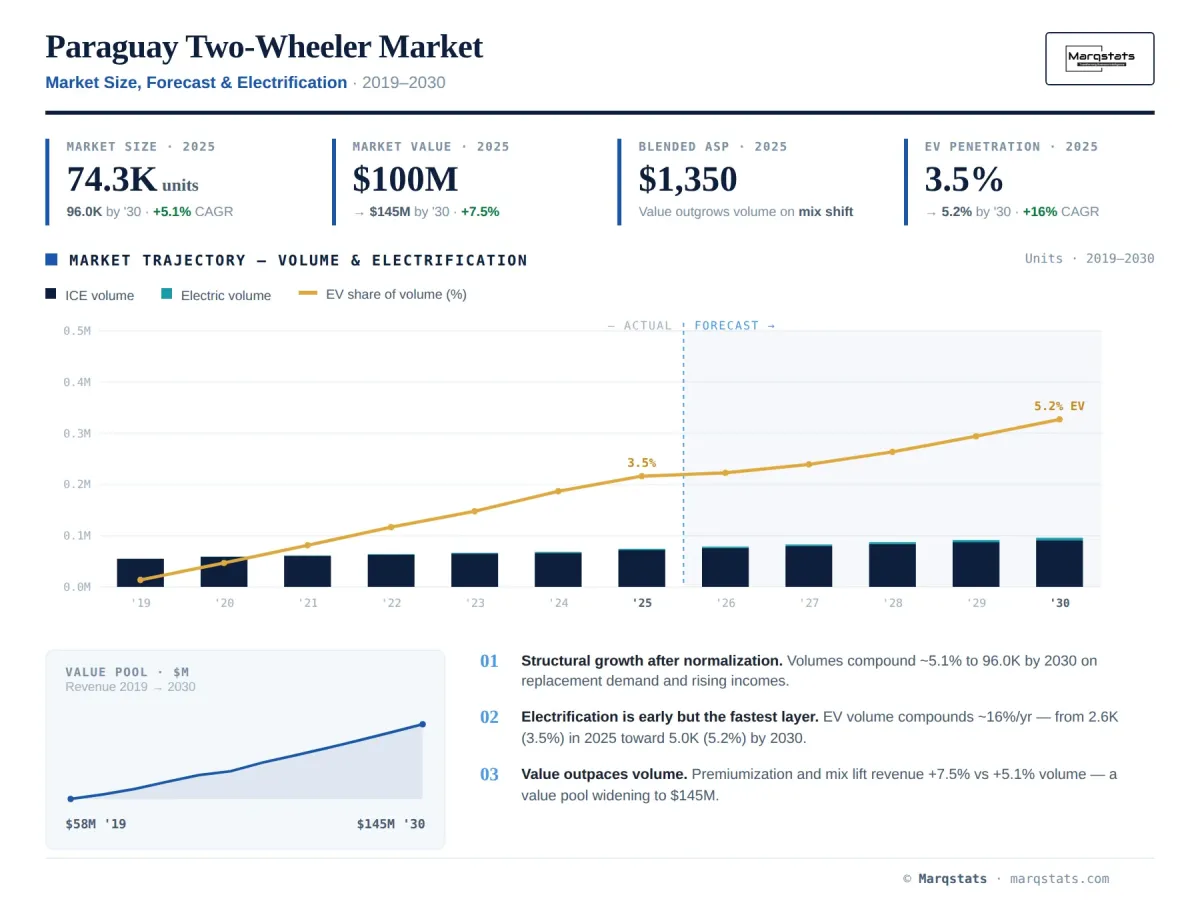
Between 2019 and 2025 the market grew steadily from about 55,000 units to about 74,300 units, reaching successive records, supported by positive economic momentum and macroeconomic stabilisation after a period of volatility. The market's defining characteristic is its supply structure: most machines are imported from China and locally assembled under domestic brands, so locally established marques hold the top positions while Japanese and Indian OEMs occupy smaller shares and premium European brands remain marginal. Growth over the forecast period combines steady unit expansion with gradual premiumisation and rapid electrification from a small base.
Paraguay's supply model — Chinese-sourced machines assembled and branded locally — mirrors the affordable, value-led pattern seen across the Africa two-wheeler market, where domestic and regional brands anchor entry-level commuting demand. Electrification is advancing quickly in percentage terms, accelerated by a global electric two-wheeler brand beginning local operations and by a government focus on greener mobility, and is moderated by limited charging access and the higher upfront cost of electric machines relative to the low-priced commuter motorcycles that dominate demand.
Two features define Paraguay's market. First, its brand structure is unusually domestic: locally established names such as Kenton, Leopard and Taiga hold the top positions, built on locally assembled, Chinese-sourced machines priced for the mass commuter market, an arrangement seen in few other countries. Second, demand is almost entirely functional: close to all sales serve commuting and small-trade use rather than leisure, which concentrates volume in affordable sub-150cc motorcycles and the entry and mass price band, and makes demand sensitive to incomes, credit access and fuel costs.
The local-assembly model is central to how the market works and where it is headed. Domestic brands import knocked-down kits and components, chiefly from China, and assemble and finish machines locally before selling them through their own dealer and financing networks under Paraguayan names. This structure keeps purchase prices low, shortens supply lines, and lets domestic marques out-distribute international OEMs on coverage and instalment credit, which is why they hold the largest share of a price-sensitive commuter market. It also means the market's fortunes are tied to component-import costs, exchange rates and local financing conditions rather than to global OEM strategy, and it gives domestic brands the flexibility to add electric models quickly as demand emerges, positioning them to defend share even as the propulsion mix begins to shift.
Market Dynamics
Key Drivers
- Market is driven by the role of motorcycles as the primary affordable transport device in a low-income economy with limited public transit.
- Demand is increasing owing to urbanisation around Asuncion, the Central department and Ciudad del Este, which concentrate population and commerce.
- An abundant supply of low-cost, locally assembled machines under domestic brands keeps entry prices low and widens ownership.
- Positive economic momentum and macroeconomic stabilisation are supporting record two-wheeler demand after a period of volatility.
- Rising online retail, growing at a 29.90% CAGR, is extending access beyond traditional dealer networks in major cities.
Key Restraints
- Demand is sensitive to low per-capita incomes, credit access and fuel costs, which constrain purchasing power in a value-led market.
- Limited charging access and the higher upfront cost of electric machines slow electrification outside major cities.
- Import dependence on Chinese components exposes the market to exchange-rate and supply-chain movements.
- A near-total focus on commuting use limits demand for higher-value leisure, touring and premium machines.
Key Trends
- Motorcycles are gaining share at a 7.30% CAGR while scooters decline, as commuters favour durable, low-cost motorcycles.
- Electric adoption is rising owing to a global brand starting local operations and a government focus on greener mobility.
- Gradual premiumisation is under way, as mid and premium classes grow faster than the entry tier and lift average value.
- Local assembly under domestic brands continues to deepen, moreover reinforcing the affordability of the commuter core.
Market Segmentation
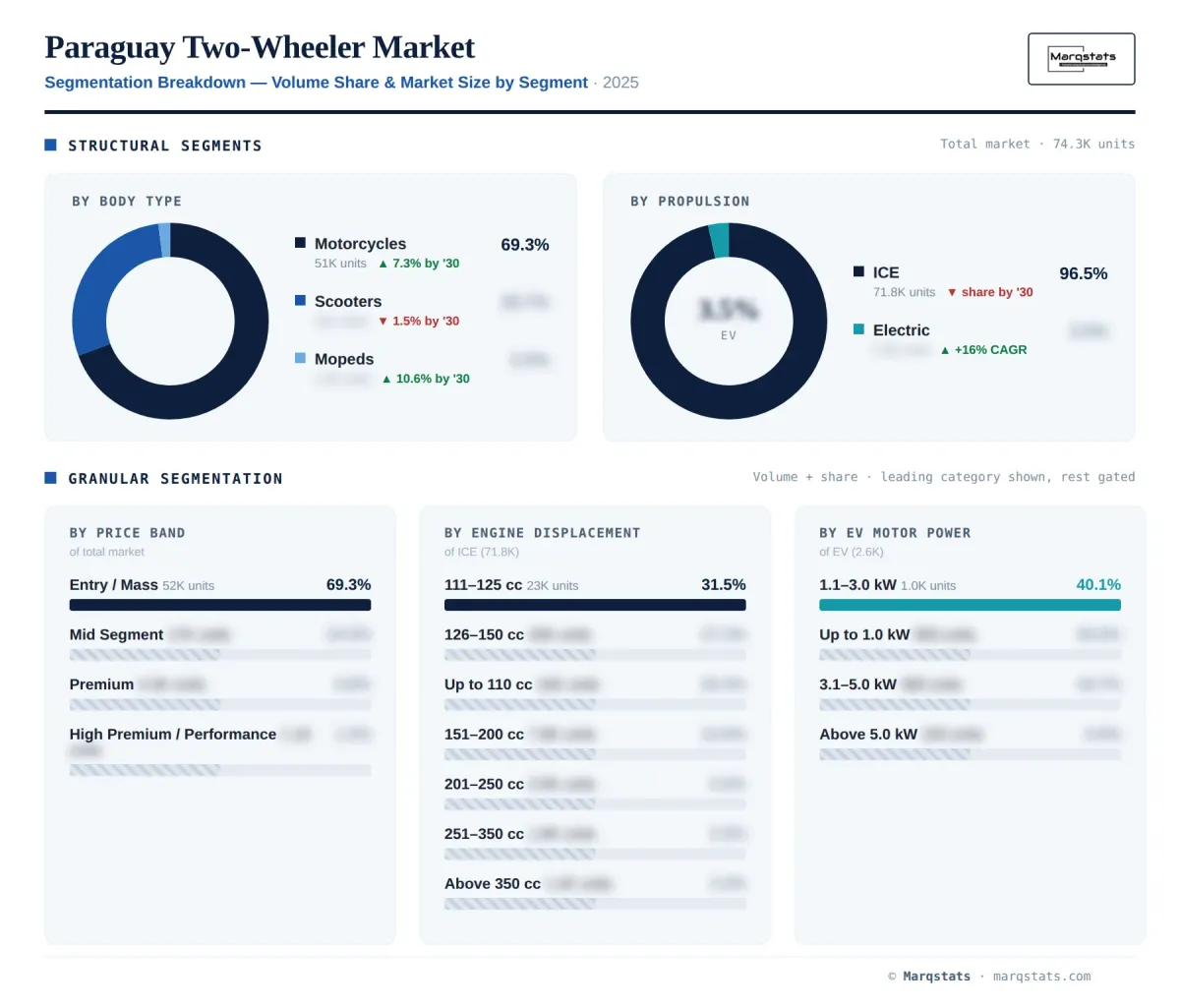
Motorcycles accounted for about 69% of 2025 volume, at roughly 51.47 thousand units, and are forecast to reach about 72.57 thousand units by 2030 at a 7.30% CAGR — the strongest-growing vehicle type. They are the backbone of Paraguayan mobility, used overwhelmingly for commuting and small trade, and demand concentrates in affordable commuter classes supplied by locally assembled domestic brands. Motorcycles drive nearly all of the market's absolute growth.
Scooters accounted for about 29% of 2025 volume, at roughly 21.35 thousand units, and ease to about 20.98 thousand units by 2030 at a 1.50% negative CAGR. Although scooters hold a substantial share, the segment is not growing, as commuters increasingly favour durable, low-cost motorcycles better suited to Paraguayan roads and utility use over automatic step-through machines.
Mopeds accounted for about 2% of 2025 volume, at roughly 1.5 thousand units, growing fastest in percentage terms to about 2.41 thousand units by 2030 at a 10.60% CAGR. The segment remains small, serving low-cost short-trip mobility, and overlaps increasingly with entry-level electric models in urban use.
ICE two-wheelers supplied about 96% of 2025 volume, at roughly 71.75 thousand units, and grow to about 90.93 thousand units by 2030 at a 4.60% CAGR. Petrol motorcycles remain the default owing to affordability, established fuelling and servicing networks, and durability, however their share erodes gradually as electric substitution accelerates from a small base.
Electric two-wheelers accounted for about 3.5% of 2025 volume, at roughly 2.57 thousand units, expanding to about 5.02 thousand units by 2030 at a 15.70% CAGR — the fastest-growing propulsion class. Adoption is increasing owing to a global electric brand beginning local operations, a government focus on greener mobility, and falling battery costs, and is moderated by limited charging access and higher upfront prices.
Within ICE machines, the 111–125cc class was the largest displacement band in 2025 at about 22.61 thousand units — the affordable commuter core — followed by the 126–150cc class at about 19.62 thousand units and the up-to-110cc class at about 14.6 thousand units. The 251–350cc band grows fastest at an 11.40% CAGR as a small group of riders trades up, while the 151–200cc class also grows healthily at 8.10%. Across electric motor-power bands, the 1.1–3.0 kW class leads volume and the above-5.0 kW category grows fastest at a 17.10% CAGR, reflecting demand for more capable electric machines.
The displacement mix reflects the market's affordability core. Sub-150cc machines dominate because they balance purchase price, fuel economy and practicality for commuting and light commercial use, and they anchor the entry and mass price band. Larger classes remain niche, serving utility and occasional leisure roles, however their faster growth and higher prices lift the blended average value, which is why revenue grows at a 7.50% CAGR against a 5.10% volume CAGR. On the electric side, low-power urban models lead adoption, with battery and motor upgrades tracking commuter and light-commercial demand.
The entry and mass band dominated 2025 volume at about 51.52 thousand units, or roughly 69% of the market, and grows at a 3.00% CAGR. The mid segment followed at about 17.43 thousand units and grows faster at 8.90%, while the premium and high-premium/performance bands, at about 4.29 thousand and 1.09 thousand units, grow at 11.30% and 9.50% CAGRs. This structure confirms an affordability-led, commuting-focused market, however the faster growth of higher bands drives the gap between value and volume growth as incomes rise in urban centres.
The B2C segment accounted for about 60% of 2025 volume, at roughly 44.6 thousand units, and grows at a 6.70% CAGR as private ownership widens. Delivery and logistics use is the second-largest category at about 15.01 thousand units, however it eases at a 1.90% negative CAGR as the segment matures, while ride-hail, rental and tourism use, at about 7.44 thousand units, grows slowly at 2.50%. B2B and fleet demand, at about 5.71 thousand units, grows at 10.00%, and government and institutional use expands fastest from a low base at 10.10%.
This end-user pattern reflects Paraguay's commuting-driven, informal economy. Private ownership is the core and grows steadily as households acquire motorcycles for daily transport and small trade, while the sizeable delivery and logistics base reflects the role of two-wheelers in urban commerce and last-mile distribution. The gradual easing of the delivery category suggests early saturation in that use case, even as B2B, fleet and institutional demand strengthen, pointing to a slow broadening of commercial two-wheeler applications.
Offline dealerships retained about 95% of 2025 volume, at roughly 70.67 thousand units, and grow at a 3.10% CAGR, reflecting the importance of physical dealers for financing, servicing and trust in a value-led market. Online channels, though only about 5% of volume at roughly 3.65 thousand units, grow fastest at a 29.90% CAGR as digital storefronts and marketplaces expand in major cities and reach younger urban buyers.
The channel structure reflects how two-wheelers are financed and serviced in Paraguay. Because many buyers rely on dealer-arranged instalment credit and value proximity for maintenance and spare parts, physical dealerships remain central to the purchase decision, particularly outside the largest cities. Online growth is concentrated in urban centres and among younger, first-time buyers who research and compare models digitally. Over the forecast period the two channels are expected to become complementary, with digital discovery feeding physical dealer sales and after-sales service rather than fully displacing them.
By Geography
Two-wheeler demand in Paraguay concentrates in the most populous and commercial areas — Asuncion and the Central department, and Ciudad del Este — which contain the bulk of population, commerce and vehicle sales. Regional differences are shaped by urbanisation, income and cross-border trade, and these factors determine where motorcycles, scooters and electric models are most prevalent. Domestic brands hold their strongest positions in the interior and mass-commuter segments, while international OEMs and electric models cluster in the wealthier urban centres.
Asuncion & Central Department
The Asuncion metropolitan area and surrounding Central department form the largest demand centre, concentrating commuting, commerce and delivery activity along with the densest dealer networks. The region anchors both motorcycle demand and the earliest electric two-wheeler adoption, and it leads the expansion of online retail and financing-based purchasing.
Ciudad del Este & the East
Ciudad del Este, a major commercial and cross-border trade hub on the Brazilian border, adds a strong base of commuter and commercial demand. Its trade-driven economy supports high motorcycle use for transport and small business, and its retail networks distribute both domestic brands and imported machines across the eastern region.
Interior & Rural Departments
The interior and rural departments rely on durable, affordable motorcycles for transport across long distances and mixed road conditions. Demand skews toward the lowest-priced commuter classes and domestic brands, electrification lags owing to sparser charging access, and growth is attributed to rising incomes and gradual infrastructure improvement.
How Competition Is Evolving
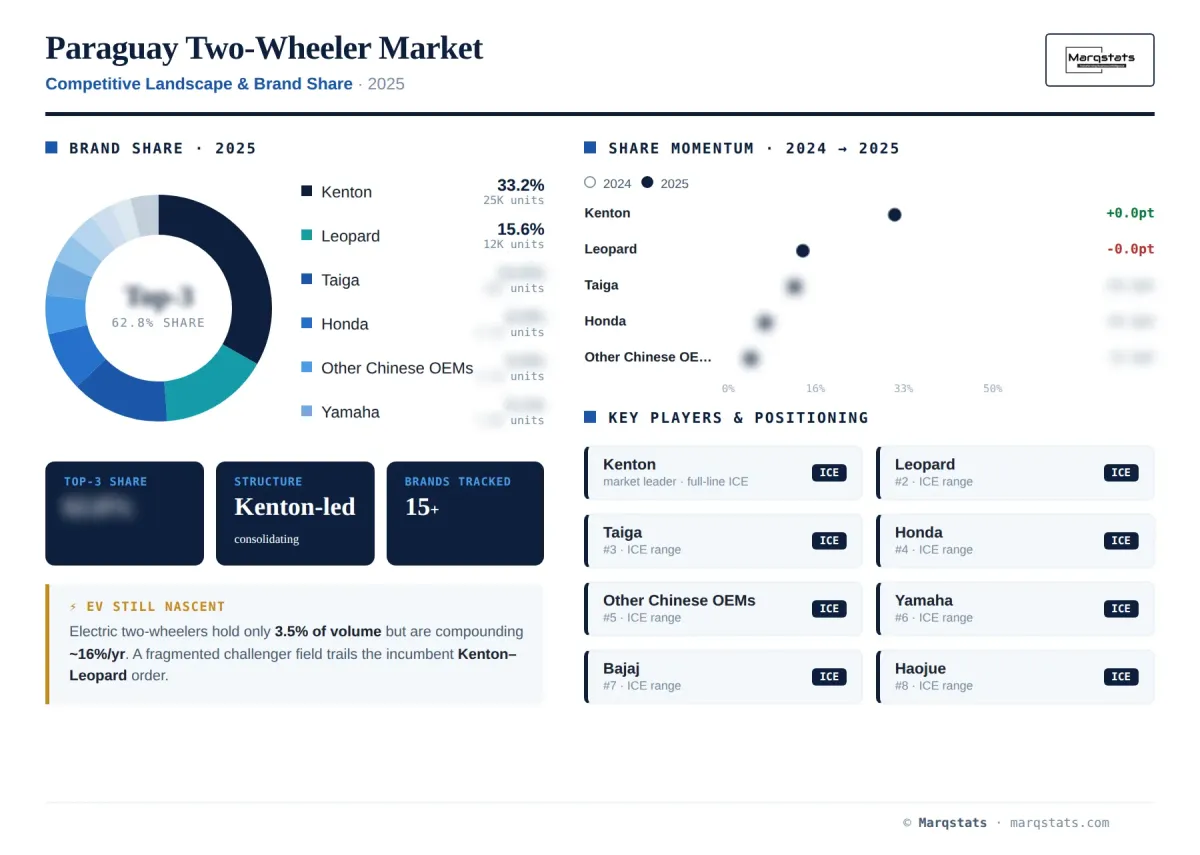
The Paraguay two-wheeler market is moderately concentrated among locally established domestic brands, an unusual structure in which Kenton leads at about a third of volume, followed by Leopard and Taiga. Honda is the highest-ranked international OEM in fourth place, with Yamaha, Suzuki, Bajaj and several Chinese brands filling out the field. Competition centres on price, dealer and financing reach, durability and spare-parts availability rather than on international brand prestige.
The market's defining feature is local assembly: domestic brands import machines and components from China, assemble them locally, and sell them under Paraguayan names at prices below international OEMs, capturing the mass commuter segment. Kenton, distributed through a major local group, has built the widest dealer and service network, while Leopard and Taiga hold strong domestic positions. Japanese brands such as Honda and Yamaha compete on reputation and resale value in the mid and upper tiers, Indian brands add value commuter options, and a global electric brand has entered with local operations to lead the emerging electric segment.
At the brand level, the domestic leaders compete primarily on affordability, dealer coverage and after-sales support, which sustain their dominance in a price-sensitive market. International OEMs pursue the gradually growing mid and premium bands where reputation and durability command a premium, while electric-focused supply targets urban early adopters. Over the forecast period the balance is expected to remain led by domestic brands, however international and electric players are positioned to gain in the faster-growing higher-value and electric niches.
Companies Covered
The report profiles 16+ companies with full strategy and financials analysis, including:
Recent Market Activity
Table of Contents
Coverage & Segmentation
This report provides a comprehensive analysis of the Paraguay two-wheeler market across a 2025 base year, historical data from 2021 to 2025, and forecasts spanning 2026 to 2030. The study sizes the market in both volume (thousand units) and value (USD million) and segments it by vehicle type (motorcycles, scooters and mopeds), propulsion type (internal combustion engine, electric), engine displacement and motor power, price band, end user, and sales channel. Brand-level analysis covers the locally established domestic brands that lead the market, alongside international Japanese, Indian and Chinese OEMs and emerging electric brands.
The study examines market drivers, restraints and trends, segment-level growth, regional demand across Asuncion, Central department and Ciudad del Este, competitive structure, and forward catalysts including local assembly, electrification, urbanisation and economic conditions. All market estimates represent Marqstats-reconciled figures derived from a bottom-up methodology validated against top-down benchmarks, using national statistics, trade indicators and registration data rather than any single external source.
The report is designed for two-wheeler manufacturers, importers, assemblers and distributors, fleet and delivery operators, component and battery suppliers, and policymakers assessing Paraguay's mobility and electrification path. It supports market sizing, brand and channel benchmarking, and scenario planning around affordability, electrification and economic conditions. Volume and value forecasts are provided at segment level for the 2026–2030 window, with 2021–2025 historical context, enabling comparison against neighbouring South American markets.