Market Snapshot
Key Takeaways
Market Overview & Analysis
Report Summary
The Egypt two-wheeler market comprises motorcycles, scooters and mopeds sold for personal transport, commercial delivery and commuting across internal combustion and electric propulsion. Egypt is a young, populous North African nation of well over 100 million people, and unlike much of sub-Saharan Africa, motorcycles are not the primary mode of transport: cars, minibuses and public transit carry most trips in a highly urbanised country. Two-wheelers instead concentrate in the fast-growing delivery economy and in commuting, with demand centred on Greater Cairo and the Nile Delta.
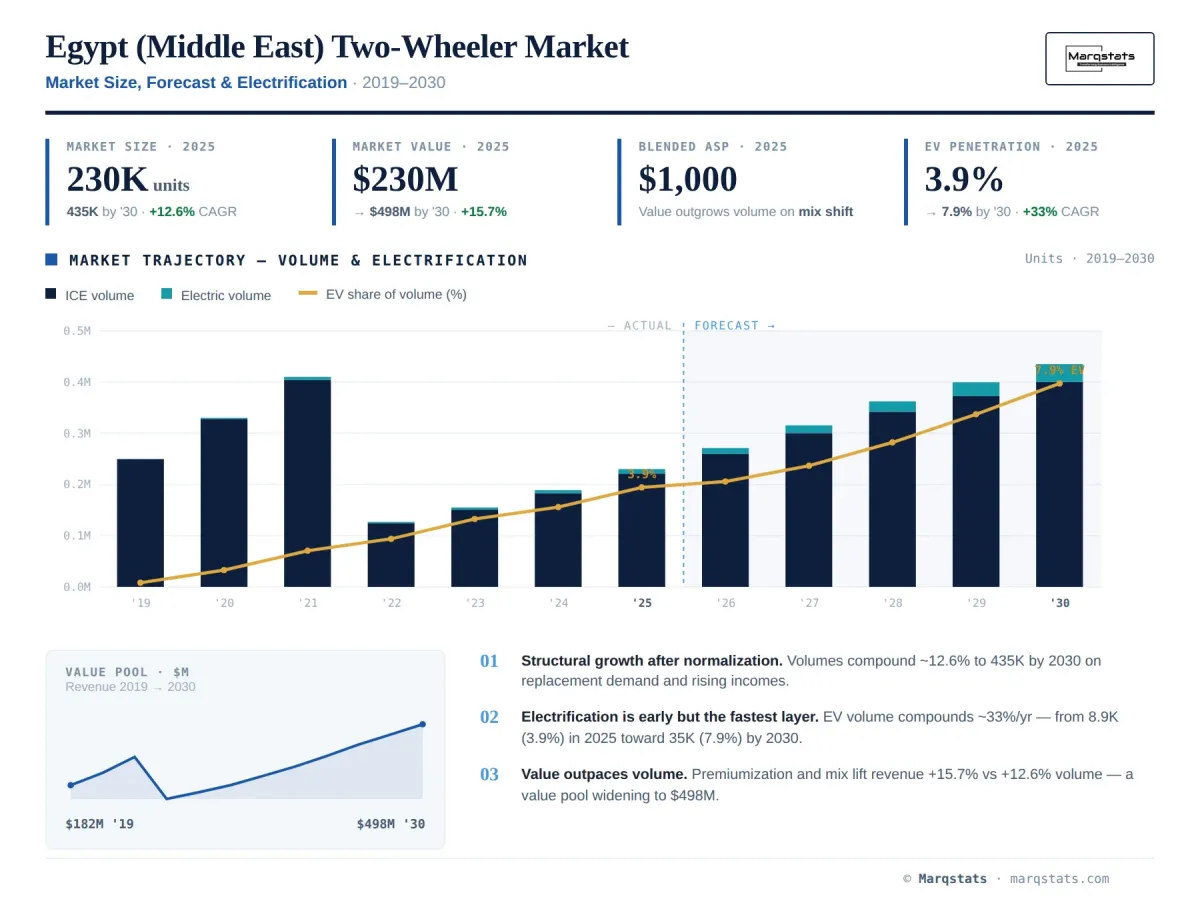
The market's recent history has been volatile. After several years of growth, two-wheeler volumes contracted sharply in 2022, hit by currency devaluation, record inflation and import restrictions that constrained the supply of imported machines and components. The market has since recovered strongly, aided by the flotation of the Egyptian pound in 2024 under an international reform programme and by macroeconomic stabilisation, and it is forecast to grow quickly through 2030. Growth over the forecast period combines rapid unit expansion with gradual premiumisation and the fastest electrification in the pack, albeit from a small base.
Egypt sits within the Africa two-wheeler market, yet its structure is distinctive: Chinese brands dominate through local knocked-down assembly plants, motorcycles serve delivery rather than mass mobility, and demand is unusually sensitive to currency and inflation. Electrification is advancing owing to battery-swap operators in Cairo, desert-condition testing with logistics firms, and a national industrial strategy that supports local electric-vehicle assembly and a domestic battery line, and is moderated by high import tariffs, hot-climate battery performance and charging-infrastructure gaps.
Two features define Egypt's market. First, it is delivery-led: the courier and food-delivery boom has made commercial last-mile use a central pillar of demand, favouring affordable, fuel-efficient 110–150cc commuter motorcycles. Second, it is locally assembled and Chinese-branded: the top marques are Chinese names produced in Egyptian assembly plants under a policy that rewards local content, which shapes pricing, availability and the pace at which electric models can be introduced.
The delivery dimension is what most distinguishes Egypt from other large emerging markets. In much of sub-Saharan Africa, motorcycles are the backbone of passenger transport through taxi fleets; in Egypt, where cars, minibuses and public transit dominate mobility, two-wheelers found their growth engine in goods movement instead. The expansion of food-delivery apps, parcel couriers and quick-commerce platforms across Cairo and the Delta created a durable base of commercial demand for reinforced commuter motorcycles, and it is this commercial layer, sitting alongside rising private ownership, that gives Egypt both its scale and its resilience. As delivery fleets professionalise and begin trialling electric machines, this same segment is likely to lead the market's electrification even as private buyers drive volume growth.
Market Dynamics
Key Drivers
- Market is driven by a large, young population and rising urbanisation across Greater Cairo and the Nile Delta, which concentrate demand.
- The food-delivery and courier boom is expanding commercial last-mile demand for affordable, fuel-efficient commuter motorcycles.
- Locally assembled Chinese brands keep entry prices accessible and widen availability under a policy that rewards local content.
- Macroeconomic stabilisation after the 2024 currency reform is restoring import capacity and consumer purchasing power.
- Electrification is accelerating owing to Cairo battery-swap networks and a national strategy supporting local electric-vehicle assembly.
Key Restraints
- High import tariffs on motorcycles and components raise costs and expose the market to exchange-rate movements.
- Currency depreciation and elevated inflation continue to make demand volatile from year to year.
- Hot-climate battery performance above 40 degrees and limited charging access slow electric adoption outside pilot fleets.
- Motorcycles remain secondary to cars and public transport in a highly urbanised country, capping their share of total mobility.
Key Trends
- Delivery fleets are standardising on 110–150cc fuel-injected commuter motorcycles adapted for hot-climate, stop-start use.
- Electric adoption is rising fastest owing to Cairo battery-swap stations that cut swap times and operating costs for riders.
- Premiumisation is under way, as mid and premium classes grow faster than the entry tier and lift average value.
- Local assembly is deepening, moreover extending toward electric two-wheelers under the national automotive strategy.
Market Segmentation
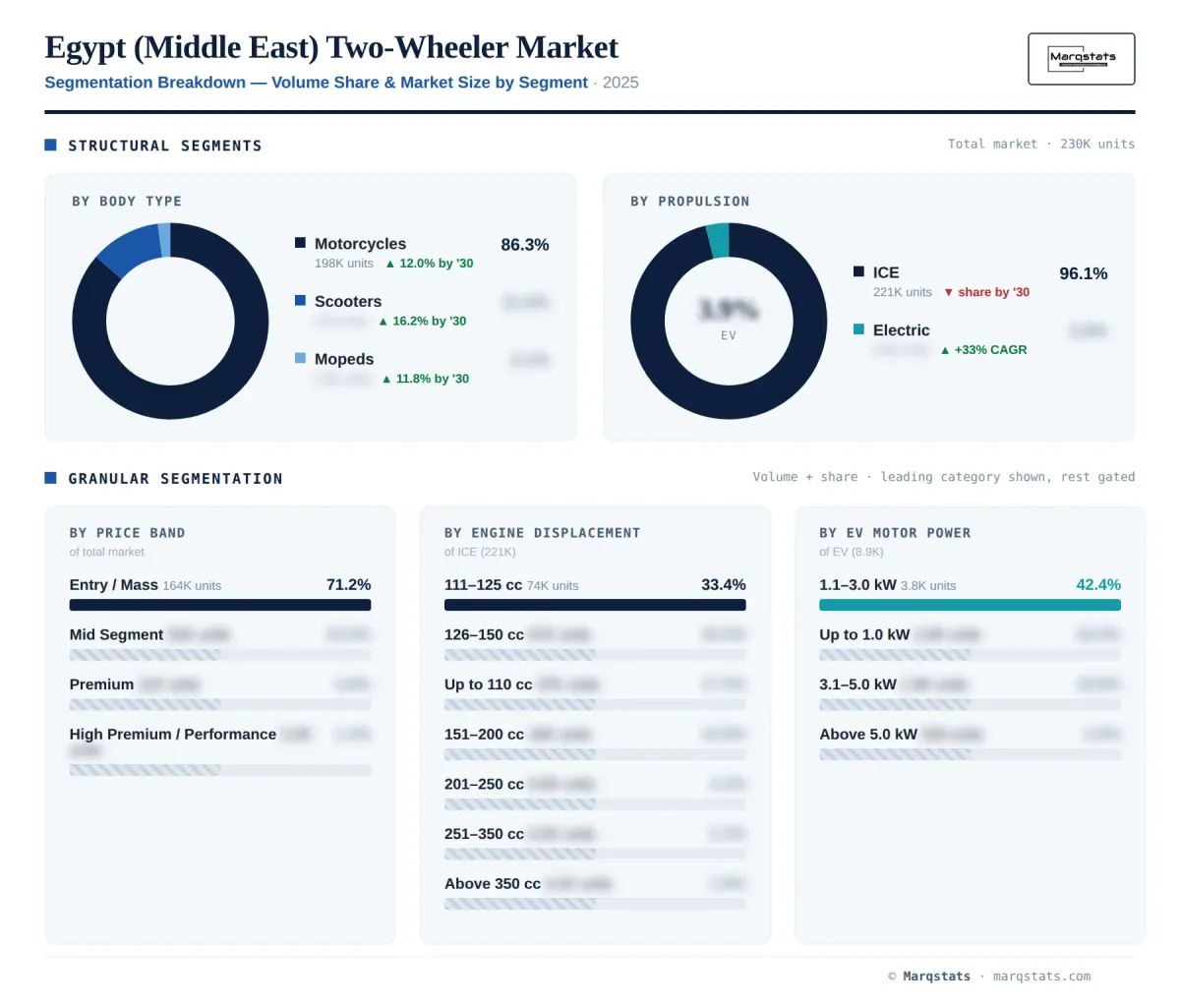
Motorcycles accounted for about 86% of 2025 volume, at roughly 198.44 thousand units, and are forecast to reach about 368.08 thousand units by 2030 at a 12.00% CAGR. They anchor the market, used mainly for delivery, commuting and small trade, and demand concentrates in affordable, fuel-efficient commuter classes adapted for hot-climate, stop-start urban conditions. Motorcycles drive the bulk of the market's absolute growth.
Scooters accounted for about 11.6% of 2025 volume, at roughly 26.69 thousand units, growing fastest to about 57.85 thousand units by 2030 at a 16.20% CAGR. Uptake is increasing owing to urban commuting in Cairo and the arrival of electric scooter models, and the segment is a focal point for early electric adoption, with a distinct scooter leader among suppliers.
Mopeds accounted for about 2.1% of 2025 volume, at roughly 4.86 thousand units, growing to about 8.95 thousand units by 2030 at an 11.80% CAGR. The segment remains niche, serving low-cost short-trip mobility, and overlaps increasingly with entry-level electric models in urban use.
ICE two-wheelers supplied about 96% of 2025 volume, at roughly 221.06 thousand units, and grow to about 400.33 thousand units by 2030 at an 11.40% CAGR. Petrol motorcycles remain the default owing to affordability, established fuelling and servicing, and rider familiarity, however their share erodes gradually as electric substitution accelerates and as the national strategy encourages local electric assembly.
Electric two-wheelers accounted for about 4% of 2025 volume, at roughly 8.94 thousand units, expanding to about 34.55 thousand units by 2030 at a 32.70% CAGR — the fastest-growing propulsion class in the pack. Adoption is driven by Cairo battery-swap operators, logistics-fleet trials and a national push for local electric-vehicle assembly, and is moderated by high import tariffs, hot-climate battery performance and charging gaps.
Within ICE machines, the 111–125cc class was the largest displacement band in 2025 at about 73.73 thousand units, narrowly ahead of the 126–150cc class at about 67.33 thousand units, together forming the commuter and delivery core, followed by the up-to-110cc class at about 37.47 thousand units. The 151–200cc band grows fastest at a 14.00% CAGR, favoured by delivery operators seeking reinforced cargo capacity, while the 251–350cc class also grows strongly. Across electric motor-power bands, the 1.1–3.0 kW class leads volume and the up-to-1.0 kW category grows fastest at a 34.70% CAGR, reflecting entry-level urban electric demand.
The displacement mix reflects the market's delivery and commuter core. Sub-150cc machines dominate because they balance purchase price, fuel economy and practicality for last-mile and commuting use, and they anchor the entry and mass price band. The 151–200cc segment stands out for its faster growth, driven by delivery fleets that value cargo capacity and durability. Larger classes remain niche, serving leisure and touring roles, however their higher prices lift the blended average value, which is why revenue grows at a 15.70% CAGR against a 12.60% volume CAGR.
The entry and mass band dominated 2025 volume at about 163.78 thousand units, or roughly 71% of the market, and grows at a 10.80% CAGR. The mid segment followed at about 51.86 thousand units and grows faster at 16.10%, while the premium and high-premium/performance bands, at about 11.13 thousand and 3.22 thousand units, grow at 20.30% and 8.60% CAGRs. This structure confirms an affordability-led market, however the fast growth of the premium band, alongside higher-priced electric machines, drives the gap between value and volume growth.
The B2C segment accounted for about 49% of 2025 volume, at roughly 112.31 thousand units, and grows at a 16.00% CAGR as private ownership widens. Delivery and logistics use is the second-largest category at about 73.77 thousand units, or roughly 32% of volume, reflecting Egypt's large courier and food-delivery economy, though it grows more slowly at 5.10% as the segment matures. Ride-hail, rental and tourism use, at about 22.27 thousand units, grows at 10.20%, B2B and fleet demand grows fastest at 19.80%, and government and institutional use expands from a low base at 12.90%.
This end-user pattern reflects Egypt's distinctive demand structure. The unusually large delivery and logistics share sets Egypt apart, a legacy of the pandemic-era logistics boom and the continued expansion of food-delivery and courier platforms in its cities. As private ownership grows faster than delivery, the mix is gradually rebalancing toward personal use, even as commercial demand remains a central pillar. The rapid growth of B2B and fleet demand points to increasing formalisation and the scaling of managed delivery fleets, including early electric deployments.
Offline dealerships retained about 93% of 2025 volume, at roughly 214.34 thousand units, and grow at a 10.30% CAGR, reflecting the importance of physical dealers for financing, servicing and trust in a value-led market. Online channels, though about 7% of volume at roughly 15.66 thousand units, grow fastest at a 33.70% CAGR as digital storefronts and marketplaces expand across Egyptian cities and reach younger buyers.
The channel structure reflects how two-wheelers are bought and serviced in Egypt. Physical dealers remain central for financing, documentation and after-sales support, particularly for delivery operators managing fleets, and local assemblers distribute through established dealer networks. Online growth is concentrated in urban centres and among younger, first-time buyers who research and compare models digitally, and electric operators increasingly use app-based sales and battery-swap accounts. Over the forecast period, digital and physical channels are expected to work together rather than the former displacing the latter.
By Geography
Two-wheeler demand in Egypt concentrates heavily in Greater Cairo and the Nile Delta, which together account for the majority of national sales, with additional demand in the coastal cities and untapped potential in Upper Egypt. Regional differences are shaped by urbanisation, delivery activity and income, and these factors determine where commuter, delivery and electric models are most prevalent.
Greater Cairo
Greater Cairo is the dominant demand centre, concentrating delivery activity, commuting and the densest dealer and battery-swap networks. The capital region anchors both commercial and private demand and leads electric adoption, hosting the battery-swap stations and logistics-fleet trials that pioneer electrification. It is also the focal point for online sales and for the courier and food-delivery platforms that drive commercial demand.
Nile Delta & Alexandria
The Nile Delta and the coastal hub of Alexandria form a strong secondary base of commuter and commercial demand, together with Greater Cairo accounting for the bulk of national sales. Dense population, agriculture and trade support motorcycle use for transport and small business, and improving retail and assembly networks distribute both commuter and delivery machines across the region.
Upper Egypt & Other Regions
Upper Egypt and other governorates rely on affordable, durable motorcycles for transport and agricultural use, and represent untapped potential for utility models. Demand skews toward the lowest-priced commuter classes, electrification lags owing to sparser charging access and hot-climate conditions, and growth is attributed to rising incomes and gradual infrastructure improvement.
How Competition Is Evolving
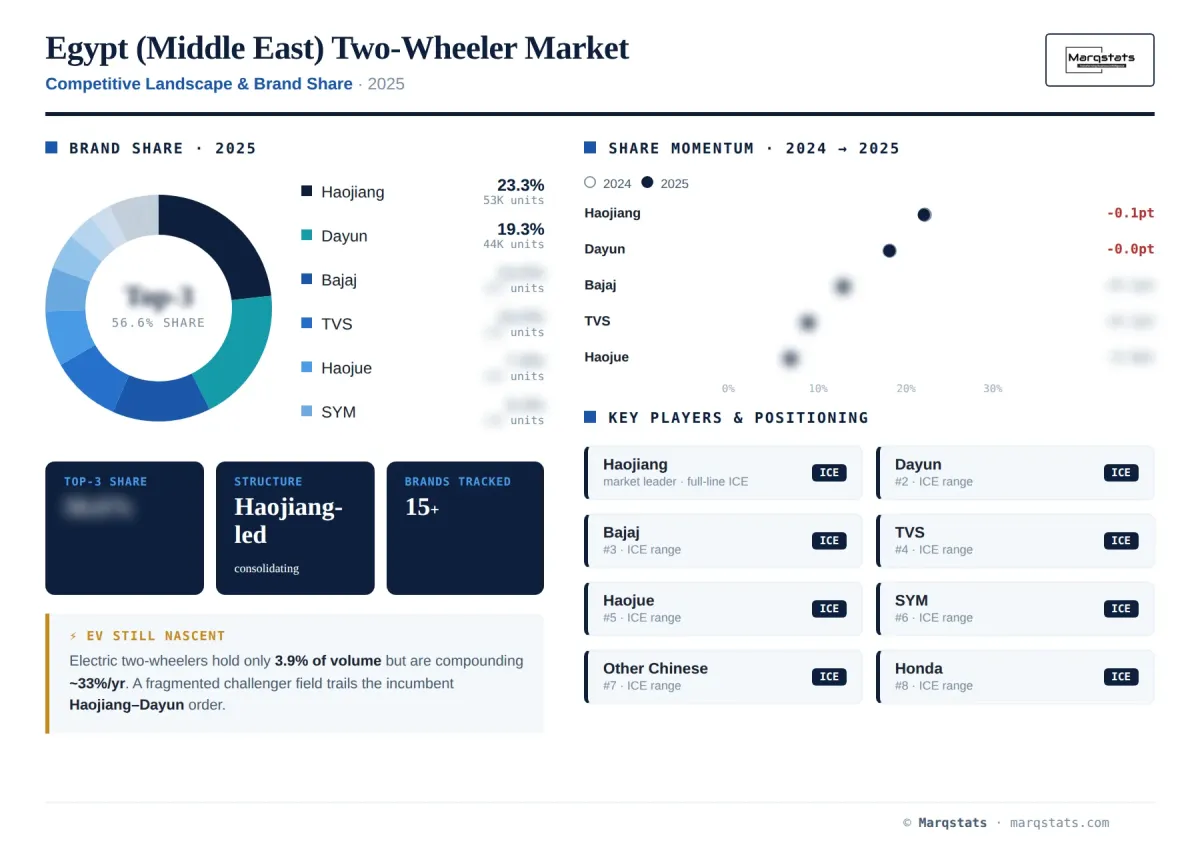
The Egypt two-wheeler market is moderately concentrated and shaped by Chinese brands assembled locally, with Haojiang holding about 23% of volume and Dayun about 19%, together more than four in ten units. Indian brands Bajaj and TVS follow, with Haojue, Taiwanese scooter specialist SYM, Japanese brands Honda, Yamaha and Suzuki, and electric brand Yadea filling out the field. Competition centres on price, local assembly, dealer coverage and hot-climate durability.
The market's defining feature is local knocked-down assembly: the top Chinese marques operate Egyptian assembly plants under a national policy that rewards local content, which lowers costs and shortens supply lines relative to fully imported machines. This structure underpins their dominance in the affordable commuter and delivery segments. Indian brands compete on durability and after-sales networks, SYM anchors the scooter segment, Japanese brands hold premium and reputation-driven niches, and a growing set of electric players, alongside Cairo battery-swap operators, contests the fast-growing electric segment.
At the brand level, the Chinese incumbents compete on affordability, local assembly and availability, which sustain their dominance in a price-sensitive market. Indian and Japanese brands differentiate on durability, resale value and service, while electric operators and local assemblers position for the electrification wave supported by national policy. Over the forecast period, the locally assembled Chinese leaders are expected to retain the largest share, however electric-focused players and premium brands are positioned to gain in the faster-growing segments.
Companies Covered
The report profiles 16+ companies with full strategy and financials analysis, including:
Recent Market Activity
Table of Contents
Coverage & Segmentation
This report provides a comprehensive analysis of the Egypt two-wheeler market across a 2025 base year, historical data from 2021 to 2025, and forecasts spanning 2026 to 2030. The study sizes the market in both volume (thousand units) and value (USD million) and segments it by vehicle type (motorcycles, scooters and mopeds), propulsion type (internal combustion engine, electric), engine displacement and motor power, price band, end user, and sales channel. Brand-level analysis covers the locally assembled Chinese leaders, Indian, Taiwanese and Japanese OEMs, and the emerging electric players that shape Egyptian supply.
The study examines market drivers, restraints and trends, segment-level growth, regional demand across Greater Cairo, the Nile Delta and beyond, competitive structure, and forward catalysts including the delivery economy, local assembly, electrification and macroeconomic conditions. The 2022 contraction is reconciled to currency devaluation, inflation and import restrictions rather than a structural change in demand. All market estimates represent Marqstats-reconciled figures derived from a bottom-up methodology validated against top-down benchmarks, using national statistics, trade indicators and registration data rather than any single external source.
The report is designed for two-wheeler manufacturers, importers, assemblers and distributors, delivery and logistics platforms, fleet operators, component and battery suppliers, and policymakers assessing Egypt's mobility and electrification path. It supports market sizing, brand and channel benchmarking, and scenario planning around currency, electrification and local assembly. Volume and value forecasts are provided at segment level for the 2026–2030 window, with 2021–2025 historical context, enabling comparison against neighbouring North African and Middle Eastern markets.