Market Snapshot
Key Takeaways
Market Overview & Analysis
Report Summary
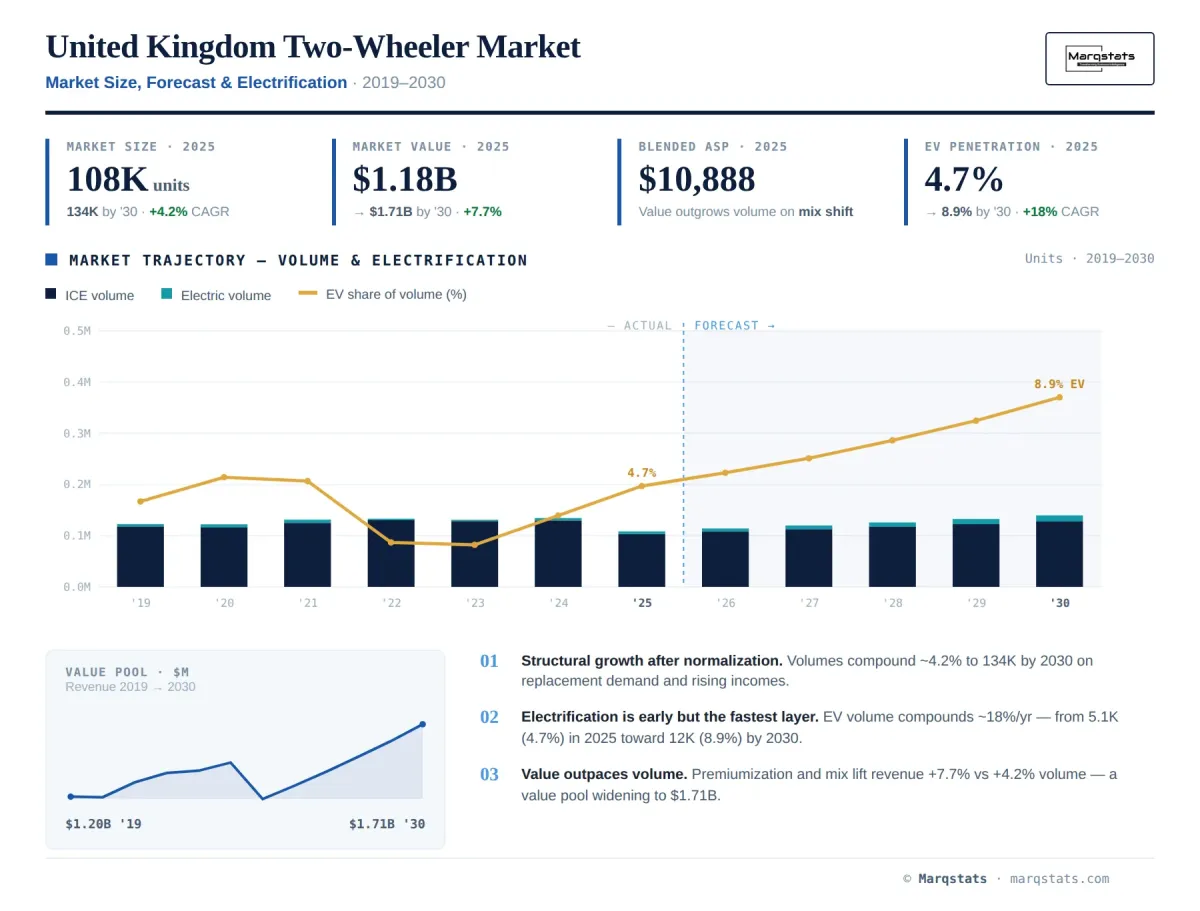
The United Kingdom two-wheeler market comprises motorcycles, scooters, and mopeds sold for personal and commercial use across internal combustion and electric propulsion. This study segments demand by vehicle type, propulsion type, engine displacement and motor power, price band, end user, sales channel, and brand, with a 2025 base year, historical coverage from 2021 to 2025, and forecasts to 2030. The market combines a premium enthusiast character with a large accessible commuter segment, giving it a structure distinct from other European markets.
The 2025 result must be read against a distorted 2024. Ahead of tighter emissions requirements, dealers and distributors registered large volumes of compliant stock in late 2024 through pre-registrations and special deals, pulling demand forward and inflating 2024 volumes. Registrations then fell sharply in early 2025 before recovering through the year, and the European Association of Motorcycle Manufacturers recorded the same pull-forward pattern across major European markets. The forecast therefore rebuilds from a distorted low toward steady growth to 2030.
Supply is broad and led by Honda, whose range spans 125cc scooters to large tourers, followed by the British marque Triumph, with its Hinckley-built modern classics and adventure bikes. BMW is strong at the premium end, Yamaha and Kawasaki hold established positions, and value brand Lexmoto anchors the learner and commuter segment. KTM and Husqvarna, both part of Pierer Mobility, saw registrations fall steeply during financial restructuring, while Chinese brands such as Voge and Keeway have begun to gain share. Electric two-wheelers remain a small share, concentrated in delivery scooters and light machines.
The market's defining feature is its bimodal structure. At one end, a large 125cc class serves commuters, delivery riders, and new riders who can access these machines on compulsory basic training, making two-wheelers an affordable urban mobility solution. At the other, a substantial above-350cc segment serves affluent enthusiasts buying touring, adventure, and modern-classic machines for leisure. The middle displacements are comparatively thin, so the market is most clearly understood as two distinct demand pools rather than a single continuum, each with different buyers, price points, and growth dynamics through the forecast period.
Market Dynamics
Key Drivers
- Recovery from the emissions-led correction drives growth, as demand normalises from the 2025 low toward a higher forecast base through 2030.
- The modern-classic and retro trend lifts demand, with affordable machines such as the Honda GB350S and Royal Enfield twins drawing new and returning riders.
- The 125cc commuter and learner class supports volume, accessible on compulsory basic training and central to urban mobility and delivery.
- Premiumisation sustains value, as large-displacement touring and adventure machines, led by the BMW GS range, command high prices.
Key Restraints
- Economic weakness and low consumer confidence weigh on demand, particularly for higher-value discretionary machines.
- Surplus pre-registered stock from 2024 depressed new registrations and margins through 2025, slowing recovery.
- The absence of an electric-motorcycle purchase incentive, unlike the grant offered for electric cars, slows electric adoption.
Key Trends
- Electrification advances slowly from a small base, concentrated in delivery scooters and light machines; the global electric ATV and UTV market reflects the wider electrification of powered leisure vehicles.
- Online retail leads the market, reaching about 40% of sales at a 15% CAGR, the highest digital share among major two-wheeler markets.
- Chinese brands gain share, as makers such as Voge and Keeway expand with competitively priced models across commuter and mid segments.
- The competitive field is reshaping, as KTM and Husqvarna restructure and the modern-classic segment reshuffles brand positions.
Market Segmentation
Motorcycles dominate at about 83% of 2025 volume, roughly 90,000 units, growing at a 3.39% CAGR. The category spans large touring and adventure machines, modern classics, naked bikes, and 125cc commuters, reflecting a market that serves both premium leisure and everyday urban mobility. Large-displacement and modern-classic models generate most of the value, while 125cc machines drive a substantial share of units. The modern-classic sub-segment, led by models such as the Honda GB350S and Royal Enfield twins, has been the market's strongest growth story, drawing both new riders and returning enthusiasts with affordable, characterful machines.
Scooters and mopeds account for about 19,000 units in 2025, roughly 17% of volume, growing faster at a 7.74% CAGR. Demand centres on urban commuting and delivery, particularly in London and other cities, and this category hosts much of the electric two-wheeler market, supporting its growth. The scooter share is higher than in most European markets, reflecting strong urban and delivery use. The Honda PCX 125 typifies the segment's appeal as a practical commuter and delivery machine, and scooters have been among the first categories to recover, growing at a double-digit pace into 2026 as urban demand and delivery fleets rebuild.
Combustion models hold about 95% of 2025 volume, roughly 103,000 units, growing at a 4% CAGR from the 2025 low. Combustion remains dominant across touring, adventure, modern-classic, and commuter classes, and it continues to define the premium large-displacement machines and the 125cc commuters that anchor the market. With electric adoption slowed by the lack of a purchase grant, combustion machines are set to retain a dominant share throughout the forecast period, particularly in the premium leisure segments where range, sound, and character remain central to the ownership experience.
Electric two-wheelers hold about 5% of 2025 volume, roughly 5,000 units, growing at an 18.32% CAGR to reach about 12,000 units by 2030. Adoption is concentrated in delivery scooters and light urban machines, with higher-power electric motorcycles emerging slowly. Growth is constrained by the absence of a purchase incentive equivalent to the electric-car grant, though clean-air zones and delivery-fleet demand support gradual uptake. Top-selling electric models tend to be delivery-oriented scooters, and the segment showed a strong percentage recovery into 2026, yet price, range, and the lack of policy support keep electric penetration below the levels seen in major Asian and some European markets.
Large-displacement machines above 350cc are the largest segment at about 43% of 2025 volume, roughly 46,000 units, growing at a 7% CAGR. Touring, adventure, and modern-classic motorcycles fall here, generating the large majority of market value and reflecting the market's premium enthusiast character. This band's growth outpaces the market as affluent riders invest in capable touring and adventure machines, and it is where premiumisation and higher average selling prices drive value ahead of unit volumes.
The 111–125cc class is nearly as large at about 37% of volume, accessible on compulsory basic training and central to commuting, delivery, and new-rider entry. The class is broadly flat in units, and together with the above-350cc band it gives the market its distinctive bimodal shape, with thin demand in the middle displacements.
Premium is the largest price band at about 36% of volume, and the high-premium and performance band adds a further 14% and grows fastest at about 11%. Together, premium and above account for half of volume and the clear majority of value, reflecting the strength of large touring and adventure machines. This premium concentration, alongside the accessible 125cc tier, is what gives the market its bimodal character, with buyers clustering at the affordable-commuter and premium-leisure ends rather than in the middle.
The entry and mass band holds about 26% of volume, driven by the 125cc class, while the mid segment adds about 24%. These bands anchor unit volumes, particularly among commuters and new riders, though they contribute a smaller share of value than the premium tiers.
Private consumers account for about 85% of 2025 volume, the core of a market weighted toward leisure and personal mobility. Ownership spans touring enthusiasts, commuters on 125cc machines, and returning riders drawn by the modern-classic trend.
Commercial demand is meaningful and led by delivery. Delivery and logistics accounts for about a tenth of volume, supported by urban food-delivery platforms, while rental and tourism grows fastest among commercial users. This delivery base is an early adopter of electric scooters. The concentration of food-delivery activity in London and other large cities sustains steady demand for small commuter scooters and mopeds, and clean-air requirements increasingly steer this fleet demand toward electric models over the forecast period.
The online channel reaches about 40% of 2025 sales, the highest digital share of any major two-wheeler market, growing at a 15% CAGR. Buyers research, configure, finance, and increasingly transact online, and the channel is central to how riders engage with the market, from accessories and used machines to complete purchases. The high online share reflects a mature e-commerce culture and the strength of online marketplaces and manufacturer platforms, and it has been reinforced by the surplus-stock environment, in which buyers search widely online for the keenest deals on new and nearly-new machines.
Franchised dealerships remain important for premium sales and after-sales service, though the channel's share is declining as digital retail expands. Dealer consolidation has continued, with the surplus stock of 2024 pressuring margins across the network. Dealers representing brands with strong new models have weathered the disruption better, while those reliant on older ranges have faced closures, reinforcing a shift toward a leaner, more digitally integrated retail network.
By Geography
Greater London & the South East
Greater London and the South East form the largest regional market, combining dense urban commuting, a substantial delivery economy, and clean-air zones that shape demand toward scooters and electric machines. The region concentrates commuter, delivery, and premium demand, and it leads early electric adoption. London's ultra-low-emission zone and congestion pricing make two-wheelers, particularly scooters and electric models, an attractive urban mobility choice, and the capital's large food-delivery workforce sustains steady demand for commuter scooters and mopeds.
The Midlands & Northern England
The Midlands and Northern England form a major market spanning urban centres and open riding country, and the Midlands is home to Triumph's Hinckley base. Demand mixes commuting with strong leisure and enthusiast riding, supporting both value and premium segments across the regions' cities and countryside. Triumph's manufacturing and design presence gives the Midlands particular significance in the domestic industry, while the large populations of the northern cities sustain commuter, delivery, and value-brand demand alongside a committed enthusiast base.
Scotland
Scotland sustains steady demand, with touring and adventure riding across the Highlands and rural areas supporting large-displacement machines. Riding is strongly seasonal, and the region's roads and scenery make it a destination for touring and rental use. The North Coast 500 and other celebrated routes draw domestic and visiting riders, sustaining demand for adventure and touring motorcycles and supporting a growing rental and guided-tour segment during the riding season.
Wales & the South West
Wales and the South West combine rural and coastal riding with touring demand, supporting adventure and modern-classic machines. Seasonal leisure riding and a strong touring culture anchor demand across these regions. The mountain roads of Wales and the coastal routes of the South West are popular with touring and adventure riders, sustaining premium and modern-classic demand and a seasonal rental market that complements private ownership.
How Competition Is Evolving
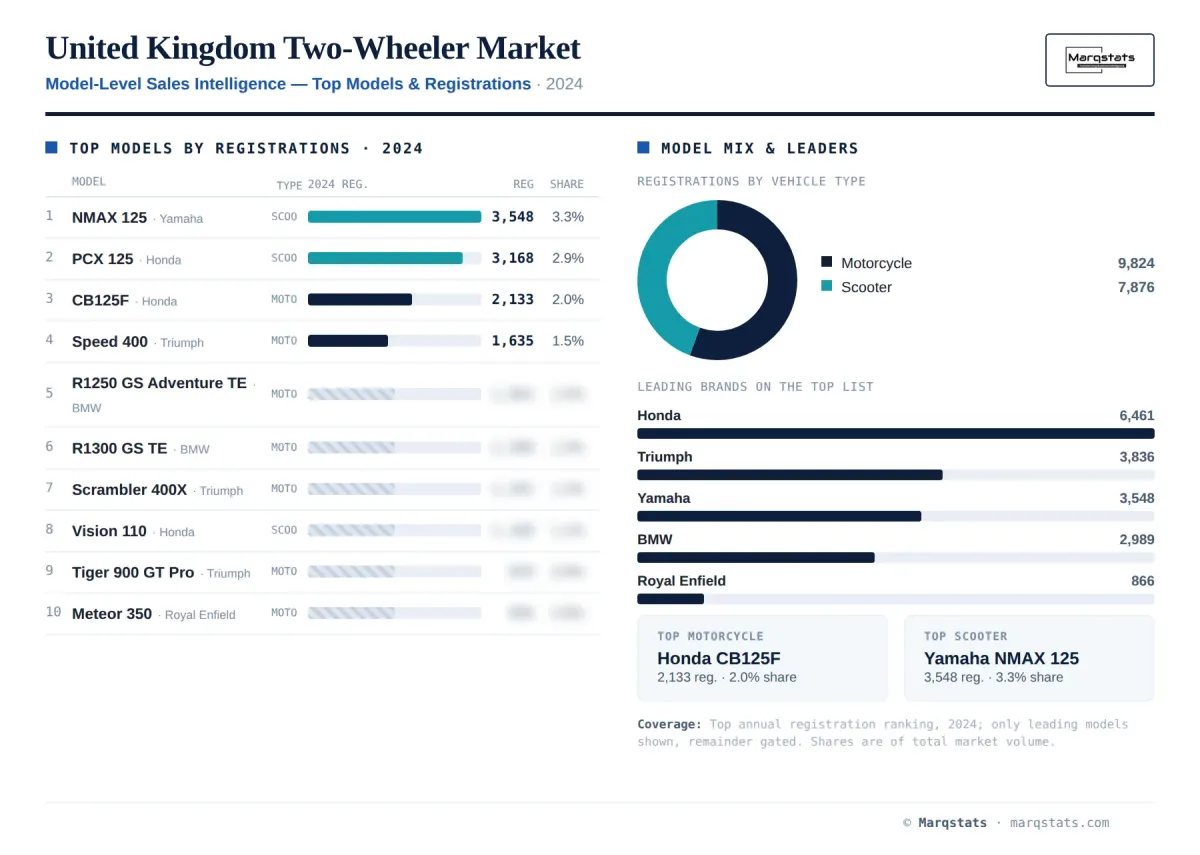
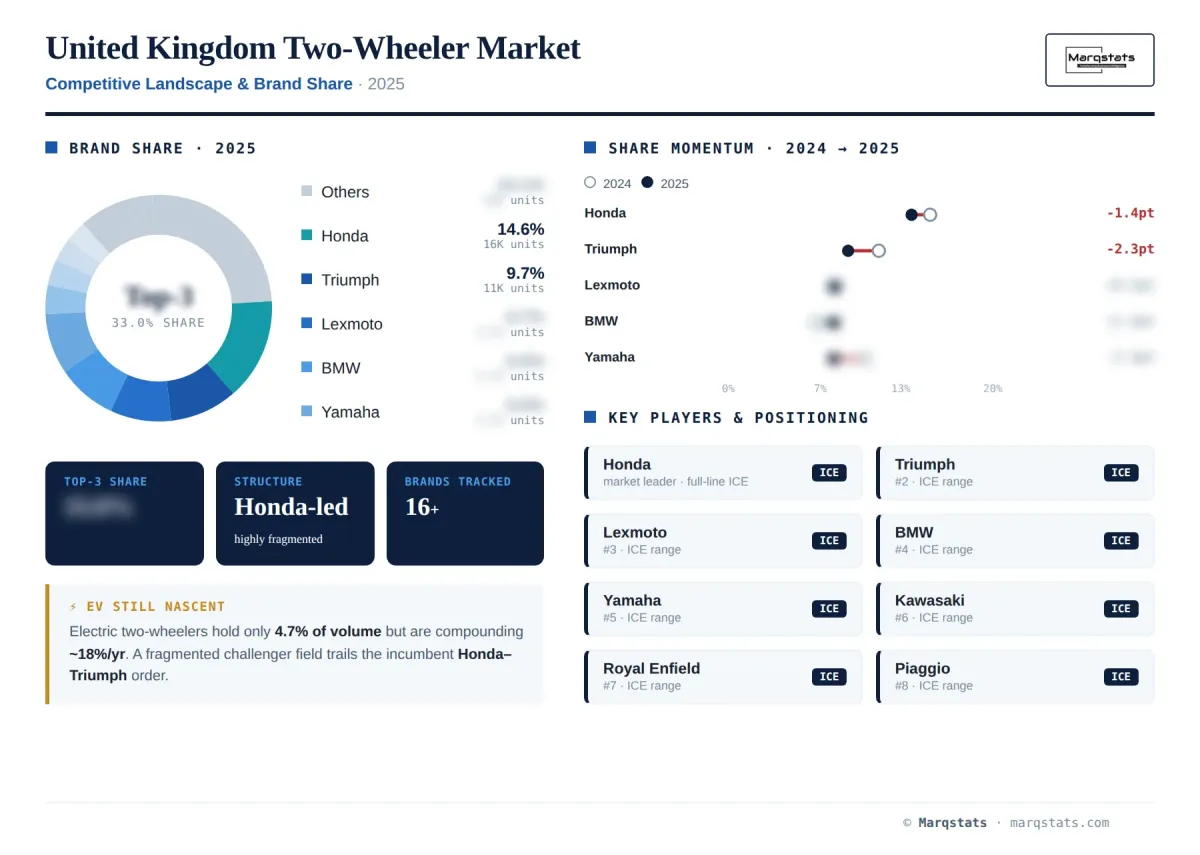
The United Kingdom two-wheeler market is moderately fragmented, without a single dominant player. Honda leads across the range, from the PCX 125 scooter to the GB350S modern classic and large tourers, followed by the British marque Triumph, whose Hinckley-built modern classics and adventure bikes hold a strong position. BMW is powerful at the premium end, led by the R 1300 GS, while Yamaha, Kawasaki, and value brand Lexmoto round out the major positions, together accounting for about half of the market.
The competitive field has shifted through the 2025 disruption. KTM and Husqvarna, both part of Pierer Mobility, saw registrations fall steeply during a financial restructuring driven by heavy debt, ceding share across sport and off-road segments. Royal Enfield has gained on the modern-classic trend, Chinese brands such as Voge and Keeway have expanded with value-priced models, and European marques including Ducati, Piaggio, and Aprilia compete in premium and scooter categories. Electric competition is small and concentrated in delivery scooters and light machines.
The surplus of pre-registered stock has reshaped competition through 2025 and into the forecast period. Large volumes of machines plated in late 2024 to beat the emissions deadline moved into the used and nearly-new market, offering buyers heavily discounted alternatives to new stock and compressing dealer margins. This overhang has pressured brands unevenly, favouring those with fresh, in-demand models such as the modern classics and hurting those reliant on older ranges, and it has accelerated dealer consolidation across the network.
Competition centres on brand, product breadth, and value in the commuter tiers, and on brand and capability at the premium end. Growth is attributed to brands that combine strong modern-classic and touring portfolios with disciplined pricing, moreover rewarding those that navigate the emissions transition and surplus stock. Honda's breadth, Triumph's British heritage, BMW's premium leadership, and the rise of value and Chinese brands together define a market in which model strength and positioning increasingly determine competitive position.
Companies Covered
The report profiles 16+ companies with full strategy and financials analysis, including:
Recent Market Activity
Table of Contents
Coverage & Segmentation
This report provides a comprehensive assessment of the United Kingdom two-wheeler market across a 2025 base year, historical data from 2021 to 2025, and forecasts spanning 2026 to 2030. Market sizing is presented in unit-volume terms and complemented by value analysis in United States dollars, with segmentation by vehicle type, propulsion type, engine displacement and motor power, price band, end user, sales channel, and brand. Brand-level shares, segment growth rates, and competitive positioning are quantified to support commercial and investment decisions.
The scope covers demand drivers, restraints, and structural trends, with particular focus on the 2025 emissions-led correction and recovery, the bimodal structure of premium and commuter demand, the modern-classic trend, high online penetration, the KTM restructuring, and the early electrification transition. An extended forecast to 2035 is available under customization for subscribers requiring a longer planning horizon, alongside deeper cuts by region, brand, or channel on request.