Market Snapshot
Key Takeaways
Market Overview & Analysis
Report Summary
The India two-wheeler market encompasses the production, sale, and aftermarket servicing of motorcycles, scooters, and mopeds across internal combustion engine (ICE) and electric propulsion platforms. The market serves a dual role in India’s mobility landscape: it is both the primary mode of personal transportation for over 200 million households and an increasingly critical tool for commercial logistics, food delivery, and ride-hailing operations. The addressable market spans the entire country, from metropolitan centres such as Mumbai, Delhi, Bengaluru, and Chennai to semi-urban corridors and rural districts where public transit coverage remains limited.
In FY 2024–25, two-wheeler domestic dispatches (SIAM) reached 19.61 million units, representing 9.1% year-on-year growth over FY 2023–24. Retail registrations (FADA) stood at 18.89 million units in FY25, rising to 21.42 million units in FY 2025–26 with 13.4% growth. The recovery has been broad-based: motorcycles grew on the back of entry-level commuter demand in rural India, while scooters outpaced the industry with approximately 17% dispatch growth in FY25, hitting an all-time high of 6.85 million units. The premiumisation trend is accelerating, with the share of motorcycles above 150cc expanding from approximately 25% in FY 2020–21 to over 30% in FY 2025–26, as urban consumers increasingly opt for performance-oriented and adventure-segment products.
India’s two-wheeler industry is also a significant contributor to the national economy, generating direct and indirect employment for over 35 million people across manufacturing, dealership networks, aftermarket services, and financing institutions. The country’s manufacturing base, concentrated in clusters around Chennai–Hosur in Tamil Nadu, Pune–Chakan in Maharashtra, Gurugram–Manesar in Haryana, and Aurangabad in Maharashtra, supports both domestic demand and a growing export franchise that exceeded 4.2 million units in FY 2024–25, registering 21.4% year-on-year growth.
Market Dynamics
Key Drivers
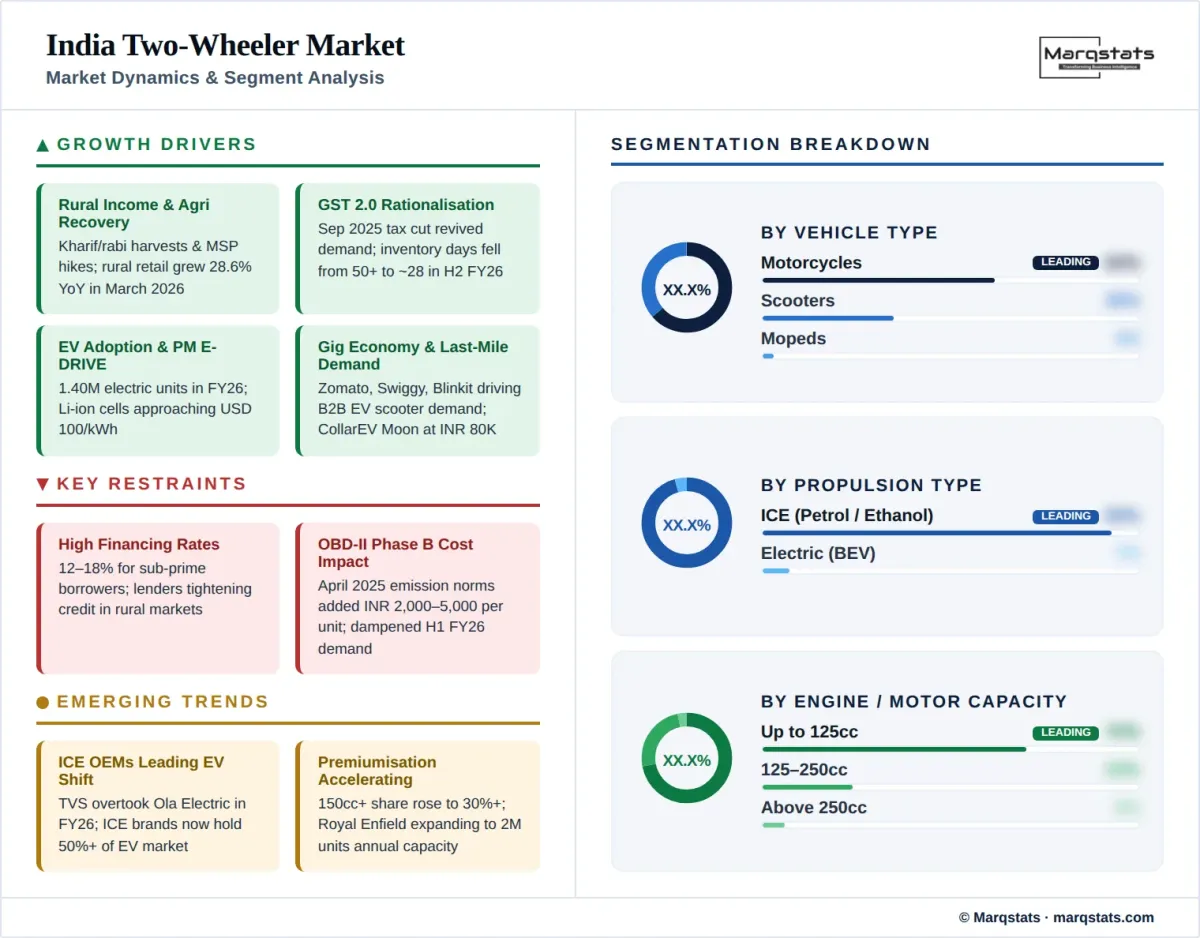
- Rising rural demand and agricultural income recovery: Strong kharif and rabi harvests, healthy reservoir levels, and rising minimum support prices have bolstered rural purchasing power. Rural two-wheeler retail grew 28.6% year-on-year in March 2026, outpacing urban growth of 28.8%, according to FADA. Entry-level motorcycles in the 100–110cc segment remain the preferred mobility solution in agrarian districts.
- GST rationalisation restoring affordability: The implementation of GST 2.0 in September 2025 reduced the effective tax rate on petrol two-wheelers, leading to immediate price reductions across models. FADA data shows that two-wheeler retail growth accelerated from low single digits in H1 FY26 to double digits in H2 FY26, with inventory days falling from over 50 to approximately 28 days, indicating healthy sell-through.
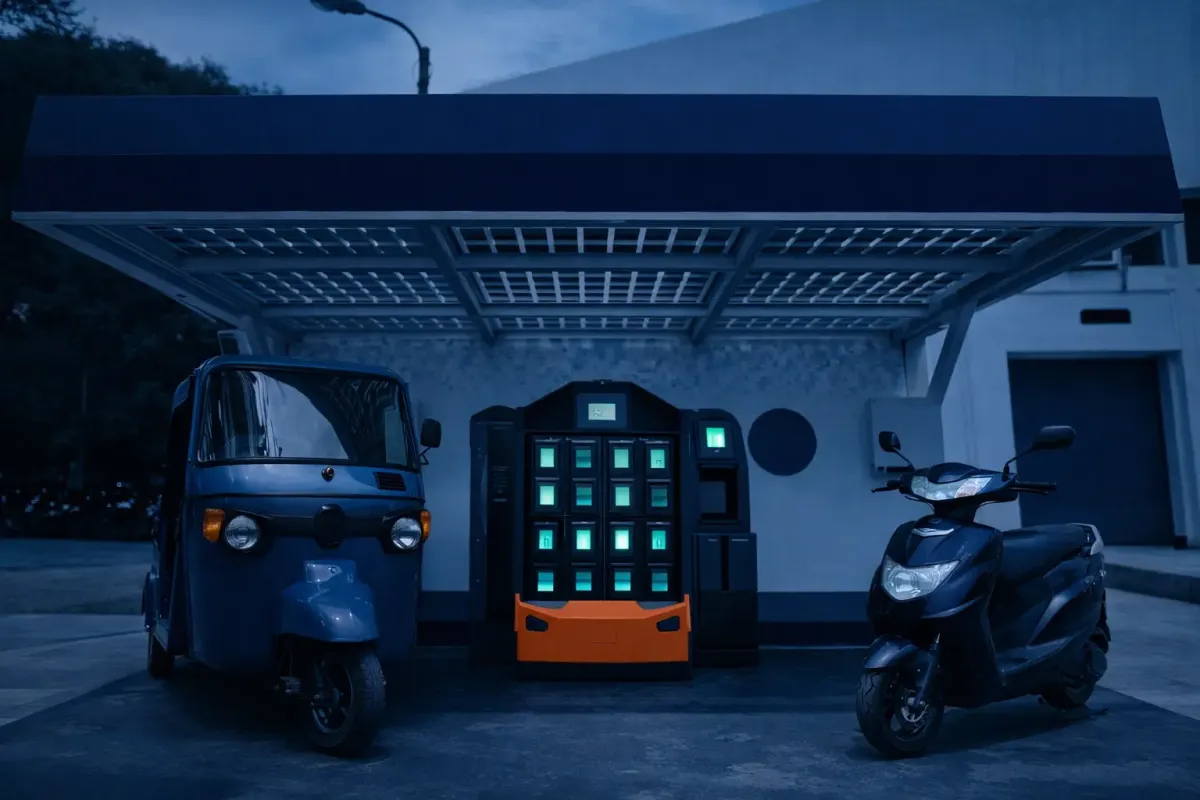
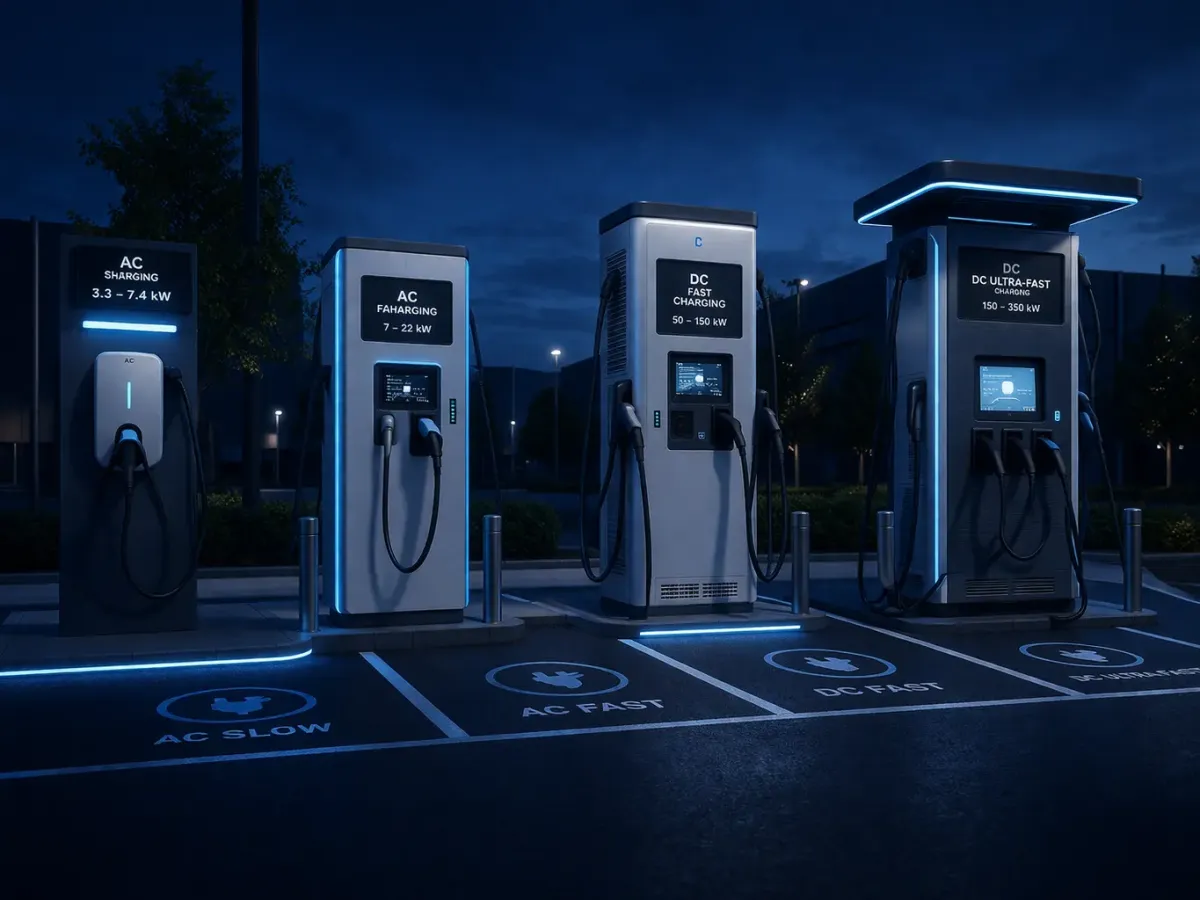
- Electric two-wheeler adoption gaining structural momentum: Government subsidies under PM E-DRIVE, declining lithium-ion battery prices (now approaching USD 100 per kWh at the cell level), expanding charging and battery-swapping infrastructure, and entry of legacy ICE OEMs have collectively pushed electric two-wheeler sales past 1.40 million units in FY 2025–26. The total cost of ownership for electric scooters is now competitive with petrol scooters in urban use cases.
- Expanding gig economy and last-mile logistics: The rapid growth of food delivery platforms (Zomato, Swiggy), quick commerce operators (Blinkit, Zepto, Instamart), and ride-hailing services has created sustained B2B demand for both ICE and electric two-wheelers. Purpose-built commercial electric scooters, such as the CollarEV Moon launched at INR 80,000, are targeting this segment directly.
- Premiumisation and lifestyle aspiration: The share of motorcycles above 125cc is rising steadily as urban consumers trade up from commuter to executive and premium segments. Royal Enfield’s expansion to 2 million units of annual capacity, and the growing traction of 200–400cc motorcycles from TVS, Bajaj, and KTM, reflect this structural shift toward higher-value products.
Key Restraints
- High interest rates and financing constraints: Despite the RBI’s cumulative 100 basis point rate cut since February 2025, two-wheeler financing rates remain elevated at 12–18% for sub-prime borrowers. Rising delinquencies in the entry-level motorcycle segment have prompted lenders to tighten credit standards, particularly in rural and semi-urban markets.
- OBD-II Phase B emission norms increasing costs: The mandatory transition to OBD-II Phase B (real-time emission diagnostics) effective April 2025 has increased vehicle prices by INR 2,000–5,000 per unit, compressing demand in the price-sensitive commuter segment during H1 FY 2025–26.
- Subsidy reduction for electric two-wheelers: The Ministry of Heavy Industries halved the PM E-DRIVE incentive for electric two-wheelers from INR 5,000/kWh (capped at INR 10,000) to INR 2,500/kWh (capped at INR 5,000) effective April 2025, with a terminal date of July 2026 for subsidy claims. This reduction, coupled with the limited commissioning of only 1 GWh out of 40 GWh awarded under the PLI-ACC battery scheme, may moderate the pace of electrification in the near term.
- Geopolitical disruptions affecting supply chains: The ongoing West Asia conflict has caused supply and dispatch disruptions for 53.2% of dealers (FADA survey, March 2026), with 17.1% reporting significant delays of three or more weeks, particularly in the commercial vehicle and select two-wheeler variant segments.
Key Trends
- ICE OEMs dominating the electric segment: The competitive landscape of the electric two-wheeler market has undergone a decisive shift. In FY 2025–26, TVS Motor Company emerged as the largest electric two-wheeler seller with 341,513 retail units, overtaking Ola Electric, whose volumes fell 52.3% to 164,295 units. Bajaj Auto and Hero MotoCorp also expanded their electric portfolios aggressively. Established ICE brands now command over 50% of the electric two-wheeler market by volume, displacing the startup-led growth phase.
- CNG two-wheelers as an emerging propulsion alternative: CNG-powered two-wheelers entered the market in FY 2025–26, achieving a marginal 0.16% share of total retail volumes. While nascent, CNG offers a middle-ground proposition between ICE and electric for cost-conscious consumers in regions with established CNG distribution infrastructure.
- State-level policy divergence shaping adoption patterns: Electric two-wheeler adoption varies significantly by state. Maharashtra led with 212,040 registrations in FY 2024–25, followed by Karnataka (148,462) and Tamil Nadu (118,837). However, northern and eastern states such as Uttar Pradesh (91.8% growth), Punjab (131.1% growth), and West Bengal (72.6% growth) are emerging as the next wave of adoption, driven by state-level EV policies and improving charging infrastructure.
- Connected and software-defined vehicles: OEMs are increasingly integrating telematics, real-time diagnostics, AI-based battery management, and over-the-air (OTA) update capabilities into two-wheelers. Matter Energy’s partnership with Iontra for adaptive battery intelligence and Hero MotoCorp’s category-swapping Surge S32 platform illustrate the shift toward software-defined vehicle architectures.
Market Segmentation
Motorcycles account for approximately 62% of India’s total two-wheeler domestic dispatches and remain the dominant vehicle type across rural and semi-urban markets. In FY 2024–25, motorcycle dispatches reached 12.25 million units, growing 5.1% year-on-year. Entry-level motorcycles (up to 110cc) held a 72% share of the motorcycle segment, though this share has declined from 75% in FY 2018–19 as consumers increasingly upgrade to 125cc and above. Hero MotoCorp dominates the motorcycle segment with models such as the Splendor, HF Deluxe, and Glamour, while Bajaj Auto leads in the 125–200cc executive and sports commuter segments. The premium motorcycle category (above 250cc), led by Royal Enfield, continues to grow at approximately 10% annually, driven by aspirational urban buyers.
Scooters are the fastest-growing vehicle type in the Indian two-wheeler market, with domestic dispatches reaching an all-time high of 6.85 million units in FY 2024–25, representing approximately 17% year-on-year growth. Scooter share of total two-wheeler volumes has expanded from 32% in FY 2023–24 to 35% in FY 2024–25. Honda Motorcycle & Scooter India leads the segment with the Activa platform, though its share has declined from over 50% to approximately 39% in H1 FY 2025–26 as TVS (29% share, up from 26%), Suzuki (15% share), and electric scooter OEMs capture volume. The convergence of rising female ridership, automatic transmission preference in congested urban traffic, and the suitability of the scooter form factor for electric powertrains are driving structural growth.
Mopeds account for a small and declining share of the overall market, primarily concentrated in the southern Indian states of Tamil Nadu and Kerala. TVS Motor Company’s XL100 remains the dominant moped platform, serving low-income rural consumers and light-duty commercial applications. The moped segment is expected to continue shrinking as entry-level electric scooters become increasingly competitive on total cost of ownership.
ICE-powered two-wheelers accounted for 93.30% of total retail volumes in FY 2025–26, with petrol and ethanol-blended fuel as the primary energy source. While ICE remains overwhelmingly dominant, its share has declined from approximately 95% in FY 2022–23 as electric and CNG alternatives gain traction. The transition to OBD-II Phase B emission norms in April 2025 has improved the environmental performance of ICE two-wheelers but has also increased per-unit costs, pushing some price-sensitive buyers toward electric alternatives or delaying purchase decisions.
The electric two-wheeler segment recorded retail sales of 1,401,818 units in FY 2025–26, growing 21.8% year-on-year from 1,150,790 units in FY 2024–25. Electric penetration rose to 6.54% from 6.09%. TVS Motor led the segment with 341,513 units (24.4% market share), followed by Bajaj Auto with 283,723 units, Ather Energy with 239,178 units (82.3% growth), and Hero MotoCorp with 174,083 units (196.1% growth). Ola Electric, the previous market leader, saw volumes decline 52.3% to 164,295 units due to quality and service issues. Electric scooters dominate the electric segment with over 85% share, while electric motorcycles are emerging as the next growth frontier with brands such as Ultraviolette, Revolt, and Matter Energy expanding their portfolios.
The up-to-125cc segment, encompassing commuter motorcycles and standard scooters, accounts for over 70% of total two-wheeler volumes and is the backbone of the Indian market. The 100–110cc motorcycle sub-segment, dominated by Hero MotoCorp’s Splendor and Honda’s Shine platforms, serves rural and semi-urban commuters who prioritise fuel efficiency and low maintenance costs. The 110–125cc sub-segment is the fastest-growing within this category, benefiting from the upsizing trend as consumers trade up from 100cc models to products offering better performance and features.
The 125–250cc segment has grown at approximately 12% year-on-year, driven by executive commuter motorcycles, premium scooters, and entry-level performance motorcycles. Key models in this segment include the Bajaj Pulsar series, TVS Apache RTR 160 and 200, Honda CB Hornet, and the Suzuki Access 125 scooter. This segment benefits from urbanisation, rising aspirational demand, and the willingness of younger consumers to pay a premium for features such as disc brakes, digital instrumentation, and Bluetooth connectivity.
The above-250cc premium segment, though small at approximately 5–6% of total volumes, commands disproportionately high value share due to elevated average selling prices. Royal Enfield dominates this segment with its Classic, Meteor, Hunter, and Himalayan platforms, with capacity expansion to 2 million units annually approved in February 2026. Other notable players include KTM (through Bajaj Auto’s partnership), Triumph (manufactured in India through a Bajaj joint venture), TVS (Apache RR 310), and Yamaha. Export potential for premium motorcycles is significant, with Royal Enfield and TVS both expanding international distribution.
By Geography
Western and Central India
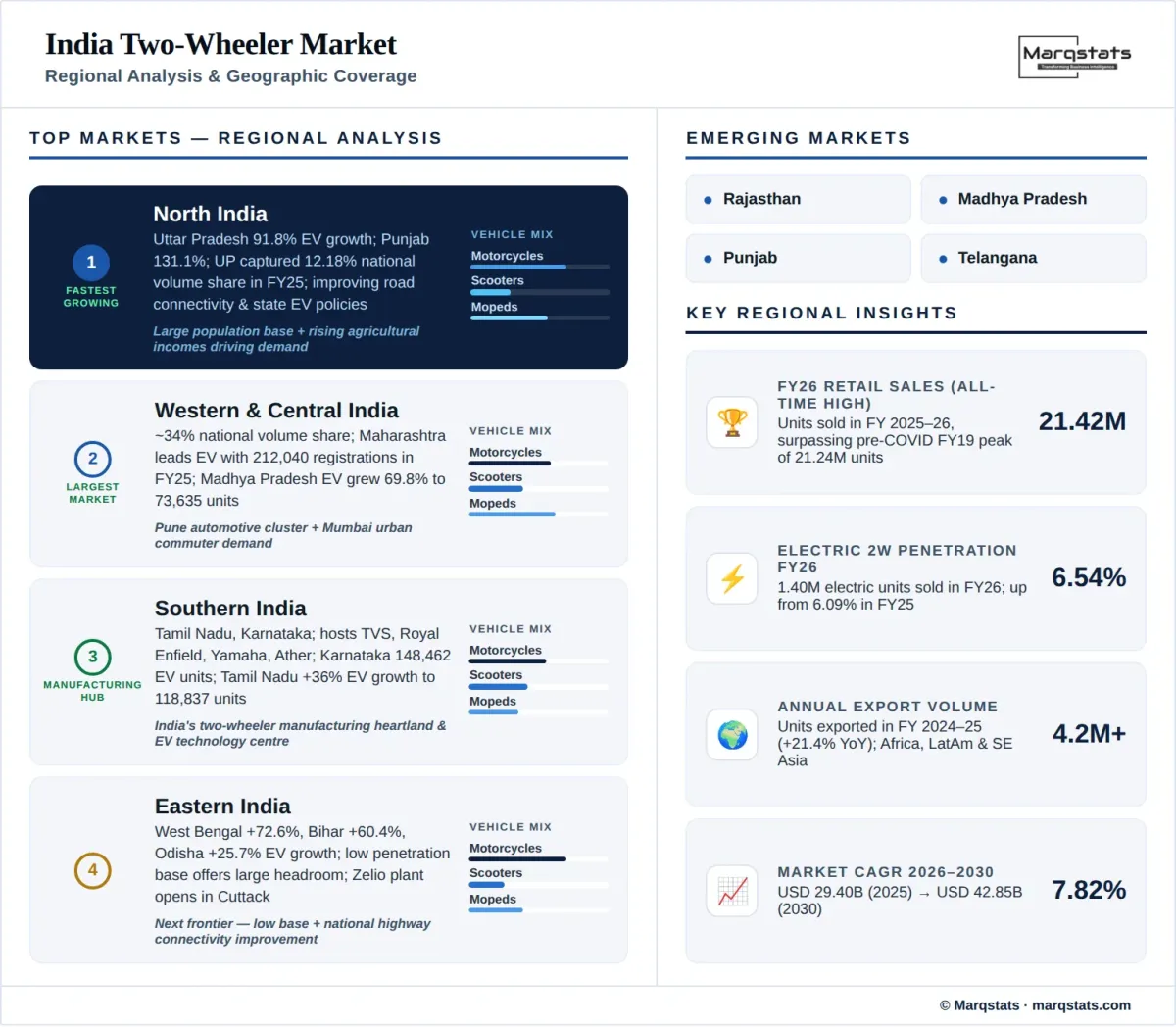
Western and Central India, led by Maharashtra, Gujarat, and Madhya Pradesh, accounts for approximately 34% of the national two-wheeler market by volume. Maharashtra is the largest single-state market for electric two-wheelers, with 212,040 registrations in FY 2024–25, driven by Pune’s automotive manufacturing cluster and Mumbai’s urban commuter demand. Gujarat, traditionally a strong scooter market, registered 58,438 electric two-wheeler units despite a 24.2% year-on-year decline, reflecting subsidy transition challenges. Madhya Pradesh showed strong recovery with 69.8% growth in electric two-wheeler registrations, reaching 73,635 units.
Southern India
Southern India, comprising Tamil Nadu, Karnataka, Kerala, Telangana, and Andhra Pradesh, is the manufacturing heartland of the Indian two-wheeler industry and a leading adopter of electric mobility. Tamil Nadu hosts production facilities of TVS Motor, Royal Enfield, Yamaha, and Ather Energy, and recorded 36% growth in electric two-wheeler registrations to 118,837 units in FY25. Karnataka, home to Ather Energy and Ultraviolette Automotive, registered 148,462 units but saw a marginal 1.1% decline as base effects normalised. Telangana, previously a leading EV market, experienced a sharp 31.8% decline to 60,351 units, attributed to changes in state-level subsidy structures.
Northern India
Northern India, led by Uttar Pradesh, Rajasthan, Delhi-NCR, Punjab, and Haryana, is emerging as the fastest-growing region for two-wheeler demand. Uttar Pradesh, India’s most populous state, recorded electric two-wheeler registrations of 102,799 units in FY25, a remarkable 91.8% year-on-year growth, and captured 12.18% of the national two-wheeler market by volume. Punjab demonstrated the highest percentage growth among major states at 131.1%, reaching 23,347 units. Delhi-NCR, despite its mature market status, saw a 28.8% decline in electric registrations to 27,247 units, partly attributed to regulatory changes. The region’s growth is underpinned by a large population base, improving road connectivity, rising agricultural incomes, and progressive state-level EV policies.
Eastern India
Eastern India, comprising West Bengal, Odisha, Bihar, and the northeastern states, represents the next frontier for two-wheeler market expansion. West Bengal recorded 72.6% growth in electric two-wheeler registrations to 24,152 units in FY25, while Odisha grew 25.7% to 55,996 units. Bihar also posted strong growth at 60.4%, reaching 23,064 units. The region benefits from a low two-wheeler penetration base, improving connectivity under national highway programmes, and the establishment of manufacturing facilities such as Zelio E-Mobility’s new plant in Cuttack, Odisha, which adds 60,000 units of annual electric two-wheeler capacity.
How Competition Is Evolving
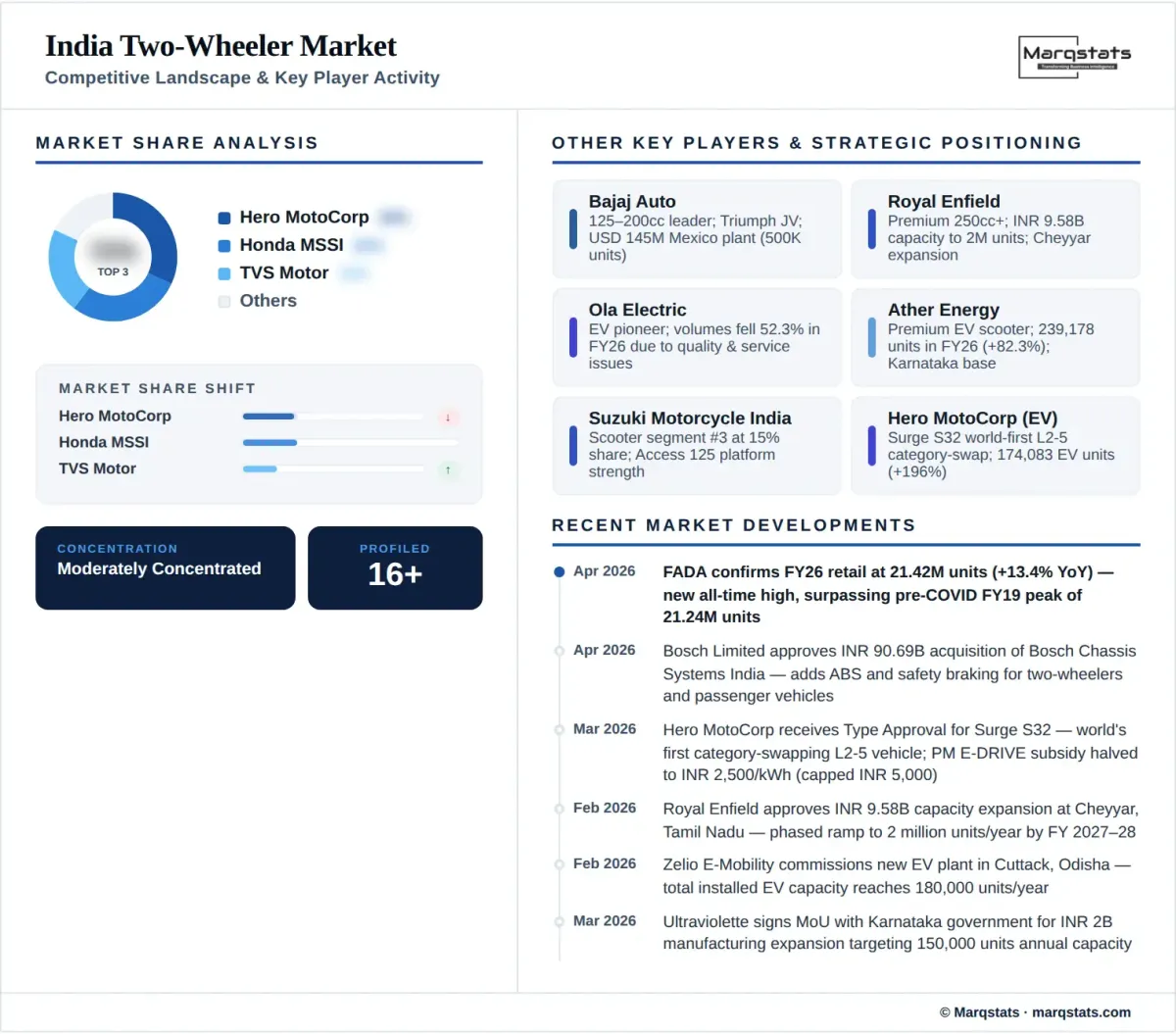
The India two-wheeler market is moderately concentrated, with the top five manufacturers—Hero MotoCorp, Honda Motorcycle & Scooter India, TVS Motor Company, Bajaj Auto, and Suzuki Motorcycle India—collectively accounting for over 90% of total retail volumes in FY 2025–26. Hero MotoCorp retained its market leadership with 6.08 million retail units and 28.40% market share, though its share has declined by approximately 1.5 percentage points year-on-year as TVS Motor and other competitors gained ground. Honda followed with 5.36 million units (approximately 25% share), while TVS delivered the strongest growth among major OEMs at 22.5%, reaching 4.05 million units.
The competitive dynamics are shifting along two axes. First, the scooter segment is intensifying as Honda’s long-standing dominance is being challenged by TVS and Suzuki, with electric scooter OEMs now commanding approximately 12% of the overall scooter market. Second, the electric two-wheeler segment has witnessed a dramatic reordering: TVS has overtaken Ola Electric as the volume leader, while Bajaj, Ather, and Hero MotoCorp have all more than doubled their electric portfolios. Ola Electric’s 52.3% volume decline in FY26 underscores the importance of after-sales quality and service network depth in sustaining market position.
Strategic activity in the market includes Royal Enfield’s INR 9.58 billion capacity expansion at its Cheyyar plant (brownfield, phased ramp-up to 2 million units by FY 2027–28), Bajaj Auto’s USD 145 million motorcycle assembly plant in Mexico’s Toluca Valley (500,000 units annual capacity), TVS Motor’s re-entry into South Africa through a distribution partnership with the Bidvest-backed Nexus Collective, and Ultraviolette Automotive’s INR 2 billion manufacturing expansion in Karnataka. On the component and technology side, Bosch Limited’s INR 90.69 billion acquisition of Bosch Chassis Systems India and NOVELIC’s establishment of an India unit for ADAS and two-wheeler radar reflect the deepening sophistication of the supply chain.
Companies Covered
The report profiles 16+ companies with full strategy and financials analysis, including:
Recent Market Activity
Table of Contents
Coverage & Segmentation
This report provides a comprehensive analysis of the India two-wheeler market covering the historical period 2021–2025 and forecast period 2026–2030, with 2025 as the base year. The study examines market size and growth in both value (USD billion) and volume (million units) terms, covering domestic sales, production, and export dynamics. The market is segmented by vehicle type (motorcycles, scooters, mopeds), propulsion (ICE, electric), engine capacity/motor power, and geography (state-level analysis covering all major states and union territories). The competitive landscape section profiles 16 leading manufacturers with analysis of market share, strategic initiatives, product portfolios, and recent developments.
Primary research includes structured interviews with 40+ industry stakeholders spanning OEM executives, component manufacturers, dealership networks, fleet operators, charging infrastructure providers, and policy analysts. Secondary research draws from government databases (SIAM, FADA, VAHAN, MoRTH, Ministry of Heavy Industries), industry body publications, company annual reports and stock exchange filings, patent databases, and trade publications. All market estimates represent Marqstats Intelligence proprietary calculations based on a bottom-up methodology validated against top-down industry benchmarks.