Market Snapshot
Key Takeaways
Market Overview & Analysis
Report Summary
The Italy two-wheeler market comprises motorcycles, scooters, and mopeds sold for personal and commercial use across internal combustion and electric propulsion. This study segments demand by vehicle type, propulsion type, engine displacement and motor power, price band, end user, sales channel, and brand, with a 2025 base year, historical coverage from 2021 to 2025, and forecasts to 2030. Italy is Europe's largest and most production-intensive two-wheeler market, combining a mass urban scooter culture with a premium motorcycle industry.
The 2025 result reflects a two-speed market. According to registration data from the national cycle and motorcycle association, scooters grew while motorcycles fell sharply, as a late-2024 pre-registration surge ahead of the Euro 5+ standard pulled demand forward. Reported through industry association data, the overall market declined about 8% in 2025, a milder correction than in other major European markets, underlining the resilience of Italy's urban scooter demand. In this study's segmentation, scooters are grouped within the motorcycle vehicle type, so the urban scooter core is most visible in the dominant 125cc displacement class.
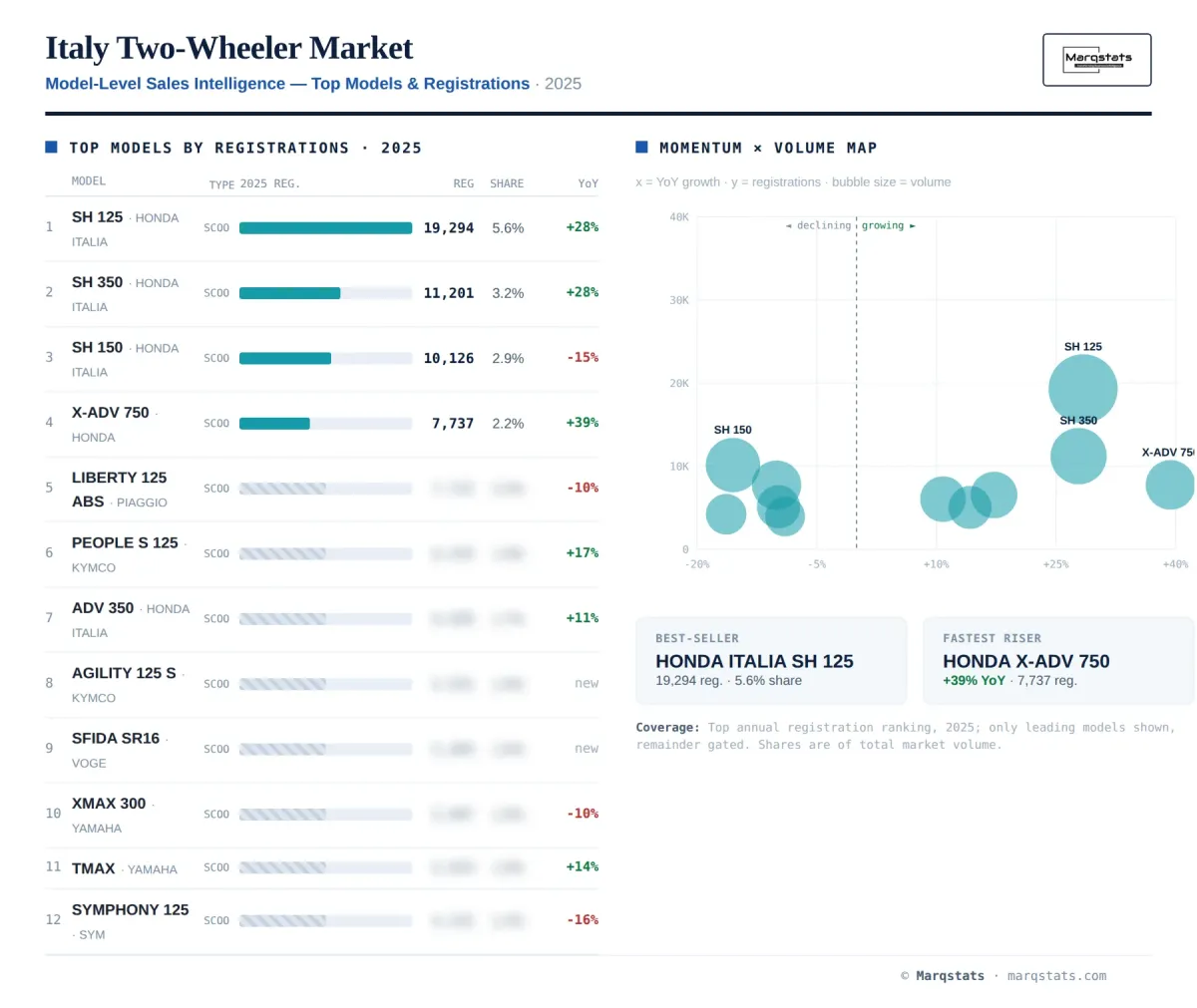
Supply is led by Honda, which gained share through the downturn, followed by the domestic Piaggio Group, home of Vespa, Aprilia, Moto Guzzi, and Gilera, and by Yamaha. Kymco, SYM, and the Italian marque Benelli hold strong positions in scooters and mid motorcycles, while Ducati and Fantic Motor anchor premium and specialist demand. Chinese brands including Voge, CFMoto, QJ Motor, and Zontes have surged, and KTM fell steeply during its parent's financial restructuring. Electric two-wheelers hold a small share concentrated in scooters and light machines.
Italy's position as the home of a major two-wheeler industry shapes the market. The country is Europe's largest producer of motorcycles and scooters, and the Piaggio Group, which invented the Vespa, remains a cornerstone of both domestic supply and national identity. Premium marques such as Ducati and Aprilia carry Italian engineering and racing heritage, while Benelli and Fantic Motor add mid-range and specialist depth. This industrial base gives Italy a distinctive market in which domestic brands compete alongside global Japanese, European, and increasingly Chinese manufacturers across every price tier.
Market Dynamics
Key Drivers
- Resilient urban scooter demand drives the market, as scooters and 125cc machines remain central to commuting in congested cities.
- A strong domestic industry supports the market, with Piaggio, Ducati, Aprilia, Benelli, and Fantic anchoring production and brand heritage.
- Premiumisation lifts value, as large-displacement and premium machines command high prices and grow revenue faster than volume.
- Recovery from the emissions-led correction supports growth, as demand normalises from the 2025 low through 2030.
Key Restraints
- Economic weakness and inflation weigh on demand, particularly for higher-value motorcycles.
- The Euro 5+ transition raised compliance costs and pulled demand into 2024, depressing 2025 registrations.
- Volatile and limited electric incentives keep electric adoption low despite the market's scale.
Key Trends
- Chinese brands surge, as Voge, CFMoto, QJ Motor, and Zontes expand rapidly; the global electric ATV and UTV market reflects the wider globalisation of powered-vehicle supply.
- Scooters outperform motorcycles, growing while larger machines correct, reinforcing the market's urban-mobility character.
- Online retail expands rapidly at a 23% CAGR, complementing dealers for research, accessories, and increasingly complete purchases.
- Electric grows fastest in percentage terms from a small base, concentrated in scooters and light urban machines.
Market Segmentation
In this study's taxonomy, motorcycles account for about 96% of 2025 volume, roughly 332,000 units, a figure that includes the scooters grouped within the category. On a standalone real-world basis, scooters are Italy's largest vehicle category, and they proved resilient in 2025 while larger motorcycles corrected. Motorcycles and scooters together span urban commuters, mid-displacement machines, and premium models, and the category concentrates heavily in the 125cc class. Industry registration data underlines the divergence within the category: scooters grew in 2025 while motorbikes fell sharply, so the headline category masks a two-speed market in which urban scooter demand offset the decline in larger motorcycles.
The standalone scooter and moped line, largely mopeds under 50cc, accounts for about 14,000 units in 2025, roughly 4% of volume, growing at a 10.44% CAGR. Mopeds have declined structurally, while scooters, counted within the motorcycle category here, remain the market's real growth driver, central to short urban trips and delivery.
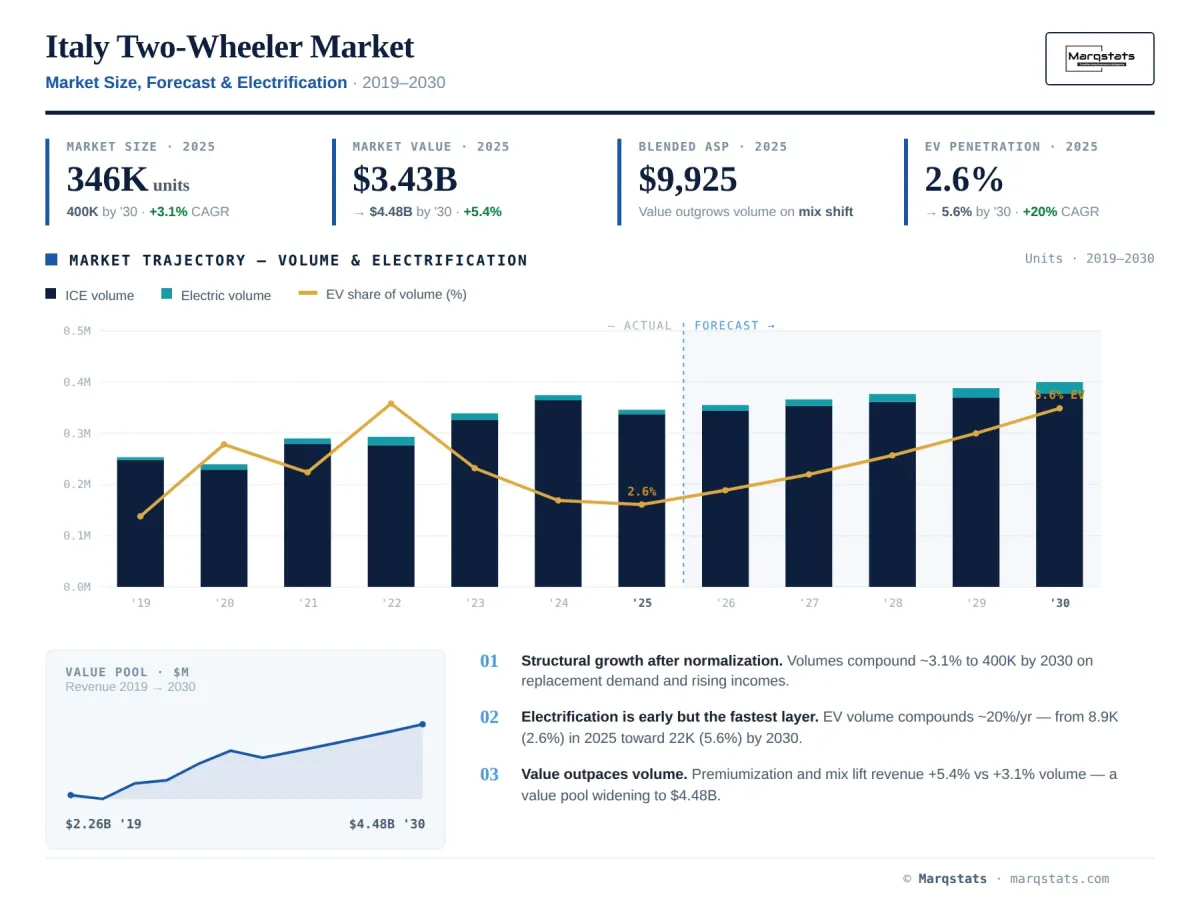
Combustion models hold about 97% of 2025 volume, roughly 337,000 units, growing at a 2% CAGR from the 2025 low. Combustion remains dominant across scooter, commuter, mid, and premium classes, now built to the Euro 5+ standard, and it continues to define the urban and premium machines at the heart of the market. With electric adoption held back by inconsistent incentives, combustion is set to remain overwhelmingly dominant throughout the forecast period, particularly in the scooter and premium segments that anchor Italian demand.
Electric two-wheelers hold about 3% of 2025 volume, roughly 9,000 units, growing fastest at a 20.20% CAGR to reach about 22,000 units by 2030. Adoption is concentrated in scooters and light urban machines. Electric penetration is lower than in France or Germany and declined in 2025 amid volatile incentives, so the pace of growth depends heavily on policy support and urban low-emission requirements over the forecast period. Despite Italy's large urban scooter base, which is well suited to electrification, the absence of stable purchase incentives has held back adoption, and the segment's recovery will hinge on policy consistency and the pricing of new electric scooter models.
The 111–125cc class is the largest displacement segment at about 36% of 2025 volume, roughly 126,000 units. This class captures the scooters and small motorcycles that dominate urban commuting in Rome, Milan, and Naples, accessible to a broad base of riders, and it is the clearest expression of Italy's mass two-wheeler mobility culture, one of the deepest in Europe. The prevalence of narrow streets, dense historic centres, and limited parking makes the 125cc scooter a practical everyday vehicle for millions of Italians, and this class proved the most resilient through the 2025 correction, underpinning the market's stability relative to the rest of Europe.
Machines above 350cc account for about 26% of volume and generate the largest share of value, though the segment is broadly flat as premium demand consolidates around fewer high-value models. The 251–350cc class is notably large at about 19%, reflecting Italy's appetite for maxi-scooters and mid-large machines, while smaller mid displacements add steady volume. The strength of the 251–350cc band is distinctive, driven by the popularity of large-wheel and maxi-scooters for commuting and touring, a category in which Italian and Japanese brands both compete strongly, and it sits between the mass 125cc class and the premium large-displacement machines.
The mid segment is the largest price band by volume at about 32%, with the entry and mass band close behind at about 30%. Together these bands anchor unit volumes, driven by scooters and commuter machines, and include much of the 125cc market that defines urban demand. It is precisely in these mid and entry tiers that the rising Chinese brands are competing most aggressively on price and equipment, intensifying pressure on established scooter and commuter marques across the domestic market.
Premium and high-premium performance bands together account for about 38% of volume and the majority of value. The high-premium and performance band, though about 15% of units, contributes a far larger share of revenue on the strength of large machines from brands such as Ducati, and premium demand grows steadily as buyers favour higher-value models.
Private consumers account for about 83% of 2025 volume, the core of a market weighted toward personal mobility. Ownership spans urban commuters on scooters and 125cc machines, mid and premium motorcycle riders, and enthusiasts drawn to the domestic marques.
Commercial demand is meaningful and led by delivery. Delivery and logistics accounts for over a tenth of volume, supported by urban food-delivery platforms, while rental and tourism grows fastest among commercial users, supported by Italy's strong scooter-tourism market. This delivery base is an early adopter of electric scooters. Italy's exceptional tourism draw sustains a large scooter and Vespa rental sector across cities and coastal areas, adding a distinctive seasonal layer of commercial demand that few other European markets match.
The online channel reaches about 20% of 2025 sales and grows fastest at a 23% CAGR. Buyers research, configure, finance, and increasingly transact online, and the channel complements the dealer network, particularly for accessories, used machines, and pre-purchase research on the growing range of value and Chinese models.
Franchised dealerships remain central to premium sales and after-sales service, though the channel's share is declining as digital retail expands. Dealers managed a difficult 2025, clearing surplus pre-registered stock that pressured margins across the network.
By Geography
Lombardy & Northern Italy
Lombardy, centred on Milan, records the highest two-wheeler registrations in Italy, combining dense urban commuting with the industrial and economic weight of the north. The region concentrates scooter, commuter, and premium demand, and its cities sustain strong year-round two-wheeler use. Milan's congestion charging and low-emission requirements steer demand toward compact scooters and cleaner machines, while the region's affluence supports premium and mid-displacement motorcycle sales, making Lombardy both the largest and most diverse regional market.
Lazio & Central Italy (Rome)
Lazio, centred on Rome, is a major market where scooters are a mainstream mobility choice through the capital's congested streets. The region combines heavy commuter scooter demand with a substantial tourism-driven rental market across the historic city centre. Rome's dense traffic, limited parking, and cobbled streets make the scooter the practical choice for daily mobility, and the city's role as a global tourist destination sustains a large scooter and Vespa rental market that adds seasonal demand on top of the resident commuter base.
Campania & Southern Italy
Campania, centred on Naples, and the wider south sustain dense urban scooter use, with two-wheelers essential for navigating narrow streets and traffic. Demand concentrates in scooters and 125cc machines, and the south is a core market for affordable urban mobility. In Naples in particular, the scooter is a defining feature of daily life, and the region's high reliance on two-wheelers for commuting, family transport, and small-scale commerce makes it one of Italy's most scooter-intensive markets, weighted toward value and entry price bands.
Northeast & Tuscany
The northeast, including Emilia-Romagna and the Veneto, is home to Ducati in Bologna and a strong motorcycling culture, while Tuscany combines urban and touring demand. These regions support premium, mid, and touring machines alongside urban scooters. Emilia-Romagna, often called Italy's Motor Valley, concentrates motorcycle engineering, racing heritage, and enthusiast demand, and together with Tuscany's mix of cities and scenic touring roads it forms a core market for premium and mid-displacement machines that complements the scooter-led demand of the larger urban regions.
How Competition Is Evolving
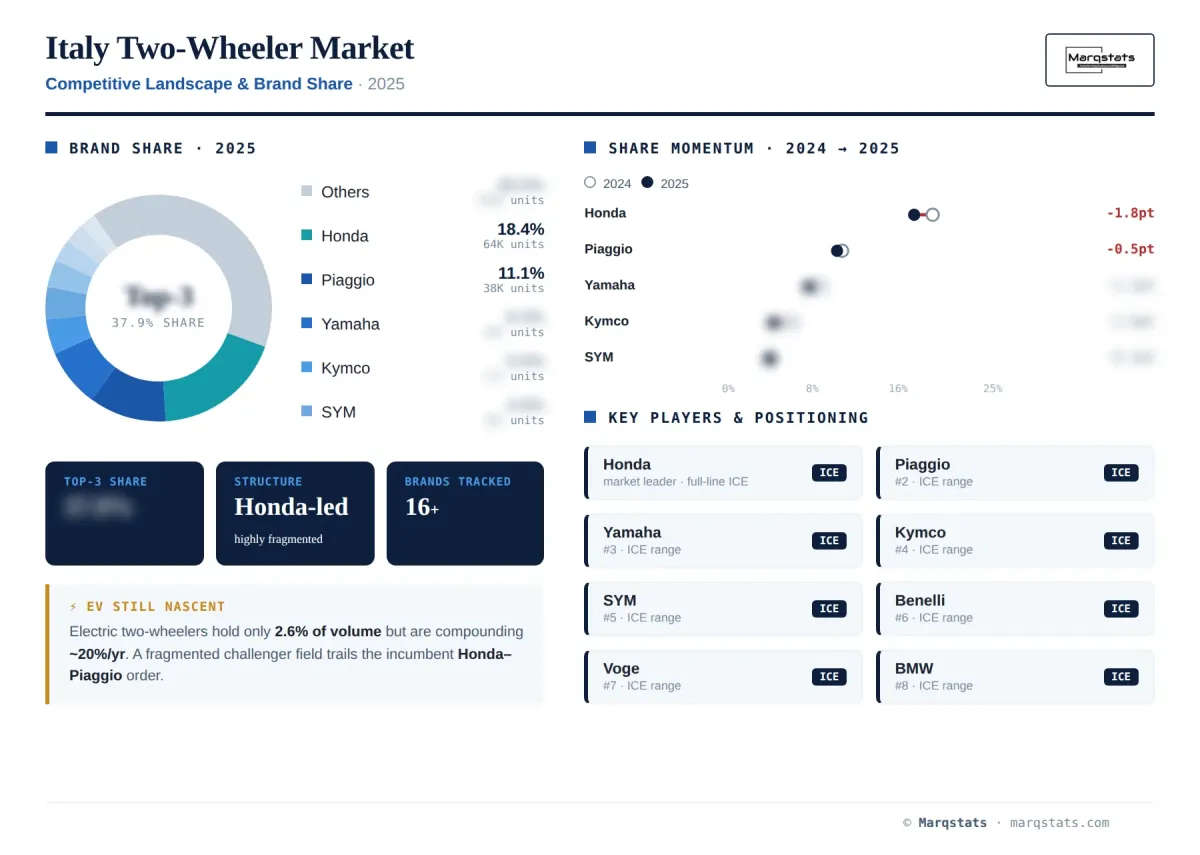
The Italy two-wheeler market is moderately fragmented, without a single dominant player. Honda leads across scooters and motorcycles and gained share through the downturn, followed by the domestic Piaggio Group, home of Vespa, Aprilia, Moto Guzzi, and Gilera, and by Yamaha. Kymco and SYM are strong in scooters, and together the market's largest brands account for under half of the market, leaving a substantial and shifting field of specialist and imported marques.
The competitive field is shifting faster in Italy than in any other major European market. Chinese brands have surged, with Voge, CFMoto, QJ Motor, and Zontes all posting sharp growth and collectively displacing established players in the mid and 125cc segments. The Italian marques Benelli, now part of a Chinese group, Fantic Motor, and Ducati compete across value and premium tiers, Royal Enfield has gained on the modern-classic trend, and KTM fell steeply during its parent Pierer Mobility's financial restructuring. Electric competition is small and concentrated in scooters and light machines.
The scale of the Chinese advance is the defining recent development. Voge, backed by Loncin, roughly doubled its volume into 2025, while Zontes, QJ Motor, and CFMoto each grew at rates well above the market, offering well-equipped machines at competitive prices that appeal to value-conscious and younger riders. Several of these brands now outsell established European names in unit terms, and their momentum has pressured incumbents to sharpen pricing and refresh model ranges. This rebalancing is most intense in the mid-displacement and 125cc segments, and it is expected to continue reshaping the competitive order through the forecast period.
Competition centres on value and product breadth in the scooter and commuter tiers, and on brand and capability at the premium end. Growth is attributed to brands that combine strong scooter and mid portfolios with disciplined pricing, moreover rewarding those that navigate the emissions transition and intensifying Chinese competition. Honda's breadth, Piaggio's domestic heritage, the surge of Chinese brands, and the strength of the premium Italian marques together define a market in which value and brand increasingly determine competitive position.
Companies Covered
The report profiles 16+ companies with full strategy and financials analysis, including:
Recent Market Activity
Table of Contents
Coverage & Segmentation
This report provides a comprehensive assessment of the Italy two-wheeler market across a 2025 base year, historical data from 2021 to 2025, and forecasts spanning 2026 to 2030. Market sizing is presented in unit-volume terms and complemented by value analysis in United States dollars, with segmentation by vehicle type, propulsion type, engine displacement and motor power, price band, end user, sales channel, and brand. Brand-level shares, segment growth rates, and competitive positioning are quantified to support commercial and investment decisions in Europe's largest two-wheeler market.
The scope covers demand drivers, restraints, and structural trends, with particular focus on the 2025 emissions-led correction and recovery, the urban scooter and 125cc culture, the strength of the domestic industry, the rapid rise of Chinese brands, and the electric transition. An extended forecast to 2035 is available under customization for subscribers requiring a longer planning horizon, alongside deeper cuts by region, brand, or channel on request.