Market Snapshot
Middle bar: base-year value × (1 + CAGR), rounded to two decimals. This is a calculated illustration, not a separately researched annual estimate.
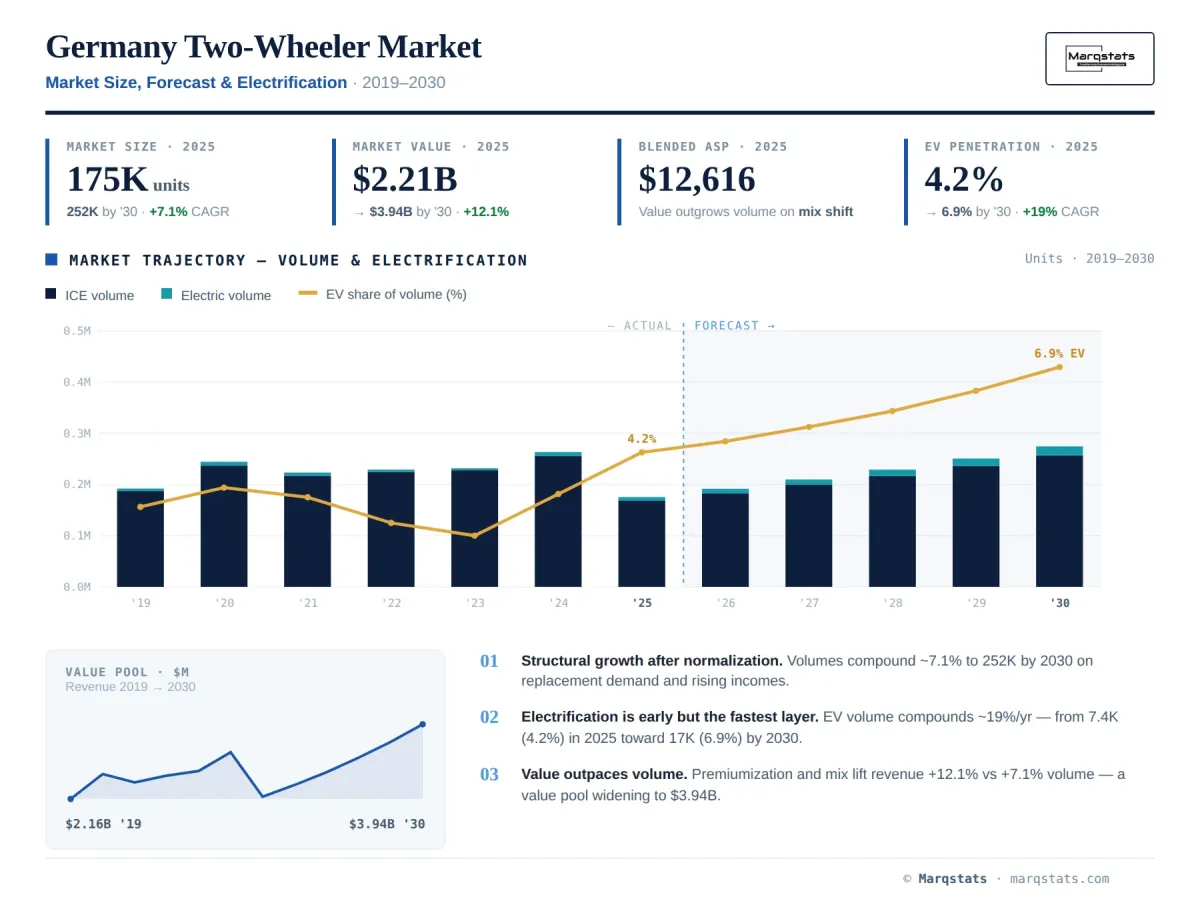
The Germany two-wheeler market reached 175,280 units in 2025 and is projected to reach 252,010 units by 2030, expanding at a 7.06% CAGR across the 2026–2030 forecast period; in value terms the market rises from USD 2.21 billion to USD 3.94 billion. Germany is a mature, premium, motorcycle-led market, the home of BMW Motorrad, defined by large-displacement touring and adventure machines rather than commuting. The 2025 figure reflects a sharp correction, owing to a pre-buy surge in 2024 ahead of the Euro 5+ emissions standard that took effect in January 2025.
Motorcycles account for about 91% of volume, and machines above 350cc alone represent roughly 62% of units, anchoring a market where touring, adventure, and premium models dominate both volume and value. Demand is overwhelmingly private and recreational, supported by one of Europe's strongest riding cultures, with more than five million two-wheelers registered nationally. Value grows faster than volume through the forecast period, reflecting premiumisation and mix shift toward larger machines.
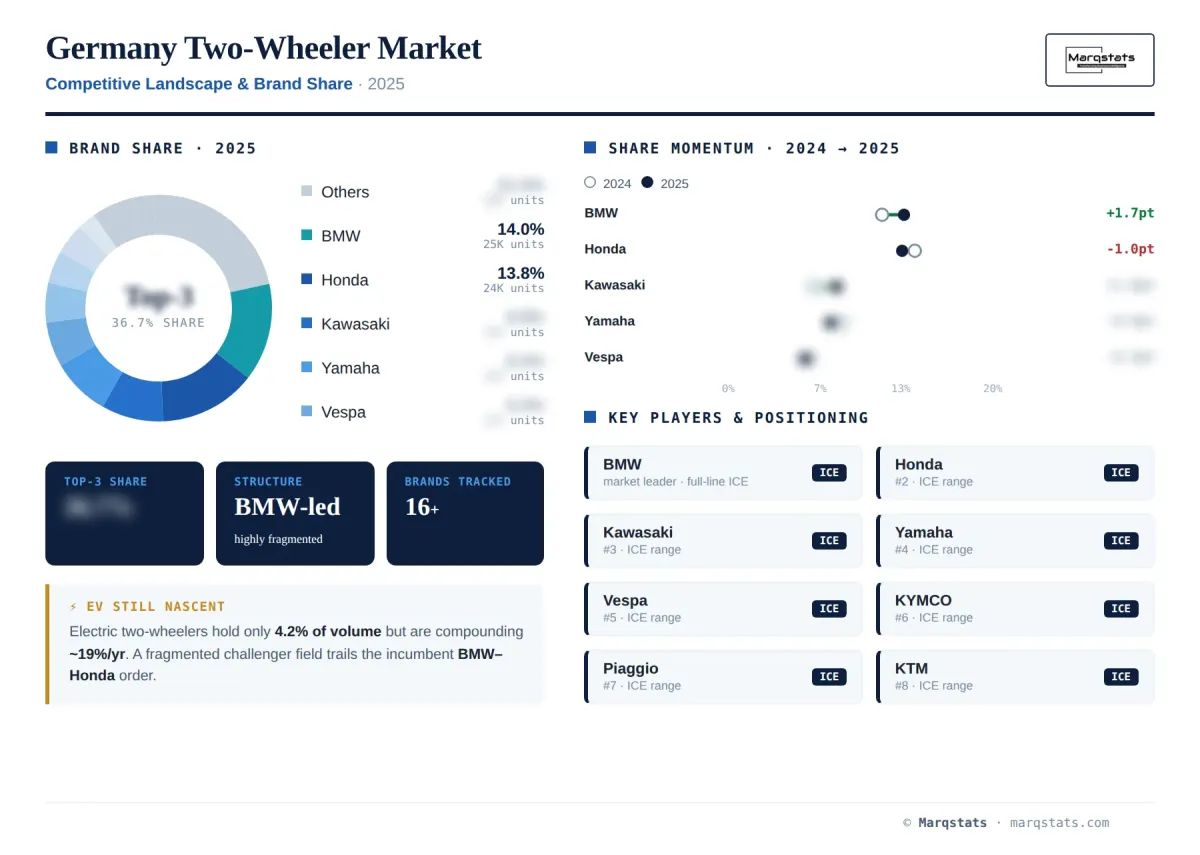
The market is moderately fragmented. BMW and Honda co-lead, with BMW dominating value on the strength of its GS adventure range, while Yamaha, Kawasaki, and a wide field of European, Japanese, and rising Chinese brands compete across segments. Growth is driven by recovery from the Euro 5+ correction, premiumisation, and electrification, tempered by economic weakness and pricing uncertainty, while KTM's financial restructuring has reshaped the competitive field.
Key Takeaways
Market Overview & Analysis
Report Summary
The Germany two-wheeler market comprises motorcycles, scooters, and mopeds sold for personal and commercial use across internal combustion and electric propulsion. This study segments demand by vehicle type, propulsion type, engine displacement and motor power, price band, end user, sales channel, and brand, with a 2025 base year, historical coverage from 2021 to 2025, and forecasts to 2030. Germany is Europe's most valuable motorcycle market, shaped by premium touring, adventure, and performance demand rather than the utilitarian commuting that drives emerging markets.
The market's 2025 result must be read against a distorted 2024. Ahead of the Euro 5+ emissions standard, effective 1 January 2025, manufacturers cleared stocks of non-compliant models through special sales and one-day registrations, pulling forward demand and inflating 2024 volumes. Registrations then corrected sharply in 2025. The Federal Motor Transport Authority records more than five million two-wheelers registered in Germany, with Bavaria alone accounting for over one million, underlining the depth of the country's riding culture even through a weak sales year.
Supply is broad and premium-oriented. BMW leads by value and co-leads by volume, Honda is the other volume leader, and Yamaha, Kawasaki, Suzuki, and European marques including Triumph, Ducati, Piaggio, and Aprilia compete across touring, sport, and scooter segments. KTM and Husqvarna, both part of Pierer Mobility, saw registrations fall steeply during financial restructuring, while Chinese brands have begun to gain share with competitively priced models. Electric two-wheelers remain a small share, concentrated in scooters and light machines.
The 2025 correction is most clearly understood as a timing effect rather than a collapse in underlying demand. In late 2024, dealers and manufacturers registered large volumes of Euro 5 machines that would become ineligible for new registration once Euro 5+ took effect, through special sales and one-day registrations. These units, sold in 2025 as effectively new, moved into the used category statistically, deepening the apparent 2025 decline. The forecast therefore rebuilds from a distorted low, with volumes recovering steadily toward 2030 as the pull-forward washes through and the market normalises around premium touring and adventure demand.
Market Dynamics
Key Drivers
- Recovery from the Euro 5+ correction drives growth, as demand normalises from the 2025 low toward a higher forecast base through 2030.
- Premiumisation and the touring and adventure segments sustain value, as affluent riders favour large-displacement machines such as the BMW GS range.
- A strong recreational and touring culture underpins demand, with Alpine and long-distance riding supporting premium and rental use across one of Europe's largest motorcycle parcs.
- The 125cc class supports volume, as car-licence holders can ride 125cc machines after modest training, drawing commuters and new riders into the market and creating a pipeline toward larger machines.
Key Restraints
- Economic weakness and inflation weigh on demand, as buyers of premium machines react sensitively to uncertainty and financing costs.
- The Euro 5+ transition raised compliance costs and removed non-compliant models, compressing supply and lifting prices.
- Tariff uncertainty on imported machines, including proposed measures affecting United States brands, adds pricing risk for premium buyers.
Key Trends
- Electrification advances from a small base, led by scooters and light machines; the global electric ATV and UTV market reflects the wider electrification of powered leisure vehicles.
- Online retail expands rapidly, reaching about 30% of sales and growing at a 20% CAGR, among the highest digital shares in the market.
- Chinese brands gain share, as makers such as CFMoto and Voge expand with competitively priced models across mid and premium segments.
- The competitive field is reshaping, as KTM and Husqvarna restructure and established brands adjust pricing and model strategies.
Market Segmentation
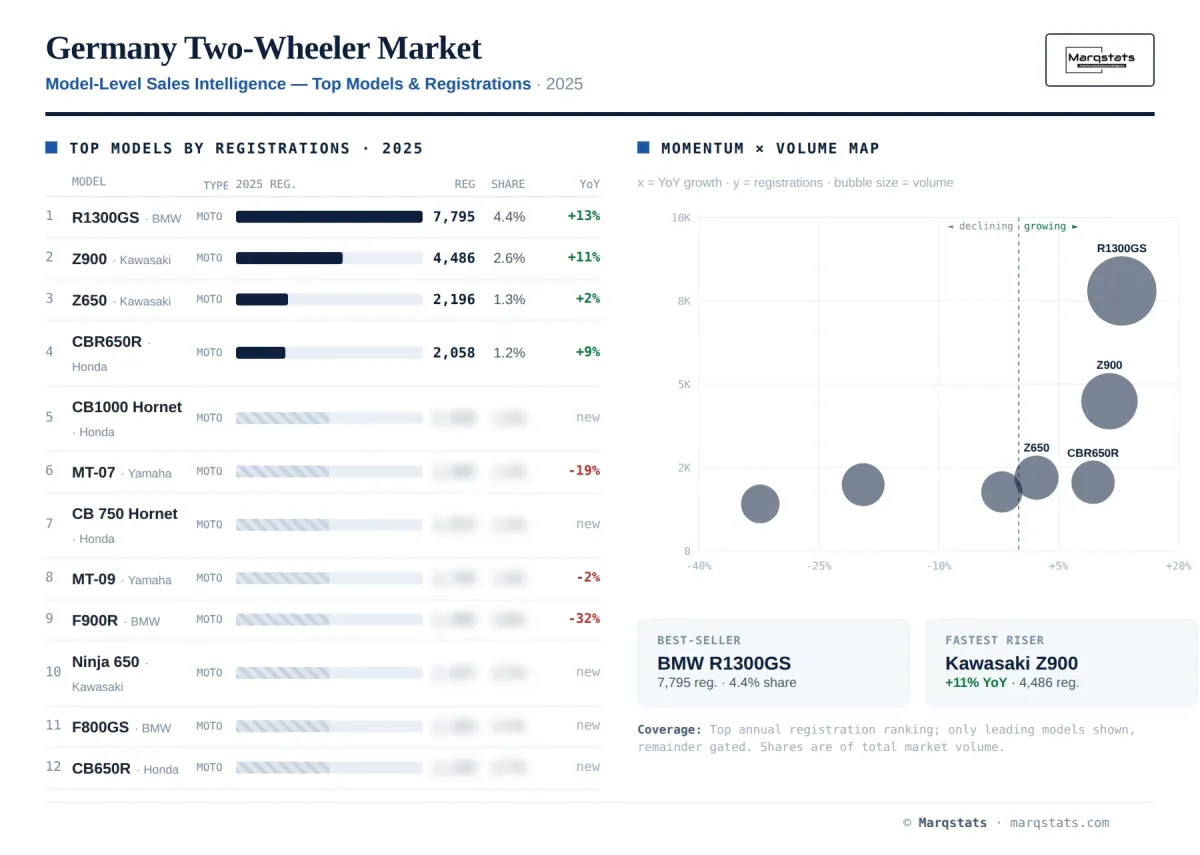
Motorcycles dominate at about 91% of 2025 volume, roughly 160,000 units, growing at a 4.99% CAGR. The category spans touring, adventure, sport, and naked motorcycles and concentrates in large displacements, reflecting a market built on premium leisure and long-distance riding. Adventure and touring machines, led by the BMW GS family, define the segment and generate the majority of market value. The dominance of adventure motorcycles, epitomised by the R 1300 GS as the country's top-selling model, reflects a riding culture centred on Alpine touring, long-distance travel, and versatile machines rather than urban commuting.
Scooters and mopeds account for about 16,000 units in 2025, roughly 9% of volume, growing fastest at an 18.95% CAGR. Demand centres on urban commuting, delivery, and short trips, and this category hosts much of the electric two-wheeler market, supporting its rapid growth from a small base. Scooters recover strongly through the forecast period as urban mobility needs, delivery use, and electric models expand, making the category the fastest-growing vehicle type even as motorcycles remain dominant in both volume and value.
Combustion models hold about 96% of 2025 volume, roughly 168,000 units, growing at a 9% CAGR from the 2025 low. Combustion remains dominant across touring, adventure, and sport classes, now built to the Euro 5+ standard, and it continues to define the premium large-displacement machines at the heart of the market. The Euro 5+ transition raised development and compliance costs and removed older non-compliant models, yet combustion machines retain a decisive advantage in range, refuelling, and the character that premium touring riders value most.
Electric two-wheelers hold about 4% of 2025 volume, roughly 7,000 units, growing at an 18.62% CAGR to reach about 17,000 units by 2030. Adoption is concentrated in scooters and light urban machines, with higher-power electric motorcycles emerging slowly. Growth is rapid in percentage terms yet modest in absolute units, reflecting the market's premium, large-displacement orientation and the slower electrification of leisure motorcycles. Electric demand is strongest in urban centres for commuting and delivery, and early growth in 2026 signals recovering momentum, though range, price, and the emotional appeal of large combustion touring machines continue to slow adoption at the premium end.
Large-displacement machines above 350cc are the defining segment at about 62% of 2025 volume, roughly 109,000 units, growing at an 8% CAGR. Touring, adventure, and performance motorcycles fall here, generating the large majority of market value. The strength of this band, unusual outside premium Western markets, is the clearest signature of German demand. It reflects a market where riders invest in capable, high-value machines for long-distance touring and Alpine riding, and it explains why German market value grows faster than unit volumes as demand concentrates in the most expensive displacement classes.
The 111–125cc class is the second-largest at about 20% of volume, growing steadily, supported by rules that allow car-licence holders to ride 125cc machines after modest training. Smaller classes below 125cc are marginal, reflecting limited demand for the smallest commuter motorcycles in a premium market. The 125cc class is central to urban mobility and to bringing new and younger riders into motorcycling, and it provides a pipeline of future buyers who may progress to the larger machines that dominate the market, making it strategically important despite its lower value per unit.
Premium and high-premium performance bands together account for over half of volume and the clear majority of value. The high-premium and performance band alone represents about 29% of units and a far larger share of revenue, reflecting the dominance of large touring and adventure machines. Premium demand is the core of the market's value. German riders' willingness to invest in flagship touring, adventure, and performance motorcycles sustains the premium tiers through economic cycles and underpins the market's status as the most valuable in Europe.
The entry and mass band is the largest single price band by volume at about 32%, driven largely by the 125cc class, while the mid segment adds about 15%. These bands anchor unit volumes, though they contribute a smaller share of value than the premium tiers above them.
Private consumers account for about 89% of 2025 volume, the defining characteristic of a recreational market. Ownership is discretionary and lifestyle-driven, weighted toward touring enthusiasts, commuters on 125cc machines, and returning riders rather than commercial buyers.
Commercial demand is smaller yet growing. Rental and tourism expands fastest at about a 12% CAGR, supported by Alpine and long-distance touring, while delivery, fleet, and institutional users add steady demand across urban centres. Motorcycle tourism is a distinctive German and wider Alpine strength, with rental operators serving domestic and visiting riders exploring mountain routes, and this segment adds valuable seasonal demand for premium touring and adventure machines.
The online channel reaches about 30% of 2025 sales and grows fastest at a 20% CAGR, among the highest digital shares of any major market. Buyers research, configure, finance, and increasingly transact online, and the channel is central to how younger and value-focused buyers engage with the market. The high online share reflects Germany's mature e-commerce environment and the willingness of riders to research and buy accessories, apparel, and increasingly complete machines through digital platforms, reshaping how manufacturers and dealers reach customers.
Franchised dealerships remain important, handling most premium sales and providing the service, financing, and community central to touring and adventure ownership, though the offline channel's share is declining as digital retail expands. For high-value machines, the dealer relationship continues to matter for test rides, servicing, and trade-ins, so the channel evolves toward a hybrid model rather than disappearing, combining online research and configuration with in-person purchase and after-sales support.
By Geography
Bavaria
Bavaria is the largest regional market, with more than one million registered two-wheelers, home to BMW Motorrad in Munich and to the Alpine roads that anchor Germany's touring culture. The region combines strong premium demand, a dense dealer network, and year-round enthusiast riding across its mountain passes. Its combination of an affluent population, a major domestic manufacturer, and some of Europe's most celebrated riding roads makes Bavaria both the commercial and cultural centre of the German motorcycle market.
North Rhine-Westphalia
North Rhine-Westphalia, the most populous state, is a major market spanning dense urban centres and industrial regions. Demand mixes commuting on smaller machines with premium leisure riding, and the region's large population supports both scooter and motorcycle sales. Its concentration of cities and commuters makes it an important market for the 125cc class, urban scooters, and early electric adoption, complementing the premium touring demand seen elsewhere in the country.
Baden-Württemberg
Baden-Württemberg, an affluent southern state centred on Stuttgart, sustains strong premium and touring demand, supported by high incomes and proximity to the Black Forest and Alpine routes. The region is a core market for large-displacement and adventure machines. Its wealthy, engineering-oriented population and access to celebrated riding roads make it one of the strongest markets for flagship touring and performance motorcycles in the country.
Northern & Eastern Germany
Northern and Eastern Germany sustain steadier demand, with seasonality shaping usage across cooler months. Urban centres such as Berlin and Hamburg support scooter, commuter, and early electric demand, while touring and premium demand tracks the national pattern. Flatter terrain and colder winters make riding more seasonal than in the south, yet the large populations of the major northern and eastern cities provide meaningful markets for urban mobility, delivery, and entry-level machines alongside the national premium base.
How Competition Is Evolving
The Germany two-wheeler market is moderately fragmented, without a single dominant player. BMW co-leads by volume and leads decisively by value, its GS adventure range and R 1300 GS anchoring the premium segment, while Honda is the other volume leader across a broad model range. Yamaha and Kawasaki hold strong positions, and together the major brands account for under half of the market, leaving a substantial field of specialist and imported marques.
The competitive field has shifted sharply. KTM and Husqvarna, both part of Pierer Mobility, saw registrations fall steeply during a financial restructuring driven by heavy debt, ceding share across sport and off-road segments. European marques including Triumph, Ducati, Piaggio, and Aprilia compete in touring, sport, and scooter categories, and Chinese brands such as CFMoto and Voge have begun to gain share with competitively priced models. Electric competition is small and concentrated in scooters and light machines.
The KTM restructuring is one of the most consequential recent developments in the European market. The Austrian group, long a force in sport and off-road motorcycles, entered court-supervised restructuring under a substantial debt burden, and its German registrations fell by well over half, with sister brand Husqvarna declining even more sharply. Early signs of recovery have appeared, yet the disruption has opened space for competitors, particularly value-focused Chinese entrants and established Japanese and European brands, reshaping the sport and adventure segments where KTM was previously strong.
Competition centres on brand, product breadth, and premium positioning rather than price in the core segments. Growth is attributed to brands that combine strong touring and adventure portfolios with disciplined pricing, moreover rewarding those that navigate the Euro 5+ transition, tariff uncertainty, and shifting demand. BMW's premium leadership, Honda's breadth, KTM's restructuring, and the steady rise of Chinese challengers together define a market in which heritage, model strength, and value increasingly determine competitive position.
Companies Covered
Companies covered in the report include:
Recent Market Activity
Table of Contents
Coverage & Segmentation
This report provides a comprehensive assessment of the Germany two-wheeler market across a 2025 base year, historical data from 2021 to 2025, and forecasts spanning 2026 to 2030. Market sizing is presented in unit-volume terms and complemented by value analysis in United States dollars, with segmentation by vehicle type, propulsion type, engine displacement and motor power, price band, end user, sales channel, and brand. Brand-level shares, segment growth rates, and competitive positioning are quantified to support commercial and investment decisions in Europe's most valuable motorcycle market.
The scope covers demand drivers, restraints, and structural trends, with particular focus on the Euro 5+ transition and 2025 correction, premiumisation and the touring and adventure segments, the KTM restructuring, rising Chinese competition, high online penetration, and the early electrification transition. An extended forecast to 2035 is available under customization for subscribers requiring a longer planning horizon, alongside deeper cuts by region, brand, or channel on request.