Market Snapshot
Middle bar: base-year value × (1 + CAGR), rounded to two decimals. This is a calculated illustration, not a separately researched annual estimate.
Thailand electric two-wheeler market covers battery electric motorcycles, mopeds, and scooters sold for personal mobility, last-mile delivery, ride-hailing, and institutional fleet use. Coverage spans both fixed-battery and swappable-battery architectures across all power ratings registrable as motorcycles under Department of Land Transport rules.
Market is valued at approximately 24 thousand units in 2025, projected to reach 89 thousand units by 2030, expanding at a CAGR of 25.61% during the forecast period. Growth is attributed to the EV3.5 incentive scheme, expanding battery-swap infrastructure, and the entry of the first ASEAN-built fixed-battery electric motorcycle from spring 2026. Cumulative BEV motorcycle registrations reached 87,151 by end-2025, indicating an accelerating installed base alongside annual flow data.
Market structure remains moderately fragmented, with 15 domestic manufacturers approved by the Thailand Automotive Institute and combined committed capacity of 550,000 units annually. Honda's UC3 launch from Thai Honda production indicates incumbent ASEAN OEMs are committing volume capacity to the segment for the first time. Fleet electrification, supported by 200% corporate tax deduction for domestically manufactured EV purchases, drives institutional demand alongside personal mobility growth.
Cumulative approved investments across EV manufacturing, key components, charging systems, and battery swapping services reached THB 137.7 billion as of mid-2025, with battery-swap projects representing THB 1.28 billion of that total. The combination of producer-side and infrastructure-side capital commitment positions Thailand as the most coordinated ASEAN-3 market for electric two-wheeler scale-up over the forecast horizon.
Key Takeaways
Market Overview & Analysis
Report Summary
Thailand electric two-wheeler market sits at an inflection point. BEV motorcycle registrations grew from 791 units in 2019 to 23,993 units in 2025, with cumulative registrations reaching 87,151 over the period. BEV share of new motorcycle registrations stabilized near 1.3% in both 2024 and 2025, indicating the early-adopter phase is complete and broader penetration depends on price-parity, charging access, and incumbent-OEM commitment. Total Thai motorcycle domestic sales reached 1,711,846 units in 2025 according to the Federation of Thai Industries, providing the addressable base.
Historical performance is uneven. Registrations rose from 791 in 2019 to 1,591 in 2020, 3,778 in 2021, 9,916 in 2022, and 21,927 in 2023, indicating triple-digit growth in the early-incentive phase. Growth moderated to 25,020 units in 2024 (+14% year on year) and softened to 23,993 in 2025 (-4%), signaling that the entry-tier consumer segment that drove early adoption has reached partial saturation. Forward growth is conditional on OEM-led volume expansion in mid-tier price points where ICE substitution economics work for working-class commuters.
Market structure differs from Indonesia and Vietnam owing to two factors. Thailand has the most transparent and continuous public BEV registration series across the ASEAN-3 markets, allowing accurate trend benchmarking. Thailand also operates a coordinated incentive package — the EV3.5 scheme — that runs from 2024 through 2027 with motorcycle-specific provisions, namely THB 10,000 subsidy for qualifying models below THB 150,000 with batteries of at least 3 kWh and excise tax reduced to 1% from prior 5% and 10% bands. Production-side commitments require manufacturers to assemble two units locally for every one imported in 2026, rising to three to one in 2027.
Forward momentum depends on three vectors. Battery swapping infrastructure expansion addresses range anxiety and apartment-resident charging gaps. OEM commitment from Honda's UC3 platform brings a 110 cc-equivalent ICE-replacement product to retail from spring 2026, with broader ASEAN context tracked in the IEA Global EV Outlook 2024. Fleet electrification by food delivery, e-commerce logistics, and ride-hailing operators provides volume-anchor demand resistant to consumer price sensitivity. The combination supports the projected 25.61% CAGR through 2030.
Market Dynamics
Key Drivers
- EV3.5 incentive scheme provides THB 10,000 per-unit subsidy for motorcycles below THB 150,000 with batteries of at least 3 kWh, reducing acquisition cost by approximately 7-10% on entry-tier models.
- Excise tax for BEV motorcycles reduced from 5% and 10% bands to 1% during 2024-2027, narrowing the after-tax cost gap with ICE equivalents.
- Battery swapping rollout, with 555 motorcycle stations approved under THB 1.28 billion board-approved investment, addresses range anxiety and removes home-charging requirement for apartment-resident commuters.
- Corporate ESG commitments enable 200% tax deduction for domestically manufactured EVs and 150% deduction for imported EVs, accelerating fleet electrification by logistics and delivery operators.
- Honda's UC3 launch from Thai Honda production in spring 2026 brings the first ASEAN-incumbent OEM volume commitment to fixed-battery electric motorcycles, validating the category for risk-averse consumers.
- ZEV 30@30 plan targets 30% of motorcycle production and registration to be electric by 2030, embedding policy continuity beyond the EV3.5 horizon and signaling sustained government support for the segment.
Key Restraints
- High household debt and stringent lending criteria from Thai financial institutions constrain consumer financing for EV purchases despite subsidy availability.
- Aftersales infrastructure for replacement batteries, controllers, and trained technicians remains concentrated in Bangkok and core provinces, with sparse coverage in peripheral regions.
- Honda's 81% share of overall motorcycle sales creates a strong incumbency moat that historically slowed EV-supportive policy adoption, however the UC3 launch shifts incentive alignment.
- Sealed lead-acid batteries dominate the entry-tier segment owing to lower upfront cost; limited cycle life and energy density restrict total cost of ownership advantages versus ICE alternatives.
Key Trends
- Swappable battery architecture standardization advances as Honda adopts CHAdeMO-based two-wheeler charging alongside its e:Swap battery network.
- Direct-to-consumer online sales channels gain traction, however no official source-backed channel-share figure has been published for Thailand.
- Lithium-ion penetration grows in mid-tier and premium segments, displacing sealed lead-acid in price points above THB 60,000.
- IoT-enabled telematics for fleet operators expands data monetization opportunities, with B2B fleet demand estimated in the 34,000-68,000 unit range annually under planning-scenario assumptions.
Market Segmentation
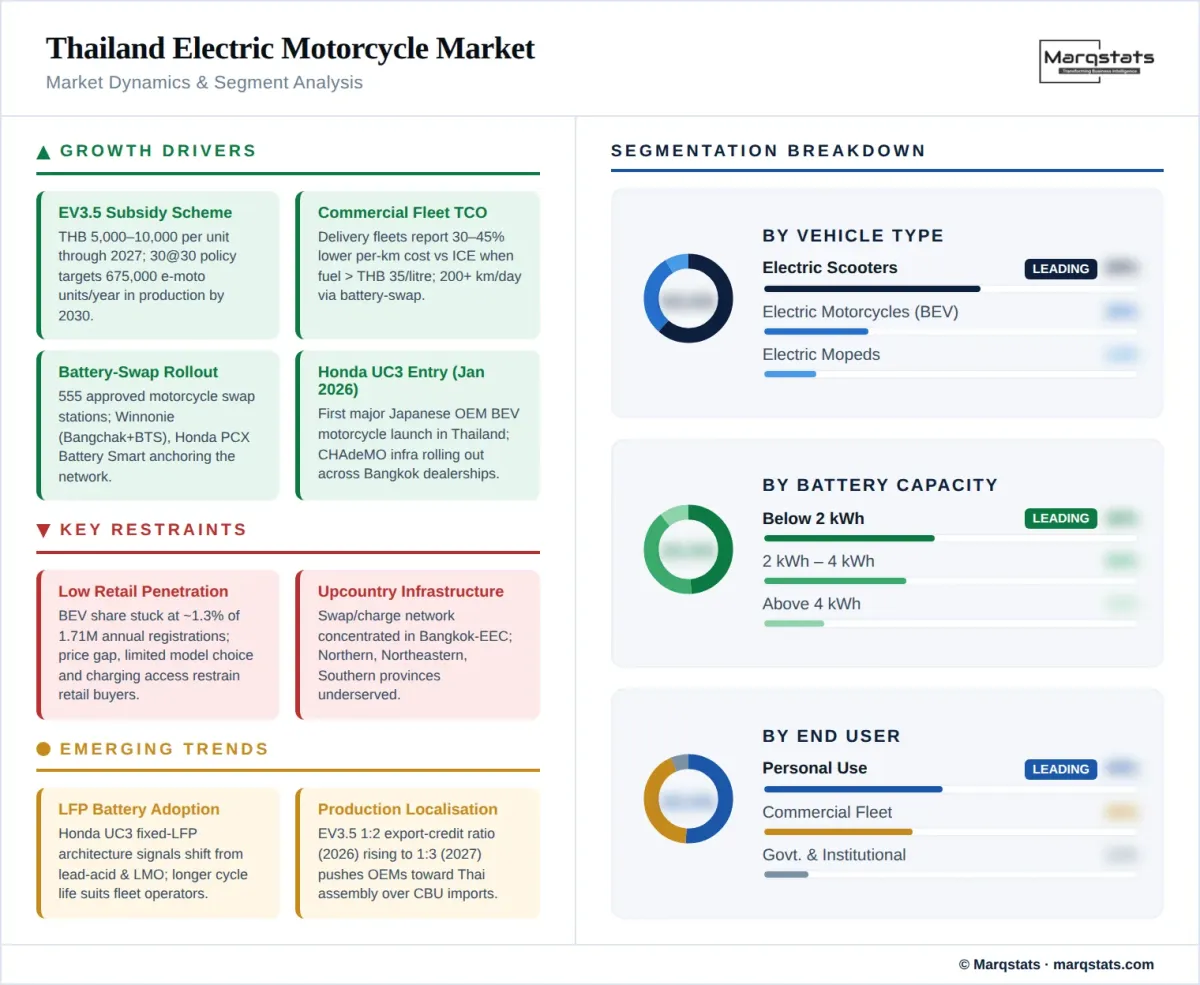
E-scooter segment held the largest share of the Thailand electric two-wheeler market in 2025 owing to affordability, ease of urban manoeuvring, and suitability for last-mile delivery. Lower acquisition price points and simpler maintenance reinforce dominance in fleet and personal segments. Lithium-ion battery variants accounted for the largest revenue share within the e-scooter category, however sealed lead-acid models retain volume share in entry-tier price points.
Demand is concentrated in commuter-distance use cases — typically below 50 kilometers per day — where 1.5 to 3 kWh battery configurations meet round-trip range requirements. Brand mix tilts toward Chinese imports (Yadea, NIU) and Thai assemblers (Deco Green Energy, H Sem Motor) at the entry tier, with European and Taiwanese brands (Zapp Scooters, Gogoro) competing on premium price points.
E-motorcycle segment accounted for moderate share in 2025, with growth accelerating from 2026 onward. Honda's UC3 fixed-battery model with 6.0 kW peak power and 122 km certified range under WMTC Mode 1 cycle establishes a new performance benchmark for the 110 cc-replacement category. Domestic production capacity from Thai Honda enables price-competitive entry against Chinese imports.
E-motorcycle adoption is constrained by acquisition cost premium versus ICE alternatives in the same displacement class. Honda's UC3 narrows this gap through the EV3.5 subsidy, excise tax reduction, and economies of scale from Thai Honda assembly. Vmoto Soco and ETRAN compete in the upper-mid segment with longer-range and higher-power models.
E-moped segment maintains steady demand from delivery and ride-hailing operators owing to operating cost advantages. Segment growth is driven by fleet renewal cycles at food delivery and parcel logistics firms, with corporate buyers benefiting from accelerated tax deduction provisions under the 200% deduction scheme for domestically manufactured EVs. Lower power requirements (typically below 1.5 kW) allow simpler, cheaper drivetrain configurations.
Fixed-battery models accounted for the majority share of the market in 2025, owing to lower system cost and simpler home-charging deployment. Honda's UC3 fixed LFP battery platform reinforces this architecture for the volume 110 cc-equivalent segment. Charging via 450W and 1200W charger options addresses both home and dealer-network use cases.
Fixed-battery economics favor personal-mobility buyers with predictable daily routes and access to home or workplace power outlets. The architecture imposes a charging-time constraint that limits suitability for high-utilization fleet applications, however technology improvements in fast-charging acceptance reduce this gap each model cycle.
Swappable-battery architecture is the fastest-growing segment, with 555 motorcycle battery-swap stations approved under coordinated board-approved investment. Architecture appeals to apartment residents without home-charging access and to fleet operators requiring zero-downtime turnarounds. Honda's e:Swap battery station network expansion alongside the UC3 launch indicates incumbent OEM commitment to swappable infrastructure.
Network economics favor density. Bangkok-area station deployment reaches commercial viability faster than upcountry rollouts, reinforcing regional concentration in the Bangkok Metropolitan Region in early phases. Standardization debates persist between OEM-proprietary networks and open-pool alternatives, with regulatory direction yet to be finalized.
Personal mobility accounted for the majority share of unit sales in 2025, driven by urban commuter demand in Bangkok and Greater Bangkok. Subsidy availability under EV3.5 reduces acquisition cost for individual buyers below the THB 150,000 price threshold. University students, young professionals, and second-vehicle households drive incremental adoption. Daily commuting distances of 15-30 kilometers fit the 100-150 km range envelope of mainstream battery configurations, removing range anxiety for the bulk of personal-use cases.
Delivery and logistics segment is the fastest-growing end-use category. E-commerce growth, food delivery operators, and parcel logistics firms drive fleet conversion supported by 200% corporate tax deduction for domestically manufactured EVs. Operating cost per kilometer advantages over ICE alternatives reinforce conversion economics. Annual fleet renewal cycles of 18-24 months at delivery operators accelerate the conversion window.
Ride-hailing operators contribute steady fleet conversion volume. Driver economics favor electric motorcycles owing to lower operating cost per kilometer despite higher upfront acquisition. Battery-swap network access reduces driver downtime relative to charging-station alternatives. Platform-led financing schemes pioneered by ride-hailing operators address upfront capital constraints faced by individual driver-owners.
Corporate ESG commitments to 30% greenhouse gas reduction by 2030 drive institutional fleet purchases. Tax deduction provisions create acquisition incentives aligned with environmental targets. Telematics-enabled fleet management platforms support data-driven utilization optimization. Public sector electrification targets at municipal level — particularly in Bangkok and Phuket — generate incremental institutional volume.
By Geography
Bangkok Metropolitan Region
Bangkok Metropolitan Region accounted for the largest share of Thailand BEV motorcycle registrations in 2025. Last-mile delivery density, concentrated charging-access infrastructure, and Honda's planned CHAdeMO charger deployment at Bangkok dealerships and shopping centers reinforce regional dominance. Greater Bangkok captures the bulk of food delivery and ride-hailing fleet conversions.
Bangkok and the surrounding provinces (Nonthaburi, Pathum Thani, Samut Prakan) host the densest concentration of e-commerce fulfilment hubs, food delivery dispatch zones, and corporate ESG-linked fleet purchases. Charging access advantage compounds — over 80% of identified battery-swap stations approved under the THB 1.28 billion programme are slated for the Bangkok Metropolitan Region in initial rollout phases. Bangkok Metropolitan Administration mobility plans prioritize zero-emission deliveries within identified low-emission zones, which provides regulatory tailwind for fleet conversion in the second half of the forecast period.
Central Thailand
Central Thailand provinces, including Samut Prakan where Royal Enfield opened a CKD assembly facility in December 2024, host concentrated motorcycle manufacturing capacity. Industrial activity in the Eastern Economic Corridor extends component supply chain depth supporting EV production scale-up. Provincial registrations grow from a smaller base however benefit from lower acquisition cost relative to Bangkok. Industrial-park employee commuter demand provides incremental fleet-style volume.
Northeastern Thailand
Northeastern Thailand (Isan) represents large absolute motorcycle population however lower BEV share owing to longer rural commuting distances and sparser charging infrastructure. Subsidy uptake remains constrained by household income relative to entry-level lithium-ion model pricing. Sealed lead-acid e-scooter variants retain disproportionate share of regional electric volume. Provincial dealer networks for major brands (Honda, Yamaha) provide existing service infrastructure that supports gradual electric model adoption from 2026 onward.
Northern Thailand
Northern Thailand, anchored by Chiang Mai, registers moderate BEV adoption supported by tourism-related ride-hailing demand and provincial-government pilot programs. Hilly terrain influences buyer preference for higher-power lithium-ion models over sealed lead-acid entry tier. University populations in Chiang Mai and Chiang Rai provide a demographic skew toward early-adopter consumer profiles.
Southern Thailand
Southern Thailand provinces, including Phuket and Songkhla, host tourism-driven scooter demand. Coastal humidity and salt exposure influence buyer specifications toward IP-rated electrical systems and corrosion-resistant frames. Tourism rental fleet operators contribute incremental conversion volume. Phuket-specific zero-emission tourism zone proposals, if implemented, would accelerate fleet-side conversion in the late forecast period.
How Competition Is Evolving
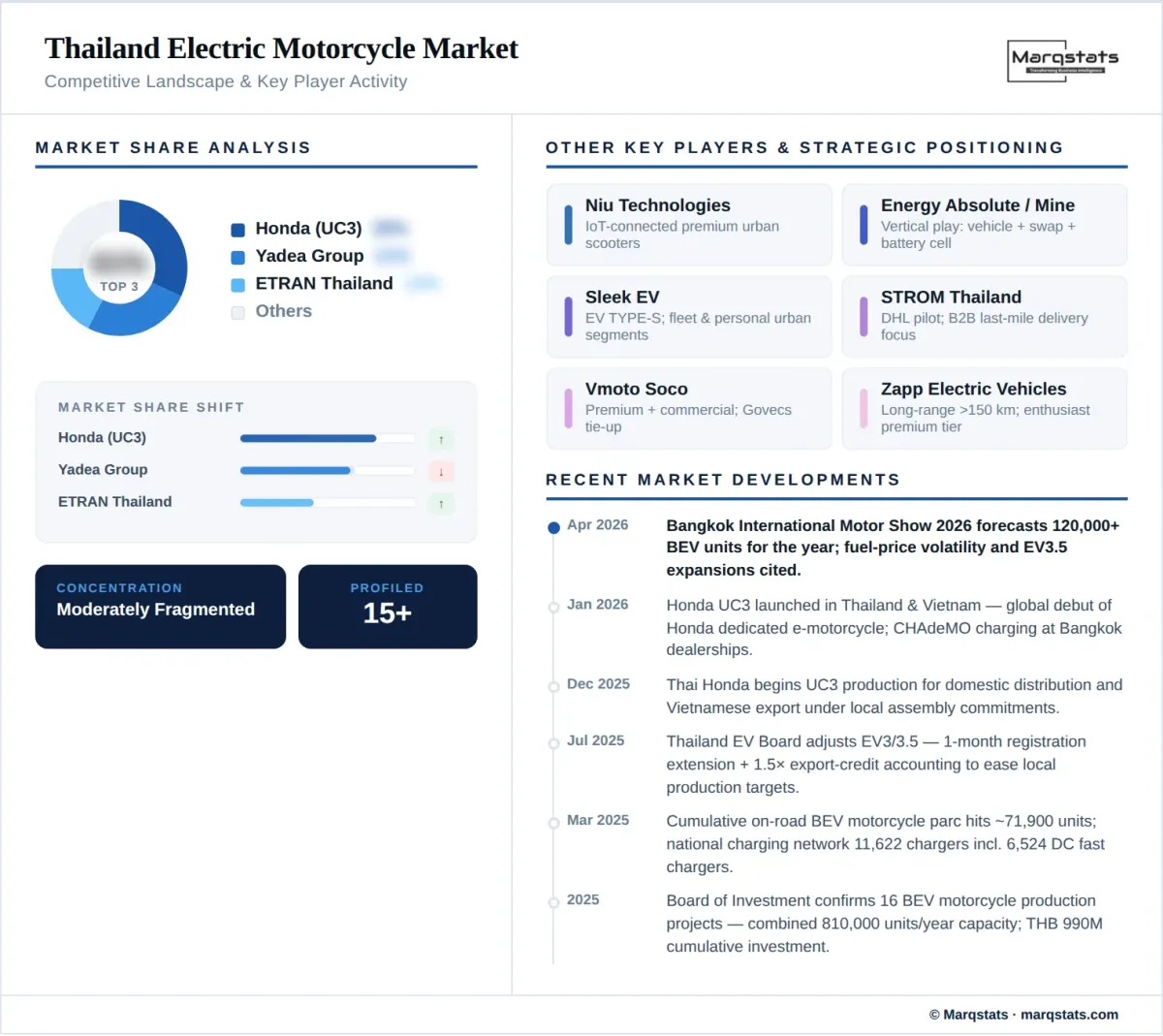
Thailand electric two-wheeler market remains moderately fragmented across 16 active manufacturers spanning incumbent Japanese OEMs, Thai pure-play EV firms, Chinese global brands, and Taiwanese battery-swap pioneers. Honda's planned UC3 entry concentrates near-term volume potential, however the 15 Thai-licensed e-motorcycle manufacturers — committing THB 922 million to facilities with 550,000-unit annual capacity — distribute production across multiple cost tiers and price points.
Competitive strategies converge on three vectors. Vertical integration through battery and motor in-house design, exemplified by Honda's wheel-mounted motor and fixed LFP battery, reduces unit economics for high-volume models. Battery-swap network access, anchored by Honda's e:Swap stations and competing networks from Chinese and Taiwanese operators, differentiates fleet-oriented offerings. Cost leadership through sealed lead-acid configurations sustains entry-tier volume; lithium-ion penetration grows above the THB 60,000 price point.
Strategic activity expanded materially in 2024-2026. Royal Enfield opened a CKD facility in Samut Prakan (December 2024). Mile Green announced Thailand EV charging network expansion (April 2025). Thailand EV Board approved EV3 and EV3.5 export-counting reforms (July 2025). Fifteen e-motorcycle manufacturers committed THB 922 million to local production facilities (January 2025). Honda announced UC3 production at Thai Honda (December 2025) and launched the model for Thai and Vietnamese markets (January 2026). Patterns observed broadly align with regional dynamics covered in the ASEAN Electric Vehicle Market report on Marqstats.
Market entry barriers remain moderate. Thai Board of Investment approval requires a minimum production commitment, alignment with EV3.5 import-to-production ratios, and battery-traceability documentation under battery recycling regulations. Type approval by the Department of Land Transport adds a homologation layer that filters out lowest-tier imported brands. Competitive pricing pressure from established Chinese players (Yadea, NIU) and Thai assemblers compresses margins for new entrants in the entry-tier segment, however the mid-tier segment between THB 60,000 and THB 150,000 remains under-served and presents a near-term opportunity for OEMs willing to invest in dealer networks and aftersales infrastructure.
Companies Covered
Companies covered in the report include:
Recent Market Activity
Table of Contents
Coverage & Segmentation
The report covers Thailand electric two-wheeler market over the 2021-2025 historical period, with 2025 base year and 2026-2030 forecast period. Coverage spans all battery electric motorcycles, mopeds, and scooters registrable under Department of Land Transport rules, including fixed-battery and swappable-battery architectures. Market sizing is presented in volume units (thousand units), with supplementary analysis of cumulative installed base and BEV share of total motorcycle registrations.
The study examines market drivers, restraints, segment shares, regional distribution, competitive structure, and forward catalysts including OEM launches and infrastructure expansion. Primary research includes 40+ interviews with OEMs, battery suppliers, charging-network operators, fleet buyers, and policy stakeholders. Secondary research draws from official government sources, industry association releases, and listed-company investor disclosures.
Forecasting methodology combines bottom-up unit projection across vehicle-type and battery-architecture segments with top-down policy-scenario sensitivity. Segment-level CAGRs are calibrated against historical registration data, OEM capacity announcements, and infrastructure deployment milestones. Scenario bands reflect upside and downside cases around the central 25.61% CAGR estimate, with material downside risk from household-debt deterioration and material upside from accelerated battery-swap network rollout.