Market Snapshot
Key Takeaways
Market Overview & Analysis
Report Summary
The Norway two-wheeler market covers motorcycles, scooters, and mopeds sold for private, commercial, and institutional use. The study measures demand in unit volumes and revenue across 2021 to 2025 historical years and 2026 to 2030 forecast years, with 2025 as the base year. Coverage spans propulsion type, engine displacement and motor power, price band, end user, sales channel, and brand.
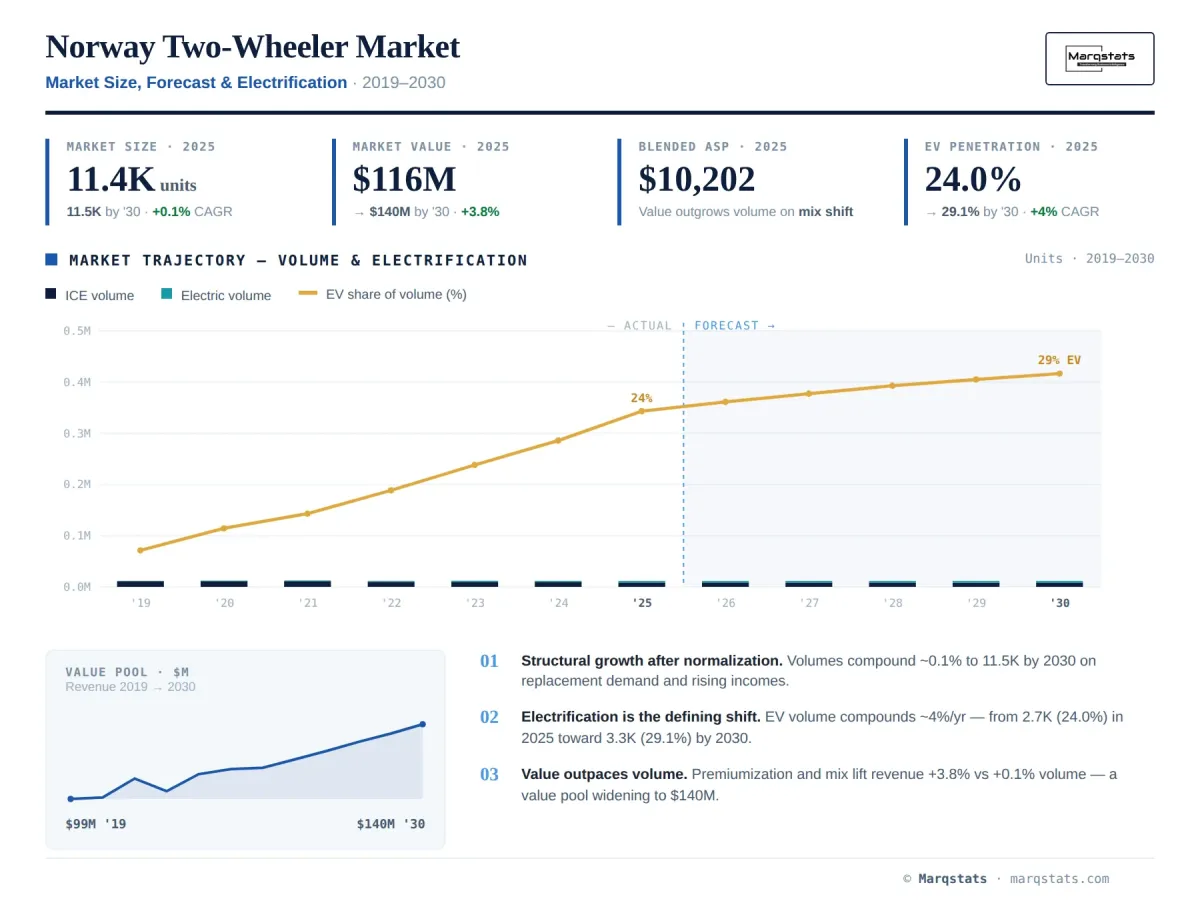
Norway is a mature market with limited volume growth and a strong premium and recreational orientation. Motorcycles serve leisure, touring, and off-road riding, and mopeds and scooters serve short urban trips. The market has the highest electric two-wheeler share in the region, supported by national policy and purchase incentives. Average selling prices are high, and revenue grows through premiumization even as unit volumes hold flat.
Policy is a defining force. National incentives, including purchase support administered through a government enterprise, lower the effective cost of electric mopeds and motorcycles. These measures, set within a broader push to phase out new fossil-fuel light vehicles, have lifted electric two-wheeler adoption well above the levels seen in most markets. Import dependence is near total, so pricing reflects landed cost and the premium mix.
Growth is attributed to premiumization, electrification, and replacement demand, rather than to unit expansion in a saturated market. Electric adoption in Norway is well ahead of most markets, and it resembles the faster electric transitions tracked in Thailand’s electric two-wheeler market. Revenue grows steadily as buyers move toward higher-value and electric models, while combustion volumes decline.
Market Dynamics
Key Drivers
- Government purchase incentives for electric mopeds and motorcycles accelerate the shift to zero-emission models.
- High disposable incomes support a premium and recreational market, owing to demand for touring and performance machines.
- An established off-road, enduro, and adventure culture sustains demand for large-displacement and electric models.
- Replacement demand supports steady sales, owing to an installed base of recreational riders.
- Low running costs and urban incentives support electric mopeds and scooters in cities.
Key Restraints
- A short riding season and cold climate concentrate demand in the warmer months and cap annual volumes.
- Market saturation limits unit growth, owing to a small population and a mature installed base.
- High prices and a premium mix constrain the entry tier, owing to elevated average selling prices.
- Limited charging support outside cities constrains electric touring and rural use.
Key Trends
- Electric two-wheelers gain share and reach close to 29% of units by 2030, the highest level in the region.
- Combustion volumes decline gradually, while premium large-displacement models hold their position.
- Premiumization lifts average prices and revenue, even as unit volumes hold flat.
- Offline dealerships remain strongly dominant, however online retail grows from a small base.
Market Segmentation
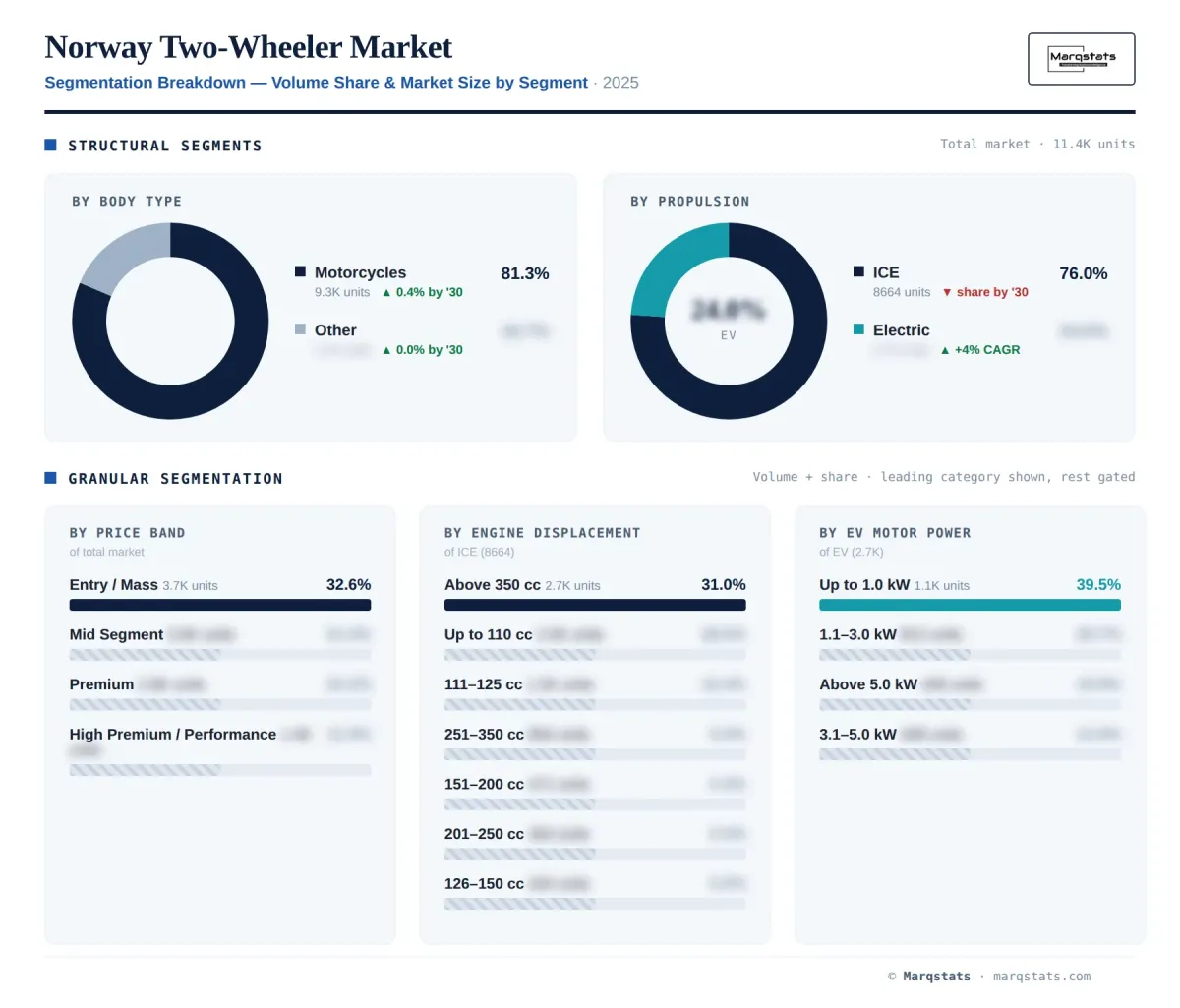
Motorcycles dominate, at about 81% of unit sales in 2025. Volumes reach 9.27 thousand units in 2025 and are projected to reach 9.42 thousand units by 2030, a 0.35% CAGR. The category spans premium touring, adventure, and performance machines, and it drives most of the market revenue.
Within motorcycles, large-displacement touring and adventure models carry most revenue, while smaller machines and learner models add volume. Off-road and enduro riding is well established, which supports demand for adventure and dual-sport machines. Electric motorcycles are a small and growing part of the category.
Scooters and mopeds form a combined category, at about 19% of units in 2025. Volumes move from 2.13 thousand units in 2025 to 2.04 thousand units by 2030, a negative 0.84% CAGR. Electric models make up a large and growing part of this category, and urban riders drive most demand.
This combined category is important in Norway, where electric mopeds and scooters have gained strong traction in cities. Purchase incentives and low running costs make electric models attractive for short urban trips, and they account for a rising share of category volume across the larger cities and their surrounding areas.
Combustion models held about 76% of units in 2025. Volumes decline from 8.66 thousand units in 2025 to 8.12 thousand units by 2030, a negative 1.17% CAGR. Combustion remains the base of the market, however its share falls as electric models advance. Premium large-displacement machines carry most combustion revenue.
Electric two-wheelers hold the highest share in the region and continue to grow. Volumes rise from 2.74 thousand units in 2025 to 3.34 thousand units by 2030, a 3.77% CAGR, and revenue expands at a 7.56% CAGR. Growth is supported by government incentives, low running costs, and a widening model range. Electric share of units is projected to reach about 29% by 2030.
Electric mopeds and scooters account for much of the electric base, owing to urban use and purchase incentives, while electric motorcycles grow from a smaller base. Low running costs, urban access benefits, and a widening premium electric range all support adoption. The high electric share is a defining feature of the market and sets it apart from most peers.
Small-displacement and moped-class models form one end of the market. Combined volumes for engines up to 125 cc account for about 44% of combustion units, with the up to 110 cc band the largest at 2.47 thousand units in 2025. Urban and entry riders sustain this base, and electric models increasingly replace small combustion machines across the moped and light-motorcycle classes.
Mid-capacity motorcycles form a thin middle in the market. These bands are small, at under 1 thousand units each in 2025, and volumes hold broadly flat. The market concentrates instead at the small and large ends of the displacement range.
This barbell structure reflects two distinct rider groups: urban riders on mopeds, scooters, and small machines, and recreational riders on premium large-displacement motorcycles. The thin middle indicates limited commuter demand for mid-capacity machines, which is a feature of a wealthy, recreation-oriented market.
Large-displacement machines form the largest combustion band, at 2.68 thousand units in 2025, close to 31% of combustion units. Touring, adventure, and performance models anchor this band, and it generates a large share of revenue. This substantial premium presence defines the recreational character of the market and distinguishes Norway from commuter-driven markets.
Large-displacement demand concentrates among higher-income recreational riders, and it is supported by touring and adventure culture. These machines anchor the premium revenue pool despite the flat overall volume, and premium electric motorcycles are beginning to enter this segment.
Within electric two-wheelers, lower-power bands serve urban mopeds and scooters, while the above 5.0 kW band grows fastest at a 5.85% volume CAGR. Higher-power electric motorcycles gain share as the premium electric range widens and charging support improves in urban areas.
The entry and mid tiers together held about 64% of units in 2025, at 3.71 thousand and 3.57 thousand units. These tiers include mopeds, scooters, and mid-capacity motorcycles. Volumes hold broadly flat, and electric models are increasingly represented here as small combustion machines give way to electric mopeds and scooters.
Premium and high-premium tiers together held about 36% of units in 2025, at 2.76 thousand and 1.35 thousand units. The high-premium tier grows fastest at a 1.42% CAGR. These tiers lift average revenue and reflect touring and performance demand.
Premium demand is resilient, owing to an affluent rider base and an established touring culture. These tiers sustain the market’s high average price and account for a large share of revenue despite flat unit volumes.
Private consumers overwhelmingly dominate, at about 95% of demand with 10.77 thousand units in 2025. Purchases serve recreation, touring, and personal mobility. This base holds broadly flat through the forecast period, in line with a saturated market, and it shifts toward electric and premium models over time.
Commercial and fleet demand is small, at about 6% of units. Delivery and logistics volumes rise at a 2.02% CAGR, and government and institutional demand adds a small share. Ride-hail and rental use is minimal in this recreation-driven market. Overall, commercial use is limited in a recreation-driven market.
The small commercial base reflects the recreational nature of the market. Delivery activity exists in the larger cities, and some fleets adopt electric mopeds, however commercial demand remains a minor share of total volume throughout the forecast period.
Dealerships and physical retailers held about 88% of units in 2025 with 9.98 thousand units. Offline volumes hold broadly flat, at a negative 0.9% CAGR, and remain strongly dominant through the forecast period. Physical dealers retain value for premium sales, service, financing, and brand experience across the country.
Online retail is the fastest-growing channel from a small base. Volumes rise from 1.42 thousand units in 2025 to 1.95 thousand units by 2030, a 6.25% CAGR, and revenue grows at a 10.04% CAGR. Online share reaches about 17% of unit volume by 2030, a lower level than in most markets.
Online adoption is limited by the value of physical inspection, service, and financing for premium machines. Dealerships remain central to sales and after-sales support, and they anchor brand presence across the country. Online channels grow steadily, supported by marketplaces and dealer websites, however they remain a minority channel.
By Geography
Oslo and Eastern Norway
Oslo and Eastern Norway form the largest demand center, owing to concentration of population and income. Registration data from the public roads administration (vegvesen.no) records the largest base here. Commuting mopeds and scooters, premium leisure motorcycles, and electric two-wheelers all concentrate in the capital region, which makes it the reference market for new-model launches and the largest concentration of electric two-wheelers.
Western Norway
Western Norway, including Bergen and Stavanger, combines urban demand with scenic touring routes. Premium and adventure models suit the terrain, and coastal cities support moped and scooter use. Wet weather and coastal conditions shape riding patterns and seasonality across the region.
Western cities combine commuting and leisure demand, and the region’s fjord and mountain routes attract touring and adventure riders in the summer. Premium and electric models both sell here, alongside urban mopeds and scooters, and dealers in Bergen and Stavanger anchor the regional market.
Southern Norway
Southern Norway benefits from a warmer climate and a longer riding season. This supports recreational and touring demand, and coastal routes attract riders in the summer months. Both premium motorcycles and electric mopeds sell here, and the milder coastal climate supports a longer active riding season than in the rest of the country.
The longer riding season in the south lifts annual mileage and supports a broader mix of recreational machines. Coastal towns and holiday areas add seasonal rental and leisure demand, which sustains premium and mid-capacity sales.
Central and Northern Norway
Central and Northern Norway, including Trondheim and the northern regions, add demand around major cities. A markedly shorter season and colder conditions limit annual volumes, and durable adventure and touring models suit the terrain and long distances between towns, and electric adoption is slower here than in the south.
How Competition Is Evolving
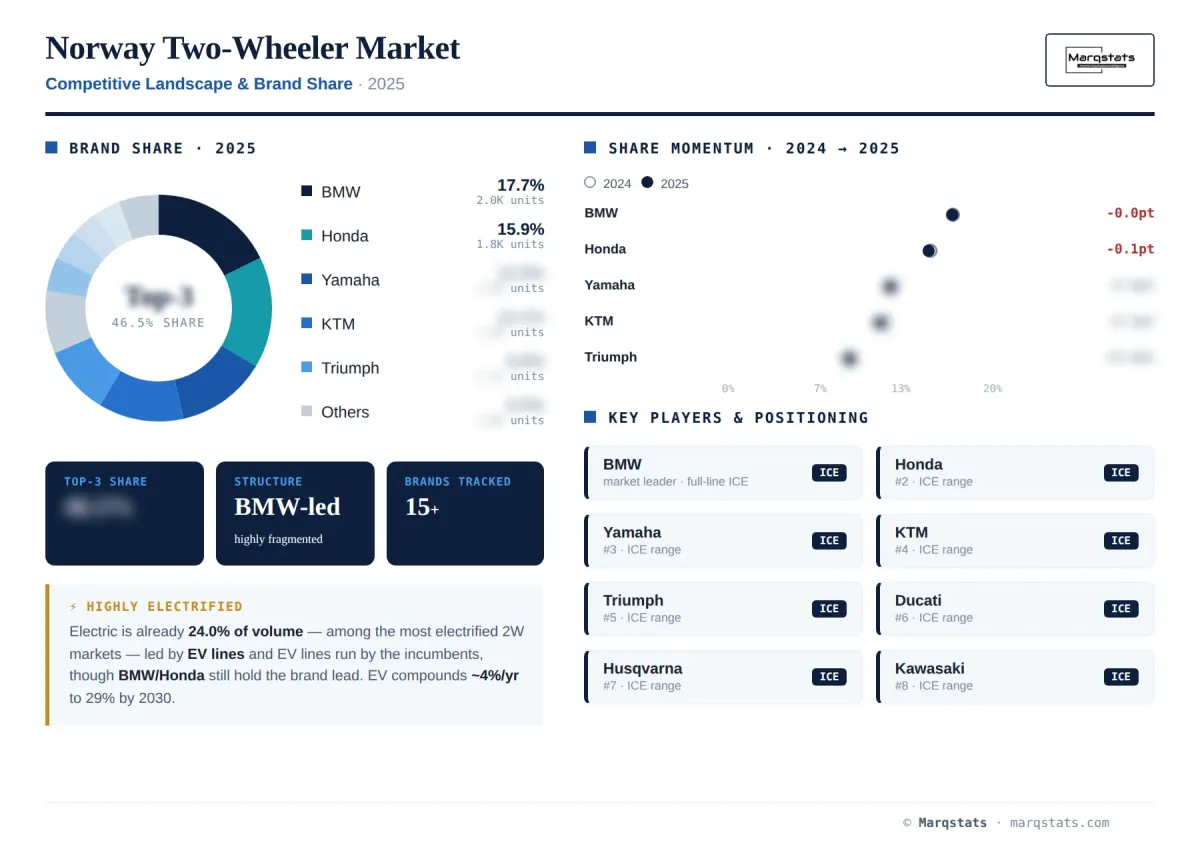
The Norway two-wheeler market is moderately concentrated among premium brands. A premium European brand led with about 18% of unit volume in 2025, ahead of Japanese and other European brands. The five largest brands held close to 68% of volume, and premium and performance marques hold an even larger share of revenue, owing to high average prices.
Competition centers on brand strength, model range, performance, and service quality. Premium touring and adventure marques compete on heritage, capability, and dealership experience. Off-road and enduro brands hold strong positions, owing to an established riding culture. Electric entrants compete on incentives, running cost, and a widening model range, and they gain share across mopeds, scooters, and motorcycles.
Distribution favors brands with strong dealer networks and service support, owing to the premium mix and the value of after-sales service. Electrification is reshaping the field, and brands with electric mopeds, scooters, and motorcycles capture the growing electric segment. Parts and service availability remain decisive for premium and recreational sales across the country.
Brand strategy also reflects the shift toward electric models and the premium mix. Established marques defend share through dealer coverage, service depth, and touring support, while electric entrants target mopeds, scooters, and, increasingly, motorcycles. Brands that combine a strong dealer network with a credible electric range are well positioned as the market electrifies.
Companies Covered
The report profiles 16+ companies with full strategy and financials analysis, including:
Recent Market Activity
Table of Contents
Coverage & Segmentation
This report provides a comprehensive analysis of the Norway two-wheeler market across 2021 to 2030, with 2025 as the base year and 2026 to 2030 as the forecast period. The study measures market size in unit volumes and revenue, and it segments demand by vehicle type, propulsion type, engine displacement and motor power, price band, end user, sales channel, and brand.
The report examines demand drivers, restraints, and trends, along with competitive structure and brand positioning. Regional coverage spans Oslo and Eastern Norway, Western Norway, Southern Norway, and Central and Northern Norway. The analysis integrates registration data, national statistics, and primary interviews to reconcile brand-level and category-level estimates into a single market view. Volume is treated as saturated, and value growth is driven by premiumization and electrification.
The study also assesses electrification, premiumization, the barbell displacement mix, and the balance between recreational and limited commercial demand. Forecasts are built at the segment level and reconciled to the total market, so that vehicle type, propulsion, displacement, price band, end user, and channel views remain internally consistent across the historical and forecast periods.