Market Snapshot
Key Takeaways
Market Overview & Analysis
Report Summary
The smart tyre market comprises tyres fitted with sensors and connectivity that monitor and report tyre and road parameters in real time. Embedded or surface-mounted sensors track pressure, temperature, tread depth, load, and road condition. Collected data reaches the vehicle electronic control unit, a telematics gateway, or a cloud analytics platform, supporting driver alerts, fleet dashboards, and predictive maintenance. Smart tyres span passenger cars, light commercial vehicles, and heavy commercial vehicles across original-equipment and aftermarket channels.
Smart tyre technology extends from tyre-pressure monitoring systems toward broader sensing of tread wear, grip, and surface condition. Pressure monitoring remains the established base, mandated across major markets. Newer systems add tread-depth measurement, road-condition sensing, and connectivity to vehicle and infrastructure networks. The technology aligns with advanced driver-assistance systems, autonomous development, and connected mobility, where real-time tyre data improves stability control, braking, and route management.
The market connects two industries. Established tyre manufacturers supply the tyre and increasingly the sensing platform, while semiconductor and sensor suppliers provide pressure, temperature, and acceleration sensors, controllers, and energy-harvesting electronics. Original-equipment fitment aligns with automaker safety programs, whereas the aftermarket serves replacement and retrofit demand. Fleet operators form a fast-growing customer base, owing to the operating-cost and safety value of continuous tyre monitoring.
Demand is increasing owing to regulatory pressure-monitoring mandates, vehicle electrification, and the safety requirements of connected and automated driving. Electrification adds a specific tailwind, owing to the weight and torque of battery electric vehicles, which raise tyre stress and reward sensor-equipped, low-rolling-resistance designs. Predictive maintenance reduces unplanned downtime for commercial fleets. Moreover, integration with telematics platforms turns tyre data into actionable fleet intelligence.
The market segments across multiple dimensions. By tyre construction, pneumatic designs hold the foremost share, owing to broad fitment, while non-pneumatic and airless designs grow at a quicker pace within specialized applications. By sensor type, embedded sensors hold the largest share, owing to accuracy and protection within the tyre, while radio-frequency identification sensors record faster growth, owing to low cost and passive operation. By propulsion, battery electric vehicles record the highest segment growth, owing to range-protection and load-monitoring requirements. By application, real-time monitoring holds the established share, while predictive maintenance grows faster across commercial fleets.
Smart tyre value concentrates in the sensing platform rather than the rubber alone. Sensor modules, controllers, antennas, and software account for a rising share of tyre value, owing to expanding functionality across pressure, temperature, tread, and grip. Original-equipment fitment ties tyre sensing to vehicle electronic architecture, whereas aftermarket retrofit kits extend monitoring to existing vehicles. The shift toward connected platforms moves competitive advantage toward data, analytics, and integration depth.
Market Dynamics
Market is driven by regulatory mandates, electrification, and demand for connected-vehicle safety. Adoption is restrained by sensor cost, integration complexity, and data-security concerns. Several structural trends, including in-tyre sensor integration and artificial-intelligence-based tyre health prediction, shape the forecast period.
Key Drivers
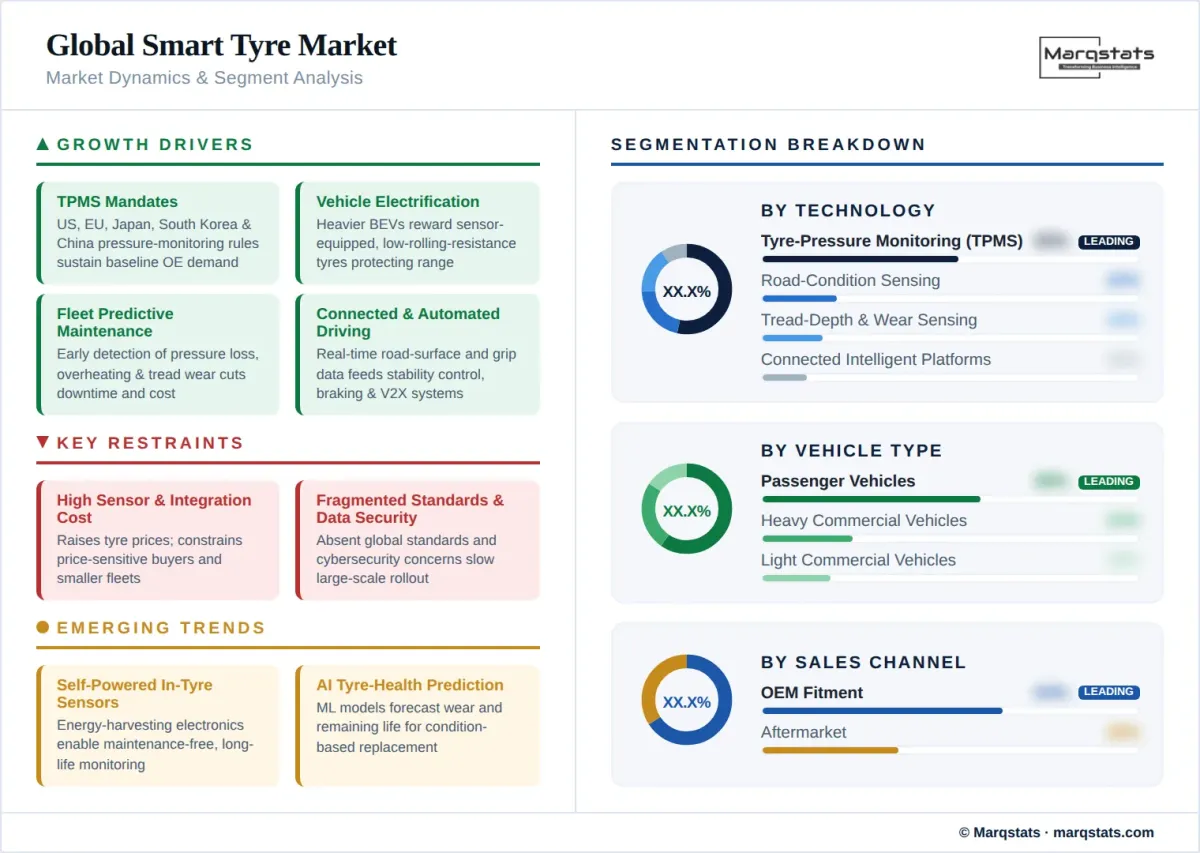
- Tyre-pressure monitoring mandates across major markets sustain baseline demand, with United States pressure-monitoring requirements and equivalent European and Asian rules requiring sensors on new vehicles.
- Vehicle electrification accelerates adoption, owing to heavier battery electric vehicles and demand for low-rolling-resistance tyres that protect range and require closer load and pressure monitoring.
- Fleet predictive maintenance reduces downtime and operating cost, owing to early detection of pressure loss, overheating, and tread wear across commercial vehicles.
- Connected and automated driving raise demand for real-time road-surface and grip data, owing to the role of tyre sensing in stability control, braking, and vehicle-to-everything communication.
- Rising vehicle-safety focus and integration with advanced driver-assistance systems expand sensor content per vehicle, supporting attach rates across new models.
Key Restraints
- High sensor and integration cost raises tyre prices, constraining adoption among price-sensitive buyers and smaller fleet operators.
- Integration complexity across tyre, sensor, controller, and vehicle network slows large-scale commercial deployment.
- Fragmented regulation and absent global standards complicate cross-market product design and certification.
- Data-privacy and cybersecurity concerns, owing to continuous transmission of vehicle and location data, raise adoption barriers for fleets.
Key Trends
- In-tyre embedded sensors and self-powered, energy-harvesting electronics expand, owing to demand for maintenance-free, long-life monitoring.
- Artificial-intelligence and machine-learning models predict tyre wear and remaining life, supporting condition-based replacement and fleet planning.
- Integration with telematics and fleet-management dashboards turns tyre data into operating intelligence, supporting uptime and route decisions.
- Vehicle-to-everything tyre systems communicate real-time data to vehicle electronics and road infrastructure, supporting autonomous-driving integration.
Market Segmentation
The market segments by technology into tyre-pressure monitoring systems, tread-depth sensing, road-condition sensing, and connected intelligent platforms. Pressure monitoring holds the foremost share, while road-condition sensing records faster growth.
Tyre-pressure monitoring systems account for the largest technology share, owing to regulatory mandates and standard original-equipment fitment across passenger vehicles. Direct systems use in-wheel pressure and temperature sensors, while indirect systems infer pressure from wheel-speed data. The segment forms the established base of the smart tyre market and anchors aftermarket replacement demand.
Regulatory adoption underpins the segment. The United States required pressure monitoring on new light vehicles from 2007, while the European Union mandated systems on new passenger cars from late 2014. Equivalent rules apply across Japan, South Korea, and China, and commercial-vehicle requirements expand under international vehicle regulations. Mandatory fitment converts pressure monitoring into a baseline feature rather than an option, sustaining steady replacement and original-equipment demand across the forecast period.
Tread-depth and wear sensing measures remaining tread and projects tyre life. The technology supports condition-based replacement and fleet planning. Adoption increases owing to the operating-cost value of timely replacement and reduced blowout risk across commercial fleets.
Road-condition sensing detects surface grip, wetness, and texture, then relays data to vehicle safety systems. The segment records the fastest technology growth, owing to alignment with advanced driver-assistance systems and autonomous development. Real-time grip data improves stability control and braking response. Vehicle makers integrate this sensing into connected platforms that share surface data with following vehicles and road infrastructure.
Connected intelligent platforms combine multiple sensors with cloud analytics and vehicle-to-everything communication. These systems transmit tyre data to fleet dashboards and road infrastructure. The segment supports the highest-value applications across autonomous and connected mobility.
These platforms convert tyre sensing into a data service. Cloud analytics aggregate pressure, temperature, tread, and grip data across vehicle fleets, then return alerts, life predictions, and route guidance. Vehicle-to-everything connectivity allows tyres to share real-time grip and surface data with vehicle electronics and digital road infrastructure, supporting automated-driving functions. The segment commands premium value, owing to recurring software and analytics revenue alongside hardware sales.
The market segments by vehicle type into passenger vehicles, light commercial vehicles, and heavy commercial vehicles. Passenger vehicles hold the foremost share, while light commercial vehicles grow at a quicker pace.
Passenger vehicles account for the largest vehicle-type share, owing to high production volume and mandatory pressure-monitoring fitment. Battery electric passenger cars expand sensor content, owing to range-protection and load-monitoring requirements. The segment anchors original-equipment demand across major automotive markets.
Within passenger vehicles, electrification reshapes tyre requirements. Battery electric cars carry heavier battery packs and deliver instant torque, which raises tyre wear and load. Sensor-equipped, low-rolling-resistance tyres protect driving range and support load monitoring. Premium and performance models adopt connected-tyre platforms that feed grip and road-condition data to stability and driver-assistance systems. The combination of regulation and electrification sustains high attach rates across new passenger models.
Light commercial vehicles record the fastest vehicle-type growth, owing to last-mile delivery expansion and fleet adoption of predictive maintenance. Continuous monitoring reduces downtime and improves safety across high-utilization duty cycles. Telematics integration strengthens the operating-cost case for fleet buyers.
Heavy commercial vehicles adopt smart tyres for fleet safety and cost control, owing to high tyre count, heavy loads, and long-distance duty cycles. Pressure and temperature monitoring reduces blowout risk and fuel loss. Fleet dashboards consolidate tyre data across large vehicle pools.
For heavy fleets, tyre cost ranks among the largest controllable operating expenses after fuel. Continuous monitoring extends casing life through correct inflation, supports retreading decisions, and reduces roadside failures. Temperature sensing detects overheating before failure across long hauls. The segment benefits from clear return on investment, owing to the high replacement cost and downtime associated with commercial tyre failure.
The market segments by sales channel into original-equipment manufacturer fitment and aftermarket. Original-equipment fitment leads, owing to regulatory mandates and automaker safety programs, while the aftermarket supports replacement and retrofit.
Original-equipment fitment holds the foremost channel share, owing to mandatory pressure-monitoring rules and integration with vehicle safety systems. Automakers specify sensor-equipped tyres during vehicle design. The channel aligns tyre sensing with advanced driver-assistance and connectivity features.
The aftermarket serves replacement and retrofit demand, owing to tyre wear cycles and fleet upgrade programs. Retrofit sensor kits extend monitoring to older vehicles and commercial fleets. The channel grows owing to fleet predictive-maintenance adoption and rising awareness of tyre-safety value. Independent service networks and tyre distributors support sensor replacement and recalibration, sustaining recurring demand across the installed vehicle base.
By Geography
Asia-Pacific
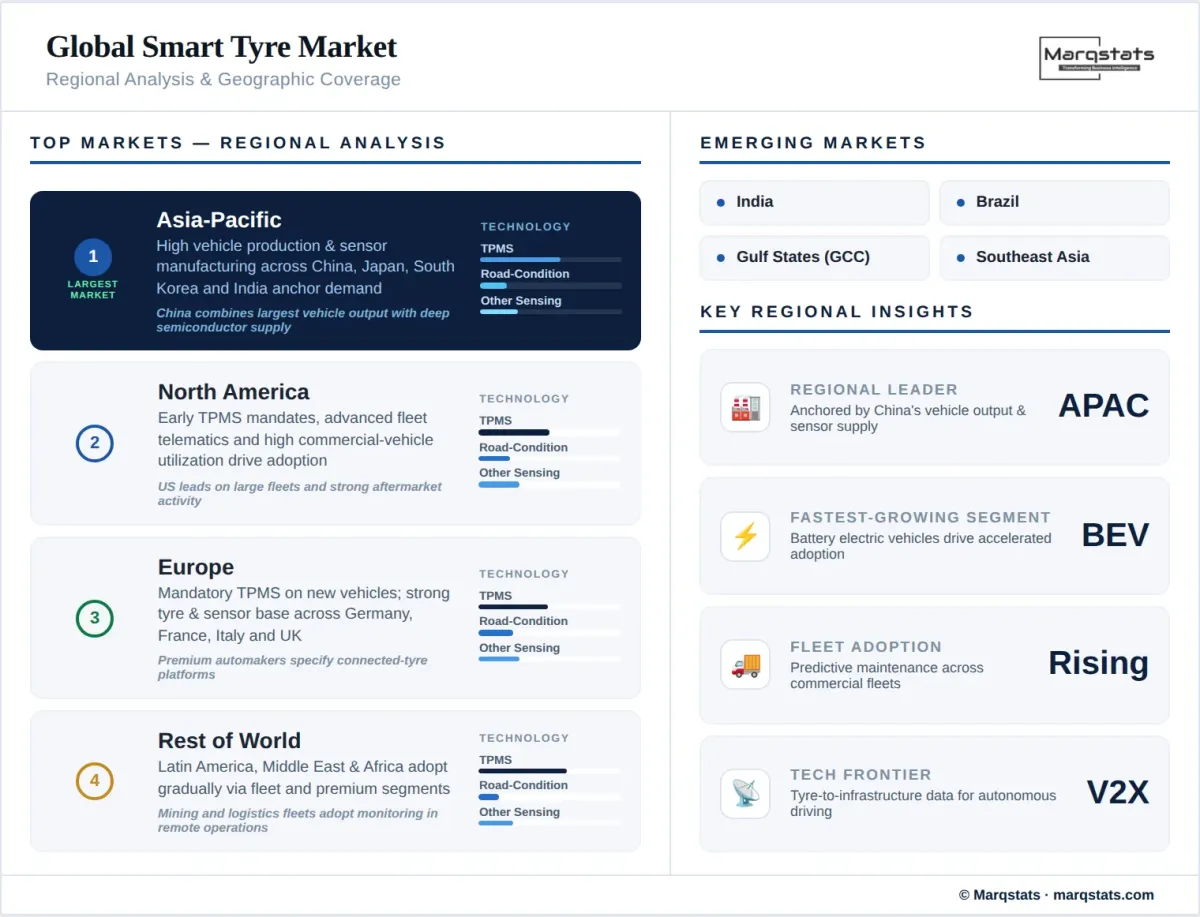
Asia-Pacific holds the largest regional share, owing to high vehicle production, sensor manufacturing capacity, and electrification across China, Japan, South Korea, and India. China anchors regional demand through extensive vehicle output and domestic sensor supply. Japan and South Korea contribute through established tyre and semiconductor manufacturers. India adds growth across passenger and commercial vehicles, supported by rising vehicle safety awareness. Regional adoption aligns with the expansion of commercial-vehicle safety and driver-monitoring systems across fleets.
Country dynamics vary across the region. China combines the largest vehicle output with deep sensor and semiconductor supply, supporting both original-equipment fitment and export. Japan and South Korea host established tyre manufacturers and sensor suppliers that develop advanced sensing platforms. India expands across passenger and commercial vehicles, owing to rising safety awareness, fleet modernization, and growing electric-vehicle adoption. Local manufacturing lowers cost and broadens access across price-sensitive buyers, reinforcing the regional growth lead.
North America
North America represents a major regional market, owing to early pressure-monitoring mandates, advanced fleet telematics, and high commercial-vehicle utilization. The United States contributes the foremost national share, owing to large vehicle fleets and strong aftermarket activity. Pressure-monitoring rules on passenger vehicles sustain baseline demand. Fleet operators adopt predictive maintenance and telematics integration, owing to operating-cost and safety value. Canada adds demand across passenger and commercial segments.
Commercial fleets anchor regional growth. Long-haul trucking, last-mile delivery, and logistics operators deploy pressure and temperature monitoring across large tyre pools, owing to the cost of unplanned downtime and tyre failure. Integration of sensor data into fleet dashboards consolidates monitoring across vehicles, supporting route and maintenance decisions. Aftermarket retrofit kits extend monitoring to existing commercial vehicles, broadening the addressable base beyond new-vehicle fitment.
Europe
Europe holds a substantial regional share, owing to mandatory tyre-pressure monitoring on new vehicles and a strong base of tyre and sensor manufacturers across Germany, France, Italy, and the United Kingdom. Sensor integration and tyre labelling follow harmonized European tyre and rubber industry standards, owing to regional regulatory alignment. Stringent vehicle-safety and emission rules favor low-rolling-resistance, sensor-equipped tyres. Premium automakers specify connected-tyre platforms across new models. Fleet electrification strengthens demand for monitoring across commercial vehicles.
Rest of World
Rest of World, spanning Latin America, the Middle East, and Africa, contributes a smaller share. Vehicle-fleet growth in Brazil and the Gulf supports gradual adoption. Rising vehicle production and safety awareness ease market entry. Limited regulatory mandates and price sensitivity constrain deployment outside fleet and premium segments. Mining, logistics, and construction fleets in resource economies adopt pressure and temperature monitoring, owing to the cost of tyre failure in remote operations.
How Competition Is Evolving
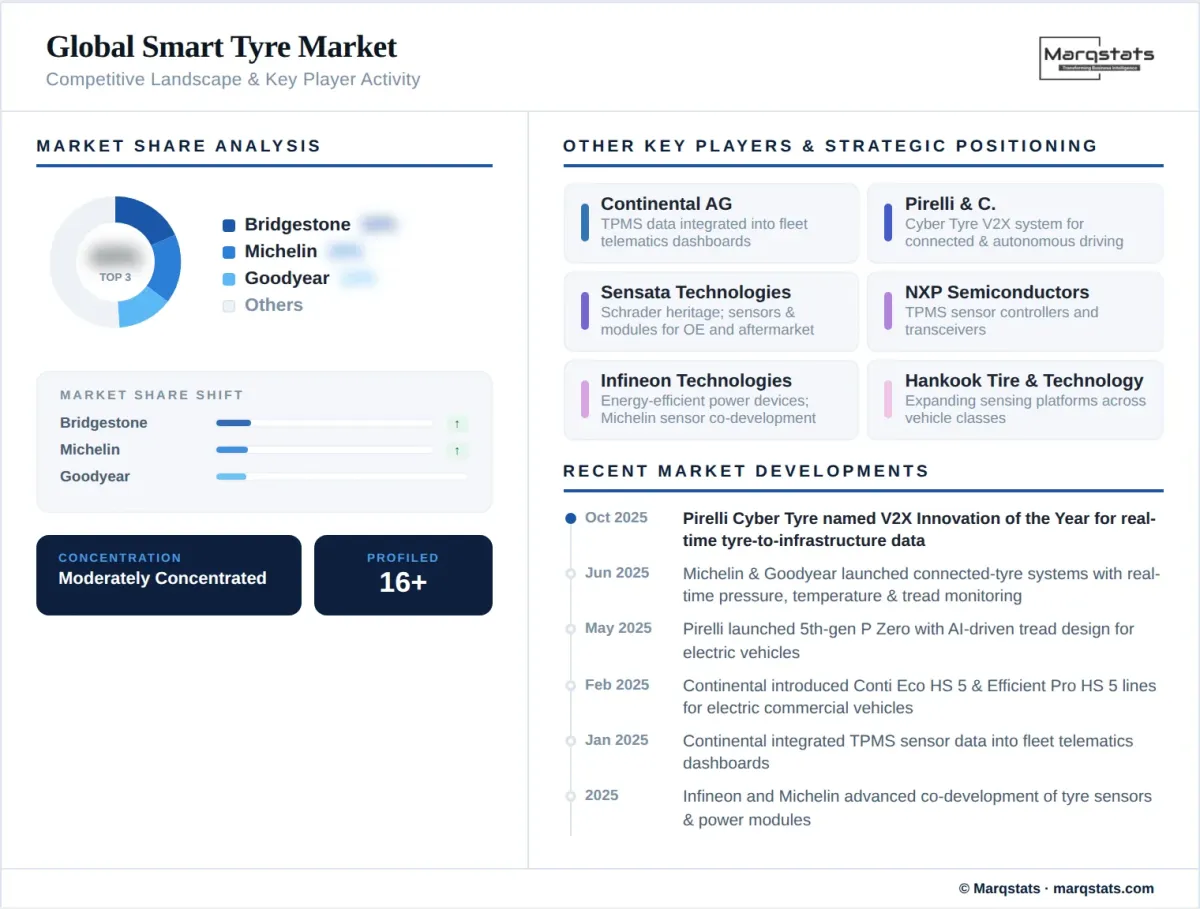
The smart tyre market combines established tyre manufacturers with semiconductor and sensor suppliers. Tyre makers hold strong positions, owing to brand recognition, original-equipment relationships, and global manufacturing. Sensor and semiconductor suppliers contribute pressure, temperature, and acceleration sensors, controllers, and energy-harvesting electronics. No single manufacturer dominates global smart tyre revenue. Competition spans pressure-monitoring fitment and premium connected-tyre platforms.
Manufacturers compete through sensor integration, cloud analytics, and vehicle-to-everything connectivity. Bridgestone advances tyre-monitoring and sensing platforms for original-equipment and fleet use. Michelin develops connected-tyre and road-sensing systems and partners with semiconductor suppliers on advanced sensors. The Goodyear Tire & Rubber Company fields connected-tyre platforms with cloud analytics for fleets. Continental integrates pressure-monitoring data into fleet telematics dashboards. Pirelli advances vehicle-to-everything tyre systems for connected and autonomous applications.
Geographic expansion and product diversification define competitive activity. Tyre manufacturers partner with semiconductor and software suppliers to add sensing and analytics. Continental expanded fleet telematics integration through 2025, while Michelin pursued sensor co-development with a semiconductor supplier. Strategic partnerships and acquisitions strengthen sensing platforms and accelerate connected-tyre deployment.
Pricing strategy, original-equipment relationships, fleet partnerships, and software ecosystems shape competitive positioning. Connected analytics, sensor accuracy, and integration depth serve as primary differentiators. Manufacturers position smart tyres on safety, fuel efficiency, and fleet operating cost, supporting adoption across passenger and commercial buyers.
Semiconductor and sensor suppliers hold a structural role in the value chain. Sensata Technologies, through its Schrader pressure-monitoring heritage, supplies sensors and modules to automakers and the aftermarket. NXP Semiconductors and Infineon Technologies provide tyre-pressure sensor controllers, transceivers, and energy-efficient power devices. These suppliers enable the shift from pressure monitoring toward integrated sensing, and partnerships between tyre makers and semiconductor suppliers accelerate connected-tyre development. Component supply concentration gives sensor specialists durable influence over platform cost and capability.
Companies Covered
The report profiles 16++ companies with full strategy and financials analysis, including:
Recent Market Activity
Table of Contents
Coverage & Segmentation
This report analyzes the global smart tyre market across the 2021–2025 historical period and the 2026–2030 forecast period, with 2025 as the base year. Coverage spans market size by value, segmentation by technology, vehicle type, and sales channel, regional and country-level analysis, competitive positioning, and recent developments. The study examines demand drivers, restraints, pricing dynamics, and regulatory influence across major regions.
Primary research included 40+ interviews with tyre manufacturers, sensor and semiconductor suppliers, fleet operators, and original-equipment automakers. Secondary research drew from government vehicle-safety regulators, industry associations, company filings, patent records, and trade publications. Market estimates were built bottom-up and validated against top-down references for internal consistency.