Market Snapshot
Key Takeaways
Market Overview & Analysis
Report Summary
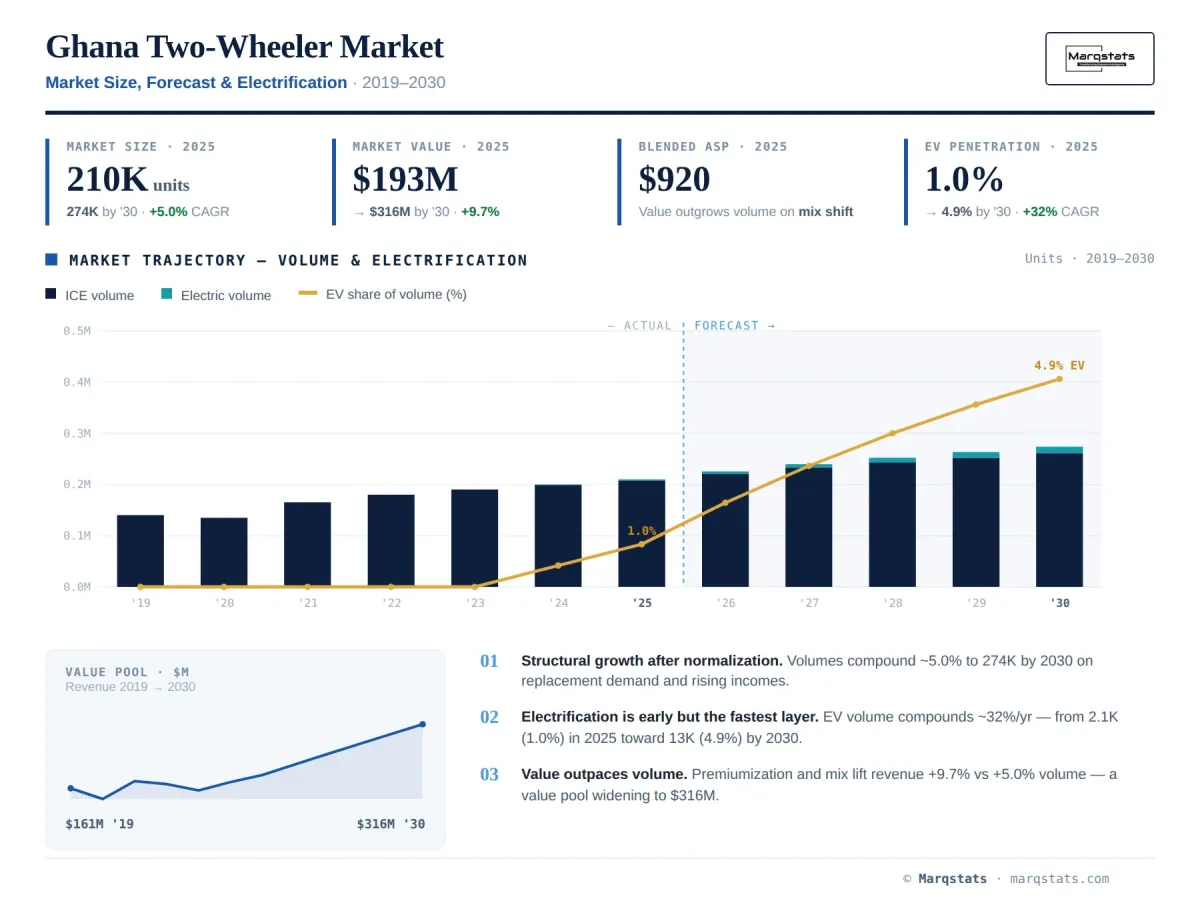
The Ghana two-wheeler market is a steadily growing motorcycle market with a regulatory profile that sets it apart from its regional peers. For years, commercial motorcycle-taxi operation, known locally as okada, was restricted under national road-traffic regulations, and the market developed around personal ownership, delivery, and utility use rather than the passenger-taxi fleets that anchor markets such as Kenya and Tanzania. The market generated USD 193.2 million in revenue in 2025 on about 210,000 units, and B2C demand holds about 71% of the market. The historic restriction on okada meant riders had no legal route to operate passenger-taxi services, so demand accumulated instead around private owners, small traders, and delivery operators who use motorcycles to move goods and reach customers.
A pivotal regulatory shift is reshaping the market. Through 2025 the government moved to formalise commercial motorcycle operation, directing the Driver and Vehicle Licensing Authority to register and license motorcycles for commercial use, and Parliament passed a Road Traffic Amendment Bill legalising okada and tricycle services. This change is set to unlock commercial and fleet demand over the forecast period, adding a new growth layer to a market that has until now been led by personal buyers. Licensed operation is expected to bring riders into recognised unions, structured financing, and formal training, changing how machines are bought and used and opening room for fleet-oriented models and financing partnerships.
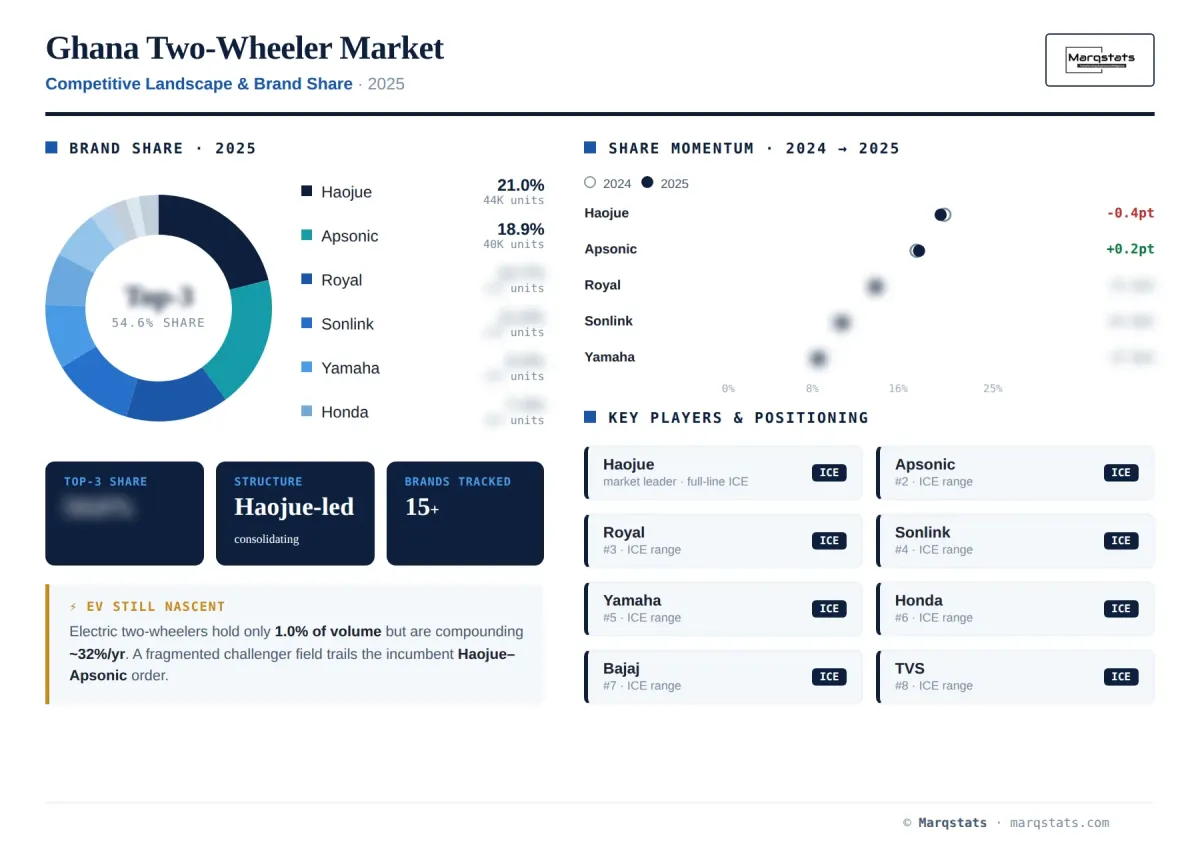
Market structure is fragmented and unusually local. Chinese brand Haojue leads at about 21% of revenue, yet Ghanaian assembler-brands hold prominent positions: Apsonic follows at about 19%, Royal at about 15%, and Sonlink at about 12%. Japanese brands Yamaha and Honda, and Indian brands Bajaj and TVS, complete the main field. The prominence of local assembler-brands, alongside Chinese, Japanese, and Indian marques, distinguishes Ghana from markets dominated by a small number of foreign leaders and reflects a mature local assembly and distribution base.
Market Dynamics
Key Drivers
- Steady urbanization and demand for affordable, flexible transport sustain rising motorcycle ownership across the country.
- The 2025 legalisation of commercial motorcycle operation is set to unlock fleet and taxi demand over the forecast period.
- Growth of delivery and e-commerce logistics raises demand for motorcycles as goods-movement vehicles in cities.
- Local assembly of major brands lowers costs and supports service and spare-parts availability nationwide.
Key Restraints
- Import duties, taxes, and currency movements raise machine prices in a price-sensitive market.
- Road-safety concerns and helmet compliance accompany the formalisation of commercial motorcycle use.
- Limited charging and swap infrastructure slows the shift toward electric two-wheelers beyond early pilots.
Key Trends
- Regulatory formalisation of okada is set to expand the commercial and fleet base of the market.
- Electric two-wheelers grow fastest at a 37.38% CAGR from a small base, led by local e-mobility startups.
- Online retail expands fastest among channels at a 23.29% CAGR, though physical dealers still handle most value.
- Local assembler-brands sustain strong positions alongside Chinese, Japanese, and Indian marques.
Market Segmentation
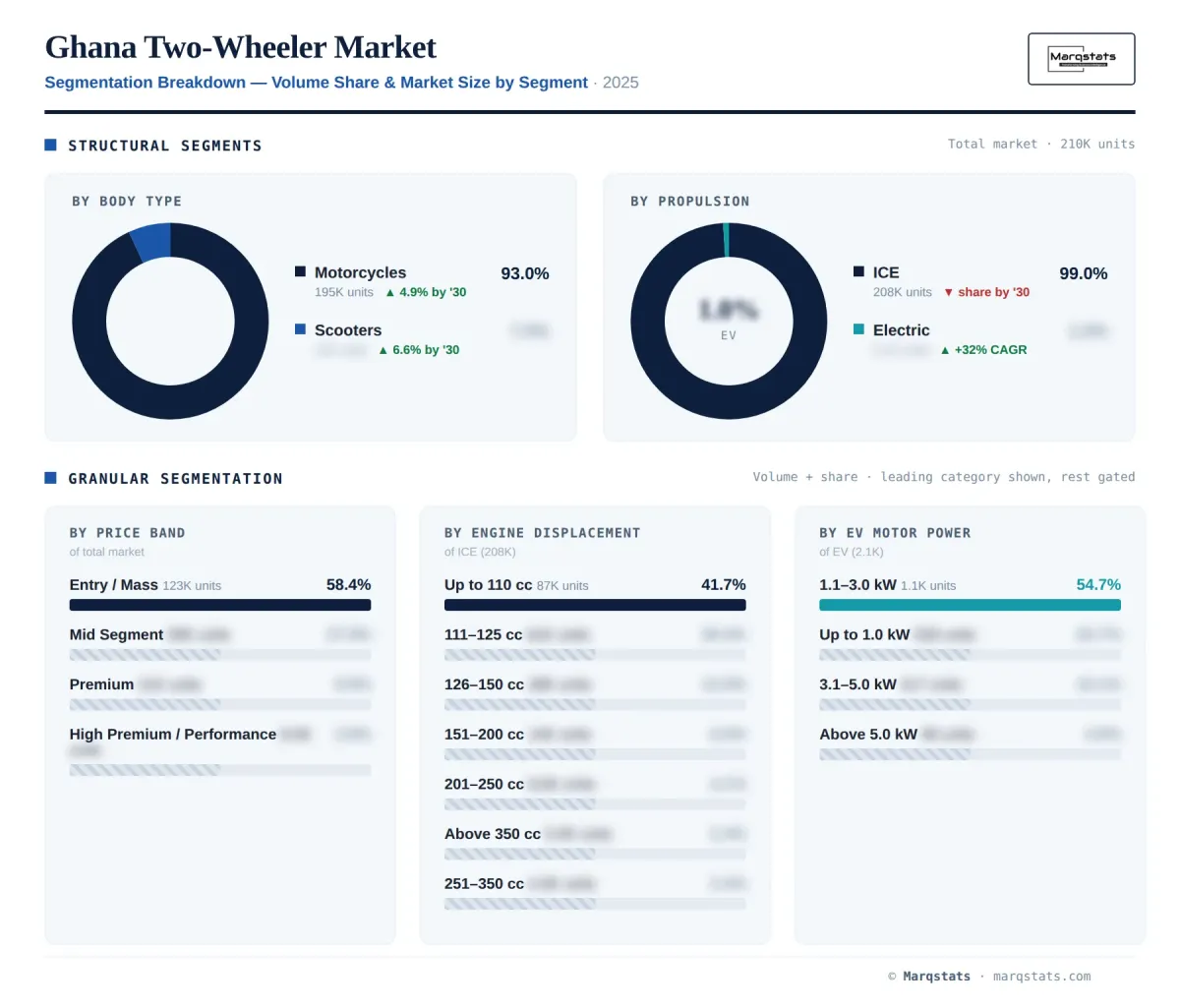
Motorcycles overwhelmingly dominate the vehicle-type segment, generating USD 179.7 million in 2025, about 93% of market revenue, and rising to USD 292.0 million by 2030 at a 9.54% CAGR. The segment is built on rugged, affordable commuter, utility, and delivery machines suited to Ghanaian conditions. Chinese and local assembler-brands supply most of this segment, with entry and mid-displacement machines forming the core of demand across cities and the motorcycle-heavy northern regions. Durability, fuel efficiency, low purchase price, and the availability of spare parts and service determine buying decisions, since machines are expected to serve daily transport and income-earning roles over long operating lives. Replacement demand from an ageing and heavily used fleet adds a steady, recurring layer of sales.
Scooters and mopeds generated USD 13.5 million in 2025, about 7% of revenue, and grow to USD 23.8 million by 2030 at an 11.21% CAGR, the faster-growing vehicle type in percentage terms. The segment serves urban commuting and lighter delivery use, and its share remains minor in a market where rugged motorcycles suited to utility and commercial roles dominate. Scooter growth outpaces motorcycles in percentage terms from a small base, though motorcycles remain almost the entire market by both value and volume. Demand for scooters is concentrated in urban southern centres rather than the motorcycle-heavy north, where rugged motorcycles better suit the terrain and utility roles that define local demand.
Internal combustion engine models overwhelmingly dominate the market, generating USD 191.3 million in 2025, about 99% of revenue, and growing to USD 300.5 million by 2030 at an 8.85% CAGR. Combustion demand is anchored in affordable, low-displacement commuter and delivery motorcycles, with Haojue, Apsonic, Royal, and Sonlink the principal brands. The combustion share edges down over the forecast period as electric machines begin to appear, though it remains the overwhelming majority of demand throughout, supported by established fuel supply and a dense network of mechanics able to service and repair machines across the country.
Electric is the fastest-growing propulsion category, expanding from USD 1.9 million in 2025 to USD 15.4 million by 2030 at a 37.38% CAGR, having emerged only recently. Adoption is at an early stage, led by local e-mobility startups and delivery-focused deployments, and it reflects the delivery-led pattern of early adoption seen in other electric two-wheeler markets tracked by Marqstats. Growth is driven by running-cost savings for delivery and commercial riders, though electric remains a small share of the market through the forecast period, constrained by charging and swap infrastructure. Local startups building electric two-wheelers and swap networks have targeted delivery fleets first, where predictable routes and high daily mileage make the running-cost savings most compelling. The pace of financing availability, battery-swap build-out, and electricity access will determine how quickly electric machines move from delivery pilots into the mainstream market.
Within combustion models, entry displacements dominate. The up-to-110 cc band is the largest tier by revenue at USD 79.7 million in 2025, followed by the 111 to 125 cc band at USD 56.1 million; together these entry classes represent about 71% of combustion revenue, consistent with a market centred on affordable commuter, utility, and delivery motorcycles. The 126 to 150 cc band adds USD 25.9 million, while larger displacements above 250 cc remain small, reflecting limited demand for premium or high-displacement machines relative to the mass base. The concentration in low-displacement classes reflects the economics of the market, where affordability, fuel efficiency, and ease of repair outweigh power for the majority of buyers.
Within electric models, demand is led by the 1.1 to 3.0 kW band at USD 1.1 million in 2025, the typical power class for commercial electric motorcycles, followed by the up-to-1.0 kW band at USD 0.5 million. The higher-power bands are smaller yet expand fastest, with the above-5.0 kW band growing at a 49.91% CAGR as more capable machines enter service. The electric motor-power mix reflects delivery and commercial use, where range and load capacity matter for riders.
The entry and mass price band dominates the market, generating USD 112.9 million in 2025, about 58% of revenue, followed by the mid segment at USD 53.9 million; together the two lower tiers account for roughly 86% of the market, underscoring its affordability-driven character. The premium and high-premium bands are smaller yet grow faster, at 10.91% and 13.86% CAGR respectively, as a segment of buyers trades up. The high-premium and performance band, at USD 7.3 million in 2025, is the fastest-expanding price tier, though it remains a minor share of overall demand. The pricing structure mirrors the affordability-driven base of the market, and premiumisation is a gradual, secondary theme rather than a primary driver of value.
B2C demand dominates the Ghana two-wheeler market, an unusual profile driven by the historic restriction on commercial motorcycle-taxi operation. The B2C segment generated USD 138.0 million in 2025, about 71% of revenue, growing at a 9.49% CAGR, while B2B and fleet demand accounted for USD 55.2 million. Within commercial demand, delivery and logistics form the largest use at USD 35.4 million, reflecting the growth of goods movement and e-commerce across the country, followed by government and institutional demand at USD 14.0 million and ride-hail and passenger services at USD 5.8 million. The small ride-hail share reflects the historic okada restriction, and the 2025 legalisation is set to raise the commercial and fleet base over the forecast period. This B2C-led profile shapes the whole market: personal buyers weigh affordability, durability, and running cost, and demand is spread across commuters, traders, and households rather than concentrated in taxi fleets, giving the market a broad and resilient base. As commercial operation is formalised, a rising share of demand is expected to shift toward fleet and taxi buyers, gradually rebalancing the market.
Offline dealers overwhelmingly dominate the channel mix, handling USD 183.5 million of revenue in 2025 and growing at an 8.60% CAGR, owing to the financing, service, and rider-support functions that motorcycle purchases require across a nationwide network. Online sales, however, expand fastest at a 23.29% CAGR, rising from USD 9.7 million as digital channels and marketplace listings gain share. The channel shift is gradual, and physical dealers retain the large majority of value through the forecast period, supported by the role of after-sales service and spare-parts access in ownership. Online channels are most visible in Accra and southern cities, where digital adoption and delivery-linked demand are highest.
By Geography
Northern Region and Northern Ghana
Northern Ghana, including the Northern, Upper East, Upper West, and Savannah regions centred on Tamale, is the motorcycle heartland of the country. In these areas, motorcycles are the primary means of personal and commercial transport, reaching communities across dispersed and rural terrain. High ownership density and everyday reliance on motorcycles make northern Ghana the largest demand region and the core of personal-ownership demand. Dealer networks and local assembler-brands are well established in these areas, and affordability governs demand where motorcycles are an economic necessity rather than a discretionary purchase.
Greater Accra and Southern Cities
Greater Accra, the capital region, and southern cities such as Kumasi and Takoradi form the commercial and delivery hub. Motorcycles are used mainly to move goods and escape traffic congestion, and okada services are commonplace despite the historic restriction. The concentration of e-commerce, delivery platforms, dealers, and financiers in these cities makes them the centre of commercial demand and the testing ground for electric and formalised commercial models. As commercial operation is licensed, these cities are expected to see the fastest growth in fleet and taxi demand.
Middle Belt and Rural Areas
Across the middle belt and rural areas, motorcycles serve as essential economic connectors, transporting agricultural produce and people where public transport is limited. Demand in these areas reflects utility and personal use, and it underpins durable, low-cost machines and sustains steady replacement activity across a large and geographically dispersed base. As incomes rise and roads improve, these areas add incremental demand and widen the geographic base of the market.
How Competition Is Evolving
The Ghana two-wheeler market is fragmented, with no single brand dominant. Chinese brand Haojue leads at about 21% of revenue in 2025, followed by Ghanaian assembler-brands Apsonic at about 19%, Royal at about 15%, and Sonlink at about 12%. Japanese brands Yamaha and Honda, and Indian brands Bajaj and TVS, hold further positions, with a tail of Chinese and local brands completing the market. The prominence of local assembler-brands is a defining feature of the Ghanaian market, and it rests on years of local assembly, adapted machines, and dealer reach into the motorcycle-heavy northern regions.
Competition centres on price, durability, financing, and dealer and service reach. Local assembler-brands compete on affordability, machines adapted to Ghanaian conditions, and extensive dealer networks, while Chinese brands compete on low prices and Japanese and Indian brands defend positions on reputation and durability. Local assembly lowers costs and supports service and spare-parts availability, and the ability to reach the motorcycle-heavy northern regions is central to competitive positioning. Brands that combine affordable pricing with dependable after-sales support and wide dealer coverage hold the strongest positions in a market where buyers depend on their machines daily.
The 2025 formalisation of commercial motorcycle operation is beginning to reshape the competitive field. As okada and tricycle services move toward licensed, regulated operation, demand for fleet-suitable machines and financing is set to rise, and brands able to serve commercial operators reliably stand to gain. Electric competitors, led by local e-mobility startups, compete on running-cost savings for delivery riders, and the pace of infrastructure build-out and financing will determine how quickly the electric segment scales from its small base.
The competitive field is likely to remain fragmented through the forecast period, with local assembler-brands, Chinese, Japanese, and Indian marques competing across price tiers and use cases, and electric startups expanding from a small base. Local assembly, financing capacity, dealer-network reach, and the ability to serve both personal buyers and a formalising commercial segment will increasingly determine which brands gain and hold share in the Ghanaian market.
Companies Covered
The report profiles 16+ companies with full strategy and financials analysis, including:
Recent Market Activity
Table of Contents
Coverage & Segmentation
This report provides a comprehensive analysis of the Ghana two-wheeler market for the 2021 to 2025 historical period and the 2026 to 2030 forecast period, with 2025 as the base year. The study quantifies market size in revenue terms and in unit volume, and segments the market by vehicle type, propulsion type, engine displacement and motor power, price band, end user, sales channel, and brand. It examines the drivers, restraints, and trends shaping demand, and profiles the competitive structure of the market.
The study focuses on registered two-wheelers, spanning motorcycles, scooters, mopeds, and electric light vehicles. Coverage addresses the distinctive regulatory profile of the Ghanaian market, including the historic restriction on commercial motorcycle operation and its 2025 formalisation, the dominance of personal-ownership and delivery demand, the fragmented and unusually local brand field, the early stage of electrification, and the composition of demand across personal, delivery, and commercial use, and the expected effect of commercial formalisation on the market. Values are reported in USD MN, and regional demand is examined across northern Ghana, Greater Accra and the southern cities, and the middle belt and rural areas.