Market Snapshot
Key Takeaways
Market Overview & Analysis
Report Summary
The India EV battery thermal safety testing market covers testing, validation, inspection, and certification services that assess the thermal stability, thermal runaway risk, fire propagation behaviour, abuse resistance, and regulatory compliance of electric vehicle battery cells, modules, and packs. The market includes AIS-156 testing for L-category vehicles, AIS-038 Revision 2 testing for M and N category vehicles, thermal propagation testing, battery fire testing, and management-system safety validation. Services extend across overcharge, short-circuit, crush, penetration, vibration, and thermal cycling protocols, together with homologation and conformity-of-production validation.
India crossed 2.27 million electric vehicle sales in calendar year 2025, with all four vehicle segments scaling new highs. Electric two-wheelers held about 56% of volume and electric three-wheelers around 35%, while electric cars and utility vehicles reached 176,980 units. The expanding installed base raises the focus on cell-level, module-level, and pack-level safety validation. A larger vehicle parc also increases demand for post-market failure analysis and warranty-related investigation.
India’s broader electric vehicle testing, inspection, and certification economy was estimated at around USD 36 million in 2023 and is assessed to approach USD 126 million by 2030, expanding at close to 19% each year. The thermal safety testing and certification segment forms a defined and fast-expanding fraction of this economy, owing to the mandatory nature of thermal propagation and abuse testing. Transportation applications account for the majority of national battery testing-inspection-certification spending, with electric two-wheeler and three-wheeler packs concentrating cell-level and pack-level test requirements. The global electric vehicle battery testing market provides directional context, assessed at around USD 4 billion in 2025 and close to USD 9 billion by 2030.
National safety standards form the structural foundation of the market. AIS-156 and AIS-038 Revision 2 were strengthened through Amendment 3, implemented in two phases on 1 December 2022 and 31 March 2023, as set out in amendments notified by the Ministry of Road Transport and Highways. The amendments added requirements covering battery cells, management systems, chargers, pack design, and thermal propagation arising from internal cell short circuit. Traction battery cells must comply with IS 16893 Part 2 and Part 3, while complete modules and packs follow AIS-156 or AIS-038 Revision 2 according to vehicle category.
Phase 1 requirements, effective from 1 December 2022, covered pack traceability, additional safety fuses, protection against regenerative braking, cell-to-cell spacing, and microprocessor-based management systems. Phase 2 requirements, effective from 31 March 2023, added earth-leakage detection on chargers, electromagnetic compatibility testing of management systems, cell testing from accredited laboratories, thermal propagation testing, audio-visual warning during a thermal event, four temperature sensors, and active parallel circuits. The phased structure made battery safety validation a recurring requirement across the industry. The earlier AIS-048 standard was withdrawn, consolidating safety validation under AIS-156 and AIS-038 Revision 2.
Market Dynamics
Key Drivers
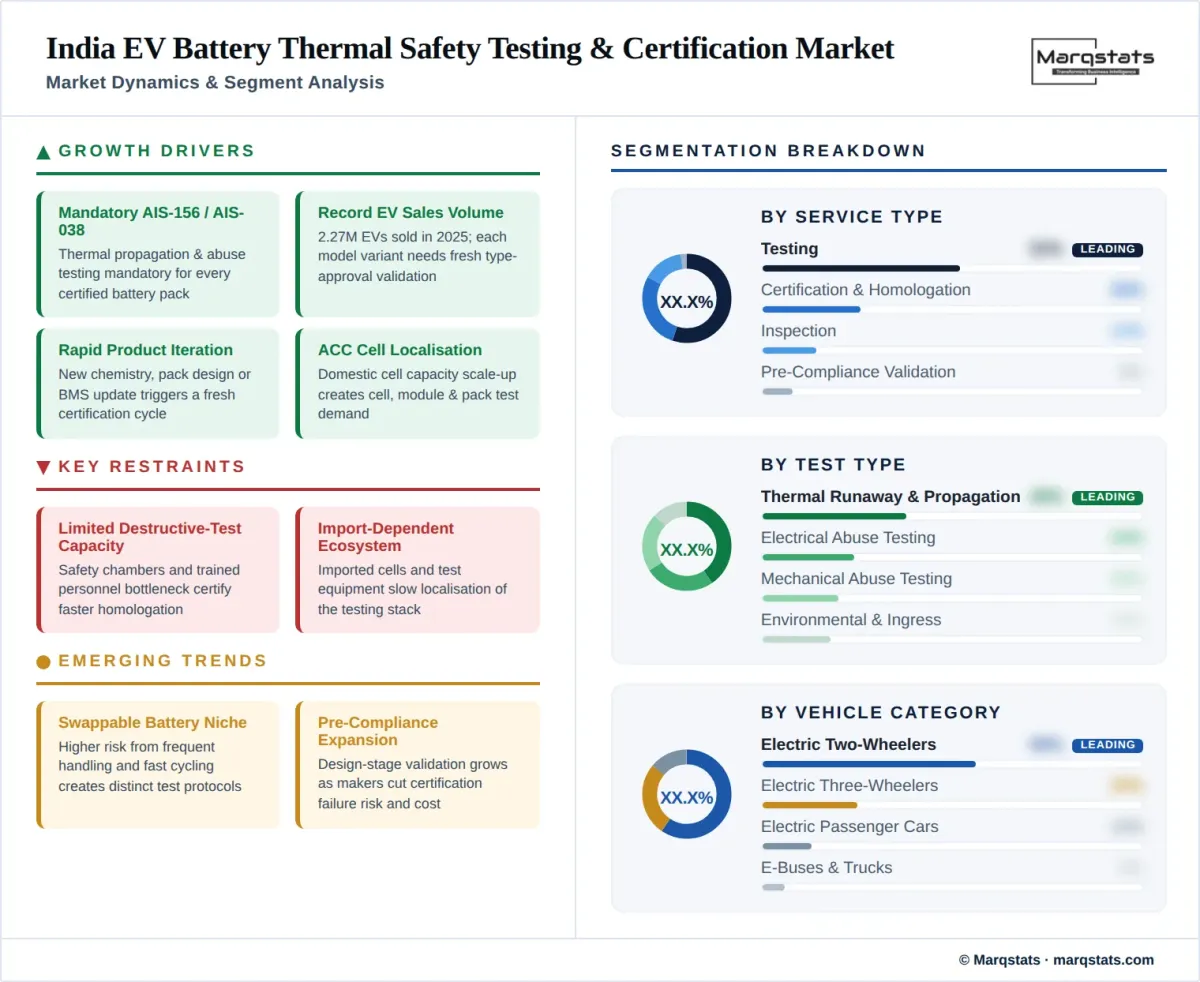
- Mandatory battery safety compliance forms the strongest driver, as national standards now require thermal propagation and abuse testing for every certified battery pack.
- Rising electric vehicle production sustains recurring test demand, with India recording 2.27 million electric vehicle sales in 2025 and more than 5.75 million units across the past three years.
- Frequent product iteration increases test frequency, since each new chemistry, pack design, management-system update, and supplier change requires fresh validation and type approval.
- Domestic cell manufacturing under the Advanced Chemistry Cell programme administered by the Ministry of Heavy Industries creates demand for cell, module, and pack testing as capacity moves from pilot to commercial scale.
- Public attention on battery fire incidents reinforces regulatory focus, sustaining demand for thermal runaway, fire propagation, and abuse testing services.
- Government adoption schemes sustain volume growth, with the PM E-DRIVE programme committing about INR 10,900 crore toward more than 28 lakh electric vehicles by March 2028, widening the certified vehicle base.
Key Restraints
- Specialised infrastructure requirements limit capacity expansion, as destructive thermal and abuse testing needs safety chambers, instrumentation, trained personnel, and regulatory recognition.
- Certification bottlenecks affect smaller manufacturers and startups, since limited accredited destructive-test facilities extend validation timelines.
- Price sensitivity among domestic manufacturers constrains premium certification packages, as margin pressure encourages selection of lower-cost accredited providers.
- Dependence on imported cells and test equipment slows localisation of the testing ecosystem, owing to limited domestic upstream capability.
- Limited domestic critical-mineral refining sustains import dependence, since refined battery-grade material is almost entirely imported, constraining the pace of an integrated domestic testing ecosystem.
Key Trends
- Swappable battery certification is becoming a defined niche, owing to higher operational risk from frequent handling, multiple users, and fast charging.
- Pre-compliance and design-stage validation is expanding, as manufacturers seek to reduce certification failures ahead of formal homologation.
- Failure analysis and forensic services are growing from a small base, supported by demand from insurers and fleet operators investigating thermal events.
- Private testing-inspection-certification firms are expanding battery service portfolios alongside government-notified agencies, increasing competition across the value chain.
- Battery recycling and second-life assessment is emerging as a connected requirement, with national recycling capacity near 2 GWh against assessed demand approaching 128 GWh by 2030.
Market Segmentation
Testing accounts for the largest share of service revenue, covering electrical, mechanical, environmental, and thermal protocols at cell, module, and pack level. Demand is driven by mandatory type-approval testing for every new battery variant. Test volume scales with each chemistry and pack-design change.
Inspection services support conformity-of-production checks and periodic safety audits across manufacturing lines. Demand is increasing owing to stricter traceability and quality requirements under amended standards. Inspection forms a recurring revenue stream tied to production volume. Conformity-of-production checks recur across the product life, sustaining steady engagement between manufacturers and notified agencies.
Certification and homologation validate that battery packs meet AIS-156 or AIS-038 Revision 2 before market entry. This segment carries high commercial value, as type approval gates product launch. Certification visibility concentrates among government-notified agencies.
Pre-compliance validation assesses battery designs ahead of formal certification. Manufacturers use this service to reduce the risk of certification failure and shorten development timelines. The segment is expanding alongside domestic cell and pack programmes.
Failure analysis investigates thermal events, field failures, and warranty claims. Demand is increasing owing to a larger installed base and rising interest from insurers and fleet operators. This segment is growing from a small base.
This category holds the dominant share, as amended standards mandate validation of fire propagation arising from internal cell short circuit. Destructive testing determines thermal stability under overcharge, peak discharge, and short-circuit conditions. The category drives the highest laboratory investment within the market.
Electrical abuse testing covers overcharge and external and internal short-circuit protocols, typically conducted at cell level. These tests confirm protection against electrical fault conditions. The category supports both cell certification and pack validation.
Mechanical abuse testing includes crush, penetration, vibration, and mechanical shock protocols. These tests validate structural integrity and resistance to physical damage. Penetration testing is applied with specific provisions for high-energy-density cells.
Environmental testing covers thermal cycling and ingress protection such as IP67. These protocols confirm performance under temperature variation and exposure to water and dust. Ingress testing is mandatory for battery packs across vehicle categories.
Battery management system validation confirms protection logic, temperature monitoring, and audio-visual warning in the event of a thermal condition. Amended standards require four temperature sensors and active protection circuits. This category is expanding alongside microprocessor-based management systems.
Cell testing validates compliance with IS 16893 Part 2 and Part 3 and addresses electrical abuse at the smallest unit. This level forms the foundation of safety validation. Demand rises with domestic cell manufacturing.
Module testing assesses thermal behaviour and structural integrity at intermediate assembly. It supports propagation analysis between adjacent cells. The level bridges cell-level and pack-level validation. Module-level propagation testing has gained prominence following amended thermal-safety requirements.
Pack and rechargeable energy storage system testing represents the most comprehensive level, validating complete assemblies against AIS-156 or AIS-038 Revision 2. This level carries the highest certification value. Pack testing concentrates the largest fraction of certification revenue.
Electric two-wheelers form the dominant category, linked to AIS-156 testing and around 56% of national electric vehicle volume in 2025, as analysed in the India electric scooter and motorcycle market report. High model turnover sustains continuous test demand across multiple chemistries.
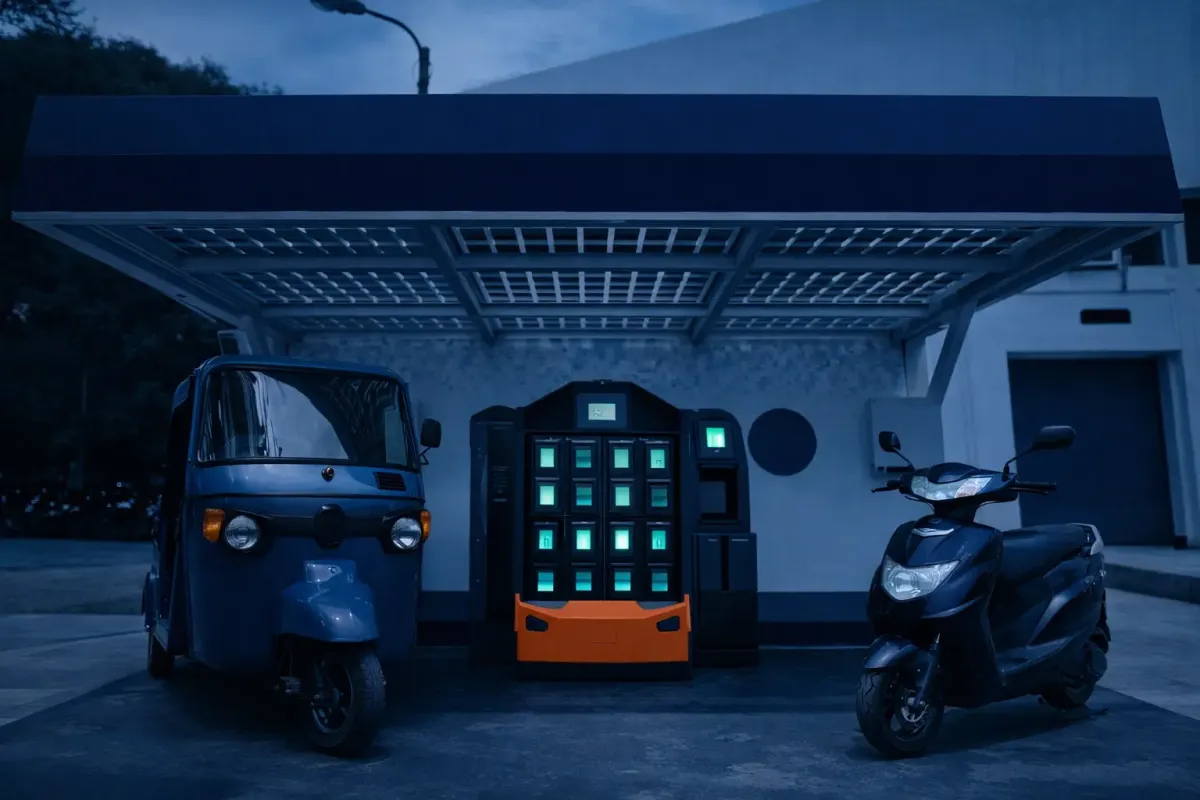
Electric three-wheelers account for a substantial share under AIS-156, supported by passenger and cargo applications. Swappable battery formats add a distinct testing requirement, also covered in the India EV battery swapping market report. Fleet usage raises the focus on durability and thermal safety.
Electric passenger cars require AIS-038 Revision 2 validation for larger packs. The segment reached 176,980 units in 2025, raising demand for high-capacity pack testing. Larger packs increase the complexity of thermal propagation validation. Higher energy content raises both test duration and certification cost per pack.
Electric buses require pack-level thermal propagation validation for high-energy systems. State transport orders sustain demand for AIS-038 Revision 2 certification. High-energy packs raise testing complexity and cost per certification.
Electric trucks and light commercial vehicles form an emerging category under AIS-038 Revision 2. Commercial fleet electrification increases demand for heavy-pack validation. The segment is expanding alongside last-mile and goods-carrier electrification.
By Geography
West India
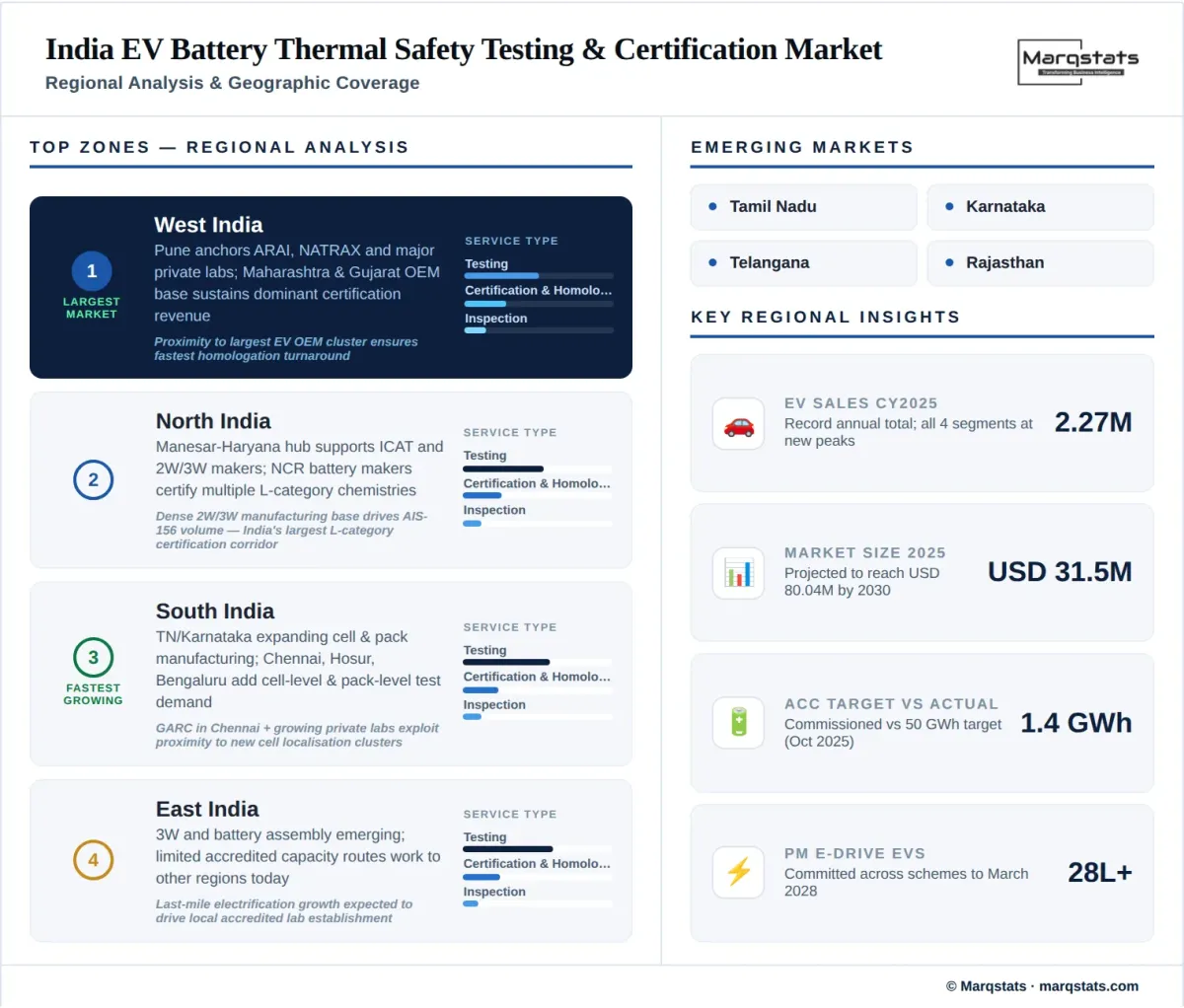
West India holds the largest share of the market, anchored by concentrated testing capacity around Pune in Maharashtra. The region hosts foremost automotive test agencies and a dense original-equipment manufacturer base across Maharashtra and Gujarat. Proximity to certification facilities supports faster homologation for battery and vehicle makers. Test demand is reinforced by passenger-car and bus assembly across Maharashtra and Gujarat. The region concentrates the largest fraction of national certification revenue.
North India
North India holds a major share, supported by automotive testing capacity around Manesar in Haryana and a strong two-wheeler and three-wheeler manufacturing base. Battery makers across the National Capital Region and Haryana certify multiple chemistries for L-category vehicles. The region records steady demand for AIS-156 validation. The cluster supports a substantial fraction of national L-category battery certification volume. Proximity to component suppliers shortens validation cycles for two-wheeler and three-wheeler makers.
South India
South India records the fastest growth, driven by expanding electric vehicle and cell manufacturing clusters across Tamil Nadu and Karnataka. The region hosts destructive-test capability and a growing base of two-wheeler and battery manufacturers. Demand is increasing owing to new cell and pack programmes near Chennai, Hosur, and Bengaluru. The region benefits from close proximity between manufacturing and destructive-test capability. Expanding cell localisation raises cell-level and pack-level test requirements.
East India
East India holds the smallest share, with demand concentrated around emerging three-wheeler and battery assembly activity. The region records growing interest in localised testing support. Limited accredited capacity directs much certification work to other regions. Demand is assessed to rise as last-mile electrification expands across the region. Growth depends on the establishment of localised accredited testing support.
How Competition Is Evolving
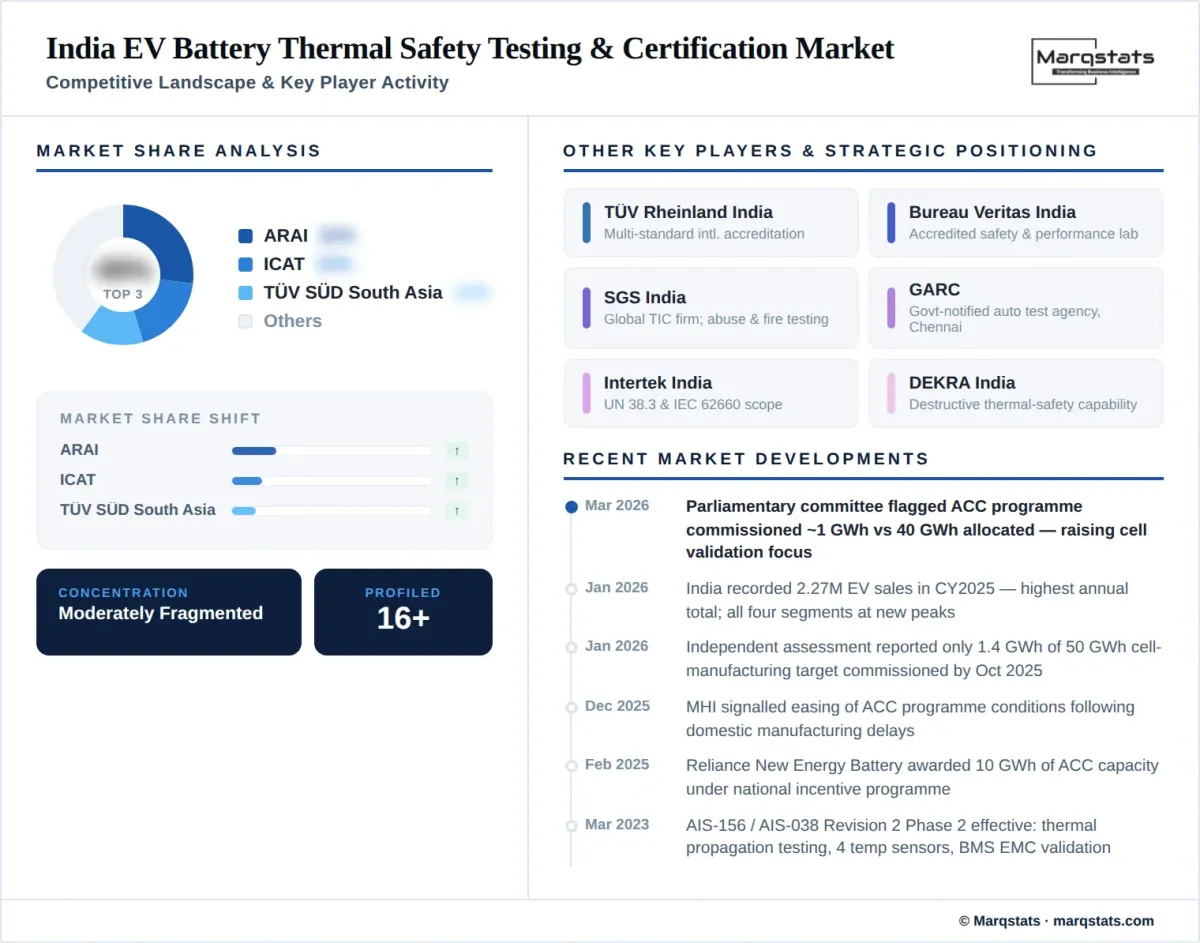
The India EV battery thermal safety testing market is moderately fragmented across four participant groups. Government-notified automotive test agencies provide homologation and certification visibility, with certification references for AIS-156, AIS-038 Revision 2, UN 38.3, and ISO 12405 published by the Automotive Research Association of India. Private testing-inspection-certification firms offer accredited safety, performance, and compliance services. Accredited engineering laboratories supply material, fire, and abuse testing. Captive validation facilities operated by manufacturers support pre-compliance design testing.
Government-notified agencies hold central positions in certification and type approval, owing to statutory recognition under the Central Motor Vehicles Rules. These agencies operate destructive-test capability for thermal runaway, overcharge, short-circuit, and penetration testing. Private firms compete through accreditation breadth, turnaround time, and integration with global certification networks. Competition is intensifying as private participants expand battery service portfolios alongside established agencies.
Competitive positioning is shaped by accreditation scope, destructive-test infrastructure, and geographic proximity to manufacturing clusters. Manufacturers increasingly combine captive pre-compliance testing with external certification to manage cost and timeline. Strategic emphasis centres on capacity expansion, laboratory accreditation, and specialised thermal-safety capability.
Government-notified agencies operate across distinct geographic hubs, with major facilities around Pune, Manesar, Indore, and Chennai. Private firms differentiate through international accreditation and multi-standard capability spanning AIS-156, AIS-038 Revision 2, UN 38.3, ISO 12405, and IEC 62660. Domestic battery makers across multiple chemistries, covering nickel-manganese-cobalt and lithium-iron-phosphate formats, continue to certify packs for two-wheeler and three-wheeler applications. Swappable battery operators form a distinct customer group, owing to the higher safety scrutiny applied to circulated and frequently handled packs.
Companies Covered
The report profiles 16++ companies with full strategy and financials analysis, including:
Recent Market Activity
Table of Contents
Coverage & Segmentation
This report provides a structured analysis of the India EV battery thermal safety testing market for the period 2021 to 2030, with 2025 as the base year and 2026 to 2030 as the forecast period. The study examines market size, growth rate, service-type segmentation, test-type segmentation, battery-level segmentation, vehicle-category segmentation, and regional distribution. Coverage extends to regulatory standards, testing infrastructure, and competitive structure across notified agencies, private firms, accredited laboratories, and captive facilities.
The scope includes AIS-156 certification, AIS-038 Revision 2 certification, rechargeable energy storage system safety testing, thermal propagation testing, thermal runaway testing, battery fire testing, abuse testing, and management-system validation. The study excludes general battery manufacturing, pack assembly, charger testing, consumer-electronics battery testing, and stationary storage testing, except where directly tied to electric vehicle traction battery safety. Market estimates use a bottom-up approach validated against top-down assessment.