Market Snapshot
Key Takeaways
Market Overview & Analysis
Report Summary
The Egypt automotive testing and homologation services market covers paid testing, calibration, conformity assessment, type-approval and homologation support and certification services tied to vehicles and automotive components. Routine workshop diagnostics are excluded, since those are vehicle maintenance rather than conformity services and belong to the aftermarket. The measure is service revenue earned by laboratories, certification bodies and engineering providers, not the value of the vehicles or components being tested.
No official industry revenue series exists for this market anywhere in Egypt, which is why confidence is graded low. Value is modelled from vehicle and model approvals, component testing activity, laboratory capacity, certification volume and the growth of local production. Service pricing and the number of tests required per model or component are not systematically published, so both the fee assumption and the engagement count carry material uncertainty. The published sizing range runs from USD 8 million to USD 14 million for 2025 and USD 22 million to USD 45 million for 2031, a spread that reflects genuine uncertainty rather than caution.
What makes the market analytically interesting is not its size but its position. At USD 11.00 million it is roughly a thirtieth of Egypt's localized component value and a hundred-and-ninety-first of domestic component demand. Yet in August 2026 the Ministry of Industry and the Federation of Egyptian Industries reviewed barriers facing automotive component producers and named high mould and testing costs alongside the absence of enough local laboratories able to issue official accreditation certificates. A component supplier that cannot obtain a certificate in Egypt cannot qualify for a programme, regardless of its manufacturing capability.
Testing and Homologation Service Revenue in Egypt
Service revenue rises from USD 11.00 million in 2025 to USD 27.54 million in 2030, a 20.15% compound annual growth rate and an absolute increase of USD 16.54 million. The indicative 2031 endpoint is approximately USD 32.06 million. The 2026 estimate of USD 15.00 million reflects a genuine step change rather than smooth growth, driven by Federal Motor Vehicle Safety Standards recognition, the first energy and emissions label permits, new GOEIC laboratory capacity and rising component certification activity. Because 2026 jumps roughly 36% on regulatory events, growth then settles to 16.40% from 2026 to 2030, and the 20.15% five-year rate blends the two.
Engagement volume and fee levels move at very different rates and the split matters for anyone entering this market. Certifications and test programmes rise from approximately 1,850 a year to 3,900, a compound rate of 16.09%, while average revenue per engagement rises only 3.50% a year from about USD 5,946 to USD 7,062. Growth comes overwhelmingly from more work rather than from higher-value work, which means capacity and accreditation scope determine revenue far more than pricing power does.
The 2031 forecast rests on recurring rather than one-off demand. More locally assembled models, electrified powertrains requiring high-voltage and battery scopes, export programmes needing destination-market certification, and supplier qualification under rising local-content requirements each generate repeat testing rather than a single approval. The forecast does not assume every laboratory accreditation granted in Egypt is automotive-specific, which is a deliberate restraint given that GOEIC's Ain Sokhna complex spans engineering scopes well beyond vehicles.
The leverage ratio is what makes this market worth a study of its own. Egypt's localized component value stands at USD 340.00 million and its domestic component demand at USD 2.10 billion, against testing and homologation revenue of USD 11.00 million. That is roughly thirty-one to one against localization and a hundred and ninety-one to one against component demand. A bottleneck sized at half a percent of the market it constrains is unusual, and it is why government intervention here has disproportionate effect: accelerating accreditation procedures costs a fraction of what new component capacity costs and unlocks more of it.
The scope boundary against the rest of the cluster is unusually clean for once. This market sits outside Egypt's automotive components market entirely, because that measure counts component demand rather than services purchased alongside it. It sits outside the vehicle manufacturing measure for the same reason. Testing revenue is a service transaction between a laboratory and a manufacturer or supplier, and it appears in none of the twelve other Egypt measures in this cluster. No overlap needs disclosing and no figure needs excluding, which is the first time that has been true across thirteen studies.
Market Dynamics
Key Drivers
- A third homologation pathway opened in July 2026 when Egypt admitted vehicles compliant with United States Federal Motor Vehicle Safety Standards, adding to the existing E-Mark and UNECE framework and creating demand for compliance interpretation, documentation and certification support across two incompatible standards regimes.
- New domestic conformity obligations began in August 2026 with the first fuel, energy-consumption and emissions-efficiency label permits issued to General Motors Egypt and MAC International under Egyptian Standard ES 9001/2024, covering a battery electric vehicle and a hybrid and creating recurring documentation demand.
- Public laboratory capacity is expanding materially, with the GOEIC industrial complex at Ain Sokhna housing 30 laboratories running 153 high-accuracy tests including automotive component, battery and engineering scopes.
- Localization directly generates validation demand, since Egypt's August 2026 roadmap links higher local content to components meeting global quality requirements and covers design, tooling, manufacturing and testing of locally produced components and vehicle bodies.
- Electrified vehicle technology adds scopes Egypt has not previously needed at volume, with the hybrid and range-extended market rising from 2,100 units in 2025 toward 26,100 by 2030 and each programme requiring high-voltage, battery and electromagnetic compatibility testing.
Key Restraints
- The accredited laboratory shortage is the market's own binding constraint, since work that cannot be certified in Egypt is performed abroad and leaves the domestic market entirely, and government identified this gap explicitly in August 2026.
- Service pricing and the number of tests required per model or component are not systematically published, which is why confidence is graded low and why the 2031 range spans USD 22 million to USD 45 million.
- Average revenue per engagement rises only 3.50% a year, so a provider cannot grow materially through pricing and must add accreditation scope or capacity instead, both of which carry long lead times.
- High mould and testing costs were named alongside laboratory scarcity as barriers facing component producers, meaning the cost of certification itself suppresses the volume of certification demanded.
Key Trends
- Test scope is fragmenting by standard rather than consolidating, with Egyptian standards, UNECE and E-Mark, Federal Motor Vehicle Safety Standards and manufacturer-specific requirements each demanding separate evidence and separate expertise.
- Advanced scopes are growing faster than conventional mechanical testing, with high-voltage, battery, electromagnetic compatibility and driver assistance and connected vehicle testing rising from a near-zero Egyptian base.
- Supplier qualification is emerging as a recurring commercial segment as local content rises, since production part approval and customer qualification generate repeat testing across a supplier's programme life rather than a single certificate.
- Export certification is becoming a distinct demand stream, since Egyptian component exports exceeding USD 1 billion in 2025 require destination-market approvals that domestic conformity does not satisfy.
Market Segmentation
The largest service segment by engagement count and the one most directly affected by the accredited laboratory shortage identified in August 2026. It covers durability, materials, dimensional and performance testing for suppliers seeking qualification, and it scales with component localization rather than with vehicle volume, which is why it grows alongside a localized component value rising from USD 340 million to USD 830.90 million.
The highest-value service per engagement and the segment most changed by the July 2026 Federal Motor Vehicle Safety Standards recognition. A vehicle model approval carries substantially more fee than a component certificate, and with three parallel standards pathways now operating, interpretation and documentation work has expanded faster than the number of models being approved.
The segment created most recently, driven by Egyptian Standard ES 9001/2024 and the first fuel, energy-consumption and emissions-efficiency label permits issued in August 2026 to General Motors Egypt and MAC International. Labelling obligations apply across internal combustion, hybrid and electric categories, which makes this the broadest recurring conformity requirement in the Egyptian market.
The steadiest and least cyclical segment, underpinning every other service because a test result is only as credible as the instrument that produced it. It benefits directly from GOEIC's Ain Sokhna complex, whose 30 laboratories run 153 high-accuracy tests, and it carries the lowest fee per engagement of the four service types.
The established pathway and still the dominant one, underpinning most vehicle approvals in Egypt and referenced explicitly in the ES 9001/2024 labelling scheme alongside Egyptian requirements. Its documentation is widely understood by international manufacturers, which makes it the lowest-friction route and therefore the highest-volume one.
The fastest-growing pathway from a standing start, created by ES 9001/2024 and activated by the first permits in August 2026. Because labelling obligations apply to approved vehicle categories broadly rather than to a subset, this pathway generates the most recurring engagements per approved model of the three.
The newest pathway, opened in July 2026 when Egypt admitted vehicles compliant with United States Federal Motor Vehicle Safety Standards. It is structurally incompatible with UNECE in several areas, which means a provider serving both must hold two distinct competencies rather than one broader one, and that is where the interpretation revenue sits.
The largest customer group by engagement count and the one whose demand grows fastest, since supplier qualification generates repeat testing across a programme's life rather than a single certificate. It is also the group most damaged by the laboratory shortage government identified in August 2026, because a supplier that cannot obtain an accreditation certificate in Egypt cannot enter a programme regardless of manufacturing capability, and localized component value is forecast to rise from USD 340.00 million to USD 830.90 million on the assumption that they can.
The highest-value customer group per engagement, requiring full type approval, labelling permits and increasingly multi-pathway documentation. General Motors Egypt and MAC International received the first ES 9001/2024 label permits in August 2026, and every locally assembled or imported model entering Egypt's 173,763-vehicle market generates approval work.
A smaller but structurally important customer group, covering conformity work commissioned by the Egyptian Organization for Standardization and Quality and testing performed at GOEIC port and industrial laboratories. Public demand is less price-sensitive and more scope-driven than commercial demand, and it underwrites capacity that commercial work alone would not justify: the 30 laboratories and 153 high-accuracy tests at Ain Sokhna serve a domestic market earning only USD 11.00 million a year in total.
The backbone of Egyptian testing capacity, centred on GOEIC's industrial laboratory complex at Ain Sokhna with 30 laboratories and 153 high-accuracy tests spanning automotive component, battery and engineering scopes. Public provision sets the accreditation baseline, and the Egyptian Accreditation Council governs recognised competence for testing and calibration laboratories nationally.
Manufacturer and Tier-1 internal laboratories handling development, validation and supplier qualification, alongside a limited private commercial sector. This is where the identified white space sits: advanced scopes that companies currently perform abroad because they cannot obtain them quickly enough in Egypt represent addressable demand already being spent, just not domestically.
By Geography
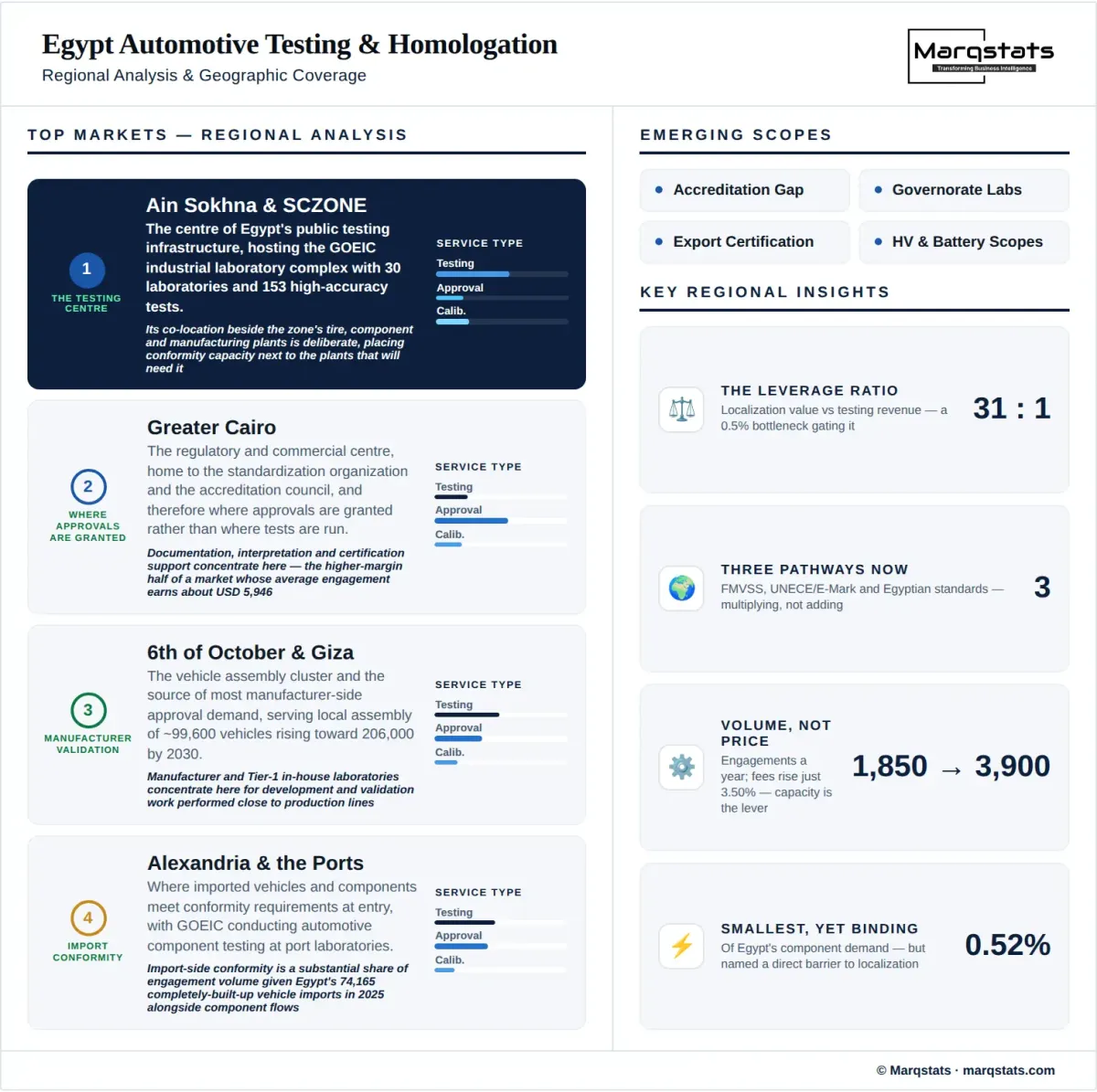
Ain Sokhna and the Suez Canal Economic Zone
The centre of Egypt's public testing infrastructure, hosting the GOEIC industrial laboratory complex with 30 laboratories and 153 high-accuracy tests. Its co-location with the zone's tire, component and manufacturing investments is deliberate, placing conformity capacity beside the plants that will need it as Egyptian component exports build on a base exceeding USD 1 billion in 2025.
Greater Cairo
The regulatory and commercial centre, home to the Egyptian Organization for Standardization and Quality and the Egyptian Accreditation Council, and therefore where approvals are granted rather than where tests are run. Documentation, interpretation and certification support concentrate here, which is the higher-margin half of a market whose average engagement earns about USD 5,946.
6th of October City and Giza
The vehicle assembly cluster and the source of most manufacturer-side approval demand, serving local assembly of about 99,600 vehicles in 2025 rising toward 206,000 by 2030. Manufacturer and Tier-1 internal laboratories concentrate here for development and validation work performed close to production lines.
Alexandria and the Ports
Where imported vehicles and components meet conformity requirements at entry, with GOEIC conducting automotive component testing at port laboratories. Import-side conformity is a substantial share of engagement volume given Egypt's 74,165 completely-built-up vehicle imports in 2025 alongside component import flows.
Rest of Egypt
Covering dispersed component manufacturing that generates testing demand without hosting laboratories, which is precisely the gap the August 2026 government review identified. A supplier in a governorate without accredited local capacity faces the same certification requirement as one beside the Ain Sokhna complex, at materially higher cost and delay.
How Competition Is Evolving
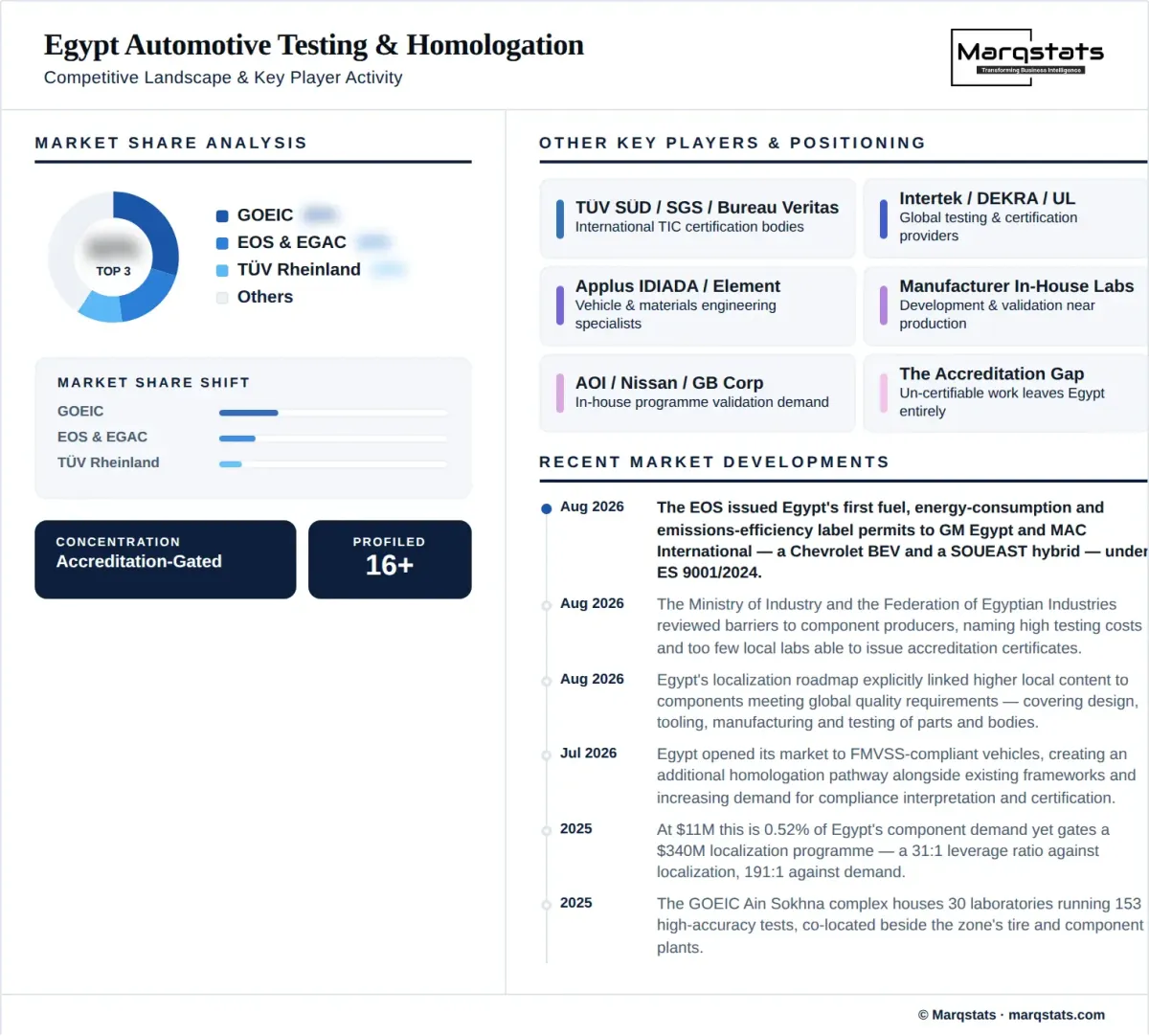
This market is structured around public infrastructure with a thin commercial layer above it. GOEIC operates the industrial laboratory complex at Ain Sokhna alongside port testing facilities, providing the bulk of Egypt's conformity capacity. The Egyptian Organization for Standardization and Quality issues standards and label approvals, including the first ES 9001/2024 permits in August 2026. The Egyptian Accreditation Council accredits testing, calibration and certification bodies nationally. Above that sit manufacturer and Tier-1 internal laboratories handling development and supplier qualification, and a limited private commercial sector.
The commercial opportunity is defined by absence rather than by competition. Government identified in August 2026 that there are not enough local laboratories able to issue official accreditation certificates for some automotive component certifications, and that mould and testing costs are high. Work that cannot be certified in Egypt is performed abroad, which means the addressable market is larger than the domestic revenue figure suggests: USD 11.00 million is what Egypt captures, not what Egyptian industry spends. A provider entering with accredited scope in a currently unserved area competes against foreign laboratories and shipping time rather than against a domestic incumbent.
Scope rather than scale determines who wins here, and the pack's own guidance is to map test requirements by standard rather than treat vehicle testing as one service. Egyptian standards, UNECE and E-Mark, Federal Motor Vehicle Safety Standards and manufacturer-specific requirements each demand separate accreditation and separate expertise, and the July 2026 FMVSS recognition means a provider serving imported American and European vehicles now needs two incompatible competencies. The scopes growing fastest are high-voltage, battery, electromagnetic compatibility and driver assistance testing, all of which start from a near-zero Egyptian base and all of which serve an electrified vehicle market rising from 2,100 units in 2025 toward 26,100 by 2030.
The white space a client should test is the difference between what Egypt captures and what Egyptian industry spends. USD 11.00 million is domestic service revenue. It excludes every test programme sent abroad because no accredited Egyptian laboratory could issue the certificate, and government confirmed in August 2026 that such gaps exist for some automotive component certifications. That offshored spend is already committed budget, already recurring, and already priced at international rates including shipping and delay. It does not need to be created, only recaptured, which is a materially easier commercial proposition than building demand from nothing. Sizing it requires asking manufacturers and suppliers directly which scopes they currently send out of country, and that question is the single most valuable extension this research supports.
Companies Covered
The report profiles 16+ companies with full strategy and financials analysis, including:
Recent Market Activity
Table of Contents
Coverage & Segmentation
The study covers paid testing, calibration, conformity assessment, type-approval and homologation support and certification services tied to vehicles and automotive components in Egypt, across the 2021 to 2025 historical period and the 2026 to 2030 forecast period, with 2025 as the base year and an indicative 2031 endpoint of approximately USD 32.06 million. Routine workshop diagnostics are excluded as vehicle maintenance rather than conformity work. The measure is service revenue earned by providers, not the value of vehicles or components tested.
No official industry revenue series is published, so value is modelled from vehicle and model approvals, component testing activity, laboratory capacity, certification volume and local production growth. Neither service pricing nor the number of tests required per model or component is systematically public, which is why confidence is graded low, the lowest in the Egypt cluster alongside the range-extended vehicle and tire components studies. The published sizing range runs from USD 8 million to USD 14 million for 2025 and USD 22 million to USD 45 million for 2031. The forecast does not assume every Egyptian laboratory accreditation is automotive-specific.