Market Snapshot
Key Takeaways
Market Overview & Analysis
Report Summary
The India commercial vehicle ADAS market covers active safety systems and driver monitoring technologies fitted in medium and heavy commercial vehicles. System coverage includes Advanced Emergency Braking System, Forward Collision Warning, Lane Departure Warning System, Lane Keeping Assist, Driver Drowsiness and Attention Warning System, Blind Spot Information System, Moving Off Information System, Vehicle Stability Function, and Electronic Braking System integration. Scope extends to AI dashcams, video telematics, in-cabin driver monitoring cameras, and fleet safety analytics platforms used by logistics, mining, intercity bus, school bus, and e-commerce operators.
Market activity is concentrated across three layers. Commercial vehicle OEMs including Tata Motors, Daimler India Commercial Vehicles, VE Commercial Vehicles, and Ashok Leyland are integrating ADAS into truck and bus platforms. Tier-1 suppliers including ZF Commercial Vehicle Control Systems, Bosch, Knorr-Bremse, and Continental supply radar modules, smart cameras, electronic control units, and braking system integration. Indian ADAS, driver monitoring, and fleet video telematics firms including Novus Hi-Tech, Starkenn Technologies, Netradyne, and Fleetx serve OEM and aftermarket channels.
The current market state reflects early premium-truck adoption transitioning to phased mandatory fitment. Tata Prima trucks have offered Collision Mitigation System, Lane Departure Warning, and Driver Monitoring System since 2022. BharatBenz introduced HX series trucks for construction and mining applications with driver state monitoring. Demand is increasing owing to phased implementation timelines covering new and existing M2, M3, N2, and N3 category models across 2027 and 2028.
The India commercial vehicle ADAS market is positioned at the intersection of regulation, road safety, and fleet digitization. Vehicle Stability Function and Advanced Emergency Braking System apply across M2, M3, N2, and N3 categories under IS 11852:2019 and AIS-162 specifications. Lane Departure Warning System aligns with AIS-188, Driver Drowsiness and Attention Warning System with AIS-184, Blind Spot Information System with AIS-186, and Moving Off Information System with AIS-187. Compliance is supported by exclusion of ADAS sensor housings, including BSIS and MOIS components, from the overall vehicle width measurement under amended Central Motor Vehicle Rules guidelines.
Vehicle category exposure is broad. M2 and M3 cover passenger transport buses including intercity coaches, school buses, and electric buses, where Vulnerable Road User detection in dense urban traffic is the primary safety priority. N2 covers medium goods vehicles spanning intra-city distribution and regional logistics. N3 covers heavy goods vehicles including long-haul tractor-trailers, construction trucks, and mining tippers, where AEBS and Driver Monitoring Systems address fatigue-linked highway accidents and continuous shift operations. Furthermore, the addressable opportunity extends to electric bus and electric truck platforms, where ADAS integration is supported by zonal electronic architecture and centralised compute capability.
Market Dynamics
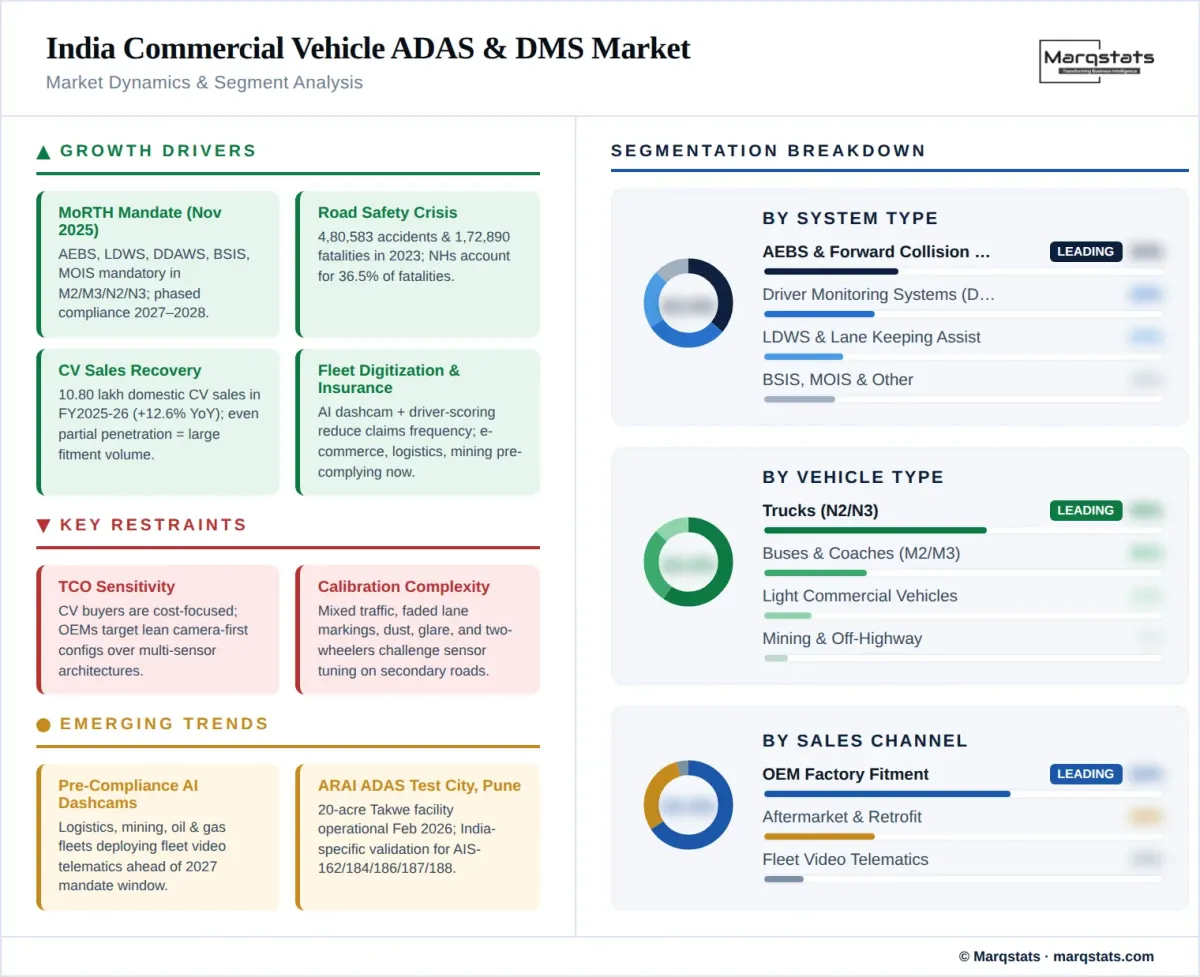
Key Drivers
- Mandatory fitment of AEBS, LDWS, DDAWS, BSIS, and MOIS in M2, M3, N2, and N3 categories under MoRTH notification drives compliance-led OEM procurement of radar, camera, and braking integration systems, and Society of Indian Automobile Manufacturers data confirm 10.80 lakh domestic CV sales in FY2025-26, up 12.6 percent year-on-year.
- Road safety urgency is elevated, with India recording 4,80,583 accidents, 1,72,890 fatalities, and 4,62,825 injuries in 2023, while national highways accounted for 31.2 percent of accidents and 36.5 percent of fatalities, supporting active safety investment.
- Commercial vehicle sales recovery supports the addressable fitment opportunity, with FADA reporting 10.61 lakh CV retail sales in FY2026, up 11.74 percent year-on-year, indicating that even partial ADAS penetration creates a sizeable annual fitment opportunity.
- Electric bus deployments and organized fleet adoption support early ADAS integration, owing to public transport safety mandates, accident reduction targets, asset uptime priorities, and insurance-linked fleet safety analytics requirements.
- India-specific calibration is supported by Automotive Research Association of India ADAS Test City at Takwe near Pune, a 20-acre facility mirroring Indian road networks and traffic conditions for repeatable testing, sensor tuning, and validation.
Key Restraints
- High system cost sensitivity restrains adoption, owing to the total cost of ownership focus among Indian commercial vehicle buyers, prompting OEMs to pursue low-cost camera and radar configurations rather than multi-sensor architectures.
- Difficult road environment restrains calibration accuracy, owing to mixed traffic, two-wheelers, pedestrians, animals, dust, glare, and informal driving behaviour combined with weak lane markings on secondary highways and urban arterials.
- Aftermarket and service ecosystem maturity is limited, owing to underdeveloped radar and camera calibration capabilities, windshield-camera alignment workflows, sensor replacement protocols, and diagnostics across the commercial vehicle service network.
- Driver-facing camera deployment is restrained by labour, privacy, and union concerns in select fleet segments; however, structured rollout with consent frameworks and operator training reduces resistance.
Key Trends
- Pre-compliance adoption of AI dashcams and video telematics is increasing among logistics, oil and gas, cement, mining, intercity bus, and e-commerce fleets, supported by insurance-linked safety analytics and driver scoring.
- Localization of cameras, radars, electronic control units, and perception software is accelerating; however, imported chips and sensors continue to influence cost structures and supply chain dependencies.
- India-specific testing and validation services are emerging as a distinct category, supported by ARAI infrastructure, simulation toolchains, controlled-environment trial tracks, and homologation under AIS-162, AIS-184, AIS-186, AIS-187, and AIS-188.
- Tier-1 OEM platform contracts are being awarded ahead of the mandate window, with bus platform programmes targeting Q1 2027 start of production and supply scope covering integration, calibration, and validation.
Market Segmentation
The Advanced Emergency Braking System segment is supported by mandatory fitment under AIS-162 specifications for M2, M3, N2, and N3 categories. The system uses front radar, smart camera, and braking integration to alert the driver and apply automatic braking when forward collision risk is detected. Adoption requires integration with electronic braking systems, owing to the dependence on actuator control for autonomous deceleration. AEBS configurations vary across long-haul truck, intercity bus, and intra-city distribution applications, with sensor selection ranging from single front radar to fused radar-camera architectures. Tier-1 supplier offerings include OnGuardMAX, anchored by India-specific testing of more than 300,000 km on Indian roads.
The Lane Departure Warning System segment is supported by mandatory fitment under AIS-188 across heavy commercial vehicle categories. Camera-based detection of lane markings, however, is constrained by faded paint on secondary highways and weather variability. Indian deployments rely on multi-purpose cameras and edge processing tuned for monsoon conditions, dust, and glare. Furthermore, integration with Lane Keeping Assist functions requires steering torque actuation, which adds platform-level complexity for Tier-1 suppliers and OEM integration teams.
The Driver Drowsiness and Attention Warning System segment is increasing owing to long-haul trucking fatigue risks, intercity bus safety mandates, and AIS-184 compliance requirements. Driver-facing cameras combined with perception software detect eye closure, head pose, gaze direction, and distraction patterns. Demand spans OEM factory fitment and aftermarket retrofit channels for logistics fleets. The Driver Monitoring Systems segment also benefits from insurance-linked fleet safety analytics, where driver scoring and event-detection capability reduce claims frequency and improve underwriting outcomes for fleet operators.
Blind Spot Information System under AIS-186 and Moving Off Information System under AIS-187 are mandatory for M2, M3, N2, and N3 vehicles. Side radars, ultrasonic sensors, and corner cameras detect vulnerable road users including pedestrians, two-wheelers, and cyclists in urban operating environments. Bus and intercity coach segments demonstrate higher relevance owing to dense urban deployment.
The truck segment accounted for the largest share, supported by N3 category mandatory fitment requirements, premium long-haul truck adoption, and mining truck driver state monitoring. Tata Prima models have integrated Collision Mitigation System, Lane Departure Warning, and Driver Monitoring System since 2022. BharatBenz HX series construction and mining trucks integrate driver state monitoring for off-highway applications.
The bus segment is supported by intercity coach safety, electric bus deployments, and school bus regulations. ZF Commercial Vehicle Control Systems secured an Indian bus platform ADAS contract with start of production targeted for Q1 2027, covering OnGuardMAX, short-range radar, AEBS, BSIS, DDAWS, LDWS, and MOIS. Bus deployment requires Vulnerable Road User detection in urban environments.
The light commercial vehicle segment includes last-mile delivery vans, electric LCVs, and intra-city distribution trucks. Adoption is supported by e-commerce fleet safety priorities and vehicle-as-a-service platform standardization. Camera-based forward collision warning, lane departure alerts, and driver scoring are typical configurations for LCV deployments.
The OEM factory fitment channel accounted for the dominant share, supported by mandatory integration timelines covering 2027 and 2028 windows for new and existing models. OEM procurement involves multi-year platform contracts, integration, calibration, and validation. Tier-1 suppliers including ZF, Bosch, Knorr-Bremse, and Continental hold platform-level positions.
The aftermarket and retrofit channel is increasing owing to pre-compliance adoption by fleet operators. AI dashcams, driver monitoring sensors, and video telematics platforms are deployed across logistics, oil and gas, mining, cement, intercity bus, and e-commerce fleets. The Netradyne Driver-i D-450 platform launched in India in September 2025 represents the segment's growth direction.
By Geography
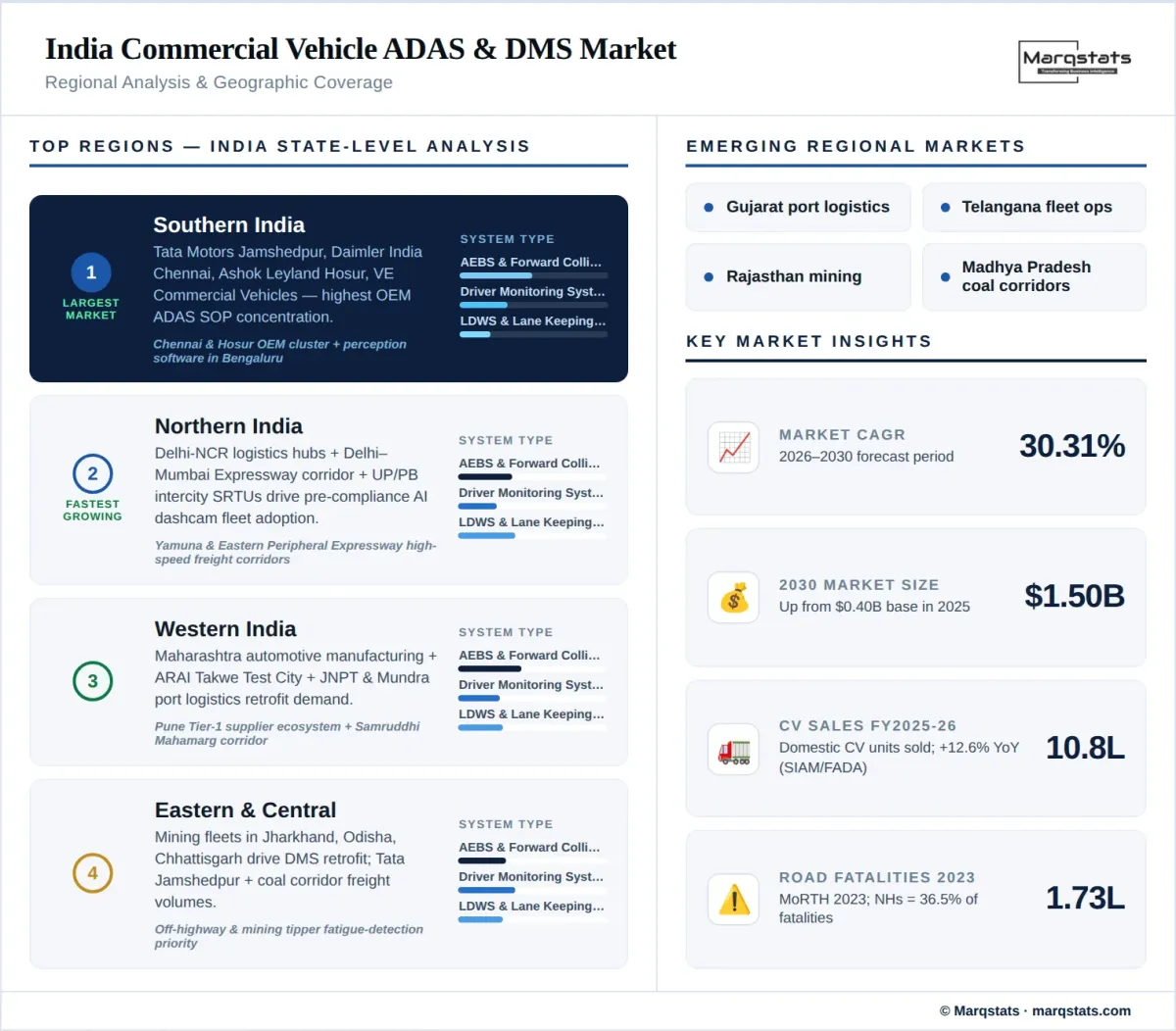
Northern India
Northern India accounted for a substantial share, supported by Delhi-NCR logistics hubs, Punjab-Haryana truck routes, and Uttar Pradesh intercity bus operations. The Yamuna Expressway, Delhi-Mumbai Expressway corridors, and Eastern Peripheral Expressway support high-speed long-haul truck operations where AEBS and LDWS adoption priorities are elevated. Cold-chain logistics and e-commerce distribution networks in the National Capital Region support pre-compliance fleet retrofit demand. State Road Transport Undertakings in Uttar Pradesh, Haryana, and Punjab procure intercity buses where Vulnerable Road User detection through Blind Spot Information System and Moving Off Information System addresses urban operating risks.
Western India
Western India is supported by Maharashtra automotive manufacturing, Gujarat port logistics, and Pune Tier-1 supplier ecosystems. ARAI's ADAS Test City at Takwe near Pune supports calibration and homologation activity. Mumbai-Pune Expressway and Mumbai-Nagpur Samruddhi Mahamarg corridors influence demand for highway-grade ADAS configurations. JNPT and Mundra port logistics fleets accelerate retrofit adoption.
Southern India
Southern India is supported by Tamil Nadu commercial vehicle manufacturing centers including Chennai and Hosur, Karnataka technology services, and Telangana fleet operations. Ashok Leyland's manufacturing footprint in Tamil Nadu, Daimler India Commercial Vehicles' plant near Chennai, and VE Commercial Vehicles' operations integrated with Hosur support OEM-level ADAS adoption. Bengaluru and Hyderabad concentrate perception software and AI dashcam development activity.
Eastern India
Eastern India is supported by Jamshedpur commercial vehicle manufacturing through Tata Motors, Kolkata logistics operations, and mining fleet operations across Jharkhand, Odisha, and Chhattisgarh. The mining truck segment supports driver state monitoring adoption owing to fatigue risks in continuous shift operations, while electric truck pilot deployments in steel, cement, and mining clusters integrate camera-based driver monitoring as standard configuration.
Central India
Central India is supported by Madhya Pradesh, Chhattisgarh, and Vidarbha mining operations, where heavy mining trucks and tipper deployments require driver monitoring and forward collision warning configurations. Indore and Nagpur logistics hubs support fleet operator adoption of AI dashcams and video telematics. Coal corridor freight traffic across Central India supports fatigue-detection retrofit volumes.
How Competition Is Evolving
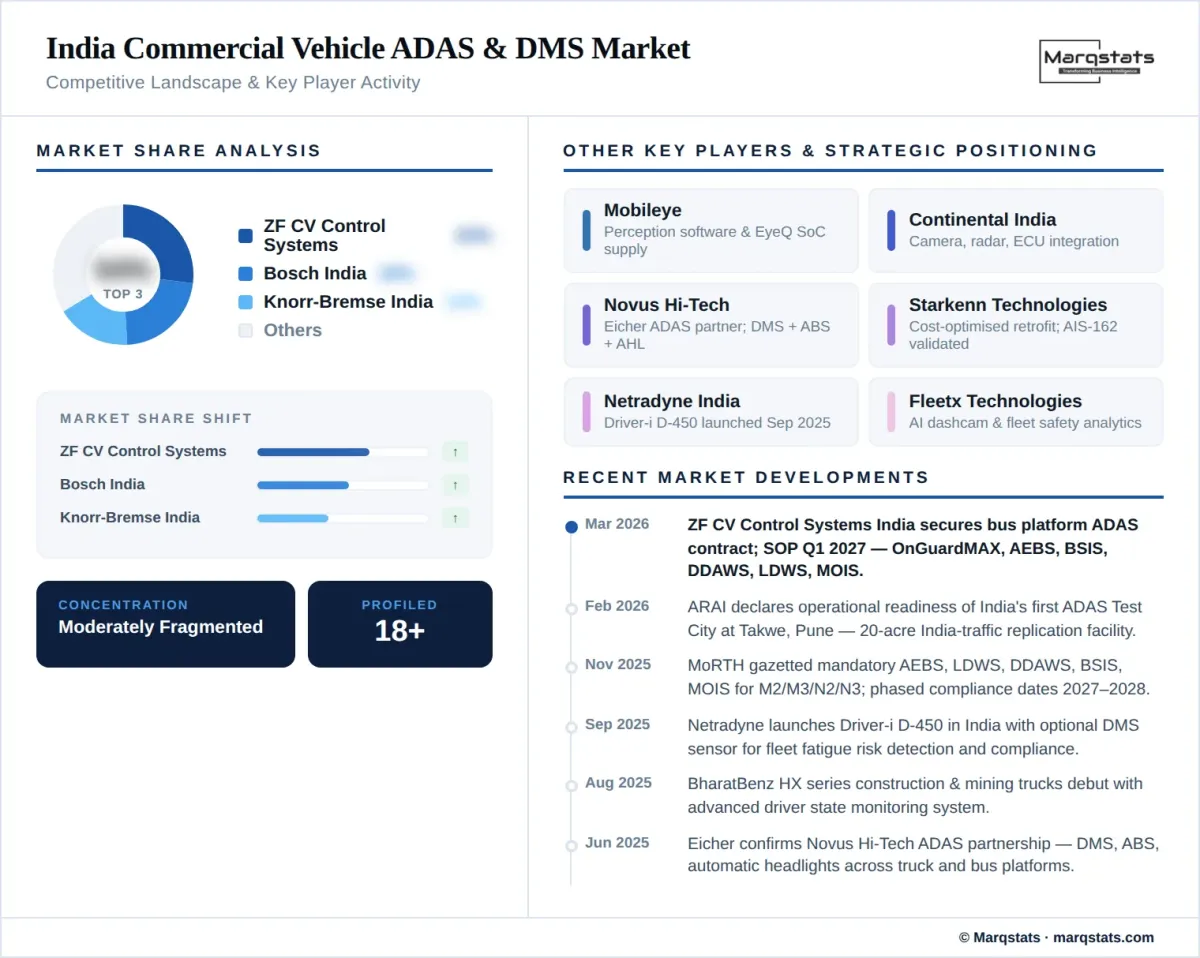
The market is moderately fragmented across three competitive layers. Commercial vehicle OEMs occupy the platform-integration layer, Tier-1 suppliers occupy the systems layer covering radar, camera, electronic braking, and perception, while Indian ADAS and fleet video telematics firms occupy the aftermarket and retrofit layer. Competitive intensity is increasing owing to phased mandate timelines that compress procurement decision windows for OEMs and fleet operators.
Companies compete through India-specific calibration, multi-platform supply scope, integration with existing braking architectures, and pricing aligned with commercial vehicle total cost of ownership. ZF Commercial Vehicle Control Systems has tested its solution for more than 300,000 km on Indian roads, demonstrating that India-specific testing depth has emerged as a competitive differentiator. Tier-1 suppliers are pursuing multi-year platform contracts ahead of Q1 2027 start of production windows, while domestic suppliers including Novus Hi-Tech and Starkenn Technologies pursue cost-optimized retrofit configurations validated under AIS-162 and AIS-184 specifications.
Strategic activity covers OEM platform wins, retrofit channel expansion, manufacturing localization, software perception layer partnerships, and validation infrastructure investment. Furthermore, fleet video telematics firms including Netradyne and Fleetx are expanding multi-camera AI dashcam deployments across logistics, mining, and intercity bus operators in advance of mandatory OEM-level fitment.
Pricing competition in the India commercial vehicle ADAS market is structured around system-level configurations rather than commodity component pricing. Multi-sensor packages combining front radar, smart camera, electronic braking integration, and driver-facing camera command higher margins, however cost-optimized camera-first configurations are gaining traction in N2 and lighter N3 segments. Domestic suppliers compete through localized manufacturing of camera modules, ECU assemblies, and harnesses, while global Tier-1 suppliers retain perception software, radar fusion algorithms, and electronic braking integration as differentiated capability layers. Furthermore, India-specific data labelling, scenario libraries, and edge case testing have emerged as proprietary assets that influence platform selection during OEM Tier-1 procurement.
Companies Covered
The report profiles 18++ companies with full strategy and financials analysis, including:
Recent Market Activity
Table of Contents
Coverage & Segmentation
This report covers the India commercial vehicle ADAS and driver monitoring systems market for the historical period 2021 to 2025 and the forecast period 2026 to 2030. The base year is 2025. The study examines market size, segment-level forecasts, regulatory mandate impact, vehicle category coverage across M2, M3, N2, and N3, system-level analysis covering AEBS, LDWS, DDAWS, BSIS, MOIS, and Vehicle Stability Function, vehicle type coverage spanning trucks, buses, light commercial vehicles, intercity coaches, school buses, electric buses, and mining trucks, and competitive positioning across OEM, Tier-1 supplier, and retrofit channels.
Coverage includes AIS-162, AIS-184, AIS-186, AIS-187, and AIS-188 compliance pathways, India-specific calibration and validation activity, OEM platform procurement, Tier-1 supplier positioning, AI dashcam and video telematics adoption, and fleet retrofit dynamics across logistics, mining, intercity bus, school bus, and e-commerce operators. Data sources span government databases, industry bodies, OEM disclosures, supplier announcements, and primary stakeholder interviews.