Market Snapshot
Middle bar: base-year value × (1 + CAGR), rounded to two decimals. This is a calculated illustration, not a separately researched annual estimate.
The India Vehicle Scrappage Infrastructure Market is estimated at 0.20 million vehicles and USD 0.20 billion in 2025, expected to expand to 1.10 million vehicles and USD 1.22 billion by 2030 at a CAGR of 44.48 percent during the 2026 to 2030 forecast window. The market measures gross realized value at authorized Registered Vehicle Scrapping Facilities, derived from formal scrappage volume multiplied by average gross value per vehicle of approximately ₹85,000 in 2025 rising toward ₹97,000 by 2030 at an applied foreign exchange rate of 87.15 Indian rupees per United States dollar (2025 annual average). The scope is intentionally narrower than the broader vehicle recycling market; third-party industry estimates of the broader recycling ecosystem range from USD 3 billion to USD 12 billion during 2024 to 2026, however those estimates encompass formal plus informal recycling, downstream material processing, parts resale, and the wider salvage ecosystem outside the authorized RVSF perimeter that anchors this analysis.
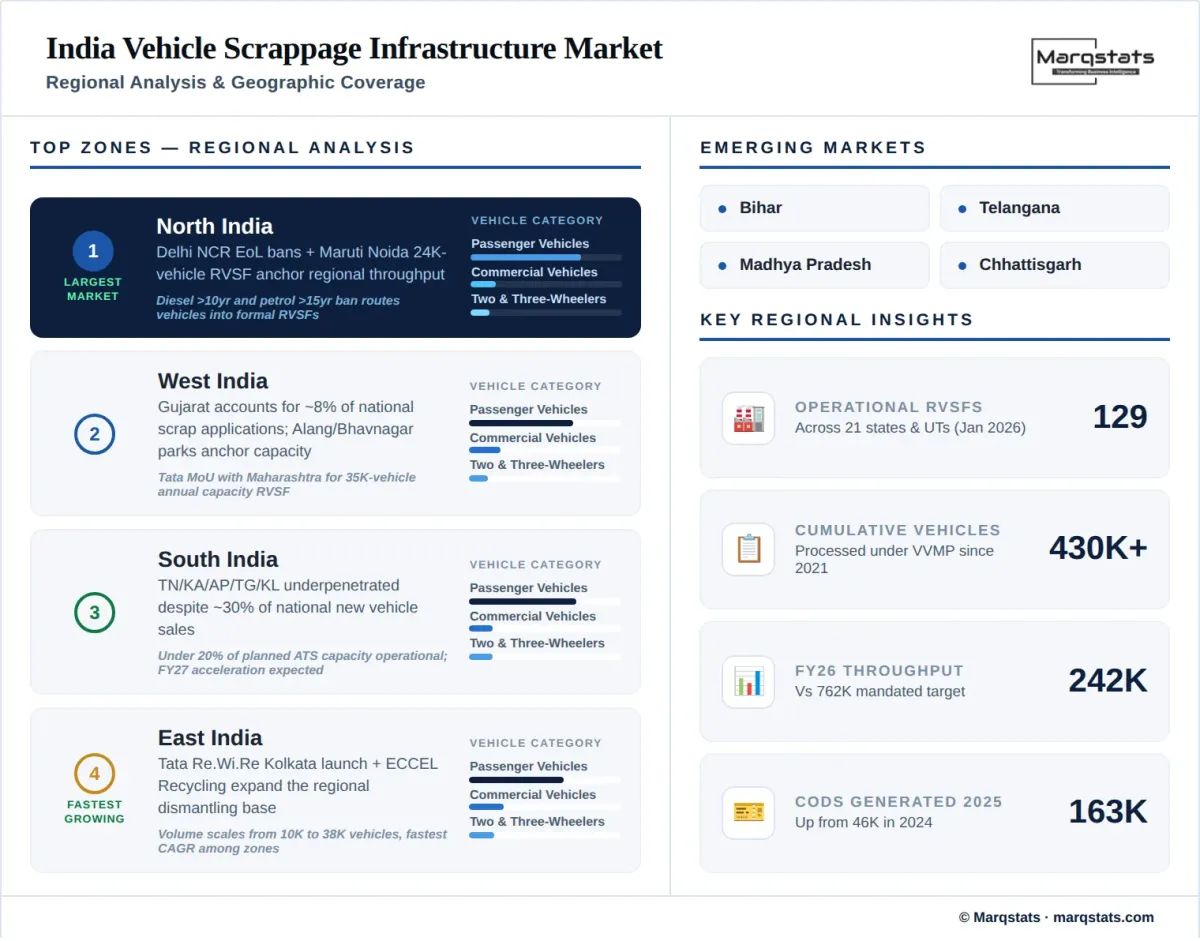
Press Information Bureau data as of January 30, 2026 reported 129 operational RVSFs across 21 states and union territories with 430,306 cumulative vehicles processed under the Voluntary Vehicle Fleet Modernization Program since the framework's commencement in 2021. Independent industry tracking indicated approximately 242,000 old vehicles reached registered scrappage centers during FY26 against a mandated target of 762,000 vehicles, representing a 68 percent shortfall in formal sector volume capture. The gap reflects the structural challenge of routing eligible end-of-life vehicles through formal channels while informal dismantlers continue to handle the bulk of vehicle disposal.
Market expansion is driven by four converging forces. Extended Producer Responsibility obligations under Environment Protection (End-of-Life Vehicle) Rules, 2025 will progressively bind OEM compliance to certified scrappage volumes through the 2026 to 2030 window. Automated Testing Station deployment, with approximately 156 operational stations against the 441 facility target for 2027, will substantially expand the pipeline of formally declared end-of-life vehicles. State-level incentive frameworks providing road tax rebates of up to 25 percent on new vehicle purchases against Certificates of Deposit are converting voluntary scrappage decisions into formal sector flow. The steel industry's expansion toward 300 million tonnes of crude steel capacity by 2030 generates structural demand for the 65 million tonnes of annual scrap supply that formal RVSF volume contributes to.
Key Takeaways
Market Overview & Analysis
Report Summary
The India Vehicle Scrappage Infrastructure Market measures the gross realized value at authorized Registered Vehicle Scrapping Facilities (RVSFs) approved under the Motor Vehicles (Registration and Functions of Vehicle Scrapping Facility) Rules, 2021. Market value is computed as the product of formal RVSF throughput volume and average gross value per vehicle, the latter comprising scrap metal sales, refurbished parts recovery, and processing service fees. The framework is anchored by the Ministry of Road Transport and Highways under Shri Nitin Gadkari and operationally executed through the Vahan portal of the National Informatics Centre, which generates Certificates of Deposit, manages vehicle de-registration, and tracks RVSF compliance at https://vscrap.parivahan.gov.in.
The analysis in this report is restricted to the authorized RVSF channel as defined by central government policy. Net service-fee-only views, which exclude scrap metal and parts value, place the market at approximately USD 0.05 to 0.08 billion in 2025; the gross RVSF market view adopted here captures the full realized value at the facility gate and is the relevant scope for OEM EPR procurement, equipment supplier targeting, and steel sector secondary supply contracting.
Current operational reality reveals substantial demand-supply imbalance. Approximately 12 million vehicles qualify for scrappage as of mid-2025, including 4.5 million medium and heavy commercial vehicles and 7.5 million light vehicles. However, formal RVSF channels processed approximately 242,000 vehicles in FY26 against a mandated 762,000 target. The 430,306 cumulative figure reported by Press Information Bureau as of January 30, 2026 represents under 4 percent of the eligible fleet, indicating the structural runway for volume expansion as enforcement, ATS coverage, and OEM EPR binding mechanisms mature during 2026 to 2030.
Recent regulatory and policy momentum accelerated through 2025 and 2026. The Ministry of Heavy Industries linked PM E-Drive electric truck support to diesel-truck scrappage certificates, permitting certificate aggregation across operators. Certificates of Deposit generated reached 163,524 in 2025 compared with 46,446 in 2024. A draft notification proposed in January 2025 to enhance the road tax rebate to 50 percent for BS-II compliant and earlier vehicles signals further policy reinforcement. Independent assessments suggest formal RVSF volume will expand by approximately 41 percent annually through 2030 supported by these mandates. State-level implementation has shown wide variance, with several states routing government fleet retirement through formal RVSFs and offering supplementary road tax discounts beyond the central framework.
Market Dynamics
Key Drivers
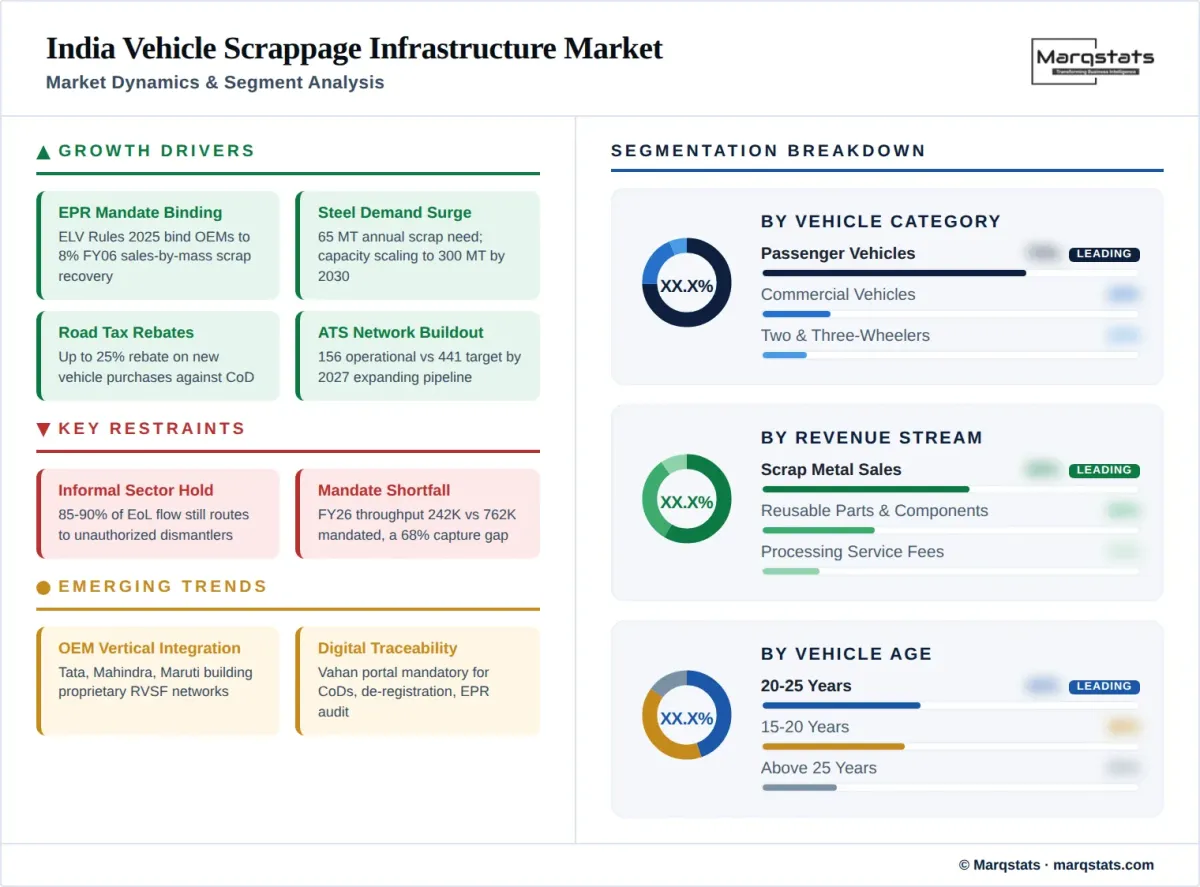
- Extended Producer Responsibility obligations under Environment Protection (End-of-Life Vehicle) Rules, 2025 require OEMs to ensure recovery of specific steel-equivalent targets, with FY26 mandating 8 percent of FY06 vehicle sales by mass and binding compliance to certified RVSF volumes.
- The Voluntary Vehicle Fleet Modernization Program mandates fitness testing for passenger vehicles over 20 years and commercial vehicles over 15 years, generating a captive pipeline of end-of-life vehicles routed exclusively to authorised RVSFs.
- India's crude steel capacity expansion target of 300 million tonnes by 2030 against approximately 160 million tonnes currently generates structural demand for 65 million tonnes of annual scrap, of which formal RVSF supply covers a growing share.
- State-level road tax rebates of up to 25 percent on new vehicle purchases against Certificates of Deposit, combined with full registration fee waivers, materially improve the financial case for voluntary scrappage among private vehicle owners.
- PM E-Drive linkage of electric truck support to diesel-truck scrappage certificates, permitting certificate aggregation across fleet operators, accelerates commercial vehicle conversion into the formal RVSF channel.
Key Restraints
- Informal dismantlers continue to capture an estimated 85 to 90 percent of end-of-life vehicle flow owing to lower overhead, immediate cash payments to owners, and limited enforcement against unauthorised scrapping operations.
- FY26 formal throughput of 242,000 vehicles fell 68 percent short of the 762,000 mandated target, reflecting the gap between policy ambition and on-ground enforcement capacity across state transport departments.
- Infrastructure coverage remains geographically uneven, with several southern states operating fewer than 20 percent of planned Automated Testing Station capacity, severely constraining the pipeline of formally declared end-of-life vehicles.
- Volatility in secondary raw material prices, particularly ferrous scrap exposed to global trade restrictions and import duties, compresses unit economics for operators dependent on metal recovery as the primary revenue stream.
Key Trends
- OEM-led vertical integration is accelerating as Tata Motors, Mahindra Accelo, and Maruti Suzuki Toyotsu India establish proprietary RVSF networks to secure EPR compliance and capture secondary raw material margins.
- Digital traceability systems anchored on the Vahan database have moved from optional to mandatory, with all certificate generation, de-registration, and compliance audit functions executed through the Parivahan portal of the National Informatics Centre.
- Bundled commercial offerings combining Certificate of Deposit benefits with new vehicle discounts of 5 to 6 percent ex-showroom price have emerged as the dominant customer acquisition pattern, accelerating end-of-life vehicle flow into formal channels.
- Joint ventures between Indian automakers and global recycling specialists such as Toyota Tsusho Corporation and Kaiho Sangyo Co., Ltd. are introducing advanced material separation technology, raising recovery rates from approximately 80 percent toward the European Union benchmark of 95 percent.
Market Segmentation
Passenger cars and utility vehicles constituted approximately 70 percent of FY26 formal scrappage volumes, driven by the maturing road tax rebate framework that converts private vehicle owners into authorized scrappage channels. The segment commands above-average gross value per vehicle owing to higher steel and aluminium content, refurbishable electronics, and battery-pack residual worth. Segment volume scales from approximately 170,000 units in 2026 toward 770,000 by 2030, with realized gross value per vehicle rising from ₹95,000 toward ₹110,000 across the forecast window. End-of-life flow from this segment is tracked in detail by the India Passenger Car Market analysis, which documents the upstream lifecycle attrition patterns.
Medium and heavy commercial vehicles, including buses and trucks, represented approximately 11 percent of FY26 formal scrappage volumes, with trucks at approximately 6 percent and buses at approximately 5 percent. The segment remains the priority for policy enforcement owing to disproportionate emissions impact, with one BS-IV truck emitting equivalent to fourteen BS-VI trucks. PM E-Drive's linkage of electric truck support to diesel-truck scrappage certificates further accelerates conversion. Realized gross value per commercial vehicle ranges from ₹180,000 for medium trucks to ₹350,000 for heavy haulage vehicles.
Two-wheelers contributed approximately 12 percent of FY26 formal scrappage volume; however, generate substantially lower revenue per unit owing to limited material content, with realized gross value averaging ₹12,000 to ₹18,000 per unit. The segment is characterised by widespread informal disposal patterns, with documented instances of dealers refurbishing dismantled components for unauthorised return to circulation, prompting regulatory attention from Regional Transport Offices in several states.
Three-wheelers, predominantly used in urban last-mile passenger and goods transport, contributed approximately 7 percent of FY26 formal scrappage volumes. The segment will expand as electric three-wheeler adoption accelerates and operators retire ageing diesel and CNG fleets in tier-1 and tier-2 cities to access state-level fleet electrification incentives. Realized gross value per three-wheeler averages ₹28,000 to ₹42,000.
Scrap metal sales account for approximately 55 percent of gross realized value at authorized RVSFs, comprising ferrous recovery from chassis, body panels, and suspension assemblies alongside non-ferrous recovery of aluminium from wheels, copper from wiring harnesses, and zinc from coated body sheets. Steel recovery per passenger car ranges from 600 to 800 kilograms at realized prices of ₹28 to ₹32 per kilogram in 2025, generating ₹17,000 to ₹26,000 per vehicle. Growth is attributed to the steel sector's structural shift toward electric arc furnace production, with EAF capacity projected to reach 50 percent of total Indian crude steel output by 2030 from approximately 15 percent currently.
Reusable parts and component sales contribute approximately 30 percent of gross realized value at authorized RVSFs. Independent industry analyses indicate refurbished components account for over 55 percent of formal scrappage revenue mix in the broader recycling market, however the authorized RVSF subset weights this segment lower owing to stricter quality and certification requirements. The stream covers recovered engines, transmissions, alternators, starter motors, headlamps, infotainment electronics, and battery packs that pass inspection, testing, and reconditioning protocols. Margins on refurbished components exceed commodity scrap margins materially, however the stream requires specialised testing capabilities that smaller operators struggle to establish.
Processing service fees, covering de-pollution charges, hazardous waste handling, certificate generation, and de-registration administration, generate approximately 15 percent of formal RVSF revenue. Mandatory hazardous waste handling under Central Pollution Control Board guidelines averages ₹4,500 per vehicle covering coolants, refrigerants, lead-acid battery acid, and airbag inflators. Certificate of Deposit generation through the Vahan portal carries a regulated fee structure determined by state transport authorities. The non-ferrous battery recovery sub-stream connects to the broader EV Battery Recycling Market documented.
By Geography
North India
North India accounts for the predominant share of formal scrappage volumes, with Delhi NCR, Haryana, Uttar Pradesh, and Punjab generating the bulk of RVSF throughput. The region's position reflects the early implementation of strict end-of-life vehicle bans by the Government of NCT of Delhi, which prohibits operation of diesel vehicles over 10 years and petrol vehicles over 15 years. Maruti Suzuki Toyotsu India Private Limited operates the country's first RVSF in Noida with annual capacity of 24,000 to 25,000 vehicles, and additional Tata Motors and Mahindra facilities cover Haryana and Punjab catchments. Regional volume is expected to scale from approximately 130,000 vehicles in 2025 toward 660,000 by 2030.
South India
South India contributes a smaller share of formal scrappage volumes despite accounting for approximately 30 percent of national new vehicle sales, reflecting an infrastructure and testing capacity gap. Tamil Nadu, Karnataka, Andhra Pradesh, Telangana, and Kerala collectively operate fewer than 20 percent of planned ATS capacity, with ATS-conducted fitness tests accounting for under 25 percent of throughput. Growth acceleration is anticipated as state transport departments operationalise the next wave of approved facilities through FY27, lifting regional volume from approximately 14,000 vehicles in 2025 toward 165,000 by 2030.
West India
West India, anchored by Maharashtra and Gujarat, represents the second-largest regional contributor. Gujarat alone accounts for approximately 8 percent of nationwide scrapping applications, supported by the development of integrated scrappage and recycling parks at Alang and Bhavnagar. Tata Motors signed a Memorandum of Understanding with the Government of Maharashtra for a 35,000-vehicle annual capacity RVSF, expanding the regional dismantling base. Regional volume scales from approximately 38,000 vehicles in 2025 toward 220,000 by 2030.
East India
East India remains underdeveloped in formal scrappage capacity; however, recent expansions are addressing the gap. Tata Motors inaugurated its eighth Re.Wi.Re facility in Kolkata in May 2025, the first in West Bengal and third in the eastern region. ECCEL Recycling Private Limited operates additional capacity in West Bengal. Bihar's implementation framework remains under judicial review with the state transport department directed to file action-taken reports on registered scrappers, collection centers, and recycling plants. Regional volume rises from approximately 10,000 vehicles in 2025 toward 38,000 by 2030, positioning the region as the fastest-growing geography in percentage terms.
Central India
Central India, comprising Madhya Pradesh and Chhattisgarh, contributes a marginal share of national scrappage volumes. The region's industrial linkage to steel and cement clusters supports downstream demand for scrap; however, RVSF density remains low. State governments have begun routing government department fleet retirement through dedicated facilities to seed demand for private operators entering the market. Regional volume rises from approximately 8,000 vehicles in 2025 toward 17,000 by 2030.
How Competition Is Evolving
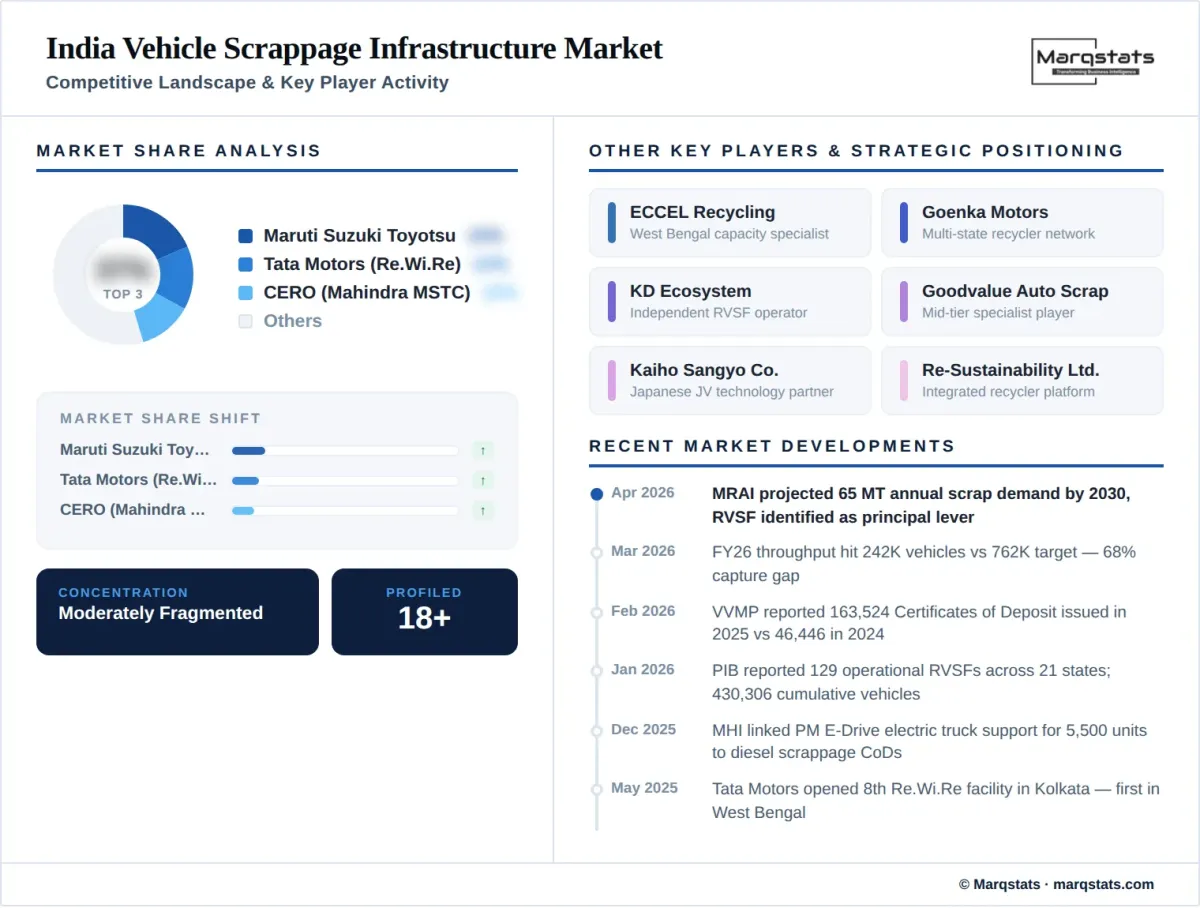
The India Vehicle Scrappage Infrastructure Market exhibits moderate fragmentation with a clear two-tier competitive structure. The upper tier consists of vertically integrated OEM-affiliated operators including Maruti Suzuki Toyotsu India Private Limited, Tata Motors Limited through its Re.Wi.Re brand, and CERO Recycling (Mahindra MSTC Recycling Private Limited), which together account for approximately 35 to 40 percent of formal scrappage volumes. These operators leverage parent-company customer relationships, bundled new-vehicle financing, and centralised procurement of dismantling equipment to achieve unit economics that independent operators struggle to match.
The second tier comprises specialised independent recyclers including ECCEL Recycling Private Limited, Goenka Motors Private Limited, KD Ecosystem Private Limited, and Goodvalue Auto Scrap Private Limited, alongside international entrants such as Kaiho Sangyo Co., Ltd. participating through Indian partnerships. Competition is structured around three primary axes: certification velocity, where early ARAI-certified operators captured first-mover positioning in their respective state markets; geographic coverage, where multi-state networks command premium positions in OEM EPR procurement; and material recovery efficiency, where operators achieving recovery rates above 90 percent capture pricing power from steelmakers and aluminium smelters seeking premium-grade feedstock.
Mergers and acquisitions activity has accelerated through 2024 and 2025 as larger industrial groups consolidate informal and sub-scale RVSF assets. Industry analyses indicate the EPR compliance deadlines under ELV Rules 2025 will accelerate further consolidation, with the proviso that informal sector integration through collection-center partnerships will remain the dominant volume-growth lever through 2030. Larger players exhibit full preparedness to capture GST input credits across plant, IT, and service expenditures, realising approximately 15 to 18 percent capital expenditure savings that compound their scale advantages.
Companies Covered
Companies covered in the report include:
Recent Market Activity
Table of Contents
Coverage & Segmentation
This report provides a comprehensive analysis of the India Vehicle Scrappage Infrastructure Market covering the historical period 2021 to 2025 and forecast period 2026 to 2030, with 2025 established as the base year. The market is measured as gross realized value at authorized Registered Vehicle Scrapping Facilities, derived from formal RVSF throughput volume multiplied by average gross value per vehicle. Coverage spans the regulatory framework executed by the Ministry of Road Transport and Highways, the operational dynamics of Registered Vehicle Scrapping Facilities and Automated Testing Stations, vehicle category and revenue stream segmentation, regional volume distribution, and qualitative analysis of competitive dynamics.
The scope is restricted to the authorized RVSF perimeter, distinct from the broader vehicle recycling market that includes informal sector flow, downstream secondary material processing, and unauthorized parts resale. Quantitative outputs include market sizing in USD billion at constant 2025 prices applying a foreign exchange rate of 87.15 Indian rupees per United States dollar (2025 annual average), volume forecasts in million vehicles, segment-level revenue and volume splits to 2030, and regional breakdowns across five Indian zones. The study supports strategic decisions for OEMs evaluating EPR compliance pathways, equipment suppliers targeting RVSF and ATS build-out, steel and non-ferrous metal producers seeking secondary raw material supply, private equity investors evaluating recycler acquisitions, and government advisory consultants supporting state-level policy implementation.