Market Snapshot
Key Takeaways
Market Overview & Analysis
Report Summary
The Japan used vehicle export market refers to the outbound sale and shipment of pre-owned motor vehicles from Japan to buyers overseas, spanning passenger cars, SUVs, minivans, pickups, light commercial vehicles, and a small share of buses and heavy equipment. Vehicles are procured predominantly through domestic wholesale auctions and dealer stock, deregistered with Japanese transport authorities, certified for export, and moved by roll-on/roll-off and container vessels to destination ports across six continents. Market value in this report is measured on an export-value basis in US dollars, with unit volume used as the validation metric.
The market has expanded steadily over two decades, rising from under 300,000 vehicles a year at the turn of the century to a record 1.71 million units in 2025. Value moved in step, reaching an estimated USD 10.05 billion in 2025 as a weaker yen, elevated new-car prices worldwide, and rising incomes across emerging markets combined to pull Japanese inventory abroad. Average export transaction values sit in the region of USD 5,500 to USD 7,000 per vehicle, with SUVs and 4x4 models such as the Toyota Land Cruiser commanding a premium over compact sedans.
Japan's structural advantages sustain the trade. The domestic "Shaken" inspection system raises the cost of keeping older vehicles, prompting owners to sell relatively low-mileage cars earlier than in most economies, which continuously refreshes export-grade supply. A mature auction ecosystem provides transparent grading sheets and photographs that give overseas buyers confidence, while an established forwarder and inspection network handles documentation, roadworthiness checks, and radiation screening required by many destinations.
Value growth over the forecast period is attributed to two reinforcing forces. Unit volumes continue to rise, however at a more moderate pace than the post-pandemic surge as the base broadens and single-hub concentration unwinds. Simultaneously, the average export value per vehicle climbs as buyers shift toward hybrids, premium minivans, and SUVs, and as currency and mix effects lift transaction sizes. The combination supports a value expansion from USD 10.05 billion in 2025 toward USD 15.10 billion by 2030, even where headline unit growth cools relative to the exceptional gains recorded through 2025.
Logistics anchor the cost structure. Vehicles move from auctions and depots to export ports, then ship by roll-on/roll-off or container vessel, with transit typically running three weeks to West Africa and the Bay of Bengal and four to five weeks to East and Southern Africa and Europe. Ocean freight of roughly USD 1,000 to USD 3,000 per unit, fuel surcharges, and destination duties shape final cost-and-freight pricing. Exporters manage margin through auction-sourcing discipline, vehicle-mix selection toward higher-value SUVs and hybrids, and negotiated annual rates with major carriers, so procurement precision and shipping efficiency matter as much as headline volume to profitability.
Market Dynamics
Key Drivers
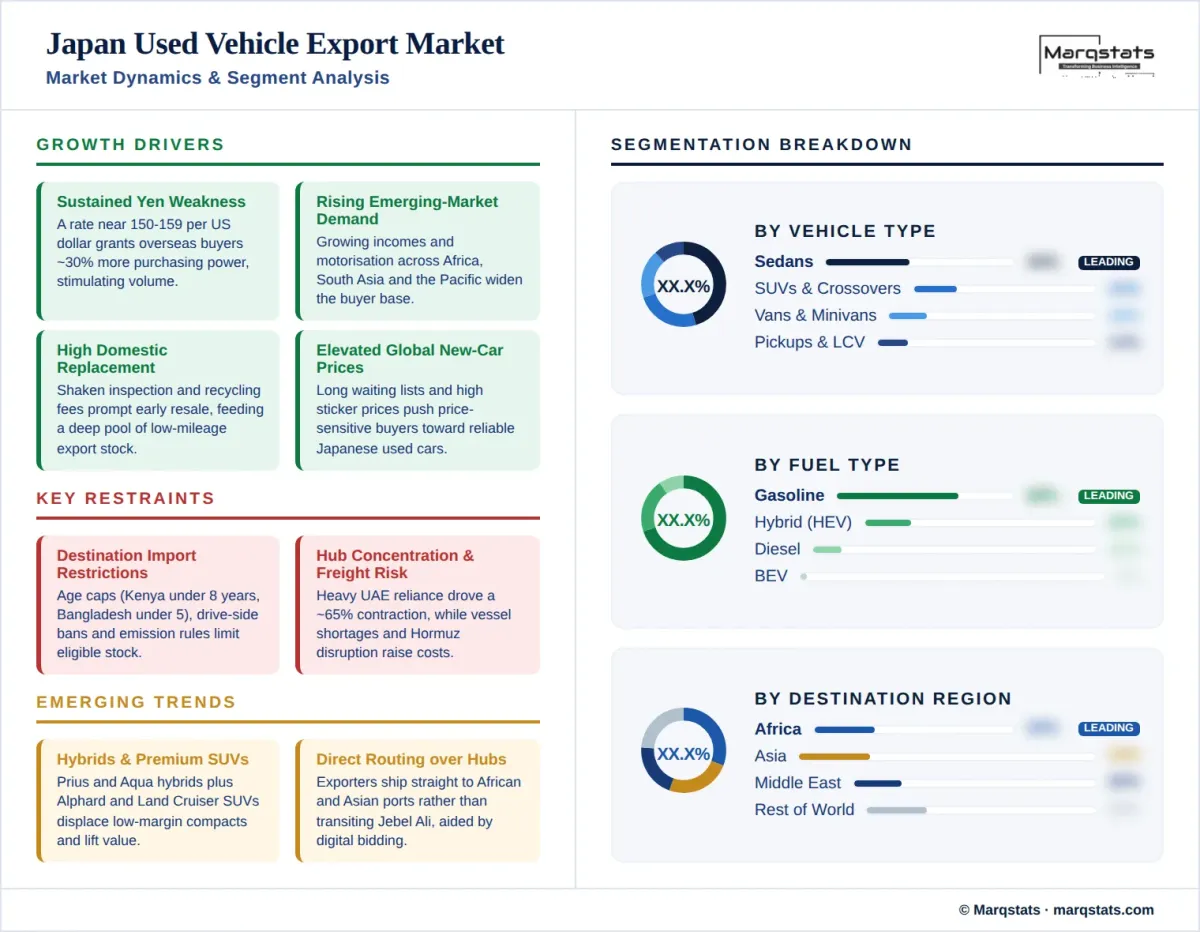
- Sustained yen depreciation — a rate near 150–159 per US dollar through 2025–2026 grants overseas buyers roughly 30% more purchasing power year-on-year, directly stimulating export volumes.
- Rising emerging-market demand — growing incomes and motorisation across Africa, South Asia, and the Pacific expand the buyer base, with East Africa a standout growth engine.
- High domestic replacement rate — Japan's "Shaken" inspection and recycling-fee structure encourage early resale, feeding a deep pool of low-mileage, well-maintained export-grade vehicles.
- Elevated global new-car prices — long waiting lists and higher sticker prices for new vehicles worldwide push price-sensitive buyers toward reliable Japanese used alternatives.
- Recycling-fee refund incentive — exporters recover the paid recycling deposit when a vehicle leaves Japan, improving unit economics and reinforcing the commercial case for export.
Key Restraints
- Destination import restrictions — age caps (Kenya ≤8 years, Bangladesh ≤5 years), drive-side bans, and emission rules limit eligible inventory and complicate compliance across markets.
- Concentration risk at re-export hubs — heavy historical reliance on the United Arab Emirates exposed exporters to a sharp demand contraction as flows redistributed through 2026.
- Quality perception and fraud — odometer tampering and undisclosed damage in parts of the trade pressure Japan's reputation and raise buyer demand for verified pre-export inspection.
- Freight and routing volatility — vessel shortages and Strait of Hormuz disruption raise shipping costs and transit times, squeezing margins on cost-and-freight shipments.
Key Trends
- Shift toward hybrids and premium SUVs — buyers increasingly favour Toyota Prius and Aqua hybrids and high-value SUVs such as the Alphard and Land Cruiser over low-margin compacts.
- Direct routing over hub consolidation — exporters route more shipments straight to African and Asian ports rather than transiting the Jebel Ali hub, owing to geopolitical and cost pressures.
- Digital auction participation — live internet bidding and online marketing widen remote buyer access, gradually reshaping the role of physical auction halls.
- Emerging used-EV exports — battery-electric models such as the Nissan Leaf begin reaching markets including New Zealand and Sri Lanka, seeding a small yet expanding niche.
Market Segmentation
Vehicle type is the primary axis of the export mix, and it maps directly to per-unit value. Passenger formats dominate volume, however the split between low-margin compacts and high-value SUVs, minivans, and pickups increasingly determines exporter profitability as buyers trade up. The paragraphs below outline each format's role, demand geography, and value position across the forecast period.
Sedans and hatchbacks form the backbone of export volume, valued for fuel efficiency, affordability, and simple maintenance in price-sensitive markets. Models from Toyota, Honda, Nissan, and Suzuki move in large quantities to Africa, South Asia, and Latin America, where they serve private ownership and shared-taxi fleets.
SUVs and crossovers command the highest per-unit values on the export market, with the Toyota Land Cruiser, Prado, and RAV4 fetching strong prices. Demand is durable across the Middle East, Russia, and East Africa, where ground clearance and durability suit harsh road and climate conditions.
Minivans and vans such as the Toyota Alphard, Voxy, and HiAce serve family transport, ride-hailing, and small-business logistics abroad. The Alphard in particular has become a high-value export owing to premium demand across Southeast Asia and the Gulf.
Pickups and light commercial vehicles, led by the Toyota Hilux, support agriculture, construction, and trade in African and Southeast Asian markets. Volumes are smaller than passenger cars, however unit values remain solid and demand is resilient across commercial use cases.
Kei cars hold a limited export position despite their domestic ubiquity. Their light construction and narrow parts availability abroad restrict resale value, so the segment stays marginal and concentrated in a handful of niche buyers.
Fuel type shapes both demand and margin as destination markets weigh running costs, tax treatment, and fuel availability. Gasoline models remain the volume default, however hybrids are the fastest-moving category as Japan's domestic electrified fleet ages into the used pool and fuel-cost-sensitive buyers seek efficiency.
Gasoline vehicles account for the largest share of exports, reflecting Japan's fleet composition and broad global compatibility. Reliability and low running costs keep gasoline models the default choice for most emerging-market importers.
Diesel models, concentrated in SUVs, pickups, and commercial vehicles, form a smaller yet steady share. Demand centres on markets with lower fuel costs and heavier-duty use requirements, where diesel torque and range are valued.
Hybrid exports are rising quickly as Japan's domestic hybrid fleet ages into the used pool. Toyota Prius and Aqua models attract buyers in markets with high fuel prices or tax incentives, and hybrids increasingly anchor the higher-margin end of shipments.
Battery-electric exports remain a small share, however the segment is emerging. Models such as the Nissan Leaf reach New Zealand and Sri Lanka, and expanding global charging access points to gradual growth over the forecast period.
Destination region determines eligible inventory through age caps and drive-side rules, and it drives the shift toward direct shipping. Africa is the largest and fastest-growing bloc, the Middle East is transitioning from hub-led dominance toward a redistributed pattern, and Asia, Eastern Europe, Oceania, and Latin America each contribute distinct, policy-sensitive demand.
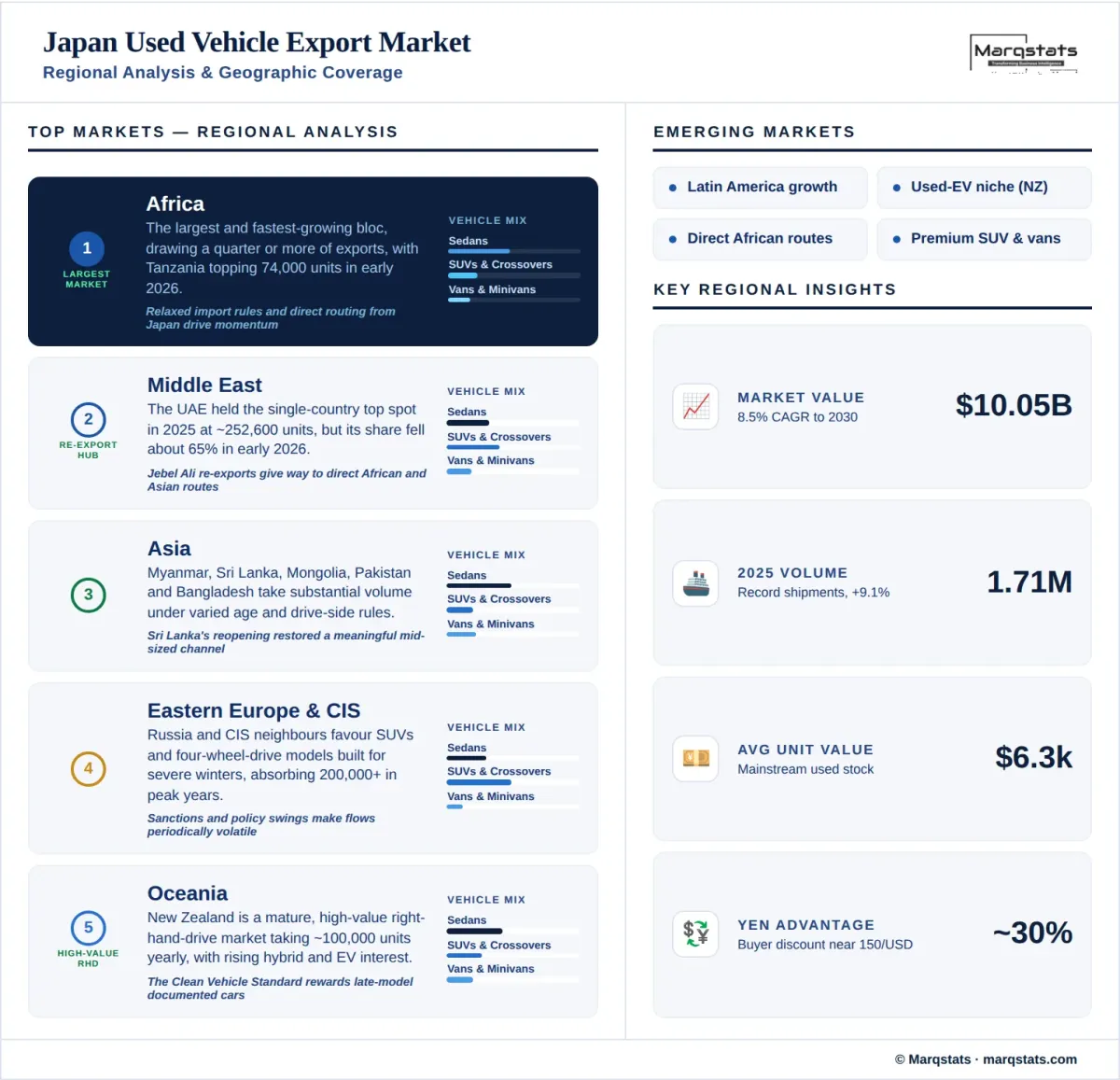
Africa is the largest destination bloc and the fastest-growing, drawing an estimated quarter or more of total exports. Tanzania, Kenya, and South Africa anchor demand, and East African volumes climbed further through 2026 as orders shifted away from Gulf intermediaries.
The Middle East, centred on the United Arab Emirates, served as both a large end-market and a re-export hub through Jebel Ali. The region held the single-country top spot in 2025, though its share contracted markedly in early 2026 as direct routing gained ground.
Asian markets including Myanmar, Sri Lanka, Mongolia, Pakistan, and Bangladesh take substantial volume, shaped by age caps and drive-side rules. Sri Lanka's reopening of used-vehicle imports restored a meaningful mid-sized channel during the forecast window.
Russia and neighbouring Commonwealth of Independent States markets remain significant destinations, favouring SUVs and 4x4s suited to severe winters. Flows here are sensitive to sanctions and policy shifts, producing periodic volatility in shipment patterns.
By Geography
Middle East
The United Arab Emirates was the single largest destination in 2025, taking roughly 252,600 units, with Jebel Ali functioning as a global re-export hub for onward flows to Africa, Central Asia, and the wider Gulf. Sharjah and Dubai concentrate import handling. Through the first half of 2026, shipments to the country fell about 65% year-on-year, a structural adjustment that redistributed demand toward direct African and Asian routes rather than a temporary dip.
Eastern Europe & CIS
Russia has ranked among the top single-country destinations, absorbing over 200,000 units in peak years, with strong preference for SUVs and four-wheel-drive models built for harsh climates. Import policy swings and sanctions have periodically redirected volume, making the region one of the more volatile pillars of the market even as underlying demand for durable Japanese vehicles persists.
Africa
Africa collectively represents the largest and fastest-expanding destination region. Tanzania led East African intake in early 2026 with over 74,000 units, alongside strong flows to Kenya and South Africa. Rising incomes, relaxed import policies in several economies, and a move toward direct shipping from Japanese ports rather than Gulf consolidation drive the region's momentum.
Asia
Asian destinations span Myanmar, Sri Lanka, Mongolia, Pakistan, and Bangladesh, each shaped by distinct age limits and drive-side requirements. Sri Lanka's reopening of used-vehicle imports after a multi-year suspension restored a mid-sized channel, while Myanmar and Mongolia sustained steady demand for compact and mid-size models.
Oceania
New Zealand is a mature, high-value right-hand-drive market, taking around 100,000 units annually with rising interest in used hybrids and battery-electric models under its Clean Vehicle Standard. The market rewards late-model, well-documented vehicles and forms a stable demand base within the region.
Latin America
Chile is the principal Latin American gateway, importing tens of thousands of right-hand-drive units and doubling monthly shipments in periods of 2025. The region combines free-port entry points with onward distribution, supporting demand for compact cars and SUVs across neighbouring economies. Steady incomes and a durable preference for reliable Japanese models sustain the channel through the forecast period.
How Competition Is Evolving
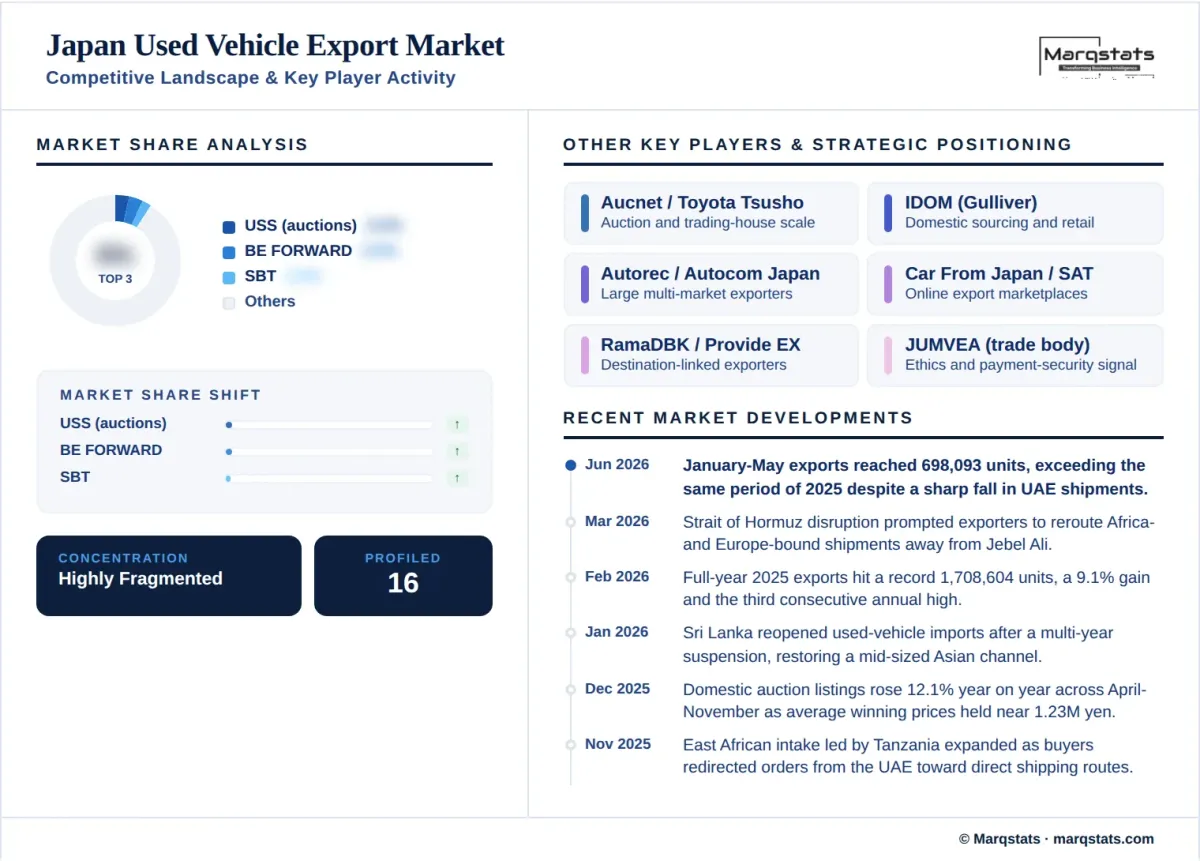
The Japan used vehicle export market is highly fragmented. Thousands of registered exporting firms operate alongside more than 200 auction groups, and no single company holds a dominant share of outbound volume. Competition turns on auction sourcing depth, inventory breadth, pricing transparency, payment protection, and logistics reliability rather than on brand scale alone. Membership of the Japan Used Motor Vehicle Exporters Association and adherence to its trade-ethics and payment-security frameworks increasingly function as trust signals that separate established exporters from smaller entrants.
Auction houses sit at the centre of the ecosystem. USS operates the largest network, and firms including Aucnet and the Toyota-affiliated auction system channel enormous monthly volumes, supplying the graded inventory that exporters bid on. Large exporters compete on stock size and global office coverage, while specialist agents differentiate through inspection quality, auction-sheet translation, and personalised support for first-time importers. Vertical integration between auction access, inspection, forwarding, and destination-market advisory services is a growing basis of competition.
Strategic priorities across the market include diversifying destination exposure away from single-hub concentration, expanding hybrid and premium-SUV sourcing to lift per-unit margins, and building direct shipping relationships to manage freight volatility. Payment-security schemes and verified inspection certificates have become competitive necessities as buyers guard against fraud and demand assurance on vehicle condition and mileage.
Companies Covered
The report profiles 14++ companies with full strategy and financials analysis, including:
Recent Market Activity
Table of Contents
Coverage & Segmentation
This report provides a comprehensive assessment of the Japan used vehicle export market for the period 2021–2030, with 2025 as the base year and 2026–2030 as the forecast window. Coverage spans market size and value forecasts, unit-volume validation, segmentation by vehicle type, fuel type, and destination region, competitive structure, and the regulatory and logistics frameworks that govern outbound trade. The study examines demand drivers, restraints, and trends shaping export flows to Africa, Asia, the Middle East, Eastern Europe and the Commonwealth of Independent States, Latin America, and Oceania.
The analysis defines the market as pre-owned vehicles exported from Japan on an export-value basis, measured in US dollars, with average transaction values and unit volumes triangulated across trade statistics, auction data, and shipment records. Market sizing follows a bottom-up build validated against top-down estimates, and all figures are reconciled to Marqstats' proprietary estimation framework rather than reproduced from any single external source.