Market Snapshot
Key Takeaways
Market Overview & Analysis
Report Summary
The global excavator market comprises crawler, wheeled, and mini or compact excavators sold new to construction, mining, utility, demolition, and other end users, alongside the replacement demand an aging installed fleet generates over time. This study segments the market by machine type, operating weight, and application, with a 2025 base year, historical coverage from 2021 to 2025, and forecasts to 2030. Market size is stated as new-equipment sales revenue in United States dollars, built from a unit-first model that applies weighted average selling price by operating-weight class rather than a single blended per-unit assumption. Propulsion type, spanning conventional diesel, battery-electric, and emerging hybrid and hydrogen options, is tracked as a cross-cutting dimension within the machine-type and operating-weight segmentation rather than as a standalone fourth segment, since electric and alternative-propulsion excavators remain a small share of total volume concentrated within specific operating-weight classes.
Operating-weight class is the single most important variable shaping excavator economics, since a mini excavator under six tonnes and a large mining-class excavator above fifty tonnes serve entirely different applications, customer bases, and price points despite sharing the same basic machine type classification. This report's unit-first, weight-class-weighted approach to market value avoids the distortion a simple average selling price across all excavator classes would introduce, since unit mix shift toward mini and compact classes can move total unit volume upward while moving total market value in a different direction. A market experiencing strong mini-excavator unit growth alongside flat or declining large-class sales would show rising total unit volume even as total market value growth moderates, a pattern this report's weight-class-weighted methodology is specifically designed to capture accurately.
Replacement demand from the existing installed fleet represents a structurally significant, if less visible, component of total excavator demand alongside new construction and mining activity growth. As machines reach the end of their typical economic life, determined by both age and accumulated utilisation hours, they generate replacement purchase demand largely independent of whether overall construction activity is expanding or contracting in a given year, giving this market a demand floor that new-activity-driven demand alone would not fully explain. Used-equipment trade flows further complicate a simple age-based replacement model, since a machine retired from a mature market's primary fleet frequently continues its working life in a secondary market after resale, meaning true replacement timing in the original market can occur well before the machine's full economic life is exhausted.
Market Dynamics
Key Drivers
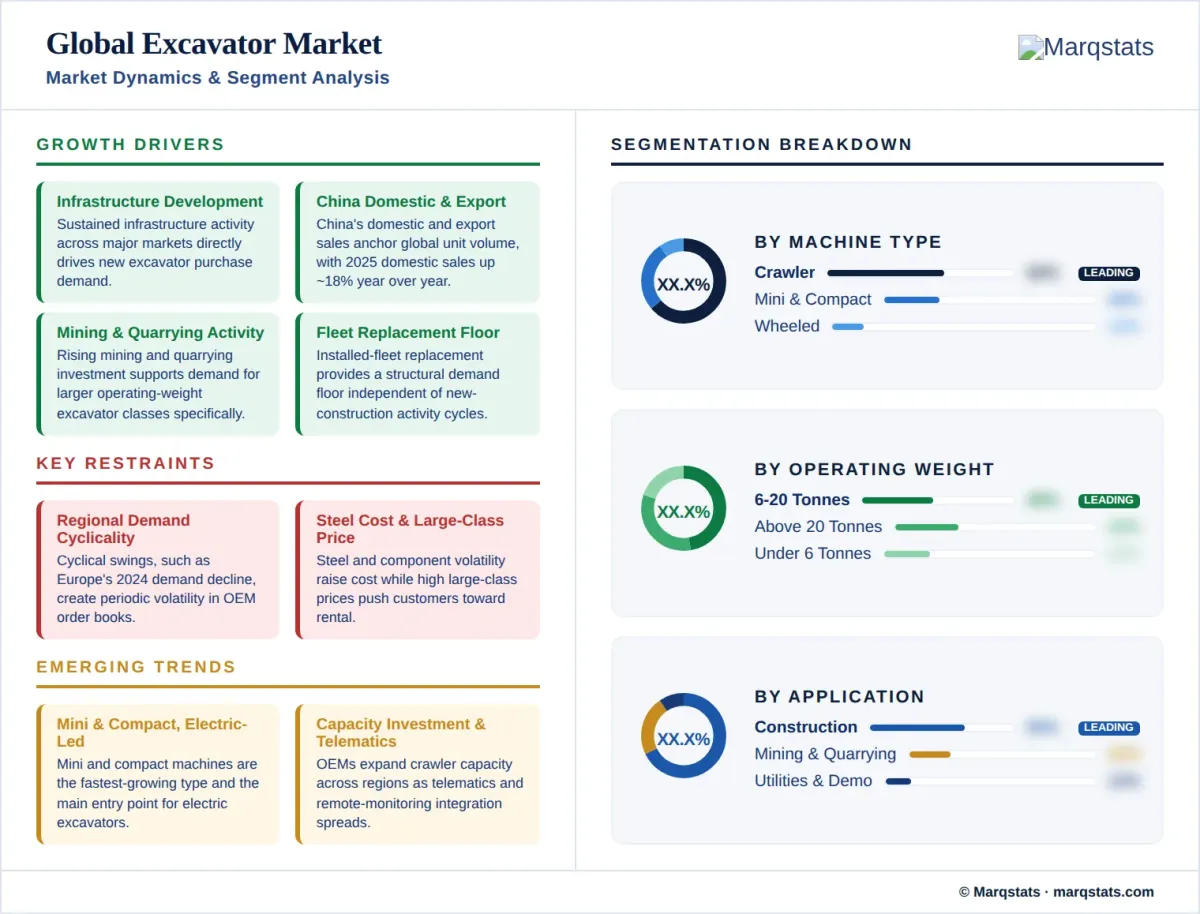
- Sustained infrastructure development activity across major markets directly drives new excavator purchase demand.
- China's domestic and export sales growth continues to anchor global unit volume, with 2025 domestic sales up 17.9% year-over-year.
- Rising mining and quarrying activity is supporting demand for larger operating-weight excavator classes specifically.
- Urbanisation and smart-city infrastructure development are supporting wheeled excavator demand suited to urban worksite conditions.
- Installed fleet replacement demand provides a structural demand floor independent of new construction activity cycles.
Key Restraints
- Regional demand cyclicality, including Europe's 2024 construction-equipment demand decline, creates periodic volatility in OEM order books.
- Steel and component price volatility directly affects OEM manufacturing cost and excavator selling prices.
- High acquisition cost for larger operating-weight classes continues to support rental as an alternative to direct purchase for many customers.
Key Trends
- Mini and compact excavators represent the fastest-growing machine-type segment, driven by urban and residential project applications.
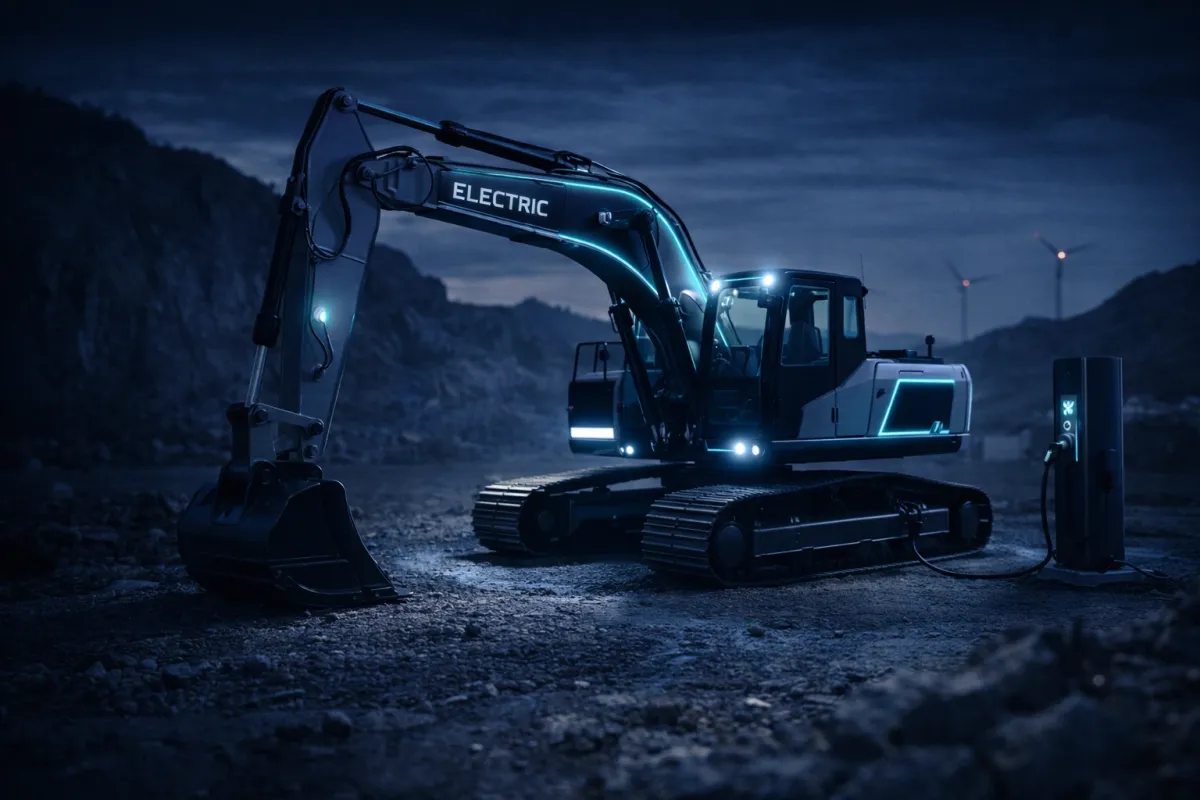
- Electric excavator deliveries are expanding from a small base, concentrated in mini and compact operating-weight classes to date.
- Major OEMs continue crawler-excavator capacity investment across multiple manufacturing regions to support both domestic and export demand.
- Telematics and remote-monitoring integration continues expanding across new excavator models, supporting fleet-management and utilisation tracking.
Market Segmentation
Crawler excavators represent the largest machine-type segment by both unit volume and revenue, valued for their stability and digging force across construction, mining, and heavy infrastructure applications where wheeled alternatives cannot match their working capability on uneven or unstable terrain. This category also spans the widest operating-weight range of any machine type, from small crawler units suited to residential work through the largest mining-class machines, giving it the broadest addressable application base within the excavator market overall.
Wheeled excavators serve urban and paved worksite applications specifically, offering road mobility between job sites that crawler machines cannot match, making them the preferred choice for utility work, urban infrastructure projects, and applications requiring frequent relocation between work sites. Demand for this machine type is concentrated in developed urban markets specifically, where paved road networks and frequent job-site relocation make wheeled mobility a genuine operational advantage rather than the secondary consideration it represents in less developed infrastructure environments.
Mini and compact excavators, typically under six tonnes operating weight, represent the fastest-growing machine-type segment, driven by residential construction, landscaping, and urban utility work where their smaller footprint and lower operating cost suit project scale better than larger machine classes. This category has also become the most common entry point for electric excavator adoption, since battery technology at this power scale has matured sufficiently for practical daily use in a way it has not yet for larger, more power-intensive machine classes.
Sub-six-tonne excavators serve the mini and compact segment specifically, with demand concentrated in residential, landscaping, and light utility applications where manoeuvrability and transport ease outweigh the digging force larger classes provide. This weight class can typically be transported on a standard trailer towed by a light truck, a practical consideration that meaningfully expands the pool of contractors and rental customers able to operate this equipment without specialised transport logistics. Homeowner and small-contractor purchasers represent a meaningful share of demand within this class specifically, a customer segment largely absent from larger operating-weight categories.
The 6-to-20-tonne class serves the bulk of general construction excavation work, representing a large share of total unit volume given its suitability for the majority of standard construction and infrastructure digging applications. This weight class also represents the most standardised, widely available segment across OEM product lines, since nearly every major manufacturer maintains a comprehensive lineup within this range given its broad applicability across customer types.
Excavators above 20 tonnes, extending through large mining-class machines above 50 tonnes, serve heavy infrastructure, quarrying, and mining applications, commanding substantially higher per-unit value than smaller classes despite representing a smaller share of total unit volume. Machines at the largest end of this range are typically specified and ordered against a specific mining project's equipment plan rather than purchased from general dealer inventory, giving this sub-segment a longer, more customised sales cycle than smaller operating-weight classes.
Construction remains the largest application by both unit volume and revenue, spanning residential, commercial, and infrastructure project types across every operating-weight class this report covers. Demand within this application tracks broader construction activity indicators closely, making it the application category most sensitive to the general economic and construction-cycle conditions this report's regional analysis discusses.
Mining and quarrying represents a significant secondary application, concentrated in larger operating-weight classes specifically, with demand tracking mining sector capital investment cycles more closely than broader construction activity trends. Commodity price cycles indirectly shape demand within this application, since mining companies typically time major equipment investment decisions around their own capital-spending plans, which in turn respond to prevailing commodity price and production-expansion economics.
Utility work, demolition, forestry, and material handling applications collectively represent the remaining demand base, often favouring wheeled and mini excavator classes given these applications' typical urban or confined-space working conditions. Demolition applications in particular frequently specify long-reach excavator configurations built on standard machine platforms, extending the base excavator's reach for high-rise or large-structure demolition work.
By Geography
Asia-Pacific
Asia-Pacific holds the largest regional share, anchored overwhelmingly by China's domestic sales and manufacturing base, alongside meaningful demand in India, Japan, and Southeast Asian markets. China's 2025 domestic sales of approximately 118,518 units, up 17.9% year-over-year, represent the single largest national demand pool this report covers. India's excavator market continues expanding alongside sustained domestic infrastructure investment, supported by both established international OEMs manufacturing locally and Escorts Kubota as a significant domestic manufacturer.
North America
North America represents a substantial, mature market, with demand closely tied to infrastructure investment programmes and residential and commercial construction activity, served by a mix of global OEMs manufacturing domestically and through import channels. The region's well-developed dealer network and equipment financing infrastructure support a relatively high replacement rate for the installed fleet, giving this market a somewhat more predictable replacement-driven demand pattern than faster-growing, new-construction-led emerging markets. Equipment rental penetration also runs comparatively high in this region, meaning a meaningful share of new excavator purchases flow into rental fleets rather than direct end-user ownership.
Europe
Europe's construction-equipment market showed renewed growth in 2025 following a notable 2024 decline, with earthmoving demand broadly stabilising after the prior year's contraction, though individual OEM demand indicators continued to show mixed regional performance across the year. This divergence between broad market recovery indicators and individual OEM performance reflects the varied pace of recovery across different national markets and customer segments within the region, rather than a uniform regional trend.
Rest of World
Latin America, the Middle East, and Africa represent a smaller, strategically important market, with demand shaped by infrastructure and mining investment programmes, and a meaningful share of regional demand served through China's export channel specifically. Major Gulf giga-project development has generated substantial excavator demand across the Middle East in particular, drawing both established international OEMs and Chinese manufacturers seeking to expand their presence in this fast-growing regional market.
How Competition Is Evolving
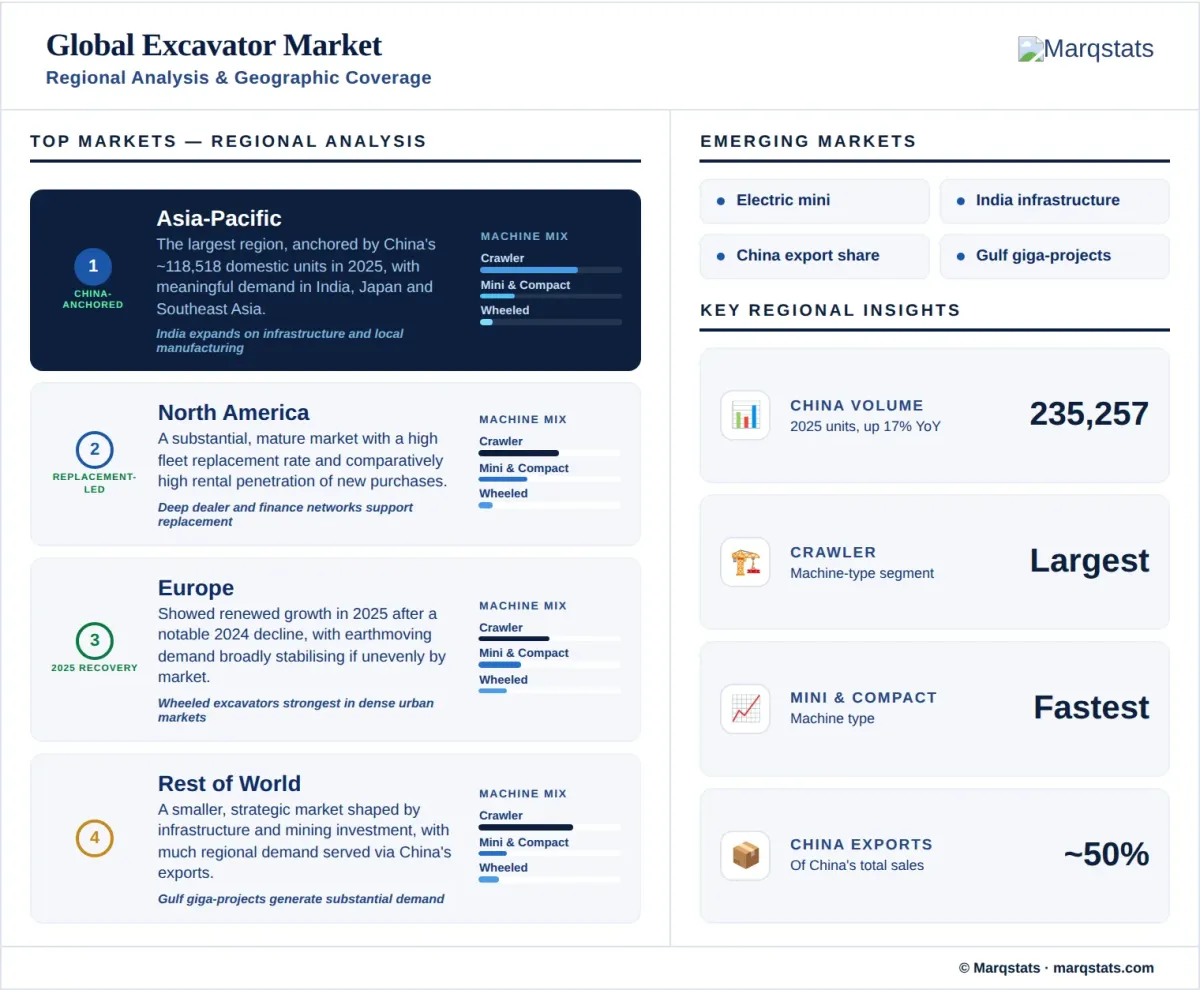
The market is moderately concentrated among a group of large global OEMs, led by established Japanese, American, and European manufacturers alongside rapidly scaling Chinese manufacturers who have captured substantial global export share on the strength of domestic manufacturing scale and competitive pricing. This competitive structure mirrors the pattern seen across much of the broader construction equipment industry, where Chinese OEMs have moved from a domestic-focused position toward meaningful international competitive presence within roughly a decade. Established OEMs generally retain the stronger position in large mining-class machines and premium construction segments, while Chinese manufacturers have achieved their greatest share gains in cost-sensitive mid-range and smaller operating-weight classes.
Competitive strategy centers on operating-weight class breadth, since customers increasingly favour OEMs able to serve their full excavator needs from mini to large mining-class machines through a single dealer relationship, alongside capacity investment to support both domestic and export manufacturing footprint. Established OEMs are increasingly investing in electrification and telematics capability specifically to differentiate against lower-cost Chinese competitors on technology rather than price alone. Dealer network depth and after-sales parts and service availability remain a further meaningful competitive differentiator, since excavator customers typically weigh total lifetime ownership cost, including downtime risk from service availability, alongside upfront purchase price.
Companies Covered
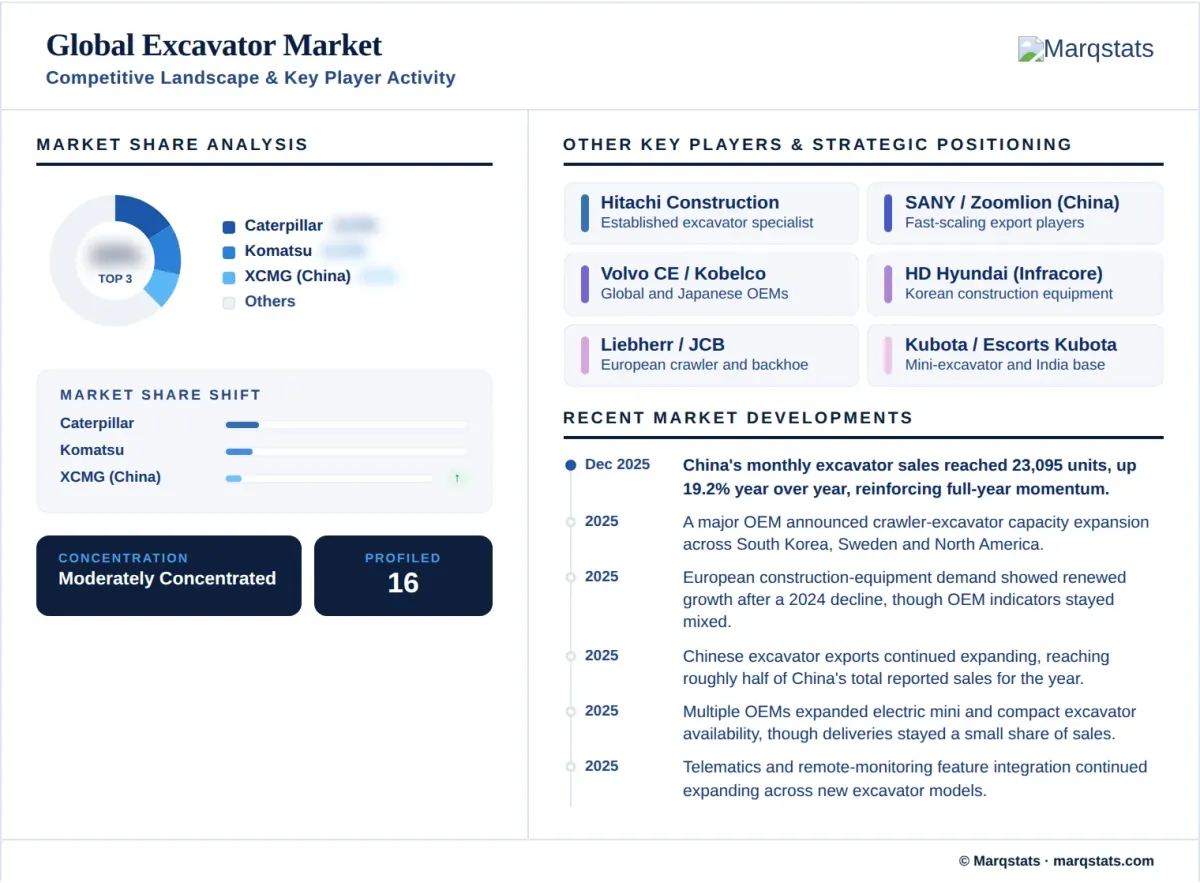
The report profiles 16+ companies with full strategy and financials analysis, including:
Recent Market Activity
Table of Contents
Coverage & Segmentation
This report provides a comprehensive assessment of the global excavator market across a 2025 base year, historical data from 2021 to 2025, and forecasts spanning 2026 to 2030. Market size is stated as new-equipment sales revenue in United States dollars, built using a unit-first model with weighted average selling price applied by operating-weight class. Segmentation covers three dimensions: machine type, operating weight, and application, alongside regional analysis spanning Asia-Pacific, North America, Europe, and the rest of world.
The scope covers crawler, wheeled, and mini or compact excavators sold new for construction, mining, utility, demolition, forestry, and material handling applications. The study excludes other construction equipment machine types, including loaders, dozers, and cranes, which Marqstats covers within its broader Global Construction Equipment Market report, and used-equipment resale transactions, which this report references only as a factor in installed-fleet replacement-cycle modelling rather than as a directly sized revenue stream. Long-reach and special-application excavator variants, including demolition and material-handling configurations built on standard excavator platforms, are included within their base machine-type and operating-weight classification rather than tracked as a separate segment, consistent with how these variants are typically ordered and reported by manufacturers. Country-level detail beyond the four-region split covered here is available under customization, alongside deeper cuts by machine type, operating weight, or propulsion type.