Market Snapshot
Key Takeaways
Market Overview & Analysis
Report Summary
The global forklift market comprises powered counterbalance trucks and powered warehouse trucks, spanning reach trucks, order pickers, and powered pallet trucks and stackers, sold new to manufacturing, logistics and third-party logistics, retail and e-commerce, food and beverage, construction, and other end users. This study segments the market by truck type, power source, and end user, with a 2025 base year, historical coverage from 2021 to 2025, and forecasts to 2030. Market size is stated as new-equipment sales revenue in United States dollars, with installed-base service, rental, and aftermarket revenue tracked as a related, distinct revenue pool. Automation level, spanning manual operation, operator-assist, and autonomous or automated-guided-vehicle-linked configurations, is tracked as a cross-cutting dimension within the truck-type and end-user segmentation rather than as a standalone fourth segment, since fully autonomous forklifts remain a small share of total unit volume concentrated within specific large logistics operations.
Lifecycle revenue represents a commercially significant component of this market that a new-equipment-only view would materially understate: aftermarket parts and service revenue, rental fleet revenue, and used-equipment sales together represent a revenue pool comparable in scale to new equipment sales for several major industry participants, reflecting both the multi-year service life a typical forklift provides and the recurring maintenance, battery, and tyre spend an installed fleet generates over that life. This report tracks new equipment and lifecycle revenue as related, distinct components rather than blending them into a single undifferentiated market figure. Several major OEMs now report service and rental revenue as distinct, separately disclosed business segments precisely because these recurring revenue streams carry materially different margin and growth characteristics than the new-equipment sales business, reinforcing why this report maintains the same distinction.
Electrification is proceeding at different speeds across truck types: warehouse trucks, including reach trucks, order pickers, and pallet trucks, are overwhelmingly electric already given their typical indoor, shorter-duty-cycle applications, while counterbalance trucks, historically dominated by internal-combustion power for outdoor and heavy-duty applications, are electrifying more gradually as battery technology and charging infrastructure extend electric counterbalance trucks' practical operating range and duty-cycle suitability. Global order data shows electric and warehouse trucks together now representing the substantial majority of new orders, with the remaining internal-combustion counterbalance share concentrated in outdoor, heavy-duty, and extended-runtime applications electric alternatives have not yet fully displaced.
Market Dynamics
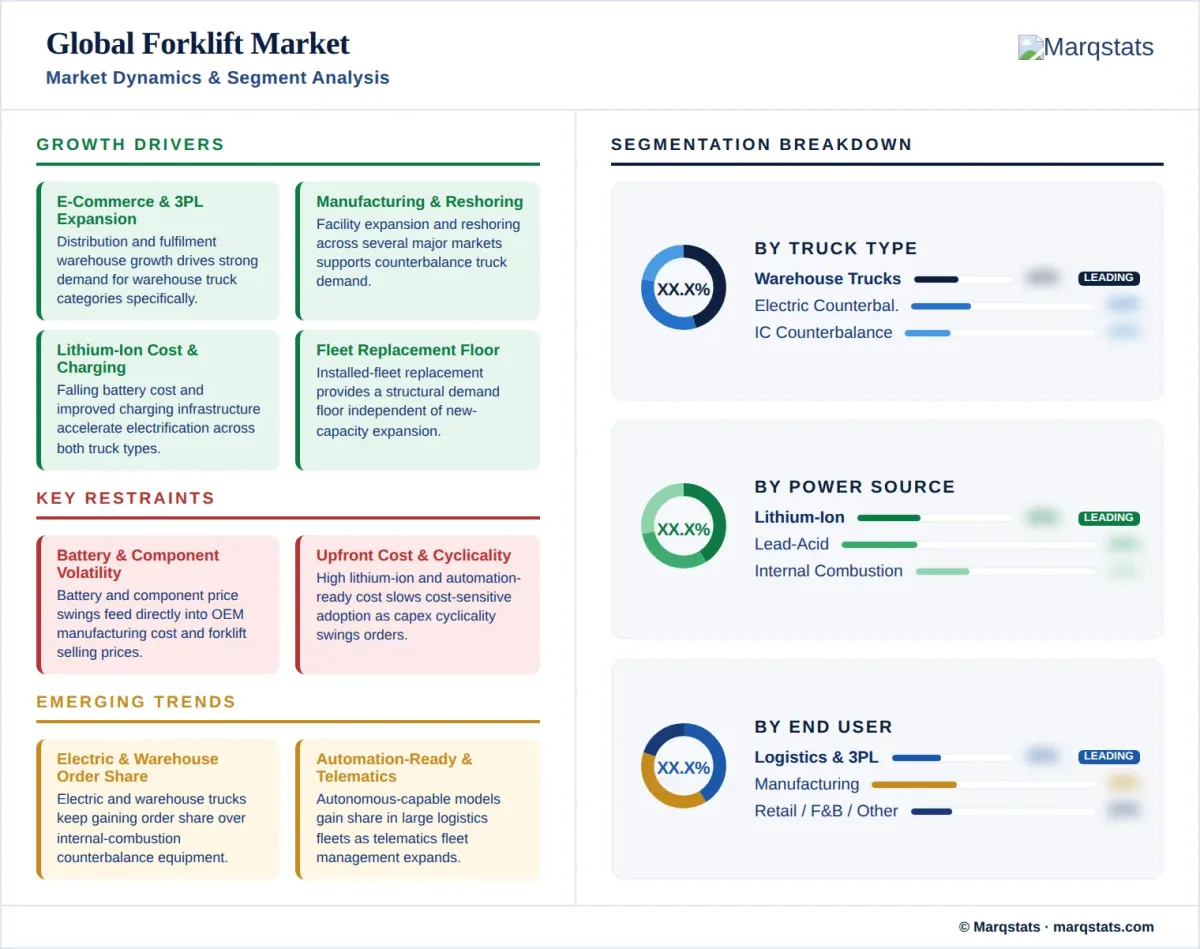
Key Drivers
- E-commerce and third-party logistics warehouse expansion continues to drive strong demand for warehouse truck categories specifically.
- Manufacturing facility expansion and reshoring activity in several major markets is supporting counterbalance truck demand.
- Lithium-ion battery cost decline and improved charging infrastructure are accelerating electrification across both truck type categories.
- Installed fleet replacement demand provides a structural demand floor independent of new warehouse or manufacturing capacity expansion.
- Growing rental and fleet-as-a-service adoption is expanding the addressable customer base beyond direct equipment purchasers.
Key Restraints
- Battery and component price volatility directly affects OEM manufacturing cost and forklift selling prices.
- High upfront cost for lithium-ion and automation-ready configurations slows adoption among smaller and cost-sensitive operators.
- Warehouse and manufacturing capital-spending cyclicality creates periodic volatility in new-equipment order volumes.
Key Trends
- Electric and warehouse truck orders continue gaining share over internal-combustion counterbalance trucks globally.
- Lithium-ion battery adoption continues expanding across both counterbalance and warehouse truck categories, gradually displacing lead-acid technology.
- Automation-ready and autonomous-capable forklift models are gaining specification share, particularly within large logistics and e-commerce fleets.
- Telematics and fleet-management technology integration continues expanding, supporting utilisation tracking and predictive maintenance.
Market Segmentation
Electric counterbalance trucks represent a growing share of the counterbalance category specifically, as battery technology and charging infrastructure extend their practical suitability into applications historically served by internal-combustion alternatives, particularly in indoor and mixed indoor-outdoor manufacturing and distribution environments. Larger-capacity electric counterbalance models, once limited by battery weight and range constraints, are increasingly available across a broader capacity range, extending electrification into applications previously considered impractical for battery power.
Internal-combustion counterbalance trucks retain a meaningful share in heavy-duty outdoor applications, including construction, ports, and rough-terrain environments, where extended run time and refuelling speed continue to offer practical advantages electric alternatives have not yet fully matched in every use case. LPG-powered trucks specifically retain a distinct advantage for indoor-outdoor mixed-use applications requiring longer runtime than typical electric shifts provide, without the emissions concerns diesel power raises for indoor operation.
Warehouse trucks, spanning reach trucks, order pickers, and powered pallet trucks and stackers, represent the largest truck-type category by unit volume, reflecting both the scale of warehouse and distribution centre operations globally and this category's near-universal electric power specification given its predominantly indoor application base. Reach trucks specifically dominate high-density racking applications, while order pickers serve the piece-picking operations that e-commerce fulfilment centres rely on heavily, giving this broad category considerable internal diversity despite sharing a common electric, indoor-application profile. Very-narrow-aisle trucks represent a further specialised sub-category within this group, purpose-built for the highest-density racking configurations found in space-constrained urban distribution facilities specifically.
Lithium-ion battery-powered trucks represent the fastest-growing power-source category, gaining share over lead-acid technology given lithium-ion's faster charging, longer service life, and lower total cost of ownership across multi-shift operations despite a higher upfront cost. Opportunity charging, topping up battery charge during operational breaks rather than requiring a dedicated overnight charging cycle, is a specific operational advantage lithium-ion enables that is reshaping multi-shift fleet planning for operators adopting the technology.
Lead-acid remains the largest installed power-source base by total unit count, reflecting decades of prior electric forklift deployment before lithium-ion technology matured to commercial viability, though new-equipment specification continues shifting toward lithium-ion across most truck-type and end-user categories. This installed base represents a meaningful replacement opportunity for lithium-ion suppliers, since operators frequently upgrade battery technology at the point of fleet renewal rather than mid-life, giving the installed lead-acid base a multi-year conversion runway rather than an immediate one.
Internal combustion power, spanning diesel, LPG, and CNG fuel types, remains concentrated in outdoor and heavy-duty counterbalance applications, with fuel type selection typically driven by regional fuel availability and cost alongside application-specific runtime requirements. Emissions regulation in several major markets is gradually tightening around internal combustion material handling equipment, adding a further factor accelerating this power source's long-term share decline relative to electric alternatives across nearly every application category this report covers.
Manufacturing represents a substantial end-user category, spanning both counterbalance and warehouse truck types across production, staging, and finished-goods handling applications throughout a typical manufacturing facility. Fleet composition within this end user tends to reflect the specific manufacturing process involved, with heavier counterbalance trucks more common in facilities handling bulk raw materials and warehouse trucks more common in facilities emphasising dense internal staging and storage between production stages.
Logistics, third-party logistics, and e-commerce fulfilment collectively represent the fastest-growing end-user category, driving substantial warehouse truck demand as distribution centre and fulfilment warehouse capacity continues expanding globally to serve growing e-commerce order volumes. This end-user category also shows the highest rental and fleet-as-a-service penetration of any segment covered in this report, reflecting the variable, seasonally-peaked demand patterns many logistics and fulfilment operations experience across the calendar year, particularly around major shopping periods when order volumes can multiply well beyond typical baseline levels.
Retail distribution, food and beverage cold-chain and processing facilities, construction, and other end users collectively represent the remaining demand base, each with distinct truck-type and power-source preferences shaped by their specific operating environment and duty-cycle requirements. Cold-chain and food processing applications specifically require specialised equipment configurations able to withstand sustained, extended low-temperature operation, a requirement that shapes both truck selection and typical maintenance schedules within this end-user category.
By Geography
Asia-Pacific
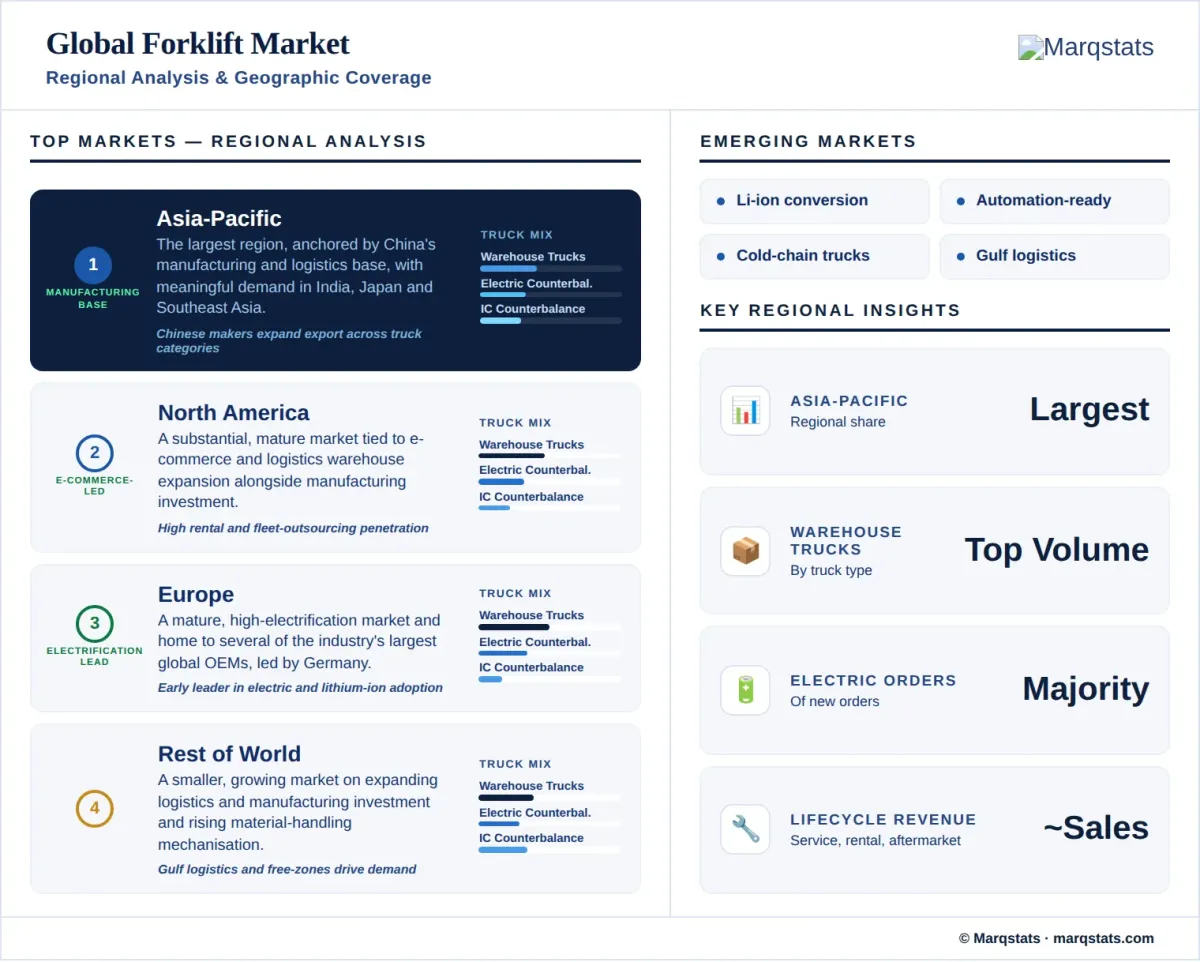
Asia-Pacific holds the largest regional share, anchored by China's extensive manufacturing and logistics infrastructure base, alongside meaningful demand in India, Japan, and Southeast Asian markets. The region combines the world's largest forklift manufacturing base with substantial domestic demand, giving Asia-Pacific suppliers a structural advantage in both regional and export-oriented supply. Chinese manufacturers, including Anhui Heli and Hangcha, have expanded export activity considerably in recent years, competing directly with established Japanese, German, and American OEMs across multiple regional markets, particularly within the electric counterbalance and warehouse truck categories where cost-competitive Chinese offerings have gained the most traction.
North America
North America represents a substantial, mature market, with demand closely tied to e-commerce and logistics warehouse capacity expansion alongside manufacturing facility investment, served by a mix of domestic and international OEMs with established regional manufacturing and dealer networks. The region's well-developed rental and fleet-financing infrastructure supports a comparatively high rate of fleet outsourcing relative to direct ownership among smaller and mid-sized operators specifically, a pattern that has made rental fleet economics a particularly closely watched indicator among industry participants operating in this market.
Europe
Europe combines a mature, high-electrification-rate forklift market with a concentration of major global OEMs headquartered within the region, reflecting both the region's early leadership in electric and lithium-ion forklift adoption and its deep industrial and logistics base. Germany specifically anchors both substantial domestic demand and the headquarters of several of the industry's largest global suppliers, giving the country an outsized influence on industry-wide technology and product development priorities.
Rest of World
Latin America, the Middle East, and Africa represent a smaller, growing market, with demand shaped by expanding logistics and manufacturing infrastructure investment and gradually rising mechanisation of material handling operations that historically relied more heavily on manual labour. Major Gulf logistics and free-zone infrastructure development has generated meaningful forklift demand across the Middle East specifically, drawing both established international OEMs and cost-competitive Chinese manufacturers seeking regional expansion.
How Competition Is Evolving
The market is moderately concentrated among a group of large global OEMs, led by established German, Japanese, and American manufacturers alongside rapidly scaling Chinese manufacturers who have captured substantial global share on the strength of competitive pricing and expanding electric product lines. Several of the largest OEMs report both new equipment and lifecycle service and rental revenue as distinct business segments, reflecting the strategic importance of recurring revenue alongside new-equipment sales. Consolidation activity has been a recurring feature of this industry, with several major OEMs having grown their current market position substantially through acquisition of complementary regional or specialty brands over the past two decades, a pattern that has produced today's multi-brand group structures common among the largest global suppliers.
Competitive strategy centers on truck-type and power-source breadth, since customers increasingly favour OEMs able to serve their full material handling fleet needs from warehouse trucks through heavy counterbalance equipment, alongside lithium-ion and automation-readiness capability that differentiates premium offerings from lower-cost alternatives. Dealer network depth and aftermarket service capability represent a further meaningful competitive differentiator, given the significant share of total industry revenue lifecycle service and rental represent alongside new equipment sales. National and regional account relationships with large logistics and manufacturing customers represent a further competitive battleground, since these multi-site fleet agreements typically lock in a substantial, recurring revenue base that competitors can only displace at contract renewal.
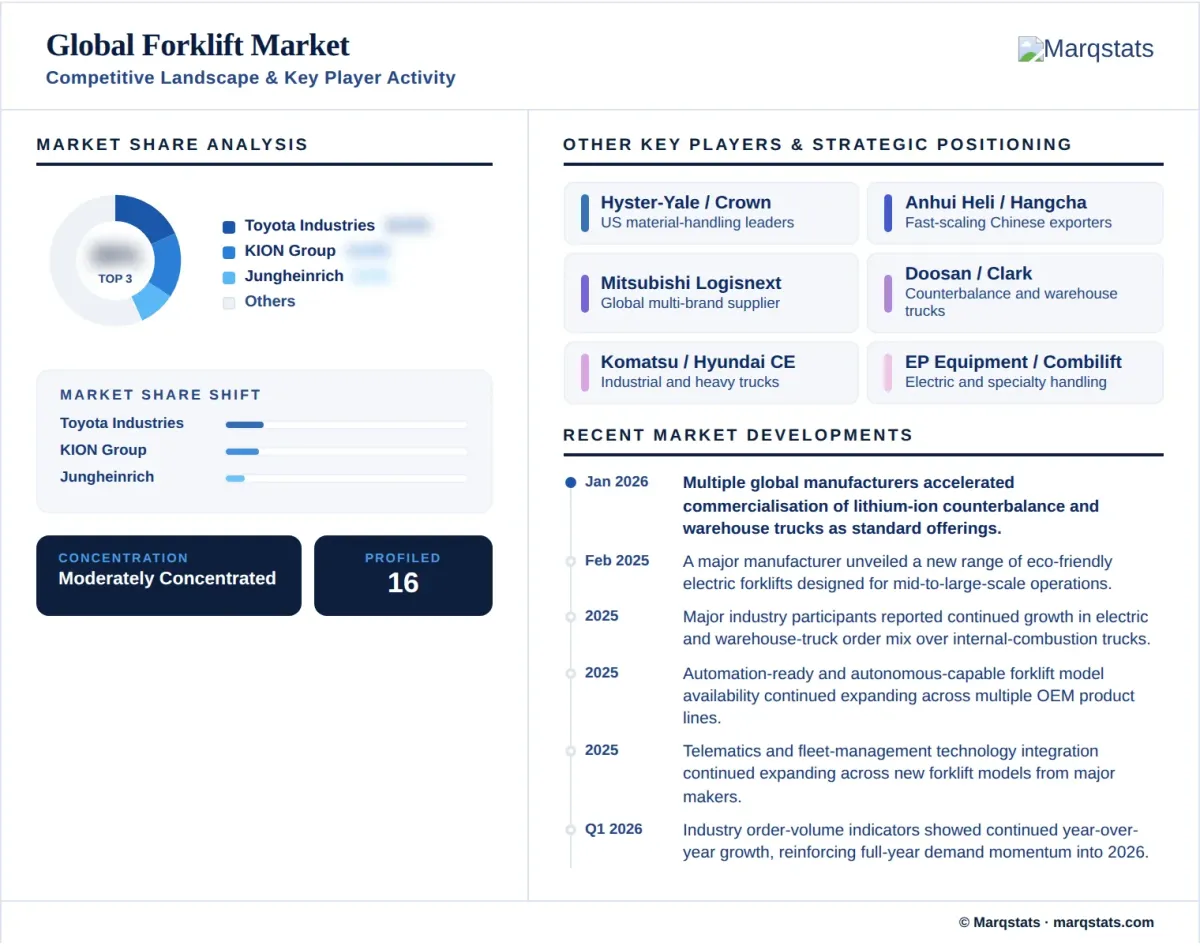
Companies Covered
The report profiles 16+ companies with full strategy and financials analysis, including:
Recent Market Activity
Table of Contents
Coverage & Segmentation
This report provides a comprehensive assessment of the global forklift market across a 2025 base year, historical data from 2021 to 2025, and forecasts spanning 2026 to 2030. Market size is stated as new-equipment sales revenue in United States dollars, with lifecycle service, rental, and aftermarket revenue tracked as a related, distinct revenue pool. Segmentation covers three dimensions: truck type, power source, and end user, alongside regional analysis spanning Asia-Pacific, North America, Europe, and the rest of world.
The scope covers powered counterbalance trucks and powered warehouse trucks, including reach trucks, order pickers, and powered pallet trucks and stackers. The study excludes manual, non-powered pallet trucks, automated guided vehicles and autonomous mobile robots, and fixed warehouse automation systems, each of which Marqstats covers separately given their distinct technology base and supplier ecosystem. Port and terminal-specific heavy-capacity forklift demand, covered within Marqstats' Global Container Handling Equipment Market report, is not separately re-sized here to avoid double-counting between the two reports. Rough-terrain and telehandler equipment, while sometimes marketed alongside forklift product lines by certain manufacturers, is treated as a distinct construction equipment category rather than included within this report's core forklift scope. Country-level detail beyond the four-region split covered here is available under customization, alongside deeper cuts by truck type, power source, or automation level.