Market Snapshot
Key Takeaways
Market Overview & Analysis
Report Summary
Thailand's plug-in hybrid and range-extender market is a manufacturing outcome before it is a consumer preference, and that single characteristic separates it from every other electrified segment in the country. Five plug-in hybrid or range-extender nameplates reached the Thai market between March and August 2026, and four of them are assembled or destined for assembly at Rayong. Buyers are choosing between locally built vehicles priced from THB 699,900, which is a competitive set that did not exist eighteen months earlier.
The measure is annual new passenger plug-in hybrid electric vehicles and range-extended electric vehicles sold domestically in Thailand. Commercial vehicles, motorcycles and conventional hybrids without a plug are excluded. Conventional hybrids are the larger neighbouring segment at 146,059 units of 2025 domestic sales and 214,317 units within total 2025 passenger production of 550,456 units, and conflating the two overstates the plug-in market by roughly fifteen times.
The analysis is written for manufacturers weighing a Thai assembly commitment against continued import, component suppliers sizing plug-in hybrid content against battery-electric content, distributors planning showroom and service investment across powertrains, and policy analysts modelling the revenue consequences of the carbon dioxide-based excise framework. It treats excise banding, export demand and battery cell allocation, rather than consumer range anxiety, as the variables that decide how large the segment becomes.
Thailand Plug-in Hybrid and Range-Extender EV Market Size and Forecast
Domestic sales were 9,611 units in 2025, comprising 8,621 plug-in hybrids and 990 range-extended vehicles, and are estimated at 18,500 in 2026 and 44,000 by 2030, an increase of 34,389 units a year. Market value moves from USD 429.00 million to USD 1,340.33 million on a per-vehicle convention falling from about USD 44,636 to USD 30,462, which at a disclosed constant THB 32.5 per USD is THB 1,450,682 falling to THB 990,016.
Two growth rates apply and both are published. The five-year value rate connecting 2025 and 2030 is 25.59%. The four-year rate connecting 2026 and 2030 is 20.41%, and the 5.18-point gap is not a change in the adoption curve. It is the 2026 launch wave: a 92.49% single-year increase carried by five nameplates arriving in one year, after which the segment grows on penetration rather than on new model availability. Units compound at 35.56% over the five-year window and at 24.19% over the four-year one.
Value compounds behind units at 25.59% against 35.56%, a 9.97-point inversion and the widest in the Thai catalogue. The mechanism is mix dilution rather than price deflation, and the 2025 starting point explains its size: a 9,611-unit market dominated by premium imports carries a blended price of about THB 1,450,682, and the locally assembled models now taking the volume are priced between THB 699,900 and THB 979,900.
A sizing range is published alongside the point estimate and should be quoted with it. The 2026 figure sits within a band of 15,000 to 22,000 units and the 2030 figure within 30,000 to 62,000, a spread of roughly 2.1 times at the terminal year that reflects genuine uncertainty about one variable: whether the carbon dioxide-based excise framework keeps a favourable band for plug-in hybrids after the EV3.5 scheme ends in 2027.
A growth rate is not assessable on its own, so it is worth restating as a penetration requirement. Reaching 44,000 units by 2030 asks plug-in hybrids and range-extenders to take about 5.64% of Thai domestic vehicle sales on an assumed 780,000-unit market, against 1.55% of the 621,166 vehicles sold in 2025. That is a near fourfold share gain, which is demanding in absolute terms and modest against a powertrain that grew 260.56% in a single year.
The bear case decomposes cleanly and is worth carrying. If the imported premium segment contracts at the reported 5% to 10% a year through the window and no locally assembled nameplate follows the Forthing V9 multi-purpose vehicle planned for 2027, the terminal settles near the lower band at 30,000 units and USD 913.86 million, a 16.33% value rate. That scenario costs 9.26 percentage points of growth and turns on model pipeline rather than on demand.
Thailand Exports Half the Plug-in Hybrids It Builds
The most important number on this page is a difference between two reported series rather than a forecast. Thailand produced 17,296 passenger plug-in hybrids in 2025, up 116.7%, and sold 8,621 domestically, so the country built 2.01 units for every one it sold at home and placed 8,675 units, or 50.16% of output, outside the domestic market.
That is the exact opposite of the battery-electric position, and stating the pair is the most useful thing this analysis does. Thailand sold 125,411 passenger battery-electric vehicles between January and July 2026 against 47,452 produced, a ratio of 2.64 sold per unit built, which means at least 62.16% of battery-electric demand was met from abroad. Thailand buys the powertrain it imports and builds the powertrain it exports.
The pattern holds across the third powertrain too, which makes it structural rather than incidental. Thailand built 214,317 conventional hybrids in 2025 against 146,059 sold domestically, an export surplus of 68,258 units or 31.85% of output. Both hybrid formats run a production surplus; only the battery-electric segment runs a deficit.
For a component supplier the consequence is a sizing error waiting to happen. A plug-in hybrid content plan built from 8,621 domestic sales understates the addressable Thai volume by 8,675 units, which is 100.63% more than the domestic figure alone implies, and the gap is widening as the Rayong plants add lines rather than as Thai buyers change their minds.
The domestic market that remains is small, premium-weighted and being rebuilt from the bottom. Mercedes-Benz Thailand reported 2,845 units across all powertrains in the first half of 2026 with plug-in hybrid sales up 34% year on year, and a Maybach S 580 e allocation of 16 units at THB 14 million shows the scale at which imported plug-in hybrids operate: a segment measured in hundreds, now carrying 15% excise, inside a production base measured in tens of thousands.
Excise Is the Price Mechanism, and It Now Runs on Carbon Dioxide
The rate on imported plug-in hybrids moved from 8% to 15% on 1 January 2026, adding about 10% to vehicle cost. In the same period, sales of imported vehicles priced above THB 5 million fell about 10% and the imported market overall was expected to contract 5% to 10% across 2026, a one-for-one correspondence between the cost increase and the volume decline that is suggestive on one year of data rather than conclusive.
The framework being finalised in September 2026 changes the basis rather than the rates. Thailand's Finance Ministry stated that carbon dioxide emissions would be the primary criterion for excise incentives, with lower rates for manufacturers investing in local production, and confirmed that the structure covers conventional hybrids, plug-in hybrids and range-extended electric vehicles alongside battery-electric vehicles. Compliant hybrids and plug-in hybrids face bands running from single-digit rates to the low 20% range, subject to localisation, battery and advanced driver assistance requirements.
Three criteria in one instrument is the detail that matters commercially. A plug-in hybrid qualifying for a favourable band has to satisfy local content, carry a battery meeting the specified requirement and fit an emissions band, so a model designed for another market cannot be dropped into Thailand and priced competitively. The 26.6 kWh battery in the Sealion 6 DM-i Extended and the 31.9 kWh pack in the Forthing Friday range-extender are engineering responses to that structure as much as to customer range expectations.
The revenue argument advanced against electrification does not survive its own arithmetic. One incumbent manufacturer pays about THB 20 billion in annual excise on roughly 260,000 vehicles, which is THB 76,923 each, while electric vehicle sales of about 120,000 units generate roughly THB 10 billion, which is THB 83,333 each. On the manufacturer's own figures the electrified fleet already yields 8.33% more excise per vehicle than the fleet it is displacing, so the incumbent case is really about volume and share rather than about tax yield.
Battery Arithmetic Favours the Bridge Powertrain
Four disclosed Thai plug-in hybrid and range-extender models give an unusually tight engineering benchmark. The BYD Sealion 5 DM-i Standard pairs a 13.08 kWh battery with 80 kilometres of electric range at 6.12 kilometres per kWh; the Premium variant runs 18.3 kWh for 110 kilometres at 6.01; the Sealion 6 DM-i Extended runs 26.6 kWh for 150 kilometres at 5.64; and the Geely Starray EM-R range-extender runs an 18.4 kWh lithium iron phosphate pack for 104.8 kilometres at 5.70.
Four independent models converging on 5.64 to 6.12 kilometres per kWh is a planning constant, and scaling it is where the policy consequence appears. Three 18.4 kWh packs consume 55.2 kWh of cells, roughly one battery-electric pack, and electrify three vehicles across 314.4 kilometres of combined electric range instead of one vehicle across a longer single range.
For a country importing most of its cells while building a domestic supply base, that ratio is not a debating point. Thailand's BOI has approved 28 battery projects worth more than THB 65 billion within more than THB 150 billion of battery-electric-related investment promotion from 2017 through the second quarter of 2026, and until those plants run at scale every kWh allocated to a long-range battery-electric vehicle is a kWh not allocated to three plug-in hybrids.
Total range is the second half of the argument and it removes the charging dependency entirely. The Sealion 5 DM-i Standard reaches 1,180 kilometres combined, the JAECOO 6T range-extender up to 800 kilometres and the Forthing Friday up to 1,100 kilometres, against roughly 4,356 public charging stations nationally as of December 2025. A vehicle that covers a daily commute on 80 to 190 kilometres of electric range and a provincial trip on liquid fuel places materially less demand on that network than a battery-electric equivalent.
A Parc That Predates the Electric Wave
EVAT recorded a plug-in hybrid parc of approximately 81,367 units as of December 2025, against 605,017 conventional hybrids and 282,312 electric passenger vehicles. The plug-in hybrid parc is therefore 28.82% of the size of the battery-electric parc, which is far larger than the powertrain's share of current sales suggests.
Dividing stock by flow makes the point precisely. The plug-in hybrid parc holds 8.47 years of 2025 sales, while the battery-electric parc of 387,000 cumulative registrations holds 3.17 years of the 122,123 passenger registrations recorded in 2025. Plug-in hybrid sales are 7.17% of battery-electric sales but the parc is 28.82% of the battery-electric parc, a four-to-one discrepancy that can only come from history.
That is the opposite of how the category is usually read. Plug-in hybrids in Thailand are commonly presented as a 2026 arrival riding the range-extender launch wave, when in fact a premium plug-in hybrid base built up over the preceding decade is still the overwhelming majority of the vehicles on the road. The new locally assembled models are not creating the segment; they are replacing an imported premium base with a domestically built mass-market one.
Capacity Is Not the Constraint, Utilisation Is
BYD's Rayong plant is rated at up to 150,000 units a year and builds three plug-in hybrid lines plus two battery-electric lines at around 50% domestic content. Thailand's entire 2025 passenger plug-in hybrid output of 17,296 units is 11.53% of that single plant's nameplate capacity, and the plant has delivered 130,000 cumulative vehicles across all powertrains since opening.
The wider picture is the same at larger scale. Chinese manufacturer capacity in Thailand is expected to exceed 500,000 units a year, against combined 2025 battery-electric and plug-in hybrid passenger production of 88,210 units, or 17.64%. The Federation of Thai Industries put average passenger-car capacity utilisation at 40.65%, so the underuse is not confined to new entrants.
Capacity additions continue regardless, which tells you where the segment is expected to go. Chery and Omoda and Jaecoo run a Rayong plant rated at up to 80,000 units with 40,000 targeted in the second half of 2026, GAC Aion brings the i60 into Rayong production in the same half after reaching 10,000 cumulative units, and Forthing plans a V9 multi-purpose vehicle for 2027 with its own plant from mid-2027 against a 10,000-unit annual target.
Investment follows the same logic and it is already measurable. BOI approvals for plug-in hybrid manufacturing stand at THB 9.429 billion across 7 projects, an average of THB 1.347 billion per project against THB 2.194 billion for the 18 approved battery-electric projects. That is 11.96% of approved electrified manufacturing capital for 5.72% of 2025 electrified output, a ratio of 2.09 and the exact inverse of the conventional hybrid position at 0.54.
Market Dynamics
Key Drivers
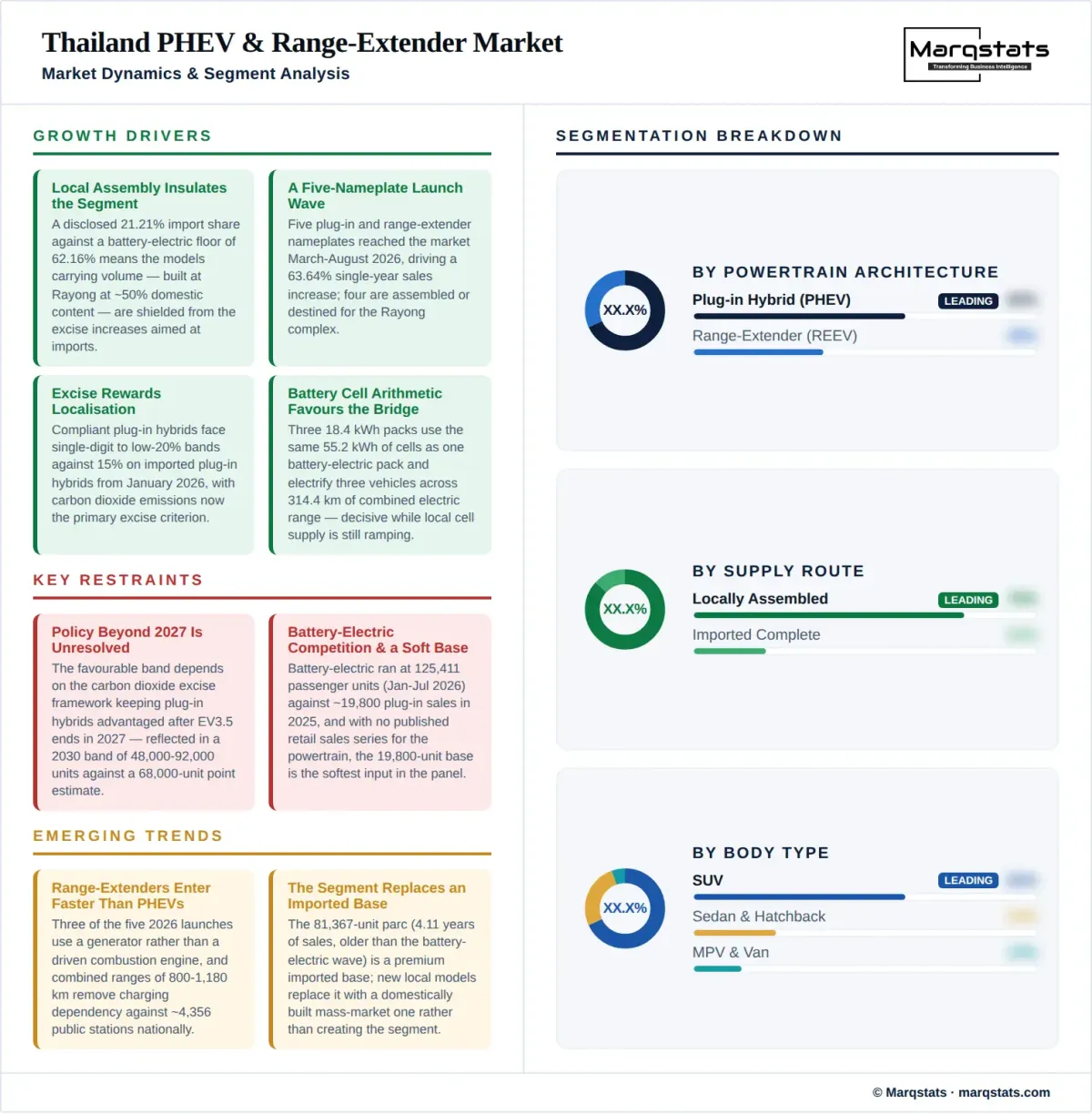
- Export demand absorbing 8,675 units, or 50.16% of the 17,296 plug-in hybrids Thailand produced in 2025, which is double the domestic market by itself.
- A launch wave of five plug-in hybrid and range-extender nameplates between March and August 2026, driving a 92.49% single-year increase in domestic sales.
- Excise banding that rewards localisation, with compliant hybrids and plug-in hybrids facing single-digit to low-20% rates against 15% on imported plug-in hybrids from 1 January 2026.
- Battery cell scarcity favouring the powertrain that electrifies three vehicles per 55.2 kWh of cells across 314.4 kilometres of combined electric range.
- Charging network limits, with roughly 4,356 public stations as of December 2025 against combined ranges of 800 to 1,180 kilometres on plug-in hybrid and range-extender models.
Key Restraints
- A domestic base of 9,611 units, only 1.55% of the 621,166 vehicles sold in Thailand in 2025 and 7.17% of battery-electric sales.
- A contracting imported premium segment, down about 10% above THB 5 million after excise rose from 8% to 15% and expected to fall 5% to 10% across 2026.
- Policy uncertainty beyond the EV3.5 scheme's 2027 expiry, reflected in a published 2030 band of 30,000 to 62,000 units against a 44,000-unit point estimate.
- Competition from battery-electric vehicles running at 125,411 passenger units in January to July 2026, against 9,611 plug-in hybrid and range-extender sales across the whole of 2025.
Key Trends
- Range-extender architectures entering faster than conventional plug-in hybrids, with three of five 2026 launches using a generator rather than a driven combustion engine.
- Value compounding behind units at 25.59% against 35.56% as mix dilutes from premium imports at about THB 1,450,682 toward locally assembled models at THB 699,900 to THB 979,900.
- Carbon dioxide emissions replacing powertrain category as the excise basis, with localisation, battery and driver assistance criteria applied together from 2026.
- Multi-purpose vehicles emerging as the second body type, with electrified models already around 35% of the multi-purpose and van market in 2025.
Market Segmentation
Parallel and series-parallel systems where the combustion engine can drive the wheels directly, accounting for 8,621 of the 9,611 units sold in 2025 and all 17,296 units of reported production. Electric range runs 80 to 150 kilometres on batteries of 13.08 to 26.6 kWh, and the format dominates both domestic volume and export output.
Series systems where the combustion engine only generates electricity, at 990 units in 2025 and represented by the Geely Starray EM-R at 18.4 kWh and 104.8 kilometres, the JAECOO 6T at 160 to 190 kilometres and the GAC Aion i60 entering Rayong production in the second half of 2026. Three of five 2026 launches used this architecture, making it the faster-growing of the two.
The dominant body type across every 2026 launch, spanning the BYD Sealion 5 and Sealion 6, the Starray EM-R and the JAECOO 6T between THB 699,900 and THB 979,900. Sport utility vehicles account for the great majority of the 9,611 units sold domestically in 2025.
The emerging second body type, where electrified models already held around 35% of the multi-purpose and van market in 2025, roughly 2.18 times the 16.02% electrified share of total passenger production. Forthing's V9 plug-in hybrid multi-purpose vehicle arrives in 2027 against a 10,000-unit annual target, itself larger than the entire 2025 domestic segment.
A smaller segment led by the locally assembled BYD Seal 5 DM-i and by imported premium models including the Mercedes-Maybach S 580 e at THB 14 million in a 16-unit allocation. Volume here is constrained by the same 15% import excise that applies across the imported plug-in hybrid range.
The band taking the segment over, running from the Sealion 5 DM-i Standard at THB 699,900 to the JAECOO 6T ULTRA at THB 979,900, and the reason the per-vehicle convention falls from about USD 44,636 to USD 30,462 across the forecast. Every model in this band is locally assembled or planned for local assembly.
European and Japanese plug-in hybrids sold largely as imports and carrying 15% excise from January 2026, a band where Mercedes-Benz Thailand grew plug-in hybrid sales 34% year on year on total volume of 2,845 units in the first half of 2026. This band explains why the 2025 blended price stands at about THB 1,450,682 on only 9,611 units.
The smallest and most exposed band, where sales fell about 10% after the excise increase added roughly 10% to cost, exemplified by a 16-unit Maybach S 580 e allocation at THB 14 million. The imported market overall is expected to contract 5% to 10% across 2026.
The 9,611 units sold in Thailand in 2025, which is the panel measured here and 49.84% of the 17,296 plug-in hybrids produced, in a market where domestic demand is 1.55% of total vehicle sales.
The 8,675-unit surplus between 2025 plug-in hybrid production of 17,296 and domestic plug-in hybrid sales of 8,621, equal to 50.16% of output and the reason a component plan sized on Thai registrations understates the addressable volume by 100.63%.
A disclosed modelled 7,200 of the 9,611 units sold in 2025, or 74.91%, built principally at BYD's 150,000-unit Rayong plant at around 50% domestic content. Local assembly qualifies for the low excise bands and satisfies the EV3.5 scheme's 40% local-content requirement.
A disclosed modelled 2,411 units in 2025, or 25.09%, concentrated in European premium models. This route carries 15% excise from 1 January 2026 against 8% previously, and a 20% import tariff applies in the relevant trade context.
Entry configurations including the Sealion 5 DM-i Standard at 80 kilometres on 13.08 kWh, the cheapest way into the segment at THB 699,900. This band delivers the highest efficiency at 6.12 kilometres per kWh and the lowest cell consumption per vehicle.
The volume band, covering the Sealion 5 Premium from THB 759,900 at 110 kilometres on 18.3 kWh, the Starray EM-R at 104.8 kilometres on 18.4 kWh and the Sealion 6 DM-i Extended at 150 kilometres on 26.6 kWh with 55 kW direct-current charging. Efficiency runs 5.64 to 6.01 kilometres per kWh here.
Long-range configurations led by the JAECOO 6T 2WD MAX at 190 kilometres of electric range and up to 800 kilometres combined, priced at THB 879,900. The band competes directly with entry battery-electric vehicles priced from THB 429,900 and wins on total range rather than on price.
By Geography
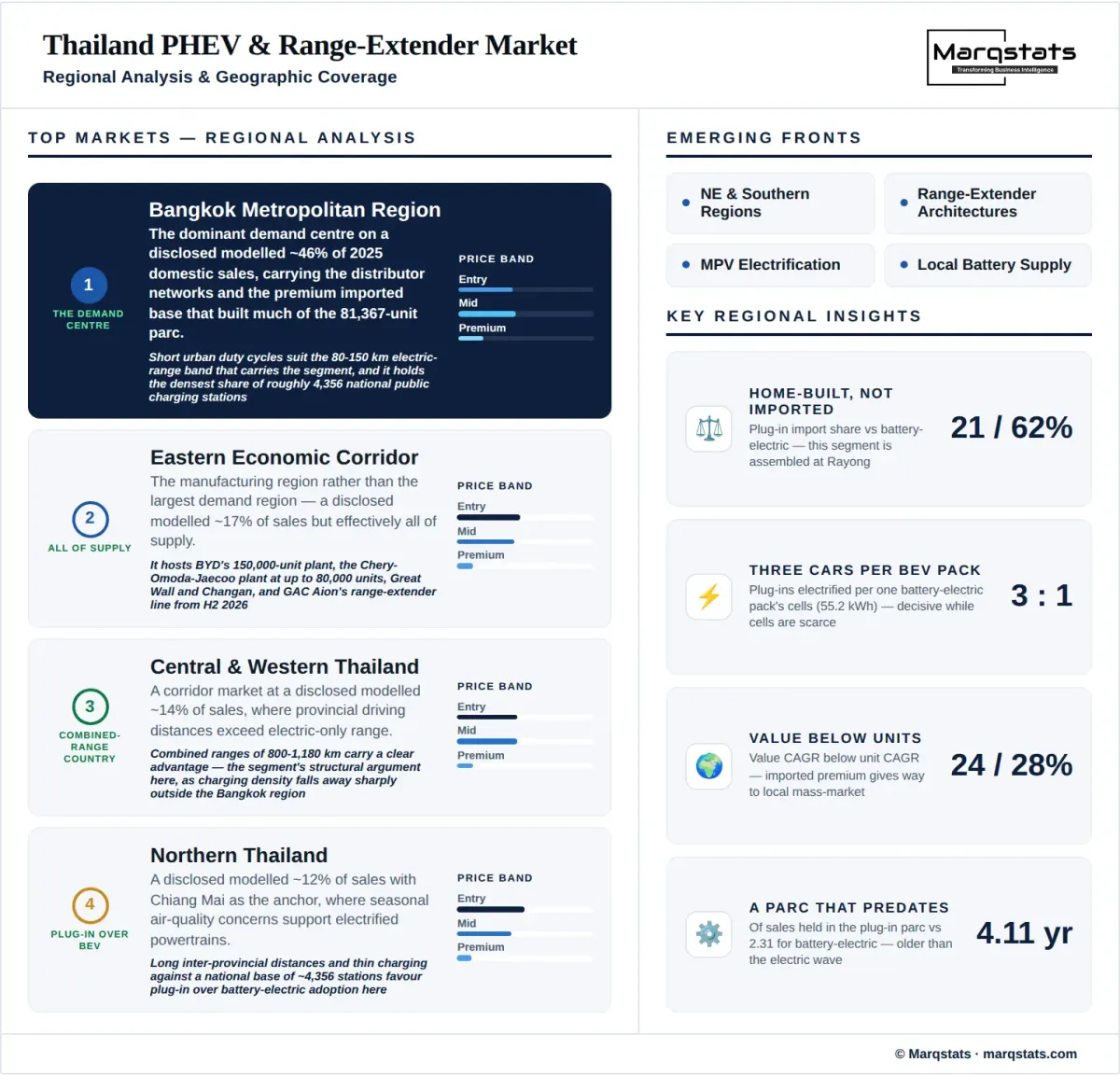
Bangkok Metropolitan Region
The dominant demand centre on a disclosed modelled allocation of approximately 46% of the 9,611 units sold in 2025, carrying the distributor networks, the premium imported base that built much of the 81,367-unit parc and the densest share of roughly 4,356 national public charging stations.
Eastern Economic Corridor
The manufacturing region rather than the largest demand region, at a disclosed modelled 17% of sales but effectively all of the 17,296 units of production, hosting BYD's 150,000-unit plant, the Chery and Omoda and Jaecoo plant at up to 80,000 units, Great Wall Motor and Changan at 80,000 and 100,000 units, and GAC Aion's range-extender line from the second half of 2026.
Central and Western Thailand
Approximately 14% of sales on a disclosed modelled allocation, a corridor market where provincial driving distances exceed electric-only range and combined ranges of 800 to 1,180 kilometres carry a clear advantage. Charging density falls away sharply outside the Bangkok region, which is the segment's structural argument here.
Northern Thailand
Approximately 12% of sales on a disclosed modelled allocation, with Chiang Mai as the anchor and seasonal air quality concerns supporting electrified powertrains. Long inter-provincial distances and thin charging coverage against a national base of roughly 4,356 stations favour plug-in over battery-electric adoption.
Northeastern and Southern Thailand
The remaining approximately 11% on a disclosed modelled allocation, the least developed regional markets for the powertrain, where price sensitivity places the THB 699,900 entry point against entry battery-electric vehicles from THB 429,900. Distributor coverage rather than product availability is the binding constraint in both.
How Competition Is Evolving
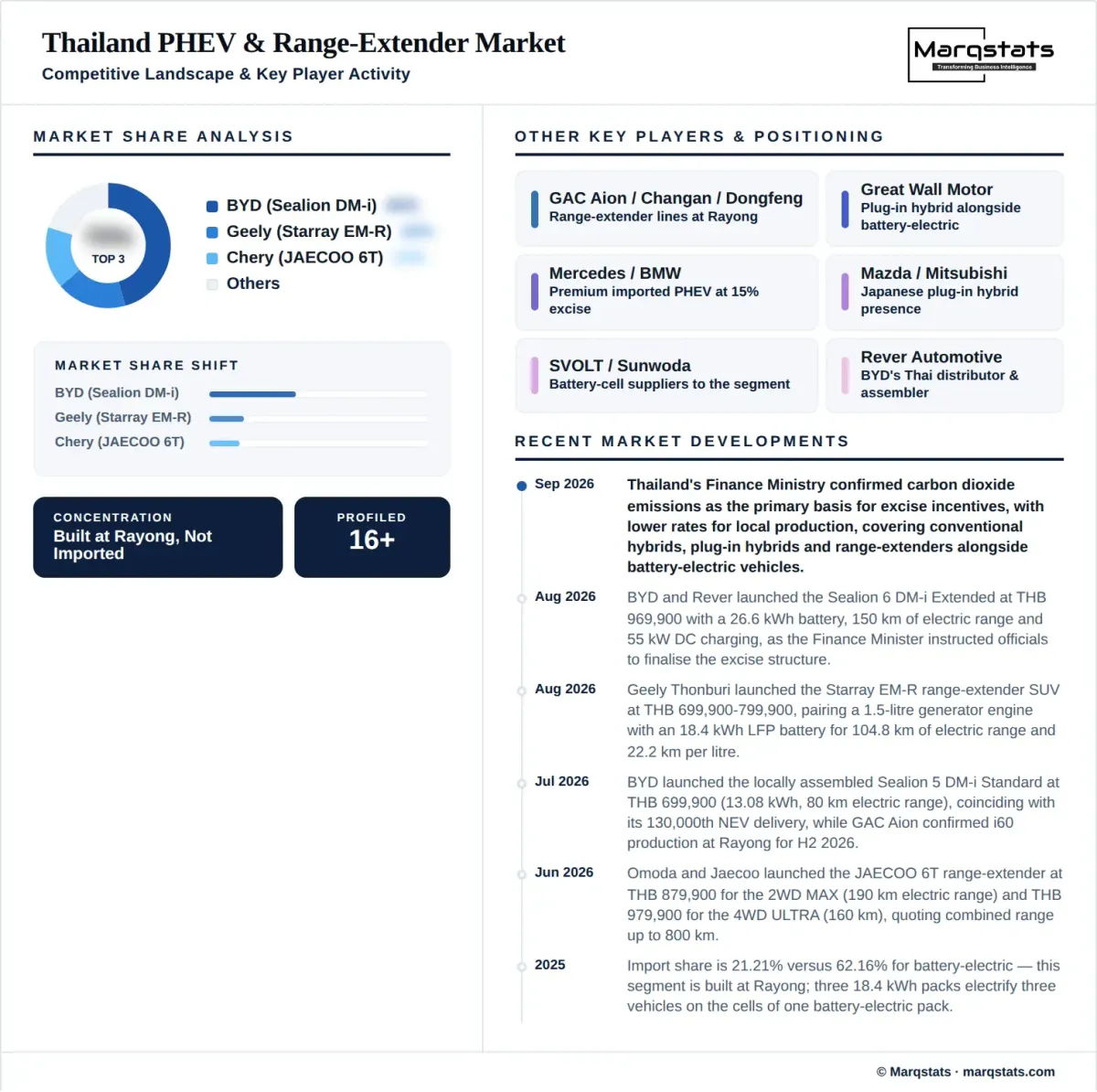
This market is more concentrated than the number of brands suggests, because the barrier is an assembly line rather than a model. BYD builds three of the plug-in hybrid nameplates sold in Thailand at a single 150,000-unit plant, which makes one manufacturer responsible for the majority of both the 9,611 units sold domestically and the 17,296 units produced, and every competitor response so far has taken the form of a plant rather than a price.
The Chinese entrants have converged on range-extender architectures, which is a deliberate differentiation rather than a coincidence. Geely entered at THB 699,900 to THB 799,900 with the Starray EM-R, Chery's Omoda and Jaecoo brand at THB 879,900 to THB 979,900 with the JAECOO 6T, and GAC Aion brings the i60 in both battery-electric and range-extender form from the second half of 2026, letting each avoid direct comparison with the established DM-i range.
European brands occupy the top of the market and are the group most exposed to the excise change. Mercedes-Benz Thailand grew plug-in hybrid sales 34% year on year on 2,845 total units in the first half of 2026, and its locally assembled electric CLA shows the route available, but an imported plug-in hybrid now carries 15% excise against 8% before January 2026 and sits in a band contracting 5% to 10%.
The Japanese incumbents are largely absent from the plug-in segment and are competing through conventional hybrids instead, at 146,059 units of 2025 domestic sales against 9,611 plug-in hybrid and range-extender units. Mazda's plan for five electrified models over three years includes a single plug-in hybrid with the production base not yet settled, which is the clearest signal that the Japanese response to this segment is still a decision rather than a product.
For an entrant the decisive judgement is whether to buy capacity or build it, and the export market is what makes the arithmetic work. Chinese capacity in Thailand is heading above 500,000 units a year against 88,210 units of combined 2025 battery-electric and plug-in hybrid passenger production, average passenger-car utilisation runs at 40.65%, and half of plug-in hybrid output already leaves the country, so a line is justified on export volume with the 9,611-unit domestic market as an addition rather than as the case.
Companies Covered
The report profiles 15+ companies with full strategy and financials analysis, including:
Recent Market Activity
Table of Contents
Coverage & Segmentation
This analysis measures annual new passenger plug-in hybrid electric vehicles and range-extended electric vehicles sold domestically in Thailand from 2021 to 2030, with 2025 as the base year and 2026 to 2030 as the forecast period. Conventional hybrids without a plug are excluded, and they are the larger neighbouring segment at 146,059 units of 2025 domestic sales, so the boundary is the one most likely to be crossed by a careless comparison. Commercial vehicles and motorcycles are excluded. Market value is expressed in USD on a disclosed per-vehicle convention falling from about USD 44,636 to USD 30,462 at a constant THB 32.5 per USD, so value moves on volume and mix rather than on exchange rate assumptions.
Coverage spans two powertrain architectures, three body types, three price bands, two destinations, two supply routes and three electric range bands, with five regional clusters analysed on demand concentration, manufacturing presence and charging density. Production is carried as a named dimension with its own series at 17,296 units in 2025, and it is never conflated with the domestic sales panel of 9,611 units or with the 81,367-unit parc, because the three measure different things and the first exceeds the second by 79.96%. Fifteen entities are profiled across manufacturers, distributors and cell suppliers.