Market Snapshot
Key Takeaways
Market Overview & Analysis
Report Summary
This analysis sizes Spain's plug-in hybrid electric vehicle market on the statutory basis administered by the Direccion General de Trafico, which awards PHEVs with certified electric range of 40 kilometers or more the Distintivo Ambiental CERO Emisiones badge, placing them in the same fiscal and access tier as battery-electric and hydrogen fuel cell vehicles. The market is measured as new passenger car (M1) registrations, cross-referenced against ANFAC and Aedive association data, with 2025 as the base year given the most recent complete annual dataset available. Coverage incorporates the January 2026 Plan Auto+ subsidy restructuring and cumulative 2026 registration data through August. Value figures are presented in USD millions using a constant EUR/USD conversion rate consistent with the source material's own stated basis.
Spain's PHEV market surged from 58,555 units in 2024 to 130,567 units in 2025, a 122.98% year-on-year increase, and continued growing 23.2% year-on-year through August 2026, confirming the acceleration as durable rather than a one-year anomaly. This growth occurred despite a genuine Premium Subsidy Paradox: the best-selling PHEV, the Mercedes-Benz GLC, prices more than EUR 22,000 above the Plan MOVES III eligibility ceiling, demonstrating that corporate fiscal treatment and municipal access privileges, not direct retail subsidies, are the primary demand driver in a market where corporate fleets account for the majority of registrations.
The 2030 base-case forecast of 150,000 annual registrations assumes the government's replacement of Plan MOVES III with a point-of-sale tax credit mechanism, now confirmed through the January 2026 Plan Auto+ restructuring, alongside standardized 20 to 28 kilowatt-hour battery packs preserving Etiqueta CERO status against the European Union's Phase 2 Utility Factor revision. The binding upside condition is whether Chinese and domestic PHEVs achieve price parity with conventional hybrids while public charging bottlenecks continue constraining battery-electric vehicle adoption; the binding downside condition is whether Phase 2 Utility Factor revisions push certified PHEV emissions above 95 grams of CO2 per kilometer while the DGT reclassifies PHEVs out of the Etiqueta CERO tier entirely, eliminating their municipal access and parking privileges.
Market Dynamics
Key Drivers
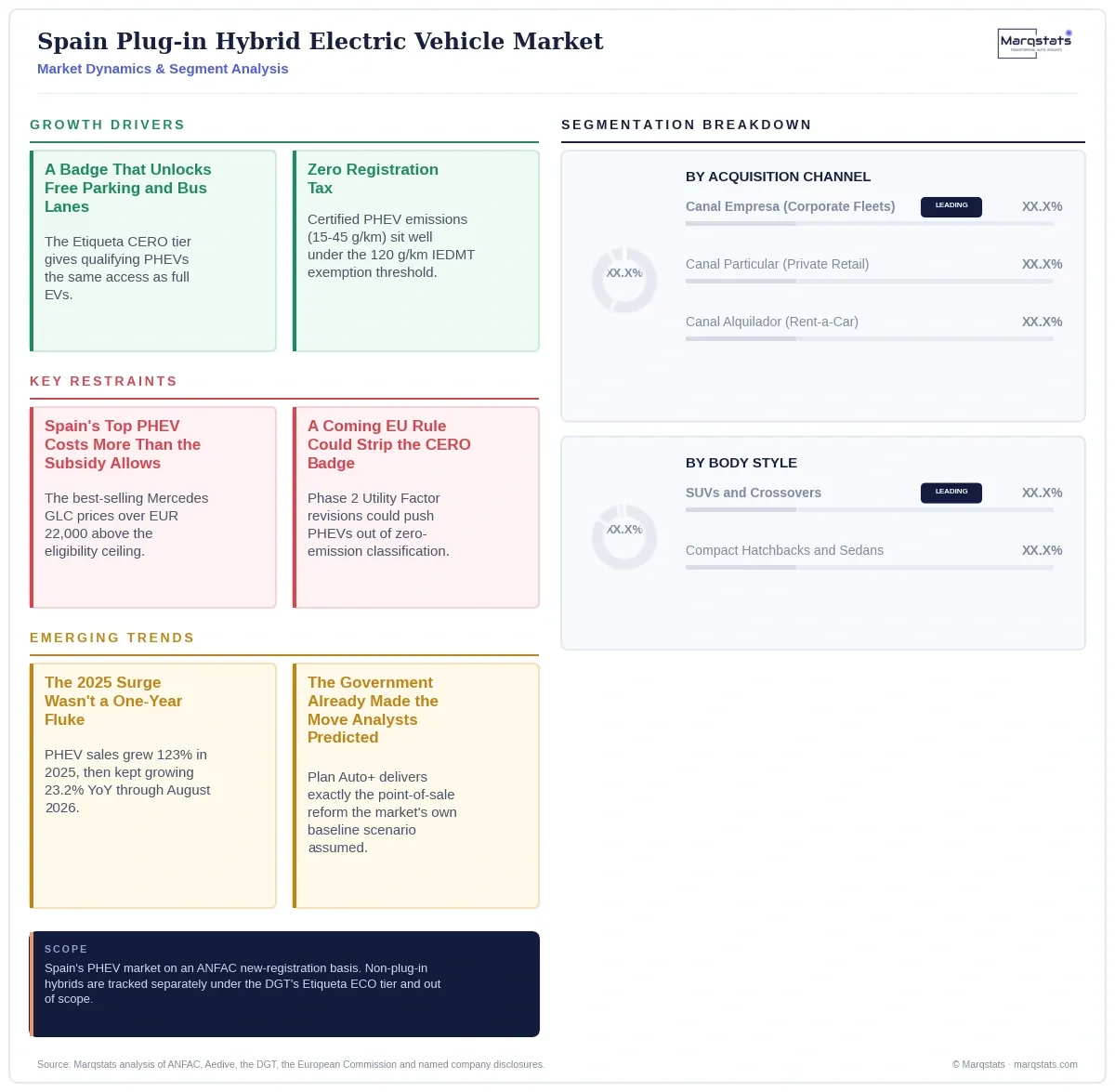
- The Etiqueta Ambiental CERO badge, awarded to PHEVs certifying 40 kilometers or more of electric range, unlocks unrestricted Zona de Bajas Emisiones access, high-occupancy BUS-VAO lane use, and full exemption from Madrid's regulated street parking tariff, a package of daily operational privileges corporate and private buyers alike value independent of purchase price.
- The IEDMT registration tax exemption, applying to all vehicles certifying below 120 grams of CO2 per kilometer, spares the entire PHEV segment from the 4.75%, 9.75% or 14.75% tax rates levied on comparable combustion vehicles, since certified PHEV emissions of 15 to 45 grams sit comfortably under the threshold.
- Plan Auto+, which replaced Plan MOVES III effective 1 January 2026 under Real Decreto 609/2026, restructures Spain's EV subsidy from a slow regional reimbursement model into a centrally administered, point-of-sale discount of up to EUR 4,500 for passenger vehicles plus a mandatory EUR 1,000 dealer discount, removing the multi-month processing delays that previously discouraged some buyers.
- Corporate benefit-in-kind tax treatment and accelerated depreciation allowances sustain the canal empresa channel, which absorbed 57.06% of all passenger PHEVs registered in 2024 at a 7.62% channel penetration rate, nearly double the 4.71% penetration recorded in the private retail channel.
- Chinese and domestic manufacturers are compressing the price gap between PHEVs and conventional hybrids: the BYD Seal U DM-i and MG HS PHEV both price below EUR 35,000, while Cupra's domestically manufactured Formentor benefits from Spain's IRPF personal income tax credit of up to EUR 3,000, together expanding the addressable market below the historical premium-SUV price tier.
Key Restraints
- The best-selling Spanish PHEV, the Mercedes-Benz GLC, retails from EUR 67,805, more than EUR 22,000 above the EUR 45,000 pre-tax price ceiling required for Plan MOVES III and Plan Auto+ eligibility, meaning a substantial share of premium-segment demand receives no direct purchase subsidy at all and depends entirely on corporate fiscal treatment to remain commercially viable.
- The European Union's Phase 2 Utility Factor revision under Regulation (EU) 2023/443 is scheduled to raise the compliance-relevant emissions impact of typical PHEVs to between 80 and 110 grams of CO2 per kilometer, a level that could disqualify small-battery PHEV configurations from meaningful fleet-compliance value and, under the market's downside scenario, prompt the DGT to reclassify PHEVs out of the Etiqueta CERO tier entirely.
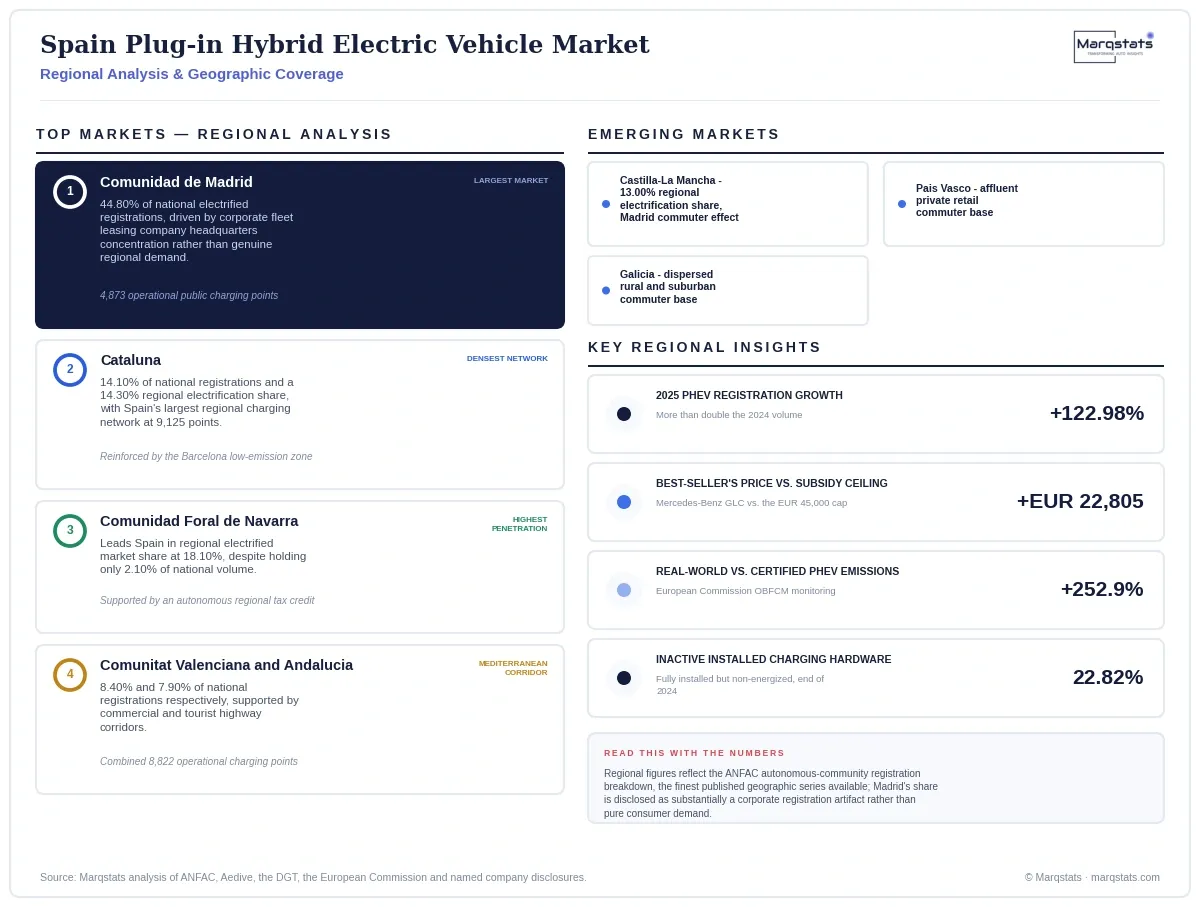
- Spain's public charging network carries a substantial inactive hardware backlog: 11,446 charging points, 22.82% of all installed hardware, remained fully installed but non-energized at the end of 2024 due to lengthy administrative permitting processes and grid-interconnection delays with distribution system operators including Endesa Distribucion and i-DE Redes Electricas Inteligentes, contributing to Spain's below-average ANFAC electromobility barometer score of 15.5 against a European Union average of 29.0.
- Real-world OBFCM emissions monitoring shows petrol PHEVs in Spain produce average real-world emissions of 139.4 grams of CO2 per kilometer against certified WLTP ratings of 39.5 grams, a 252.9% disparity driven primarily by corporate fuel-card programs that reimburse petrol expenses but not home electricity costs, leaving many company car PHEVs operating with a permanently discharged battery pack.
Key Trends
- Spain's 2025 registration surge has proven durable rather than a one-year anomaly: cumulative PHEV registrations continued growing 23.2% year-on-year through August 2026, a deceleration from 2025's extraordinary 122.98% rate but still confirmation that the market has established a genuinely higher baseline rather than reverting toward 2024 levels.
- Plan Auto+'s January 2026 replacement of Plan MOVES III validates the market's own baseline scenario ahead of schedule: the shift from a slow regional reimbursement model to a centralized, point-of-sale discount mechanism is precisely the structural reform the market's 2030 base case assumed would eventually occur, now confirmed as already in force.
- The gap between Spain's top-selling PHEV's price and its own subsidy eligibility ceiling illustrates a broader European pattern in which corporate fiscal treatment, not retail purchase incentives, increasingly determines which PHEV models achieve genuine commercial scale, a dynamic distinct from markets where direct subsidies remain the dominant demand driver.
- Chinese manufacturers are converting Spain into an active manufacturing base rather than remaining a pure import market: Chery Automobile's April 2024 joint venture with EV Motors re-industrialized a former Nissan complex in Barcelona to produce the Ebro brand alongside Omoda and Jaecoo nameplates, representing the first active Chinese vehicle-assembly partnership in the country.
- Regional registration concentration in Madrid, at 44.80% of the national total, is increasingly understood as a corporate registration artifact rather than a genuine demand signal, since Spain's major fleet leasing and rental companies maintain their tax domiciles in the capital even as their vehicles operate nationwide, a distinction that materially affects how regional market data should be interpreted.
Strategic Implications
For a prospective entrant, particularly a Chinese original equipment manufacturer expanding into Southern Europe, pricing below the EUR 45,000 Plan Auto+ eligibility threshold and building direct commercial relationships with Madrid-headquartered corporate fleet leasing companies are the two most consequential near-term priorities, since the corporate channel accounts for the majority of national PHEV registrations and over 65% of Spanish vehicle owners lack dedicated home charging, favoring dual-mode platforms offering 100 to 125 kilometers of certified electric range.
For an incumbent European manufacturer, the European Union's Phase 2 Utility Factor revision makes legacy small-battery configurations of 10 to 13 kilowatt-hours a genuine compliance liability; manufacturers should prioritize modular platforms integrating 20 to 30 kilowatt-hour battery packs with 40 to 50 kilowatt on-board DC fast-charging capability, matching the specification already established by the Mercedes-Benz GLC and Cupra Formentor, to preserve both Etiqueta CERO status and EU fleet-compliance value.
For a corporate fleet operator or charge-point infrastructure investor, the persistent gap between certified and real-world PHEV emissions represents a genuine Corporate Sustainability Reporting Directive compliance exposure; fleet managers should package vehicle financing with subsidized workplace charging hardware and telematics-based fleet management software specifically to raise real-world electric driving shares, while infrastructure investors should prioritize 11 to 22 kilowatt AC curbside charging in residential neighborhoods with multi-family housing over high-power DC corridors, given that 71.00% of Spain's public charging network already consists of AC destination charging matched to typical PHEV on-board charger specifications.
Outlook
Base case: 150,000 new registrations by 2030 (12.5% share), EUR 6.075 billion (USD 6.561 billion) annual value. This trajectory assumes the government's replacement of Plan MOVES III with a point-of-sale tax credit mechanism, already confirmed through the January 2026 Plan Auto+ restructuring, alongside compact and mid-size PHEVs standardizing battery capacities between 20 and 28 kilowatt-hours to preserve Etiqueta CERO status against the European Union's Phase 2 Utility Factor revision.
Upside case: 215,000 new registrations by 2030 (17.2% share), EUR 8.385 billion (USD 9.055 billion) annual value. The specific trigger is persistent administrative delays and grid-interconnection bottlenecks in Spain's commercial fast-charging network slowing broader battery-electric adoption among motorists lacking private home charging, combined with Chinese and domestic manufacturers narrowing the PHEV-to-conventional-hybrid retail price premium to under EUR 3,500.
Downside case: 85,000 new registrations by 2030 (7.0% share), EUR 3.655 billion (USD 3.947 billion) annual value. The specific trigger is the European Commission's Phase 2 Utility Factor revision pushing certified PHEV emissions above 95 grams of CO2 per kilometer without concessions for extended-range powertrains, combined with the DGT establishing an Etiqueta CERO+ category reserved strictly for pure zero-emission vehicles and reclassifying PHEVs under the more restrictive Etiqueta ECO designation, eliminating their municipal parking and access privileges.
Market Segmentation
Corporate fleets absorbed 33,410 passenger PHEVs in 2024, 57.06% of national volume, achieving a 7.62% channel penetration rate driven by benefit-in-kind tax treatment, accelerated depreciation and IEDMT exemption, even as corporate demand contracted 0.88 percentage points that year as fleet managers reassessed acquisition costs.
Private retail buyers registered 20,757 passenger PHEVs in 2024, 35.45% of national volume, at a 4.71% channel penetration rate, as consumers increasingly selected plug-in hybrids as an accessible entry point to electric driving that eliminates the range anxiety associated with pure battery-electric vehicles.
The vehicle rental channel registered 4,388 passenger PHEVs in 2024, 7.49% of national volume, at a 3.18% channel penetration rate, as rental operators in major tourism hubs largely preferred conventional full hybrids, since leisure travelers were often hesitant to manage plug-in charging during short holiday rentals.
Compact and mid-size sport-utility vehicles and crossovers represented more than 85% of total Spanish PHEV registrations, anchored by the Mercedes-Benz GLC, Ford Kuga, Cupra Formentor and Hyundai Tucson, reflecting the segment's ability to accommodate a substantial traction battery without materially compromising cabin or cargo space.
Traditional compact hatchbacks and sedans accounted for less than 12% of registrations, concentrated primarily in business fleet programs through models such as the Mercedes-Benz A-Class, Cupra Leon and Peugeot 308, serving corporate executive commuting needs distinct from the SUV-dominated core of the market.
By Geography
Comunidad de Madrid
Madrid accounts for approximately 44.80% of national electrified vehicle registrations with 4,873 operational public charging points, a concentration driven primarily by its role as the administrative and tax domicile for Spain's major corporate fleet leasing and rental companies rather than genuine regional consumer demand, since many centrally registered vehicles operate primarily outside the capital.
Cataluna
Cataluna holds 14.10% of national electrified registrations and a 14.30% regional electrification share, the largest regional public charging network in Spain at 9,125 operational points, reinforced by the Barcelona low-emission zone and the province's status as Spain's second-largest automotive manufacturing hub.
Comunitat Valenciana and Andalucia
The Comunitat Valenciana holds 8.40% of national registrations, supported by commercial and tourist highway corridors and 4,146 operational charging points, while Andalucia holds 7.90% with an 8.90% regional electrification share and 4,676 operational points, together representing Spain's Mediterranean corridor manufacturing and logistics concentration.
Comunidad Foral de Navarra
Navarra leads Spain in regional electrified market share at 18.10%, despite holding only 2.10% of national registration volume, supported by an autonomous regional personal income tax credit independent of central government programs and a comparatively affluent private retail commuter base.
Castilla-La Mancha and Remaining Communities
Castilla-La Mancha achieves a 13.00% regional electrification share, driven by commuter dynamics in provinces adjacent to Madrid where residents rely on Etiqueta CERO status to navigate the capital's urban access rules, while interior and agricultural regions including Extremadura, Castilla y Leon and inland Andalusia recorded lower electrified shares between 6.5% and 8.9%, constrained by lower median household incomes and reduced secondary-road charging density.
How Competition Is Evolving
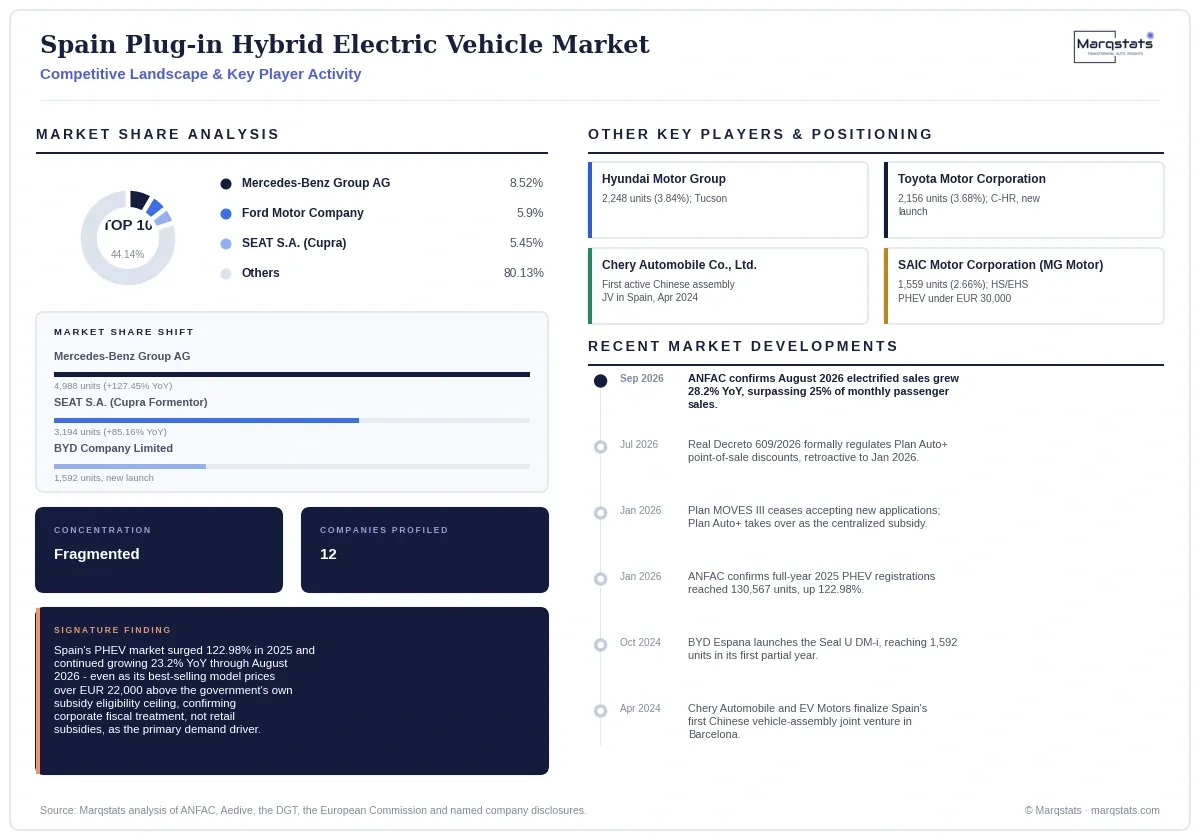
Spain's PHEV market is fragmented relative to its battery-electric counterpart, where the top two models capture nearly 29% of sales; the ten top-selling PHEV models captured a combined 44.14% of 2024 segment registrations, led by the Mercedes-Benz GLC at 8.52% share, leaving the remainder distributed among more than forty competing nameplates.
Competitors differentiate primarily on battery capacity, price positioning relative to the Plan Auto+ eligibility threshold, and domestic manufacturing presence; premium German brands compete on certified electric range and corporate fleet relationships despite frequently exceeding the subsidy price ceiling, while Chinese and value-oriented entrants compete on price, with the BYD Seal U DM-i and MG HS PHEV both pricing below EUR 35,000 to undercut comparable European models.
The most significant recent competitive-landscape shift is Chery Automobile's April 2024 joint venture with Spain's EV Motors, re-industrializing a former Nissan manufacturing complex in Barcelona's Zona Franca to produce the revived Ebro brand alongside Chery's Omoda and Jaecoo nameplates, representing the first active Chinese vehicle-assembly partnership in Spain and a structural shift from import-only competition toward domestic production.
Companies Covered
The report profiles 12+ companies with full strategy and financials analysis, including:
Recent Market Activity
Table of Contents
Coverage & Segmentation
Coverage spans Spain's Plug-in Hybrid Electric Vehicle market on a new passenger car (M1) registration basis, as reported by the Asociacion Espanola de Fabricantes de Automoviles y Camiones, across a 2020-2025 historical period and a 2026-2030 forecast period, with 2025 as the base year given the most recent complete annual dataset available. The market is sized in both EUR/USD value and unit volume, covering PHEVs statutorily defined under the DGT's Etiqueta Ambiental CERO classification framework. Two segmentation dimensions are quantified: acquisition channel and body style.
Excluded from scope: non-plug-in hybrid and mild hybrid vehicles, which are tracked as separate categories under the DGT's Etiqueta ECO tier; light commercial and heavy commercial PHEVs, which represent a negligible 0.7% share and are not separately forecast; and a fully granular 2026 brand-level table, since complete annual 2026 data was not available from permitted sources at time of writing. A separate Marqstats study addresses Spain's battery-electric vehicle market on a comparable basis. Regional figures reflect the ANFAC autonomous-community breakdown, the finest published geographic series available.