Market Snapshot
Middle bar: base-year value × (1 + CAGR), rounded to two decimals. This is a calculated illustration, not a separately researched annual estimate.
The Thailand EV charging station market was valued at USD 416 million in 2025 and is projected to reach USD 1.45 billion by 2030, expanding at a 28.41% CAGR across the 2026–2030 forecast period. Growth is attributed to the national 30@30 electrification policy, capital-cost incentives for charge-point deployment, and a sharp rise in battery-electric vehicle adoption that reached 19.4% of new-car sales in 2025. The Thailand EV charging station market is anchored by an official target of 12,000 direct-current fast-charging outlets by 2030, which converts policy ambition into sustained hardware and service demand.
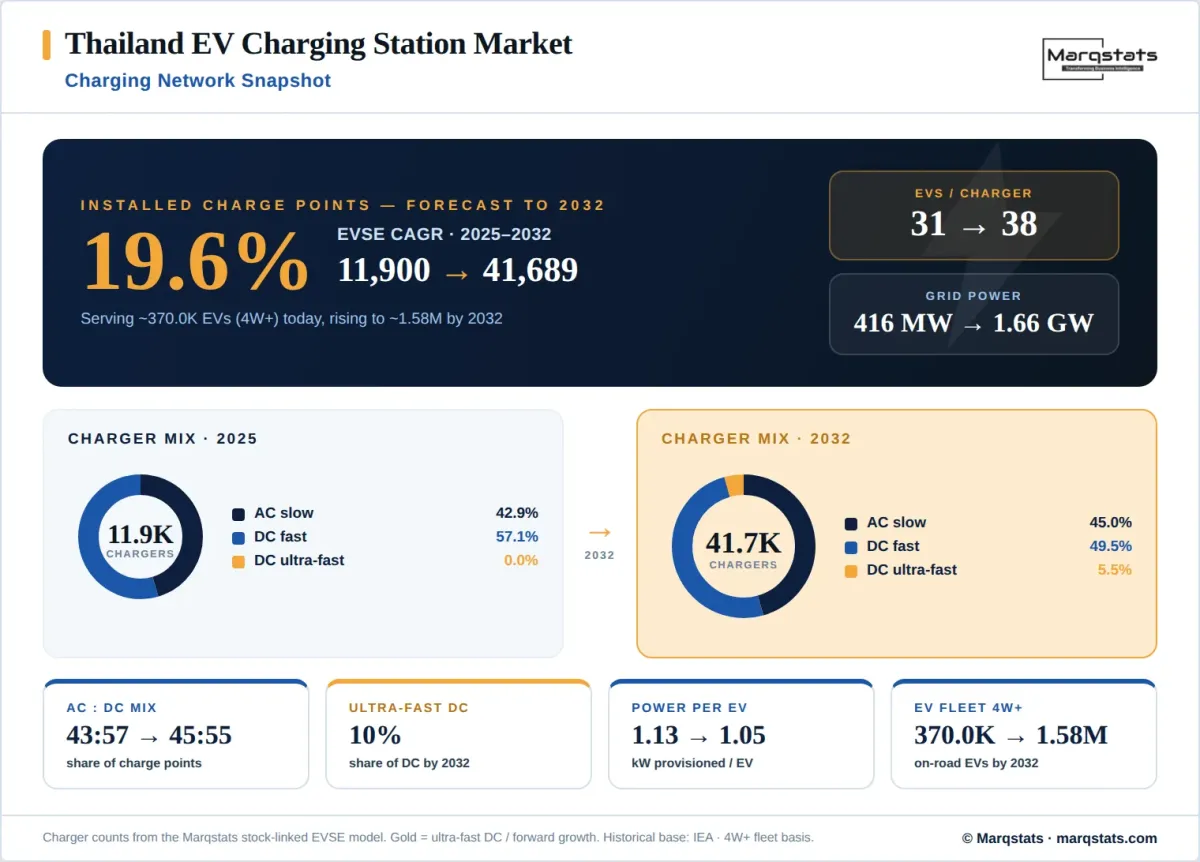
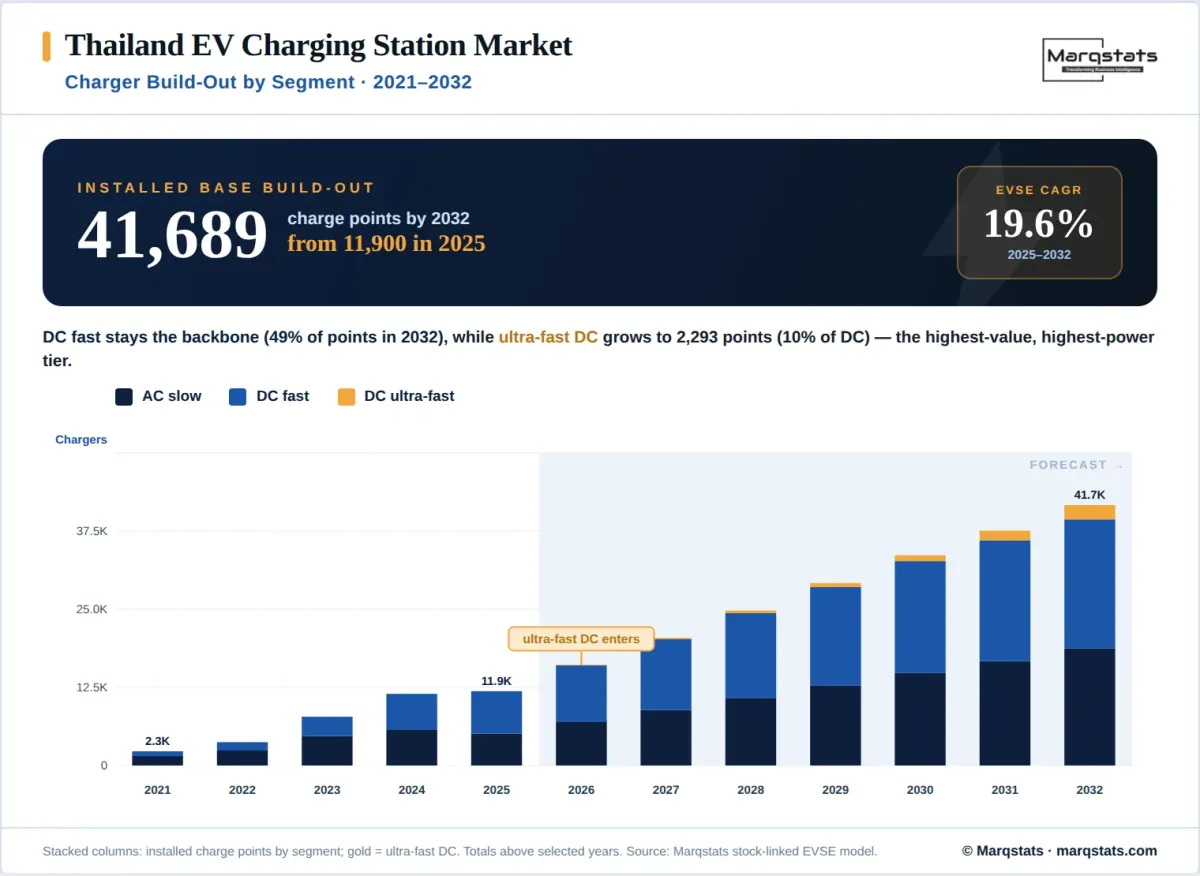
The market spans alternating-current and direct-current charging hardware, installation, networking software, and charging services across public, private, commercial, and fleet applications. Thailand's installed public-charging base, supported by Board of Investment corporate-income-tax exemptions for stations carrying 40 or more chargers, reached 11,467 public connectors at the close of 2024 and roughly 11,900 in 2025, split almost evenly between alternating-current and direct-current units. Direct-current charging commands the larger share of market value, owing to higher hardware prices and intercity deployment intensity.
Charge-point operation is moderately fragmented and beginning to consolidate. EV Station PluZ, operated by the PTT group, holds close to 30% of public charging, followed by EA Anywhere near 16% and PEA VOLTA near 13%. Installed capacity is concentrated in the Bangkok Metropolitan Region, however highway corridors linking Bangkok to Pattaya, Hua Hin, and Chiang Mai are densifying quickly as intercity travel demand expands.
Key Takeaways
Market Overview & Analysis
Report Summary
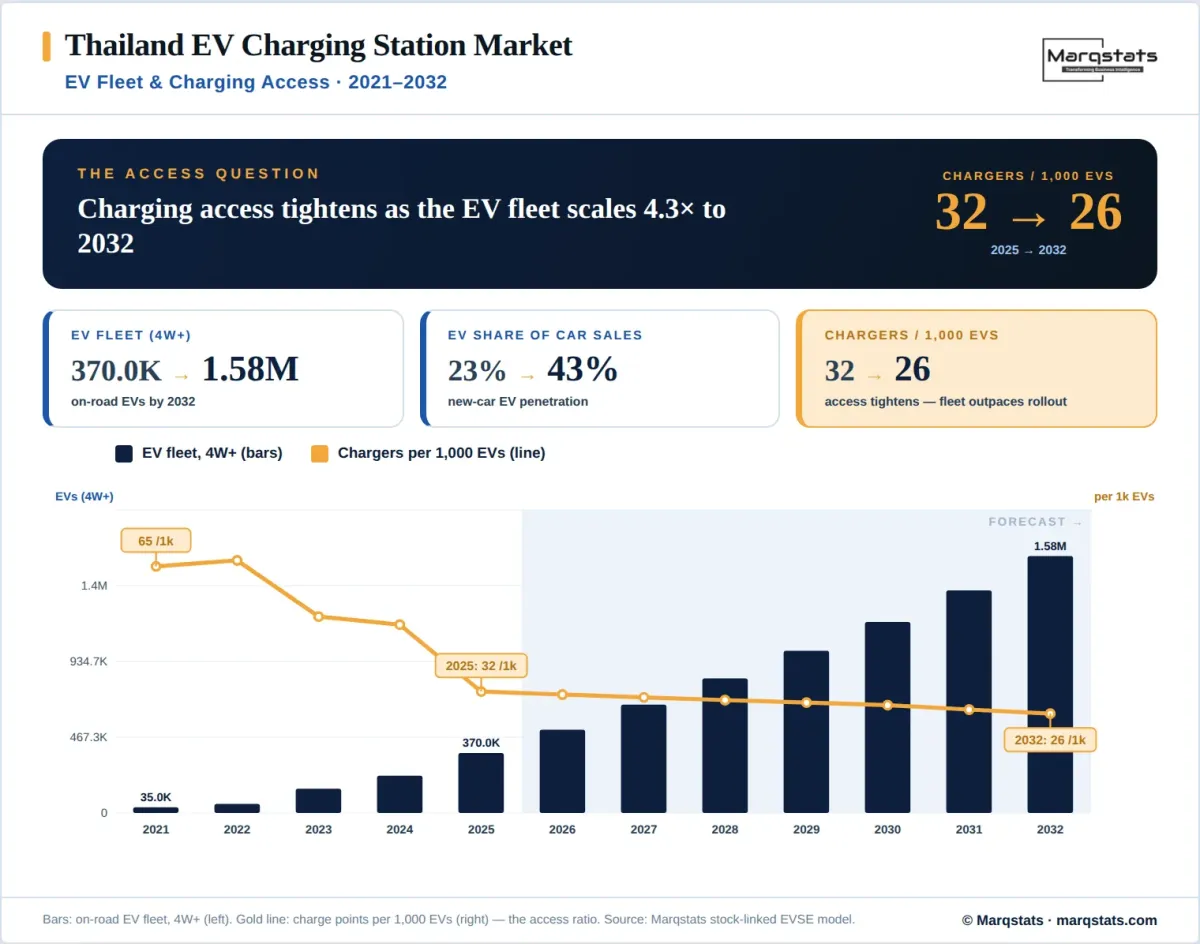
The Thailand EV charging station market sits at the intersection of transport, energy, and digital infrastructure, and has entered a critical scaling phase. Thailand is Southeast Asia's largest automotive producer, and the government's drive to convert that manufacturing base toward electric mobility has generated high-velocity demand for reliable public and private charging. Battery-electric vehicle registrations reached 120,301 units in 2025, an 80.3% increase over the prior year, lifting battery-electric share to 19.4% of new-car sales and expanding the vehicle parc that depends on public charging.
Public charging supply has scaled in parallel, though execution lags ambition. The installed base advanced from 2,285 connectors in 2021 to 11,467 by December 2024 and surpassed the 2025 deployment target early, reaching 3,720 stations and 11,622 connectors by March 2025. The 30@30 framework, administered through the Energy Policy and Planning Office, targets 30% zero-emission vehicle production by 2030 and 12,000 direct-current fast-charging outlets, of which more than 30% are intended for locations outside Greater Bangkok.
Policy has matured from demand subsidies toward infrastructure and localization. The EV 3.0 package offered purchase subsidies of up to THB 150,000 per vehicle and drove a steep rise in battery-electric sales, while the succeeding EV 3.5 programme, effective 2024 through 2027, tapered subsidies to THB 100,000 in the first year and obliged subsidised importers to assemble two vehicles locally for every one imported from 2026, rising to three to one from 2027. The Board of Investment has approved 137.7 billion baht of EV supply-chain investment, of which 5.56 billion baht spans 29 charging-infrastructure projects, and grants a five-year corporate-income-tax exemption to stations carrying 40 or more chargers, including at least ten direct-current units.
Energy policy reinforces the build-out. The Power Development Plan 2025–2037 targets a 51% renewable share in power generation, encouraging solar-integrated charging sites, while time-of-use off-peak tariffs near 4.50 THB per kWh lower home-charging cost and low-priority tariffs support public-station economics. Market value is built from hardware, installation, networking software, and charging-service revenue; direct-current fast chargers carry far higher unit prices than alternating-current units and therefore dominate value despite an even unit split, while charging-service revenue scales with electricity throughput as the operational fleet grows. The immediate challenge is the transition from fragmented, pilot-scale deployment toward a coordinated, high-density network capable of servicing a rapidly expanding national fleet without straining provincial distribution grids.
Market Dynamics
Key Drivers
Market is driven by the 30@30 policy, which sets a binding target of 12,000 direct-current fast-charging outlets by 2030 and converts national ambition into sustained infrastructure demand.
Rapid battery-electric adoption supports growth, with 120,301 battery-electric vehicles sold in 2025 at 19.4% of new-car sales, expanding the parc that depends on public charging.
Capital incentives accelerate deployment, with Board of Investment five-year corporate-income-tax exemptions for stations carrying 40 or more chargers and 137.7 billion baht of approved EV supply-chain investment.
Foreign manufacturer localization reinforces demand, as BYD, Great Wall Motor, Changan, and GAC Aion establish Thai assembly under local-production offset obligations, deepening the domestic EV ecosystem.
Intercity and tourism travel sustains corridor investment, with operators equipping the Bangkok–Pattaya, Bangkok–Hua Hin, and Bangkok–Chiang Mai routes with fast-charging hubs.
Key Restraints
High direct-current capital expenditure constrains returns, as average station utilization remains between 15% and 25%, lengthening payback for charge-point operators.
Provincial grid limitations slow rollout, owing to multi-month substation-upgrade lead times for the 300 kW-plus service required by multi-port fast-charging plazas.
Coverage remains uneven, as public charging concentrates in Bangkok while rural provinces and secondary highways stay underserved, limiting long-distance confidence.
Operating economics stay sensitive to electricity tariffs and price competition among operators, compressing margins as networks expand ahead of utilization.
Key Trends
Hardware is shifting toward 150 kW and higher direct-current classes with CCS2 standardization, mirroring the upgrade cycle seen across the global EV DC charging station market.
Solar generation and battery storage are being integrated at charging sites under the Power Development Plan 2025–2037, reducing peak grid demand and operating cost.
Fleet and ride-hail electrification is creating anchor demand, with dedicated commercial charging hubs serving delivery and ride-hailing operators at urban-fringe nodes.
Roaming and interoperability are advancing through operator super-apps and unified payment, easing access across the EV Station PluZ, EA Anywhere, and PEA VOLTA networks.
Market Segmentation
Direct-current charging holds the largest share of market value, owing to high unit prices and concentration along intercity corridors, commercial sites, and fleet depots. A typical 50 kW to 150 kW unit replenishes a passenger battery in roughly 30 to 40 minutes, making it the practical choice for highway travel where dwell time is short. Within the category, the installed base is migrating from sub-50 kW units toward 150 kW and higher ultra-fast classes, which form the fastest-growing sub-segment as new battery-electric models support higher charge acceptance and operators compete on session speed. Direct-current units made up roughly half of the 2024 connector base and a higher share of new additions.
Alternating-current charging accounts for roughly one-third of value and a substantial share of installed points, anchored by residential, workplace, and destination locations where lower hardware and installation cost favors dense deployment. Onboard chargers in mass-market models typically draw 7 kW to 11 kW, sufficient for overnight and long-dwell replenishment. Growth is attributed to expanding home and condominium charging supported by time-of-use off-peak tariffs, which make residential charging materially cheaper than public direct-current sessions.
CCS2 is the dominant direct-current connector and the standard fitted to every battery-electric vehicle sold in Thailand since 2022, giving it a structural majority of fast-charging value and universal support across public networks. The single-standard environment lowers interoperability friction, allowing drivers to use any major operator with a common physical connector while authentication and payment remain app-based.
Type 2 connectors serve the alternating-current base across homes, workplaces, and destination sites. CHAdeMO holds a small and declining share tied to a handful of legacy imported models, while GB/T remains a niche presence linked to specific Chinese platforms. The consolidation around CCS2 for fast charging and Type 2 for alternating-current charging simplifies hardware procurement for operators and reduces stranded-asset risk.
Passenger cars represent the largest vehicle segment by charging value, owing to battery-electric penetration reaching 19.4% of new-car sales and 120,301 units in 2025, with a parc concentrated in Bangkok and provincial capitals. Chinese brands, led by BYD and Great Wall Motor, dominate model supply, and their aggressive pricing has broadened the addressable base of households that require regular public and home charging.
Commercial vehicles, spanning electric buses, trucks, and vans, form the fastest-growing vehicle segment, supported by depot and fleet charging and public-transport electrification programs. Bangkok's electric-bus rollout and the electrification of delivery and ride-hailing fleets are creating predictable, high-throughput demand that anchors dedicated charging plazas at urban-fringe logistics nodes.
Electric two- and three-wheelers contribute a smaller value share, served largely by home charging and battery solutions rather than high-power public infrastructure. While unit adoption is rising in last-mile delivery, the modest energy needs of these vehicles limit their pull on the public direct-current network relative to four-wheel segments.
Public charging holds the largest application share, anchored by petrol-network and retail-site deployment that places chargers where motorists already stop. Highway-corridor and fleet charging form the fastest-growing applications as intercity travel and commercial electrification expand, with operators equipping the Bangkok–Pattaya, Bangkok–Hua Hin, and Bangkok–Chiang Mai routes with fast-charging hubs spaced for long-distance confidence.
Residential and workplace charging scales with private vehicle ownership and off-peak tariffs, and is supported by separate metering arrangements for home chargers. Commercial sites at shopping malls, hotels, hospitals, and offices add destination capacity that complements the public network, allowing drivers to replenish during routine activities and easing pressure on highway fast-charging at peak periods. Property developers increasingly treat charging provision as a standard amenity in new condominiums and office towers, embedding alternating-current points at the construction stage and broadening the private installed base ahead of resale demand.
By Geography
Bangkok Metropolitan Region
The Bangkok Metropolitan Region, covering Bangkok, Nonthaburi, Samut Prakan, Pathum Thani, and Samut Sakhon, holds the largest installed base and market value, owing to the highest vehicle density, abundant commercial sites, and early operator focus. Dense condominium living drives demand for workplace and destination charging, and the capital anchors the networks of every major operator. The region remains the demand core for both public and private charging, though the government intends more than 30% of new fast chargers to be sited outside Greater Bangkok by 2030 to close the coverage gap.
Eastern Economic Corridor
The Eastern Economic Corridor, spanning Chonburi, Rayong, and Chachoengsao, records the fastest regional growth. The corridor hosts Thailand's automotive and battery manufacturing cluster, including the BYD plant in Rayong and additional Chinese-brand assembly on the Eastern Seaboard, generating fleet and workforce charging demand. Heavy leisure traffic through Pattaya and the Bangkok–Rayong highway supports dense fast-charging deployment, and the zone's industrial grid capacity eases the substation constraints that slow rollout elsewhere.
Northern Thailand
Northern Thailand, centered on Chiang Mai and extending to Chiang Rai and Lampang, expands on tourism and intercity corridor demand. Charging investment follows the long Bangkok–Chiang Mai route, where reliable fast-charging is essential for the multi-stage journey, alongside urban clusters tied to retail and hospitality developments that serve domestic and international visitors.
Northeastern Thailand
Northeastern Thailand, the Isan region anchored by Nakhon Ratchasima, Khon Kaen, and Udon Thani, is an earlier-stage market where coverage is building along primary highways such as Mittraphap Road and across provincial capitals. As adoption broadens beyond the central belt, operators are extending corridor charging to connect the region to Bangkok and to cross-border routes toward Laos.
Southern Thailand
Southern Thailand, including Phuket, Hua Hin, Surat Thani, and Krabi, grows on tourism corridors and island connectivity, with destination charging concentrated around hospitality and resort hubs. Seasonal visitor peaks shape utilization, and operators prioritise high-traffic leisure routes and airport-linked sites, while the long peninsula highway requires fast-charging spacing to support travel between the central region and the southern provinces.
How Competition Is Evolving
The Thailand EV charging station market is moderately fragmented and consolidating around a few large operators backed by state energy enterprises. EV Station PluZ, run by the PTT group, leads with close to 30% of public charging and more than 650 sites, built by adding chargers to an existing petrol-retail network. EA Anywhere, operated by Energy Absolute, holds near 16% and concentrates on standalone highway hubs between Bangkok and major leisure destinations, while PEA VOLTA, managed by the Provincial Electricity Authority, holds near 13% and competes on the lowest off-peak direct-current tariffs, near 5.30 THB per kWh against EA Anywhere's flat rate near 7.29 THB per kWh.
State utilities extend the field through the Metropolitan Electricity Authority and the EleX network operated by the Electricity Generating Authority of Thailand, while private entrants such as EVolt and SHARGE pursue targeted niches. SHARGE formed a 400 million baht joint venture with Grab to deploy commercial charging hubs for ride-hail fleets, and Tesla expanded its Supercharger footprint to 29 stations. Global hardware suppliers, including Delta Electronics, ABB, Schneider Electric, Siemens, and Huawei Digital Power, supply the underlying charging equipment.
Competition centers on site access, charging speed, tariff structure, and network reliability. Operators differentiate through petrol-network bolt-on convenience, highway-corridor coverage, off-peak pricing, and renewable-integrated sites. CCS2 standardization and operator super-apps are reducing switching friction, shifting the basis of competition toward uptime, location density, and customer experience. Bundled loyalty programmes, retail partnerships, and renewable-energy branding are emerging as further points of differentiation as the network matures.
Companies Covered
Companies covered in the report include:
Recent Market Activity
Table of Contents
Coverage & Segmentation
This report provides a comprehensive analysis of the Thailand EV charging station market across the 2021–2025 historical period and the 2026–2030 forecast period, with 2025 as the base year. The study covers alternating-current and direct-current charging hardware, installation, networking software, and charging services across public, private, commercial, and fleet applications, segmented by charging type, connector type, vehicle type, and application, with sub-national coverage of the Bangkok Metropolitan Region, the Eastern Economic Corridor, and the northern, northeastern, and southern regions. Market sizing is benchmarked against International Energy Agency charging datasets and national registration records.
The study examines market size, growth, segment-level value, competitive structure, and the policy and regulatory framework, including the 30@30 roadmap and Board of Investment incentives. Primary research includes 40+ interviews with charge-point operators, hardware manufacturers, fleet operators, utilities, and policy makers, supported by data from the Electric Vehicle Association of Thailand and government databases.