Market Snapshot
Key Takeaways
Market Overview & Analysis
Report Summary
This analysis sizes India's plug-in hybrid electric vehicle market on the VAHAN 4.0 statutory registration basis administered by the Ministry of Road Transport and Highways and the National Informatics Centre, which maintains a distinct PLUG-IN HYBRID EV classification separate from PURE EV and STRONG HYBRID EV/HYBRID categories. The market is measured as annual retail registrations, with CY2025 as the base year. Because India's PHEV segment is presently confined to completely built-up ultra-luxury imports, coverage emphasizes fiscal and regulatory mechanics, geographic wealth concentration, and total cost of ownership economics rather than a conventional multi-brand competitive segmentation.
India's PHEV market expanded from 28 units in CY2021 to 245 units in CY2025, a 71.98% compound annual growth rate, but this growth occurred entirely within an ultra-luxury enclave defined by a 43% to 50% effective indirect tax burden under the pre-reform Goods and Services Tax structure. GST 2.0, effective 22 September 2025, restructured this framework by eliminating the compensation cess and introducing a two-slab system of 18% for smaller vehicles and 40% for larger ones - a genuinely current development that offers a substantially more favorable starting tax position to the compact, mass-market PHEV segment central to the market's own upside scenario, independent of any further GST Council action.
The 2030 base-case forecast of 4,200 annual registrations rests on Corporate Average Fuel Efficiency Phase III enforcement pressuring original equipment manufacturers toward electrified powertrains while the Goods and Services Tax rate remains otherwise unchanged from its post-reform structure. The binding upside condition is whether the GST Council extends further rate relief specifically to plug-in hybrids certifying a minimum electric range, combined with Production Linked Incentive credit extension to hybrid transmissions; the binding downside condition is continued regulatory exclusion of PHEVs from central purchase incentive schemes combined with no further state-level road tax relief beyond Uttar Pradesh's existing waiver.
Market Dynamics
Key Drivers
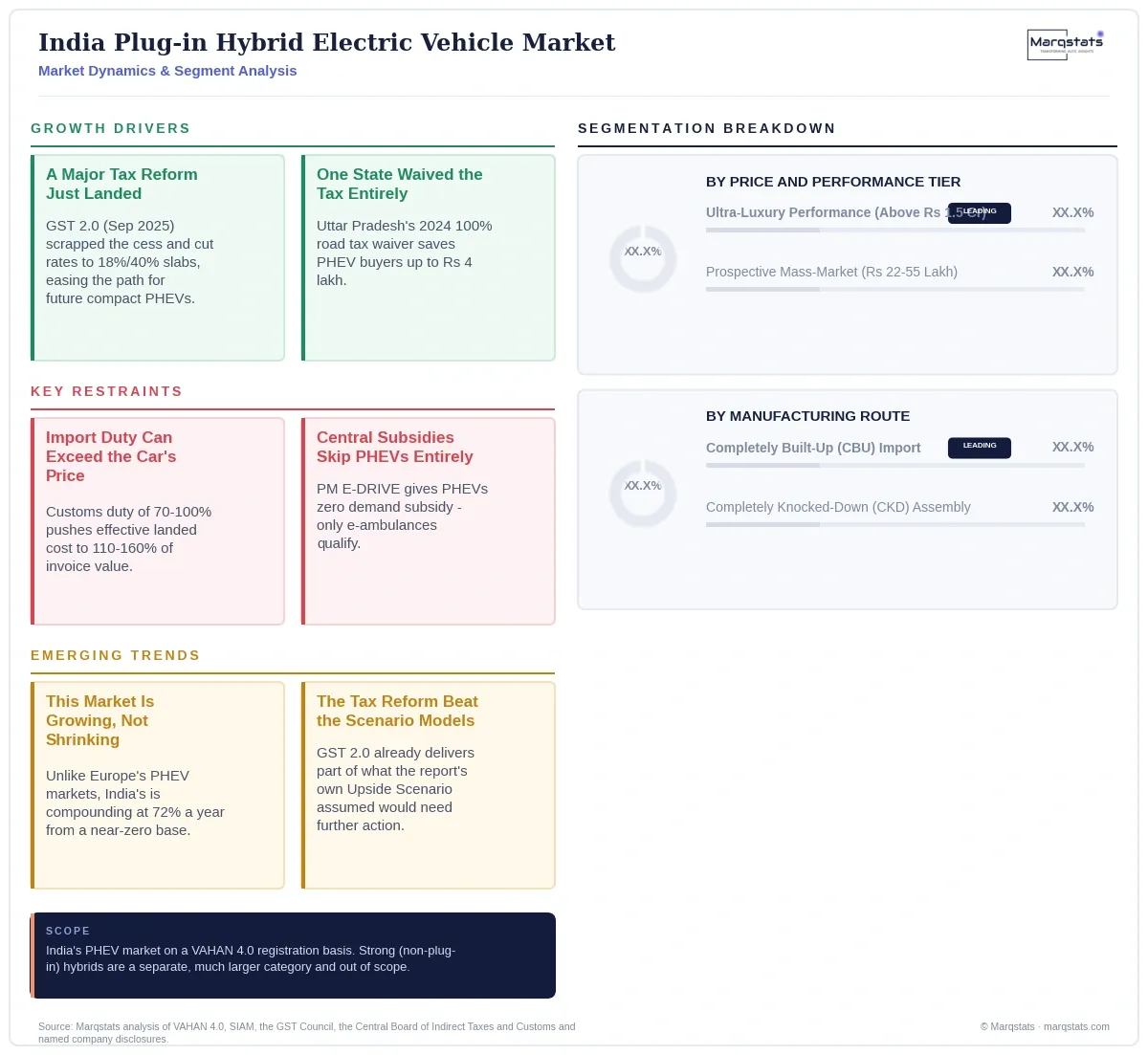
- GST 2.0, effective 22 September 2025, eliminated India's compensation cess and introduced a simplified two-slab structure of 18% for smaller vehicles and 40% for larger ones, offering a materially lower starting tax position for a future compact PHEV than the pre-reform 43% to 50% effective burden, independent of any further GST Council-specific relief for hybrid powertrains.
- Uttar Pradesh's July 2024 decision to grant a 100% road tax and registration fee waiver to strong hybrids and plug-in hybrids, matching the tax parity BEVs already enjoy, saves buyers between Rupees 1.5 lakh and 4.0 lakh on qualifying vehicles and has driven registration activity through neighboring Noida even for buyers based in Delhi.
- Corporate Average Fuel Efficiency Phase III enforcement, scheduled to take effect from 2027, is expected to pressure original equipment manufacturers with high-emission internal combustion sport-utility-vehicle portfolios toward electrified powertrains, creating a compliance-driven incentive for hybrid and plug-in hybrid technology adoption independent of consumer demand signals alone.
- BYD India's confirmed plan to introduce the Seal U DM-i in the second half of 2026, using proprietary Dual Mode-intelligent technology and a Lithium Iron Phosphate Blade battery, represents the first credible mass-market or premium plug-in hybrid entry into India, targeting an estimated Rupees 35 to 45 lakh price band well below the ultra-luxury segment that presently defines the market.
- Ultra-luxury performance flagships from BMW Group India and Automobili Lamborghini continue to expand the addressable high-net-worth buyer base, with the BMW M5 launching in November 2024 at an ex-showroom price of Rupees 1.99 crore and the Lamborghini Urus SE launching in August 2024 at Rupees 4.57 crore, both sustaining demand among ultra-high-net-worth individuals for whom acquisition tax is a secondary consideration.
Key Restraints
- India's Basic Customs Duty structure imposes a 70% tariff on completely built-up units valued under 40,000 US dollars Cost, Insurance and Freight, and 100% on units exceeding that threshold, plus a 10% Social Welfare Surcharge, escalating the effective landed duty on imported luxury plug-in hybrids to between 110% and 160% of invoice value and confining the commercial market to an ultra-luxury niche.
- Central government purchase incentives under the PM Electric Drive Revolution in Innovative Vehicle Enhancement scheme allocate zero demand subsidies to private passenger plug-in hybrids, restricting hybrid and PHEV financial support exclusively to a narrow carve-out for specialized electric ambulances developed with the Ministry of Health and Family Welfare, a formalized exclusion inherited from the predecessor FAME-II scheme.
- Even under India's post-reform Goods and Services Tax structure, a localized plug-in hybrid carrying an 18 to 25 kilowatt-hour battery alongside an internal combustion engine, power electronics and a complex hybrid transmission incurs a manufacturing cost premium of at least Rupees 4.5 lakh over a comparable internal combustion platform, expanding to an on-road price delta of Rupees 8.5 lakh to 11.0 lakh once taxation and state registration fees are applied.
- Public charging infrastructure investment under central initiatives such as PM E-DRIVE is concentrated on high-power direct current fast-charging systems of 50 to 250 kilowatts designed for pure battery-electric vehicles, a format most plug-in hybrids cannot use given onboard chargers typically limited to 3.7 to 11 kilowatts of alternating current input, forcing PHEVs into charge-sustaining combustion mode on interstate corridors.
Key Trends
- India's PHEV market is on a fundamentally different trajectory than the European markets covered in comparable analyses: rather than recovering from a post-subsidy collapse, it is compounding from a near-zero base at 71.98% annually, though this growth is confined entirely to an ultra-luxury enclave rather than broadening into mainstream vehicle segments.
- GST 2.0's September 2025 restructuring is a genuinely current fiscal development the market's own forward scenarios, built around the pre-reform tax framework, could not have incorporated - the reform offers a materially more favorable starting position for a future compact PHEV than the scenarios' own base assumptions describe, independent of any additional GST Council action targeting hybrid powertrains specifically.
- Domestic manufacturer opposition to further hybrid tax relief is broadening rather than narrowing: Hyundai Motor India has reportedly joined Tata Motors and Mahindra and Mahindra in resisting additional Goods and Services Tax reduction for hybrid platforms, expanding what had been a two-manufacturer opposition coalition to at least three major domestic and joint-venture original equipment manufacturers.
- State-level fiscal policy divergence is deepening as a market-shaping force: while Delhi, Tamil Nadu and Karnataka direct incentives almost entirely toward battery-electric vehicles, Uttar Pradesh's road tax parity for plug-in hybrids has created a documented pattern of registration activity migrating toward the state to capture the tax benefit, even for buyers whose primary residence sits elsewhere in the National Capital Region.
- Statutory data infrastructure gaps continue to obscure the true scale of India's PHEV market: because the Society of Indian Automobile Manufacturers reports domestic factory wholesale dispatches, and India's active PHEVs are entirely imported completely built-up units, standard industry wholesale statistics show near-zero PHEV volume, creating a persistent false impression that the segment is smaller or less active than customs import data confirms it to be.
Strategic Implications
For a prospective global entrant, direct completely-built-up importation in price categories below Rupees 50 lakh remains commercially unviable given the 70% to 100% Basic Customs Duty structure; entrants should instead localize through completely-knocked-down assembly routes, which attract substantially lower duties of 15% to 35%, targeting the Rupees 35 lakh to 55 lakh bracket while prioritizing certified electric range of at least 80 kilometers and bundling dedicated home wallbox chargers directly into the ex-showroom transaction to insulate buyers from India's fragmented public charging network.
For a domestic incumbent manufacturer such as Tata Motors or Mahindra and Mahindra, defending the pure battery-electric product roadmap remains the primary commercial imperative, and continued lobbying against hybrid tax relief is a rational extension of billions of rupees already committed to dedicated battery-electric architectures; at the same time, accelerating the rollout of competitively priced battery-electric platforms into mainstream price bands will be necessary to defend market share as global automakers introduce completely-knocked-down hybrid alternatives under the more favorable post-GST-2.0 tax structure.
For a Tier-1 automotive component supplier, over-investing exclusively in either pure internal combustion or pure battery-electric architectures presents asymmetric downside risk given India's genuinely uncertain hybrid policy trajectory; suppliers can mitigate this volatility by investing in dual-use components serving both plug-in hybrid and battery-electric powertrains, such as high-voltage power inverters, electric compressors, regenerative braking systems and AIS-038-compliant battery enclosures, while developing localized integrated e-axles to capture domestic value-addition credits under the Automotive Component Production Linked Incentive scheme regardless of which powertrain technology ultimately gains greater market share.
Outlook
Base case: 4,200 new registrations by CY2030 (76.47% five-year volume CAGR), USD 343.37 million annual value. This trajectory assumes Corporate Average Fuel Efficiency Phase III enforcement from 2027 pressures original equipment manufacturers toward electrified powertrains while the Goods and Services Tax rate remains at its post-GST-2.0 structure, with BYD's Seal U DM-i and comparable completely-knocked-down entries establishing a genuine mid-market presence alongside continued ultra-luxury completely-built-up demand.
Upside case: 18,500 new registrations by CY2030 (136.98% five-year volume CAGR), USD 1,003.01 million annual value. The specific trigger is the GST Council reducing plug-in hybrid rates to an intermediate 18% slab with zero cess for vehicles certifying at least 50 kilometers of pure-electric range, combined with Production Linked Incentive credit extension to hybrid transmissions, enabling JSW MG Motor, Toyota-Maruti and Hyundai to introduce locally assembled plug-in hybrid sport-utility vehicles in the Rupees 22 to 35 lakh bracket.
Downside case: 480 new registrations by CY2030 (14.40% five-year volume CAGR), USD 161.93 million annual value. The specific trigger is the GST Council leaving hybrid taxation unchanged at its post-reform structure with no further hybrid-specific relief, the Ministry of Road Transport and Highways maintaining zero road tax relief for plug-in hybrids outside Uttar Pradesh, and successor schemes to PM E-DRIVE maintaining the complete exclusion of non-battery-electric vehicles from central purchase incentives.
Market Segmentation
This tier presently constitutes effectively the entire Indian PHEV market, anchored by the BMW XM, BMW M5, Lamborghini Urus SE and Porsche Cayenne E-Hybrid, all sold as completely built-up imports to ultra-high-net-worth individuals who treat the plug-in hybrid architecture primarily as a performance-enhancing mechanism rather than a daily zero-emission commuting tool.
This tier does not yet exist in active sales volume but is confirmed as a near-term entry point, led by BYD India's planned Seal U DM-i launch in the second half of 2026 and JSW MG Motor India's evaluation of an HS or Hector-based plug-in hybrid, both targeting a price band an order of magnitude below the current ultra-luxury segment.
100% of India's current PHEV volume arrives as completely built-up units, subject to a Basic Customs Duty of 70% for vehicles under 40,000 US dollars Cost, Insurance and Freight value and 100% above that threshold, plus a 10% Social Welfare Surcharge, escalating effective landed duty to between 110% and 160% of invoice value and confining the route to ultra-luxury flagships.
No plug-in hybrid is currently assembled via the completely-knocked-down route in India, but this route attracts substantially lower Basic Customs Duty of 15% to 35%, and is the confirmed entry strategy for BYD's Seal U DM-i and the scenario-dependent path for JSW MG Motor, Toyota-Maruti and Hyundai's prospective mid-market plug-in hybrid programs.
By Geography
Maharashtra
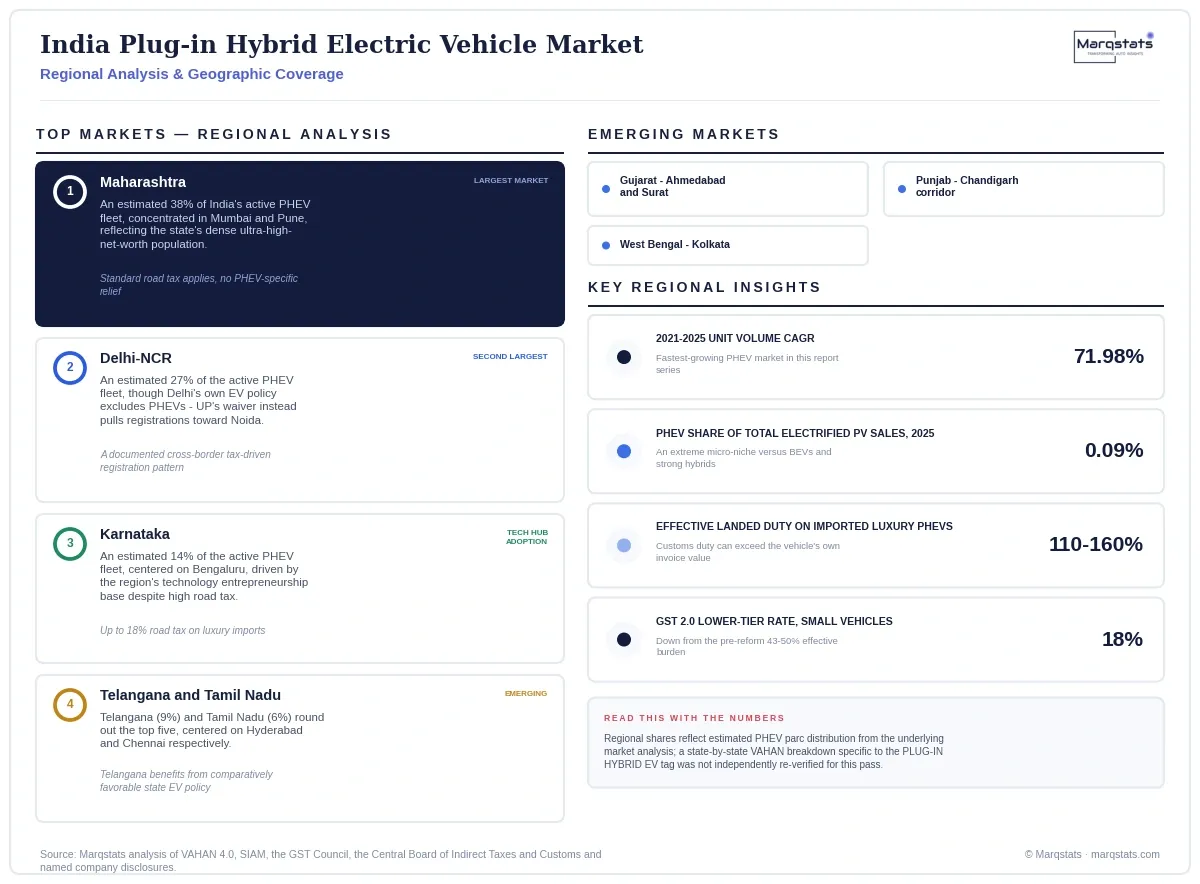
Maharashtra accounts for an estimated 38% of India's active PHEV fleet, concentrated in the Mumbai Metropolitan Region and Pune, reflecting the state's high density of ultra-high-net-worth individuals; standard road tax applies, with no specific plug-in hybrid exemption offsetting the acquisition cost.
Delhi-NCR
Delhi-NCR accounts for an estimated 27% of the active PHEV fleet across South and Central Delhi, Gurugram and Noida, though Delhi's own electric vehicle policy excludes plug-in hybrids from subsidies; Uttar Pradesh's 100% registration waiver has instead driven a documented pattern of registration activity through neighboring Noida.
Karnataka
Karnataka accounts for an estimated 14% of the active PHEV fleet, concentrated in Bengaluru's Urban, Whitefield and Indiranagar areas, driven by the region's technology entrepreneurship base, despite comparatively high road tax of up to 18% on luxury imports.
Telangana
Telangana accounts for an estimated 9% of the active PHEV fleet, concentrated in Hyderabad's Jubilee Hills, HITEC City and Gachibowli areas, supported by comparatively favorable state electric vehicle policies and an expanding corporate fleet and executive adoption base.
Tamil Nadu and the Rest of India
Tamil Nadu accounts for an estimated 6% of the active PHEV fleet, concentrated in Chennai and Coimbatore under standard motor vehicle taxation, while the remaining approximately 6% is fragmented across Gujarat, additional Uttar Pradesh cities, Punjab and West Bengal, with tactical registration surges in Uttar Pradesh driven by its tax waiver circular.
How Competition Is Evolving
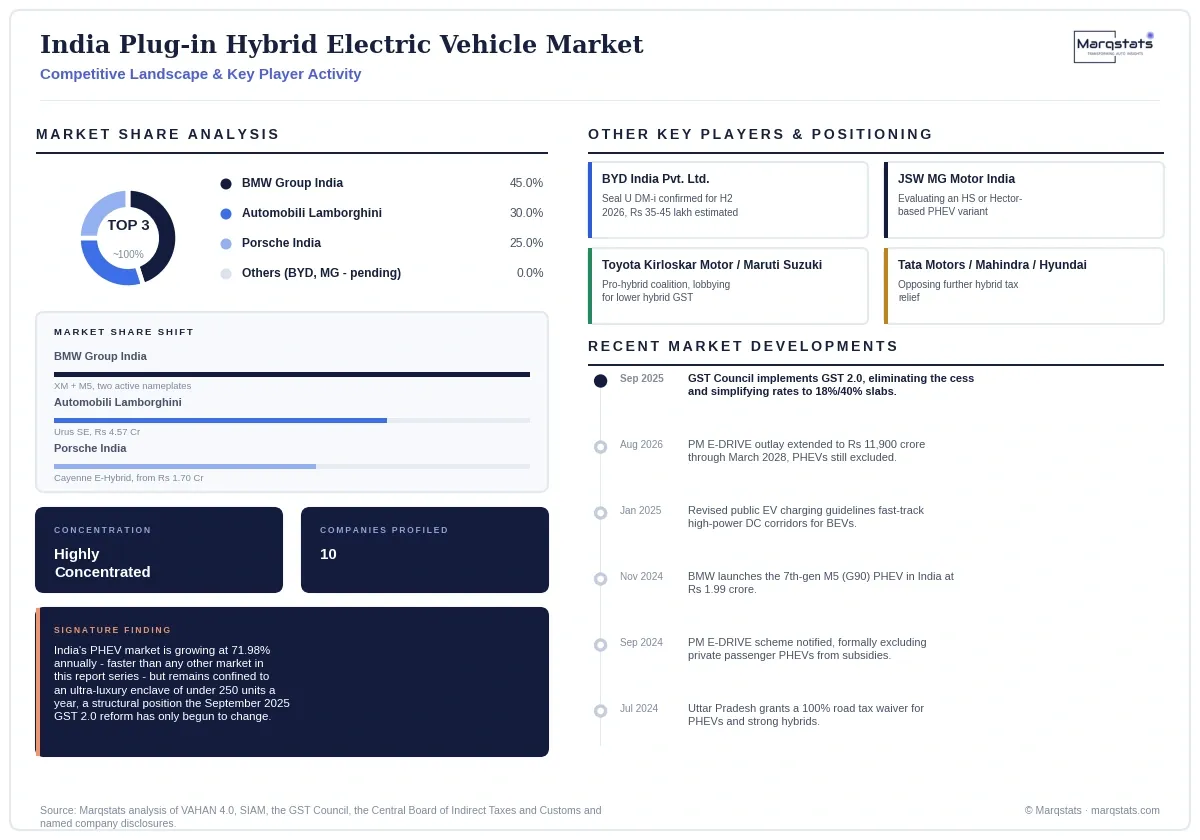
India's PHEV market is highly concentrated: BMW Group India alone accounts for two of the market's four active nameplates, and the top three manufacturers by presence, BMW Group India, Automobili Lamborghini and Porsche India, collectively define effectively the entire current ultra-luxury segment, since no domestic or joint-venture original equipment manufacturer presently assembles or imports a mass-market plug-in hybrid.
Competitors in the active market compete almost entirely on performance specification and brand exclusivity rather than price or total cost of ownership, since every current nameplate sits above Rupees 1.5 crore; BMW Group India has established the broadest active portfolio with both the BMW XM and seventh-generation BMW M5, while Automobili Lamborghini and Porsche India each maintain a single flagship plug-in hybrid nameplate.
The most significant near-term competitive shift is the confirmed entry of BYD India with the Seal U DM-i, planned for the second half of 2026 via completely-built-up or semi-knocked-down exploration, which would introduce the market's first plug-in hybrid priced an order of magnitude below the current ultra-luxury segment, alongside JSW MG Motor India's ongoing evaluation of an HS or Hector-based plug-in hybrid for its mid-to-premium sport-utility-vehicle portfolio.
Companies Covered
The report profiles 10+ companies with full strategy and financials analysis, including:
Recent Market Activity
Table of Contents
Coverage & Segmentation
Coverage spans India's Plug-in Hybrid Electric Vehicle market on a VAHAN 4.0 statutory registration basis, as administered by the Ministry of Road Transport and Highways and the National Informatics Centre, across a CY2021-CY2025 historical period and a CY2026-CY2030 forecast period, with CY2025 as the base year. The market is sized in both USD value and unit volume, covering plug-in hybrids tracked under the distinct PLUG-IN HYBRID EV registration tag. Two segmentation dimensions are quantified: price and performance tier, and manufacturing route.
Excluded from scope: strong hybrid and mild hybrid vehicles, which are tracked as a separate, substantially larger category under India's VAHAN classification; light commercial and two/three-wheeler plug-in hybrids, which are not separately sized; and a conventional body-style or acquisition-channel segmentation, which is not meaningful given the market's current composition as entirely individual ultra-luxury purchases. A separate Marqstats study addresses India's battery-electric vehicle market on a comparable basis.