Market Snapshot
Key Takeaways
Market Overview & Analysis
Report Summary
This analysis sizes Poland's plug-in hybrid electric vehicle market on the statutory basis established under Article 2, Point 13 of the Act of 11 January 2018 on Electromobility and Alternative Fuels, which legally defines a hybrid vehicle charged from an external power source as distinct from both non-chargeable hybrids and the zero-emission classification reserved for battery-electric and hydrogen fuel cell vehicles. The market is measured as new passenger car retail registrations, cross-referenced against net active fleet additions tracked by the PZPM/PSNM Licznik Elektromobilnosci registry, with 2024 as the base year given the most recent complete annual dataset available. Coverage explicitly separates new factory-fresh retail sales from the used-import channel throughout.
Poland's PHEV active fleet grew from 8,834 units in 2020 to 68,866 units in 2024, a 67.03% compound annual growth rate, while new factory-fresh retail registrations reached 14,919 units in 2024, a 12.60% year-on-year increase. A reconciliation of these two figures reveals that 6,810 units, 31.34% of net fleet additions, were secondhand vehicles imported from other European markets rather than new domestic sales - a distinction essential to accurately sizing the market, since treating net fleet growth as a proxy for new vehicle demand overstates the domestic retail market by approximately 45.6%.
The 2030 base-case forecast of 28,500 annual registrations assumes major manufacturers successfully redesign PHEV platforms with 20 to 28 kilowatt-hour battery packs to remain under the 50 grams CO2 per kilometer Euro 6e-bis threshold, preserving access to the 150,000 PLN corporate tax deduction ceiling, while the 50% excise duty reduction remains in place through its legislated 2029 expiration. The binding upside condition is whether persistent charging-infrastructure bottlenecks extend corporate reliance on long-range PHEVs while Poland raises the corporate depreciation ceiling to 200,000 PLN; the binding downside condition is whether more than 70% of available PHEV models cross the Euro 6e-bis emissions threshold, shifting them into the reduced 100,000 PLN tax tier just as a revamped Moj Elektryk 2.0 subsidy program opens corporate battery-electric leasing to renewed public support.
Market Dynamics
Key Drivers
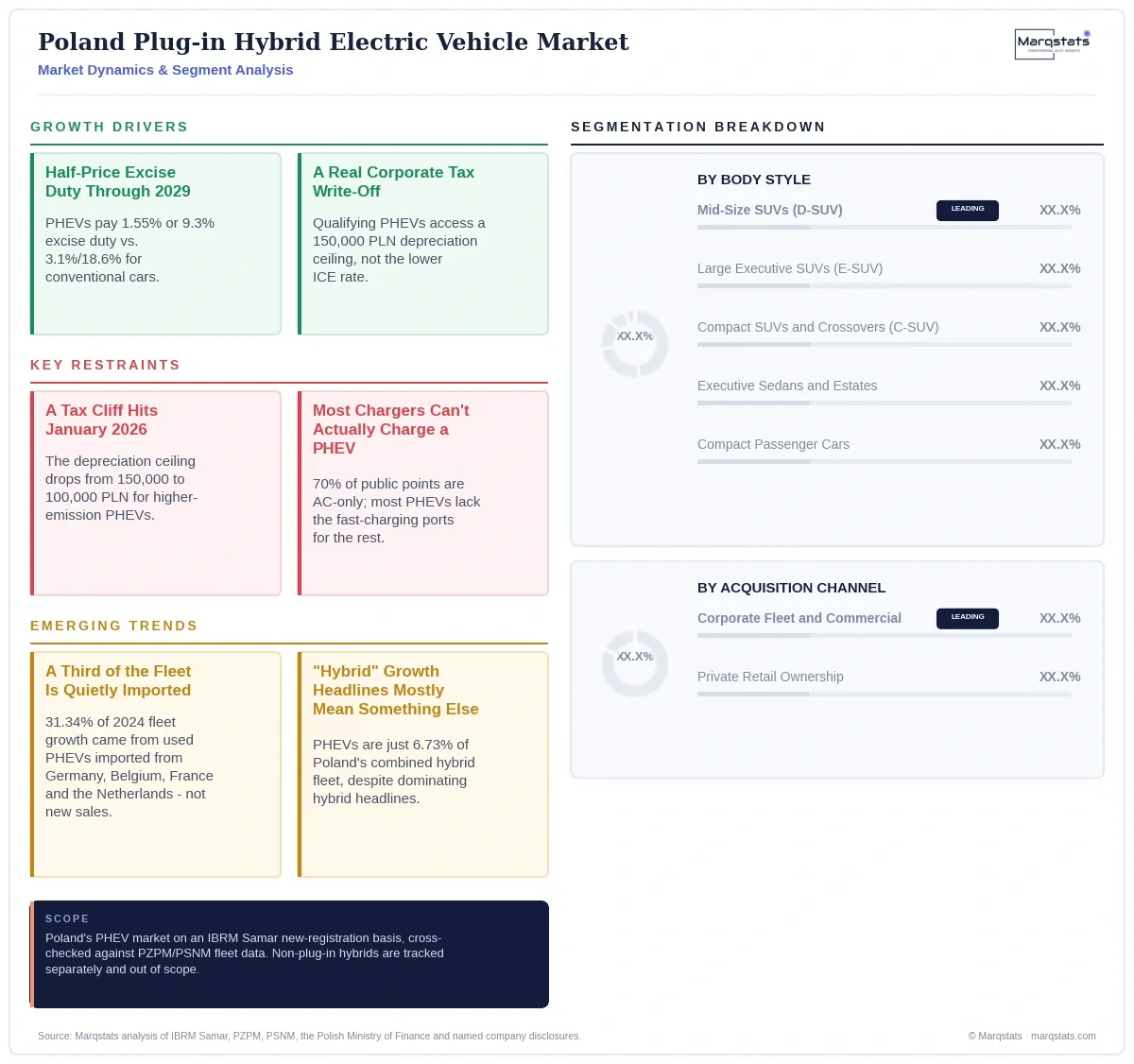
- Poland's 50% statutory excise duty reduction for PHEVs, established under Article 109a of the Excise Duty Act and extended through 31 December 2029, fixes rates at 1.55% for smaller-displacement PHEVs and 9.3% for larger-displacement models, against 3.1% and 18.6% baselines for conventional combustion vehicles respectively - among the most durable PHEV-specific fiscal advantages in the European Union.
- Corporate income tax deductibility rules continue to favor PHEVs certifying under 50 grams of CO2 per kilometer, granting access to a 150,000 PLN depreciation and lease-cost ceiling against 100,000 PLN for higher-emission vehicles, a distinction that shapes fleet procurement decisions across Poland's dominant corporate and commercial buyer segment.
- The temporary depletion of the Moj Elektryk battery-electric leasing subsidy in mid-2024 redirected corporate fleet demand toward PHEVs, since battery-electric vehicles lost their primary cost advantage over plug-in hybrids for leasing companies during the funding gap.
- Chinese manufacturers are using Poland's excise duty structure to establish a new competitive price floor, with BYD's Seal U DM-i and Chery's Omoda and Jaecoo brands pricing PHEVs between 169,900 and 184,900 PLN - a direct consequence of European Union countervailing tariffs imposed on Chinese-built battery-electric vehicles that do not apply to plug-in hybrids.
- Mixed-use VAT recovery rules allow enterprises to reclaim 50% of input VAT on PHEV acquisition and operating lease expenses, compounding with corporate income tax write-offs to sustain the 80% to 85% corporate share of new PHEV registrations that defines the Polish market's demand structure.
Key Restraints
- A corporate income tax deduction cliff takes effect 1 January 2026, reducing the depreciation and leasing cost ceiling from 150,000 PLN to 100,000 PLN for any PHEV whose certified emissions cross 50 grams of CO2 per kilometer, a threshold the European Union's revised Euro 6e-bis Utility Factor testing standard will push many existing PHEV models across without any physical change to the vehicles themselves.
- Poland's public charging network is structurally mismatched to PHEV operational needs: 70.0% of the 8,659 public charging points are AC normal or slow chargers, while the DC fast-charging share remains inaccessible to more than 90% of PHEVs, and public charging operators enforce parking idle fees after 60 to 180 minutes of continuous connection, making public charging economically impractical for daily PHEV use.
- Warsaw's Clean Transport Zone, which entered force on 1 July 2024 as Poland's first such zone, denies PHEVs the automatic green-plate exemptions battery-electric vehicles receive, instead granting entry based strictly on baseline Euro emissions standards and vehicle age - meaning a modern PHEV receives no preferential treatment over a comparable conventional combustion vehicle.
- Without automated employee home-electricity reimbursement schemes, which remain legally complex under current Polish tax treatment of company car fringe benefits, many corporate PHEVs operate predominantly on their internal combustion engines once initial deliveries are completed, widening the gap between certified and real-world emissions performance for the fleet segment that dominates the market.
Key Trends
- General market reporting on Polish hybrid vehicle growth frequently conflates plug-in hybrids with non-chargeable mild and full hybrids under the broad Polish term hybrydy, obscuring the fact that PHEVs represent only 6.73% of the combined hybrid vehicle fleet even as headline hybrid adoption figures continue climbing.
- A substantial and largely unreported used-import channel is quietly expanding Poland's active PHEV fleet: 6,810 secondhand vehicles imported from Germany, Belgium, France and the Netherlands accounted for 31.34% of net fleet additions in 2024, a volume large enough that treating new retail sales alone as a proxy for total market demand would understate the true scale of PHEV adoption on Polish roads by nearly a third.
- Chinese original equipment manufacturers are converting European Union trade policy into a structural market opportunity, using Poland's PHEV-favorable excise treatment specifically to bypass countervailing duties targeting Chinese-built battery-electric vehicles, a pattern that positions plug-in hybrids as a tariff-arbitrage vehicle rather than merely a transitional technology choice.
- The approaching Euro 6e-bis Utility Factor revision is expected to bifurcate the Polish PHEV market by battery capacity: models with larger battery packs of 25 to 32 kilowatt-hours and optional DC fast charging, already evident in Mercedes-Benz's latest GLC and E-Class platforms, are positioned to remain under the critical 50 grams CO2 per kilometer threshold, while smaller-battery legacy platforms face an increasingly binary choice between costly redesign and exit from the corporate-fleet-favorable tax tier.
- Poland's extreme geographic concentration in the Mazowieckie Voivodeship, at 44.5% of the national plug-in fleet, reflects corporate registration practices as much as genuine regional demand, since large car fleet management companies centrally register leased vehicles using Warsaw municipal plates regardless of where the vehicle is actually operated day to day.
Strategic Implications
For a Chinese or other new market entrant, Poland's 50% excise duty reduction combined with the absence of any equivalent duty relief for battery-electric imports makes plug-in hybrids the more commercially viable near-term entry route; however, sustaining this position beyond 2025 requires securing Euro 6e-bis type-approvals that keep certified emissions under 50 grams CO2 per kilometer and offering electric ranges of 100 or more kilometers to retain eligibility for the 150,000 PLN corporate tax deduction ceiling essential to competing in Poland's fleet-dominated market.
For an incumbent European or Japanese manufacturer, remaining under the Euro 6e-bis emissions threshold will require incorporating larger battery packs of 25 to 32 kilowatt-hours and optional direct-current fast charging, a strategy already visible in Mercedes-Benz's latest GLC and E-Class platforms, even as these technical additions narrow the price gap between premium PHEVs and comparable battery-electric alternatives and position PHEVs primarily as a fleet emissions hedge through the 2025-2027 compliance window rather than a durable long-term product category.
For a car fleet management company or corporate fleet operator, the 1 January 2026 deduction cliff requires an immediate audit of procurement pipelines to determine which currently offered PHEV models will retain sub-50 grams CO2 per kilometer certification under the revised Euro 6e-bis standard, alongside investment in corporate telematics and workplace charging infrastructure to document actual electric driving shares for Corporate Sustainability Reporting Directive compliance and to prevent unbudgeted increases in fuel expenditure across the fleet.
Outlook
Base case: 28,500 new registrations by 2030 (11.39% five-year volume CAGR), PLN 7.125 billion (USD 1.781 billion) annual value. This trajectory assumes major manufacturers successfully redesign PHEV platforms with 20 to 28 kilowatt-hour battery packs to remain under the Euro 6e-bis emissions threshold, preserving access to the 150,000 PLN corporate deduction ceiling, while the 50% excise duty reduction remains in place through its legislated 2029 expiration and Chinese manufacturers expand competitively priced offerings without triggering retaliatory trade measures.
Upside case: 42,000 new registrations by 2030 (18.82% five-year volume CAGR), PLN 10.710 billion (USD 2.678 billion) annual value. The specific trigger is persistent power grid connection delays and distribution system operator capacity shortages under the Alternative Fuels Infrastructure Regulation rollout, causing corporate fleets to extend reliance on long-range PHEVs capable of 100 or more kilometers of electric driving, further accelerated if Poland raises the corporate depreciation ceiling for certified low-emission vehicles to 200,000 PLN.
Downside case: 11,500 new registrations by 2030 (-4.26% five-year volume CAGR). The specific trigger is Euro 6e-bis Utility Factor testing pushing more than 70% of available PHEV models across the 50 grams CO2 per kilometer threshold into the reduced 100,000 PLN corporate depreciation tier, occurring simultaneously with a revamped Moj Elektryk 2.0 subsidy program that opens renewed public financial support for corporate battery-electric leasing, accelerating fleet migration away from plug-in hybrids entirely.
Market Segmentation
Mid-size sport-utility vehicles led the Polish PHEV market with 48.2% of 2024 volume, anchored by the Volvo XC60, Mercedes-Benz GLC, Lexus NX, Audi Q5 and Toyota RAV4, reflecting the segment's ability to package a substantial traction battery without materially compromising cabin or cargo space.
Large executive sport-utility vehicles held 24.6% of 2024 volume, anchored by the Porsche Cayenne, Lexus RX, Volvo XC90, Audi Q8 and BMW X5, serving the premium corporate and private buyer segment least sensitive to the retail price premium PHEVs carry over comparable combustion models.
Compact sport-utility vehicles and crossovers held 14.1% of 2024 volume, anchored by the Toyota C-HR, Kia Sportage, BMW X1 and BYD Seal U, representing the segment where Chinese manufacturers have concentrated their initial competitive entry.
Executive sedans and estates held 8.5% of 2024 volume, anchored by the BMW 5 Series, Mercedes-Benz E-Class and Audi A6, maintaining presence almost exclusively through premium German nameplates in the corporate fleet segment.
Compact passenger cars held 4.6% of 2024 volume, anchored by the Kia Ceed SW, Peugeot 308 and Volkswagen Golf, representing the smallest body-style segment as automakers increasingly phase plug-in hybrid technology out of compact platforms in favor of dedicated battery-electric alternatives.
Corporate entities, including commercial vehicle fleets, small-to-medium enterprises, sole proprietorships and car fleet management leasing companies, account for 80% to 85% of new PHEV registrations, driven by 50% input VAT recovery on mixed-use vehicles and corporate income tax write-offs up to the 150,000 PLN deduction ceiling.
Private individual retail buyers represent only 15% to 20% of new PHEV volume, since these buyers cannot access VAT recovery or corporate tax write-offs, leaving the typical 35,000 to 65,000 PLN retail premium over a comparable petrol or full-hybrid model unrecoverable through domestic residential electricity arbitrage alone.
By Geography
Mazowieckie (Warsaw)
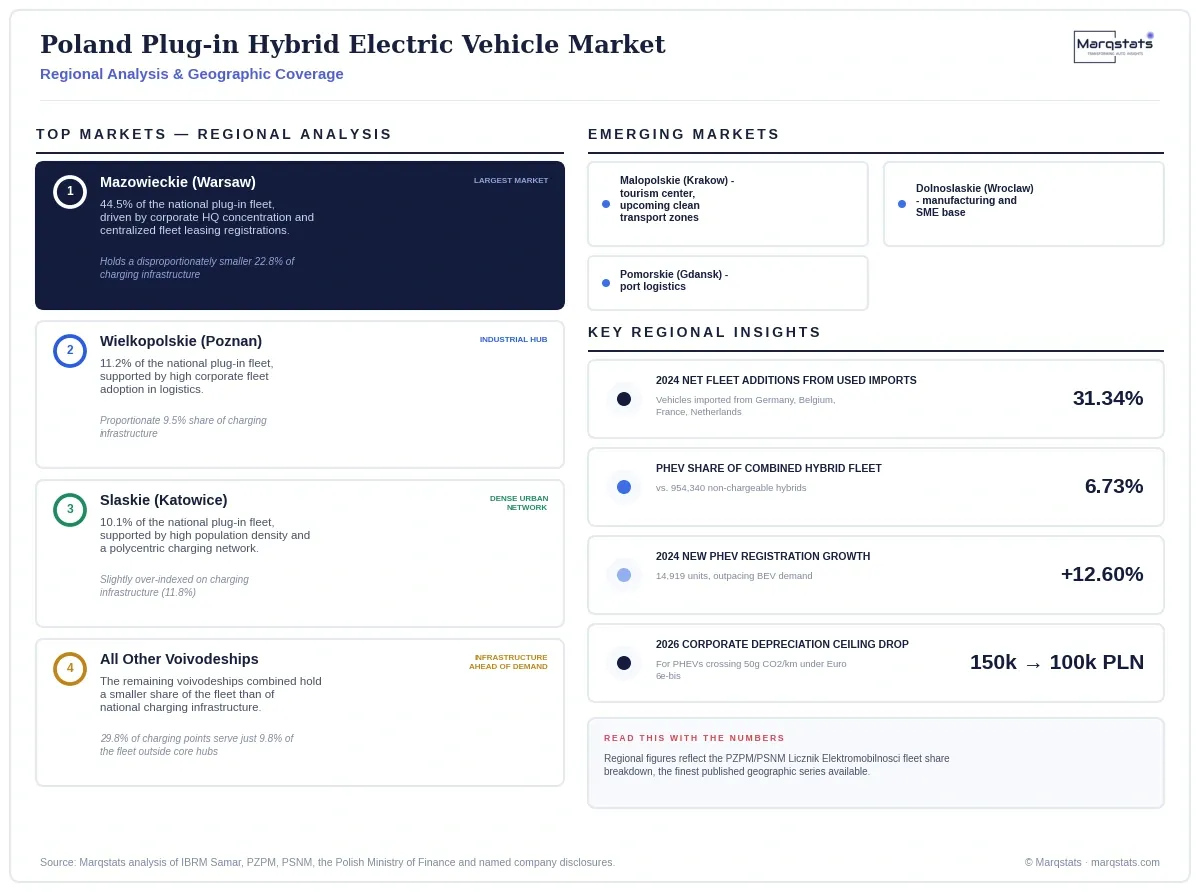
Mazowieckie accounts for approximately 44.5% of Poland's national plug-in vehicle fleet, driven by the concentration of major corporate headquarters, the centralized registration practices of large car fleet management leasing companies using Warsaw municipal plates, and elevated regional per capita income; the voivodeship holds a comparatively modest 22.8% share of national public charging infrastructure relative to its outsized fleet share.
Wielkopolskie (Poznan)
Wielkopolskie holds 11.2% of the national plug-in fleet, supported by the region's status as an industrial logistics hub with high corporate fleet adoption and a proportionate 9.5% share of national charging infrastructure.
Slaskie (Katowice)
Slaskie holds 10.1% of the national plug-in fleet, supported by high population density and a polycentric urban charging network that gives the region a slightly disproportionate 11.8% share of national charging infrastructure relative to its fleet share.
Malopolskie (Krakow) and Dolnoslaskie (Wroclaw)
Malopolskie holds 9.4% of the national plug-in fleet as a tourism center anticipating upcoming clean transport zones, while Dolnoslaskie holds 8.2%, supported by a strong international manufacturing and small-to-medium enterprise base; the two voivodeships together hold 17.0% of national charging infrastructure.
Pomorskie (Gdansk) and the Remaining Voivodeships
Pomorskie holds 6.8% of the national plug-in fleet, supported by port logistics infrastructure and regional charging hubs, while the remaining ten voivodeships together account for 9.8% of the national fleet despite holding a disproportionately large 29.8% share of national charging infrastructure, indicating that public charging investment is outpacing local fleet registration growth outside the core economic centers.
How Competition Is Evolving
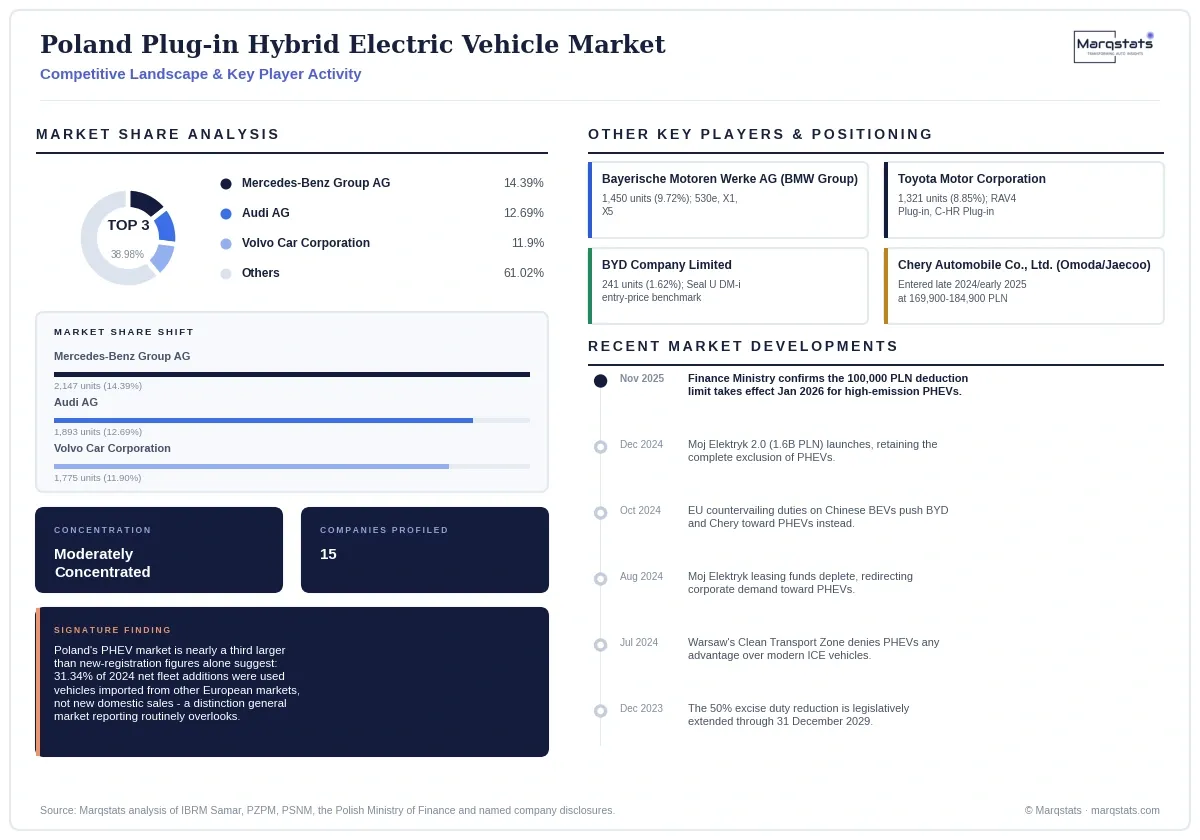
Poland's PHEV market is moderately concentrated among established luxury and premium brands: Mercedes-Benz, Volkswagen Group (Audi, Porsche and Skoda), BMW, Volvo and Toyota together account for over three-quarters of new PHEV registrations, with Mercedes-Benz leading at 2,147 units (14.39% share) in 2024, followed by Audi at 1,893 units (12.69%) and Volvo at 1,775 units (11.90%).
Competitors differentiate primarily on battery capacity relative to the Euro 6e-bis emissions threshold and price positioning; established European and Japanese brands compete on larger battery packs and optional direct-current fast charging to preserve corporate tax eligibility, while Chinese entrants led by BYD and Chery's Omoda and Jaecoo brands compete on price, undercutting comparable European models by using Poland's excise duty reduction to establish list prices near 170,000 PLN.
The most significant recent competitive-landscape shift is the accelerating entry of Chinese manufacturers directly tied to European Union trade policy: following October 2024 countervailing duties on Chinese-built battery-electric vehicles, BYD's Seal U DM-i and Chery's Omoda 7 and Jaecoo 7 Super Hybrid have positioned plug-in hybrids specifically to bypass those duties while capturing price-sensitive private and small-business buyers Poland's corporate-fleet-dominated incumbent brands have largely ceded.
Companies Covered
The report profiles 15+ companies with full strategy and financials analysis, including:
Recent Market Activity
Table of Contents
Coverage & Segmentation
Coverage spans Poland's Plug-in Hybrid Electric Vehicle market on a new passenger car registration basis, as reported by IBRM Samar and cross-referenced against net active fleet additions tracked by the PZPM/PSNM Licznik Elektromobilnosci registry, across a 2020-2024 historical period and a 2025-2030 forecast period, with 2024 as the base year given the most recent complete annual dataset available. The market is sized in both PLN/USD value and unit volume, covering PHEVs statutorily defined under the Act on Electromobility and Alternative Fuels. Two segmentation dimensions are quantified: body style and acquisition channel.
Excluded from scope: non-chargeable mild and full hybrid vehicles, which are tracked as a separate, substantially larger category; light commercial and heavy commercial PHEVs, which are not separately sized; and a fully reconciled 2025 figure, since complete annual data for that year was not available from permitted sources at time of writing. A separate Marqstats study addresses Poland's battery-electric vehicle market on a comparable basis.