Market Snapshot
Middle bar: base-year value × (1 + CAGR), rounded to two decimals. This is a calculated illustration, not a separately researched annual estimate.
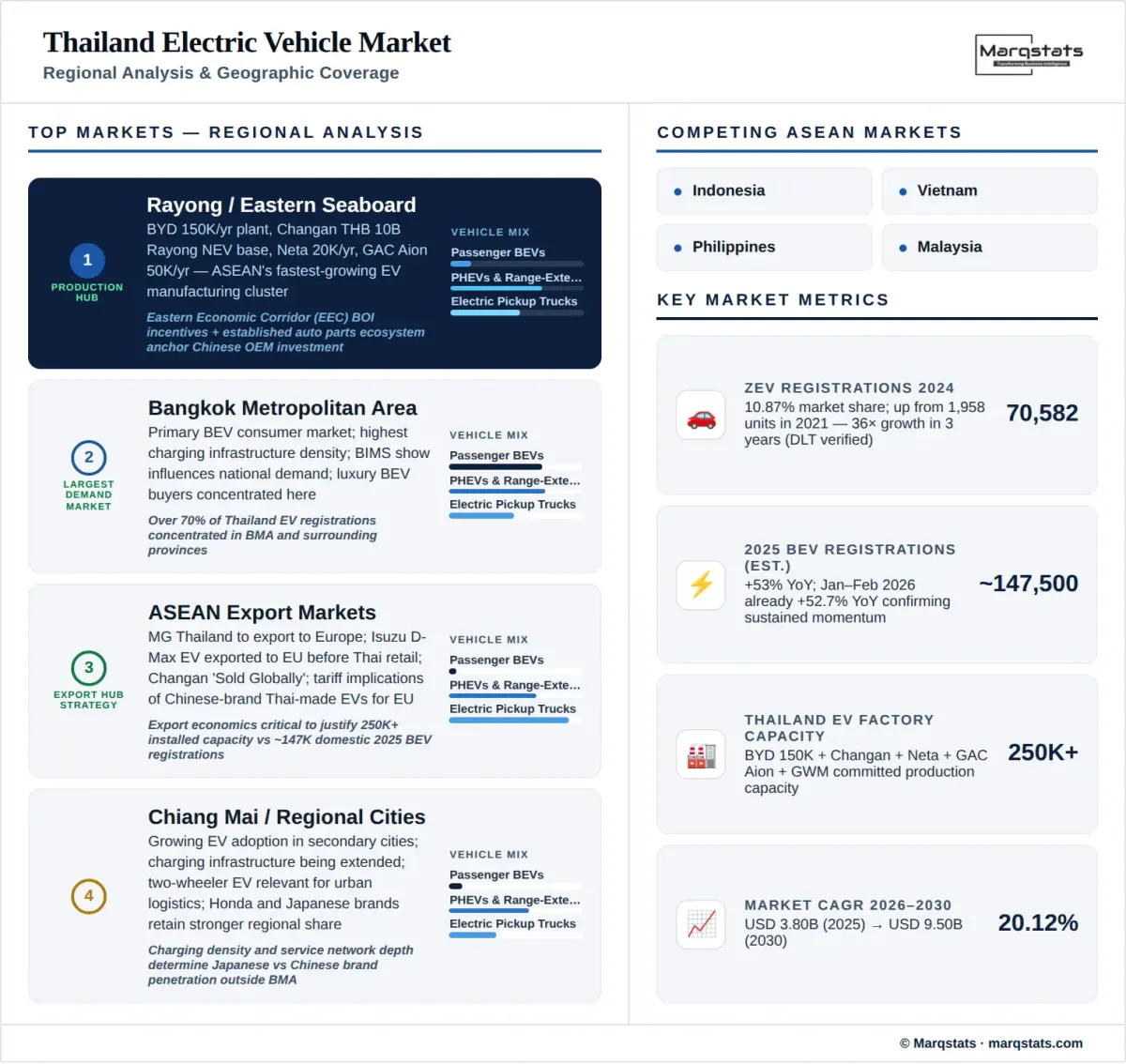
The Thailand electric vehicle market was valued at USD 3.80 billion in 2025 and is projected to reach USD 9.50 billion by 2030, expanding at a CAGR of 20.12% during the forecast period 2026–2030. Thailand’s EV market is best described as an “incentives-to-industry” archetype: rapid registration growth in 2022–2024 occurred alongside policy packages that explicitly tie sales incentives to local production and supply-chain localisation. Verified administrative data from the Department of Land Transport shows ZEV passenger car and pickup registrations rising from 1,958 units in 2021 to 70,582 in 2024, with market share climbing from 0.25% to 10.87% even as the total passenger car and pickup market contracted sharply. BEV registrations in 2025 rose approximately 53% year-on-year to around 147,500 units, confirming continued momentum beyond the 2024 adjustment.
Thailand is not just another EV demand market. It is strategically important because of the government’s deliberate coupling of purchase incentives with local manufacturing commitments, the scale of Chinese OEM production investment, and Thailand’s positioning as an ASEAN EV manufacturing and export hub. The EV 3.0 and EV 3.5 policy packages are not merely subsidy schemes—they are industrial localisation mechanisms linking tax reductions and import duty cuts to production obligations. BYD’s Rayong plant (150,000 vehicles/year capacity, approximately 10,000 jobs, completed in 16 months), Changan’s THB 10 billion Rayong NEV production base, Neta’s 20,000-unit factory, and GAC Aion’s 50,000-unit plant demonstrate that Thailand is transitioning from an EV import market to a regional production node integrated into global OEM supply networks.
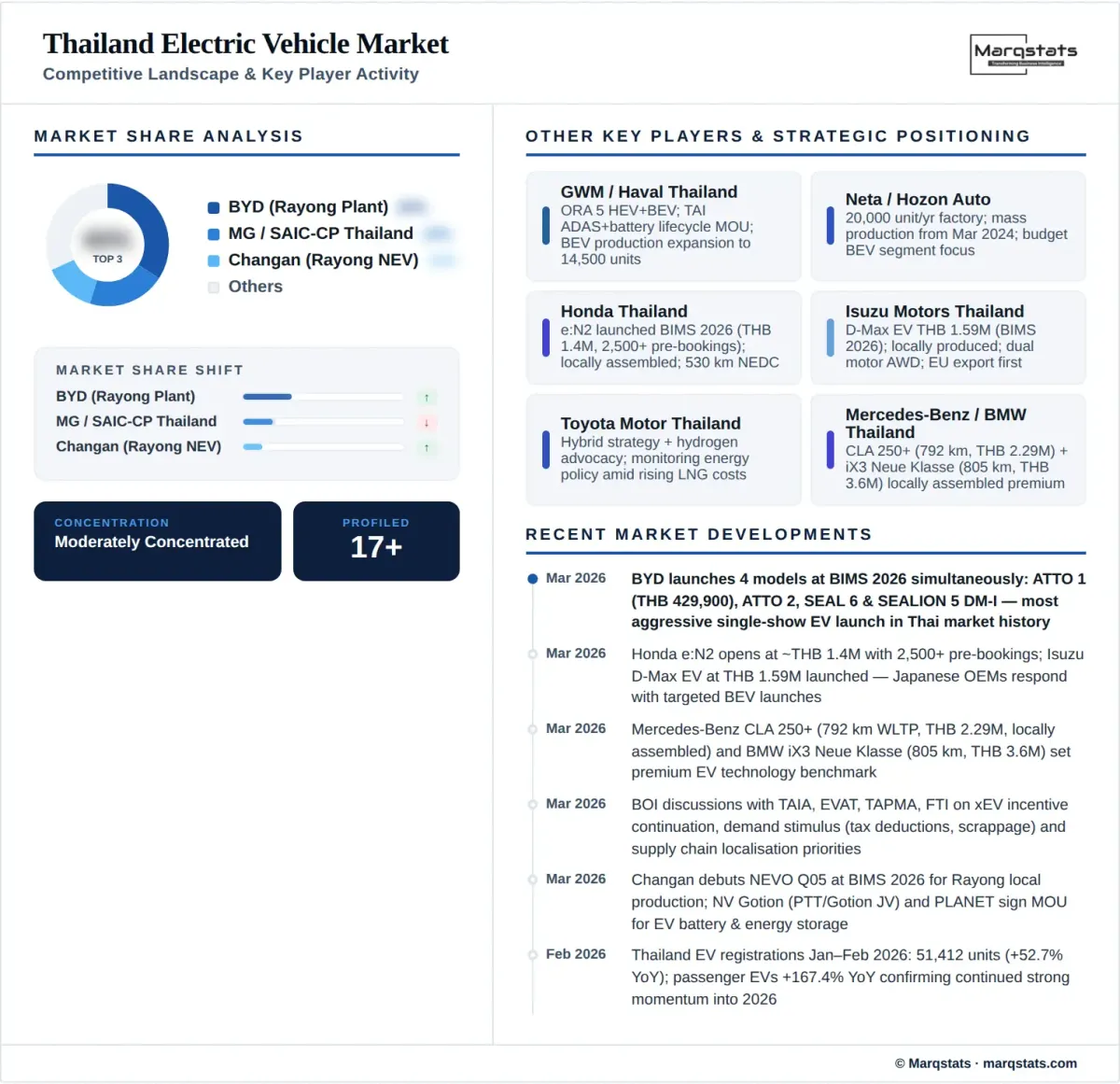
The market is experiencing an intense competitive inflection. At the 47th Bangkok International Motor Show (March 2026), BYD launched four models simultaneously (ATTO 1, ATTO 2, SEAL 6, SEALION 5 DM-I) with prices starting from THB 429,900. Honda’s e:N2 attracted over 2,500 pre-bookings. Mercedes-Benz launched the locally assembled CLA 250+ electric with 792 km WLTP range. BMW showcased the Neue Klasse iX3. MG set a 30,000-unit 2026 sales target with plans to export Thailand-produced vehicles to Europe. Changan debuted the NEVO Q05 for local production under its “Made in Thailand, Sold Globally” strategy. However, domestic auto demand is weakening due to high household debt, tighter lending, and rising energy costs from Middle East geopolitical disruptions, creating tension between ambitious production capacity buildout and softer near-term domestic absorption.
Key Takeaways
Market Overview & Analysis
Report Summary
The Thailand electric vehicle market encompasses battery-electric vehicles (BEVs), plug-in hybrid electric vehicles (PHEVs), and range-extended electric vehicles (REEVs) across passenger cars, pickup trucks, two-wheelers, buses, and commercial vehicles sold and manufactured in Thailand. The market covers the full ecosystem: vehicle sales and registrations, local assembly and manufacturing (CKD and CBU), component and battery supply chain localisation, charging infrastructure (AC and DC), policy and incentive architecture (EV 3.0, EV 3.5, excise tax, import duties), and Thailand’s positioning as an ASEAN production and export hub.
Thailand’s EV market should be analysed as a coupled system: incentives and fiscal measures that lower upfront cost and shape OEM pricing; production localisation requirements tied to those incentives; rapid entry of Chinese OEMs bringing model variety and aggressive pricing; and charging infrastructure scaling to sustain adoption. The UNDP technical review provides verified administrative data confirming ZEV registrations rising from 1,958 in 2021 to 70,582 in 2024 and market share reaching 10.87%. However, 2024 showed a notable pattern: absolute ZEV registrations decreased from 76,361 in 2023, but market share rose because the total passenger car and pickup market contracted more sharply (from 847,385 to 649,280 units).
On the supply side, OEM and supplier announcements in 2024–2026 indicate Thailand is moving into “industrial capture mode”: local assembly, component manufacturing, and plans for ASEAN and European exports. The competitive landscape is defined by Chinese EV OEMs—BYD, Changan, Neta, MG (SAIC), GWM, Chery, Dongfeng—competing on price, model variety, and localisation, while legacy Japanese OEMs (Toyota, Honda, Isuzu, Suzuki) are responding with HEV strategies and selective BEV launches. The BOI’s March 2026 discussions with industry associations focused on three priorities: continuing xEV incentives across HEV/PHEV/BEV, stimulating domestic demand through tax deductions and scrappage programmes, and strengthening supply chain localisation through preferential treatment for domestically produced vehicles.
Market Dynamics
Key Drivers
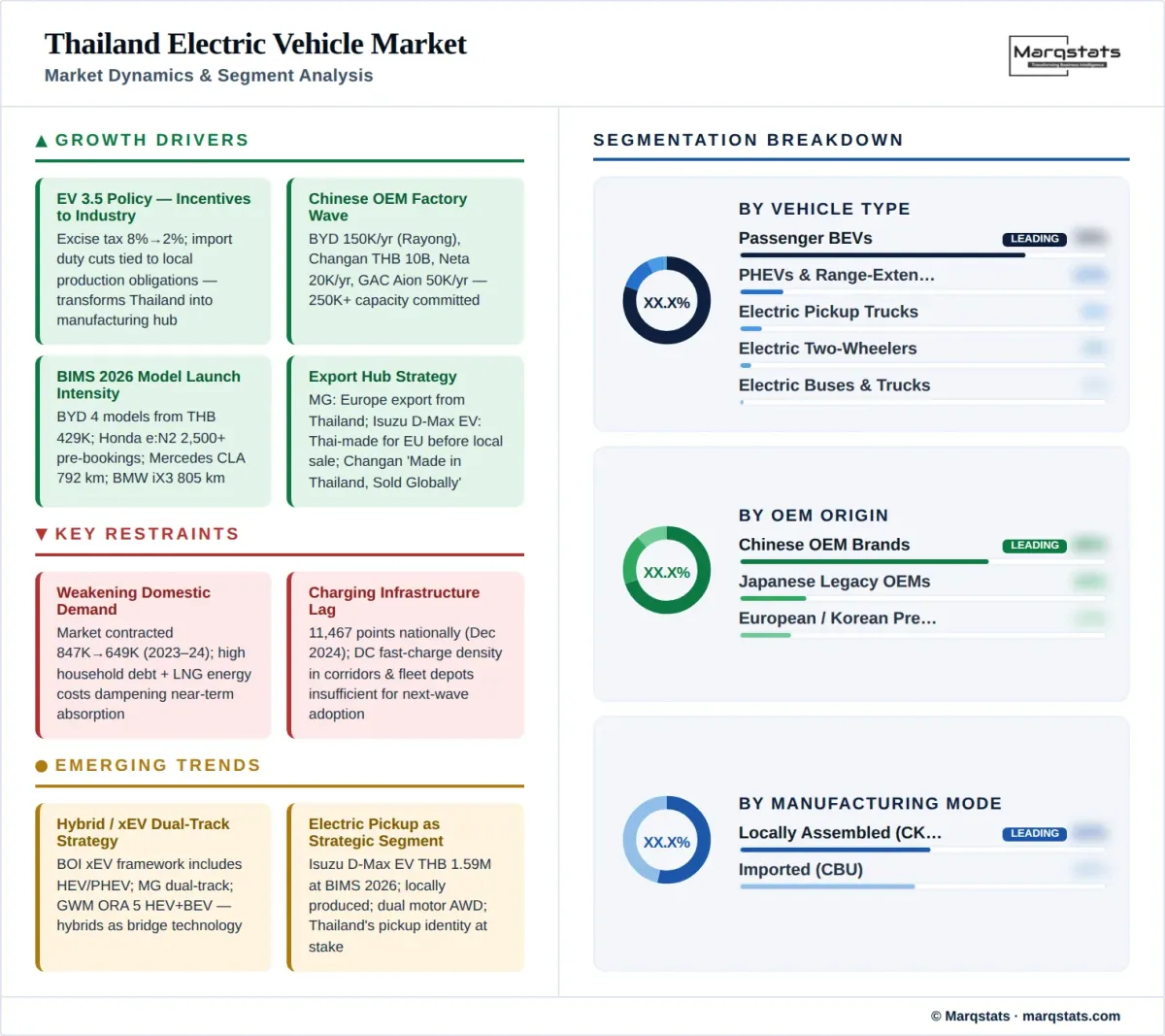
- EV 3.5 industrial policy coupling incentives with local production: EV 3.5 (2024–2027) reduces excise tax from 8% to 2% for electric cars priced up to THB 7 million and cuts import duties up to 40% for qualifying CBUs priced up to THB 2 million during 2024–2025. Critically, these incentives are tied to local production commitments—OEMs receiving import duty benefits must produce domestically within specified timelines and ratios. This mechanism transforms Thailand from an import-driven consumption market into a manufacturing ecosystem, attracting over THB 10 billion in investment from Changan alone and 150,000 vehicles/year from BYD.
- Chinese OEM investment scale creating production hub momentum: BYD’s Rayong plant (150,000 vehicles/year, stamping/painting/welding/final assembly, approximately 10,000 projected jobs, completed in 16 months) anchors Thailand’s EV manufacturing transformation. Neta began mass production in March 2024 with 20,000 units/year capacity. GAC Aion commenced construction of a 50,000 units/year facility. GWM is expanding BEV production to 14,500 units over two years. Changan invested THB 10 billion in its Rayong integrated NEV base. Dongfeng Forthing announced Thai market entry with potential local production. This wave of Chinese OEM investment creates a self-reinforcing ecosystem with supplier localisation and export capability.
- Bangkok Motor Show 2026 model launches demonstrating competitive intensity: BIMS 2026 saw an unprecedented density of EV launches. BYD launched four models (ATTO 1 from THB 429,900; ATTO 2 from THB 629,900; SEAL 6 from THB 899,900; SEALION 5 DM-I from THB 759,900). Honda e:N2 opened at approximately THB 1.4 million with 2,500+ pre-bookings. Mercedes-Benz CLA 250+ electric launched at THB 2.29 million with 792 km range. BMW iX3 Neue Klasse debuted at THB 3.6 million with 805 km range. MG IM5 launched at THB 1.55 million with 860+ km range. Chery Q, Changan NEVO Q05, Suzuki e VITARA, GWM ORA 5, and Isuzu D-Max EV all debuted.
- Export strategy amplifying local production economics: Thailand’s EV manufacturing investments are not solely domestic-demand-driven. MG plans to export Thailand-produced vehicles to European markets. Isuzu’s D-Max EV was produced locally for European export before Thailand retail launch. Changan’s “Made in Thailand, Sold Globally” strategy positions Rayong as an export hub. This export dimension improves factory utilisation economics and justifies the scale of Chinese OEM investment, reducing dependence on uncertain domestic demand.
- Tier-1 supplier localisation deepening the ecosystem: FORVIA opened a seat assembly plant for BYD in Thailand with 180,000 seating sets/year capacity. NV Gotion (PTT Group and Gotion High-tech JV) signed an MOU with PLANET for EV battery and energy storage partnerships. TAI and GWM partnered on ADAS development and EV battery lifecycle management. DPU and X Mobility (XPeng Thailand) signed an MOU on EV talent development. These supplier and ecosystem investments signal that Thailand’s EV industry is building depth beyond final assembly.
Key Restraints
- Weakening domestic auto demand constraining near-term absorption: Thailand’s total passenger car and pickup market contracted from 890,615 in 2022 to 649,280 in 2024. High household debt, tighter lending standards, and rising energy costs from Middle East geopolitical disruptions are dampening vehicle demand. Toyota Thailand noted that domestic car bookings declined from mid-March to early April 2026. February 2026 electric mobility registrations fell 22.1% year-on-year to 5,744 units, though this partly reflects the end of the EV 3.0 scheme transition to EV 3.5.
- Oversupply risk from rapid capacity buildout versus demand: Combined Chinese OEM manufacturing capacity commitments exceed 250,000 vehicles annually, while verified 2024 ZEV registrations were approximately 70,582 units. Even with 2025 growth to approximately 147,500 BEV units, a significant gap exists between installed capacity and domestic absorption. Export-orientation partially mitigates this risk, but export market access (EU tariffs on Chinese-made EVs, ASEAN demand development) introduces additional uncertainty.
- Rising energy costs narrowing EV cost advantage: Higher electricity costs, driven by more expensive LNG (approximately 60% of Thailand’s power generation), are narrowing the operating cost advantage of EVs versus ICE vehicles. Toyota Thailand specifically flagged rising electricity costs as dampening EV demand and plans to engage the new government on energy and EV incentive policy.
- Charging infrastructure scaling lagging production ambitions: Thailand had 11,467 charging points as of December 2024 (5,685 AC, 5,782 DC). While growing, DC fast-charging density in metro corridors and fleet depots remains insufficient for the next wave of adoption, particularly commercial and fleet electrification. Grid coordination between utilities, charging operators, and permitting authorities is becoming the binding operational constraint.
Key Trends
- Hybrid strategy emerging alongside pure BEV push: MG’s “Dual Track” strategy develops EV, HEV, and ICE models in parallel. GWM introduced the ORA 5 in both HEV and BEV variants. Honda’s e:HEV hybrid lineup alongside the e:N2 BEV reflects the transition reality. The BOI’s March 2026 discussions explicitly included HEV and PHEV alongside BEV in the xEV incentive framework, acknowledging that hybrid technologies serve as a bridge for consumers and fleet operators not yet ready for full electrification.
- Electric pickup trucks entering the market as a strategic segment: Isuzu launched the D-Max EV at BIMS 2026 at THB 1.59 million with 66.9 kWh battery and 331 km NEDC range. Pickups are strategically important in Thailand where they represent a dominant vehicle segment, and excise rates for pickups are policy-sensitive. Electric pickup development positions Thailand to maintain its global role as a pickup production hub in the EV era.
- Battery and EV lifecycle management emerging as policy focus: TAI and GWM’s MOU on ADAS development includes EV battery end-of-life management. Battery recycling, second-life applications, and safety standards for spent batteries are becoming “second-order” constraints. NV Gotion’s battery and energy storage partnership with PLANET signals the beginning of a domestic battery ecosystem beyond vehicle assembly.
- New government engagement on automotive industrial policy: Thailand’s new Industry Minister pledged support for EV growth and cleaner technologies under the BCG model in April 2026. The BOI held structured discussions with TAIA, EVAT, TAPMA, and FTI on xEV incentive continuation, demand stimulation, and supply chain localisation. Toyota plans to engage the new government on energy policy and EV incentives. This policy re-engagement period will shape whether Thailand’s EV trajectory accelerates or moderates.
Market Segmentation
Passenger BEVs are the dominant segment, accounting for the vast majority of Thailand’s ZEV registrations. In the first two months of 2026, 46,941 passenger electric vehicles were registered (up 167.4% year-on-year). The segment spans from budget-oriented models (BYD ATTO 1 at THB 429,900) through mid-range (Honda e:N2 at THB 1.4 million, MG IM5 at THB 1.55 million) to premium (Mercedes-Benz CLA 250+ at THB 2.29 million, BMW iX3 at THB 3.6 million). Chinese OEMs dominate the budget and mid-range segments, while European OEMs focus on premium locally-assembled offerings.
PHEVs and REEVs are emerging as a complementary segment, reflecting the hybrid strategy trend. BYD’s SEALION 5 DM-I (THB 759,900, 110 km electric range) and Dongfeng Forthing’s Friday REEV (31.9 kWh battery + 1.5L engine, 1,100 km total range) represent this segment. The BOI’s inclusion of PHEV alongside BEV in xEV incentive discussions signals policy support for plug-in hybrid as a transition technology.
Electric pickups are strategically critical for Thailand’s automotive identity as a global pickup production hub. Isuzu’s D-Max EV (launched at BIMS 2026, THB 1.59 million, locally produced, 66.9 kWh, dual motor AWD) is the first major electric pickup in Thailand. Export potential is significant: the D-Max EV was produced for European export before Thai retail availability. Pickup incentive policy (excise rates, import duties) will determine the segment’s growth trajectory.
Electric two-wheelers represent a growing but distinct segment. Electric motorcycle registrations reached 4,247 units in the first two months of 2026. Honda showcased the WN7 electric naked bike at BIMS 2026. The segment is significant in the broader ASEAN context where two-wheelers dominate urban mobility, though it falls outside the core ZEV passenger car KPI tracked by DLT.
Commercial EV registrations remain small but growing: 98 pickup trucks/vans, 19 buses, and 95 trucks were registered in January–February 2026. The segment is infrastructure-limited and will expand as fleet depot charging and commercial EV incentives develop. NV Gotion’s battery and energy storage partnerships signal growing interest in commercial electrification support.
By Geography
Thailand’s ASEAN Hub Positioning
Thailand is positioning itself as the ASEAN EV manufacturing and export hub, leveraging its established automotive industrial base (historically the “Detroit of Asia” for Japanese OEMs), BOI investment promotion, and geographic proximity to growing ASEAN demand markets. Changan’s “Made in Thailand, Sold Globally” strategy and MG’s plans to export to European markets from Thai factories demonstrate this hub role. The risk is competition from Indonesia (which offers its own EV incentive packages and a larger domestic market) and Vietnam (where VinFast has established domestic manufacturing).
China-Linked Supply Chains
Thailand’s EV transition is deeply linked to Chinese supply chains. BYD, Changan, Neta, GAC Aion, GWM, Chery, MG (SAIC), and Dongfeng all have manufacturing presence or investment commitments. FORVIA’s seat assembly plant and NV Gotion’s battery partnerships reflect Tier-1 localisation from China-linked supply networks. This dependency creates both opportunity (cost competitiveness, technology transfer) and risk (geopolitical exposure, EU tariff implications for Thai-produced Chinese-brand vehicles).
Japan-Linked Automotive Legacy
Thailand’s automotive industry was historically built around Japanese OEMs: Toyota, Honda, Isuzu, Suzuki, Mitsubishi, and Nissan. These incumbents are responding to the EV transition with hybrid strategies (Toyota hydrogen advocacy, Honda e:HEV lineup), selective BEV launches (Honda e:N2, Isuzu D-Max EV, Suzuki e VITARA), and engagement with the new government on energy and incentive policy. Toyota may adjust Thai production if energy cost and demand pressures persist. The Japanese–Chinese competitive tension is the central structural dynamic of Thailand’s automotive transformation.
How Competition Is Evolving
Thailand’s EV competitive landscape features three distinct tiers. Chinese EV OEMs (BYD, MG/SAIC, Changan, GWM, Neta, Chery, GAC Aion, Dongfeng) lead in model variety, price competitiveness, and manufacturing investment commitment. BYD launched four models at BIMS 2026 with prices starting from THB 429,900; MG targets 30,000-unit sales and top-3 brand positioning; Changan has invested THB 10 billion in its Rayong plant. These OEMs are competing on aggressive pricing, rapid model launches, and localised production.
Japanese legacy OEMs (Toyota, Honda, Isuzu, Suzuki, Nissan, Mitsubishi) are defending market position through hybrid strategies, existing dealer and service networks, and selective BEV launches. Honda’s e:N2 attracted 2,500+ pre-bookings, demonstrating strong brand loyalty. Isuzu’s D-Max EV addresses the strategically important pickup segment. Toyota is advocating hydrogen alongside electrification. The Japanese OEMs’ advantage is established manufacturing scale, extensive dealer networks, and deep aftersales infrastructure.
European OEMs (Mercedes-Benz, BMW) compete in the premium segment with locally assembled models. Mercedes-Benz’s CLA 250+ (792 km range, THB 2.29 million, locally assembled) and BMW’s iX3 Neue Klasse (805 km range, THB 3.6 million) set technology benchmarks. European OEMs differentiate on range, technology, and brand prestige rather than price competition.
Companies Covered
Companies covered in the report include:
Recent Market Activity
Table of Contents
Coverage & Segmentation
This report provides a comprehensive analysis of the Thailand electric vehicle market covering the historical period 2021–2025 and forecast period 2026–2030, with 2025 as the base year. The study examines market size in value (USD billion) and volume (units), segmented by vehicle type (passenger BEV, PHEV/REEV, pickup, two-wheeler, bus/truck), manufacturing status (locally assembled vs CBU import), charging infrastructure (AC/DC, station count, grid integration), and competitive positioning (Chinese OEMs, Japanese incumbents, European premium). The competitive landscape profiles 17 leading OEMs, Tier-1 suppliers, and battery/charging ecosystem players.
Primary research includes structured interviews with 40+ industry stakeholders spanning vehicle OEMs, BOI and government policy teams, charging operators, battery and component suppliers, industry associations (TAIA, EVAT, TAPMA, FTI), and fleet operators. Secondary research draws from Department of Land Transport registration data, UNDP technical review, EVAT charging infrastructure data, independent charging infrastructure analysis, BOI investment records, company disclosures, and Bangkok Motor Show announcements. All market estimates represent Marqstats Intelligence proprietary calculations.