Market Snapshot
Middle bar: base-year value × (1 + CAGR), rounded to two decimals. This is a calculated illustration, not a separately researched annual estimate.
The Thailand electric commercial vehicle market is estimated at USD 674.9 million in 2025 and is projected to reach USD 1,896.5 million by 2030, at a CAGR of 22.96%. Battery-electric commercial registrations rise from 7,200 units a year to 27,350, a 30.59% CAGR, with medium and heavy trucks growing fastest at 35.89% and Chinese manufacturers supplying 72% of volume.
Market size and forecast figures are generated using Marqstats' proprietary estimation framework, updated as of September 2026.
This report counts new battery-electric commercial vehicles registered in Thailand — light commercial pickups and vans, medium and heavy trucks, and electric buses. Passenger cars, motorcycles and electric tuk-tuks are excluded. The Marqstats Thailand EV Charging Station report covers the charging layer, which is excluded from this value series.
Thailand is building the opposite of a protected market. Where South Korea's July 2026 subsidy assessment excluded BYD outright, Thailand's investment framework pulls the same manufacturers in: buyers deduct twice the price of a domestically produced electric truck or bus against taxable income with no price ceiling, but only one and a half times for an imported one, and imported units must be matched by local production. The result is a market where Chinese manufacturers hold 72% of volume and are simultaneously building the factories that supply it — THB 137.7 billion of approved electric vehicle supply chain investment by mid-2025, of which THB 41 billion is vehicle assembly.
Key Takeaways
Market Overview & Analysis
Report Summary
This report sizes the Thailand electric commercial vehicle market — battery-electric light commercial vehicles, medium and heavy trucks, and buses registered in the country. Thailand's position in Southeast Asian automotive manufacturing gives this market a character no other in the region shares: it is simultaneously a demand market and an export base, and the policy instruments that drive one are the instruments that build the other.
The mechanism is a deduction rather than a subsidy. Commercial buyers deduct two times the actual price of a domestically produced electric truck or bus against taxable income, with no price ceiling, against one and a half times for an imported vehicle — a structure covering container, liquid, hazardous substance, special and tow trucks alongside air-conditioned and non-air-conditioned buses. Because it is a deduction, its value scales with the buyer's tax position and with the vehicle price, which favours exactly the heavy classes that subsidy schemes elsewhere struggle to move.
Behind the deduction sits the local production requirement. Manufacturers importing electric vehicles under the EV3 and EV3.5 frameworks must match those imports with Thai production, and since 30 July 2025 an exported vehicle counts as one and a half units toward that obligation — a change designed to turn Thailand from an import destination into an export hub, with electric vehicle exports projected to rise from roughly 12,500 units in 2025 to 52,000 in 2026. Approved supply chain investment reached THB 137.7 billion by end-June 2025: THB 80.1 billion in batteries across 53 projects, THB 41.08 billion in vehicle assembly across 21, and THB 5.56 billion in charging across 29.
The contrast with South Korea is the clearest natural experiment in this report series. Both countries use policy to shape which manufacturers can sell electric commercial vehicles. Korea's July 2026 assessment regime scored manufacturers on local contribution and excluded BYD outright, with seven electric truck and van makers failing. Thailand offers the same manufacturers a deduction worth more than the vehicle if they build locally — and Chinese makers hold 72% of Thai commercial volume as a result. Same firms, opposite instruments, and readers holding both reports can see which approach builds an industry faster.
Market Dynamics
Key Drivers
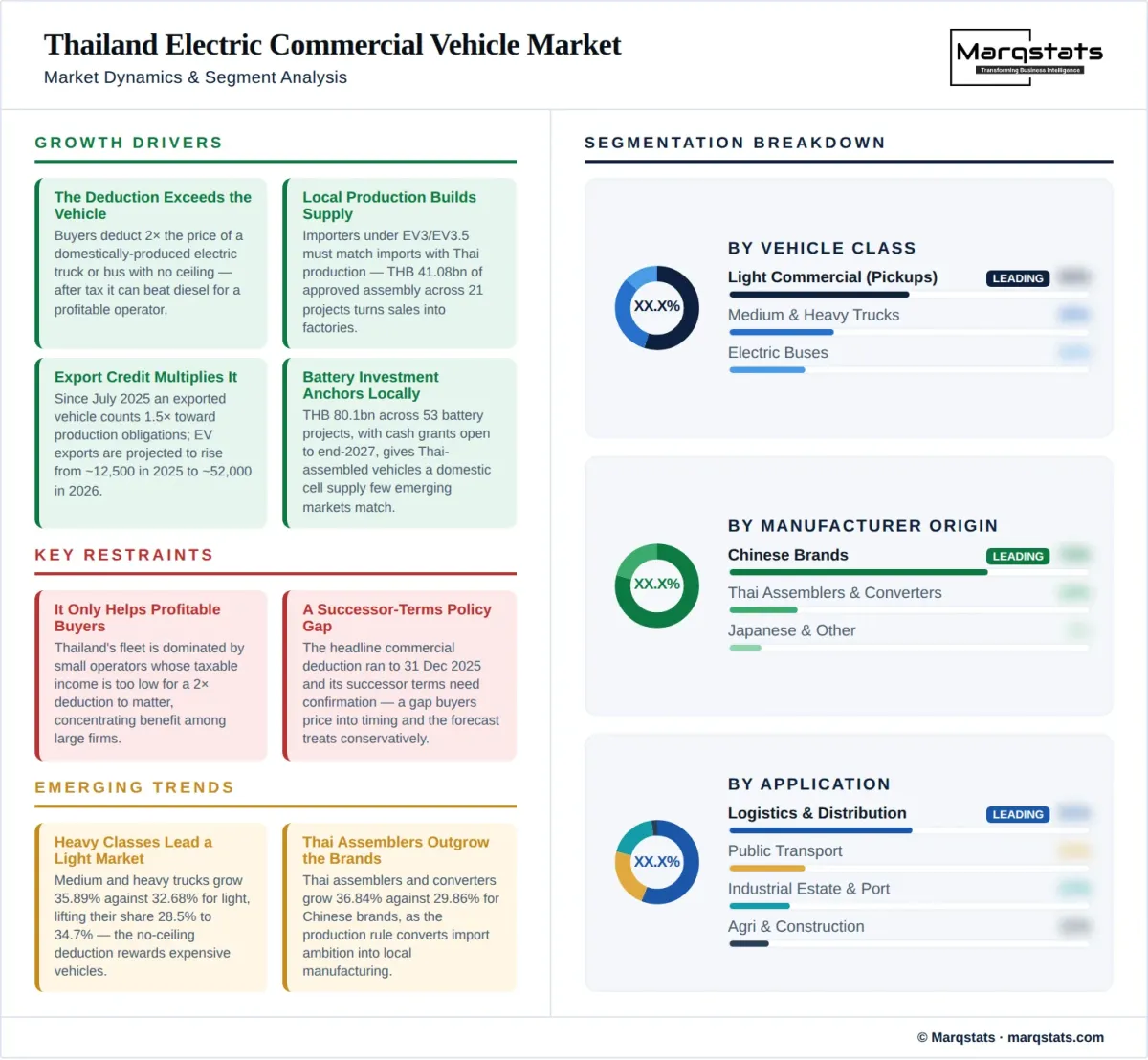
The deduction can exceed the vehicle's value in tax terms. A buyer deducts twice the actual price of a domestically produced electric truck or bus against taxable income with no ceiling, which for a profitable logistics operator can make the electric vehicle cheaper after tax than its diesel equivalent.
The local production requirement builds supply as it creates demand. Manufacturers importing under the EV3 and EV3.5 frameworks must match imports with Thai production, converting every sales ambition into an assembly commitment — THB 41.08 billion of approved vehicle assembly investment across 21 projects by mid-2025.
Export credit multiplies the incentive. Since 30 July 2025 an exported vehicle counts as 1.5 units toward local production obligations, with electric vehicle exports projected to rise from roughly 12,500 units in 2025 to about 52,000 in 2026 — turning Thai plants into regional supply bases.
Battery investment anchors the supply chain locally. THB 80.1 billion across 53 battery projects by mid-2025, supported by cash grants from the competitiveness fund with proposals open to end-2027, gives Thai-assembled commercial vehicles a domestic cell supply few emerging markets can match.
Industrial estate and port logistics convert on duty cycle. Fixed-route material movement within the Eastern Economic Corridor's industrial estates and around Laem Chabang suits battery operation precisely, and this application grows at 32.10% against a market average of 30.59%.
Key Restraints
The headline commercial deduction ran to 31 December 2025 and its successor terms require confirmation, leaving a policy gap that buyers price into purchase timing and that this forecast treats conservatively.
A deduction only helps a profitable buyer. Thailand's commercial fleet is dominated by small operators whose taxable income is too low for a two-times deduction to matter, which concentrates the benefit among large logistics companies and industrial estate tenants.
Charging outside Bangkok and the Eastern Economic Corridor is thin. Heavy truck operations on the northern and northeastern corridors face route coverage that has not kept pace with vehicle availability, which is why those regions grow from a small base despite favourable freight economics.
Local production obligations can be met without local value. The export credit and matched-production rules are counted in units, so a manufacturer can satisfy the requirement through assembly operations of modest domestic content — the industry being built is real but its depth is not guaranteed by the policy alone.
Key Trends
Heavy classes lead a market that started light. Medium and heavy trucks grow at 35.89% against 32.68% for light commercial vehicles, lifting their share of units from 28.5% to 34.7% — the deduction's no-ceiling structure rewards expensive vehicles.
Thai assemblers grow faster than the Chinese brands they build for, at 36.84% against 29.86%, as the local production requirement converts import ambitions into domestic manufacturing and conversion businesses.
The Eastern Economic Corridor consolidates as the market's centre, rising from 24% of registrations to 28% at 34.68%, because it is simultaneously where the vehicles are built and where the industrial fleets that buy them operate.
Unit growth outruns value growth by 7.63 points as prices fall across every class — a light commercial vehicle drops from roughly USD 32,000 to USD 27,500 — reflecting Chinese competition and local assembly reaching scale.
Market Segmentation
Pickups and vans are the volume core at 50% of 2025 registrations, growing at 32.68% to 14,800 units by 2030. Thailand's commercial fleet is built on the one-tonne pickup, and electric variants from Chinese manufacturers and Thai converters now serve last-mile distribution across the Bangkok region. The class benefits most from Chinese price competition and least from the deduction's no-ceiling structure.
The fastest-growing class at 35.89%, from 2,050 units in 2025 to 9,500 by 2030 and from 28.5% of units to 34.7%. The two-times deduction with no price ceiling is worth far more on a USD 118,000 truck than on a pickup, which inverts the usual pattern where heavy classes convert last. Container, tow and specialist trucks are explicitly named in the incentive framework.
The slowest class at 14.50%, from 1,550 units to 3,050. Thailand's bus electrification ran ahead of trucks early — Bangkok's operators took substantial electric fleets from 2022 — so the segment is now converting at replacement rate rather than expanding. Both air-conditioned and non-air-conditioned buses qualify for the domestic-production deduction.
Dominant at 72% of 2025 registrations, easing to 70% by 2030 while growing at 29.86%. BYD, Foton, JAC, Dongfeng and Great Wall serve the market both by import and increasingly through Thai assembly, and their position here is the mirror image of South Korea's, where the July 2026 assessment excluded BYD from subsidy entirely.
The fastest-growing supplier group at 36.84%, rising from 19% of registrations to 24%. Local assembly operations, body-builders and diesel-to-electric converters exist because the production-matching requirement created them, and they capture growing value as the EV3.5 obligations mature into operating plants.
Declining from 9% of registrations to 6% while still growing at 20.42%. Japanese manufacturers dominate Thailand's diesel commercial vehicle market but have moved slowly on battery-electric commercial platforms, and their share erosion in this segment is the sharpest reversal of position in the Thai automotive market.
The largest application at 51% of registrations rising to 53%, growing at 31.60%. Thailand's e-commerce and cold-chain distribution networks operate the predictable urban and regional routes that suit battery vehicles, and large logistics operators have the taxable income to use the deduction fully.
At 21% of registrations easing to 19% at 28.01%. Bangkok's bus operators drove early electrification and provincial systems follow, but the segment grows more slowly than commercial applications because public budgets do not benefit from a corporate tax deduction.
Growing at 32.10% from 17% of registrations to 18%. Fixed-route material movement inside Eastern Economic Corridor industrial estates and around Laem Chabang port is the duty cycle battery vehicles serve best, and estate operators buy fleets rather than individual vehicles.
At 11% of registrations easing to 10%, growing at 28.13%. Provincial agricultural logistics and construction site support vehicles convert where charging exists, and the segment's growth is constrained by charging coverage outside the central regions rather than by demand.
By Geography
Bangkok Metropolitan Region
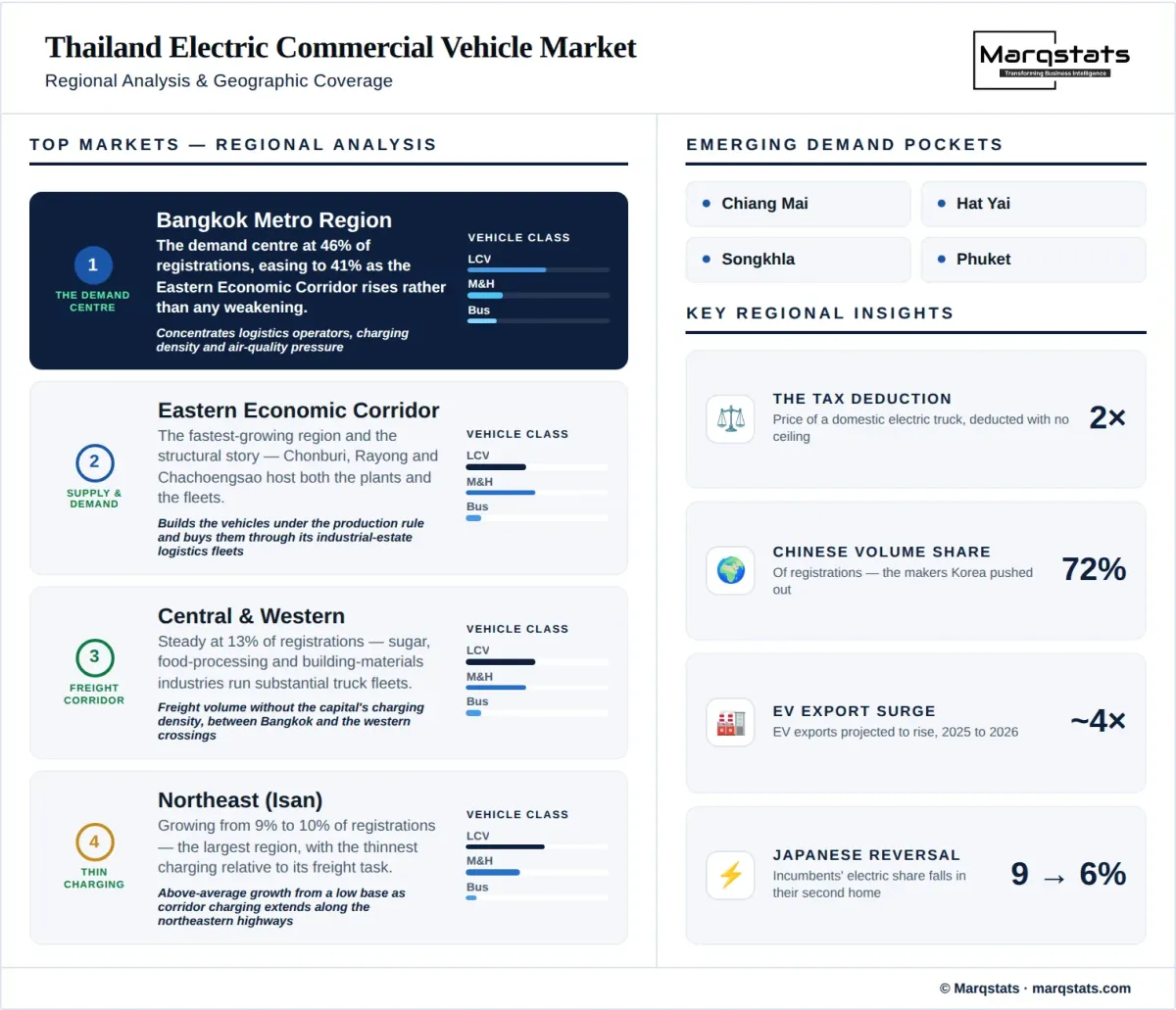
The demand centre at 46% of 2025 registrations, easing to 41% by 2030 at 27.62%. Bangkok concentrates Thailand's logistics operators, its charging density and its air quality pressure, and its declining share reflects the Eastern Economic Corridor's rise rather than any weakening of demand.
Eastern Economic Corridor
The fastest-growing region at 34.68%, from 24% of registrations to 28% by 2030 — and the structural story of this market. Chonburi, Rayong and Chachoengsao host both the vehicle assembly plants built under the production-matching requirement and the industrial estates whose logistics fleets buy the output, making the region simultaneously supply and demand.
Central and Western Thailand
Steady at 13% of registrations, growing at 30.59% in line with the market. The region's sugar, food processing and building materials industries run substantial truck fleets, and its position between Bangkok and the western border crossings gives it freight volume without the charging density of the capital.
Northeast (Isan)
Growing at 33.38% from 9% of registrations to 10%. Thailand's largest region by population and area has the thinnest charging coverage relative to its freight task, so its above-average growth comes from a low base as corridor charging extends along the northeastern highways.
North and South
Steady at 8% of registrations, growing at 30.59%. The northern provinces around Chiang Mai and the southern corridor toward Malaysia both run significant freight volumes, but long inter-city distances and limited charging keep electric commercial adoption concentrated in urban delivery rather than line-haul.
How Competition Is Evolving
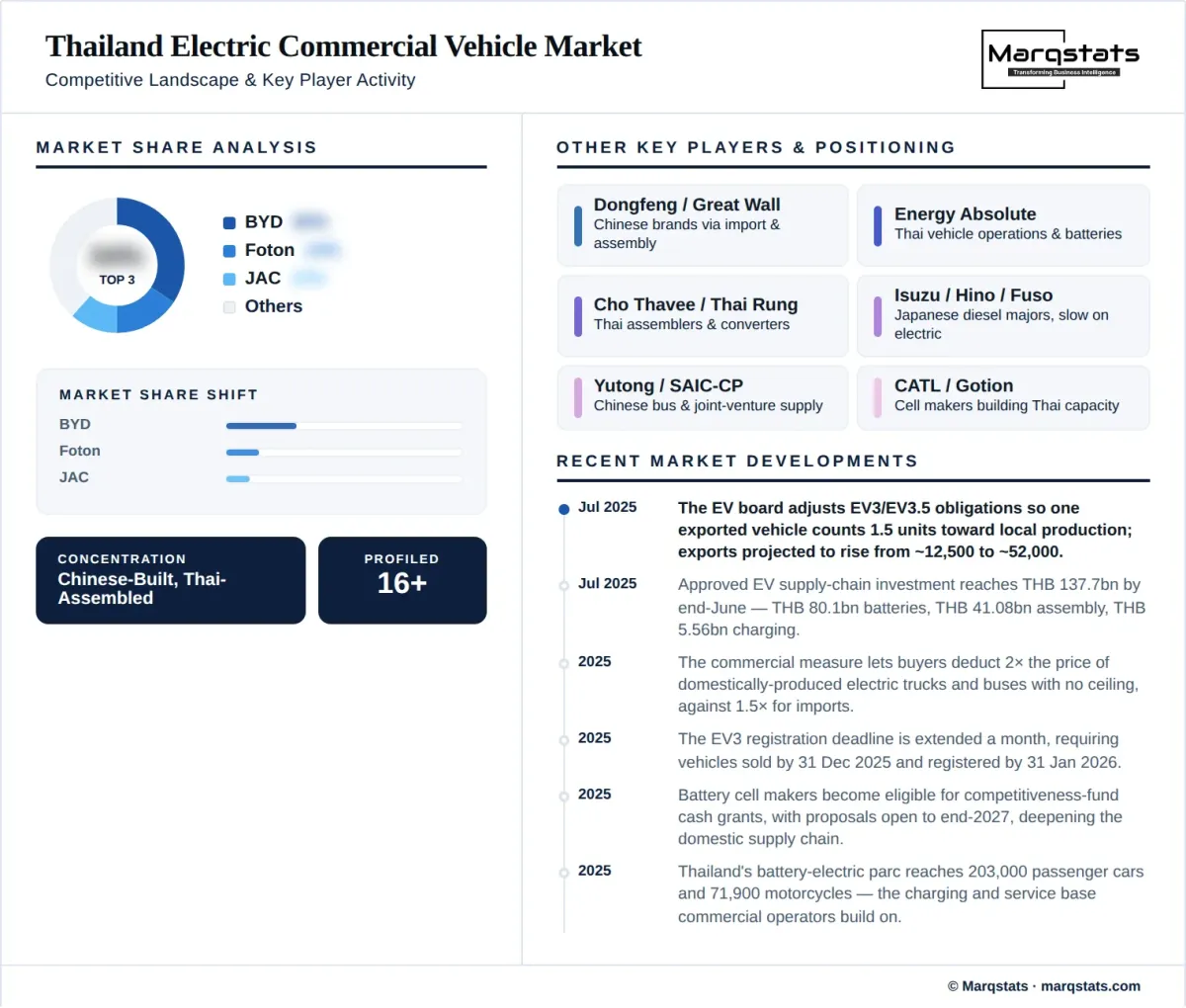
Thailand's electric commercial vehicle market is Chinese-supplied and Thai-assembled, and the policy framework is what welds those two facts together. BYD, Foton, JAC, Dongfeng and Great Wall Motor hold roughly 72% of registrations between them, but the local production requirement means their Thai volume increasingly comes from Thai plants rather than from imports — the same manufacturers that South Korea's July 2026 assessment regime pushed away are the ones Thailand's framework has pulled in and rooted.
The Thai layer beneath them is the market's most interesting development. Assemblers, body-builders and diesel-to-electric converters — companies including Energy Absolute's vehicle operations, Cho Thavee and a set of specialist converters — grew from a negligible base into 19% of registrations because the production-matching obligation created a business that did not previously exist. They grow at 36.84%, faster than the Chinese brands whose vehicles they often build, and they represent the durable industrial outcome the policy was designed to produce.
The Japanese incumbents are the losers, and the scale of the reversal is striking. Isuzu, Toyota, Hino and Mitsubishi Fuso dominate Thailand's diesel commercial vehicle market so completely that Thailand is often described as their second home market — yet their combined electric commercial share falls from 9% to 6% across this forecast. They have moved slowly on battery-electric commercial platforms while Chinese competitors arrived with product, price and a willingness to meet local production terms, and no market in Southeast Asia shows the consequences of that hesitation more clearly.
Companies Covered
Companies covered in the report include:
Recent Market Activity
Table of Contents
Coverage & Segmentation
This study covers new battery-electric commercial vehicles registered in Thailand across 2021 to 2030, measured at vehicle value in US dollars. Segmentation runs across three vehicle classes, three manufacturer-origin groups, four applications and five regional markets. Passenger cars, motorcycles and electric tuk-tuks are excluded, as is charging infrastructure, which the Marqstats Thailand EV Charging Station report covers. Hydrogen vehicles are not present in the Thai commercial market at measurable scale and are not modelled.
Two figures require careful handling. The 203,000 battery-electric passenger cars and 71,900 motorcycles cited as market context belong to excluded segments and must never be added to this report's commercial series — they are roughly forty times its size. And the export projections of 12,500 and 52,000 units cover all electric vehicle exports, overwhelmingly passenger cars, not the commercial vehicles this report counts; they are cited to explain the production-obligation mechanism, not as a commercial export forecast.
Prices are stated at vehicle level in US dollars and fall across every class: a light commercial vehicle from roughly USD 32,000 to USD 27,500, a medium or heavy truck from USD 118,000 to USD 99,000, and a bus from USD 205,000 to USD 180,000. That decline is why unit growth of 30.59% outruns value growth of 22.96% by more than seven points, and it reflects two forces at once — Chinese competition in a market with no tariff wall against it, and local assembly reaching the volumes at which Thai-built vehicles cost less than imported ones. Baht-denominated incentive values are converted at prevailing rates; the underlying measures are set in baht and revised by board decision.