Market Snapshot
Key Takeaways
Market Overview & Analysis
Report Summary
This analysis sizes Thailand's plug-in hybrid electric vehicle market on the statutory basis administered by the Department of Land Transport under the Motor Vehicle Act B.E. 2522, which classifies PHEVs as vehicles combining an internal combustion engine with an externally rechargeable electric motor, distinct from both non-plug-in hybrids and battery-electric vehicles. The market is measured as new passenger car (Ry. 1 classification) registrations, cross-referenced against Federation of Thai Industries wholesale delivery data, with 2025 as the base year. Coverage incorporates the January 2026 excise tax restructuring and the pending three-tier import tax reform, both independently verified as current developments postdating portions of the original source material's fiscal framework.
Thailand's PHEV market surged from 10,820 units in 2024 to 21,850 units in 2025, a 101.94% year-on-year increase, driven substantially by BYD's Sealion 6 DM-i compressing the price premium PHEVs carry over conventional vehicles to under THB 100,000. As of September 2026, Thailand's Excise Department is finalizing a three-tier import tax structure specifically targeting the tariff-free Chinese import loophole that allowed Chinese brands to capture 89% of the electrified vehicle market - a genuinely current regulatory response to exactly the price competition dynamic that produced 2025's registration surge, creating a real tension this analysis discloses rather than resolves: the same policy environment that enabled the 2025 rebound is now the subject of a corrective trade measure whose final rate and implementation date remain undetermined at time of writing.
The 2030 base-case forecast of 45,500 annual registrations assumes the Ministry of Finance implements its planned 2026 excise schedule favoring PHEVs with electric ranges over 80 kilometers while EV3.5 battery-electric subsidies expire after 2025, removing an artificial pricing distortion between the two powertrains. The binding upside condition is whether the Board of Investment introduces dedicated production incentives extending plug-in hybrid architecture to one-ton pickup trucks and pickup passenger vehicles, the market's largest unelectrified segment; the binding downside condition is whether the pending three-tier import tax reform, combined with continued declines in localized battery-electric vehicle pricing below THB 650,000, erodes the price advantage PHEVs currently hold over comparably positioned battery-electric alternatives.
Market Dynamics
Key Drivers
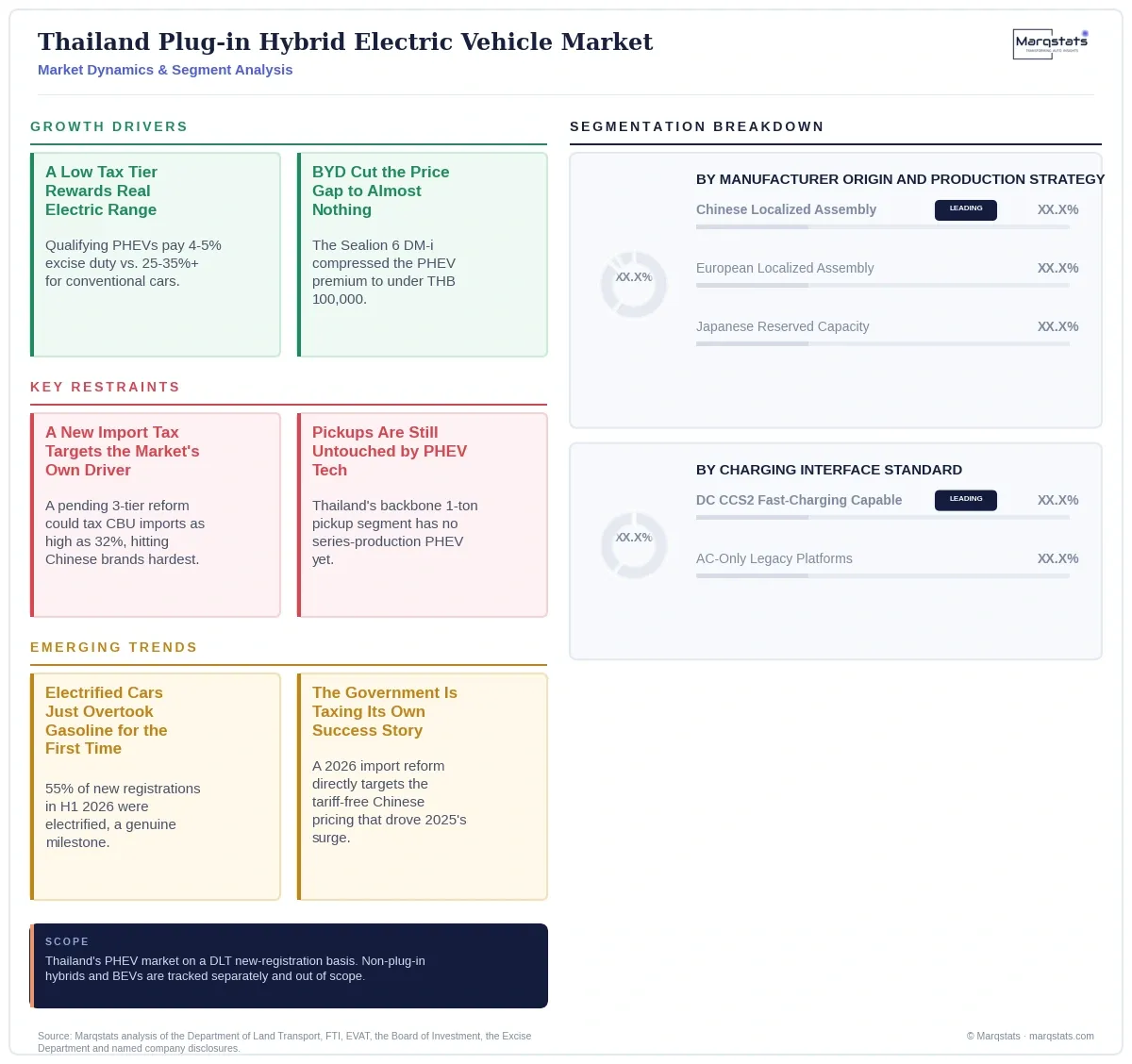
- Under the current excise structure, PHEVs meeting displacement, emissions and electric-range criteria qualify for a concessional 4% to 5% ad valorem rate against 25% to 35% or more for standard internal combustion vehicles, a fiscal advantage the January 2026 restructuring preserved and simplified by basing eligibility solely on certified electric-only driving range rather than the previous combination of criteria including a 45-liter fuel tank cap.
- The Board of Investment's Activity Category 5.6 and 5.7 incentives grant PHEV assemblers a 3-to-5-year corporate income tax exemption and duty-free machinery imports, provided manufacturers domesticate at least one core high-voltage component such as battery modules, traction motors or power control units, a lower localization bar than the 8-year exemption battery-electric vehicle projects can access but sufficient to anchor Chinese and European assembly investment in the Eastern Economic Corridor.
- BYD Auto Thailand's Sealion 6 DM-i, assembled domestically since August 2024 and priced from THB 939,900, compressed the historical PHEV price premium over conventional vehicles to under THB 100,000, reducing the total cost of ownership payback period for suburban buyers with home charging access from 15 to 20 years to under two years.
- Off-peak time-of-use electricity tariffs, set by the Energy Regulatory Commission at approximately THB 2.90 per kilowatt-hour against peak rates of THB 4.70 to THB 5.20, reduce the operational cost of overnight PHEV charging to roughly THB 10,000 annually for a 20,000-kilometer urban commuter, a savings of THB 52,500 relative to a conventional gasoline vehicle covering the same distance.
- Great Wall Motor's Haval H6 PHEV, built on a 34 kilowatt-hour ternary lithium battery pack delivering a certified pure-electric range exceeding 200 kilometers, allows owners in peri-urban provinces including Chonburi and Nonthaburi to commute into central Bangkok entirely on electric power, extending PHEV utility beyond the dense urban core that historically defined the segment's addressable market.
Key Restraints
- As of September 2026, Thailand's Excise Department is finalizing a three-tier import tax structure that would tax fully imported vehicles above the current 10% baseline while granting the lowest rates to domestically manufactured models, a direct policy response to Chinese brands capturing 89% of the country's electrified vehicle market under a tariff-free loophole created by the 2003 Thailand-China free trade agreement, with a coalition of ten domestic automotive associations petitioning for import rates as high as 32%.
- Thailand's commercial one-ton pickup truck segment, the structural backbone of the country's automotive production base, has not yet adopted series-production plug-in hybrid powertrains domestically, confining current PHEV sales exclusively to the passenger car classification and representing the single largest volume opportunity the market's own upside scenario identifies as currently unaddressed.
- Public charging infrastructure economics increasingly favor battery-electric vehicles over older-generation PHEVs: while 57.60% of the 13,042 national charging connectors are now direct-current CCS2 fast chargers, many legacy Japanese and early European PHEV platforms carry only single-phase 3.3 to 7.4 kilowatt on-board alternating-current chargers, requiring 2.5 to 5 hours for a full charge and preventing these owners from using the high-power DC infrastructure operators are prioritizing.
- The Mitsubishi Outlander PHEV's continued reliance on a CHAdeMO direct-current charging port, rather than the CCS2 standard Thailand's public network operators have standardized on, has constrained the model's competitive position as commercial charging investment concentrates capital expenditure on CCS2-compatible high-power infrastructure along highway corridors.
Key Trends
- Thailand's PHEV market experienced a genuine boom-bust-rebound cycle within a single five-year window: registrations grew steadily through 2022, plateaued in 2023, contracted in 2024 as EV3.0 battery-electric subsidies diverted consumer demand, then surged 101.94% in 2025 once BYD's domestically assembled Sealion 6 DM-i eliminated the price premium that had previously confined PHEVs to a luxury niche.
- The pending three-tier import tax reform represents a direct regulatory response to precisely the competitive dynamic that produced 2025's registration surge: Chinese manufacturers' tariff-free access under the 2003 Thailand-China free trade agreement enabled the aggressive pricing that expanded the addressable PHEV market, and the same pricing advantage is now the explicit target of corrective trade policy, creating forward uncertainty this analysis discloses rather than resolves given the reform's final rate and implementation timeline remain undetermined.
- Electrified vehicles, spanning hybrids, plug-in hybrids and battery-electric models, outpaced internal combustion vehicles in new Thai registrations for the first time in the first seven months of 2026, reaching 55% of the market - a milestone that signals Thailand's automotive transition has moved past an early-adopter phase into genuine mainstream displacement of conventional powertrains.
- Japanese incumbents Toyota and Honda have concentrated domestic passenger assembly on conventional non-plug-in hybrids rather than PHEVs, holding plug-in platform investment in reserve until pickup truck and sport-utility-vehicle tax revisions take effect, a strategic patience that leaves the Chinese and European PHEV entrants currently dominating the segment largely unchallenged in the near term.
- Regional PHEV adoption beyond the Bangkok Metropolitan Region increasingly tracks provincial commuting distance rather than income alone: Central and Eastern Economic Corridor provinces benefit from automotive-cluster employment and single-family home charging access, while the Northern Region's adoption is additionally reinforced by seasonal particulate matter pollution concerns specific to Chiang Mai and surrounding provinces.
Strategic Implications
For a Chinese original equipment manufacturer with existing Thai assembly capacity, the pending three-tier import tax reform makes continued and expanded domestic production the clear strategic priority over reverting to completely-built-up imports once EV3.5 battery-electric subsidies expire after 2025; manufacturers should accelerate localization of battery modules and power electronics specifically to secure the lowest tax tier under the new structure, and should engineer PHEV platforms with battery capacities of 18 to 20 kilowatt-hours delivering over 80 kilometers of real-world electric range to retain the 4% to 5% concessional excise bracket alongside standard CCS2 fast-charging capability.
For an incumbent Japanese manufacturer such as Toyota or Honda, the combination of Thailand's 2026 excise restructuring and pending import tax reform creates a genuine window to reenter the PHEV segment with less competitive disadvantage than the current Chinese price leadership suggests, particularly by extending plug-in hybrid architecture to one-ton pickup trucks and pickup passenger vehicles, the market's largest unelectrified segment, leveraging existing dealership networks and engine manufacturing capacity that Chinese entrants have not yet replicated in provincial Thailand.
For a Tier-1 component supplier or charging infrastructure investor, the Eastern Economic Corridor's localization requirements under Board of Investment Activity Categories 5.6 and 5.7 create sustained demand for domestically sourced battery modules, wire harnesses, electronic control units and traction inverters; charge point operators should prioritize dynamic pricing structures accommodating both fast-charging PHEVs and long-range battery-electric vehicles along primary highway corridors, where utilization economics increasingly favor CCS2-standardized high-power sites over legacy AC destination charging.
Outlook
Base case: 45,500 new registrations by 2030 (15.80% five-year volume CAGR), THB 70.53 billion (USD 2.074 billion) annual value. This trajectory assumes the Ministry of Finance implements its planned 2026 excise schedule favoring PHEVs with electric ranges over 80 kilometers while EV3.5 battery-electric subsidies expire after 2025, and Chinese manufacturers expand local production lines in Rayong and Chonburi to add 3 to 5 new plug-in crossover nameplates without the pending import tax reform materially disrupting current production economics.
Upside case: 68,000 new registrations by 2030 (25.49% five-year volume CAGR), THB 98.60 billion (USD 2.988 billion) annual value. The specific trigger is the Board of Investment and Excise Department introducing dedicated production incentives for dual-motor plug-in hybrid commercial platforms, encouraging manufacturers including BYD, Great Wall Motor and Isuzu to assemble PHEV pickup trucks domestically, expanding the addressable market beyond the passenger car segment into Thailand's dominant one-ton pickup category.
Downside case: 28,000 new registrations by 2030 (5.09% five-year volume CAGR), THB 46.20 billion (USD 1.320 billion) annual value. The specific trigger is domestic battery manufacturing investments reducing retail prices for local battery-electric vehicles below THB 650,000, eroding PHEV price competitiveness, combined with the pending three-tier import tax reform disrupting Chinese manufacturers' current cost structure and Japanese incumbents continuing to commit exclusively to non-plug-in hybrid platforms.
Market Segmentation
Chinese manufacturers, led by BYD and Great Wall Motor, captured a combined 60.5% of 2025 PHEV registrations through Rayong-based Completely Knocked Down assembly, having leveraged tariff-free access under the 2003 Thailand-China free trade agreement to establish an aggressive price floor now the explicit target of the pending three-tier import tax reform.
European manufacturers, led by BMW, Mercedes-Benz and Volvo, maintain domestic assembly footprints across Amata City, Samut Prakan and Rayong facilities specifically to mitigate the 80% customs tariff assessed on completely built-up luxury imports, incorporating traction batteries of 25.4 to 31.2 kilowatt-hours that qualify these models for Thailand's lowest 4% excise tax tier.
Japanese manufacturers including Toyota and Honda have concentrated domestic passenger assembly on non-plug-in hybrids rather than PHEVs, holding plug-in platform investment in reserve until national pickup truck and sport-utility-vehicle tax revisions take effect, leaving Mitsubishi as the segment's sole active Japanese PHEV assembler.
PHEVs equipped with native DC CCS2 charging ports, including the BYD Sealion 6 DM-i and Mercedes-Benz C 350e, can complete an 80% charge in 20 to 30 minutes at highway fast-charging stations, aligning with the 57.60% of national public charging infrastructure now built around the CCS2 standard.
Older Japanese and early European PHEV platforms equipped only with single-phase 3.3 to 7.4 kilowatt on-board AC chargers require 2.5 to 5 hours for a full charge and cannot use public DC fast-charging infrastructure, a growing competitive disadvantage as commercial network operators concentrate capital expenditure on high-power DC deployment.
By Geography
Bangkok Metropolitan Region
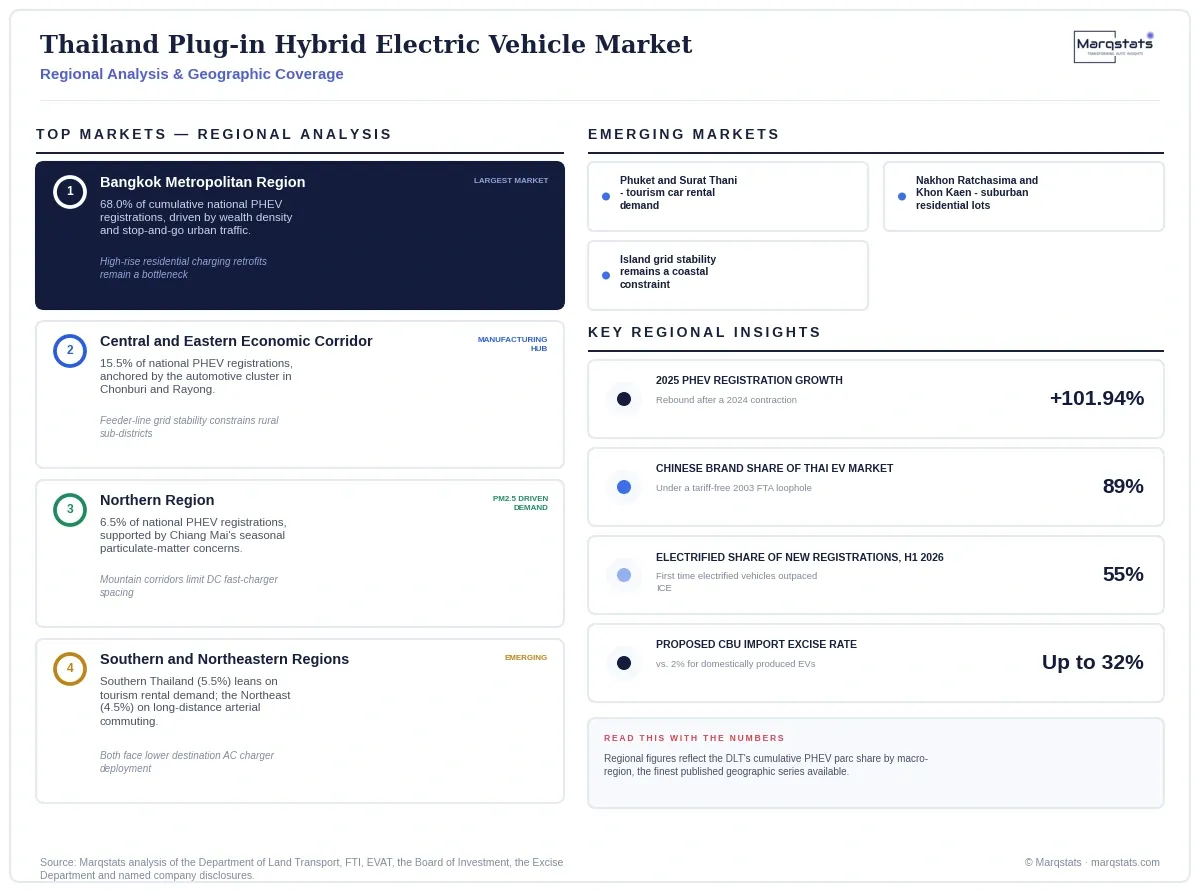
The Bangkok Metropolitan Region, encompassing Bangkok, Samut Prakan, Nonthaburi and Pathum Thani, accounts for approximately 68.0% of cumulative national PHEV registrations, driven by elevated household purchasing power, dense commercial charging availability and stop-and-go urban traffic patterns that maximize electric-mode fuel savings, though high-rise residential charging retrofits remain a persistent infrastructure bottleneck.
Central and Eastern Economic Corridor
The Central and Eastern Economic Corridor, spanning Chonburi, Rayong, Chachoengsao and Ayutthaya, holds 15.5% of national PHEV registrations, anchored by the region's automotive manufacturing cluster, single-family home charging access and a resident base of original equipment manufacturer staff, constrained mainly by feeder-line grid stability in rural sub-districts.
Northern Region
The Northern Region, led by Chiang Mai, Chiang Rai and Phitsanulok, holds 6.5% of national PHEV registrations, supported by inter-provincial commuting patterns and heightened consumer sensitivity to seasonal particulate matter pollution, though long distances between direct-current fast chargers in mountain corridors constrain longer-range electric operation.
Southern Region
The Southern Region, centered on Phuket, Surat Thani and Songkhla, holds 5.5% of national PHEV registrations, driven by tourism-related vehicle rental demand and elevated fuel transport costs to island and peninsular markets, constrained by island grid stability and coastal charging corridor density.
Northeastern Region (Isan)
The Northeastern Region, encompassing Nakhon Ratchasima, Khon Kaen and Udon Thani, holds 4.5% of national PHEV registrations, supported by long-distance regional arterial commuting and suburban residential lot ownership, constrained by low deployment of destination alternating-current chargers outside primary urban centers.
How Competition Is Evolving
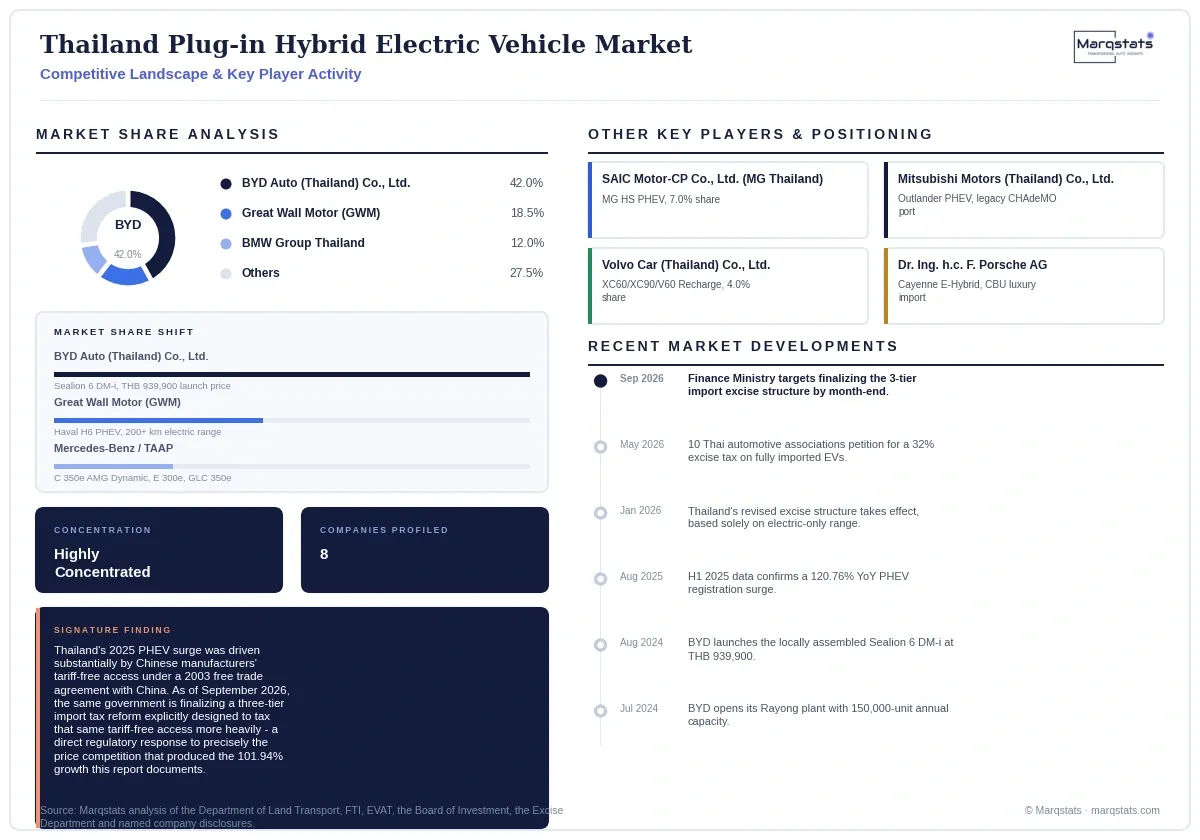
Thailand's PHEV market is highly concentrated: BYD Auto Thailand alone captured 42.0% of 2025 registrations, and the top three manufacturers, BYD, Great Wall Motor and BMW Group, together held 72.5% combined share, reflecting the market's rapid transition from a fragmented European luxury oligopoly toward Chinese-manufacturer dominance anchored by domestic Rayong assembly capacity.
Competitors differentiate primarily on price positioning relative to conventional hybrids and charging interface capability; Chinese manufacturers led by BYD compete on price and native DC CCS2 fast-charging, having compressed the historical PHEV premium to under THB 100,000, while European brands including BMW, Mercedes-Benz and Volvo compete on larger battery capacity and brand prestige to retain premium corporate and private buyers willing to pay a substantial price premium.
The most significant recent competitive-landscape shift is BYD Auto Thailand's opening of its Rayong manufacturing plant in July 2024, with annual capacity of 150,000 units, followed by the August 2024 commercial launch of the Sealion 6 DM-i Super Hybrid at THB 939,900, a price point that disrupted C-segment pricing and drove the company past 100,000 cumulative Thai deliveries; this dominance is now the explicit target of a pending three-tier import tax reform intended to favor further domestic-content localization.
Companies Covered
The report profiles 8+ companies with full strategy and financials analysis, including:
Recent Market Activity
Table of Contents
Coverage & Segmentation
Coverage spans Thailand's Plug-in Hybrid Electric Vehicle market on a new passenger car (Ry. 1 classification) registration basis, as reported by the Department of Land Transport and cross-referenced against Federation of Thai Industries wholesale delivery data, across a 2020-2025 historical period and a 2026-2030 forecast period, with 2025 as the base year. The market is sized in both THB/USD value and unit volume, covering PHEVs statutorily distinguished from non-plug-in hybrids and battery-electric vehicles under DLT vehicle taxonomy. Two segmentation dimensions are quantified: manufacturer origin and production strategy, and charging interface standard.
Excluded from scope: non-plug-in hybrid and battery-electric vehicles, tracked as separate categories; commercial one-ton pickup truck PHEVs, which have not yet entered series production domestically; and a finalized rate for the pending three-tier import tax reform, since its precise structure and implementation date remained undetermined at time of writing. A separate Marqstats study addresses Thailand's battery-electric vehicle market on a comparable basis.