Market Snapshot
Key Takeaways
Market Overview & Analysis
Report Summary
The Egypt hybrid and range-extended vehicle market covers new hybrid, plug-in hybrid and range-extended electric passenger vehicles sold in Egypt. Pure battery electric vehicles are excluded. The distinction matters more in Egypt than in most markets because the registration system has not been enforcing it: range-extended and plug-in hybrid models have been licensed in the electric vehicle category pending the introduction of a formal hybrid classification, which means published electric vehicle registration counts contain vehicles that carry a combustion engine.
That measurement gap is the market's defining feature rather than a footnote to it. The supplied model-level dataset for 2025 carries explicit powertrain codes on only 1,332 units, of which approximately 1,081 are hybrid, mild hybrid, plug-in hybrid or mixed codes and roughly 254 are pure battery electric. Untagged rows are not zero-electrified, they are simply uncoded, so the 2,100-unit working estimate for 2025 applies a coverage uplift to a documented lower bound. The confidence grade on the base year is correspondingly moderate, and the page states this rather than presenting the figure as a reported statistic.
What is not uncertain is the direction and the pace. Automotive Information Council reporting placed electric-category registrations at 352 units in May 2026, a 665% year-on-year increase and about 3% of passenger car sales in a month when the total market reached 16,900 vehicles. Cumulative electric passenger vehicle licences since 2021 stand at approximately 18,500, which means a substantial share of the entire installed base arrived in the eighteen months to mid-2026. Four premium range-extended nameplates launched between July and August 2026 alone.
Three Egyptian measures cut through the same vehicle parc on different axes and none is additive to the others. Egypt's vehicle manufacturing and localization market counts locally assembled units of all brand origins and all powertrains at 99,600 in 2025. Egypt's Chinese automotive brands market counts Chinese-origin passenger cars of all powertrains at 50,699. This market counts electrified passenger vehicles of all brand origins and both assembly routes at 2,100. Every pair intersects partially and no pair sums, so a figure drawn from one cannot be added to a figure drawn from another.
Hybrid, Plug-in Hybrid and Range-Extended Vehicle Sales in Egypt
Annual sales rise from 2,100 vehicles in 2025 to 26,100 in 2030, a 65.53% compound annual growth rate and an absolute increase of 24,000 units. The indicative 2031 endpoint is approximately 38,014 vehicles. The 2026 estimate of roughly 5,800 units is anchored on observed registration data and launch timing rather than interpolated, because the category acquired four premium nameplates within a six-week window in mid-2026 and the resulting step change is not a smooth-path event.
The two-phase structure of that growth should be read explicitly. Volume rises approximately 176% between 2025 and 2026, then compounds at 45.65% annually from 2026 through 2030. A reader who takes the 65.53% five-year figure as a forward-looking annual rate will overstate every year after 2026 by roughly twenty percentage points. The 45.65% rate is the one that describes the forecast period as it actually behaves, and it is itself high by any normal standard.
Retail value grows from USD 94.50 million to USD 887.40 million, a 56.51% compound annual growth rate. Average transaction value falls from approximately USD 45,000 to USD 34,000, a decline of about 5.45% each year, because the 2025 base is dominated by low-volume premium models while the forecast mix broadens toward mainstream hybrid sport utility vehicles. Value therefore compounds more slowly than units, which is the reverse of the pattern in Egypt's Chinese-brand passenger car market and reflects a category moving from premium introduction toward volume.
The classification contradiction carries a quantified commercial consequence that the forecast has to accommodate. A range-extended vehicle currently enters Egypt under a hybrid tariff heading at 30% customs duty for a generator of 1,600cc or below, plus a 3% development fee and a 1% planning tax, while a pure battery electric vehicle of comparable value pays 0% customs and only 14% value-added tax on a reduced valuation. The same range extender is then registered in the electric vehicle category on the road. When the formal hybrid classification is introduced, the registration treatment will align with the tariff treatment rather than the reverse, and models whose commercial case was built on electric-category benefits will need to be re-underwritten.
Market Dynamics
Key Drivers
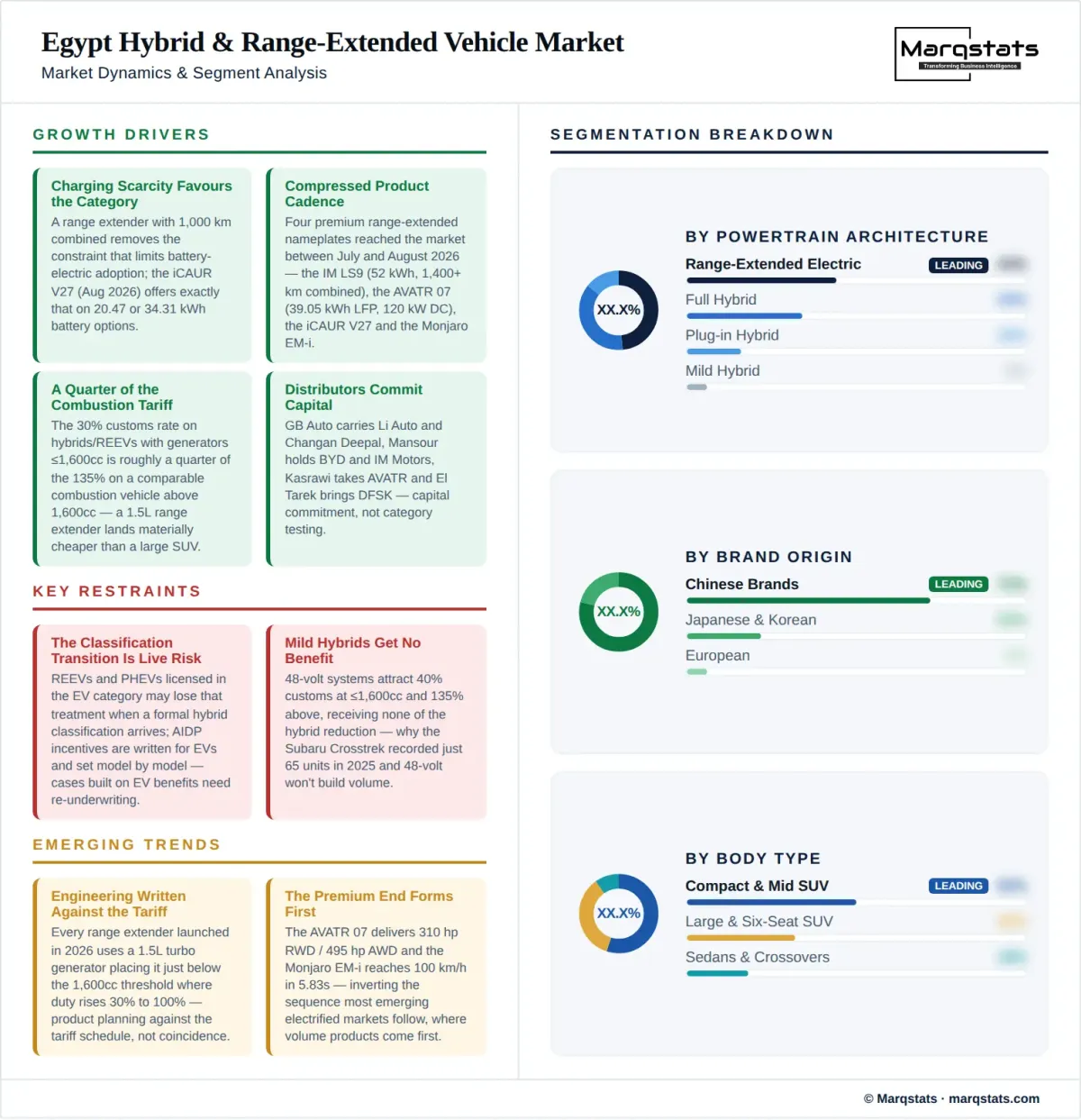
- Charging infrastructure scarcity is the primary driver and it works in this category's favour rather than against it. A range extender with a 1,000-kilometre combined range removes the constraint that limits battery electric adoption, and the iCAUR V27 launched in August 2026 offers exactly that on 20.47 or 34.31 kWh battery options.
- Product cadence is compressing entry timelines, with four premium range-extended nameplates reaching the market between July and August 2026: the IM LS9 with a 52 kWh CATL Freevoy battery and more than 1,400 kilometres of combined range, the AVATR 07 on a 39.05 kWh LFP pack supporting 120 kW DC charging, the iCAUR V27 and the Geely Monjaro EM-i.
- The 30% customs rate on hybrid and range-extended vehicles with generators of 1,600cc or below is roughly a quarter of the 135% payable on a comparable combustion vehicle above 1,600cc, which makes a 1.5-litre range extender materially cheaper to land than a conventional large sport utility vehicle.
- Distribution groups are committing capital rather than testing the category, with GB Auto carrying Li Auto, Genesis and Changan Deepal, Mansour Group holding BYD and IM Motors, Kasrawi Group taking AVATR and El Tarek Automotive bringing DFSK range-extended models.
- Consumer acceptance is measurable rather than assumed, with Deepal recording 431 vehicles in the first four months of 2026 across the S05 at 200 units, G318 at 149 and S07 at 82, from a 2025 coded base of roughly 303 units.
Key Restraints
- The classification transition creates genuine commercial uncertainty, since range-extended and plug-in hybrid models licensed in the electric vehicle category may lose that treatment when a formal hybrid classification is introduced, and Automotive Industry Development Programme incentives are written for electric vehicles with eligibility determined model by model.
- Mild hybrid systems receive no tariff benefit at all, attracting 40% customs at 1,600cc and below and 135% above it, which is why the Subaru Crosstrek recorded only 65 units in 2025 and why 48-volt architectures are unlikely to build volume in Egypt.
- Battery warranty exposure and service capability are unproven at fleet age, since Egypt's earliest meaningful electrified cohorts arrived in 2024 and 2025 and the technology carries repair costs that conventional aftermarket networks are not yet equipped to absorb.
- Foreign currency availability and the personal import limit of one vehicle every five years, set by Cabinet decision in December 2024, constrain the parallel import channel that supplied roughly one third of monthly electric vehicle sales at the end of 2025.
Key Trends
- Product engineering is being written against the tariff table, with every range extender launched in Egypt during 2026 using a 1.5-litre turbocharged generator that places it below the 1,600cc threshold where customs duty rises from 30% to 100%.
- Range claims have become the primary marketing axis, moving from the 300-kilometre electric range of the IM LS9 to combined figures above 1,400 kilometres, and the ROX 01 exceeding 1,100 kilometres, in a market where public charging density remains the binding constraint.
- The premium end is forming before the volume end, with the AVATR 07 delivering 310 horsepower in rear-wheel drive and 495 in all-wheel drive and the Geely Monjaro EM-i reaching 100 kilometres per hour in 5.83 seconds, which inverts the sequence most emerging electrified markets follow.
- European-origin hybrids retain a tariff advantage under the EU-Egypt Association Agreement at roughly 19% effective duty below 1,600cc against 30% for Chinese-made equivalents, yet Chinese brands are taking the category, which indicates product cadence is outweighing landed cost.
Market Segmentation
The fastest-growing architecture and the one that defines the category in Egypt. Four premium nameplates launched between July and August 2026, led by the IM LS9 with a 52 kWh CATL Freevoy battery delivering around 300 kilometres of electric driving and more than 1,400 kilometres combined. The proposition is electric drive with gasoline-generated range, which places it closer to a battery electric experience than to a conventional hybrid and makes it commercially distinct.
The established volume base, anchored by the Nissan X-Trail HV at 674 units in 2025, the largest single explicitly hybrid row in the model-level dataset. Full hybrids attract the same 30% customs rate below 1,600cc as range extenders but carry no plug capability and no electric-category registration treatment, so they sit outside the classification ambiguity affecting the rest of the market.
A smaller cohort that shares the range extender's tariff position and licensing treatment without its series-hybrid drivetrain. Li Auto recorded 9 units on the L6 and 8 on the L9 in 2025, and BYD's DM-i architecture, introduced through Mansour Group in early 2026 with up to 1,000 kilometres of total range, broadens plug-in hybrid awareness well beyond the strict range-extended subset.
Structurally disadvantaged in Egypt and unlikely to build meaningful share. The 48-volt architecture is treated as a standard combustion vehicle for customs purposes at 40% below 1,600cc and 135% above, receiving none of the hybrid tariff reduction, which is why the Subaru Crosstrek MHV recorded just 65 units in 2025 against 674 for a comparable full hybrid.
The volume core of the category and the body type most range-extended entrants target first. The iCAUR V27 and Geely Monjaro EM-i both sit here, and the segment benefits from the same demand structure that made compact and mid sport utility vehicles roughly the leading body type among Chinese brands taking 37.8% of Egypt's passenger car market in 2025.
The premium expression of the range-extended proposition and the segment carrying the highest transaction values, which is why average transaction value across the category stood near USD 45,000 in 2025. The IM LS9 pushed range-extender technology into the premium six-seat class in July 2026, and the Li Auto L9 occupies comparable territory.
The smallest of the three body groups and the slowest to electrify, since the range and towing arguments that justify a range extender carry less weight in a sedan. The Deepal S05 at 200 units in the first four months of 2026 and the S07 at 82 demonstrate that crossover-format electrified models sell, but the volume concentration remains in higher-riding formats.
The dominant origin and the source of essentially all range-extended supply, with Chery through iCAUR, Changan through Deepal and AVATR, SAIC through IM Motors, Geely, BYD, Li Auto and DFSK all present. Chinese brands reached 37.8% of Egypt's total passenger car market in 2025 and their share of the electrified subset is materially higher, since no non-Chinese manufacturer has launched a range extender in Egypt.
The incumbent hybrid position, concentrated in full hybrids rather than plug-in or range-extended architectures. The Nissan X-Trail HV at 674 units in 2025 is the single largest explicitly hybrid model in the market, and Lexus recorded 19 units on the LX, but neither manufacturer has brought a plug-in or range-extended nameplate to Egypt at scale.
The smallest cohort despite holding the strongest tariff position, at roughly 19% effective duty below 1,600cc under the EU-Egypt Association Agreement against 30% for Chinese-built equivalents. The gap between that structural advantage and the resulting volume is the clearest available evidence that product availability and launch cadence, not landed cost, are determining outcomes in this category.
Effectively the whole market. Every range extender launched in Egypt during 2026 uses a 1.5-litre turbocharged generator, and the band attracts 30% customs duty plus a 3% development fee and 1% planning tax for hybrid and plug-in hybrid vehicles. The concentration is not coincidental: it is product planning written directly against Egypt's tariff schedule.
A structurally marginal band carrying 100% customs duty plus development fees of 5 to 8.5% and planning tax of 15 to 30%, against 30% plus 4% below the threshold. The differential is large enough that a manufacturer will redesign a generator rather than cross it, which is why the band contains almost no volume despite including several globally significant hybrid nameplates.
By Geography
Greater Cairo
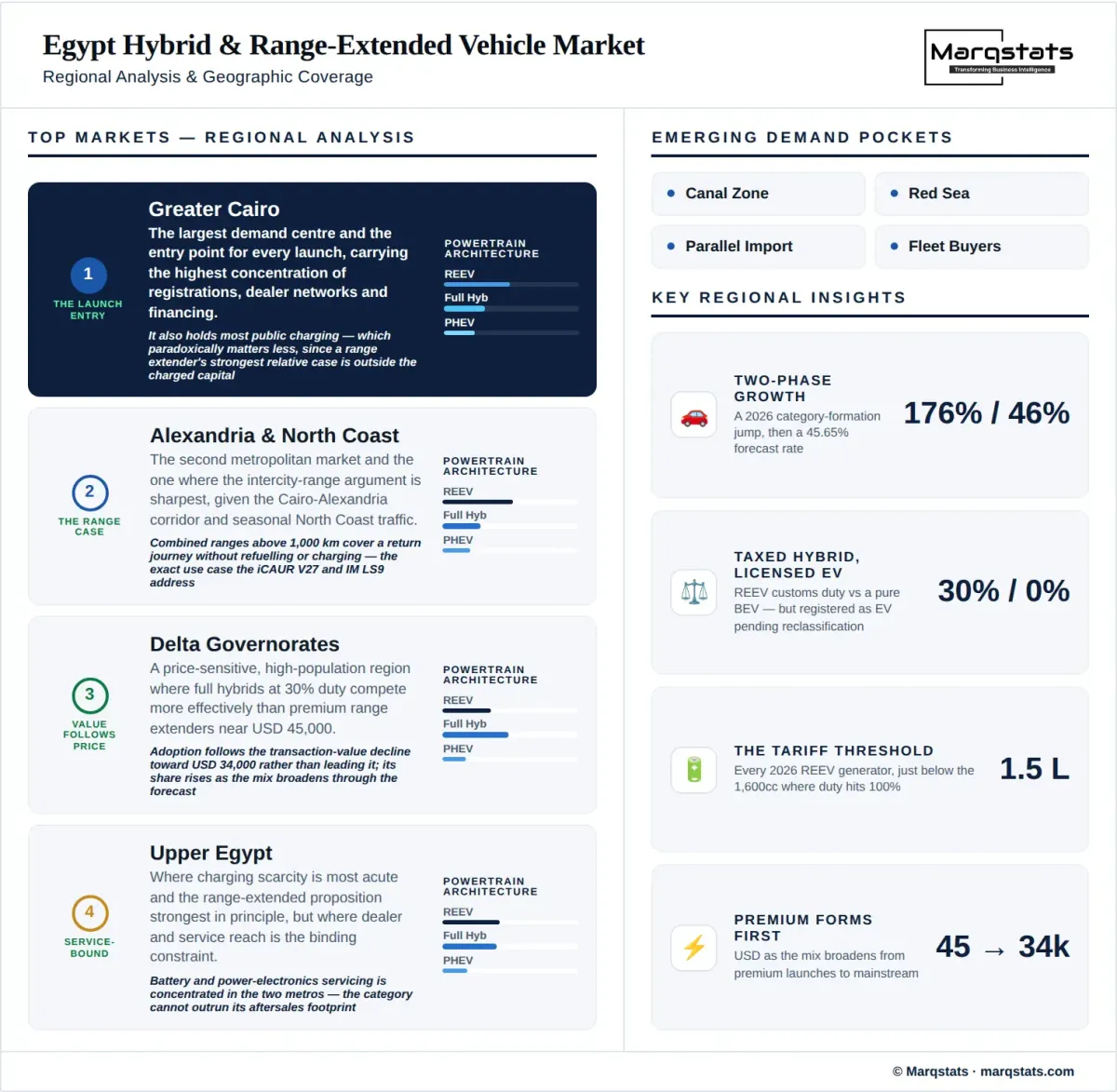
The largest demand centre and the entry point for every launch in the category, carrying the highest concentration of registrations, dealer networks and financing availability. It also holds most of Egypt's public charging capacity, which paradoxically matters less here than elsewhere: a range extender sells on the absence of charging, and its strongest relative case is outside the capital.
Alexandria and the North Coast
The second metropolitan market and the one where the intercity range argument is sharpest, given the Cairo-Alexandria corridor and heavy seasonal North Coast traffic. Combined ranges above 1,000 kilometres cover a return journey without refuelling or charging, which is the specific use case the iCAUR V27 and IM LS9 marketing addresses.
Delta Governorates
A price-sensitive, high-population region where full hybrids at 30% duty compete more effectively than premium range extenders carrying transaction values near USD 45,000. Adoption here follows the transaction value decline toward USD 34,000 by 2030 rather than leading it, and the region's share of category volume rises through the forecast period as the mix broadens.
Upper Egypt
The region where charging scarcity is most acute and the range-extended proposition strongest in principle, but where dealer and service network reach is the binding constraint. Battery and power-electronics servicing requires trained capability that is concentrated in the two metropolitan centres, and the category cannot outrun its aftersales footprint.
Canal Zone and Red Sea
A smaller demand centre with distinctive import economics, given free-zone proximity and the parallel import channel that supplied roughly one third of monthly electric vehicle sales at the end of 2025. The one-vehicle-per-person-per-five-years limit set in December 2024 constrains that channel, and its effect is felt disproportionately here.
How Competition Is Evolving
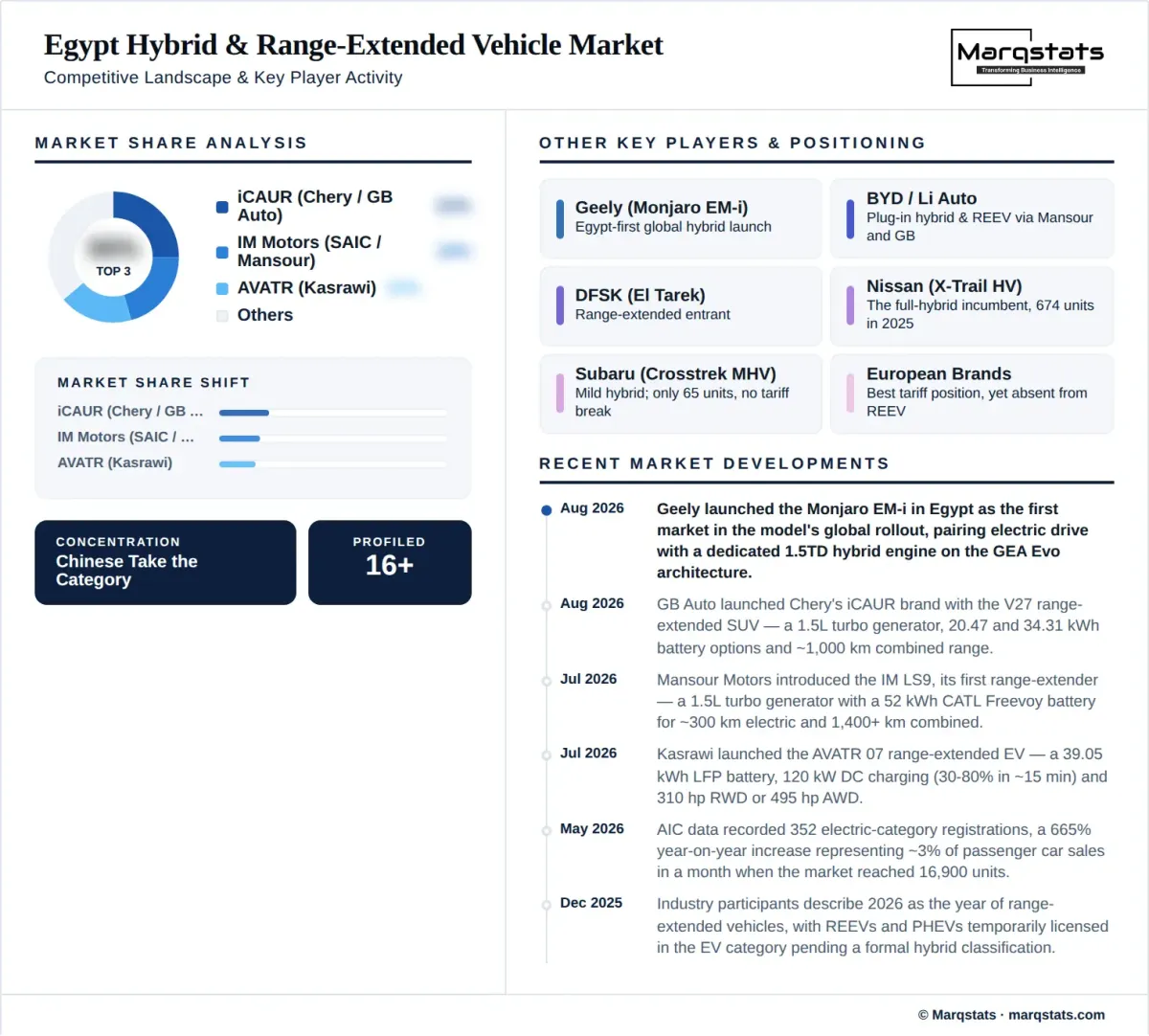
The competitive structure is unusual because the manufacturers are new and the distributors are not. Every range-extended nameplate in Egypt reaches buyers through an established Egyptian group with decades of conventional franchise history: GB Auto carries Li Auto, Genesis and Changan Deepal, Mansour Group holds BYD and IM Motors, Kasrawi Group took AVATR, El Tarek Automotive brought DFSK and Natco carries Exeed. The manufacturer supplies the technology and the group supplies the network, financing and service capability, and the group's depth is a better predictor of a nameplate's trajectory than the product specification is.
Competition is being fought on range claims rather than price, which is unusual for an emerging electrified market and follows directly from the infrastructure position. Combined range figures have escalated from around 1,000 kilometres for the iCAUR V27 to more than 1,400 for the IM LS9, with the ROX 01 above 1,100, in the space of a single product cycle. Battery capacity is the underlying variable, ranging from 20.47 kWh on the entry iCAUR V27 to 52 kWh on the IM LS9, and charging capability differentiates further, with the AVATR 07 supporting 120 kW DC charging from 30% to 80% in about fifteen minutes.
Market concentration is high and falling quickly. In 2025 a single model, the Nissan X-Trail HV at 674 units, represented roughly a third of all coded electrified volume, and the top three models covered more than half. By the second half of 2026 at least eight distinct electrified nameplates were competing across four architectures and three price bands. The concentration is dissolving faster than in any comparable segment of the Egyptian market, and the durable competitive positions will be determined by which groups build battery service capability first rather than by which manufacturer arrives first.
The pricing structure that will decide the next phase is not yet visible in transaction data. Average transaction value across the category stood near USD 45,000 in 2025 on a base dominated by low-volume premium models, and the forecast carries it down to approximately USD 34,000 by 2030, a decline of about 5.45% each year. That path assumes mainstream compact and mid sport utility vehicle range extenders arrive in volume and that the 30% tariff band holds. If the formal hybrid classification raises the effective duty on range-extended models, the transaction value decline stalls and the volume forecast compresses toward the lower end of its range rather than the upper.
Companies Covered
The report profiles 16+ companies with full strategy and financials analysis, including:
Recent Market Activity
Table of Contents
Coverage & Segmentation
The study covers new hybrid, plug-in hybrid and range-extended electric passenger vehicles sold in Egypt across the 2021 to 2025 historical period and the 2026 to 2030 forecast period, with 2025 as the base year and an indicative 2031 endpoint. Pure battery electric vehicles are excluded from the measure. Where a model-level source applies a mixed battery-electric and plug-in hybrid code that cannot be separated, the row is treated as evidence of category activity rather than as an in-scope volume, and the treatment is disclosed rather than resolved silently.
Sizing proceeds from a documented lower bound upward rather than from a top-down penetration assumption. The 2025 model-level dataset carries explicit powertrain codes on 1,332 units, of which approximately 1,081 fall inside the hybrid, mild hybrid and plug-in hybrid definition. Untagged rows are treated as uncoded rather than as zero-electrified, and a coverage uplift produces the 2,100-unit working estimate for 2025. The 2026 figure of 5,800 units is anchored on observed registration data and confirmed launch timing. The 2030 forecast follows from the 2026 anchor at a 45.65% compound rate, and the 2025 to 2030 headline rate of 65.53% is reported alongside it so that the category-formation year is visible rather than embedded.