Market Snapshot
Key Takeaways
Market Overview & Analysis
Report Summary
This report covers plug-in hybrid electric vehicles registered in Brazil under MERCOSUR tariff heading NCM 8703.60.00: passenger automobiles and light commercial vehicles combining an externally rechargeable battery with an internal combustion engine. It excludes battery-electric vehicles (NCM 8703.80.00), non-plug-in hybrids (NCM 8703.40.00), 12V/48V mild hybrids with no autonomous electric traction, and commercial vehicles above 3.5 tonnes gross vehicle weight. Brazilian media routinely report an aggregate "eletrificados" figure that mixes all of these categories; on that composite basis 2025 registrations reached 223,912 units, of which PHEVs were 101,364, or 45.27%. This report sizes the market on the narrower, PHEV-only basis throughout.
Registration volume is a statutory series: ABVE compiles it from RENAVAM licensing records and reports it monthly. PHEV registrations rose from 11,461 units in 2021 to 101,364 units in 2025, a run broken only by a 9.71% contraction in 2022 as European OEMs including Volvo and BMW redirected constrained semiconductor supply toward battery-electric platforms. Chinese entrants filled the resulting gap from 2023 onward. Market value is a Marqstats construction: volume-weighted average selling price runs from entry-level sedans near R$ 175,800 to imported luxury crossovers above R$ 750,000, producing a blended 2025 ASP of R$ 254,000 (US$ 46,605.50 at 5.45 BRL/USD) and a base-year market value of R$ 25.75 billion (US$ 4,724.12 million).
The forecast holds on one condition: that domestic assembly absorbs the tariff escalation to 35% in July 2026 without a corresponding collapse in volume. GWM opened its Iracemápolis plant in August 2025 and BYD opened Camaçari in October 2025, both aimed at avoiding the full import duty on completely built-up units. If local content ramps as scheduled, Marqstats projects 275,000 units and R$ 67.38 billion (US$ 12,250.00 million) by 2030 — a 21.21% CAGR in Brazilian Real terms and 20.99% in US Dollar terms, the 0.22-percentage-point gap reflecting the model's FX assumption moving from 5.45 to 5.50 BRL/USD. If assembly ramp-up slips and the Brazilian real weakens past 6.20 BRL/USD, the downside case of 185,000 units becomes the more likely outcome.
Market Dynamics
Key Drivers
- Falling battery cost, not falling vehicle price, is what pulled PHEVs into the mass market. The entry price per usable kilowatt-hour fell 58.12% between 2021 and 2025, from R$ 26,666/kWh on the Volvo XC40 T8 to R$ 11,170/kWh on the GWM Haval H6 PHEV19, letting BYD price the Song Pro DM-i at R$ 189,990 from its September 2024 launch — inside striking distance of a combustion-engine Toyota Corolla Cross.
- Programa Mover, established under Federal Law nº 14.902/2024, ties R$ 19.3 billion in tax credits through 2028 to well-to-wheel lifecycle emissions rather than tailpipe-only measurement, a structure that rewards ethanol-compatible combustion engines rather than penalizing them. CAOA Chery, GWM and BYD have each committed R&D toward flex-fuel PHEV architectures specifically to capture these credits, a Brazil-specific design response with no equivalent in markets without an ethanol-blend fuel network.
- Municipal traffic exemptions concentrate demand in São Paulo, where electrified powertrains are excused from the city's peak-hour driving restriction (rodízio municipal). That single exemption helped drive 28,212 electrified registrations inside the municipality in 2025, 12.60% of the national total, as urban fleet operators and multi-car households register plug-in vehicles specifically to avoid the restriction.
- Dual-fuel range security addresses a problem pure electric vehicles cannot solve on Brazil's continental highway network. Public and semi-public charging connectors grew only 5.2-fold between 2021 and 2025 (1,250 to 16,880 locations) against a 13.5-fold expansion in the plug-in fleet, and PHEV buyers routing between cities retain a combustion-engine backup that BEV buyers do not.
- State-level tax competition is pulling registrations toward jurisdictions with the lowest vehicle tax burden. Distrito Federal's 100% IPVA exemption, running through 2027, helped the Federal District generate 21,639 electrified registrations in 2025 — 9.66% of the national total from a jurisdiction holding 1.4% of Brazil's population — and other states are positioned to compete on the same lever.
Key Restraints
- PHEVs carry a higher import duty than BEVs at every tariff step so far, and the gap is scheduled to persist. GECEX set PHEV duty at 20% against BEV duty of 18% in July 2024, and 28% against 25% in July 2025, widening to a 35% PHEV ceiling in July 2026 with no confirmed BEV-parity date, a structural cost disadvantage a pure import strategy cannot outrun.
- Charging infrastructure growth is falling further behind fleet growth each year, not closing the gap. Connectors expanded 5.2-fold from 2021 to 2025 while the combined BEV-and-PHEV fleet expanded 13.5-fold over the same period, and the report finds no published national buildout target that would reverse the divergence before 2030.
- Regional concentration leaves the market exposed to a single geography's policy and income conditions. The Southeast holds 46.43% of 2025 electrified registrations and São Paulo state alone holds 30.64%, so a state-level tax change or a regional economic slowdown in the Southeast would move the national number disproportionately.
- Domestic assembly is not yet at the scale the 2030 forecast requires. GWM's Iracemápolis plant opened in August 2025 with initial capacity of 20,000–30,000 units a year against a company ceiling of 50,000, and BYD's Camaçari plant opened in October 2025 at 150,000 units a year in SKD form only, with full CKD-stage output of the Song Plus and Atto 2 not scheduled until 2027 — a gap this report's base case assumes closes on time.
Key Trends
- Chinese manufacturers are converting import volume into domestic manufacturing footprint. GWM inaugurated its Iracemápolis (SP) plant on 15 August 2025 using a part-by-part import system rather than CKD or SKD kits, and BYD opened SKD assembly at Camaçari (BA) on 9 October 2025, reaching 100,000 units assembled by mid-2026 — the clearest sign that the 35% tariff ceiling is reshaping where PHEVs are built, not just where they are sold.
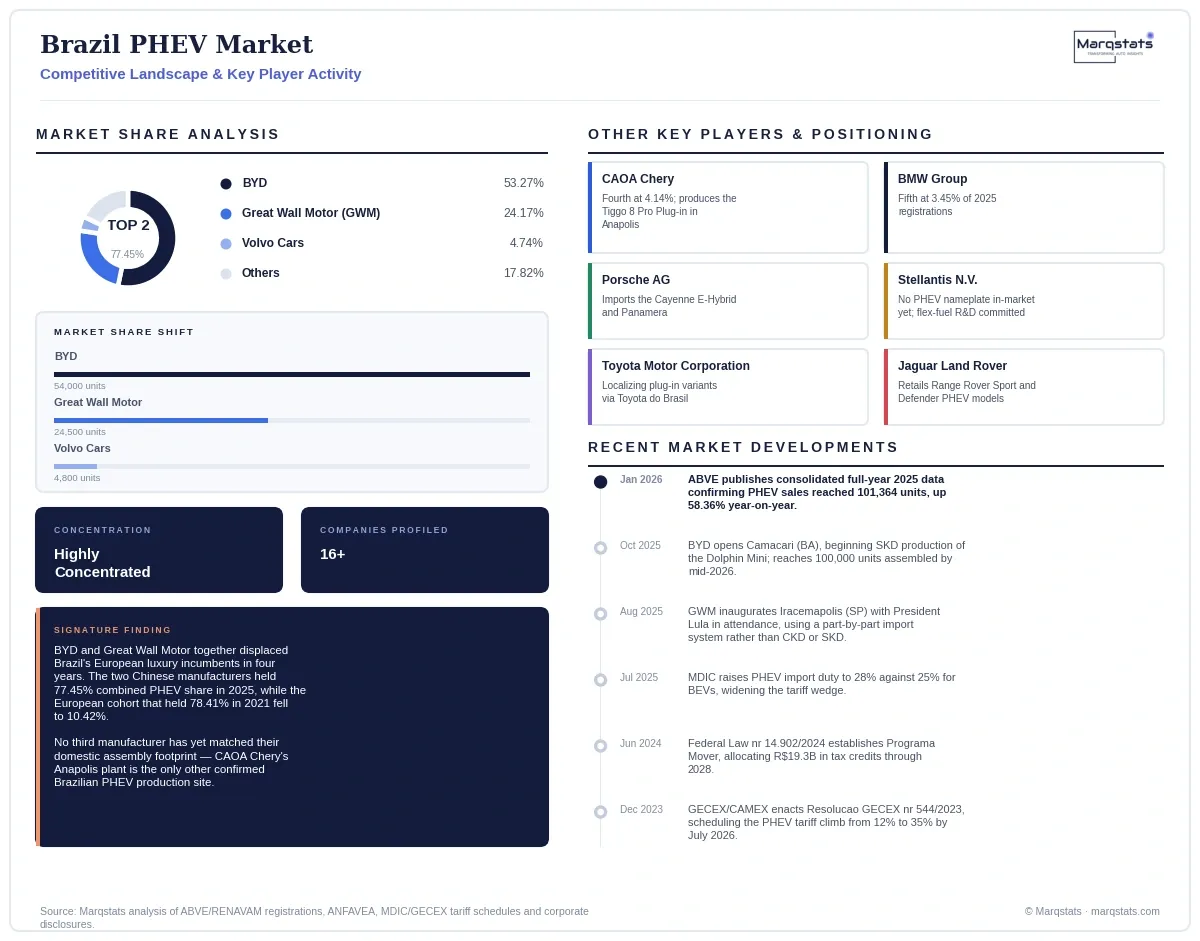
- The competitive base is narrowing toward two manufacturers even as unit volume triples. BYD and GWM held a combined 77.45% of 2025 PHEV registrations, up from a market where European luxury brands held 78.41% in 2021, and no third manufacturer has yet built comparable Brazilian assembly capacity.
- Flex-fuel PHEV architecture is moving from announcement to committed R&D. CAOA Chery, GWM and BYD have each stated flex-fuel development plans aimed at Programa Mover's well-to-wheel credit structure, positioning ethanol-compatible plug-in hybrids as a Brazil-specific product category with no direct equivalent in markets without an established ethanol-blend network.
- Entry-level pricing is compressing the segment from the bottom. The BYD King DM-i and Song Pro DM-i pushed the entry price band to R$ 170,000–210,000, a band that held 22.50% of 2025 volume and is growing faster than the premium tier, which plateaued near 7,800 units a year between 2023 and 2025 as luxury demand saturated.
- Second-hand value is starting to diverge by fuel architecture rather than by brand. Fleet auction data shows imported gasoline-only PHEVs depreciating 24.5% in their second year against 11.2% for flex-fuel commercial models, as corporate buyers favor ethanol-compatible engines to meet Scope 1 carbon-accounting requirements — an early signal that residual value will track fuel flexibility, not badge.
Strategic Implications
For an entrant, importing completely built-up units is no longer a viable entry strategy once the tariff reaches 35% in July 2026. Securing domestic assembly capacity or a contract-manufacturing agreement with an existing hub is now a precondition for competing on price, and calibrating engines for hydrated ethanol captures Programa Mover's IPI tax reduction that a gasoline-only import cannot.
For an incumbent legacy automaker, continued reliance on 12V or 48V mild-hybrid powertrains concedes the mid-market SUV segment to Chinese competitors who have already captured 77.45% combined share. Defending share requires converting existing engine platforms to flex-fuel plug-in hybrid architecture, using the same nationwide dealer and service network that Chinese entrants are still building, rather than competing on price alone against manufacturers with lower landed cost.
For a tier-1 supplier or infrastructure investor, component demand is shifting toward parts specific to flex-fuel PHEVs — ethanol-resistant fuel injectors, bi-fuel fuel rails, high-voltage wiring harnesses — while charging infrastructure investment should weight public fast-charging along freight and travel corridors over further urban buildout, since the fleet-to-connector ratio is already worse outside major cities than the 5.2-fold national connector growth figure suggests.
Outlook
The base case reaches 275,000 units and R$ 67.38 billion (US$ 12,250.00 million) by 2030, a 21.21% value CAGR. This holds if import duties reach the scheduled 35% ceiling in July 2026 as planned, GWM's Iracemápolis and BYD's Camaçari plants together exceed 120,000 combined annual units, CAOA Chery's Anápolis operation stays stable, the exchange rate holds between 5.40 and 5.50 BRL/USD, and Programa Mover incentives remain unchanged through 2028.
The upside case reaches 360,000 units and R$ 86.40 billion (US$ 15.71 billion) by 2030. It requires Stellantis and Toyota to bring high-volume, locally assembled flex-fuel PHEVs to market by 2027, at least three additional states to adopt IPVA reductions modeled on São Paulo and Rio de Janeiro, federal ethanol tax preferences to hold under the Combustível do Futuro program, and benchmark interest rates to fall enough to ease vehicle financing.
The downside case falls to 185,000 units and R$ 47.18 billion (US$ 8.28 billion). It follows from tooling or supply-chain delays at Camaçari or Iracemápolis that leave OEMs exposed to the full 35% tariff, the Brazilian real depreciating past 6.20 BRL/USD, or state authorities rolling back IPVA exemptions such as the Federal District's to protect their own tax base.
Market Segmentation
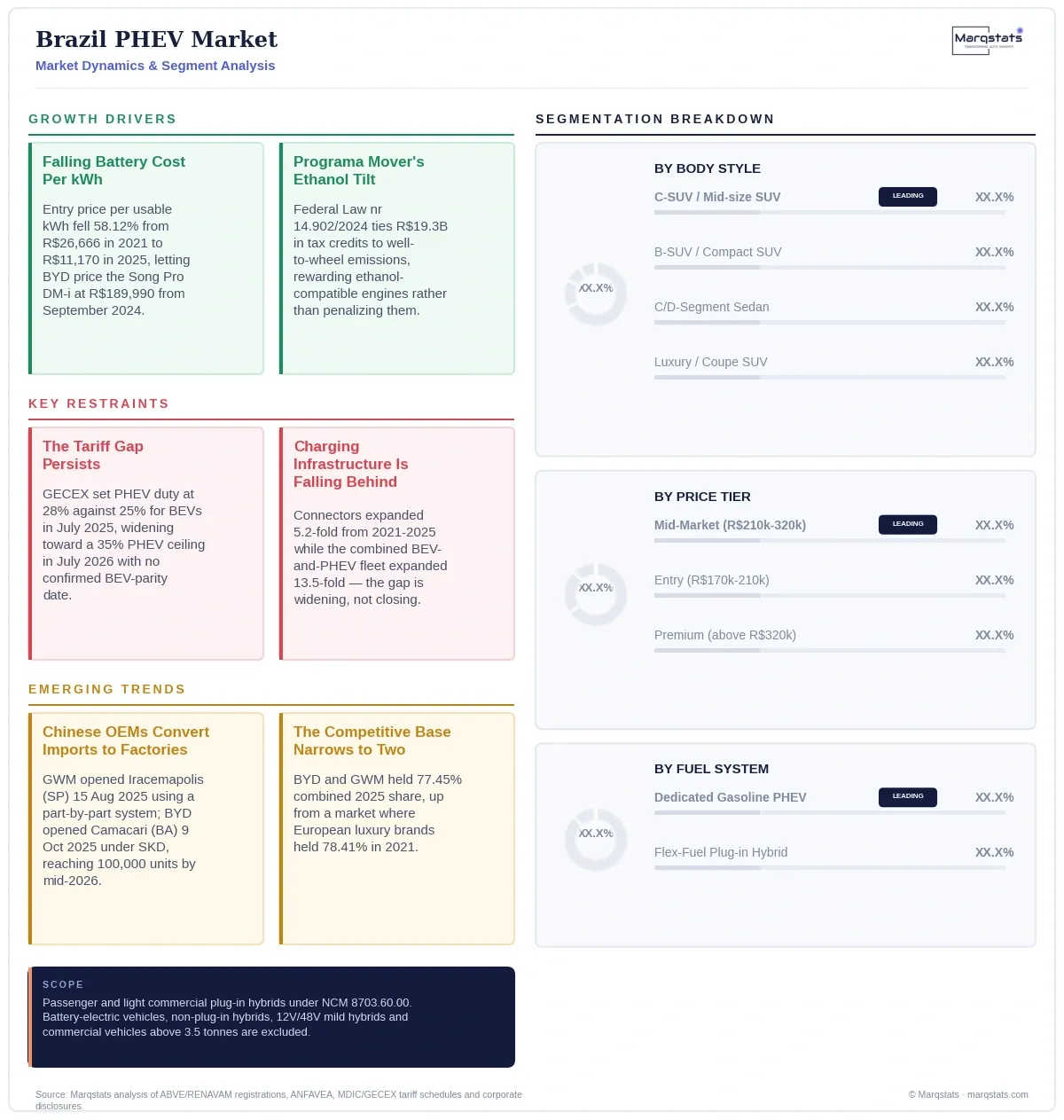
C-SUV and mid-size SUV body styles led 2025 PHEV registrations with 69,130 units, 68.20% of volume, anchored by the BYD Song Plus DM-i, GWM Haval H6 PHEV and CAOA Chery Tiggo 8 Pro Plug-in. Demand concentrates here because Brazilian buyers prioritize high ground clearance for secondary unpaved roads, and this segment's three leading nameplates are also the three highest-volume PHEVs sold in the country.
Compact SUVs held 14,700 units, 14.50% of 2025 volume, led by the BYD Song Pro DM-i, a model introduced in September 2024 specifically to extend PHEV pricing down toward R$ 189,990. This segment grew faster than the overall market through 2025 as compact-SUV buyers traded up from combustion models at a similar price point.
Sedans accounted for 8,920 units, 8.80% of volume, led by the BYD King DM-i and BMW 330e. The King DM-i was positioned to compete directly against the combustion-engine Toyota Corolla, and sedans remain the smallest of the four body-style categories despite the King's strong individual sales.
Luxury and coupé SUVs held 8,614 units, 8.50% of volume, spanning the Volvo XC60/XC90, GWM Haval H6 GT and Porsche Cayenne E-Hybrid. This tier plateaued at roughly 7,800 units a year between 2023 and 2025 for models priced above R$ 450,000, indicating the premium bracket has reached saturation while the rest of the market continues to grow.
The mid-market tier is the leading price band with 66,393 units, 65.50% of 2025 volume, carried by the BYD Song Plus DM-i, GWM Haval H6 PHEV19 and CAOA Chery Tiggo 8 Pro PHEV. Two-thirds of the market's volume sits inside a R$ 110,000 price window, which is why manufacturer pricing decisions inside this band move national volume more than any other single lever.
The entry tier held 22,807 units, 22.50% of volume, driven by the BYD King DM-i and Song Pro DM-i. This band expanded through 2024 and 2025 as battery cost fell 58.12% on a per-kWh basis, and it is the fastest-growing of the three price tiers on a percentage basis.
Premium PHEVs held 12,164 units, 12.00% of volume, including the Volvo XC60, BMW X5, Audi Q5 TFSI e and Porsche Panamera. This tier has plateaued rather than grown, consistent with the same saturation pattern seen in the luxury/coupé body-style segment above.
Gasoline-only PHEVs held 89,200 units, 88.00% of 2025 volume, including the BYD Song Plus, BYD King and imported GWM Haval H6 CBU batches. This share reflects the predominance of Chinese-imported models, none of which currently ship with a flex-fuel variant for the Brazilian market.
Flex-fuel PHEVs held 12,164 units, 12.00% of volume, led by the CAOA Chery Tiggo 8 Pro PHEV Flex and GWM's Haval H6 Flex CKD variant. This is the smallest fuel-system category today, but Programa Mover's well-to-wheel credit structure and three manufacturers' committed flex-fuel R&D point to this share expanding as domestic assembly scales.
By Geography
Southeast (Sudeste)
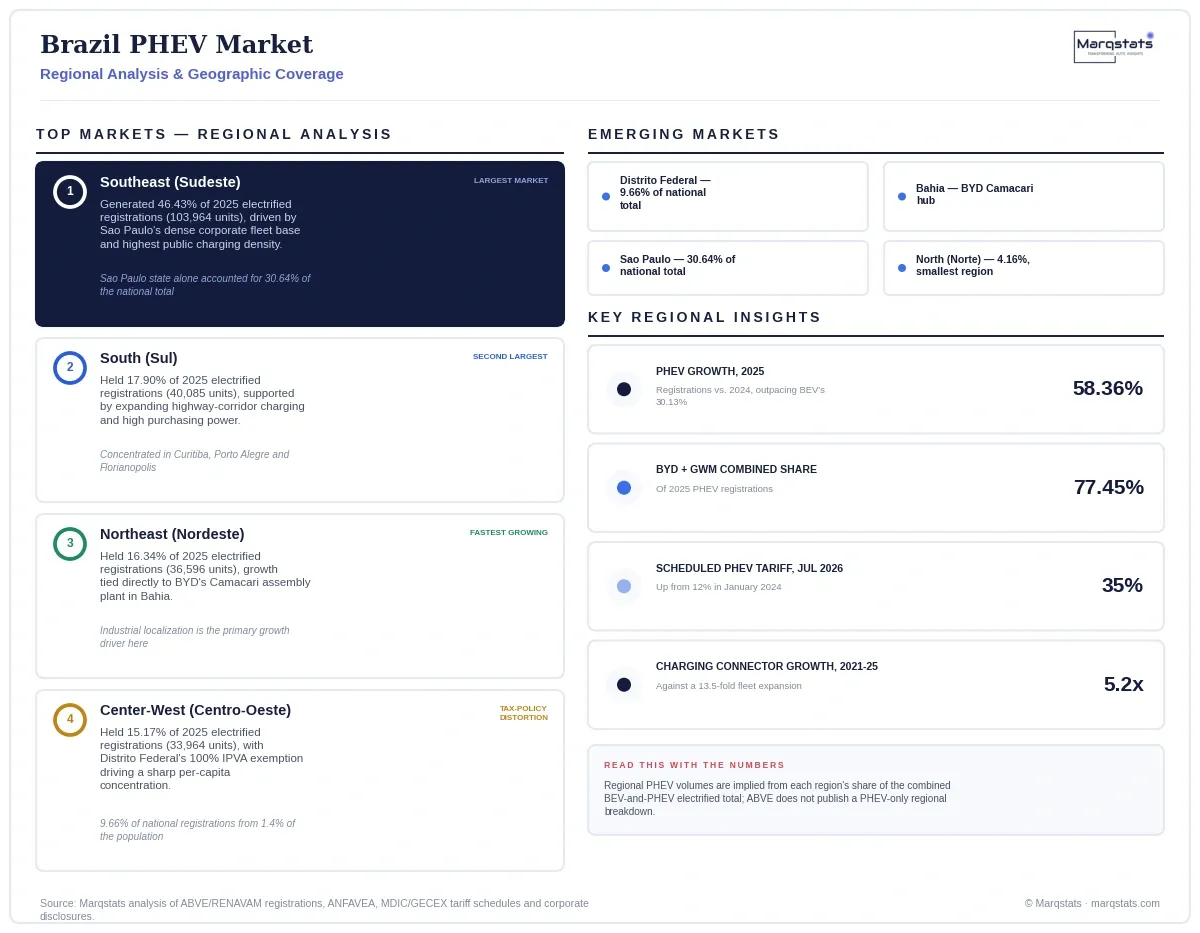
The Southeast is Brazil's PHEV market and not merely its largest region: it generated 46.43% of 2025 electrified registrations (103,964 units, an implied 47,039 PHEV units), driven by São Paulo state's dense corporate fleet base, the country's highest public charging density, and the São Paulo municipal rodízio exemption for electrified vehicles. São Paulo state alone accounted for 68,618 electrified registrations, 30.64% of the national total.
South (Sul)
The South held 17.90% of 2025 electrified registrations (40,085 units, an implied 18,142 PHEV units), supported by expanding highway-corridor charging networks and high purchasing power concentrated in Curitiba, Porto Alegre and Florianópolis. This is the second-largest region and the one most dependent on intercity charging infrastructure outside the Southeast.
Northeast (Nordeste)
The Northeast held 16.34% of 2025 electrified registrations (36,596 units, an implied 16,563 PHEV units), and its growth is tied directly to industrial localization: BYD's Camaçari plant sits in Bahia, one of the two states the report credits with driving the region's above-national growth rate.
Center-West (Centro-Oeste)
The Center-West held 15.17% of 2025 electrified registrations (33,964 units, an implied 15,372 PHEV units), a figure distorted upward by Brasília's 100% IPVA exemption. Distrito Federal alone produced 21,639 registrations, 9.66% of the national total, from a jurisdiction holding only 1.4% of Brazil's population — the sharpest per-capita concentration in the country and a tax-policy artefact rather than an organic demand signal.
North (Norte)
The North held 4.16% of 2025 electrified registrations (9,303 units, an implied 4,248 PHEV units), the smallest of the five regions, constrained by limited fast-charging infrastructure along the region's long-distance highways. Adoption concentrates in Belém and Manaus, and this report finds no published infrastructure buildout timeline that would materially close the gap with the other four regions before 2030.
How Competition Is Evolving
Brazil's PHEV market is highly concentrated: BYD and Great Wall Motor held a combined 77.45% of 2025 registrations (53.27% and 24.17% respectively), against a European luxury cohort — Volvo, BMW, Porsche among them — that has fallen from 78.41% combined share in 2021 to 10.42% in 2025. That is not gradual share erosion; it is a near-complete displacement inside four years.
Manufacturers are competing on landed cost and local assembly timing rather than on model breadth. BYD's Song Pro DM-i, launched September 2024 at R$ 189,990, and GWM's flex-fuel Haval H6 variant under development both target the same entry-to-mid-market band, and the manufacturer that reaches domestic CKD-stage output first — avoiding the full 35% import tariff from July 2026 — gains a structural cost advantage the other cannot match on imported units alone.
Capacity investment has moved from announcement to operation in 2025. GWM opened its Iracemápolis (SP) plant on 15 August 2025 with initial capacity of 20,000–30,000 units a year, rising toward 50,000, using a part-by-part import system. BYD opened Camaçari (BA) on 9 October 2025 at 150,000 units a year under an SKD regime, reaching 100,000 units assembled by mid-2026, with full CKD-stage production of the Song Plus and Atto 2 targeted for 2027 once SKD/CKD tariff-quota exemptions expire. CAOA Chery's Anápolis (GO) plant produces the Tiggo 8 Pro Plug-in Hybrid on a three-engine DHT powertrain, giving Brazil three distinct PHEV assembly hubs as of late 2025.
Companies Covered
The report profiles 16+ companies with full strategy and financials analysis, including:
Recent Market Activity
Table of Contents
Coverage & Segmentation
This report covers Brazil's plug-in hybrid electric vehicle market for passenger automobiles and light commercial vehicles registered under MERCOSUR tariff heading NCM 8703.60.00, for the historical period 2021–2025 (base year 2025) and the forecast period 2026–2030. Market value is stated in USD Million, converted from Brazilian Real at 5.45 BRL/USD for the base year and a modeled 5.50 BRL/USD across the forecast; unit volume is stated in registered units sourced from RENAVAM via ABVE.
Excluded from this report: battery-electric vehicles (NCM 8703.80.00), non-plug-in conventional hybrids (NCM 8703.40.00), 12V/48V mild hybrids with no autonomous electric traction, and commercial vehicles above 3.5 tonnes gross vehicle weight. Readers seeking Brazil's battery-electric vehicle market, or a combined view across all electrified powertrains, should consult Marqstats' separate Brazil Electric Vehicle Market and Brazil Hybrid Electric Vehicle Market coverage, which use the same RENAVAM-sourced registration base but a different scope boundary.