Market Snapshot
Key Takeaways
Market Overview & Analysis
Report Summary
This report measures new-vehicle PHEV registrations and retail transaction value in South Korea, defined under Article 2, Paragraph 5 of the Act on the Development and Promotion of Environment-Friendly Motor Vehicles and the Clean Air Conservation Act as a vehicle combining an internal combustion engine with an externally-chargeable electric motor meeting statutory fuel-economy thresholds set by the Ministry of Trade, Industry and Energy (MOTIE). Mild hybrids using 48-volt architectures and conventional hybrids without external charging are excluded, a boundary the Korea Automobile Importers & Distributors Association (KAIDA) itself formalized when it separated 48V mild hybrids from its hybrid classification. Readers who encounter a South Korea PHEV figure closer to 9,152 units for 2024 elsewhere are likely seeing a different registry cut; this report anchors to KAIDA's import-association total of 9,174 units, verified independently against KAIDA's own published statistics.
Structurally, this is not a market domestic manufacturers compete in. Since the Ministry of Environment withdrew its 5,000,000 KRW purchase subsidy in January 2021, Hyundai Motor Company and Kia Corporation have recorded zero domestic PHEV sales in every complete year from 2022 onward, even as both groups continue to build PHEVs in South Korea for export markets. Every unit registered domestically since then has come through a foreign importer — overwhelmingly BMW Group Korea Co., Ltd., Volvo Car Korea Co., Ltd., Porsche Korea Co., Ltd., Mercedes-Benz Korea Co., Ltd. and Toyota Motor Korea Co., Ltd. — and demand concentrates in premium sedans and SUVs priced above 75,000,000 KRW, a price floor that keeps the segment insulated from mass-market cross-shopping.
The forecast rests on two conditions holding simultaneously. First, that at least one mainstream import brand successfully lands a sub-50,000,000 KRW nameplate, which BYD Korea Co., Ltd. is attempting with the Sealion 6 DM-i at an estimated 42,000,000 KRW. Second, that the individual consumption tax exemption for eco-friendly vehicles, currently scheduled to expire December 31, 2026 under the Restriction of Special Taxation Act, is extended by the National Assembly before that date. Two separate bills to extend the exemption, to December 2027 and to December 2030 respectively, were pending before the Assembly as of the most recent verification and neither had passed; the base-case forecast assumes one of them succeeds, and the downside scenario models what happens if neither does.
Market Dynamics
Key Drivers
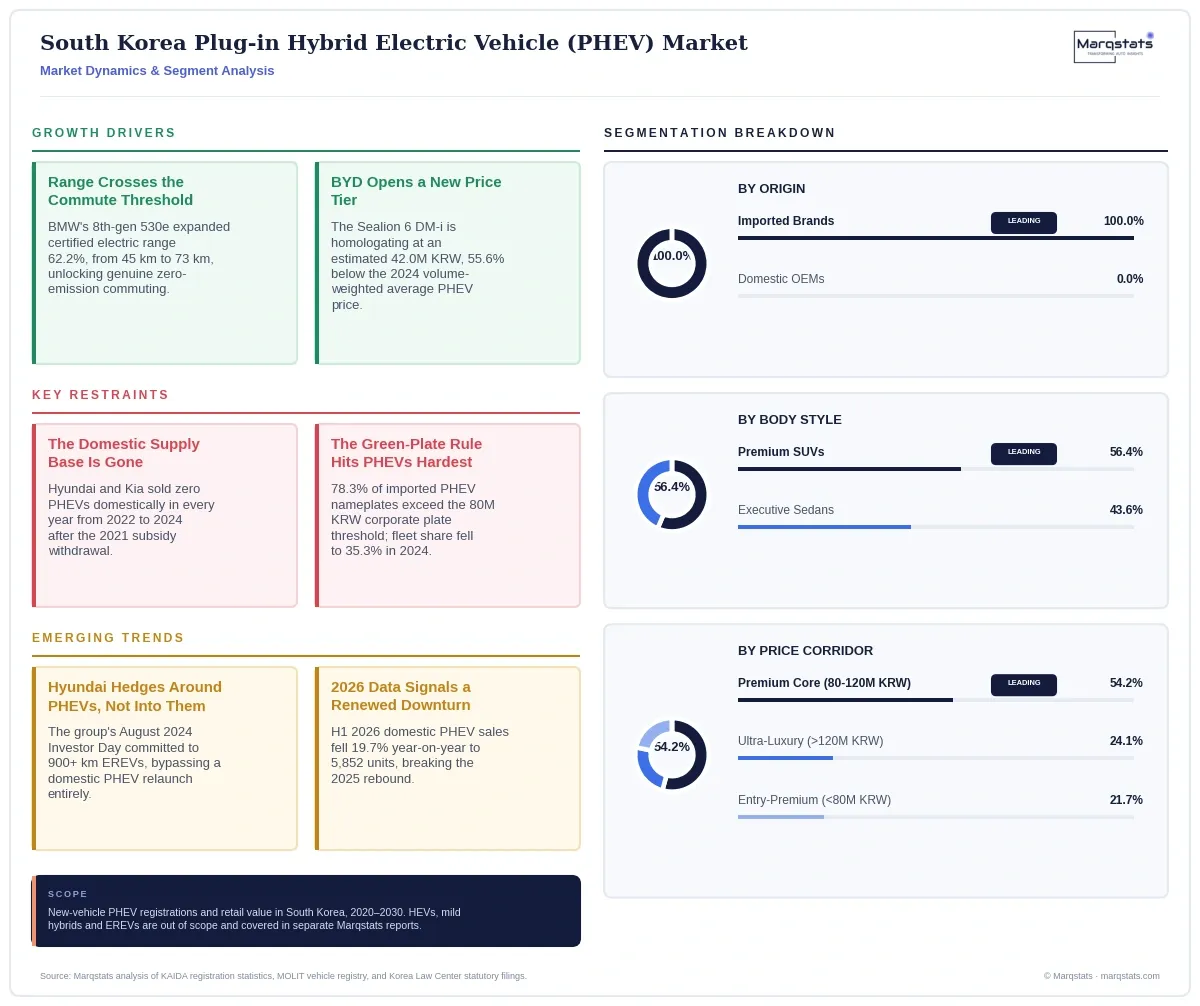
Certified electric range has crossed the threshold where a PHEV can cover a typical Seoul commute on battery power alone, and that is what is pulling registrations back up. The eighth-generation BMW 530e expanded its certified pure-electric range 62.2%, from 45 km to 73 km, and BMW Group Korea Co., Ltd. launched the model in March 2024 priced from 89,200,000 KRW; registrations recovered 48.45% the following year.
A sub-50,000,000 KRW price tier is opening for the first time, and it belongs to a manufacturer with no prior PHEV presence in the country. BYD Korea Co., Ltd. is homologating the Sealion 6 DM-i at an estimated 42,000,000 KRW, 55.56% below the 2024 volume-weighted average PHEV transaction price of 94,500,000 KRW, targeting exactly the mass-market segment domestic OEMs vacated in 2021.
The individual consumption tax waiver remains, for now, the only meaningful fiscal support left standing. Under the Restriction of Special Taxation Act, PHEV buyers still receive up to 1,000,000 KRW in consumption-tax relief, plus education-tax and VAT relief worth a further 430,000 KRW, a combined 1,430,000 KRW saving that partially offsets the loss of the 5,000,000 KRW direct subsidy withdrawn in 2021.
Battery-fire concerns are pushing risk-averse buyers toward a plug-in option rather than away from electrification entirely. Following underground apartment parking garage EV battery fire incidents in 2024, South Korean buyers who might otherwise have considered a battery-electric vehicle increasingly default to hybrids with a combustion-engine fallback, a dynamic that favors PHEVs among buyers who still want some plug-in capability.
Corporate buyers below the 80,000,000 KRW green-plate threshold face no new disincentive, and importers are positioning trims accordingly. With 21.70% of 2024 volume (1,991 units) already sitting in the Entry-Premium tier under 80,000,000 KRW, led by the Toyota RAV4 PHEV and Lexus NX 450h+, importers have a proven template for structuring trims that avoid the Ministry of Land, Infrastructure and Transport's corporate plate mandate.
Key Restraints
The 2021 subsidy withdrawal did not just remove an incentive, it removed the entire domestic supply base. Hyundai Motor Company's Niro PHEV, the last domestically-marketed PHEV, sold through December 2021 before Kia Corporation's second-generation Niro launched in January 2022 without a plug-in variant, leaving every 2022-2024 registration dependent on foreign importers who set their own allocation and pricing for the Korean market.
The 80,000,000 KRW corporate license plate threshold hits PHEVs harder than any other powertrain because of where PHEV pricing sits. Over 78.3% of available imported PHEV nameplates exceed the Ministry of Land, Infrastructure and Transport's threshold for mandatory light-green plates, and corporate registrations fell to 35.3% of volume in 2024 from 46.8% in 2023 as fleet buyers avoided the visibility penalty.
Multi-family apartment charging access, not price, is what is actually capping PHEV uptake against conventional hybrids. Standard HEVs, which need no charging infrastructure at all, surged 23.7% in 2024 to 454,000 units and captured 98.02% of combined hybrid registrations, while PHEVs held just 1.98% despite carrying a smaller price premium over HEVs than over comparable gasoline models.
The tax exemption every current PHEV buyer relies on is not secured past 2026. The individual consumption tax waiver under the Restriction of Special Taxation Act is scheduled to expire December 31, 2026, and while two Assembly bills to extend it were pending as of the most recent verification, neither had passed; a buyer purchasing in 2027 could face a materially higher effective price with no change in the vehicle itself.
Key Trends
Hyundai Motor Group is hedging around PHEVs rather than into them. At its August 2024 CEO Investor Day, the group committed to Extended Range Electric Vehicles (EREVs) targeting 900-plus km range for 2026/2027 commercialization, a technology that uses a generator engine rather than a mechanical drivetrain link and structurally differs from a PHEV — Hyundai's own domestic PHEV re-entry is not part of the plan.
Chinese entrants are targeting the exact price gap import incumbents have left open. BYD Korea Co., Ltd.'s Sealion 6 DM-i at an estimated 42,000,000 KRW is the first PHEV pitched below the Entry-Premium tier's Toyota RAV4 PHEV and Lexus NX 450h+, and its arrival tests whether South Korean PHEV demand has been suppressed by price or is genuinely confined to premium buyers by preference.
Battery-range competition among incumbents is intensifying faster than pricing competition. BMW Group Korea Co., Ltd.'s 62.2% range expansion on the 530e outpaces the modest MSRP moderation modeled across the forecast period, suggesting importers are currently competing on usability rather than on the price floor BYD is targeting.
Corporate fleet demand is migrating toward jurisdictions with lower subway-bond purchase requirements rather than toward lower emissions. Busan Metropolitan City's 30.50% share of national corporate PHEV registrations, against under 6.5% of national population, tracks municipal bond-purchase rates of 0.0%-2.0% rather than any regional PHEV-specific demand signal, and the pattern is likely to persist as long as the rate gap versus Seoul's 5.0%-12.0% remains open.
Strategic Implications
An entrant weighing South Korea's PHEV market is not weighing a market with an incumbent domestic competitor; it is weighing a market with none. The absence of Hyundai Motor Company and Kia Corporation from domestic retail means a new importer competes only against other foreign brands, and the open sub-50,000,000 KRW tier that BYD Korea Co., Ltd. is entering remains genuinely unclaimed. An entrant with a credible mid-priced nameplate and a range above roughly 70 km — the level that now unlocks genuine zero-emission commuting — has a cleaner run at share than the presence of 45 vehicle brands in the broader import market would suggest.
An incumbent premium importer, and BMW Group Korea Co., Ltd. above all, is defending a 42.02% share built on a price floor and a range advantage that both erode from different directions. BYD Korea Co., Ltd. erodes the price floor from below; Hyundai Motor Group's EREV strategy, if it reaches South Korea, could erode the range advantage from a different technology entirely. The defensible response is continued range investment rather than price competition, since incumbents cannot profitably chase a 42,000,000 KRW price point without abandoning the premium positioning that built their share.
A supplier or fleet-leasing operator should treat the 80,000,000 KRW corporate plate threshold as a hard product-design constraint, not a pricing footnote. With 78.3% of current nameplates exceeding it and corporate share falling as a direct result, the commercial opportunity sits in trims specifically engineered to land just under the threshold — the Entry-Premium tier's 21.70% share is the existing proof that this positioning works, and it is currently served by only two brands.
Any party relying on the current tax exemption in a multi-year financial model should build the December 2026 sunset into its base case rather than assume an extension. Two bills are pending before the National Assembly, but neither had passed as of the most recent verification, and a buyer or a leasing operator underwriting a 2027 delivery on the assumption of continued exemption is underwriting a political outcome, not a settled fact.
Outlook
Base case: 31,500 units and USD 1,890.00 million by 2030, a 14.99% USD CAGR from the 2025 base. This case requires one of the two pending National Assembly bills to extend the individual consumption tax exemption past its December 31, 2026 sunset, BYD Korea Co., Ltd. to successfully land the Sealion 6 DM-i below the 45,000,000 KRW threshold, and incumbent German brands to hold certified electric range at or above 75 km on their core nameplates.
Upside case: 48,000 units and USD 2,737.78 million by 2030. This requires direct purchase rebates to be reinstated for PHEV models certifying 80 km or more of electric range, the 80,000,000 KRW green-plate threshold to be raised, and at least one domestic OEM — most plausibly Hyundai Motor Company or Kia Corporation — to resume domestic PHEV retail rather than routing all electrified investment into EREVs.
Downside case: 14,500 units and USD 912.96 million by 2030. This is the outcome if neither pending Assembly bill passes and the consumption-tax exemption lapses as scheduled at the end of 2026, if public charging-tariff increases raise the running-cost advantage PHEVs currently hold over HEVs, and if Hyundai Motor Group's EREV rollout captures the segment of domestic demand that might otherwise have waited for a domestic PHEV relaunch. Early 2026 data already shows H1 domestic PHEV sales down 19.7% year-on-year to 5,852 units, which is consistent with this downside path rather than with the base case's assumed continuation of the 2025 rebound, and should be watched closely at the next scheduled refresh.
Market Segmentation
Imported brands hold 100.00% of South Korea's PHEV market and have held it exclusively since 2022. The segment registered 9,174 units in 2024, all of it through foreign importers, led by BMW Group Korea Co., Ltd., Volvo Car Korea Co., Ltd. and Lexus Korea, the commercial plug-in hybrid division of Toyota Motor Korea Co., Ltd.
Domestic OEMs hold 0.00% of the domestic PHEV market despite continuing to manufacture PHEVs in South Korea for export. Hyundai Motor Company's Ulsan Plant and Kia Corporation's AutoLand Hwaseong facility assemble Tucson, Santa Fe, Sorento and Sportage PHEVs strictly for overseas markets; none of that domestic production capacity is sold to a Korean buyer, a gap this report's Signature Finding quantifies at over 100,000 export units in 2021 alone against zero domestic sales.
Premium SUVs are the leading body style and the segment domestic buyers actually choose when a PHEV is on the table. The segment captured 56.40% of 2024 registrations (5,174 units), led by the BMW X5 xDrive50e, Volvo XC60 Recharge, Porsche Cayenne E-Hybrid and Lexus NX 450h+, and its share advantage over sedans reflects South Korean buyers' broader preference for SUV body styles across all powertrains.
Executive sedans are the second-largest body style, holding 43.60% of 2024 volume (4,000 units), anchored by the BMW 530e and Mercedes-Benz E 350e. The segment's near-parity with Premium SUVs, rather than the wider SUV skew seen in the broader Korean new-car market, reflects the corporate-fleet buyer base that still favors sedans for executive transport.
Compact hatchbacks, estate wagons and light commercial vehicles recorded 0.00% share of 2024 PHEV registrations. No importer currently offers a sub-compact or light-commercial PHEV in South Korea, and BYD Korea Co., Ltd.'s planned Sealion 6 DM-i, a compact SUV, is the first nameplate positioned to open this segment rather than serve the existing Premium SUV or Executive Sedan buyer.
The Premium Core corridor is the market's largest price band, holding 54.20% of 2024 volume (4,972 units), anchored by the BMW 530e and Volvo XC60 Recharge. This is also the band most exposed to the Ministry of Land, Infrastructure and Transport's 80,000,000 KRW corporate plate threshold, since most of its volume sits just above the cutoff.
The Ultra-Luxury corridor captured 24.10% of 2024 volume (2,211 units), driven by the BMW X5 xDrive50e and Porsche Cayenne E-Hybrid. Buyers in this band are largely insulated from the corporate plate mandate's behavioral effect, since a vehicle already priced well above the threshold gains little by trimming down to avoid it.
The Entry-Premium corridor held 21.70% of 2024 volume (1,991 units), represented primarily by the Toyota RAV4 PHEV and Lexus NX 450h+ from Toyota Motor Korea Co., Ltd. This is the only corridor currently priced below the green-plate threshold, and it is the corridor BYD Korea Co., Ltd.'s Sealion 6 DM-i will compete in directly once it reaches the market at an estimated 42,000,000 KRW, well below the segment's current floor.
By Geography
Gyeonggi Province
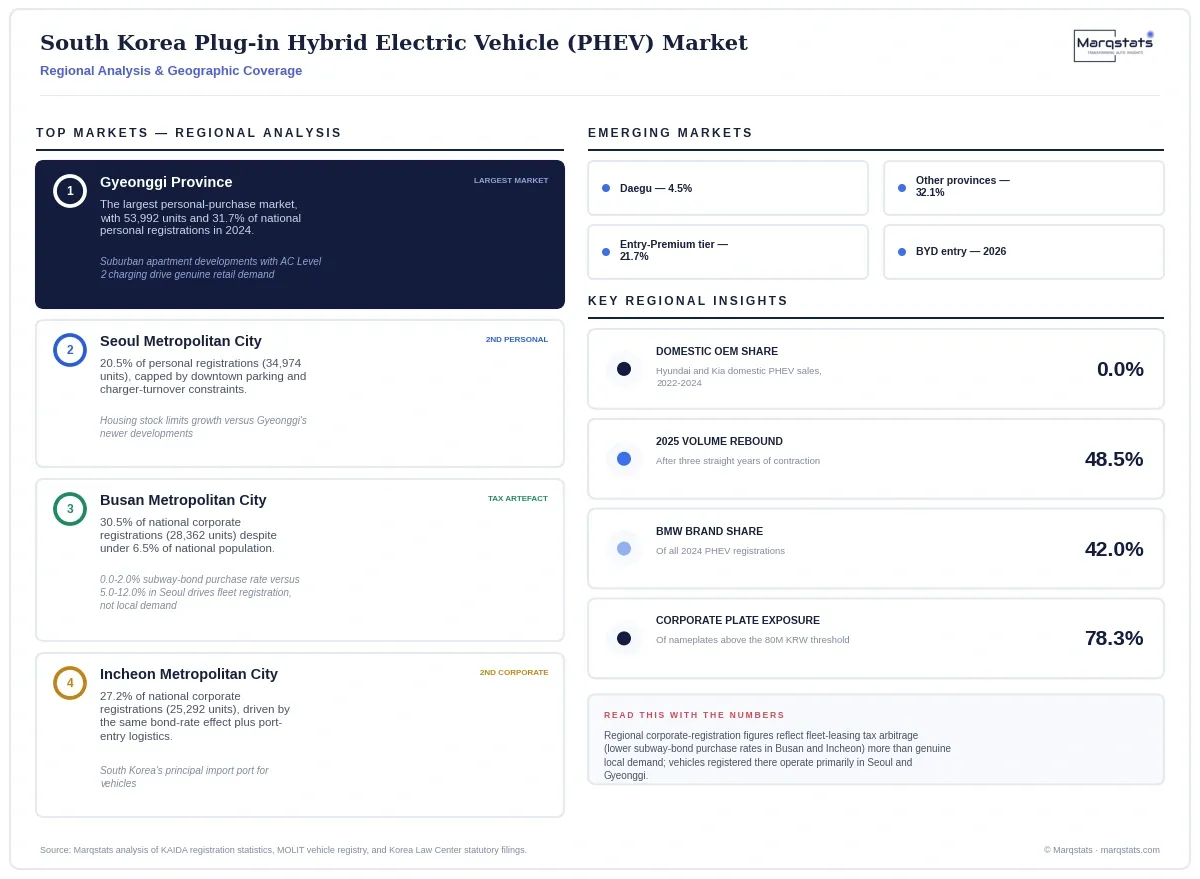
Gyeonggi Province is where South Korea's genuine personal PHEV demand actually lives. The province absorbed 31.70% of national personal-purchase registrations in 2024 (53,992 units), the highest of any region, concentrated in suburban master-planned developments with multi-family apartment complexes that carry AC Level 2 charging infrastructure — the exact charging access this report identifies as the binding constraint on PHEV adoption elsewhere in the country.
Seoul Metropolitan City
Seoul is the second-largest personal-retail market, holding 20.50% of 2024 personal registrations (34,974 units), but its growth is structurally capped by its own housing stock. Downtown parking garage congestion and high charger turnover rules constrain PHEV expansion in ways Gyeonggi's newer apartment developments do not face, so Seoul's personal share trails Gyeonggi's despite the city's larger population and higher average income.
Busan Metropolitan City
Busan Metropolitan City is where the regional data stops describing consumer demand and starts describing tax arbitrage. The city recorded 30.50% of national corporate PHEV registrations (28,362 units, all-import basis) despite holding under 6.5% of South Korea's population, a pattern driven by municipal subway-bond purchase requirements of 0.0%-2.0%, against 5.0%-12.0% in Seoul; national leasing providers register fleet vehicles in Busan for the lower bond cost while the vehicles themselves operate primarily in Seoul and Gyeonggi.
Incheon Metropolitan City
Incheon Metropolitan City is the second-ranked corporate registration region, recording 27.20% of the national corporate total in 2024 (25,292 units, all-import basis), driven by the same lower subway-bond purchase requirement that pulls corporate registrations toward Busan. Incheon's status as South Korea's principal port of entry for imported vehicles adds a second, distinct pull: pre-delivery inspection and fleet-leasing operations are already concentrated there for logistics reasons independent of the tax effect.
Other Regional Provinces
The remaining provinces collectively hold 32.10% of personal registrations and 30.90% of corporate registrations, dispersed across Gangwon, Chungcheong and Jeolla with no single province individually exceeding the top four. This dispersion is consistent with genuine, if thin, adoption outside the Seoul Capital Area rather than a second concentration effect.
How Competition Is Evolving
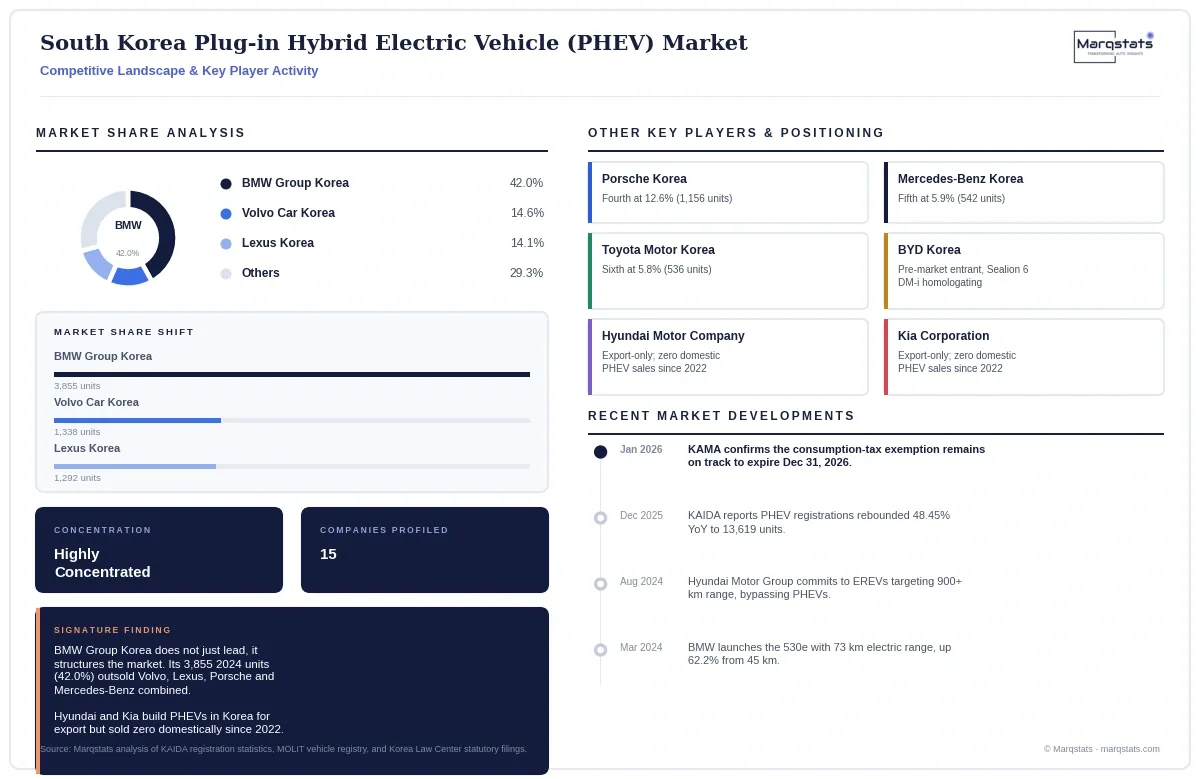
South Korea's PHEV market is highly concentrated by any standard measure: the top three brands, BMW Group Korea Co., Ltd. (42.02%), Volvo Car Korea Co., Ltd. (14.58%) and Lexus Korea (14.08%), together held 70.68% of 2024 registrations, and BMW alone outsold the combined total of Lexus Korea, Porsche Korea Co., Ltd., Mercedes-Benz Korea Co., Ltd. and Toyota Motor Korea Co., Ltd. Concentration this severe in a market with no dominant domestic incumbent is unusual, and it reflects the narrowness of the buyer base as much as any one brand's strategy: with demand confined almost entirely to buyers who can afford 75,000,000 KRW or more, the addressable customer pool for a new entrant is structurally small before any competitive dynamic is considered.
Firms compete here primarily on certified electric range and corporate-fleet trim structuring rather than on headline price. BMW Group Korea Co., Ltd.'s 62.2% range expansion on the eighth-generation 530e is the clearest example: it did not reprice the model, it made the existing price defensible by making the car usable as a genuine daily electric commuter. Separately, several importers now offer Entry-Premium trims specifically structured to land under the Ministry of Land, Infrastructure and Transport's 80,000,000 KRW corporate plate threshold, a response to Finding 3's fleet-share decline rather than to consumer price sensitivity.
The most consequential competitive move in this market did not come from an existing importer. BYD Korea Co., Ltd.'s planned Sealion 6 DM-i, entering at an estimated 42,000,000 KRW, is the first credible attempt to compete below the Entry-Premium tier rather than within it, and it tests a segment no current importer has proven exists. Separately, Hyundai Motor Group's August 2024 commitment to Extended Range Electric Vehicles (EREVs) signals that the domestic manufacturers with the deepest South Korean distribution network have chosen not to compete in PHEVs at all, leaving the entire category, present and future, to imports.
Companies Covered
The report profiles 15+ companies with full strategy and financials analysis, including:
Recent Market Activity
Table of Contents
Coverage & Segmentation
This study covers new-vehicle plug-in hybrid electric vehicle (PHEV) registrations and retail transaction value in South Korea from 2020 through 2030, sized on a retail transaction basis inclusive of individual consumption tax, education tax and value-added tax, denominated in South Korean Won and converted to United States Dollars at 1,350 KRW per USD. The base year is 2024, the most recent year with a complete, published KAIDA annual registration series available at the time of research; 2025 figures are published but sit outside the historical averaging window used for the forecast build. PHEVs are defined under Article 2, Paragraph 5 of the Act on the Development and Promotion of Environment-Friendly Motor Vehicles and verified against the Clean Air Conservation Act; mild hybrid electric vehicles using 48-volt architectures and conventional hybrids without external charging capability are excluded.
This report does not cover South Korea's broader hybrid vehicle (HEV) market, which registered 454,000 units in 2024 against this report's 9,174 PHEV units and is covered separately in the Marqstats South Korea Hybrid Vehicle (HEV) Market report. It also does not cover Extended Range Electric Vehicles (EREVs), the technology Hyundai Motor Group has committed to for 2026/2027 domestic commercialization; EREVs use a generator engine with no mechanical drivetrain connection and are a structurally distinct category from a PHEV, and will be covered in a separate report once commercial volumes exist. Regional or province-level PHEV data below the level published by KAIDA — for example, PHEV-specific corporate registrations broken out by province beyond Busan and Incheon — is not available from any permitted source and is out of scope for this reason rather than by design.