Market Snapshot
Key Takeaways
Market Overview & Analysis
Report Summary
The Thailand luxury car market is defined less by what buyers want than by what the tax code allows a manufacturer to charge, and in 2025 and 2026 that structure moved decisively against the marques that have led the segment for three decades. Thailand's luxury tier is not shrinking. It is being recomposed, and the composition change is visible in registration data quarter by quarter rather than as a forecast.
The measure is new luxury passenger car registrations in Thailand, covering established premium marques and the electric challenger marques positioned against them, valued at blended transaction value at a disclosed constant THB 32.5 per USD. Commercial vehicles, luxury pickups and the used and grey import trade are excluded. The electric portion of the universe sits inside Thailand's national battery electric registration series and is never added to it.
The analysis is written for manufacturers deciding whether Thai assembly is worth its fixed cost, distributors holding franchises whose tier position is being contested, policymakers weighing an excise overhaul against an eight-decade-old duty wall, and investors pricing a premium market where unit growth and value growth point in different directions.
Thailand Luxury Car Market Size and Forecast
Registrations are measured at 44,348 units in 2025, estimated at 46,420 units in 2026 and forecast at 71,400 units by 2030, an increase of 27,052 units a year. Market value moves from USD 3.98 billion through a USD 3.69 billion trough in 2026 to USD 5.36 billion, on a blended transaction value falling from THB 2.914 million to THB 2.442 million, or USD 89,661 to USD 75,130 at a constant THB 32.5 per USD.
Two growth rates apply and the gap between them is a mix effect rather than a policy step. The five-year value rate connecting 2025 and 2030 is 6.13%; the four-year rate connecting 2026 and 2030 is 9.78%. The 3.65-point gap runs the opposite way to most pages in the catalogue because 2026 is a trough rather than a step, with value falling 7.29% while units rise 4.67%, as the established tier contracts faster than the challenger tier can replace its revenue per unit.
Value compounds 3.86 points behind volume at 6.13% against 9.99%, and the mechanism is tier mix rather than discounting. A unit leaving the established tier is worth THB 3.676 million on average and the unit replacing it from the challenger tier is worth THB 1.752 million, so each substitution removes THB 1.924 million of market value while leaving the unit count unchanged. The same inversion holds across the narrower window, where units compound at 11.36% against a 9.78% value rate.
Tier share is the series that makes the forecast assessable. Established marques hold 26,785 units or 60.40% in 2025 and 30,400 units or 42.58% by 2030; electric challengers hold 17,563 units or 39.60% rising to 41,000 units or 57.42%. The terminal assumes the established tier stabilises and grows 13.50% in aggregate over five years, which is a recovery assumption rather than a decline one.
A sizing range is published rather than a point. The 2030 figure sits within a band of 62,000 to 80,500 units and USD 4.62 billion to USD 6.19 billion, corresponding to value rates of 3.03% and 9.23%, and the spread turns on how much of the imported established tier converts to local assembly and at what price.
The Double Count That Overstates This Market by 11.16%
Thailand publishes two premium registration tables and they overlap. The premium brand table recorded 31,734 units in 2025 across eight marques, down 8.1% from 34,540. The semi-premium electric table recorded 17,563 units across seven marques. Tesla's 4,949 registrations appear in both at an identical figure, so the tables sum to 49,297 against a true universe of 44,348.
The classification is also unstable across periods, which is the more damaging problem. Tesla sits at rank three in the full-year 2025 premium table at 15.6% share, and is absent from the first-quarter 2026 premium table entirely, having been moved to the electric list. A series built by taking the premium table year on year therefore compares a universe containing Tesla with one that does not, and reports a decline that is partly a definitional change.
The reconciled universe used here assigns each marque to exactly one tier for every period. The established tier carries BMW at 10,611 units, Mercedes-Benz at 8,376, Volvo at 2,652, Porsche at 1,826, MINI at 1,665, Lexus at 889 and Audi at 766, totalling 26,785. The challenger tier carries Tesla at 4,949, Denza at 3,117, XPeng at 2,786, Zeekr at 2,668, Hyptec at 2,091, IM at 1,258 and Avatr at 694, totalling 17,563.
The Tax Wall Is 80% and the Chinese Tier Walks Around It
A fully imported luxury car entering Thailand pays 80% import duty on the landed value, then excise of 30% to 50% depending on engine displacement and carbon dioxide output calculated on the duty-inclusive figure, then an interior tax at 10% of the excise, then value-added tax at 7% on everything above. The stack compounds to roughly 2.77 times landed cost before any dealer margin, and retail prices commonly reach three times the home-market equivalent.
Vehicles built in China enter at 0% duty under the ASEAN-China free trade agreement, which removes the first and largest multiplier entirely. The result is visible in the price list rather than in a trade statistic: a Porsche Taycan lists at THB 14,490,000 while a locally assembled BMW iX3 lists at THB 2,859,000, a 5.07 times spread between two battery electric vehicles of broadly comparable class.
The same asymmetry appears inside a single brand. Mercedes-Benz sells an imported EQS 450+ at THB 8,570,000 and a locally assembled CLA 250+ at THB 2,290,000, a 3.74 times spread that owes more to assembly route than to the vehicles themselves. Thailand's luxury pricing is a tariff schedule expressed as a product range.
Local Assembly Cuts 30.01% off an Identical Car
The clearest evidence that duty rather than product sets Thai luxury pricing arrived on 26 January 2026, when BMW began assembling the i5 eDrive40 M Sport at BMW Group Manufacturing Thailand in Rayong. The price fell from THB 4,999,000 to THB 3,499,000, a reduction of THB 1,500,000 worth 30.01%, on a vehicle offering 627 kilometres of WLTP range, 250 kilowatts and a 6.0 second acceleration figure.
BMW has been building the supporting supply chain for several years rather than reacting to a single rule. A high-voltage battery assembly plant in Rayong carrying THB 1.6 billion of investment across 4,000 square metres began production in the second half of 2025, converting imported cells into modules, and the group has manufactured high-voltage batteries in Thailand since 2019. The Rayong plant built more than 12,000 cars and nearly 11,000 motorcycles in 2023 across about two dozen models.
Mercedes-Benz reached the same conclusion by a longer route. Assembly at the Thonburi Automotive Assembly Plant dates to 1979, the 200,000th locally assembled vehicle was completed in January 2024, and the contract runs a further 10 years covering 13 models including the Maybach S-Class and the EQS. The electric CLA 250+ launched locally assembled at THB 2,290,000 on 27 March 2026 and took more than 300 units in its first two months against a backlog above 1,350.
The Challenger Tier Is 14.60% of a Market That Grew 80.27%
The electric challenger tier is not a luxury phenomenon that happens to be electric. It is the top end of Thailand's battery electric market, which reached 120,301 registrations in 2025 on 80.27% growth, and the 17,563 challenger units represent 14.60% of that total. The tier grows because the national electric market grows, and it competes on price against established marques whose electric offerings sit two to five times higher.
Luxury is also structurally over-indexed on battery electric propulsion. Battery electric vehicles are an estimated 22,663 of the 44,348 luxury units in 2025, or 51.10%, against 120,301 of 604,755 total car registrations nationally, or 19.89%. The luxury tier is 2.57 times more electrified than the Thai market as a whole, which inverts the usual relationship in which premium segments adopt new powertrains last.
Distribution is consolidating behind that shift. Geely established a single Thai company effective 1 January 2026 managed directly from China, covering Geely, Zeekr and Riddara, with Geely positioned below THB 1 million and Zeekr explicitly above it as the premium marque, and Zeekr Thailand rebranding in the second half of 2026. XPeng sold about 3,000 units in 2025 against 2,786 registrations, targets 6,000 in 2026, operates 20 showrooms with three more planned, and has a Thai production feasibility study underway.
The Crossover Is Already Nearly Complete on Quarterly Data
First-quarter 2026 registrations show the two tiers 149 units apart. Established marques recorded 6,518 units against 8,053 a year earlier, a 19.1% decline, with BMW at 2,622 and Mercedes-Benz at 2,000. Electric challengers recorded 6,369 units against 4,258, a 49.6% increase, with Tesla at 2,087, Zeekr at 1,440 and XPeng at 1,325.
The combined universe grew 4.68% over the same quarter, from 12,311 to 12,887 units, which is the single most important number on the page. Thailand's luxury market is not contracting. Roughly a fifth of the established tier's volume moved to the challenger tier inside twelve months while the total held, and a manufacturer reading only its own tier's table would conclude the opposite.
Churn within the challenger tier is severe enough to complicate any single-brand forecast. Denza fell 75.1% to 361 units and Hyptec fell 39.8% to 580 in the first quarter of 2026, while Tesla rose 232.3%, XPeng rose 259.1% and Zeekr rose 114.0%, with IM entering at 455 units. Tier share is durable; brand share within the tier is not.
A Third Published Definition, and Why It Strengthens the Reconciliation
A third incompatible premium definition circulates alongside the two registration tables, and its existence is the best argument for the reconciliation this page performs. BMW Group Thailand reported 12,247 registrations across BMW and MINI for 2025 with a 47% premium share and a sixth consecutive year of leadership, which implies a premium universe of roughly 26,057 units, against a separately cited Thai premium market of around 32,000 units and the published table's 31,734.
The marque detail within that reporting is unusually complete and it corroborates the figures used here. BMW brand registrations were 10,582 units at 40.5% premium share including 1,261 battery electric vehicles or 24.2% of the premium electric segment; MINI recorded 1,665 units, up 15%, of which 1,104 were battery electric, up 372%, at 21.2% of the premium electric segment; and the group held 45% of premium battery electric with deliveries up 43%. Mercedes-Benz recorded 8,378 units, down around 800 year on year.
Three definitions producing three answers for the same year is not a data problem to be averaged away, it is the reason a single reconciled universe has to be constructed and disclosed. Every share on this page is taken against 44,348 units, and the marque figures above sit within one or two units of the registration table used to build it.
The Chinese Premium Entry Is Priced and Dated
Chinese premium marques entered Thailand in 2026 at price points that make the established tier's cost base visible. Hongqi launched the E-HS9 at THB 2.99 million for its first 400 units with a 120 kWh battery and a dealer network heading to 10 within three years, while NIO's firefly launched in right-hand drive from THB 799,000 through Thonburi BlueSky, which is a European-adjacent product at a quarter of the established tier's blended transaction value.
The established tier is answering at the top of its range rather than the bottom. BMW's iX3 50 xDrive M Sport, imported from China, lists from THB 3,599,000 with 805 kilometres of WLTP range, and local production at Rayong is under consideration, which would repeat the i5 arithmetic on a second model.
Order intake at the 2026 Bangkok International Motor Show shows the contest is already close. Zeekr took 2,339 bookings and Mercedes-Benz 2,111, with XPeng at 2,089, AVATR at 1,435 and BMW at 1,001, within a show total of 132,951. A Chinese challenger outbooking every established marque at the country's principal retail event is the clearest forward indicator available of the crossover this page forecasts.
Product risk is the counterweight and it is not theoretical. Volvo suspended EX30 sales in Thailand after battery overheating fires, recalling 1,668 units against 45 customer complaints, which is a reminder that a tier being rebuilt on new entrants carries validation risk the incumbents spent decades retiring.
Market Dynamics
Key Drivers
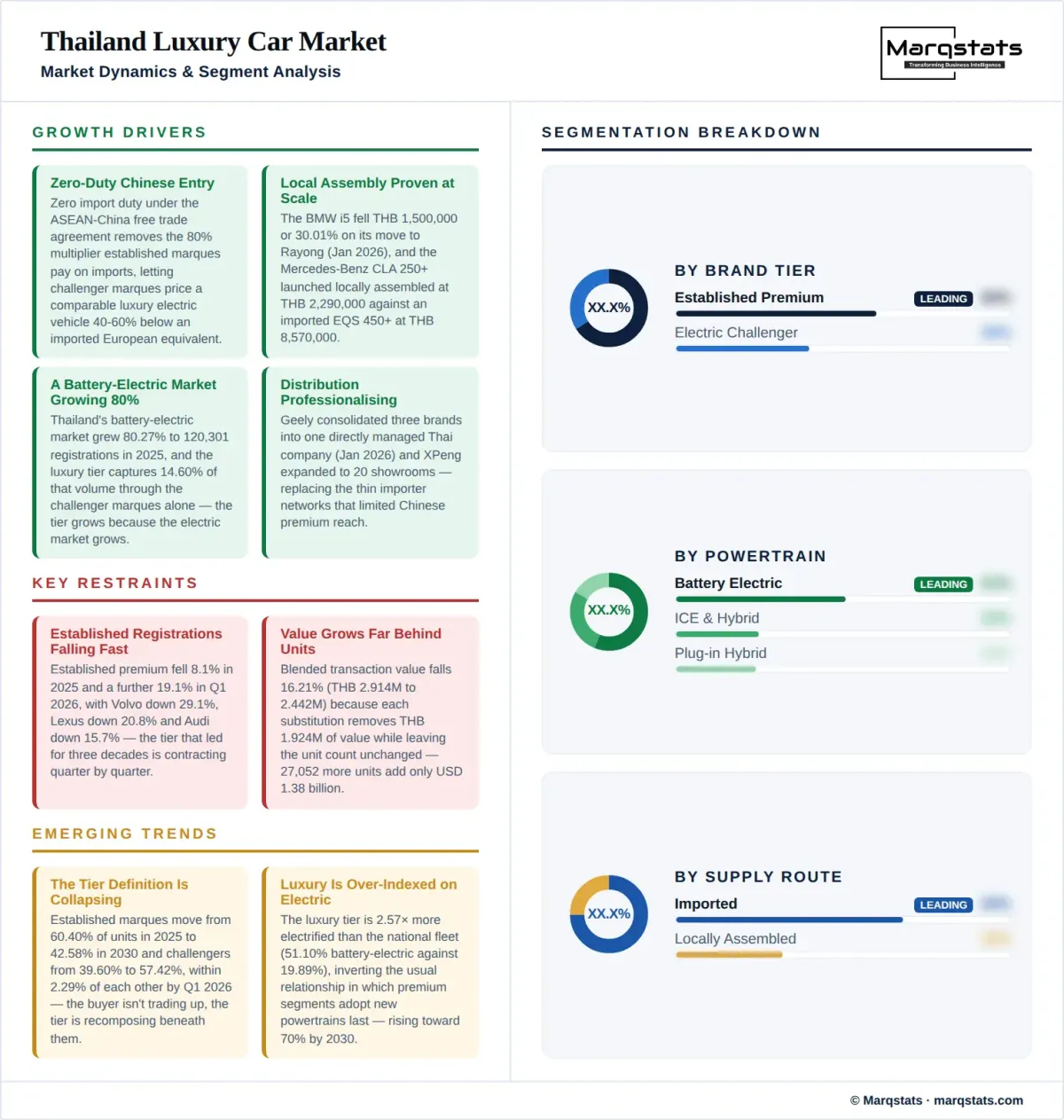
- Zero import duty under the ASEAN-China free trade agreement removes the 80% multiplier that established marques pay on fully imported vehicles, letting challenger marques price a comparable luxury electric vehicle 40% to 60% below an imported European equivalent.
- Local assembly economics are now proven at scale, with the BMW i5 falling THB 1,500,000 or 30.01% on the move to Rayong and the Mercedes-Benz CLA 250+ launching locally assembled at THB 2,290,000 against an imported EQS 450+ at THB 8,570,000.
- Thailand's battery electric market grew 80.27% to 120,301 registrations in 2025 and is projected near 250,000 units in 2026, and the luxury tier captures 14.60% of that volume through the challenger marques alone.
- Distribution is professionalising as Geely consolidated three brands into one directly managed Thai company from 1 January 2026 and XPeng expanded to 20 showrooms with three more planned, replacing the thin importer networks that limited Chinese premium reach.
- The luxury tier is 2.57 times more electrified than the national fleet at 51.10% battery electric against 19.89%, so every incremental electric model lands in the segment already most receptive to it.
Key Restraints
- Established premium registrations fell 8.1% in 2025 to 31,734 on the published basis and a further 19.1% in the first quarter of 2026, with Volvo down 29.1%, Lexus down 20.8% and Audi down 15.7% across the full year.
- Blended transaction value falls 16.21% from THB 2.914 million to THB 2.442 million, so the market adds 27,052 units between 2025 and 2030 while adding only USD 1.38 billion of value.
- The excise overhaul being finalised toward September 2026 would raise rates on fully built-up imports without accompanying Thai production, which reaches established marques importing top-of-range models and challenger marques alike.
- Brand volatility inside the challenger tier is extreme, with Denza down 75.1% and Hyptec down 39.8% in a single quarter, making franchise investment and residual value assumptions difficult to underwrite.
Key Trends
- The tier crossover moves established marques from 60.40% of units in 2025 to 42.58% in 2030 and challengers from 39.60% to 57.42%, with quarterly data showing the two within 2.29% of each other by the first quarter of 2026.
- Local content is migrating upward through the range, from the 13 Mercedes-Benz models assembled at Thonburi including the Maybach S-Class to BMW's THB 1.6 billion Rayong battery plant supporting locally built electric vehicles.
- Chinese challenger marques are studying Thai assembly rather than remaining importers, with XPeng running a feasibility study on a joint venture facility and Geely weighing parent-company investment or outsourced local assembly.
- Value and volume have decoupled, with 2026 recording a 7.29% contraction in value against 4.67% unit growth, a pattern that makes revenue-based and registration-based views of the same market disagree on direction.
Market Segmentation
BMW, Mercedes-Benz, Volvo, Porsche, MINI, Lexus and Audi together recorded 26,785 registrations in 2025, or 60.40% of the reconciled universe, down from 30,420 units on the same basis in 2024. BMW led for a sixth consecutive year at 10,611 units, with Mercedes-Benz at 8,376 and a combined top-two share of 42.81%. The tier's defence is assembly depth rather than price, and its 2030 position of 30,400 units assumes that defence works.
Tesla, Denza, XPeng, Zeekr, Hyptec, IM and Avatr recorded 17,563 registrations in 2025, or 39.60% of the universe, and grew 49.6% year on year in the first quarter of 2026 to 6,369 units. Every marque in the tier is battery electric and every one enters at 0% import duty, which is the entire basis of a price position running 40% to 60% below imported European equivalents. The tier is forecast at 41,000 units and 57.42% share by 2030.
Tesla's 4,949 registrations in 2025 rose 20.1% in a market that fell 8.1%, and the marque is the only one Thai publishers place in both tables, which is why adding them overstates the market by 11.16%. Tesla is treated here as a challenger marque for every period, because it is imported at 0% duty from China and priced from THB 1,149,000 for a Model 3 Standard, alongside a Model Y Long Range at THB 2,019,000. First-quarter 2026 registrations of 2,087 units represent 32.8% of the challenger tier.
Battery electric vehicles account for an estimated 22,663 luxury registrations in 2025, or 51.10% of the universe, comprising all 17,563 challenger units and roughly 5,100 established-marque units. That figure is 18.84% of Thailand's 120,301 battery electric registrations, so the luxury tier is 2.57 times over-indexed against its 7.33% share of the total car market. The share rises toward 70% by 2030 on the tier crossover alone.
Plug-in hybrids account for an estimated 10,600 luxury registrations in 2025, or 23.90%, concentrated almost entirely in BMW and Mercedes-Benz ranges assembled locally at Rayong and Thonburi. Mercedes-Benz reported 34% growth in its plug-in hybrid segment in the first half of 2026, making it one of the few established-tier lines growing against a 19.1% tier decline. Imported plug-in hybrid excise rising toward 15% from 1 January 2026 falls on the imported portion of this segment rather than the assembled one.
Conventional and mild hybrids account for an estimated 4,200 luxury registrations in 2025, or 9.47%, with Lexus supplying the largest single share of a marque total that fell 20.8% to 889 units. The segment is structurally squeezed from both sides, lacking the excise advantage that battery electric vehicles hold and the range flexibility that plug-in hybrids offer, and it is forecast to shrink in absolute terms through 2030.
Pure internal combustion vehicles account for an estimated 6,885 luxury registrations in 2025, or 15.53%, concentrated in Porsche at 1,826 units, high-displacement Mercedes-Benz and BMW models and the ultra-luxury range. This is the segment carrying the full excise burden of 30% to 50% by displacement and carbon dioxide band, rising to 50% above 3,000cc, and it holds position on products for which no electric substitute exists rather than on price.
The entry band accounts for an estimated 12,900 registrations in 2025, or 29.09%, and effectively did not exist in the Thai luxury market five years ago. It is populated almost entirely by challenger marques, with a Tesla Model 3 Standard at THB 1,149,000, an XPeng G6 from THB 1,189,000 and a Model 3 Long Range at THB 1,599,000, and it is the band pulling blended transaction value down 16.21% across the forecast.
The core band accounts for an estimated 19,600 registrations in 2025, or 44.20%, and is where the two tiers now meet directly. A locally assembled Mercedes-Benz CLA 250+ at THB 2,290,000 and a BMW iX3 at THB 2,859,000 compete against an XPeng X9 from THB 2,399,000 and Zeekr and IM models in the same range. Local assembly is what allows established marques to hold this band at all.
The upper band accounts for an estimated 8,800 registrations in 2025, or 19.84%, and is the band most directly reshaped by assembly decisions. The BMW i5 eDrive40 M Sport entered it from above on 26 January 2026 when local assembly cut THB 1,500,000 from a THB 4,999,000 price, and the 30.01% reduction moved a flagship electric saloon into a volume position it could not previously reach.
The top band accounts for an estimated 3,048 registrations in 2025, or 6.87%, and carries the highest tax multiple in the market at roughly 2.77 times landed cost. A Mercedes-Benz EQS 450+ at THB 8,570,000 and a Porsche Taycan at THB 14,490,000 illustrate the range. Mercedes-Benz reported Maybach volumes up 83% and G-Class up 100% in the first half of 2026, so the band is growing in units even as the tiers below it deflate.
Locally assembled vehicles account for an estimated 14,200 luxury registrations in 2025, or 32.02%, produced at BMW Group Manufacturing Thailand in Rayong and the Thonburi Automotive Assembly Plant, which together cover about two dozen BMW and MINI models and 13 Mercedes-Benz models up to the Maybach S-Class. The share rises to an estimated 43.42% by 2030 as established marques extend assembly and challenger marques begin localising.
Fully imported vehicles account for an estimated 30,148 luxury registrations in 2025, or 67.98%, split between European models carrying the 80% duty and Chinese models carrying none. That split is the reason a single supply-route share conceals two opposite economics, and it is also the exposure that an excise overhaul raising rates on imports without local investment would land on hardest.
Sport utility vehicles and crossovers account for an estimated 21,300 luxury registrations in 2025, or 48.03%, and carry the segment's highest average transaction value outside the ultra-luxury band. The body type dominates both tiers simultaneously, running from a BMW iX1 at THB 2,359,000 and iX3 at THB 2,859,000 to a Zeekr X and an XPeng G6 from THB 1,189,000, which is why it is the most directly contested format in the market.
Sedans account for an estimated 15,900 luxury registrations in 2025, or 35.85%, and remain disproportionately important in Thailand relative to most Asian luxury markets. The format carries the two most consequential launches of 2026, the locally assembled Mercedes-Benz CLA 250+ at THB 2,290,000 and the repriced BMW i5 eDrive40 M Sport at THB 3,499,000, and both are electric.
Multi-purpose vehicles and luxury vans account for an estimated 4,600 luxury registrations in 2025, or 10.37%, a share well above the global luxury average and driven by chauffeur-driven business use in Bangkok. Mercedes-Benz reported V-Class volumes up 14% and Sprinter up 83% in the first half of 2026, while challenger entries including the XPeng X9 from THB 2,399,000 and Zeekr 009 attack the format directly.
Coupes, convertibles and sports cars account for an estimated 2,548 luxury registrations in 2025, or 5.75%, the smallest segment and the one least exposed to the tier crossover. Porsche registrations rose 7.1% to 1,826 units in a market down 8.1%, and the format's resilience rests on there being no challenger-marque equivalent at any price rather than on any tax or assembly advantage.
By Geography
Bangkok Metropolitan Region
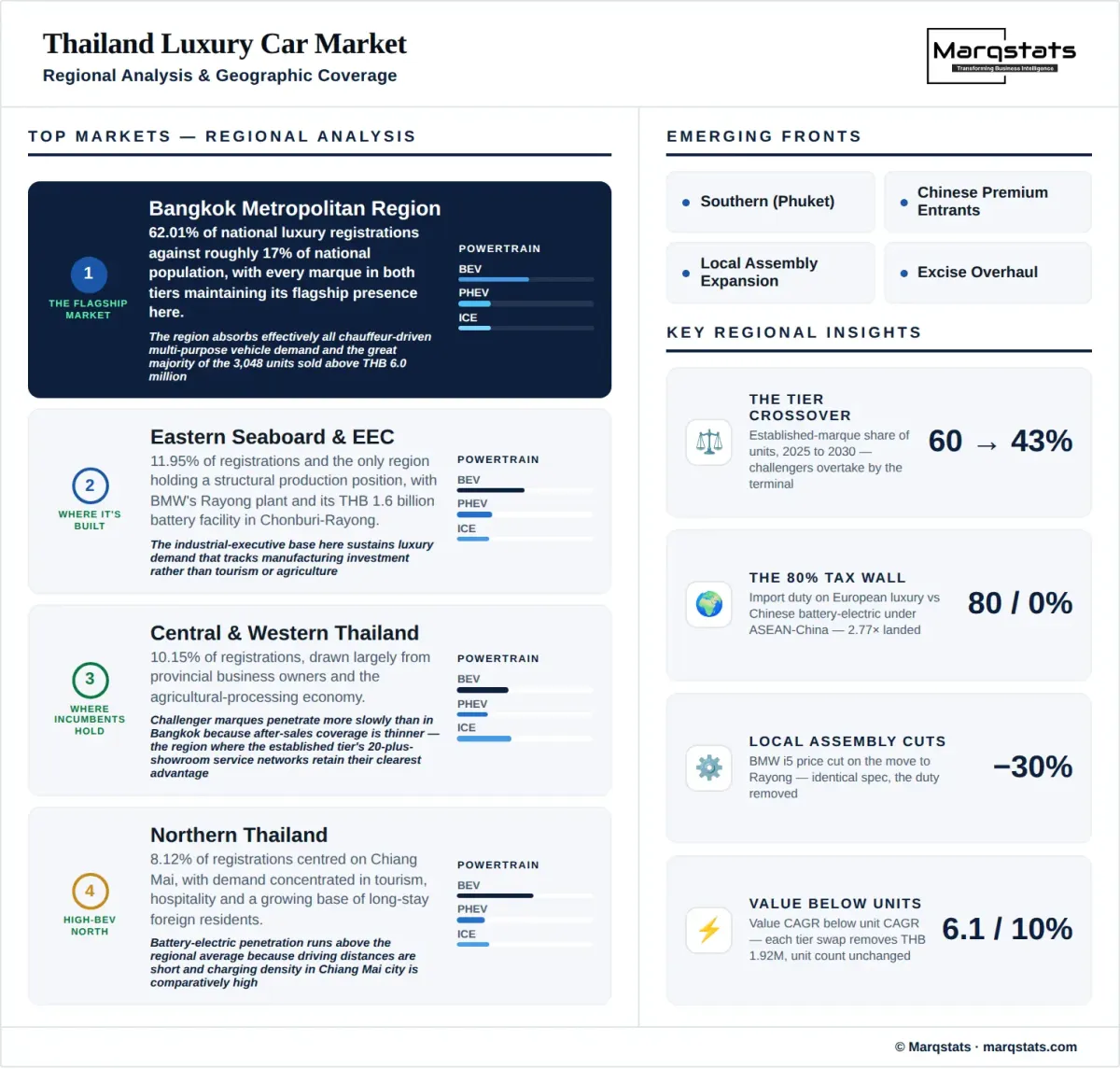
Greater Bangkok accounts for an estimated 27,500 luxury registrations in 2025, or 62.01% of the national total, a concentration far above its roughly 17% share of national population. Every marque in both tiers maintains its flagship presence here, and the region absorbs effectively all chauffeur-driven multi-purpose vehicle demand and the great majority of the 3,048 units above THB 6.0 million.
Eastern Seaboard and the Eastern Economic Corridor
The eastern provinces account for an estimated 5,300 luxury registrations in 2025, or 11.95%, and hold a structural position no other region shares. BMW Group Manufacturing Thailand and its THB 1.6 billion battery plant sit in Rayong, and the industrial executive base across Chonburi and Rayong sustains luxury demand that tracks manufacturing investment rather than tourism or agriculture.
Central and Western Thailand
The central and western provinces account for an estimated 4,500 luxury registrations in 2025, or 10.15%, drawn largely from provincial business owners and the agricultural processing economy. Challenger marques penetrate this region more slowly than Bangkok because after-sales coverage is thinner, and it is where the established tier's 20-showroom-plus service networks retain their clearest advantage.
Northern Thailand
The northern provinces centred on Chiang Mai account for an estimated 3,600 luxury registrations in 2025, or 8.12%, with demand concentrated in tourism, hospitality and a growing residential base of long-stay foreign residents. Battery electric penetration here runs above the regional average because driving distances are short and charging density in Chiang Mai city is comparatively high.
Southern Thailand
The southern provinces account for an estimated 3,448 luxury registrations in 2025, or 7.77%, concentrated in Phuket, Surat Thani and Hat Yai. Phuket alone carries a disproportionate share of the region's top-band volume through resort, hospitality and expatriate demand, and the region's luxury mix skews toward sport utility vehicles and convertibles more heavily than any other.
How Competition Is Evolving
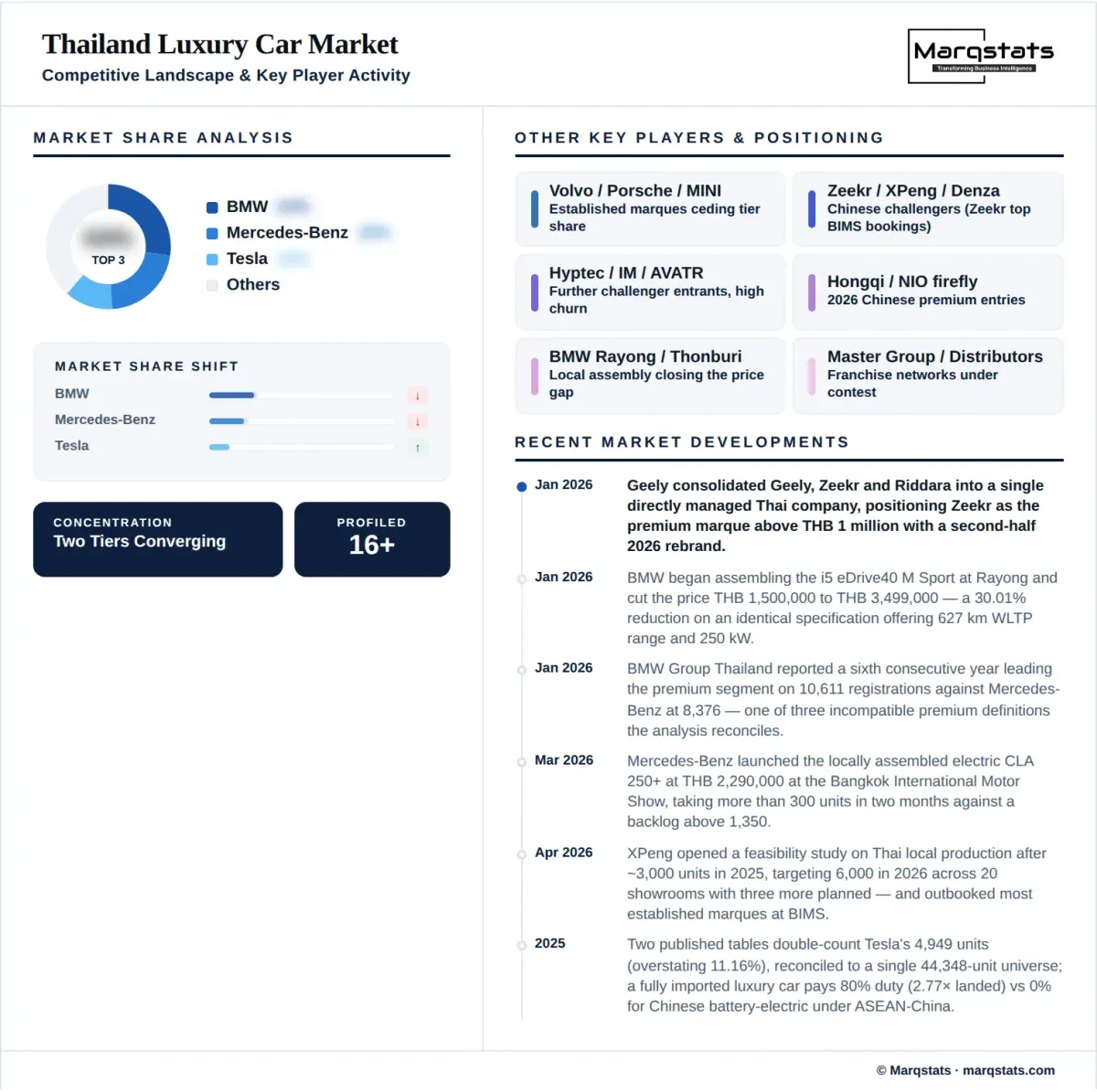
The Thailand luxury car market is moderately fragmented and becoming more so. The top two marques hold 42.81% of the reconciled 44,348-unit universe and the top four hold 61.00%, but fourteen marques now register meaningful volume against seven five years ago, and the seven new entrants have taken 39.60% of the market between them without any of them individually exceeding 11.16% share.
Competition is not running on product attributes in the way luxury competition usually does. The established tier competes on assembly depth, after-sales network and residual value, all of which take years to build and none of which a first-year entrant can claim. The challenger tier competes on a duty exemption worth 80% of landed value and on specification density at a given price, and neither advantage requires any local investment at all. That asymmetry is the market's defining competitive feature and it is also its least stable one, because it depends entirely on a trade agreement and an excise schedule that the government is actively reviewing toward September 2026.
Consolidation is already visible on the distribution side. Geely folded Geely, Zeekr and Riddara into a single directly managed Thai entity from 1 January 2026 with explicit price-band positioning above and below THB 1 million, and ruled out a fourth brand on product overlap grounds. XPeng is evaluating a joint venture production facility that would become its second in Southeast Asia. Established marques are moving the other way, deepening rather than broadening, with Mercedes-Benz extending its Thonburi contract a further 10 years across 13 models and BMW localising high-voltage battery assembly.
Companies Covered
The report profiles 15+ companies with full strategy and financials analysis, including:
Recent Market Activity
Table of Contents
Coverage & Segmentation
This analysis measures new luxury passenger car registrations in Thailand from 2021 to 2030, with 2025 as the base year and 2026 to 2030 as the forecast period, valued at blended transaction value at a disclosed constant THB 32.5 per USD. The universe is a single reconciled tier covering established premium marques and the electric challenger marques positioned against them, constructed so that no marque is counted twice, because Thailand's two published premium tables overlap on Tesla and their sum overstates the market by 11.16%. Commercial vehicles, luxury pickup trucks, motorcycles and the used and grey import trade are excluded. The battery electric portion of the universe sits inside Thailand's national battery electric registration series and is never added to it.
Coverage spans three brand tiers, four powertrains, four price bands, two supply routes and four body types, with five regional clusters analysed on registration concentration and dealer network distribution. Registrations are carried as the volume series at 44,348 units in 2025 and blended transaction value as a derived series at THB 2.914 million, and both are published alongside the value panel because a market being recomposed by tier substitution moves in mix rather than in price. Fifteen entities are profiled across established manufacturers, challenger manufacturers, and the Thai assembly and distribution companies through which both reach the market.