Market Snapshot
Middle bar: base-year value × (1 + CAGR), rounded to two decimals. This is a calculated illustration, not a separately researched annual estimate.
The India e-cart market size is estimated at USD 0.19 billion in 2025 and is projected to reach USD 0.29 billion by 2030, at a CAGR of 8.83%. An e-cart is a battery-operated goods three-wheeler capped at 2,000 watts, 310 kilograms of payload and 25 km/h under the Central Motor Vehicles Rules. Operating cost drives adoption: an e-cart runs at INR 0.4 to INR 0.8 per kilometre against INR 2.7 to INR 3.6 for a diesel three-wheeler. India registered 86,466 e-carts in FY2026 — more than all electric buses, trucks and light commercial vehicles combined — and no manufacturer holds above 7% share.
Market size and forecast figures are generated using Marqstats' proprietary estimation framework, updated as of August 2026.
The e-cart is the largest electric goods-vehicle segment in India by units and the least covered. Registrations reached 86,466 in FY2026, up 32.9% year on year and 2.1 times the FY2024 level, against 14,803 electric goods carriers of every larger class combined. Measured on the calendar-year series that runs back to 2018, volumes have compounded at 62.9% a year, from 2,739 units to 83,400. The segment now accounts for 73% of all electric three-wheeler cargo registrations in India, and electrification of the three-wheeler cargo market as a whole crossed the halfway mark in 2025 at 51.9%.
What makes the market unusual is that none of this was bought with subsidy. Under PM E-DRIVE the entire registered e-rickshaw and e-cart class received an allocation of INR 50 crore against 39,034 units, roughly INR 12,800 a vehicle. The faster L5 electric three-wheeler class received INR 857 crore against 288,809 units, roughly INR 29,700 a vehicle — 2.3 times the per-unit support for a segment selling a fraction of the volume. In August 2025 the government moved a further INR 142 crore away from e-rickshaws and e-carts and into the L5 pool, cutting the class allocation by 73%. The L5 allocation was exhausted and closed on 26 December 2025. The e-cart allocation had drawn just 5,267 units, 13% of its target, and was extended to March 2028 — an extension granted because the money was not being spent, not because the segment was being favoured.
The economics explain the divergence. An e-cart costs INR 1.0 to 1.5 lakh against INR 3.0 to 4.5 lakh for an L5 electric cargo three-wheeler and INR 2.45 lakh for a diesel equivalent. It needs no transport permit, having been exempted from section 66(1) of the Motor Vehicles Act in 2016, and its driver needs only a ten-day certified training course rather than a standard commercial licence. It runs at a fifth of diesel's energy cost. Against that it carries 310 to 500 kilograms at 25 km/h, which confines it to short, flat, intra-neighbourhood work. The e-cart is not competing with the L5 class. It is competing with the hand-cart, the cycle-rickshaw and porterage labour, and that is why its price ceiling sits near INR 1.5 lakh and why the segment has never been branded.
Scope for this study covers new e-cart sales, replacement battery demand from the operating fleet, and spares and service, across the vehicle class registered in India as e-Rickshaw with Cart (Goods). Passenger e-rickshaws, faster L5N electric cargo three-wheelers, electric two-wheelers and all four-wheeled electric goods vehicles fall outside scope.
Key Takeaways
Market Overview & Analysis
Report Summary
An e-cart is defined in Rule 2(cc) of the Central Motor Vehicles Rules, 1989 as a special-purpose battery-operated vehicle with three wheels, intended to provide last-mile connectivity for carrying goods for hire or reward, carrying a maximum of 310 kilograms in addition to the driver, with net motor power of not more than 2,000 watts and a maximum speed of not more than 25 kilometres per hour. Section 2A(2) of the Motor Vehicles Act sets a statutory ceiling of 4,000 watts, but the operative type-approval limit is the 2,000-watt figure in the rules. In the Vahan registration database the class appears as e-Rickshaw with Cart (Goods), distinct both from e-Rickshaw (Passenger) and from the faster L5N electric three-wheeler goods carriers. Indian reporting conflates these three constantly, and almost every widely quoted e-rickshaw statistic refers to the passenger class or to both low-speed classes combined.
The class was created by a specific regulatory intervention. Following a Delhi High Court order in 2014 that left unregulated e-rickshaws in legal limbo, notification GSR 27(E) amended the Central Motor Vehicles Rules to create a licensing, registration and type-approval regime, and the Motor Vehicles (Amendment) Act 2015 inserted section 2A to give e-carts and e-rickshaws statutory standing. In August 2016 the government exempted both from the permit requirement under section 66(1). That exemption, combined with the relaxed licensing route in Rule 8A requiring only ten days of certified training, is the single largest structural advantage the e-cart holds over every other goods vehicle in India, and it is worth more than any subsidy the segment has ever received.
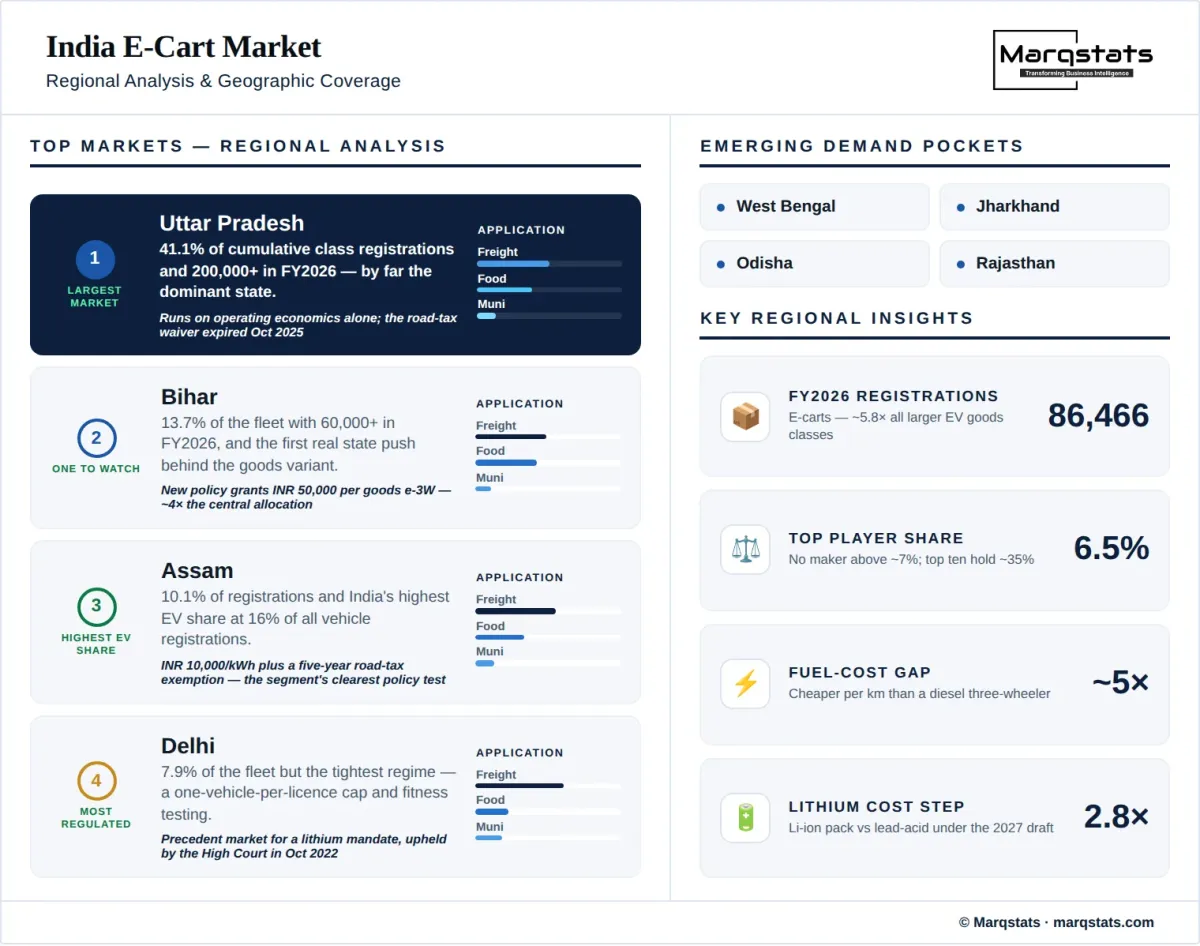
Demand is concentrated in the Gangetic plain. On cumulative registrations of the low-speed class between 2017 and 2025, Uttar Pradesh accounts for 41.1%, Bihar 13.7%, Assam 10.1%, Delhi 7.9% and West Bengal 5.2% — five states holding 78% of the national fleet. The contrast with the south is extreme: Karnataka registered 337 vehicles of this class in FY2026 and Kerala 77, against more than 200,000 in Uttar Pradesh. This is not an adoption gradient but a regulatory-permissiveness gradient. Southern states largely did not allow the low-speed class to displace conventional auto-rickshaws; northern and eastern states did. Assam illustrates the arithmetic: electric vehicles are 16% of its registrations, the highest share in India, and 8% once the low-speed three-wheeler class is stripped out.
The supply side is the most fragmented in Indian automotive. On cumulative registrations from 2018 to 2025, the leading manufacturer holds 6.5%, the top three hold 16.8% and the top ten hold about 35%, leaving 65% with a long tail of regional assemblers operating out of Sonipat, Kanpur, Meerut, Lucknow and Panipat. In February 2026 the monthly leader held 6.78% and the 'others' category held 79.8%. Twelve years after the class was legalised, no scale advantage has emerged — because the product is a welded frame, an imported motor-and-controller kit and four lead-acid batteries, and the buyer optimises on purchase price and local service availability alone.
Growth to 2030 turns on three questions. Whether the draft lithium-ion mandate is notified and enforced from April 2027, and if so whether the resulting price step can be absorbed by a buyer financing an INR 1.25 lakh vehicle at 23% interest over 12 to 18 months. Whether battery swapping scales far enough to convert that capital cost into an operating cost. And whether the FY2027 slowdown to 2.4% growth is a pause or an inflection, given that the faster L5N class grew 84.3% over the same months.
Market Dynamics
Key Drivers
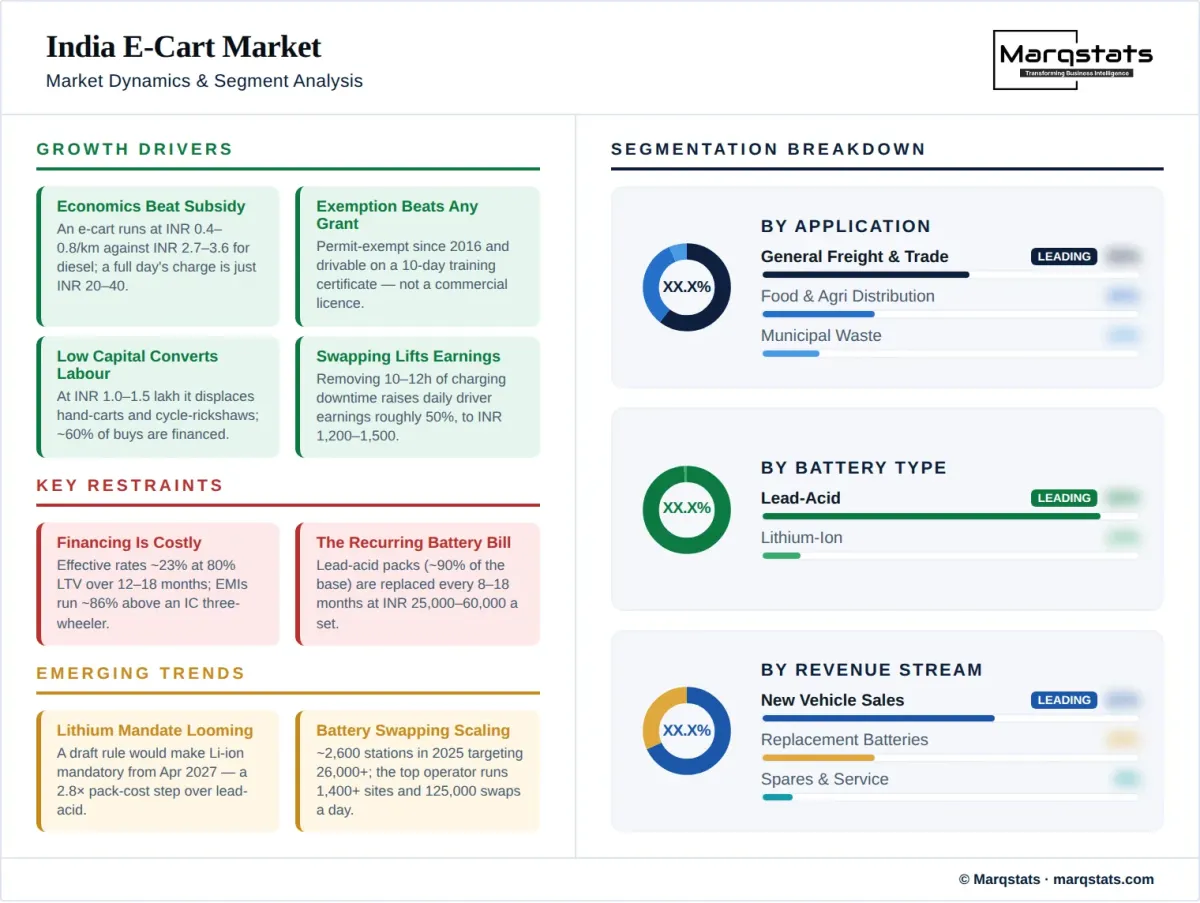
Operating economics work without any subsidy. An e-cart runs at INR 0.4 to INR 0.8 per kilometre against INR 2.3 to INR 2.7 for CNG and INR 2.7 to INR 3.6 for diesel — roughly a fifth of diesel's energy cost. A full day's charging costs INR 20 to INR 40 for 80 to 120 kilometres. This is why the class grew 32.9% in FY2026 while holding a central allocation worth under 9% of a vehicle's price.
Regulatory exemption is worth more than the subsidy. E-carts have been exempt from the section 66(1) permit requirement since August 2016 and their drivers qualify through a ten-day training certificate under Rule 8A rather than a standard commercial licence. Against an L5 vehicle costing three times as much and requiring both a permit and a commercial licence, this removes the two highest barriers facing a first-time owner-operator.
The capital threshold is low enough to convert informal haulage. At INR 1.0 to 1.5 lakh the e-cart sits within reach of buyers who would otherwise use a hand-cart, a cycle-rickshaw or hired porterage. Retail finance penetration in the segment is about 60%, and micro-credit routes including MUDRA loans are used for purchase, which extends reach further down the income distribution.
Municipal procurement provides a floor of institutional demand. Purpose-built garbage-loader variants are a standard catalogued product line sold into door-to-door waste collection tenders, giving the segment a buyer that is neither an owner-driver nor a fleet operator and that purchases on multi-year cycles.
Battery swapping materially improves operator economics where it is available. Swapping removes 10 to 12 hours of charging downtime and has been shown to lift daily driver earnings from INR 700 to 800 to INR 1,200 to 1,500, a gain of roughly 50%, at a cost to the driver of INR 240 to 360 a day. For a goods operator whose revenue is trip-linked, charging downtime is a direct revenue loss, which makes swapping more valuable here than in passenger use.
Key Restraints
Financing is the binding constraint and it is expensive. Asian Development Bank survey data puts effective interest rates for this class at 23%, loan-to-value at 80% and tenure at only 12 to 18 months, against 20%, 90% and 24 to 48 months for an internal-combustion three-wheeler. Equated monthly instalments per INR 100,000 borrowed run about 86% higher than for the conventional equivalent, and three-wheeler buyers carry the least stable credit profiles of any Indian electric vehicle segment.
The segment is bankable only through risk-sharing structures. Specialist non-banking finance companies report non-performing assets of 1.5% to 2%, but do so on intensive field-collection models paired with first-loss default guarantees underwritten by manufacturers. Conventional banks underwriting the same borrower on standard processes have reported default rates as high as 30%. Electric vehicles remain outside the Reserve Bank of India's priority sector lending directions as of 2025, closing off the cheapest available funding route.
The recurring battery bill dominates ownership cost. Lead-acid packs, which account for roughly 90% of the installed base, require replacement every 8 to 18 months at INR 25,000 to 60,000 per set — an annualised cost equal to 20% to 40% of the original vehicle price. Range degrades from 80 to 100 kilometres when new to 50 to 60 kilometres at end of life, and roughly 90% of end-of-life lead-acid batteries are recycled informally.
The tax advantage over internal combustion narrowed sharply in 2025. The GST Council cut the rate on three-wheeled vehicles from 28% to 18% effective 22 September 2025 while electric vehicles remained at 5%, reducing the gap from 23 percentage points to 13. An inverted duty structure compounds the problem: 5% output GST on the vehicle against 18% input GST on batteries and components.
Component supply is concentrated offshore. Industry-body estimates put imports of motors at INR 870 crore and controllers at INR 410 crore in 2024, up 172% and 193% respectively from 2021, with domestic MSME supplier share falling below 35%. The segment is structurally excluded from the automotive production-linked incentive scheme, whose domestic value-addition thresholds and turnover criteria no INR 1.4 lakh regional assembler can meet.
Key Trends
A draft rule would force the lithium transition. Draft amendments circulated in August 2025 would cap top speed at 25 km/h from 1 April 2026 and make lithium-ion batteries mandatory for e-rickshaw and e-cart manufacturers from 1 April 2027, alongside mandatory certification of the battery value chain. At INR 16,600 per kWh against INR 6,000 for lead-acid, this is a 2.8 times pack-cost step. Precedent exists: the Delhi High Court upheld a lithium-ion mandate covering both classes in the capital in October 2022.
Battery swapping is scaling toward the segment. India had roughly 2,600 swapping stations as of April 2025 against a government projection of more than 26,000 by March 2026 and roughly 111,000 by 2030. The largest operator runs over 1,400 stations across 40 cities serving 70,000 drivers and 125,000 swaps a day, and raised INR 185.5 crore in August 2026 at a valuation of roughly INR 4,075 crore.
A cybersecurity exposure surfaced in the class in 2026. Vehicles were shown being remotely disabled through Bluetooth battery-management applications using default credentials, traced to imported BMS hardware. Four applications were removed from distribution in July 2026, the Ministry of Heavy Industries issued an advisory requiring audits of battery communication interfaces, and phased cybersecurity and software-update management requirements have been proposed from 1 October 2026.
State policy is beginning to target goods three-wheelers directly. Bihar's amended electric vehicle policy, applying to vehicles purchased from 15 May 2026, offers INR 50,000 for goods-carrying electric three-wheelers and INR 60,000 for scheduled-caste and scheduled-tribe buyers, with a 50% motor vehicle tax rebate, against a FY2027 outlay of INR 110 crore. This is materially larger per vehicle than the central allocation and is the first state scheme framed explicitly around the goods variant.
Registration enforcement is being tightened across the major states, which will lift reported volumes independently of underlying demand. West Bengal mandated registration of the low-speed class from October 2025 with the deadline extended twice to 30 June 2026; Delhi resumed registration on 15 May 2026 under a one-vehicle-per-licence cap with mandatory training and annual fitness certification. An industry body estimates roughly 475,000 vehicles of this class still operate entirely unregistered.
Market Segmentation
Battery chemistry is the decisive segmentation for this market, because it governs both the vehicle's price point and the size of the recurring aftermarket that sits behind it.
Lead-acid holds roughly 90% of the installed base and is very likely higher among e-carts than passenger e-rickshaws, given the lower price point. A 48-volt, 100-ampere-hour pack rates 4.8 kWh nominal but delivers only 50% to 60% of that as usable energy, against roughly 90% for lithium. At about INR 6,000 per kWh the pack is cheap to buy and expensive to own, lasting 200 to 500 cycles and requiring replacement within 8 to 18 months. Lead-acid remains dominant because the buyer optimises on the purchase price he can finance, not the cost he will incur.
Lithium-iron-phosphate packs cost roughly INR 16,600 per kWh, 2.8 times the lead-acid equivalent, but deliver 2,000 to 4,000 cycles across three to seven years and 80,000 to 150,000 kilometres, with a weight reduction of three to four times. Adoption sits near 10% of the installed base and is rising from a small base. The draft mandate from April 2027, if notified, would force the transition rather than allow it to happen on economics — which is why battery swapping matters, since it converts the pack from a capital purchase the buyer cannot finance into a daily operating charge he can.
Treating this market as new-vehicle sales alone understates it by roughly a third and misses where the money actually recurs.
New vehicle sales are approximately 62% of market value, at a blended ex-showroom price near INR 1.25 lakh across a range running from roughly INR 1.0 lakh for unbranded assembly to INR 1.75 lakh for the highest-specified branded loaders. The gap between branded and unbranded pricing is narrow in absolute terms and decisive in a market where the buyer is financing 80% of the purchase at 23%.
Replacement batteries are approximately 30% of market value and the segment's true annuity. An operating fleet of roughly 205,000 registered vehicles, overwhelmingly on lead-acid packs replaced within 8 to 18 months, generates recurring demand that is largely independent of new vehicle volumes. This stream reprices sharply under a lithium mandate: fewer replacements per vehicle over time, at two to three times the value each.
Spares, tyres and service make up the remaining 8% of market value, served almost entirely through local informal workshops rather than manufacturer networks. The absence of an organised aftermarket is itself a structural feature — with no manufacturer above 7% share, no player has the installed base to justify building one.
No source publishes a quantified split of e-cart applications, and the figures below describe the observable structure of demand rather than measured shares.
The largest use is short-haul freight for small traders, market vendors and neighbourhood retail, typically operated by a single owner-driver on routes of a few kilometres. On-demand logistics platforms list e-loaders as a bookable category in Delhi from around INR 150 per trip for payloads of 50 to 350 kilograms, which is the clearest available price signal for the work these vehicles do.
Purpose-built garbage-loader variants form a distinct product line with type approval, sold into municipal door-to-door collection tenders. This is the only application with a dedicated catalogued SKU across multiple manufacturers, and the only one with an institutional rather than individual buyer.
Vegetable, milk, poultry, water-can and cooking-gas distribution account for a substantial share of observed use, particularly in the Uttar Pradesh and Bihar markets that dominate registrations. These are short, repetitive, load-light routes that suit the 25 km/h ceiling and the 310-kilogram payload precisely.
By Geography
State-level data for the goods variant specifically is not published; the shares below describe the low-speed three-wheeler class as a whole, within which e-carts are the goods component.
Uttar Pradesh
Uttar Pradesh is the dominant market with 41.1% of cumulative registrations of the class between 2017 and 2025 and more than 200,000 registrations in FY2026 alone. Electric vehicles account for about 10% of the state's total vehicle registrations, falling to 5% once the low-speed three-wheeler class is excluded. The state has no active electric vehicle purchase subsidy and its road-tax waiver expired on 13 October 2025 — the largest market in the country runs on operating economics alone.
Bihar
Bihar holds 13.7% of cumulative registrations with more than 60,000 in FY2026, and is the state to watch. Its amended electric vehicle policy, applying to purchases from 15 May 2026, offers INR 50,000 for goods-carrying electric three-wheelers and INR 60,000 for scheduled-caste and scheduled-tribe buyers against an FY2027 outlay of INR 110 crore. That is roughly four times the central per-vehicle allocation and the first state incentive framed explicitly around the goods variant.
Assam
Assam holds 10.1% of cumulative registrations on a far smaller vehicle base, producing the highest electric vehicle share of any Indian state at 16% of total registrations — a figure that falls to 8% once this class is removed. Assam also runs among the most generous state incentives at INR 10,000 per kWh with a five-year road tax exemption, making it the clearest test case for what the segment does when policy support is actually present.
Delhi
Delhi holds 7.9% of cumulative registrations with more than 200,000 vehicles of the class on its roads, and is the most tightly regulated market. Registration was suspended from November 2025 and resumed on 15 May 2026 under a one-vehicle-per-licence cap with mandatory pre-registration training and annual fitness certification, following the revocation of an earlier circular permitting corporate and multiple registrations. Some 236 roads and colonies are gazetted as prohibited to the class. Delhi is also the precedent market for a lithium mandate, upheld by the High Court in October 2022.
West Bengal and Rest of India
West Bengal holds 5.2% of cumulative registrations with roughly 90,000 in FY2026, and mandated registration of the class from October 2025 with a deadline extended twice to 30 June 2026, driving a visible surge in reported volumes through late 2025 and early 2026. Outside these five states the class is thinly represented: Karnataka registered 337 vehicles in FY2026 and Kerala 77, a gap of more than two orders of magnitude against Uttar Pradesh that reflects state permissiveness rather than demand.
How Competition Is Evolving
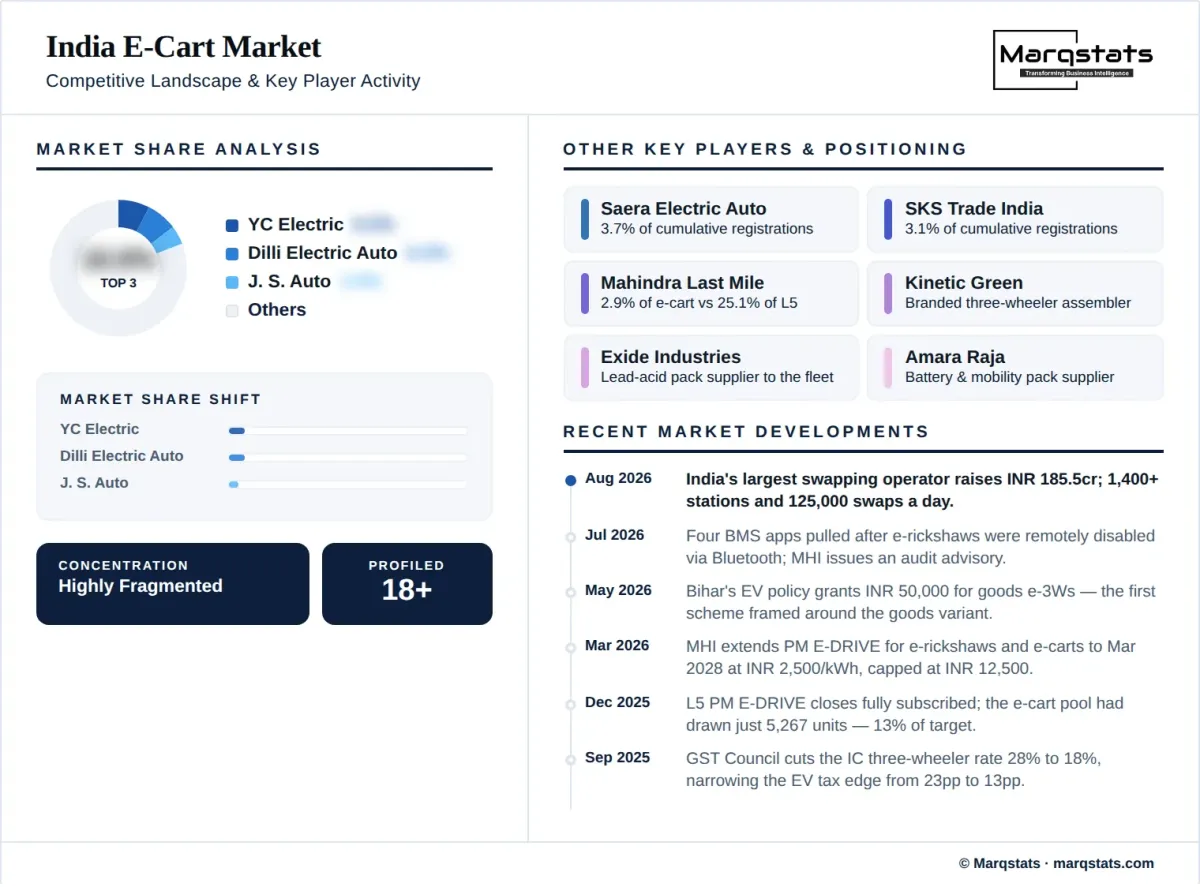
The e-cart market is the most fragmented vehicle segment in India. On cumulative registrations between 2018 and 2025, YC Electric Vehicle led with 6.5%, Dilli Electric Auto Private Limited held 6.4%, J. S. Auto Private Limited 3.9%, Saera Electric Auto Private Limited 3.7% and SKS Trade India Private Limited 3.1%. The top ten manufacturers together held approximately 35%, leaving about 65% distributed across a long tail of small and regional assemblers. In February 2026 the monthly leader held 6.78% and the 'others' category held 79.8%. No manufacturer has exceeded roughly 7% share in any recent full-year or annualised cut.
The comparison with the adjacent L5 electric cargo class could not be sharper. There, Mahindra Last Mile Mobility Limited alone holds 25.1%, Omega Seiki Mobility 14.4%, Piaggio Vehicles Private Limited 12.7%, Bajaj Auto Limited 9.2% and Euler Motors 9.2% — a top five of 70.6%. Those companies are almost entirely absent from the e-cart segment. Only Mahindra Last Mile Mobility Limited plays meaningfully in both, and holds 2.9% of e-cart against 25.1% of L5. The branded, listed three-wheeler industry has not entered this market, and after twelve years there is no evidence it intends to.
Fragmentation persists because there is nothing to consolidate around. The product is a welded frame, an imported motor-and-controller kit and four lead-acid batteries; the manufacturing is assembly rather than engineering; and the buyer selects on purchase price and the availability of a mechanic within a few kilometres. The monthly leaderboard shows constant churn, with established names shrinking while new entrants scale rapidly from a low base. Industry counts put roughly 680 to 700 manufacturers across the electric three-wheeler segment as a whole, up from 479 in mid-2024, with the majority selling fewer than 100 units a year. An industry body separately estimates that around 475,000 vehicles of this class operate entirely unregistered, outside the registration data altogether.
Because replacement batteries are roughly 30% of market value, the battery manufacturers are as commercially significant as the vehicle assemblers. Exide Industries Limited, Amara Raja Energy & Mobility Limited, Eastman Auto and Power Limited and Okaya Power Private Limited supply the lead-acid packs that the operating fleet consumes on an 8-to-18-month cycle. A mandated shift to lithium would transfer that value pool toward cell importers, pack integrators and battery-swapping operators, and would be the most significant redistribution of profit this segment has seen.
Companies Covered
Companies covered in the report include:
Recent Market Activity
Table of Contents
Coverage & Segmentation
This report sizes and forecasts the India e-cart market over a 2022 to 2025 historical period and a 2026 to 2030 forecast period, using calendar year 2025 as the base year. The vehicle class covered is the one registered in India's Vahan database as e-Rickshaw with Cart (Goods) and defined in Rule 2(cc) of the Central Motor Vehicles Rules — a battery-operated goods three-wheeler limited to 2,000 watts of net motor power, 310 kilograms of payload and 25 kilometres per hour. Market value is expressed in USD billion and covers new vehicle sales, replacement battery demand from the operating fleet, and spares and service. Volume is expressed in units.
Registration data for India is reported on both calendar and fiscal-year bases. This study uses the calendar-year series as its modelling base because it runs unbroken from 2018, and cross-references the fiscal-year series ending 31 March where the more recent reading matters. Both are quoted explicitly wherever used. Segmentation covers battery type — lead-acid and lithium-ion; revenue stream — new vehicle sales, replacement batteries, and spares and service; and application — general freight and trade, municipal waste collection, and food and agricultural distribution. Geographic coverage spans Uttar Pradesh, Bihar, Assam, Delhi, West Bengal and the rest of India. Passenger e-rickshaws, L5N electric cargo three-wheelers, electric two-wheelers and four-wheeled electric goods vehicles are excluded throughout.