Market Snapshot
Key Takeaways
Market Overview & Analysis
Report Summary
The Thailand car dealership market is expanding in every dimension except the one that pays for it. Volume is rising, networks are being built at a pace the country has not seen since the Japanese brands established themselves, and retail demand indicators are at records. Channel margin per vehicle is falling throughout, because the brands driving the volume arrived with distribution models that need less channel than the ones they are displacing.
The measure is the margin captured by importers, distributors and dealers on new vehicle sales in Thailand, covering exclusive importer-distributor appointments, multi-brand dealer groups, joint venture distribution and direct manufacturer operation, together with dealer-level charging and delivery services. The retail value of the vehicles belongs to the vehicle markets that carry them and is never added to this panel. Used vehicle retail, aftermarket service revenue and vehicle financing are excluded, each being a separate market.
The analysis is written for distributors and dealer groups assessing whether volume growth compensates for margin compression, manufacturers choosing between four channel models with materially different economics, investors pricing network build-out against a thinning per-unit return, and regulators drafting consumer protection rules for a retail channel that has already produced one high-profile failure.
Thailand Car Dealership Market Size and Forecast
Channel margin is valued at USD 1,597.64 million in 2025, an estimated USD 1,728.45 million in 2026 and USD 1,778.40 million by 2030, an increase of USD 180.76 million against 138,834 additional units retailed. Retail volume moves from 621,166 to 760,000 vehicles, on channel margin per unit falling from USD 2,572 to USD 2,340, or THB 83,590 to THB 76,050 at a constant THB 32.5 per USD.
Two growth rates apply and the second is nearly flat. The five-year value rate connecting 2025 and 2030 is 2.17%; the four-year rate connecting 2026 and 2030 is 0.71%. The 1.46-point gap runs the opposite way to most pages in the catalogue because 2026 is a peak rather than a trough, with volume up 11.08% and value up 8.19% on a post-show demand surge, after which margin compression does the work.
Value compounds 1.95 points behind volume at 2.17% against 4.12%, and the mechanism is channel model mix rather than discounting. An exclusive importer-distributor captures the deepest margin in the market, a joint venture splits it, and a direct manufacturer operation removes it from the channel entirely, so every brand that enters on a direct or joint venture basis dilutes the blended rate whatever it does on price. Across the narrower window volume compounds at 2.45% against a 0.71% value rate.
The channel model split is the series that makes the forecast assessable. Exclusive importer-distributors hold an estimated 44.00% of channel margin in 2025, multi-brand dealer groups 28.00%, joint venture distribution 17.00% and direct manufacturer operation 11.00%, and the terminal assumes the last two together move from 28.00% toward the low forties.
A sizing range is published rather than a point. The 2030 figure sits within a band of USD 1,560.00 million to USD 2,020.00 million against 710,000 to 820,000 units, corresponding to rates of negative 0.47% and 4.80%, and the spread turns on how quickly direct and joint venture models take share and on whether the imported segment stabilises.
One Event Reads the Market Better Than a Quarter of Data
Bangkok International Motor Show bookings reached 132,951 units in March and April 2026, up 71.82% from 77,379 a year earlier, across 1,798,312 visitors. That single event took bookings equal to 21.40% of the entire 2025 domestic market of 621,166 units, and the Federation of Thai Industries attributed strong March delivery figures directly to it.
The brand table from that show is the clearest competitive statement available. BYD led on 17,354 bookings ahead of Toyota on 15,750, a gap of 10.18%, with Omoda and Jaecoo on 15,088, MG on 10,537, Deepal and Nevo together on 8,573, Geely on 7,811, Chery on 7,509, Great Wall Motor on 6,819, GAC on 6,287 and Honda on 5,907. Eight of the top ten were Chinese.
Aggregated, the top twenty brands took 127,422 bookings or 95.84% of the show total, of which Chinese marques held 88,410 units or 69.38% against 39,012 for Japanese, European and other brands combined. Mazda took 4,889, Mitsubishi 4,178, Isuzu 3,568, Riddara 2,569, Zeekr 2,339, Mercedes-Benz 2,111, XPeng 2,089, Nissan 1,608, AVATR 1,435 and BMW 1,001.
Fourteen Operators, 574 Outlets, One Year
Network expansion in Thailand is running at a pace with no recent precedent, and it is almost entirely Chinese-brand driven. Great Wall Motor operates 71 Partner Stores and targets 100 by the end of 2026; Chery moves from 42 locations in January 2026 through 55 to a target of 70; Changan targets 100 dealers across 60 provinces against 2025 sales of 14,065 units, up 80.9%, and a 2026 target of 30,000.
The distributor groups are building faster than the brands they carry. Eternity at One, which handles Changan, Deepal, AVATR and Nevo, has delivered over 15,000 electric and range-extended vehicles from more than 30 showrooms with 12 under construction and a target of 60 by 2026. Wuling Sales, the EV Primus and SGMW joint venture, moves from 24 showrooms to 50 against an 8,000-unit target across five new models.
Smaller entrants are committing on the same curve. LEPAS targets 50 dealer locations and 1,000 units; Geely Riddara operates 29 showrooms and service centres toward 40 across 30 provinces; Hyundai Mobility extends to 28 locations with an Ioniq 5 target of 2,800 against 2,300 in 2025; SAIC Maxus plans 20 outlets through Evante aiming at 10% of a roughly 50,000-unit light commercial market within two years; Forthing moves from 5 dealers to 10 with an eventual 100 and THB 100 million committed to three parts warehouses; Hongqi targets 10 through Metro Group; Tesla moves from 8 sales locations to 10; and NEX Point operates 9 for the BAW M8, having acquired Thai EV outright for THB 149.95 million. Metro Group introduced the Hongqi E-HS9 at THB 2.99 million for its first 400 units.
Four Channel Models, Four Different Economics
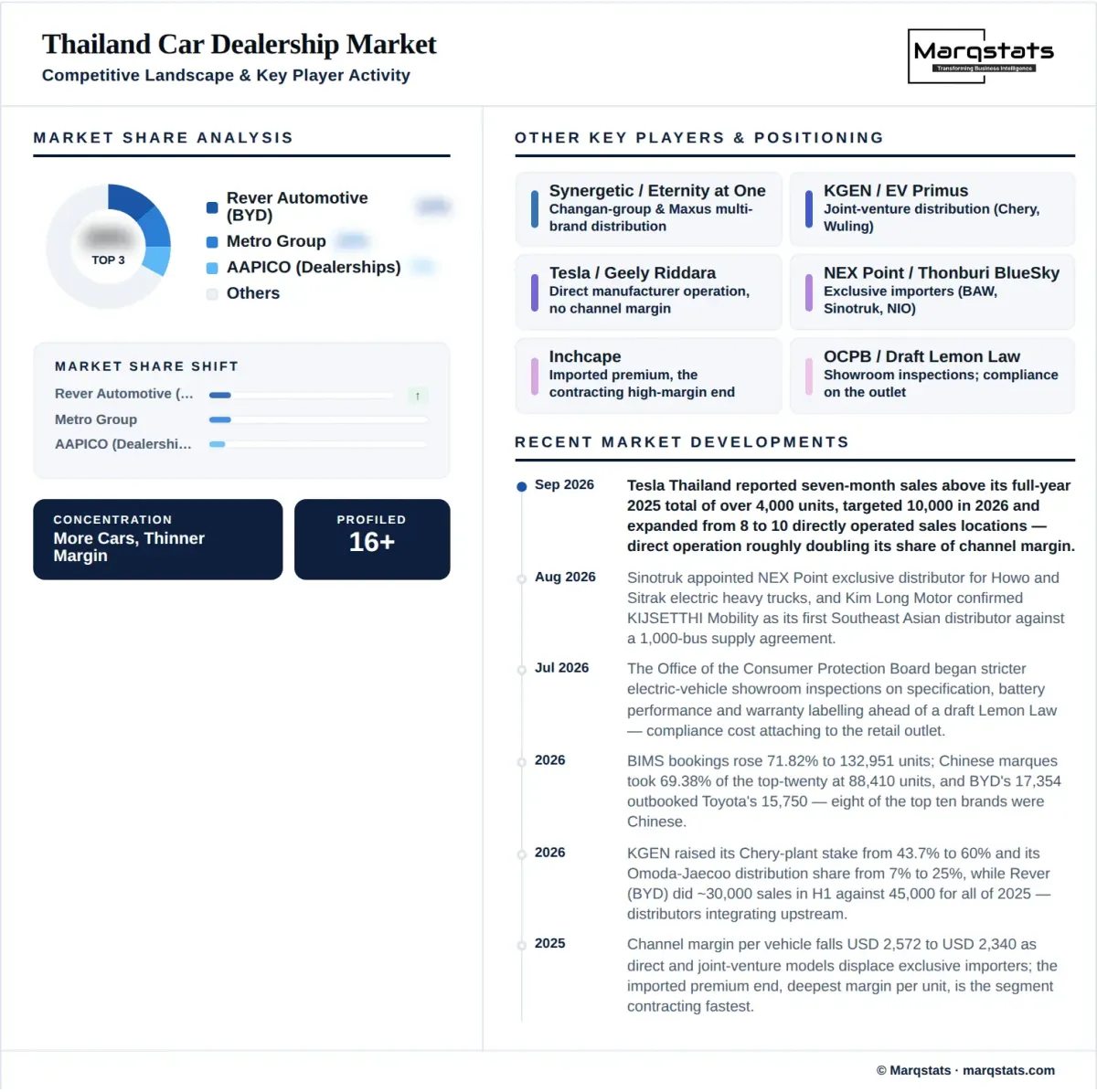
Thailand now runs four distinct routes to market simultaneously, and they capture materially different shares of the same transaction. Exclusive importer-distributors take the deepest margin, covering Rever Automotive for BYD, X Mobility for XPeng, Thonburi BlueSky for NIO firefly, Metro Group for Hongqi, NEX Point for BAW and Sinotruk, Evante for SAIC Maxus, P80 JET for NIU and KIJSETTHI Mobility for Kim Long Motor.
Joint venture distribution splits it between manufacturer and partner, as with EV Primus and SGMW on Wuling and KGEN with Chery. Direct manufacturer operation removes the channel margin altogether: Tesla sells and services directly across 8 locations rising to 10 while investing in showrooms, service centres and charging, and Geely Riddara operates directly rather than through an importer.
Multi-brand dealer groups sit across all of it and are the most resilient position. Metro Group holds dealerships for Toyota, Honda, Mitsubishi, Mercedes-Benz and Zeekr and was appointed Hongqi distributor by FAW in February 2026; AAPICO operates 17 dealerships for Mitsubishi, Ford and MG alongside its component business; Synergetic Auto Performance runs both Eternity at One for the Changan group and Evante for SAIC Maxus. A group carrying five franchises is insulated from any one brand's channel model changing.
A Distributor Is Buying the Factory
The most significant structural move of 2026 ran upstream rather than down. KGEN said in June 2026 that it would raise its stake in the Chery joint venture plant at Rayong from 43.7% to 60% during July and August, while lifting its share of the Omoda and Jaecoo distribution business from 7% to 25%, against projected 2026 sales above THB 20 billion.
That is a distributor taking control of manufacturing and deepening its hold on distribution at the same time, which is the opposite of the asset-light logic driving most new entrants. It also concentrates a single Thai group's exposure to one Chinese brand family across the factory gate and the showroom floor.
Vertical movement is running the other way too. Rever Automotive, BYD's exclusive Thai distributor, reported around 30,000 sales in the first half of 2026 against 45,000 for the whole of 2025, set a 70,000-unit target for the year and passed 130,000 cumulative deliveries. A distributor doing two thirds of its prior full-year volume in six months is a different commercial proposition from the importer model that term usually describes.
The NETA Failure Was a Distribution Failure
Thailand's clearest cautionary case in this market was not a product problem. The Excise Department prepared legal action in January 2026 against NETA Auto Thailand to recover subsidies and enforce bank guarantees from contract manufacturer Bangchan General Assembly, after the brand received over THB 2 billion and its THB 150,000-per-vehicle subsidy was suspended.
The failures the Consumer Council cited in its 2025 class action are all channel functions: delayed registration plates, parts shortages and unprepared service centres. None of them concerns how the vehicle drives. A brand can arrive with competitive product and a subsidy entitlement and still fail on the operational capability its distributor was supposed to supply.
Regulation followed the failure. The Office of the Consumer Protection Board began stricter inspections of electric vehicle showrooms and sales outlets in July 2026, starting in Bangkok and nearby provinces and requiring accurate labelling of specifications, battery performance and warranty terms, ahead of a draft Lemon Law. Compliance cost now attaches to the retail outlet rather than to the manufacturer.
Tax Is Closing the Highest-Margin Part of the Channel
The imported segment carries the deepest channel margin and it is the one shrinking. Inchcape Thailand reported in February 2026 that plug-in hybrid import excise rose from 8% to 15%, adding roughly 10% to cost, that sales above THB 5 million fell about 10%, and that the imported car market is expected to contract 5% to 10% across 2026.
Further tightening is proposed rather than settled. The Electric Vehicle Board's three-tier excise structure would place imported electric vehicles above 10% against current rates of 10%, 8% and 2%, which would compress importer economics again on the segment where distributors earn most per unit.
Demand itself is not the problem. Domestic vehicle sales reached 406,162 units in January to July 2026, up 15.4%, with July alone at 59,196 units, up 20.1%. The channel is growing into a market that is expanding while the most profitable route into it narrows.
Market Dynamics
Key Drivers
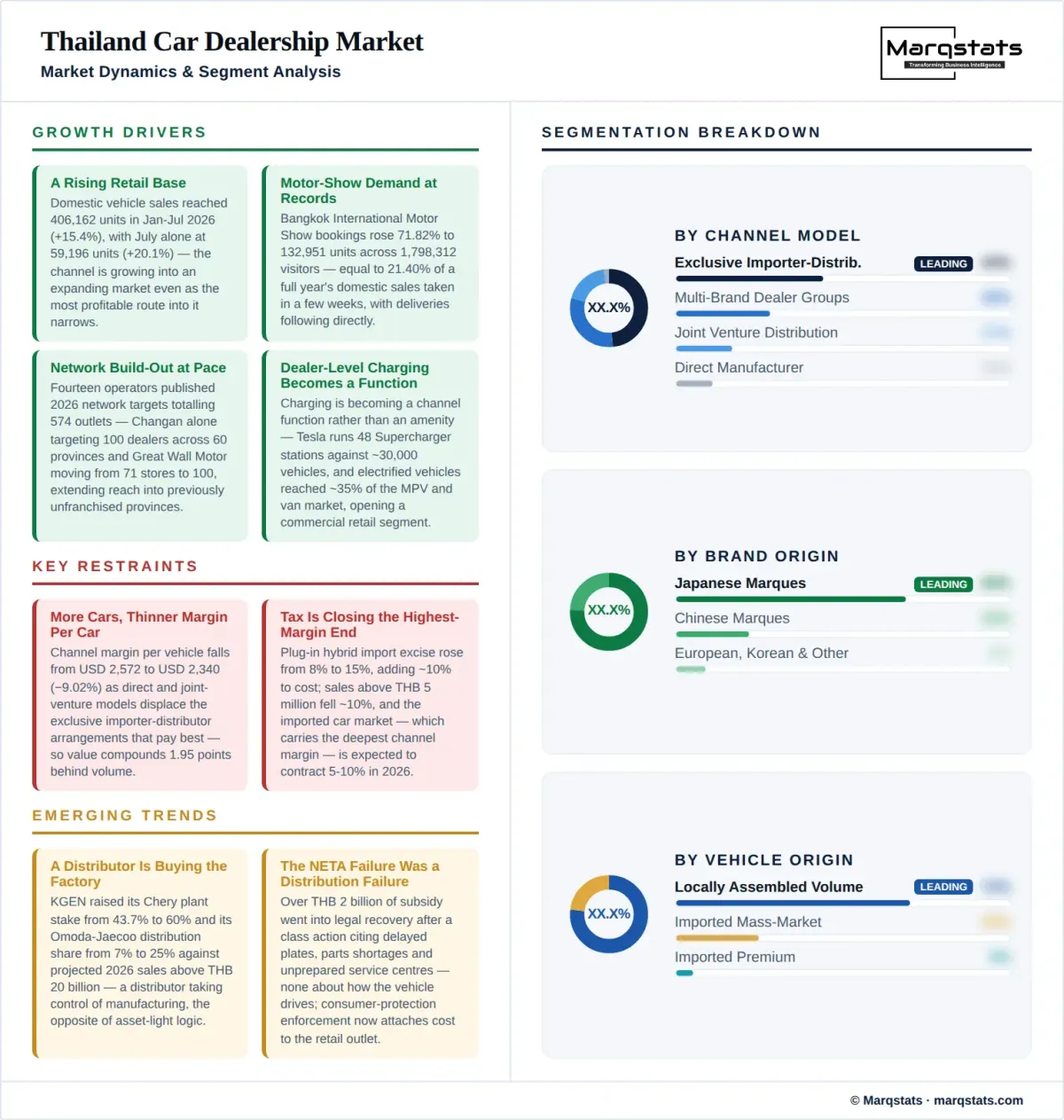
- Domestic vehicle sales reached 406,162 units in January to July 2026, up 15.4%, with July alone at 59,196 units, up 20.1%, giving the channel a rising base to sell into.
- Motor show bookings rose 71.82% to 132,951 units from 77,379 across 1,798,312 visitors, equal to 21.40% of a full year's domestic sales, with deliveries following directly.
- Fourteen operators published 2026 network targets totalling 574 outlets, extending retail reach into provinces that previously had no franchised presence for most brands.
- Dealer-level charging is becoming a channel function rather than an amenity, with Tesla running 48 Supercharger stations against roughly 30,000 vehicles in operation and about 4,356 charging stations nationwide.
- Electrified vehicles reached about 35% of the multi-purpose vehicle and van market in 2025, opening a commercial retail segment that previously ran almost entirely on internal combustion.
Key Restraints
- Channel margin per vehicle falls from USD 2,572 to USD 2,340, down 9.02%, as direct and joint venture models displace the exclusive importer-distributor arrangements that pay best.
- Plug-in hybrid import excise rose from 8% to 15%, adding about 10% to cost, with sales above THB 5 million down around 10% and the imported market expected to contract 5% to 10% in 2026.
- Consumer protection enforcement began in July 2026 with showroom inspections on specification, battery performance and warranty labelling ahead of a draft Lemon Law, placing compliance cost on the retail outlet.
- The NETA case put over THB 2 billion of subsidy into legal recovery after a class action citing delayed plates, parts shortages and unprepared service centres, raising counterparty risk on new brand appointments.
Key Trends
- Distributors are integrating upstream, with KGEN raising its Chery plant stake from 43.7% to 60% and its Omoda and Jaecoo distribution share from 7% to 25% against projected 2026 sales above THB 20 billion.
- Direct manufacturer operation is establishing itself, with Tesla selling and servicing directly across 8 locations rising to 10 and Geely Riddara operating without an importer.
- Multi-brand groups are accumulating Chinese franchises alongside Japanese ones, with Metro Group adding Hongqi in February 2026 to dealerships for Toyota, Honda, Mitsubishi, Mercedes-Benz and Zeekr.
- Commercial vehicle distribution is professionalising, with Sinotruk appointing NEX Point for Howo and Sitrak electric trucks and Kim Long Motor naming KIJSETTHI Mobility against a 1,000-bus supply agreement.
Market Segmentation
Exclusive importer-distributors account for an estimated USD 703.00 million of channel margin in 2025, or 44.00%, the deepest per-unit economics in the market. Rever Automotive for BYD, X Mobility for XPeng, Thonburi BlueSky for NIO firefly, Metro Group for Hongqi, NEX Point for BAW and Sinotruk, Evante for SAIC Maxus and KIJSETTHI Mobility for Kim Long Motor all sit here, and the model's share falls through the forecast as alternatives take new appointments.
Multi-brand dealer groups account for an estimated USD 447.34 million in 2025, or 28.00%, and hold the most resilient position in the channel. Metro Group carries Toyota, Honda, Mitsubishi, Mercedes-Benz and Zeekr and added Hongqi in February 2026; AAPICO operates 17 dealerships for Mitsubishi, Ford and MG; Synergetic Auto Performance runs Eternity at One and Evante in parallel. A group with five franchises is insulated from any single brand changing its channel model.
Joint venture distribution accounts for an estimated USD 271.60 million in 2025, or 17.00%, and splits margin between manufacturer and partner. EV Primus and SGMW operate Wuling Sales Thailand from 24 showrooms toward 50 against an 8,000-unit target, and KGEN's Chery arrangement extends from a 43.7% plant stake toward 60% alongside a distribution share rising from 7% to 25%.
Direct manufacturer operation accounts for an estimated USD 175.70 million in 2025, or 11.00%, and removes channel margin from third parties entirely. Tesla operates 8 sales locations rising to 10 with direct investment in showrooms, service centres and charging, alongside 48 Supercharger stations, while Geely Riddara sells directly rather than through an importer. The model roughly doubles its share of margin through the forecast.
Japanese marques account for an estimated 430,468 retail units in 2025, or 69.30% of volume, down from 76.7% in 2024. The tier retains the deepest and oldest dealer networks in the country, and its share of channel margin exceeds its share of units because franchised Japanese dealers carry higher fixed cost and higher per-unit margin than the new entrants.
Chinese marques account for an estimated 136,656 retail units in 2025, or 22.00%, and took 69.38% of top-twenty motor show bookings in 2026, which is the clearest available leading indicator of where volume goes next. Essentially all network expansion announced for 2026 belongs to this group, and so does essentially all of the channel model disruption.
European, Korean and other marques account for an estimated 54,042 retail units in 2025, or 8.70%, and carry the highest margin per unit of any origin group through imported premium product. The segment is directly exposed to import excise, with sales above THB 5 million down about 10% and Hyundai Mobility extending to 28 locations against an Ioniq 5 target of 2,800 units.
Locally assembled volume brands account for an estimated 434,816 retail units in 2025, or 70.00%, and carry the thinnest margin per unit in the channel. Volume economics and manufacturer-set pricing leave the dealer little discretion, which is why groups in this segment depend on franchise count and throughput rather than on per-unit return.
Imported mass-market vehicles account for an estimated 155,292 retail units in 2025, or 25.00%, and this is where the Chinese entrants sit before localisation. The segment carries better margin than local assembly and is the one most exposed to the Electric Vehicle Board's proposed three-tier excise, which would place imported electric vehicles above 10% against current rates of 10%, 8% and 2%.
Imported premium and luxury vehicles account for an estimated 31,058 retail units in 2025, or 5.00%, and deliver the highest channel margin per unit in the market. It is also the segment contracting fastest, with plug-in hybrid import excise up from 8% to 15%, sales above THB 5 million down about 10% and the imported market expected to fall 5% to 10% in 2026.
Internal combustion vehicles account for an estimated 345,195 retail units in 2025, or 55.57% of volume, and remain the base that supports established network fixed cost. The segment declines in share rather than collapsing, and its throughput is what allows Japanese franchised groups to fund the facilities that newer entrants are only now building.
Hybrids account for an estimated 146,059 retail units in 2025, or 23.51%, and are the least disruptive powertrain for the channel because they sell through existing Japanese networks with no charging obligation and no new service requirement. The segment carries near-normal margin and requires no additional dealer capital.
Battery electric vehicles account for an estimated 120,301 retail units in 2025, or 19.37%, and impose the largest new obligation on the channel. Dealer-level charging, battery warranty administration and specification labelling all attach here, and it is the segment the Office of the Consumer Protection Board began inspecting in July 2026.
Plug-in hybrids and range extenders account for an estimated 9,611 retail units in 2025, or 1.55%, the smallest powertrain segment and the one most damaged by tax in 2026. Import excise rose from 8% to 15%, adding roughly 10% to landed cost on a configuration that was already a niche in Thai retail.
New vehicle retail margin accounts for an estimated USD 958.58 million in 2025, or 60.00% of channel value, and is the function most exposed to model change. A direct manufacturer operation removes it entirely, which is why its share of the total falls even as the number of outlets carrying it rises toward the 574 targeted across fourteen operators.
Importer and wholesale margin accounts for an estimated USD 543.20 million in 2025, or 34.00%, and is the layer that tax policy reaches most directly. Plug-in hybrid import excise moving from 8% to 15% and the proposed three-tier structure placing imported electric vehicles above 10% both land here before they reach the showroom floor.
Dealer-level charging and delivery services account for an estimated USD 95.86 million in 2025, or 6.00%, the smallest function and the fastest-growing. Tesla runs 48 Supercharger stations against roughly 30,000 vehicles in operation, Honda is adding CHAdeMO chargers at Bangkok dealerships, and about 4,356 charging stations operated nationwide at the end of 2025.
By Geography
Bangkok Metropolitan Region
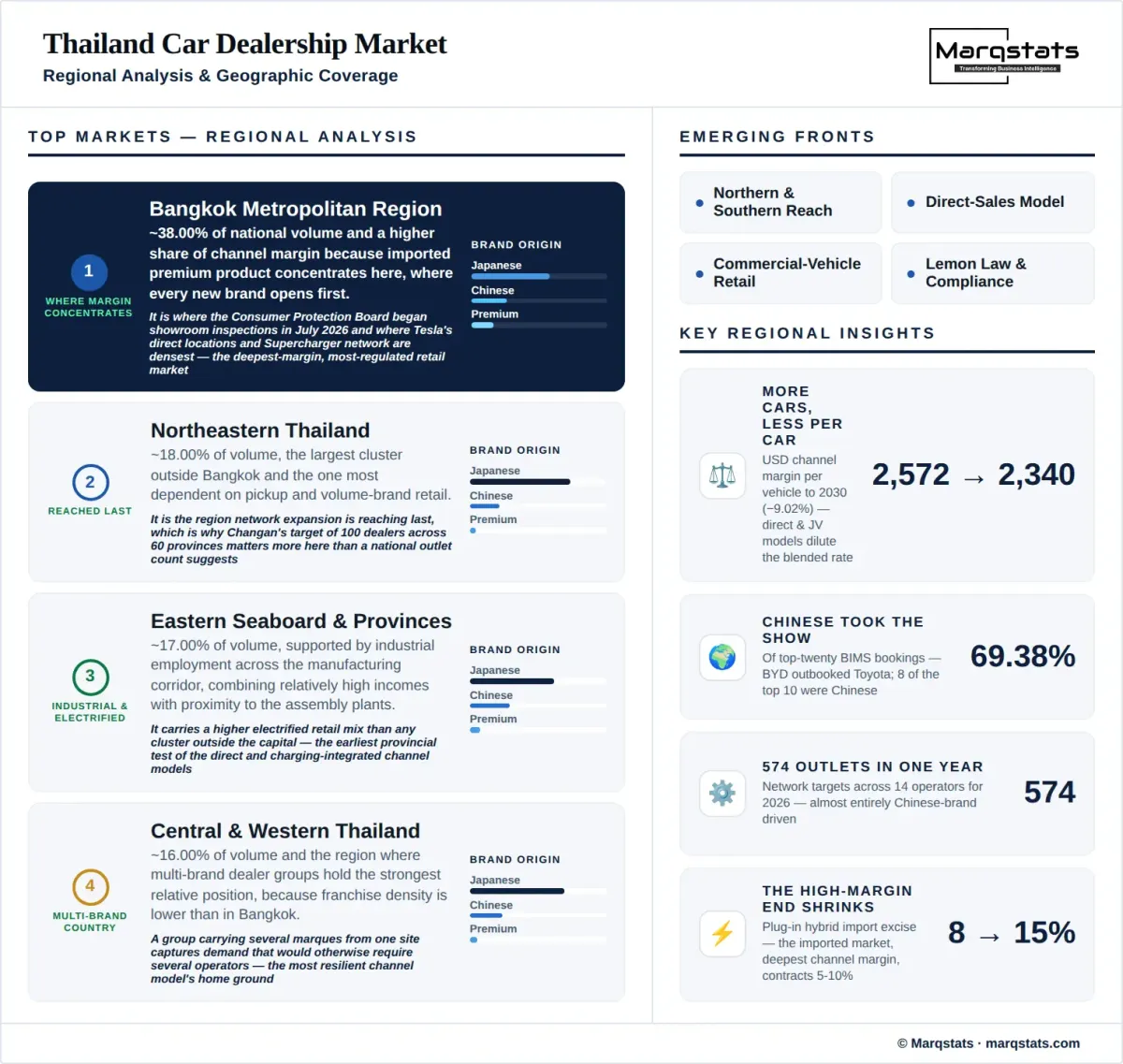
Greater Bangkok accounts for an estimated 236,043 retail units in 2025, or 38.00% of national volume, and a higher share of channel margin because imported premium product concentrates here. It is where the Office of the Consumer Protection Board began its showroom inspections in July 2026, where Tesla's direct locations and Supercharger network are densest, and where every new brand opens first.
Northeastern Thailand
The northeastern provinces account for an estimated 111,810 retail units in 2025, or 18.00%, the largest cluster outside Bangkok and the one most dependent on pickup and volume-brand retail. It is the region network expansion is reaching last, which is why Changan's target of 100 dealers across 60 provinces matters more here than a national outlet count suggests.
Eastern Seaboard and Eastern Provinces
The eastern provinces account for an estimated 105,598 retail units in 2025, or 17.00%, supported by industrial employment across the manufacturing corridor. The region combines relatively high incomes with proximity to the assembly plants, and it carries a higher electrified retail mix than any cluster outside the capital.
Central and Western Thailand
Central and western Thailand accounts for an estimated 99,387 retail units in 2025, or 16.00%, and is the region where multi-brand dealer groups hold the strongest relative position. Franchise density is lower than in Bangkok, so a group carrying several marques from one site captures demand that would otherwise require several operators.
Northern and Southern Thailand
Northern and southern Thailand together account for an estimated 68,328 retail units in 2025, or 11.00%, the thinnest coverage and the longest travel distances to a franchised outlet. These are the provinces where the 574 outlets targeted for 2026 change the retail proposition most, and where parts logistics investment such as Forthing's THB 100 million for three warehouses becomes a competitive requirement.
How Competition Is Evolving
The Thailand car dealership market is fragmented by operator and consolidating by group, and the two movements are happening at once. No distributor holds a commanding share of a USD 1.60 billion margin pool, but the groups that matter increasingly hold several franchises each: Metro Group carries Toyota, Honda, Mitsubishi, Mercedes-Benz, Zeekr and now Hongqi; Synergetic Auto Performance runs Eternity at One for the Changan family and Evante for SAIC Maxus; AAPICO combines 17 dealerships with a components business.
Competition runs on network reach and operational readiness rather than on price, because manufacturer-set pricing leaves little retail discretion on volume brands. That is why the published 2026 targets are outlet counts rather than volume shares, and why the NETA failure is the most instructive case in the market: the brand had product and a subsidy entitlement and still collapsed on delayed plates, parts shortages and unprepared service centres. Operational capability, not commercial terms, is what a manufacturer is actually buying when it appoints a Thai distributor.
The structural risk sits with the pure importers. A distributor whose entire economics rest on an exclusive import appointment faces two simultaneous threats: excise policy raising the landed cost of the product it imports, and the manufacturer switching to direct or joint venture operation once volume justifies it. Rever Automotive at around 30,000 units in the first half of 2026 and over 130,000 cumulative deliveries is precisely the scale at which that second question arises, and KGEN's move to take 60% of a factory rather than more of a distribution agreement is one answer to it.
Companies Covered
The report profiles 15+ companies with full strategy and financials analysis, including:
Recent Market Activity
Table of Contents
Coverage & Segmentation
This analysis measures the margin captured by importers, distributors and dealers on new vehicle sales in Thailand from 2021 to 2030, with 2025 as the base year and 2026 to 2030 as the forecast period, covering exclusive importer-distributor appointments, multi-brand dealer groups, joint venture distribution and direct manufacturer operation, together with dealer-level charging and delivery services and the consumer protection rules governing vehicle sales. The retail value of the vehicles belongs to the vehicle markets that carry them and is never added to this panel. Used vehicle retail, aftermarket parts and service revenue, vehicle financing and insurance are excluded, each being a separate market. Values are expressed in USD at a disclosed constant THB 32.5 per USD.
Coverage spans four channel models, three brand origin groups, three vehicle origin groups, four powertrains retailed and three network functions, with five regional clusters analysed on retail volume and franchise density. New vehicle retail volume is carried as the unit series at 621,166 in 2025 and channel margin per vehicle as a derived series at USD 2,572, and both are published alongside the value panel because a channel whose volume and margin move in opposite directions cannot be represented by either alone. Fifteen entities are profiled across Thai and international distributors, multi-brand dealer groups and the manufacturer principals whose channel decisions set the market's economics.