Market Snapshot
Key Takeaways
Market Overview & Analysis
Report Summary
The India electric car market covers battery electric passenger vehicles—hatchbacks, sedans, sports utility vehicles, and multi-purpose vehicles—sold to retail and fleet buyers in India. The segment is the fastest-growing vertical within the broader passenger vehicle market, with retail registrations nearly doubling in FY 2025-26 to cross the 199,923-unit milestone. Unlike India's two-wheeler and three-wheeler electric segments, which lead by unit volume, the electric passenger vehicle market leads by revenue because of substantially higher average selling prices spanning INR 9 lakh to INR 3 crore.
Adoption is concentrated in electric SUVs, which account for over 60% of volume, followed by electric hatchbacks including the Tata Tiago.ev, MG Comet EV, and Citroen eC3. Mid-size electric SUVs such as the MG ZS EV, Hyundai Creta Electric, and BYD Atto 3 have expanded the addressable price band, while premium electric SUVs from BMW iX, Mercedes-Benz EQS SUV, Audi Q8 e-tron, Volvo EX40, and VinFast VF 7 are scaling rapidly above INR 50 lakh. Battery warranty for electric cars in India has become a decisive purchase factor, with 8-year/160,000-km now the category floor and lifetime high-voltage battery warranty offered on select Tata variants.
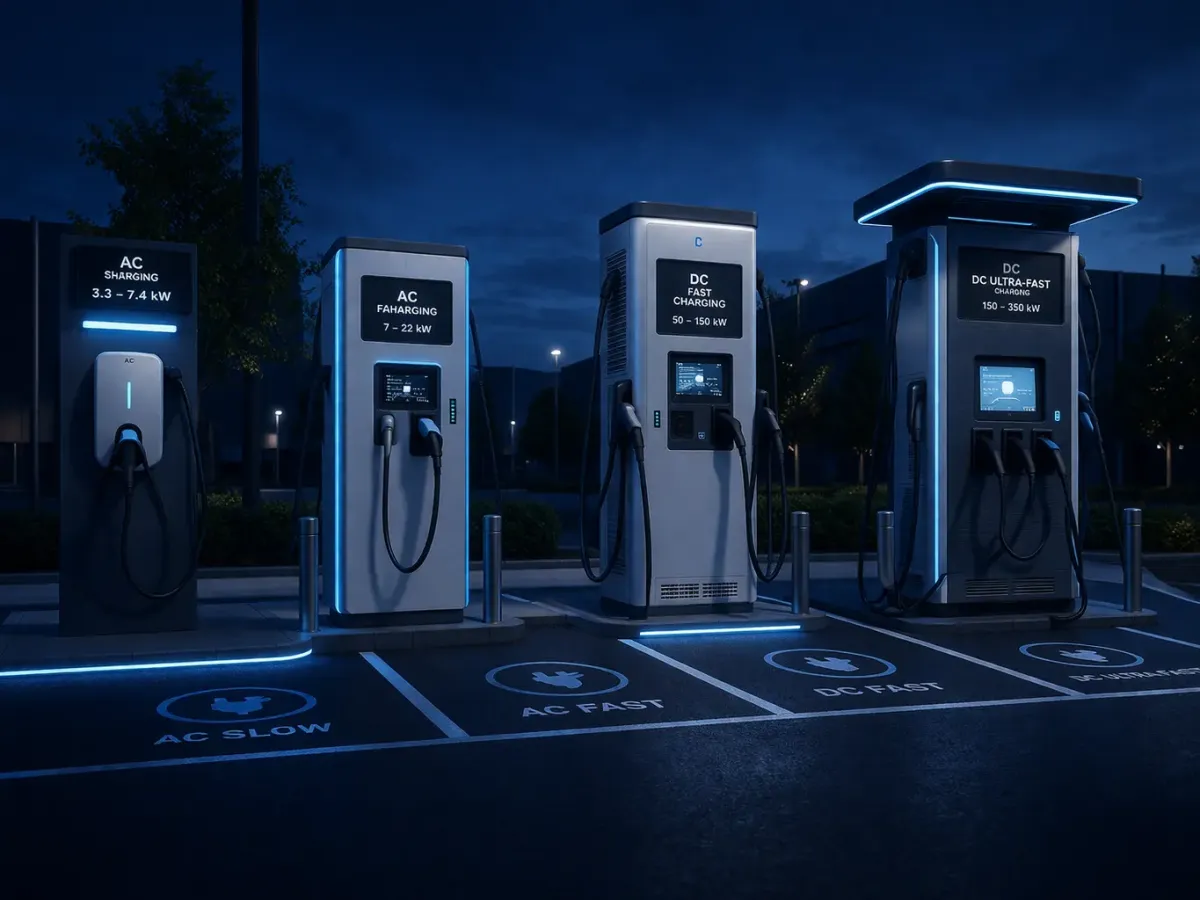
Public charging stations and home charging readiness remain the two defining constraints on EV range-anxiety perception. Public EV charging stations in India crossed 39,485 units under PM E-Drive cumulative deployment and 6,645 operational units under legacy FAME-II sanction as of March 2026, with interoperability rules mandated under the 2024 charging guidelines. Home charging adoption among electric car owners has reached roughly 78% in metropolitan markets, supported by state-level electricity tariff discounts for EV charging and builder-enabled EV-ready parking in new residential projects.
Market Dynamics
Key Drivers
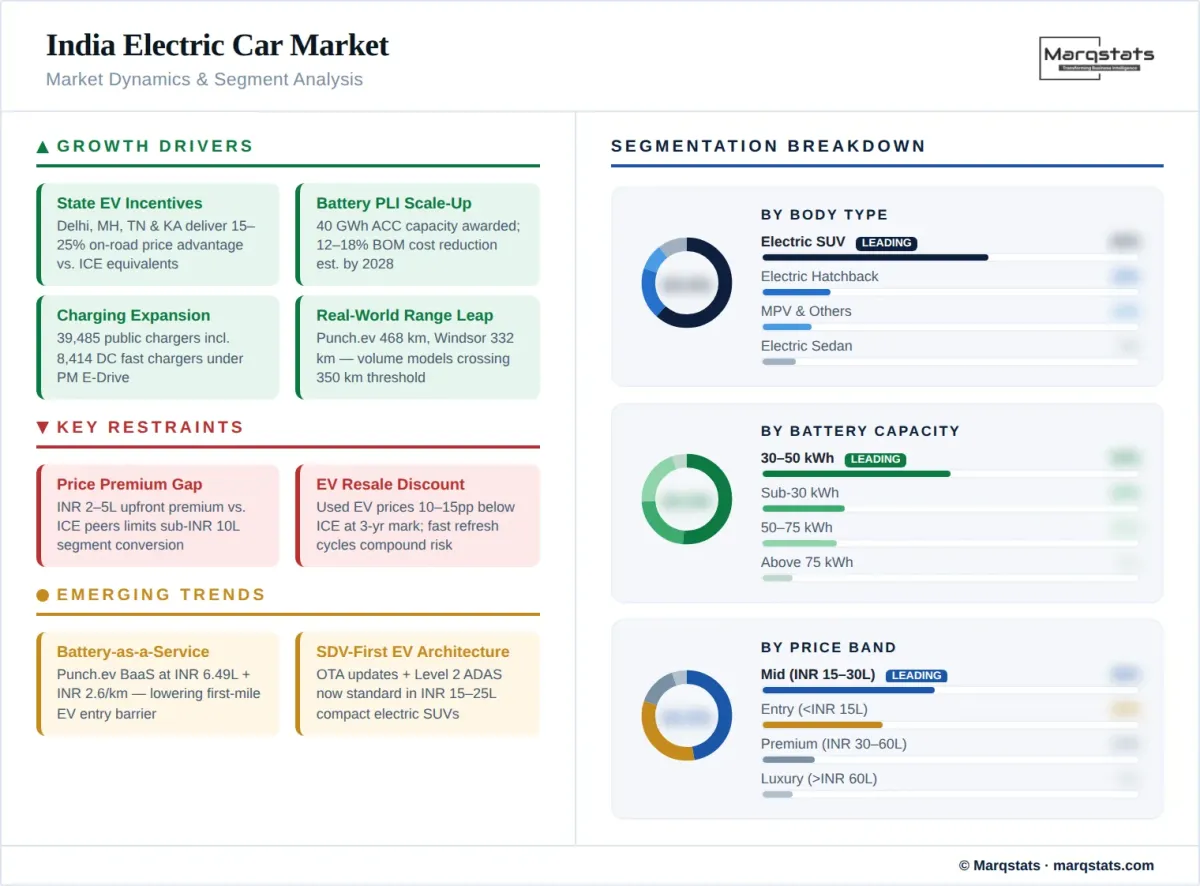
- State EV policy incentives and road tax waivers in Delhi, Maharashtra, Tamil Nadu, and Karnataka deliver a 15–25% on-road price advantage, making electric cars in India under INR 15 lakh price-competitive with ICE peers.
- Battery localization under the ACC Battery PLI scheme is reducing imported cell dependence, with 40 GWh of capacity awarded and 1 GWh commissioned by March 2026 — lowering the EV bill of materials by an estimated 12–18% through 2028.
- EV charging infrastructure in India reached 39,485 public chargers under PM E-Drive deployment, with 8,414 DC fast chargers for passenger cars easing long-distance range anxiety.
- Real-world range for electric cars in India has crossed the 350 km threshold across volume models, with the Tata Punch.ev (355 km), MG Windsor (332 km), and Mahindra XUV 3XO EV (285 km) converting first-time EV buyers in Tier-1 and Tier-2 markets.
- SPMEPCI scheme and reduced 15% CBU import duty on electric cars above USD 35,000 have drawn VinFast, BYD, Tesla, and Volvo to accelerate India launches, widening the electric SUV India pipeline into 2027.
Key Restraints
- Upfront price premium of INR 2–5 lakh versus ICE equivalents persists despite state incentives, limiting first-time buyer conversion in the sub-INR 10 lakh electric cars band.
- Public charging station density remains uneven across Tier-2 and Tier-3 cities, with highway corridor coverage still below the 1.32 million charger threshold estimated for 2030 demand.
- Electric car resale value in India is 10–15 percentage points below ICE equivalents at the three-year mark, reflecting battery warranty uncertainty and fast product refresh cycles.
- Interoperability friction across charging networks — pay-per-use apps, wallet memberships, connector-standard mismatches — continues to fragment the public charging experience for EV owners.
- Cell manufacturing capacity shortfall against the 50 GWh ACC PLI target, with only 1 GWh commissioned as of March 2026, extends import dependence on LFP and NMC cells from China and South Korea.
Key Trends
- Electric SUVs in India are consolidating share, with the compact electric SUV sub-segment projected to cross 60% of electric car volumes by 2028.
- Battery-as-a-Service (BaaS) offers are gaining traction, with Tata offering Punch.ev BaaS at an upfront vehicle price of INR 6.49 lakh plus INR 2.6 per kilometre battery rental — reducing on-road price entry barriers.
- Home charging adoption is accelerating with state electricity boards offering EV-specific tariffs and smart-home charger installers bundling warranty, commissioning, and maintenance.
- Software-defined EV architectures with over-the-air updates, connected features, and Level 2 ADAS are becoming standard in the INR 15–25 lakh electric SUV segment.
- EV fleet sales in India are scaling through government-backed electric taxi programs, corporate EV leasing, and ride-hailing operator commitments, with BluSmart, Lithium Urban Technologies, and Evera operating growing EV fleets across metropolitan markets.
Market Segmentation
Electric hatchbacks represent approximately 18% of 2025 India electric car volumes, anchored by the Tata Tiago.ev, MG Comet EV, and Citroen eC3. This sub-segment addresses the best electric cars under 10 lakh price band where affordability, compact parking footprint, and adequate city-commute range (140–250 km) are the primary purchase drivers. Growth is moderating as buyer preference shifts decisively toward electric SUVs.
Electric sedans contribute roughly 8% of electric car volumes, led by the Tata Tigor.ev, BYD Seal, Hyundai Ioniq 5 (liftback), and premium entrants Mercedes-Benz EQS, BMW i7, and Audi e-tron GT. Fleet demand from app-based ride-hailing operators and corporate lease programs underpins Tigor.ev volumes, while luxury EV sedans anchor the premium value pool.
Electric SUVs in India dominate with over 60% of electric car volumes and the fastest growth trajectory. The compact electric SUV sub-segment (Tata Punch.ev, Mahindra XUV 3XO EV, MG Windsor) drives mass-market adoption in the INR 10–17 lakh band, while mid-size electric SUVs (Tata Nexon.ev, Hyundai Creta Electric, MG ZS EV, BYD Atto 3, Tata Curvv.ev) serve INR 17–30 lakh buyers. Premium electric SUVs (BMW iX, Mercedes-Benz EQS SUV, Audi Q8 e-tron, Volvo EX40, VinFast VF 7, Kia EV6) anchor the above-INR 50 lakh cohort.
Electric MPVs and vans contribute less than 5% of electric car volumes but are expanding as Kia localises the Carens EV, Maruti Suzuki prepares the e Vitara pipeline, and fleet operators absorb electric MPV alternatives for shared mobility programs.
Sub-30 kWh battery packs power entry electric cars such as the Tata Tiago.ev (24 kWh), MG Comet EV (17.3 kWh), and Citroen eC3 (29.2 kWh). These models target city commutes with real-world range between 140 and 250 km, offering the lowest entry price in the electric cars under 10 lakh category.
The 30–50 kWh battery band is the volume sweet spot, powering the Tata Punch.ev (30/40 kWh), Mahindra XUV 3XO EV (39.4 kWh), MG Windsor (38 kWh), and Hyundai Kona Electric. Real-world range of 250–400 km paired with INR 12–18 lakh on-road pricing makes this the best electric cars under 20 lakh india battleground.
Mid-to-large battery packs of 50–75 kWh power mid-size electric SUVs including the Tata Curvv.ev (55 kWh), BYD Atto 3 (60.48 kWh), and MG ZS EV (50.3 kWh). Real-world range extends to 450–550 km, supporting long-distance travel and fleet commercial use cases.
Above-75 kWh battery packs are concentrated in premium electric SUVs and sedans — BMW iX (111.5 kWh), Mercedes-Benz EQS SUV (107.8 kWh), Audi Q8 e-tron (114 kWh), Kia EV9, and the BYD Seal. These models deliver 500–700 km WLTP range and cater to long-haul premium buyers with DC fast charging compatibility up to 250 kW.
The entry band captures roughly 32% of electric car volumes and is dominated by the Tata Tiago.ev, Tigor.ev, Punch.ev (30 kWh), MG Comet EV, and Citroen eC3. Entry electric cars target first-time EV buyers in Tier-1 and Tier-2 cities, with state incentives and road tax waivers pushing effective on-road prices below INR 11 lakh in key markets.
The INR 15–30 lakh band accounts for approximately 46% of electric car volumes and is the primary battleground. Compact and mid-size electric SUVs compete intensely: Tata Punch.ev (40 kWh), Mahindra XUV 3XO EV, Tata Nexon.ev, MG Windsor, MG ZS EV, Hyundai Creta Electric, and Tata Curvv.ev. Real-world range, charging speed, battery warranty, and ADAS feature content are the key differentiators.
Premium electric cars contribute around 14% of volumes and the fastest value growth, led by VinFast VF 7, BYD Atto 3, Kia EV6, Hyundai Ioniq 5, Mahindra BE 6, and Mahindra XEV 9e. This cohort attracts upgrade-cycle buyers from premium ICE SUVs and offers 450+ km range, Level 2 ADAS, and fast-charging capability.
Luxury electric cars hold around 8% of volumes but a disproportionate 24% of market value, anchored by Mercedes-Benz EQS SUV, EQS Sedan, Mercedes-Maybach EQS, Electric G-Class, BMW iX, i7, i4, Audi Q8 e-tron, e-tron GT, Volvo EX40, Lexus RZ, and Jaguar I-PACE. Top-end BEV demand grew 85% year-on-year in FY 2025-26 per Mercedes-Benz India disclosures.
Private owners account for roughly 78% of electric car registrations, dominated by metropolitan and Tier-1 city buyers with access to home charging and workplace charging. Purchase decision drivers include electric car price in India, real-world range, charging time, battery warranty, and software feature content.
EV fleet sales in India contribute approximately 22% of electric car registrations, driven by app-based ride-hailing (BluSmart, Evera), corporate leasing (ALD Automotive, Orix), last-mile delivery e-commerce fleets, and state government electric taxi quotas. Fleet procurement favours the Tata Tigor.ev, Tata Xpres-T, MG ZS EV, and BYD e6, with total cost of ownership and charging depot infrastructure as primary decision criteria.
By Geography
Western India
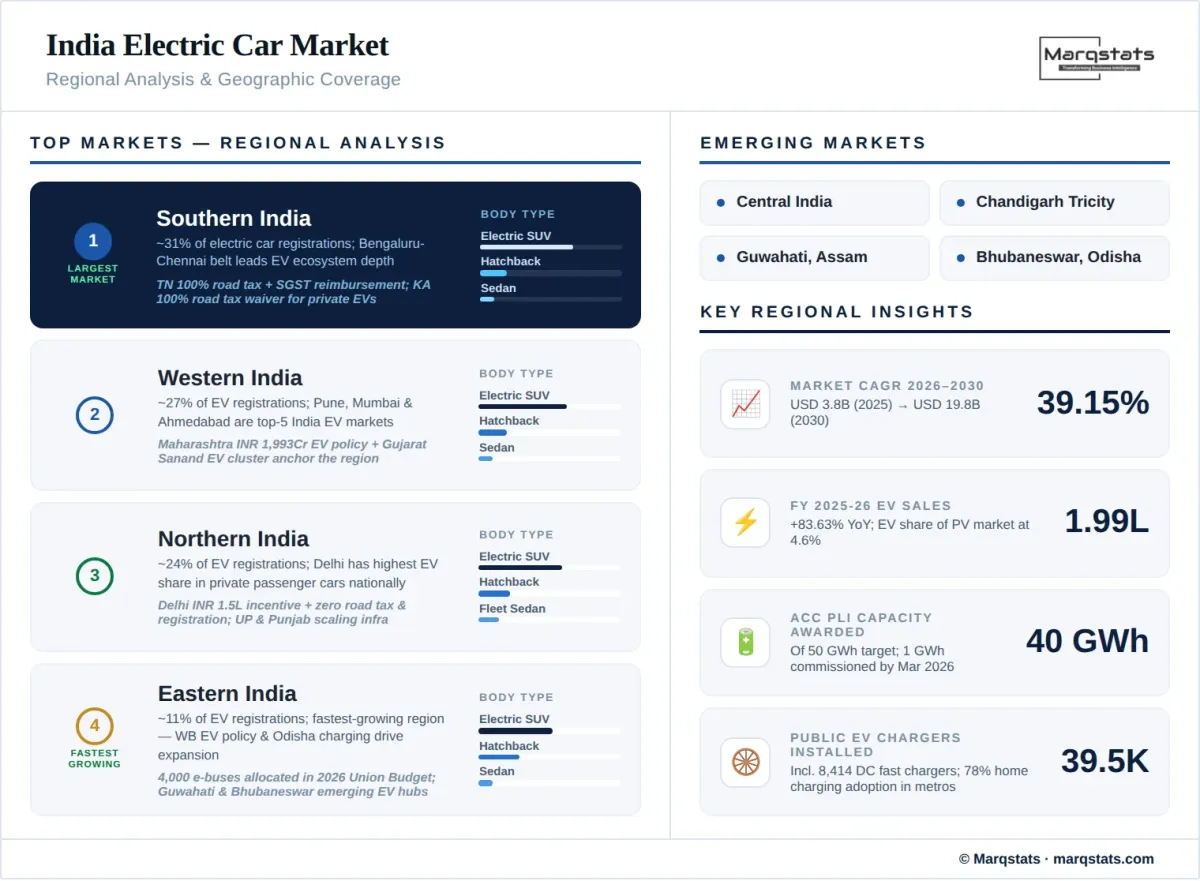
Western India accounts for approximately 27% of India electric car registrations, anchored by Maharashtra and Gujarat. Maharashtra's draft EV Policy 2025–30 allocates INR 1,993 crore for manufacturing and infrastructure incentives, while targeting 10% of new vehicle registrations as EVs by end-2025. Gujarat hosts Tata Motors' Sanand EV cluster and attractive road-tax waivers, making Pune, Mumbai, and Ahmedabad three of the top five Indian electric car retail markets.
Southern India
Southern India contributes around 31% of electric car volumes — the largest regional share — driven by Karnataka's Bengaluru-centred EV ecosystem, Tamil Nadu's manufacturing depth, and Kerala's strong fleet electrification mandates. Tamil Nadu EV Policy offers 100% road tax exemption and SGST reimbursement, while Karnataka's EV policy supports OEM manufacturing and a 100% road tax waiver for private EVs. Chennai, Bengaluru, Hyderabad, and Thiruvananthapuram lead regional volume.
Northern India
Northern India represents roughly 24% of electric car registrations, anchored by Delhi NCR. Delhi's EV policy offers up to INR 1.5 lakh in direct purchase incentive plus road tax and registration fee waiver, producing the country's highest EV share in private passenger cars. Punjab, Haryana, and Uttar Pradesh are scaling EV infrastructure while Uttarakhand offers full road tax waivers.
Eastern India
Eastern India contributes approximately 11% of electric car registrations and is the fastest-growing region by percentage terms. West Bengal's EV policy, Odisha's aggressive charging deployment, and the 4,000 e-buses allocated for eastern states under the 2026 Union Budget are catalysing retail and fleet EV demand in Kolkata, Bhubaneswar, and Guwahati.
Central India
Central India accounts for around 7% of electric car volumes, with Madhya Pradesh and Chhattisgarh scaling EV infrastructure through state-level charging network expansion. Tier-2 city adoption is growing from a low base as compact electric SUV launches reach dealership networks outside metro markets.
How Competition Is Evolving
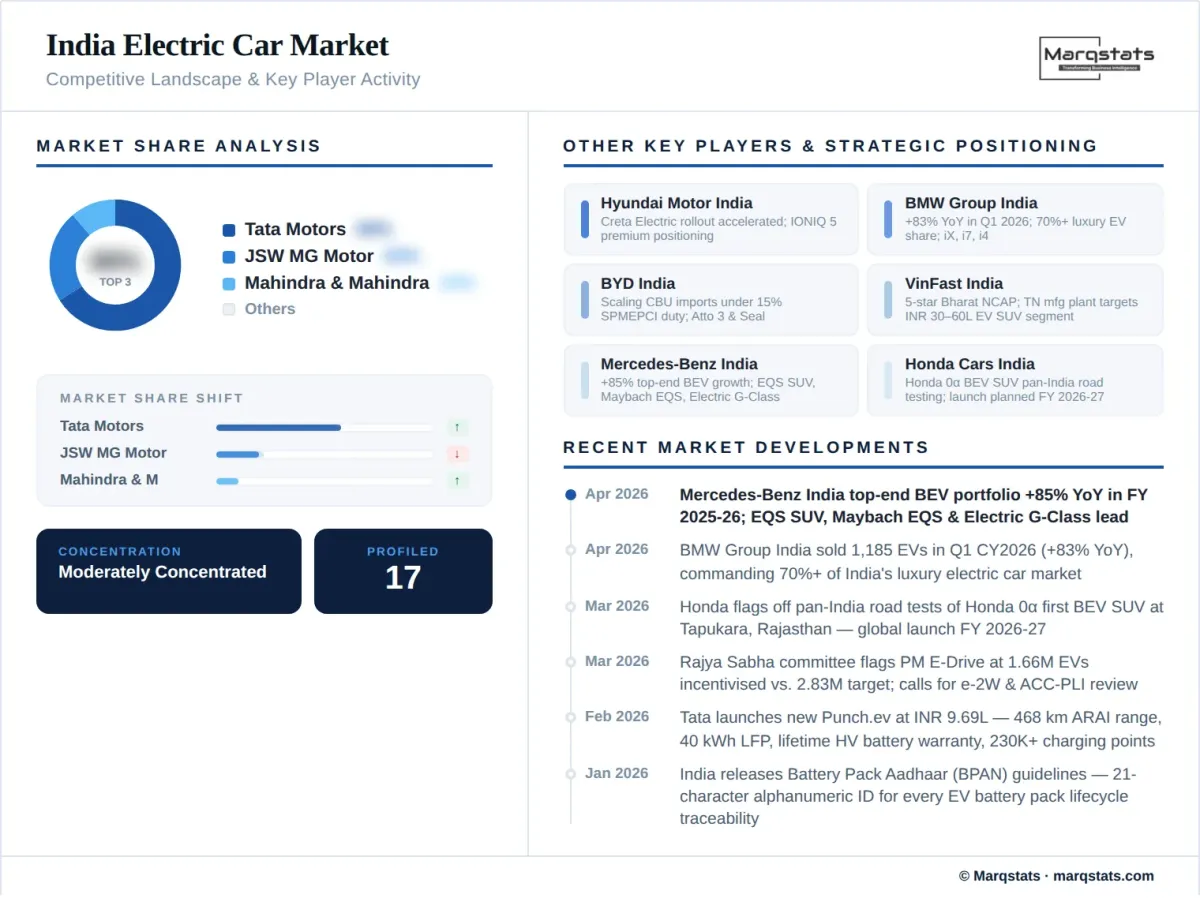
The India electric car market is moderately concentrated at the volume end and highly fragmented at the premium end. Tata Motors Limited holds the clear mass-market lead with roughly 58% of electric passenger car share through the Punch.ev, Nexon.ev, Tigor.ev, and Curvv.ev. JSW MG Motor India Private Limited ranks second with approximately 20% share anchored by the MG Windsor, ZS EV, and Comet EV. Mahindra & Mahindra Limited has gained rapidly with the XUV 3XO EV, BE 6, and XEV 9e pushing its electric car market share past 10%. Together these three players account for approximately 88% of electric passenger car sales.
The premium and luxury electric car segment is led by BMW Group India, which sold 1,185 BMW and MINI EVs in Q1 CY2026 — an 83% year-on-year increase — commanding over 70% share of India's luxury EV market. Mercedes-Benz India's top-end BEV portfolio grew 85% in FY 2025-26, led by the EQS SUV, EQS Maybach SUV, and Electric G-Class. Audi, Volvo, Jaguar Land Rover, and Lexus anchor the remaining premium EV demand pool, while Tesla's India entry and VinFast's Tamil Nadu manufacturing facility are expected to reshape the INR 30–60 lakh premium electric SUV segment through 2027.
Strategic moves across 2025–26 include Hyundai Motor India's accelerated electric Creta roll-out, Kia India's Carens EV localisation under parent Kia's global 2030 strategy, Honda Cars India's pan-India road testing of the Honda 0 α electric SUV, BYD's expanding CBU import volumes under the 15% duty framework, and VinFast India's 5-star Bharat NCAP certification for the VF 6 and VF 7. Battery localisation momentum is building as Luminous Power commissioned a 500 MWh lithium-ion assembly line, Octillion Power Systems crossed 3,653 EV battery systems produced in a single day across India-US-China facilities, and the ACC PLI awarded 40 GWh of cell capacity against the 50 GWh target.
Companies Covered
The report profiles 17+ companies with full strategy and financials analysis, including:
Recent Market Activity
Table of Contents
Coverage & Segmentation
This report provides a comprehensive analysis of the India electric car market for the historical period 2021–2025 and forecast window 2026–2030, with 2025 as the base year. Coverage spans battery electric hatchbacks, sedans, sports utility vehicles, and multi-purpose vehicles sold to private and fleet buyers across India. The study examines market sizing by units and value, segment-level forecasts by body type, battery capacity, price band, and end use, competitive positioning, charging infrastructure readiness, battery localisation progress, state EV policy impact, and safety and regulatory compliance under Bharat NCAP, AVAS, Battery Pack Aadhaar, and CMVR frameworks.
Primary research included structured interviews with more than 40 industry stakeholders spanning EV OEM product and strategy leaders, Tier-1 battery and power-electronics suppliers, charge-point operators, dealership principals specialising in electric cars, EV financing partners, fleet operators, and senior policy analysts. Secondary research drew on the Federation of Automobile Dealers Associations, Ministry of Road Transport and Highways, VAHAN registration data, Ministry of Heavy Industries, Press Information Bureau, NITI Aayog, Bureau of Energy Efficiency, state transport departments, company annual reports, investor presentations, stock exchange disclosures, and internally curated Marqstats Intelligence datasets.