Market Snapshot
Key Takeaways
Market Overview & Analysis
Report Summary
The Japan electric kei car market covers battery electric vehicles conforming to Japan’s kei car regulations: a maximum engine displacement of 660cc (irrelevant for BEVs but defining the regulatory category), maximum dimensions of 3.4 metres length, 1.48 metres width, and 2.0 metres height, and a maximum power output of 47 kW. The market encompasses both passenger kei BEVs (Nissan Sakura, Mitsubishi eK X EV, Honda N-ONE e) and commercial kei BEVs (Honda N-VAN e, Suzuki e EVERY, Toyota/Daihatsu mini-commercial platforms). Hybrid (HEV) and plug-in hybrid (PHEV) kei vehicles, fuel cell vehicles, and non-kei minicars are excluded from the market scope. The study covers battery pack specifications (primarily 20 kWh lithium-ion for first-generation models, scaling to 36.6 kWh LFP in the Suzuki e EVERY), charging architecture (home charging, normal AC charging, CHAdeMO DC quick charging), and vehicle-to-home/vehicle-to-load (V2H/V2L) emergency power supply capabilities that are uniquely important in Japan’s earthquake-prone market.
The Japan electric kei car market is strategically important for three reasons. First, kei is already Japan’s largest vehicle segment by market share—not a fringe category—so its electrification trajectory will substantially determine Japan’s overall EV adoption rate. Second, kei vehicles serve Japan’s aging society and rural mobility needs: elderly drivers in regional areas depend on compact, affordable personal mobility, making the kei-to-electric transition a social infrastructure question, not just a product cycle. Third, the kei EV’s emphasis on home charging, emergency power supply, and daily urban driving creates a fundamentally different value proposition from larger EVs—one centered on household utility and low running cost rather than performance and long-distance capability. Japan’s broader policy target—all new passenger vehicle sales electrified by 2035 (including HEVs, PHEVs, BEVs, and FCEVs)—supports growth but does not force full BEV conversion, leaving room for a mixed powertrain pathway within kei.
Market Dynamics
Key Drivers
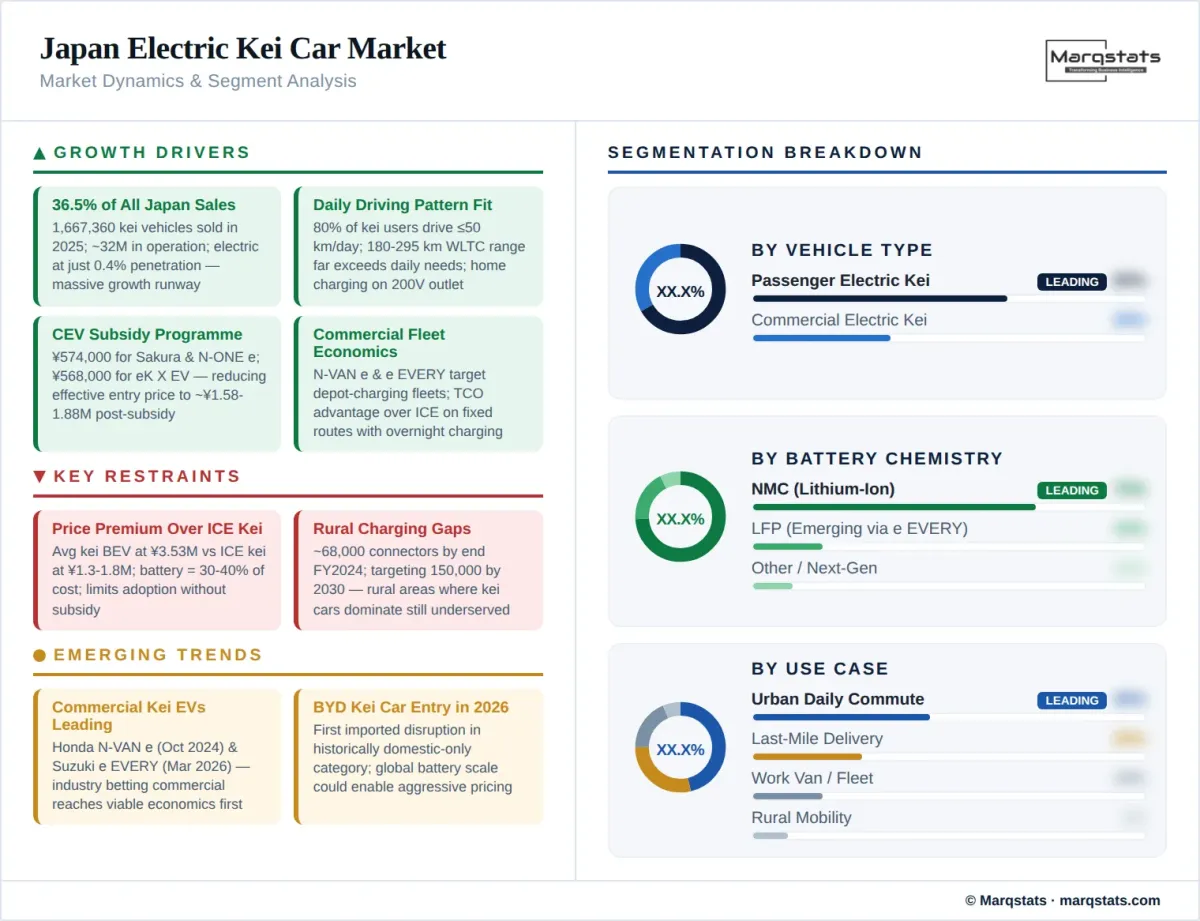
- Kei category’s 36.5% share of Japan’s new vehicle market creating massive electrification base: With 1,667,360 kei vehicles sold in 2025 and approximately 32 million in operation, the kei segment represents the single largest addressable market for automotive electrification in Japan. Electric penetration at just 0.4% of the kei parc means the growth runway is structurally long. Every percentage point of electric penetration within kei translates to approximately 320,000 additional EVs on Japanese roads. Kei cars accounted for roughly 55% of Japan’s total BEV sales in 2023, demonstrating that when affordable electric options exist in this category, consumer uptake is strong.
- Daily driving patterns aligning perfectly with kei BEV range: Approximately 80% of kei/compact vehicle users drive 50 km or less daily, making the 180–295 km WLTC range of current electric kei cars far more than sufficient for daily use. This eliminates range anxiety for the vast majority of kei users, unlike larger EV segments where range concerns persist. The average electric kei car battery of approximately 20 kWh can be fully charged overnight on a standard 200V home outlet, reinforcing the home-charging-centric proposition that differentiates kei EVs from highway-focused larger BEVs.
- Japan’s CEV subsidy programme reducing effective kei BEV prices: The current Clean Energy Vehicle Introduction Promotion Subsidy provides ¥574,000 for the Nissan Sakura and Honda N-ONE e, and ¥568,000 for the Mitsubishi eK X EV. These subsidies bring effective entry pricing to approximately ¥1.58 million for the eK X EV business trim, ¥1.73 million for the Sakura S, and ¥1.88 million for the N-ONE e G—approaching the pricing range of well-equipped ICE kei cars. The government raised the maximum EV subsidy ceiling in January 2026, and Japan’s EV sales responded with a 77.4% year-over-year increase in February 2026. In March 2026, the government announced further revision of CEV evaluation criteria effective April 2026, adding weight to domestic battery production and economic security—a policy shift that directly benefits domestically manufactured kei EV batteries.
- Japan’s aging society and rural mobility needs driving structural demand: Japan’s demographic profile—with 29% of the population aged 65 or older—creates unique demand for compact, easy-to-drive personal mobility in regional and rural areas where public transport is declining. Kei cars serve this population disproportionately. Electric kei cars offer silent operation, smooth automatic transmission, low running cost (¥10,800 annual tax, home-charged electricity versus gasoline), and simplified maintenance—advantages that align precisely with elderly driver needs. Local governments and municipalities increasingly view electric kei vehicles as community mobility solutions, not just private vehicles.
- Commercial kei EV economics working for last-mile logistics: Last-mile delivery and work-van applications represent the strongest near-term economics for kei EVs, where fixed daily routes, depot charging, and high daily utilization rates maximize TCO advantages. Honda’s N-VAN e (245 km WLTC range, launched October 2024) and Suzuki’s e EVERY (257 km range, 36.6 kWh LFP, launched March 2026) directly target this segment. Toyota has explicitly framed its Suzuki/Daihatsu/Toyota mini-commercial BEV programme around last-mile logistics. Japan Post, Yamato Transport, and other major delivery operators have trialled kei-class electric delivery vehicles.
Key Restraints
- Kei BEV range still approximately one-third of non-kei BEVs: While 180–295 km WLTC range is sufficient for daily kei usage, the 3x range gap versus non-kei BEVs (typically 450–600+ km) constrains electric kei cars to urban/suburban use. Consumers who occasionally need longer trips may choose conventional kei cars or larger EVs instead. The 20 kWh battery standard in first-generation models (Sakura, eK X EV) is a deliberate cost-range compromise; the Suzuki e EVERY’s 36.6 kWh pack and Honda N-ONE e’s 295 km range demonstrate the path forward, but at higher price points.
- Average kei BEV price of ¥3.53 million still above mainstream kei affordability: Despite subsidies reducing effective entry prices, the average kei BEV at approximately ¥3.53 million remains significantly above the ¥1.3–1.8 million range of popular ICE kei cars. Battery cost—approximately 30–40% of vehicle price—is the primary culprit. Until battery costs decline further or manufacturers accept lower margins, the price premium will limit electric kei adoption to subsidy-supported purchases and cost-conscious fleet operators.
- Charging infrastructure still developing, particularly in rural areas: Japan had approximately 68,000 charging connectors by end of FY2024 (12,000 quick chargers, 56,000 normal chargers), targeting 150,000 by 2030 including 30,000 public quick chargers. While kei EVs are primarily home-charged, the lack of destination and en-route charging in rural areas—where kei cars are most prevalent—constrains adoption among apartment dwellers and those without home charging access. Honda’s “Honda Charge” network (approximately 200 rapid chargers, targeting several thousand sockets by 2030) addresses this gap but remains urban-focused.
- Japan’s 2035 electrification target includes HEVs, not BEV-only: METI’s target for all new passenger vehicle sales to be “electrified” by 2035 includes HEVs, PHEVs, BEVs, and FCEVs—not a pure BEV mandate. This means kei manufacturers can comply through hybrid technology, reducing urgency for full BEV transition. Honda’s March 2026 announcement that it will revise its 2040 all-EV goal—acknowledging “it will be difficult to achieve”—and its plan to expand hybrid lineup further illustrates how the mixed-powertrain pathway may slow pure electric kei car growth.
Key Trends
- Commercial kei EVs scaling faster than passenger segment: The Honda N-VAN e (October 2024) and Suzuki e EVERY (March 2026) represent a clear industry bet that commercial kei EVs will reach viable economics before passenger models. The Toyota/Suzuki/Daihatsu mini-commercial BEV programme explicitly targets work-van and last-mile applications. Commercial users value TCO over sticker price, can depot-charge overnight, and operate fixed routes that match electric range—creating a stronger near-term business case than private buyers who compare against cheap ICE kei alternatives.
- LFP chemistry entering kei EV segment via Suzuki e EVERY: Suzuki’s e EVERY uses a 36.6 kWh LFP battery—the first LFP deployment in a Japanese kei EV. LFP’s lower cost, superior thermal stability, and longer cycle life versus NMC align with commercial-use duty cycles requiring daily deep discharges. If LFP proves successful in the e EVERY, it could shift the chemistry mix across the kei EV segment, reducing battery costs and improving safety profile.
- BYD’s planned 2026 kei car entry as first imported disruption: Reuters reported in October 2025 that BYD plans to launch an all-electric kei car in Japan by end of 2026. This would be the first serious imported challenge in a category historically dominated by Nissan, Mitsubishi, Honda, Suzuki, Daihatsu, and Toyota. BYD’s global battery manufacturing scale and cost advantages could enable aggressive pricing, but success depends on navigating Japan’s unique kei regulations, dealer network requirements, and brand trust dynamics.
- Ultra-affordable micro-EV concepts expanding the segment’s lower boundary: KG Motors’ mibot—a single-seat electric kei car priced at approximately USD 7,000 (about ¥1.05 million)—represents a radically different approach to electric kei mobility. While not yet a volume product, the mibot and similar micro-EV concepts test whether the kei segment can support an even more affordable, minimalist electric tier below the current Sakura/eK X EV/N-ONE e class. This positions kei EVs as potential mobility solutions for elderly single-occupant use, neighborhood deliveries, and first/last-mile connections.
- V2H and emergency power supply as uniquely Japanese value proposition: Japan’s earthquake and typhoon exposure makes vehicle-to-home (V2H) capability a uniquely compelling selling point for kei EVs. Mitsubishi’s kei EV messaging emphasizes home charging, normal charging, and emergency power supply functionality. A 20 kWh kei EV battery can power essential household appliances for 2–4 days during a grid outage. This practical resilience value—distinct from driving performance—is a purchase motivator that has no equivalent in most global EV markets.
- CEV subsidy criteria tightening toward domestic battery production: The March 2026 announcement that Japan’s government will revise CEV evaluation criteria effective April 2026 to give more weight to domestic battery production and economic security signals a policy shift favoring domestically manufactured kei EV batteries. This could disadvantage imported models (including BYD’s planned entry) while benefiting Nissan, Honda, Suzuki, and Mitsubishi’s domestic supply chains. The revision also incorporates Japan-U.S. frameworks for rare earth supply security.
Market Segmentation
Passenger kei BEVs constitute the current volume core of the Japan electric kei car market. The Nissan Sakura—Japan’s best-selling EV in FY2024 with 20,832 units—set the segment template with a 20 kWh lithium-ion battery, 180 km WLTC range, and post-subsidy pricing from approximately ¥1.73 million. The Mitsubishi eK X EV shares the NMKV joint venture platform, offering similar specifications with a slightly lower effective price of ¥1.58 million. Together, the Sakura and eK X EV crossed 100,000 cumulative production units in September 2024. Honda’s N-ONE e (launched September 2025) represents the second generation, pushing range to 295 km WLTC—a 64% improvement over first-generation models—at a post-subsidy price of approximately ¥1.88 million. KG Motors’ mibot single-seat concept at approximately USD 7,000 tests the ultra-affordable micro-EV tier. BYD’s planned 2026 entry would add the first foreign nameplate to this historically domestic segment.
Commercial kei BEVs are the fastest-growing sub-segment, with stronger near-term economics driven by depot charging, fixed routes, and TCO-focused fleet purchasing. Honda’s N-VAN e launched in October 2024 with 245 km WLTC range, targeting delivery and work-van applications. Suzuki’s e EVERY launched in March 2026 with a 36.6 kWh LFP battery, 257 km range, and a design tailored for cargo operations. Toyota’s explicit framing of the Suzuki/Daihatsu/Toyota mini-commercial BEV programme around last-mile logistics signals the industry’s conviction that commercial kei EVs will achieve volume viability before passenger models. Major logistics operators including Japan Post and Yamato Transport have evaluated kei-class electric delivery vehicles for urban distribution networks.
The 20 kWh lithium-ion battery—used in the Nissan Sakura and Mitsubishi eK X EV—represents the first-generation kei EV battery standard. This capacity delivers 180 km WLTC range, sufficient for 80% of daily kei usage patterns. The 20 kWh pack balances cost, weight, and range within kei dimensional constraints (3.4m × 1.48m × 2.0m), keeping vehicle pricing within subsidy-accessible range. Full overnight charging on a 200V home outlet makes home-based charging the primary use pattern.
Suzuki’s e EVERY deploys a 36.6 kWh LFP battery—the largest and first LFP pack in a Japanese kei vehicle—achieving 257 km range. Honda’s N-ONE e achieves 295 km with an undisclosed pack size but clearly exceeding first-generation 20 kWh specifications. These larger packs address the key restraint of range limitation but increase cost and weight, creating a segmentation tier within kei EVs: affordable/sufficient-range (20 kWh) versus premium/extended-range (30+ kWh). The LFP chemistry choice in the e EVERY signals a potential shift from NMC-dominated kei EV batteries toward LFP’s lower cost and higher safety profile.
The dominant use case for electric kei cars: short-distance daily driving of 50 km or less, home-charged overnight. The compact dimensions, silent operation, and ultra-low running cost (¥10,800 annual tax, home electricity) position electric kei cars as optimal second/third household vehicles in suburban Japan. Elderly drivers in regional areas represent a growing share of this use case as Japan’s aging society intensifies demand for simplified, compact mobility.
Fastest-growing use case with strongest TCO advantages. Fixed urban delivery routes of 100–200 km daily, overnight depot charging, and high vehicle utilization rates create compelling economics versus gasoline kei vans. The N-VAN e and e EVERY directly target this segment. E-commerce growth in Japan continues to expand last-mile delivery volumes, supporting kei-class electric delivery fleet deployment.
A uniquely Japanese value proposition: kei EVs serving as household emergency power sources during earthquakes, typhoons, and grid outages. A 20 kWh battery can power essential household appliances for 2–4 days. This functional differentiation has no direct equivalent in other global markets and adds practical value beyond transportation, particularly in disaster-prone regional areas.
By Geography
Greater Tokyo Metropolitan Area
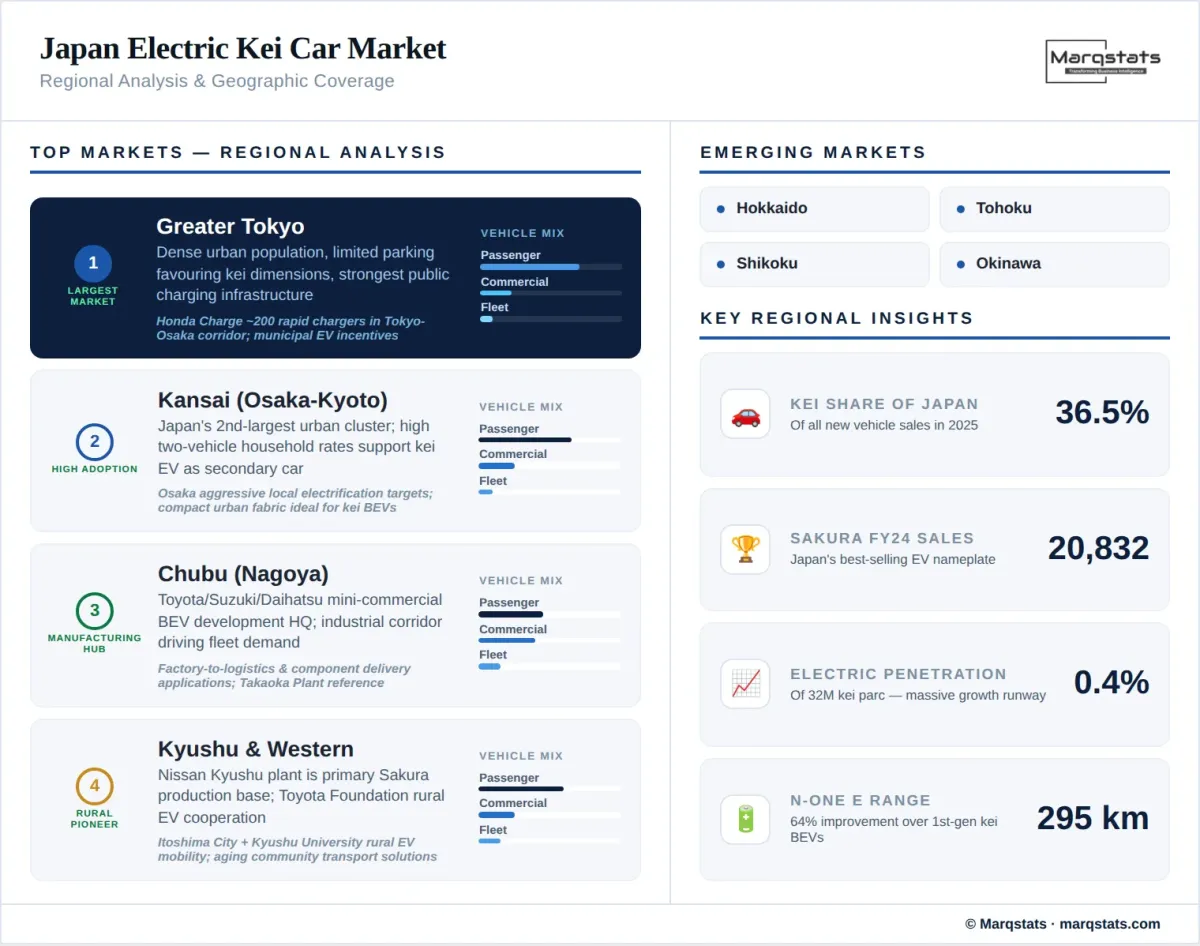
The Greater Tokyo region represents the largest single market for electric kei cars, driven by dense urban population, limited parking space (favouring kei dimensions), and strong public charging infrastructure relative to regional areas. Tokyo’s environmental policies and municipal incentives supplement national CEV subsidies. Honda’s “Honda Charge” network is concentrated in the Tokyo-Osaka urban corridor, with approximately 200 rapid chargers providing plug-and-charge convenience at commercial facilities.
Kansai Region (Osaka, Kyoto, Kobe)
Japan’s second-largest urban cluster, with strong kei car adoption rates and expanding EV infrastructure. The region’s compact urban fabric and high two-vehicle household rates support electric kei cars as secondary vehicles. Osaka’s metropolitan government has set aggressive local electrification targets complementing national policy.
Chubu Region (Nagoya and Toyota City)
Home to Toyota’s manufacturing base and the Suzuki/Daihatsu/Toyota mini-commercial BEV development partnership. The Chubu region’s industrial corridor creates strong commercial kei EV demand for factory-to-logistics and component delivery applications. Toyota’s Takaoka Plant produces the RAV4 PHEV and serves as a manufacturing reference point for electrified vehicle production.
Kyushu and Western Japan
Nissan’s Kyushu plant is a primary Sakura production base, and Toyota Mobility Foundation signed a cooperation agreement with Itoshima City (Fukuoka Prefecture), Kyushu University, and Showa Jidosha in March 2026 to consider expanding EV deployment and resolving rural transportation challenges. Kyushu’s aging rural communities represent important demand centres for electric kei cars as personal mobility solutions.
Hokkaido and Northern Japan
Cold-climate testing ground for kei EVs: battery performance degradation in sub-zero temperatures is a key concern. Isuzu’s partnership with ANA deploys electric cargo trucks at New Chitose Airport (Hokkaido) in cold-climate conditions. Cold-weather range reduction and heating energy demands create distinct technical requirements for kei EV battery management in northern Japan.
Rural and Regional Japan
The strategic heart of the Japan electric kei car market’s long-term growth. Japan’s aging society is most pronounced in rural prefectures where public transport is declining, creating dependency on personal vehicles—predominantly kei cars. Electric kei vehicles offer elderly-friendly features (quiet, simple operation, low maintenance) and community resilience (V2H emergency power). However, limited public charging infrastructure and longer inter-town distances in rural areas constrain adoption. Subaru’s plan to install 50 units of 150kW rapid chargers at dealerships by FY2027, while focused on its own EVs, illustrates the gradual expansion of dealer-based charging that benefits all EVs including kei.
How Competition Is Evolving
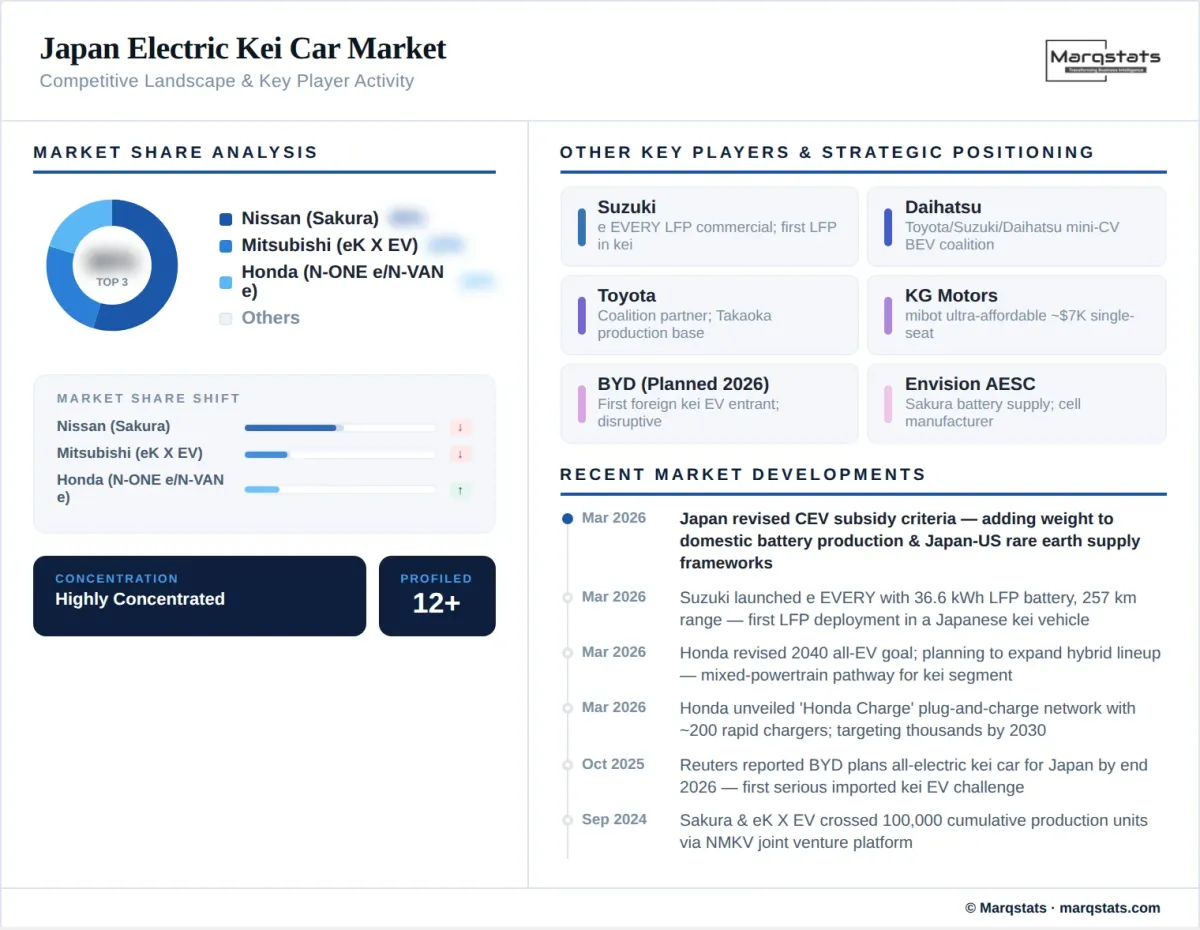
The Japan electric kei car market is highly concentrated among domestic incumbents, with no foreign manufacturer having sold an electric kei car in Japan as of early 2026. Nissan and Mitsubishi created the category through the NMKV joint venture, launching the Sakura and eK X EV on a shared platform that reached 100,000 cumulative units by September 2024. The Sakura’s position as Japan’s best-selling EV in FY2024 (20,832 units) gives Nissan the undisputed volume leadership, though this share will erode as Honda and Suzuki scale their entries.
Honda is the most important next-wave challenger. Its dual-front strategy—N-VAN e for commercial (October 2024, 245 km) and N-ONE e for passenger (September 2025, 295 km)—gives it the broadest electric kei portfolio among Japanese OEMs. Honda’s structural advantage is its dominance in the broader kei segment through the N-Box (Japan’s best-selling vehicle overall), providing unmatched dealer network reach and brand leverage. The “Honda Charge” plug-and-charge network and Battery-as-a-Service explorations through Honda Power Pack Energy add ecosystem depth.
Suzuki’s e EVERY launch in March 2026 (36.6 kWh LFP, 257 km) introduces LFP chemistry to the kei EV segment and positions Suzuki strongly in commercial applications. The Suzuki/Daihatsu/Toyota mini-commercial BEV coalition targets last-mile logistics, potentially creating the largest-volume commercial kei EV programme in Japan. BYD’s planned 2026 kei car entry represents the most significant competitive disruption potential: BYD’s global battery manufacturing scale and Blade Battery technology could enable aggressive pricing, but success requires navigating kei regulations, building a Japan dealer network, and overcoming consumer preference for domestic brands. KG Motors’ mibot at approximately USD 7,000 tests ultra-affordable micro-EV positioning for single-occupant mobility. The March 2026 revision of CEV subsidy criteria to favour domestic battery production could further tilt the competitive landscape toward Japanese incumbents.
Companies Covered
The report profiles 15+ companies with full strategy and financials analysis, including:
Recent Market Activity
Table of Contents
Coverage & Segmentation
This report provides a comprehensive analysis of the Japan electric kei car market covering the historical period (2021–2025) and forecast period (2026–2030), with 2025 as the base year. The study examines market size in USD and JPY, unit volume forecasts, growth trends, competitive dynamics, and segment-level analysis across vehicle type (passenger kei BEV, commercial kei BEV), battery specification (20 kWh NMC, 30–37 kWh LFP/extended range), use case (urban commuting, last-mile delivery, V2H emergency power), and regional geography. Company profiling covers all active and announced kei EV manufacturers, the NMKV joint venture, battery and component suppliers, and BYD’s planned entry. Policy analysis covers CEV subsidy structure, METI 2035 electrification target, kei tax treatment, and charging infrastructure targets.
Research methodology combines bottom-up unit sales modelling from JAMA, Keikenkyo (Japan Light Motor Vehicle Inspection Association), and METI data, validated against OEM sales disclosures, CEV subsidy registration records, and Japanese automotive press coverage. Primary research includes interactions with kei EV OEMs, battery suppliers, charging network operators, and policy stakeholders. The Marqstats global used car market report and global sensor market report provide complementary intelligence on adjacent automotive segments.