Market Snapshot
Middle bar: base-year value × (1 + CAGR), rounded to two decimals. This is a calculated illustration, not a separately researched annual estimate.
The ASEAN electric vehicle market is undergoing a structural transformation, emerging as one of the fastest-growing EV markets globally. The market was valued at USD 8.50 billion in 2025 and is projected to reach USD 30.80 billion by 2030, expanding at a compound annual growth rate (CAGR) of 29.39% during the 2026–2030 forecast period. Electrified vehicle (xEV) sales across the ASEAN-6 bloc — Indonesia, Malaysia, Thailand, the Philippines, Vietnam, and Singapore — surged 62% year-on-year in the first half of 2025, with average xEV adoption reaching 18% of total light-vehicle sales, according to industry analyses. This momentum contrasts sharply with a 5.4% contraction in overall ASEAN-6 light-vehicle volumes in 2024, confirming that electrification is accelerating even as broader auto demand softens.
National policy architectures are the primary demand engine. Thailand's EV3.5 subsidy scheme channels an estimated THB 34 billion in incentives requiring local assembly for eligibility. Indonesia's Presidential Regulation 79/2023 formalises phased local-content (TKDN) requirements through 2030, linking import facilitation to domestic manufacturing commitments. Vietnam has extended a 0% vehicle registration fee for battery EVs through February 2027 under Decree 51/2025, complementing a 3% special consumption tax for BEVs of nine seats or fewer — the most consumer-friendly fiscal stack in the region. Singapore, meanwhile, maintains its status as ASEAN's most EV-ready market with a 72% xEV adoption rate and structured public-bus electrification mandates.
The competitive landscape is being reshaped by an influx of Chinese OEMs — BYD, GAC AION, Changan, GWM, MG (SAIC), XPeng, Leapmotor, and Wuling — that are combining aggressive pricing with early-mover manufacturing investments across Thailand, Indonesia, and Malaysia. Vietnamese champion VinFast has emerged as the leading xEV brand in ASEAN-6 by volume, reporting 175,099 EV deliveries in Vietnam alone in 2025 and targeting 300,000 global deliveries in 2026. The charging infrastructure ecosystem is scaling in parallel: Indonesia's PLN operates 4,516 SPKLU charging units nationally, V-Green (Vietnam) plans 99 ultra-fast hubs in 2026, and Thailand's cumulative electric mobility registrations reached 147,522 units by end-2025, supported by approximately 4,356 charging stations. Battery supply-chain investments — including BYD's USD 1 billion plant in Subang, West Java, and the 10 GWh Hyundai-LG Energy Solution cell plant in Karawang — are progressively anchoring ASEAN's position as a global EV production hub.
Key Takeaways
Market Overview & Analysis
Report Summary
The ASEAN electric vehicle market encompasses battery electric vehicles (BEVs), plug-in hybrid electric vehicles (PHEVs), and hybrid electric vehicles (HEVs) — collectively referred to as xEVs — across passenger cars, commercial vehicles, two-wheelers, and three-wheelers in Southeast Asia's six major automotive markets. The study covers the ASEAN-6 economies: Indonesia, Malaysia, Thailand, the Philippines, Vietnam, and Singapore. Within the broader ASEAN bloc, these six markets account for the overwhelming majority of EV sales, policy-driven demand creation, and manufacturing investment.
The region's EV transition is structurally distinct from Europe or China. It is not driven by a single uniform regulatory mandate but rather by a mosaic of national incentive architectures, localisation requirements, and OEM ecosystem strategies that interact differently across markets. Thailand and Indonesia are positioning themselves as dual hubs — manufacturing bases and consumer markets simultaneously. Vietnam is unique in that its EV transformation is led by a single dominant domestic OEM (VinFast) backed by a national industrial ecosystem stretching from vehicles and charging to ride-hailing. Singapore and Malaysia are advancing as premium-EV and localisation-testing markets respectively, while the Philippines represents the region's highest-upside emerging market as EVIS (Electric Vehicle Incentive Strategy) incentives begin to take hold.
From a powertrain perspective, BEVs dominate new EV registrations in Thailand and Vietnam, while PHEVs and HEVs remain significant in Malaysia and the Philippines where consumer range-anxiety and charging access persist. Commercial EV adoption — particularly electric buses — is accelerating through state procurement programmes in Singapore, Vietnam, Indonesia, and Malaysia, creating a parallel demand vertical distinct from passenger-car electrification. The competitive inflection is real and irreversible: xEV sales across ASEAN-6 surged 63% year-on-year through the first three quarters of 2025, even as total industry volumes fell marginally, confirming that powertrain transition is no longer a future narrative but a present market reality.
Market Dynamics
Key Drivers
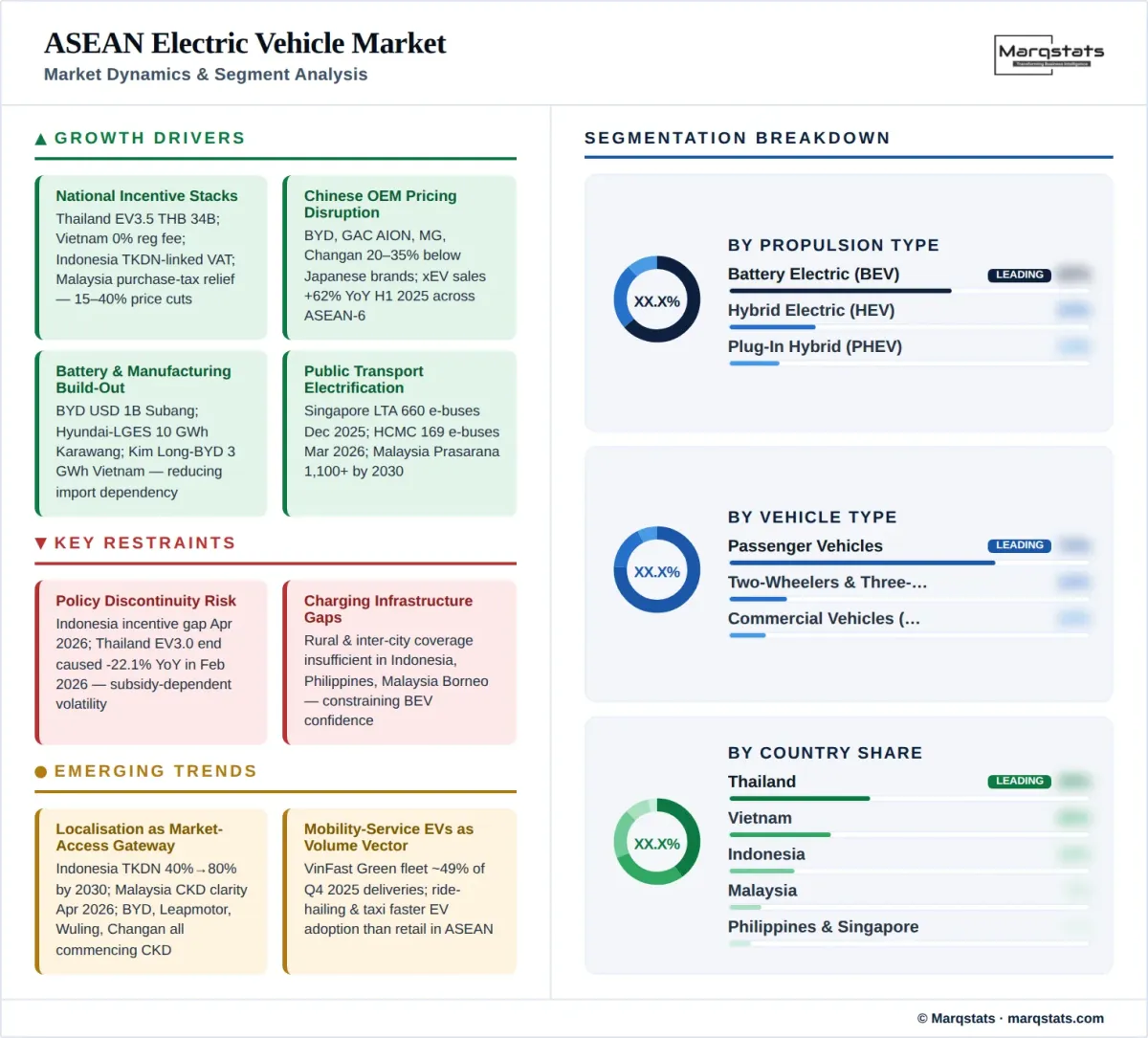
- Government incentive stacks and tax relief programmes: Thailand's EV3.5 scheme, Indonesia's luxury-tax exemptions and TKDN-linked VAT support, Vietnam's 0% registration fee through 2027, and Malaysia's purchase-tax reliefs have collectively reduced EV sticker prices by 15–40% versus equivalent ICE models, directly inflecting volume uptake.
- Expanding Chinese OEM presence and competitive pricing: BYD, GAC AION, MG, GWM, Changan, XPeng, and Leapmotor have entered ASEAN with BEV models priced 20–35% below comparable Japanese brands, compressing the ICE-EV price gap rapidly and triggering a competitive response that is itself pulling volume.
- Battery supply-chain investment and local manufacturing build-out: Indonesia's Hyundai-LGES JV (10 GWh cell plant), BYD's USD 1 billion Subang assembly facility, Wuling's MAGIC Battery production line, and Kim Long Motor's BYD-partnered 3 GWh battery plant in Vietnam are progressively reducing import dependency and lowering per-unit costs.
- Rising fuel costs and total-cost-of-ownership parity: The Middle East conflict-driven oil price spike in early 2026 directly amplified EV purchasing intent across ASEAN. VinFast launched a 'Gasoline Trade-in for Electric' promotion in Vietnam, Indonesia, the Philippines, and India, citing oil price volatility. Toyota Motor Thailand cited rising fuel and LNG-linked electricity costs as distorting the ICE-EV economics equation.
- Public transport electrification programmes: State bus fleet tenders in Singapore (LTA: 660 buses in December 2025), Vietnam (Ho Chi Minh City: 169 electric buses on nine routes from March 2026), and Malaysia (Prasarana: 1,100+ electric buses by 2030) are creating bankable, volume-scale demand for commercial EVs that anchors OEM investment decisions.
Key Restraints
- Policy discontinuity and incentive uncertainty: Indonesia's government had not finalised a new EV incentive framework as of April 2026, following the sunset of several 2024–2025 measures. Thailand's post-EV3.0 registration volumes fell 22.1% YoY in February 2026 as the scheme concluded, demonstrating how subsidy-dependent demand can correct sharply at programme transitions.
- Charging infrastructure gaps outside metropolitan corridors: While Vietnam's V-Green network covers 34 provinces with 150,000+ charging ports and Thailand has 4,356 stations, inter-city and rural charging density remains inadequate in Indonesia, the Philippines, and Malaysia's Borneo markets, constraining consumer confidence in long-distance BEV use.
- High household debt and tight consumer credit conditions: Thailand's domestic vehicle sales face persistent headwinds from high household debt and tighter auto-loan underwriting; Indonesia experienced an -11% TIV contraction in 2025 partly driven by weakened purchasing power. These macroeconomic conditions delay EV uptake among aspirational first-time buyers.
- Japanese OEM portfolio gaps in the BEV segment: Toyota, Honda, and Isuzu — which collectively hold a 60–90% share of ASEAN automotive sales — have limited competitive BEV offerings versus Chinese rivals. Although Toyota launched the Hilux BEV and Urban Cruiser EV in Malaysia in April 2026 and Isuzu introduced the D-MAX EV in Thailand, the Japanese BEV product pipeline lags Chinese entrants by 3–5 years in price-performance competitiveness.
Key Trends
- Localisation as market-access gateway: Indonesia's TKDN requirements (40% through 2026, 60% by 2027–2029, 80% from 2030) and Malaysia's CKD-policy clarification are transforming local assembly from a cost option into a regulatory necessity. Leapmotor, Wuling, BYD, Changan, GWM, and XPeng have all announced or commenced CKD operations in ASEAN.
- Mobility-service EVs as volume-scale commercial use case: VinFast's Green lineup (Limo Green, Herio Green, Nerio Green) — optimised for ride-hailing, taxi, and fleet applications — accounted for approximately 49% of VinFast's total Q4 2025 deliveries, demonstrating that urban mobility platforms are a faster EV adoption vector than retail consumer sales in markets with younger demographics and lower private-car ownership.
- Premium and ultra-long-range EV launches raising ASP: The BIMS 2026 event in Bangkok featured the Mercedes-Benz CLA 250+ Electric (WLTP range: 792 km), BMW iX3 50 xDrive M Sport (805 km, 800V architecture), and MG IM5 (860 km NEDC, 800V SiC platform), signalling that ASEAN is being treated as a legitimate premium BEV market alongside China and Europe.
- Battery-swap and ultra-fast charging as range-extension infrastructure: U Power's 30 battery-swapping heavy trucks deployed in Thailand (March 2026), V-Green's 150 kW supercharging hub rollout, and the NV Gotion-PLANET MOU for LFP/NCM batteries in Thailand reflect a broader shift from slow residential charging to rapid fleet-turnover models suited to tropical, high-utilisation ASEAN operating patterns.
Market Segmentation
BEVs are the dominant propulsion segment in the ASEAN EV market, accounting for approximately 86% of EV market share by volume in 2024. BEV penetration is highest in Vietnam (VinFast's entire lineup), Thailand (where the EV3.5 scheme explicitly targets BEV production and imports), and Indonesia (where TKDN-linked incentives favour BEVs with qualifying domestic content). Across ASEAN-6, BEV sales growth was driven primarily by Chinese brands — BYD registered 39,856 units in Thailand in 2025 (up 47.5% YoY), GAC AION grew 438% YoY in Thailand in January 2026 alone, and MG (SAIC) sold 27,007 units in Thailand in 2025, up 57% YoY. The BEV segment is forecast to maintain the largest share through 2030, supported by progressive emission-based excise tax structures that penalise ICE vehicles and reward zero-emission models.
PHEVs occupy a strategically important mid-adoption position in markets where charging infrastructure is still developing — primarily Malaysia, the Philippines, and Thailand. The Proton e.MAS 7 PHEV launched in Malaysia in February 2026 at MYR 109,800 dominated Malaysia's 2025 EV registrations with 8,677 units, reflecting strong consumer appetite for extended-range electrification in markets with range anxiety. BYD's SEALION 5 DM-i launched in Thailand at BIMS 2026 at THB 759,900, and Denza D9 PHEV entered the Philippines at PHP 3,998,000, expanding the luxury PHEV tier. Thailand's new emissions-based excise tax framework from January 2026 provides PHEVs with preferential tax treatment versus ICE vehicles, reinforcing the segment's value proposition.
HEVs retain a significant market position in Malaysia, Indonesia, and the Philippines as a cost-accessible bridge technology. Malaysia's HEV adoption is led by Toyota models (Vellfire HEV, Yaris Cross HEV) and Nissan's Serena e-POWER, which launched in March 2026 at MYR 154,800. VAMA data for Vietnam showed HEV sales up 48% YoY in February 2026. Thailand's cumulative HEV registrations stood at approximately 605,017 units by end-2025 versus 282,312 BEVs, reflecting the depth of hybrid penetration as a consumer preference even in Asia's most advanced EV markets. HEVs are projected to grow at a moderate rate through 2030 as policy incentives progressively favour pure-electric vehicles.
Passenger EVs dominate the ASEAN EV market, accounting for approximately 90% of BEV registrations in Thailand, over 85% in Indonesia, and virtually all EV sales in Vietnam through VinFast's consumer lineup. Key volume drivers include the sub-USD 15,000 urban EV segment (VinFast VF 3, Geely EX2 at IDR 229 million in Indonesia, Wuling Bingo EV at MYR 67,800 in Malaysia) and the mid-size SUV segment dominated by BYD (Atto 3, Seal, Sealion 7), MG (ZS EV, S5 EV), and GAC AION (UT, V). By 2030, passenger BEVs will account for the majority of incremental market value as product proliferation spans A-segment minicars to D-segment luxury saloons.
Electric commercial vehicles represent the fastest-growing segment by growth rate in the ASEAN EV market, driven by public procurement of electric buses and urban logistics electrification. Singapore's LTA awarded 660 electric buses in December 2025; Ho Chi Minh City deployed 169 electric buses on nine routes from March 2026; Indonesia's PT VKTR Sakti Industries inaugurated ASEAN's largest electric bus assembly plant in April 2026 with capacity for 10,000 units. Electric vans are scaling through VinFast's EC Van (contributing significantly to Vietnam monthly volumes) and Kim Long Motor's GK48-EV (VND 480 million, 305 km range) in Vietnam. Electric trucks remain in early-commercial and pilot stages, with Jiuzi Holdings securing agreements for 100+ electric heavy trucks in Vietnam and U Power deploying 30 battery-swapping trucks in Thailand. Commercial EVs are forecast to grow at a CAGR of approximately 34.72% through 2030, the highest of any vehicle-type segment.
Electric two-wheelers represent a massive but undercounted segment in ASEAN, particularly in Vietnam, Indonesia, and Thailand. Vietnam's VinFast produced its highest-ever electric motorcycle volume in 2025. Thailand registered 24,163 electric motorcycles in 2025, up significantly YoY. V-Green expanded its motorcycle battery-swapping network alongside car charging in its April 2026 partnership with Vikki Bank. Indonesia's government has targeted conversion of 6 million petrol motorcycles to electric annually, reflecting the enormous scale of the market opportunity. As two-wheeler electrification scales, it represents a structurally distinct — and potentially much larger — volume pool than passenger cars.
By Geography
Thailand
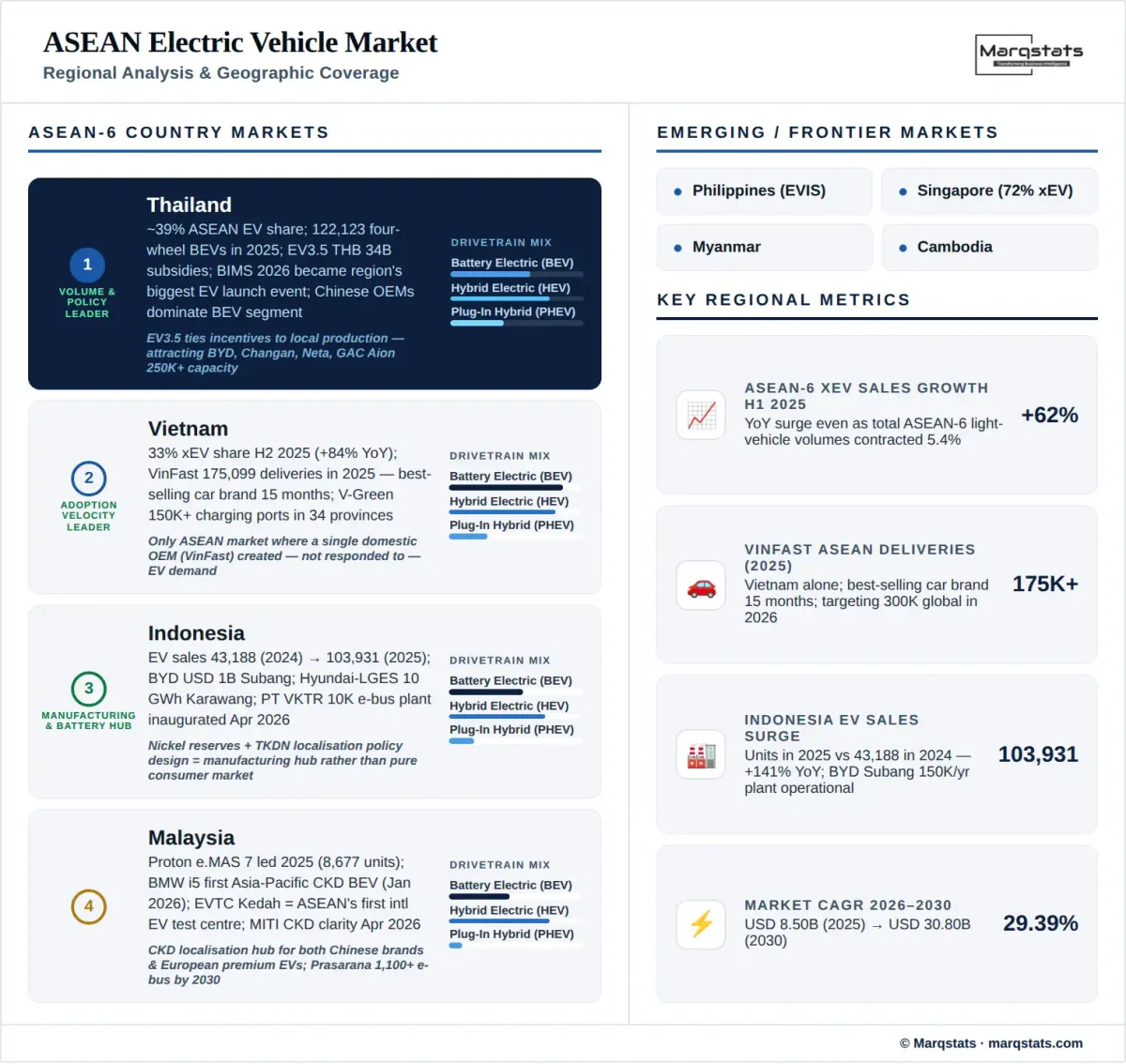
Thailand is the ASEAN EV market's current volume and policy leader, accounting for approximately 39% of regional EV market share in 2024. The country's EV3.0 scheme (2022–2024) and EV3.5 successor programme deployed over THB 34 billion in subsidies, lifting BEV registrations from effectively zero in 2021 to 122,123 four-wheeled passenger EVs in 2025. Thailand implemented an emissions-based excise tax overhaul effective January 2026, creating a progressive cost penalty on ICE vehicles through 2030 while maintaining minimal tax rates for compliant BEVs. Chinese OEMs dominate the BEV segment: BYD (39,856 units in 2025), MG/SAIC (27,007 units), and GAC AION (registering 438% YoY growth in January 2026) lead registrations. The 47th Bangkok International Motor Show (March 2026) featured launches by BYD (ATTO 1, ATTO 2, SEAL 6, SEALION 5 DM-i), Honda (e:N2 at THB 1.43M), Mercedes-Benz (locally assembled CLA 250+ Electric), Isuzu (D-MAX EV), and Changan (NEVO Q05), confirming Thailand's status as a major launch market. The FTI projects vehicle production of 1.5 million units in 2026, with EVs accounting for a growing share of output for both domestic sale and export.
Vietnam
Vietnam has emerged as ASEAN's most dynamic EV market by adoption velocity. By October 2025, Vietnam's EV share of new car sales had reached approximately 40%, with xEV adoption surging 84% YoY through Q3 2025. VinFast's 175,099 EV deliveries in 2025 — a figure that doubled the prior year — made it the best-selling car brand in Vietnam for 15 consecutive months. The VinFast ecosystem encompasses approximately 150,000 charging ports across 34 provinces and cities, with V-Green planning 99 ultra-fast charging hubs in 2026 backed by a VND 10 trillion investment. Vietnam's fiscal architecture is the region's most EV-friendly: 0% registration fee for BEVs (extended to February 2027), 3% special consumption tax for BEVs of nine seats or fewer, and strong government support for domestic EV manufacturing. Kim Long Motor's truck manufacturing plant in Hue (March 2026), the BYD Battery Factory groundbreaking (USD 130 million, 3 GWh Phase 1), and Jiuzi Holdings' 100+ electric truck agreements underscore Vietnam's expanding commercial EV manufacturing ambitions alongside its passenger car dominance.
Indonesia
Indonesia is ASEAN's critical manufacturing and battery-supply-chain hub, even as domestic EV adoption trails Vietnam and Thailand by penetration rate. GAIKINDO-reported EV sales surged from 43,188 units in 2024 to 103,931 units in 2025, yet xEV adoption remained approximately 15–18% of total vehicle sales versus Vietnam's 33% and Thailand's 30%. Indonesia's policy architecture — centred on Presidential Regulation 79/2023 and its TKDN-phased incentive structure — is designed to leverage commodity assets (world-leading nickel reserves) and manufacturing potential rather than subsidy-led consumer demand. Key milestones include: inauguration of Indonesia's first electric bus and truck assembly plant by PT VKTR Sakti Industries (April 2026, 10,000-unit annual capacity); BYD's USD 1 billion Subang assembly plant (150,000 units/year); the 10 GWh Hyundai-LGES cell facility in Karawang (inaugurated 2024); and a targeted 1H 2026 groundbreaking for the Huayou-EVE Energy battery consortium project in West Java and North Maluku. Stellantis-Leapmotor and Wuling are also deepening CKD operations. Indonesia's path to 2030 envisions 2 million electric cars and 13 million electric motorcycles — requiring a step-change acceleration beyond current rates.
Malaysia
Malaysia is evolving from an import-led EV market into a CKD localisation hub, with both Proton and Perodua — as well as Wuling, Leapmotor, and GWM — establishing or planning local assembly for EV and PHEV models. The Proton e.MAS 7 led Malaysia's 2025 EV registrations with 8,677 units, followed by BYD Sealion 7 (4,454 units) and Tesla Model Y (4,401 units). Malaysia's National Automotive Policy (NAP) and MITI's CKD policy clarification (April 2026) are providing regulatory clarity that encourages long-term supply-chain localisation. Prasarana's 1,100+ electric bus plan by 2030 and the inauguration of ASEAN's first international EV test centre (EVTC) in Kedah (December 2025) signal Malaysia's ambition to be a regional quality and certification benchmark. BMW Malaysia launched the locally assembled i5 eDrive40 M Sport Pro in January 2026, marking the Asia-Pacific's first CKD BMW EV — reinforcing Malaysia's credibility as an EV manufacturing base beyond just CKD Chinese brands.
Philippines and Singapore
The Philippines, with a vehicle market projected to surpass 500,000 units in 2026, represents ASEAN's highest-upside emerging EV market. The Electric Vehicle Incentive Strategy (EVIS) is providing a structured policy runway, with Mitsubishi Motors Philippines announcing plans for local HEV production by 2028 and VinFast ranking second among BEV brands in March 2026. Toyota Philippines recorded 45% YoY xEV sales growth through November 2025. The Manila International Auto Show 2026 featured BYD, GAC, Changan, and other Chinese brands alongside Japanese incumbents, reflecting the intensifying competitive landscape. Singapore, while not a mass-market opportunity by volume, functions as ASEAN's most mature EV system — with 72% xEV adoption, LTA's 660-bus procurement in December 2025, and ComfortDelGro Engineering's new 27,400 sqm EV-capable service centre demonstrating world-class public EV infrastructure. Singapore benchmarks serve as the regional standard for structured fleet electrification programmes.
How Competition Is Evolving
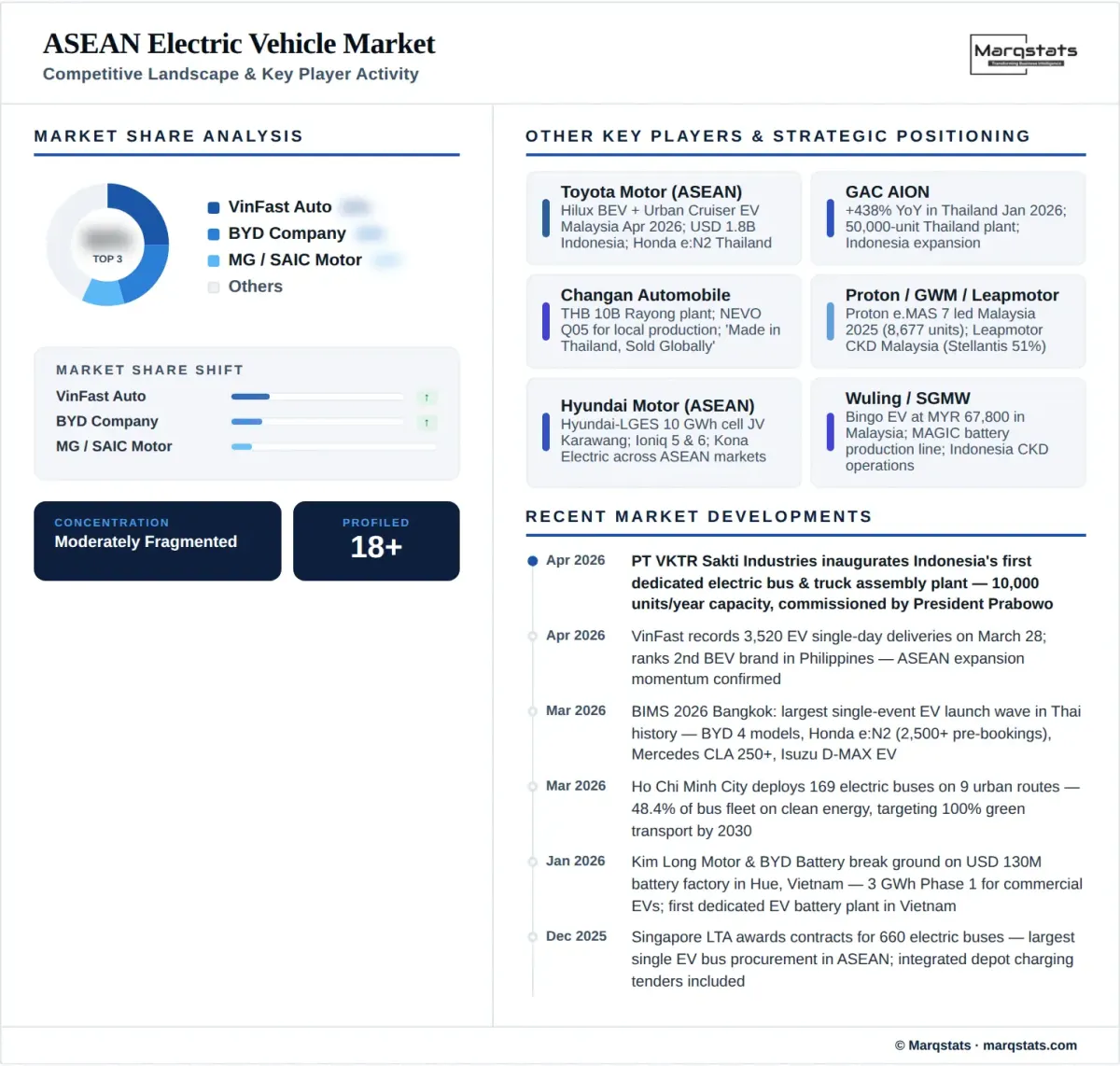
The ASEAN EV market is moderately fragmented at the OEM level but highly concentrated by brand tier within individual country segments. Chinese OEMs have captured the dominant position in BEV-specific sales across Thailand, Indonesia, and Malaysia, while Japanese OEMs retain overall leadership in total automotive volumes through ICE and hybrid vehicles. Industry analyses indicate that Chinese brands now account for more than 60% of BEV registrations in key ASEAN markets, a competitive shift that has occurred within three years of their market entry — driven primarily by price-performance positioning, rapid model proliferation, and aggressive localisation commitments.
BYD Company Limited is the highest-profile market shaper in the region, combining finished-vehicle sales, CKD assembly programmes (Thailand-manufactured for export to Europe), and battery manufacturing investment (Indonesia Subang plant, Vietnam BYD Battery Factory JV with Kim Long Motor) into a vertically integrated ASEAN strategy. VinFast Auto Ltd. has achieved something no other single OEM has accomplished in ASEAN: creating a demand-led EV market rather than responding to one. Its ecosystem of vehicles, V-Green charging infrastructure (150,000+ ports), VinBus bus fleet, and Green SM ride-hailing service has made Vietnam a globally significant EV proof point. Independent analyses place VinFast as the leading xEV brand in ASEAN-6 by Q3 2025 volume.
Among Japanese incumbents, Toyota is the most active in repositioning its EV portfolio for ASEAN: launching the Hilux BEV and Urban Cruiser EV in Malaysia (April 2026), producing the Hilux Travo-e in Thailand, and committing approximately USD 1.8 billion in Indonesia over five years for EV production. Honda launched the e:N2 in Thailand at BIMS 2026 with over 2,500 pre-bookings, signalling renewed urgency. Mitsubishi, Isuzu, and Suzuki are each executing phased electrification plans — Isuzu's locally produced D-MAX EV in Thailand and Suzuki's e VITARA launched in Indonesia and Thailand in 2026 mark key milestones. The M&A and partnership landscape is active: Stellantis holds 51% of Leapmotor International, enabling CKD localisation in Malaysia with an initial EUR 5 million investment as an ASEAN EV platform; Changan has invested over THB 10 billion in a Rayong (Thailand) manufacturing base producing Deepal S05 for domestic and European export markets.
Companies Covered
Companies covered in the report include:
Recent Market Activity
Table of Contents
Coverage & Segmentation
This report provides a comprehensive analysis of the ASEAN electric vehicle market covering the 2021–2030 study period, with 2025 as the base year, historical data from 2021 to 2025, and a forward-looking forecast from 2026 to 2030. The study encompasses all major EV powertrain categories — battery electric vehicles (BEVs), plug-in hybrid electric vehicles (PHEVs), and hybrid electric vehicles (HEVs) — across passenger vehicles, commercial vehicles, and two-wheeler segments in six primary ASEAN markets: Indonesia, Malaysia, Thailand, the Philippines, Vietnam, and Singapore, with contextual references to broader ASEAN-10 policy developments where relevant.
The analysis examines market size and growth rates by country, propulsion type, vehicle type, and end-user category. Competitive intelligence covers 15+ OEMs including Chinese entrants, Japanese incumbents, Korean players, and the dominant Vietnamese domestic champion. Policy architectures are evaluated across six national frameworks, with particular depth on Indonesia's TKDN-linked incentive structure, Vietnam's registration-fee and consumption-tax relief measures, and Thailand's EV3.5 subsidy and 2026 excise tax overhaul. Supply-chain and manufacturing investment mapping covers battery cell production, CKD assembly operations, and charging infrastructure build-out from 2024 through projected 2030 milestones. Primary research for this report includes 40+ interviews with automotive industry executives, fleet operators, government officials, and charging infrastructure operators across ASEAN markets.