Market Snapshot
Middle bar: base-year value × (1 + CAGR), rounded to two decimals. This is a calculated illustration, not a separately researched annual estimate.
Overview of the Pre-Owned Luxury Car Market
The pre-owned luxury car market covers the sale of used premium and luxury passenger vehicles — including sedans, SUVs, coupes, convertibles, and sports cars from brands including Mercedes-Benz, BMW, Audi, Porsche, Lexus, Land Rover, Cadillac, Volvo, Genesis, Maserati, Bentley, Rolls-Royce, and equivalent marques — transacted through OEM-backed certified pre-owned programmes, authorised franchise dealers, independent premium retailers, and digital automotive marketplaces. A vehicle is classified as luxury pre-owned within this report's scope when it carries a manufacturer's suggested retail price of approximately USD 40,000 or above at the time of original sale, or is sold under a manufacturer's certified pre-owned (CPO) designation. This market is distinct from the broader used-car market in that it is defined by brand positioning, warranty trust infrastructure, inspection standards, financing sophistication, and buyer expectation — rather than by price tier alone.
The global pre-owned luxury car market was valued at approximately USD 245 billion in 2025 and is projected to reach approximately USD 360 billion by 2030, expanding at a CAGR of approximately 8.01% during the 2026–2030 forecast period. This market sits at the intersection of three powerful structural trends: the persistent gap between new-vehicle affordability and consumer aspiration, the maturation of OEM-backed certification as a trusted retail channel, and the rapid growth of digital platforms that are making premium used-car discovery, financing, and purchase accessible to a significantly broader buyer base than traditional dealer networks could reach.
The structural case for pre-owned luxury cars begins with the arithmetic of the broader used-car market. In the United States, used-vehicle transactions outnumber new-car sales by approximately 2.5 to 1. In Germany, passenger-car ownership transfers exceeded new registrations by a similar ratio. In the United Kingdom, used-car transactions exceeded 7.7 million in 2025 — several times larger than the new-car market — with used battery electric vehicles growing approximately 44% year on year, reflecting the accelerating entry of late-model premium EVs into the secondary market. In China, used-car transactions exceeded 20 million units in 2025, with used new-energy vehicles growing approximately 40% year on year. In every major market, the used channel is structurally larger than the new-car channel, and within the used channel, premium brands are disproportionately well-represented because their long service lives, strong residual-value perception, and broad aspirational appeal sustain secondary-market demand through multiple ownership cycles.
Certified pre-owned programmes are the trust infrastructure that has transformed pre-owned luxury cars from opportunistic resale to structured premium retail. Porsche Cars North America recorded approximately 47,000 Porsche Approved CPO sales in 2025 — a single-brand record and an 11% increase year on year — demonstrating that CPO is now a mainstream purchase path for premium buyers rather than a fallback option. Mercedes-Benz, BMW, Lexus, Audi, and Cadillac operate similarly structured CPO programmes with multi-year/multi-mileage age caps, multi-point inspection requirements, and manufacturer-backed warranty extensions — all of which are designed to deliver a trust and ownership experience close to the new-vehicle standard at materially lower cost.
Key Takeaways
Market Overview & Analysis
Report Summary
The pre-owned luxury car market is undergoing a structural shift: from a channel that premium brands tolerated as a secondary consequence of new-car sales, to a strategically managed retail segment that premium brands invest in as a customer acquisition, retention, and brand-building tool. The study period is 2021–2030 with 2025 as base year. The market's key structural dynamic is the gap between new-vehicle affordability and aspirational demand for premium brands — a gap that makes certified pre-owned luxury cars the entry route into Mercedes-Benz, BMW, Porsche, and Lexus ownership for a large and growing cohort of buyers who can afford the used-market price but not the new-car sticker. As new-car prices remain elevated and the gap between new and used vehicle prices has widened in several premium segments, the pre-owned luxury channel has become more strategically important, not less.
The market's growth is driven by four structural forces acting simultaneously. First, affordability pressure is pushing buyers from new to used across all income segments — Reuters has reported this as a sustained trend in US used-car demand since the post-pandemic price surge. Second, OEM certification has raised the quality and trust floor of pre-owned luxury transactions — making CPO a credible rather than a compromise purchase. Third, digital platforms have expanded market reach, reducing geographic friction and enabling national and cross-border used-car transactions that traditional dealer networks could not serve. Fourth, the increasing age and volume of late-model premium EVs reaching the three-to-five-year resale window is creating a growing used luxury EV sub-market that will become structurally significant by 2027–2028 as volumes reach scale.
The market is geographically diverse, with North America, Europe, and China as the three primary regions, each with distinct characteristics. North America is the world's most mature CPO luxury market — Porsche, Mercedes-Benz, BMW, and Lexus all operate nationally scaled programmes with OEM-backed warranty extensions and standardised inspection processes. Europe is distinguished by both the highest penetration of premium brands in new-car sales globally and the most advanced transaction-trust infrastructure — Belgium's Car-Pass, the Netherlands' RDW/NAP, and the EU's evolving roadworthiness reform. China is the fastest-growing used luxury market by volume — with 20+ million total used transactions in 2025 growing in the high single digits, and used NEV luxury vehicles growing fastest within that — though the trust infrastructure and CPO penetration are less mature than North America or Europe.
Market Dynamics
Key Drivers
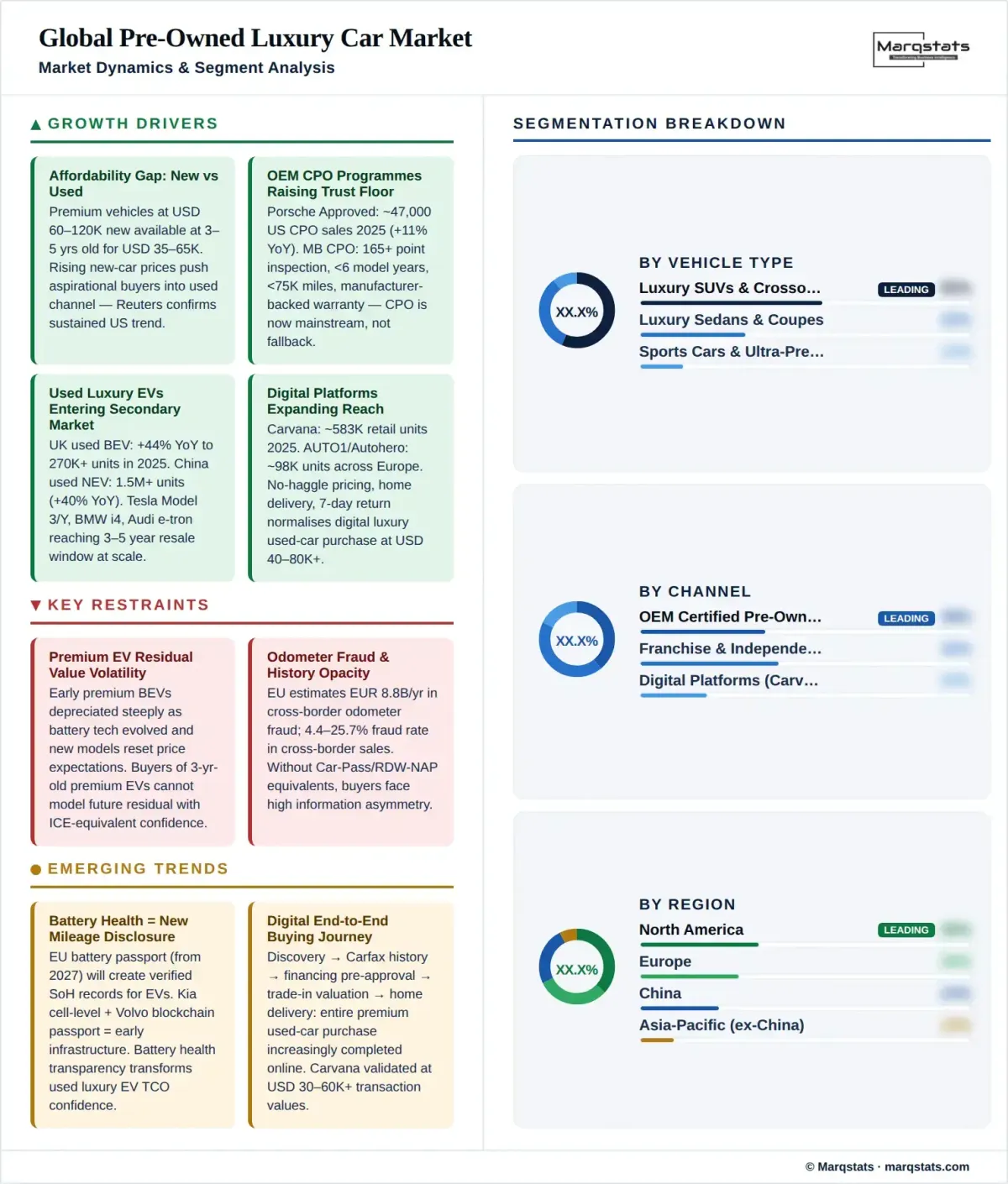
- Affordability gap between new and used luxury cars driving first-time premium buyers into the pre-owned market: The clearest structural driver of pre-owned luxury car demand is simple arithmetic — premium vehicles that carry new-car prices of USD 60,000–120,000 can be purchased at three to five years old for USD 35,000–65,000, often with remaining manufacturer warranty or CPO coverage. As new-car inflation kept average transaction prices elevated through 2023–2025, more aspirational buyers found the pre-owned luxury route the only accessible entry into their preferred brand. Reuters reported that rising new-car prices fueled booming used-car demand in the US, a pattern reinforced by NIADA data showing independent used-vehicle dealers sold approximately 9.8 million vehicles in 2025. In Europe, the JRC notes that new cars represent only about one-third of total annual car sales in the four largest EU markets — 26% in France, 34% in Germany, 37% in Italy, and 31% in Spain — confirming that the used channel is structurally dominant. For luxury brands, the affordability equation is especially powerful because premium buyers who cannot or will not pay new-car prices for their preferred brand will often wait for the right used example rather than trade down to a mainstream brand.
- OEM certified pre-owned programmes transforming pre-owned luxury into a structured premium retail channel: OEM-backed CPO programmes have dramatically changed the risk profile of pre-owned luxury car purchases by applying new-vehicle-adjacent quality standards to used inventory. Mercedes-Benz Certified Pre-Owned requires eligible vehicles to be fewer than six model years old and under 75,000 miles, and pass a 165+ point inspection, with manufacturer-backed warranty extension. BMW Premium Certified, Porsche Approved, Lexus L/Certified, and equivalent programmes apply similar frameworks — creating a tier of pre-owned luxury vehicles that carry meaningful warranty coverage and documented inspection history. Porsche's US CPO sales reaching approximately 47,000 in 2025 — an 11% increase year on year — is direct evidence that CPO has moved from a niche programme to a mainstream sales channel representing a substantial fraction of total US Porsche deliveries. This CPO premium-positioning effect is commercially critical because it shifts the pre-owned luxury car conversation from price negotiation toward value and assurance — capturing buyer segments that would have previously defaulted to new-car purchase.
- Used luxury SUV demand leading all body types on the back of the broader SUV market shift: The structural shift in new luxury car preferences toward SUVs and crossovers over the past decade — reflected in BMW X-series, Mercedes-Benz G/GLE/GLC, Audi Q-series, Land Rover, and Porsche Cayenne/Macan leading new-car sales — has directly shaped the used luxury market as those vehicles enter their second, third, and fourth ownership cycles. Used luxury SUVs carry strong residual values because their buyer pools are large, their functionality is broadly appealing, and their positioning as family-capable premium vehicles sustains demand across buyer cohorts. BMW 3 Series and Audi A3 appearing in the UK's top 10 used models list for 2025 confirms that premium brands already have meaningful used-market liquidity — and the SUV-dominant model mix of 2018–2022 new-car sales means the used luxury SUV pipeline is particularly well-stocked through 2026–2028 as those vehicles age into the prime CPO window.
- Pre-owned luxury EVs entering the market as late-model premium BEVs reach the resale window: Pre-owned luxury EVs are the fastest-growing sub-segment within the used luxury car market, driven by the maturation of the first large wave of premium battery electric vehicles sold between 2019–2022. In the UK, used BEV transactions grew approximately 44% year on year in 2025, exceeding 270,000 units. In China, used new-energy vehicles exceeded 1.5 million units in 2025, growing approximately 40% year on year, accounting for approximately 7.5% of all used-car transactions — a number that will grow significantly as the large 2021–2023 cohort of premium EV sales ages into the three-to-five-year secondary market. Tesla Model 3 and Model Y, BMW i4, Mercedes EQC, and Audi e-tron/Q4 e-tron represent the most liquid pre-owned luxury EV models. The battery-health transparency challenge — buyers need assurance about remaining battery capacity and degradation — is being addressed by manufacturer state-of-health disclosures, independent battery health checks, and increasingly by battery passport infrastructure that provides verifiable lifecycle data.
- Digital platform expansion enabling national and cross-border pre-owned luxury discovery and transaction: Digital automotive retail platforms have materially expanded the addressable buyer pool for pre-owned luxury cars by enabling national and international inventory discovery, digital financing applications, vehicle history report integration, and in some cases fully remote purchase. Carvana's retail model — no-haggle online pricing, home delivery, seven-day return — has demonstrated that premium used-car buyers are willing to transact digitally for vehicles at significant price points. AUTO1 Group's Autohero platform, operating across multiple European markets, similarly provides a consistent pricing and quality presentation for used vehicles that reduces the trust friction historically associated with cross-border used-car purchase. GM's CarBravo platform for Chevrolet, Buick, and GMC, and equivalent OEM digital platforms, are extending manufacturer-validated inventory presentation to the digital channel — while Cadillac's retention of a traditional CPO programme reflects the brand's judgement that its buyers still prefer high-touch dealer certification for ultra-premium transactions.
Key Restraints
- Residual-value volatility — especially in premium EVs — creating inventory risk and buyer hesitation: Residual-value uncertainty is the primary commercial risk in the pre-owned luxury car market. Traditional internal-combustion luxury vehicles have established depreciation curves that dealers, finance companies, and buyers can model with reasonable confidence. Premium EVs have much less historical data, and residual values have been volatile as battery technology has evolved rapidly, new-model introductions have accelerated, and government incentive changes have affected new-car pricing in ways that ripple into used values. A buyer purchasing a three-year-old premium EV at USD 45,000 cannot know with the same confidence as a used ICE buyer whether that vehicle will be worth USD 25,000 or USD 15,000 in two years. This residual-value uncertainty creates hesitation among buyers of pre-owned luxury EVs, limits dealer willingness to hold large inventories of older premium BEVs, and constrains the depth of OEM CPO EV programmes that are still being developed.
- Odometer fraud, vehicle history opacity, and cross-border trust deficits constraining used luxury transaction confidence: The EU estimates odometer fraud costs approximately EUR 8.8 billion per year in cross-border used-car sales alone, with fraud rates of 4.4% to 25.7% in cross-border transactions and 2.2% to 10% in national sales. For pre-owned luxury cars, the stakes are higher because the monetary impact of undisclosed mileage fraud on a USD 60,000 vehicle is proportionally greater than on a USD 15,000 economy used car. The EU's April 2025 roadworthiness reform package — proposing digital vehicle documents, cross-border data sharing, and anti-odometer-tampering measures — directly addresses this constraint, but implementation will take years to have full market effect. Meanwhile, buyers in markets without Belgium-style Car-Pass or Netherlands-style RDW/NAP central mileage verification face higher information asymmetry risk, particularly in cross-border purchases.
- High maintenance and repair costs creating total-cost-of-ownership uncertainty for out-of-warranty pre-owned luxury vehicles: Premium vehicles carry significantly higher maintenance and repair costs than mass-market equivalents — a BMW 7 Series or Mercedes S-Class out of warranty can cost USD 3,000–8,000 per year in scheduled maintenance and significantly more for major mechanical failures. This total-cost-of-ownership uncertainty constrains buyer confidence in pre-owned luxury vehicles that are outside OEM warranty or CPO coverage, particularly for buyers transitioning from mass-market vehicles who may underestimate ongoing ownership costs. CPO programmes directly address this restraint by including extended warranties and roadside assistance — but non-CPO used luxury vehicles, particularly those at the older end of the age spectrum, face a meaningful buyer qualification challenge.
- Inventory supply constraints as new-car shortages reduce the future used-car pipeline for certain premium segments: The new-vehicle production disruptions of 2021–2023 — driven by semiconductor shortages and supply chain dislocations — reduced new-car sales volumes, which in turn reduces the future supply of three-to-five-year-old used vehicles in 2024–2027. For premium brands that saw the sharpest new-car production cuts in this period, the downstream used-market inventory will be tighter than historical norms, potentially supporting used-car residual values but constraining total transaction volume.
Key Trends
- Luxury car resale value and depreciation transparency — digital vehicle history and condition reports becoming standard: The pre-owned luxury car market is moving rapidly toward transparent, verifiable vehicle history as a standard rather than an optional feature. Carfax in the US, the European Car History Check, Belgium's Car-Pass, and the Netherlands' RDW/NAP all provide varying levels of mileage and ownership history documentation. The EU's proposed 2025 roadworthiness digital vehicle documents and cross-border data sharing would bring more markets to the Belgian/Dutch standard. For luxury brands, history transparency is particularly valuable because it validates the premium pricing of well-documented CPO vehicles versus undocumented alternatives — creating a measurable value premium for verified vehicle history in the pre-owned luxury segment.
- Used luxury car market convergence with digital financing, insurance, and delivery creating end-to-end online buying journeys: The used luxury car purchase is increasingly completed entirely online — from vehicle discovery and history check through financing pre-approval, trade-in valuation, insurance quote, and home delivery scheduling. Carvana's model demonstrated that USD 30,000–60,000 vehicle purchases can be completed without a dealer visit. Digital lenders (Capital One Auto Finance, Ally Financial, manufacturer captive finance arms) increasingly pre-approve used-vehicle financing at the point of online discovery rather than at dealer delivery. This convergence of discovery, trust, financing, and logistics into a single digital journey is particularly powerful for pre-owned luxury because premium buyers are typically comfortable with online high-value transactions and value time efficiency.
- Pre-owned luxury EV battery health transparency as the new CPO inspection standard: As used luxury EVs grow in volume and commercial importance, battery state-of-health disclosure is emerging as the central trust variable — analogous to mileage disclosure for ICE vehicles. Several OEMs are beginning to include battery health reports in CPO EV offerings. Third-party battery health assessment services (analogous to Carfax for mileage) are being developed. EU battery passport regulations — requiring state-of-health tracking for EV batteries placed on the European market from 2027 — will progressively create a verified battery health record that accompanies EVs into their second and third ownership cycles, potentially transforming the transparency and confidence of used luxury EV transactions in European markets. Kia's cell-level battery passport trial and Volvo's blockchain-based battery passport represent early commercial implementations of this infrastructure.
- Subscription and short-term premium car ownership models feeding the used luxury pipeline with low-mileage, well-documented inventory: Automotive subscription services (Porsche Drive, Mercedes-Benz Collection, BMW Access) and short-term executive lease programmes create pools of low-mileage, professionally maintained premium vehicles that enter the CPO and pre-owned channels with full documented service history. These vehicles are ideal for the CPO channel because they meet age and mileage criteria, have clean service records, and are sourced through controlled channels that OEM CPO programmes can verify. The growth of subscription and flexible lease models in North America and Europe is progressively creating a higher-quality premium used-vehicle supply pipeline than the traditional private-sale used-car market.
Market Segmentation
Used luxury SUVs are the dominant segment of the pre-owned luxury car market and the primary driver of market growth, reflecting the structural shift in new luxury car sales toward SUV and crossover body styles over the past decade. The most liquid pre-owned luxury SUV models — BMW X5, BMW X3, Mercedes-Benz GLE, Mercedes-Benz GLC, Audi Q5, Audi Q7, Porsche Cayenne, Porsche Macan, Land Rover Defender, Land Rover Discovery, and Lexus RX — all carry strong secondary-market demand because their buyer pools are large, their functionality (cargo space, ground clearance, family capacity) sustains demand across buyer cohorts, and their technology content (premium infotainment, driver assistance, air suspension, all-wheel drive) ages well relative to the purchase price premium. Used luxury SUV transactions typically command the highest price points within the pre-owned luxury segment, with clean late-model examples from BMW, Mercedes, and Porsche commanding USD 45,000–75,000 in the US market and EUR 40,000–65,000 in European markets. The Porsche Cayenne and Land Rover Defender in particular have established strong residual-value reputations that support used pricing above other luxury SUV competitors.
Used luxury sedans and coupes represent the traditional core of the pre-owned luxury car market — the segment in which Mercedes-Benz S-Class, BMW 7 Series, Audi A8, Porsche Panamera, and Lexus LS command the highest absolute transaction prices but have historically suffered steeper depreciation curves than their SUV counterparts. The significant depreciation of flagship luxury sedans from new to three-year-old creates the most dramatic value proposition in the pre-owned luxury market: a three-year-old Mercedes S-Class or BMW 7 Series can be purchased at 40–55% of its new-car price while retaining the overwhelming majority of its technology, comfort, and prestige features. This depreciation dynamic makes luxury sedans the highest-value-for-money proposition in the pre-owned luxury segment and sustains strong demand from aspirational buyers. Used luxury coupes — Mercedes-Benz E/C-Class Coupe, BMW 4 Series, Audi A5 — serve a younger, style-oriented buyer demographic and maintain strong residual values in well-specified configurations. BMW 3 Series and Audi A3 appearing in the UK's top-10 used models list for 2025 confirms that premium sedans already generate meaningful used-market volume at competitive price points.
Used luxury sports cars and high-performance vehicles — Porsche 911, Ferrari, Lamborghini, Bentley Continental GT, Aston Martin, BMW M-series, Mercedes-AMG — represent the highest-value individual transaction segment of the pre-owned luxury car market, though by definition the smallest by unit volume. These vehicles often appreciate or hold value unusually well relative to mainstream luxury, particularly for limited-edition, low-volume, or highly specified examples. Porsche 911s in particular have a well-documented history of used values exceeding new-car prices for desirable specifications. Ferrari and Lamborghini pre-owned vehicles transact through specialist dealer networks that operate near-luxury-retail standards with full documentation, certified condition, and in some cases manufacturer-backed programmes. The ultra-high-net-worth buyer segment that acquires these vehicles is less price-sensitive and more focused on provenance, condition documentation, and relationship with a trusted dealer or OEM representative — creating a segment where trust and brand association matter more than price and where CPO programmes command the strongest premium.
OEM certified pre-owned programmes are the primary structural differentiator of the pre-owned luxury car market from the broader used-car market. Each major luxury brand operates a programme with similar core elements — age and mileage eligibility caps, multi-point inspection standards, reconditioning requirements, manufacturer-backed warranty extension, and in most cases roadside assistance and complimentary maintenance. Mercedes-Benz Certified Pre-Owned applies a 165+ point inspection and restricts eligibility to vehicles fewer than six model years old and under 75,000 miles, with a manufacturer-backed warranty that provides confidence comparable to new-vehicle ownership. BMW Premium Certified, Porsche Approved (approximately 47,000 US sales in 2025), Lexus L/Certified, and Cadillac Certified Pre-Owned operate similar frameworks. Cadillac's retention of a dedicated CPO programme — while GM shifts mainstream Chevrolet, Buick, and GMC toward the broader CarBravo digital platform — directly confirms the industry's conviction that luxury pre-owned buyers place a higher premium on brand-controlled certification than mass-market buyers and that brand integrity is best preserved through manufacturer-managed CPO rather than aggregator-platform used retail.
Authorised franchise dealerships and independent premium specialist retailers are the largest volume channel for pre-owned luxury cars, handling the full spectrum from CPO vehicles at the top end to older, higher-mileage examples that do not qualify for manufacturer certification. Franchise dealers benefit from OEM certification access, approved financing relationships, and brand-consistent retail environment — giving them the strongest ability to command CPO premiums. Independent premium retailers — businesses such as CarMax in the US (which applies its own no-haggle, limited-warranty retail standard), and specialist independent luxury dealers in Europe — serve the volume between CPO and private sale: vehicles with complete documented history and visible reconditioning but without OEM brand backing. The independent channel benefits from greater sourcing flexibility and lower operating cost than OEM-franchised dealers, but must work harder to establish buyer trust through their own reputation, third-party inspections, and vehicle history documentation.
Digital platforms are the fastest-growing channel in the pre-owned luxury car market, progressively capturing inventory and buyer traffic from traditional dealer-only models. Carvana — the largest US digital used-car retailer — sold approximately 583,000 retail units in 2025 and regularly transacts vehicles in the USD 40,000–80,000+ range that qualify as pre-owned luxury. Carvana's no-haggle pricing, seven-day return policy, and national logistics capability directly address the trust barriers of digital used-car purchase for high-value vehicles. In Europe, AUTO1 Group's Autohero retail platform sold approximately 98,000 vehicles in 2025, with pan-European logistics enabling cross-border used-vehicle retail at a scale that traditional national dealer networks cannot match. GM's CarBravo, Ford's Blue Advantage, and equivalent OEM-sponsored digital used-vehicle marketplaces are extending manufacturer-quality assurance to online discovery and purchase while maintaining dealer-network service coverage. For pre-owned luxury specifically, digital platforms are particularly powerful as a discovery and comparison tool — enabling buyers to compare similar BMW X5 or Mercedes GLE configurations across thousands of dealers nationally or continentally, normalising pricing transparency and reducing the information asymmetry that traditionally allowed dealers to capture margin from uninformed buyers.
Depreciation — and its inverse, residual value — is the financial foundation of the pre-owned luxury car market. The depreciation curve of a premium vehicle determines the economic proposition for both the first owner (total cost of ownership) and the used-car buyer (value-for-money relative to new). Premium vehicles generally follow steeper initial depreciation than mass-market vehicles in the first two to three years — driven by the large gap between new-car sticker prices and real transaction values — before stabilising at a residual-value level that reflects their mechanical longevity, brand desirability, and service cost. Vehicles with strong residual values — Porsche (particularly 911 and Cayenne), Land Rover Defender, certain BMW M-series, Lexus — command premium used pricing that approaches or occasionally exceeds replacement cost for desirable specifications. Vehicles with weaker residual trajectories — older luxury sedans from brands with more aggressive new-car pricing or faster technology obsolescence — offer the steepest value propositions for used-car buyers.
Used luxury EV depreciation is the most commercially important residual-value question in the pre-owned luxury car market for the forecast period. Early premium BEVs — first-generation Tesla Model S, early Jaguar I-Pace, BMW i3 — experienced steeper-than-expected depreciation as battery technology improved rapidly and new-model introductions reset price expectations. More recent premium BEVs with larger battery capacities, faster charging, and over-the-air software update capability appear to be holding residual values more durably — but the 2026–2030 period, as the large cohort of 2021–2023 premium EV sales reaches its secondary market window, will be the first real test of whether today's premium BEV residual values are structurally sustainable or whether another depreciation reset is coming as next-generation models arrive.
By Geography
North America — World's Most Mature CPO Luxury Market
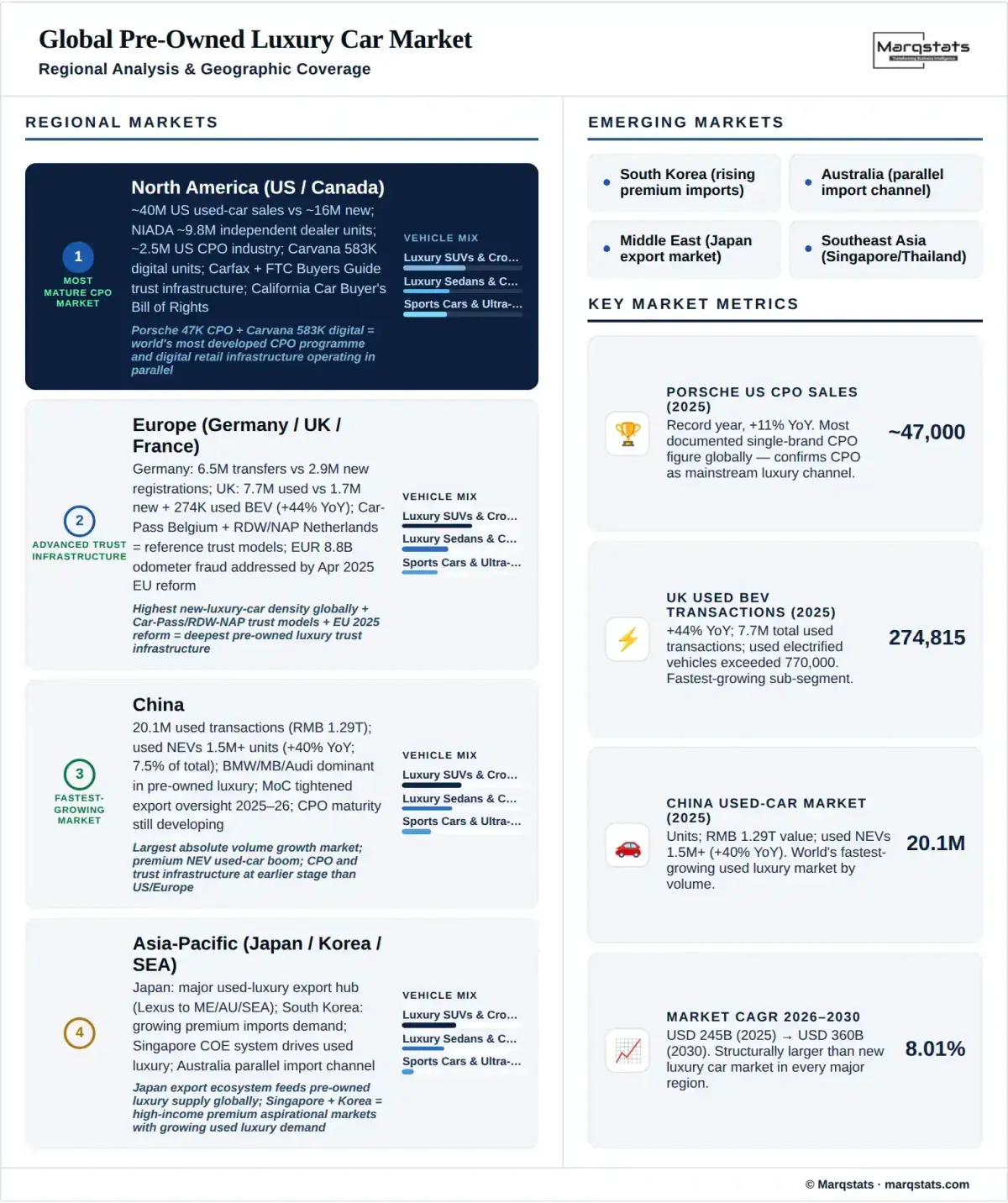
North America — primarily the United States, with Canada as a significant secondary market — is the world's most mature certified pre-owned luxury car market, characterised by OEM-scaled CPO programmes, high consumer familiarity with CPO as a purchase category, developed digital retail infrastructure, and transparent vehicle history reporting (Carfax, AutoCheck). US used vehicle sales total approximately 40 million annually versus approximately 16 million new vehicles, confirming the structural dominance of the used channel. NIADA reported independent used-vehicle dealers sold approximately 9.8 million vehicles in 2025, with CPO industry volumes estimated near 2.5 million — a significant portion driven by premium brands. Porsche's record approximately 47,000 US CPO sales in 2025 are the most clearly documented single-brand CPO data point in the market. The FTC Used Car Rule provides baseline disclosure standards nationally, while California's Car Buyer's Bill of Rights adds state-level protections around financing transparency and two-day cancellation options. Digital retail platforms are most advanced in North America — Carvana's approximately 583,000 unit sales representing the global benchmark for digital used-car retail scale.
Europe — Advanced Trust Infrastructure and Premium Brand Density
Europe is the world's second-largest pre-owned luxury car market and the most advanced in consumer-protection and vehicle-history transparency infrastructure. Germany is the largest individual market — with approximately 6.5 million passenger-car ownership transfers in 2025 against approximately 2.9 million new registrations — and hosts the world headquarters of the most commercially significant luxury OEMs (BMW, Mercedes-Benz, Audi/VW Group, Porsche). The UK is Europe's second-largest used-car market, recording approximately 7.7 million used-car transactions in 2025, with used electrified vehicles exceeding 770,000 — including approximately 274,000 used BEV transactions, a 44% year-on-year increase that signals accelerating pre-owned luxury EV volumes. France and Spain follow as significant volume markets. Belgium and the Netherlands operate the EU's most advanced used-car mileage and history verification systems — Belgium's government-backed Car-Pass and the Netherlands' RDW/NAP central odometer database are the reference models for used-vehicle transaction trust. The EU's April 2025 roadworthiness reform package — proposing digital vehicle documents, cross-border data sharing, and stronger anti-odometer-tampering measures to address estimated EUR 8.8 billion in annual cross-border odometer fraud — will progressively improve the trust infrastructure for cross-border pre-owned luxury car transactions across all EU member states.
China — Fastest-Growing Used Luxury Market
China is the fastest-growing major pre-owned luxury car market, with used-car transactions exceeding 20 million units in 2025 and a total transaction value of approximately RMB 1.3 trillion. Used new-energy vehicles exceeded 1.5 million units — growing approximately 40% year on year and accounting for approximately 7.5% of all used-car transactions — with the used premium NEV segment (Tesla, BMW i-series, Nio, Li Auto, Xpeng, and imported premium EVs) growing fastest. China's used-car market is at an earlier stage of CPO penetration and trust infrastructure maturity than North America or Europe, with vehicle history documentation and mileage verification less standardised. The Chinese government's 2025–2026 crackdown on zero-mileage used cars — tightening oversight for vehicles exported as used within 180 days of registration, with after-sales documentation requirements for premium imports — represents a significant trust-building step. Domestic luxury brands (Hongqi, extended Li Auto/Nio premium lines) are beginning to challenge imported luxury in the Chinese used market, but imported premium brands (BMW, Mercedes-Benz, Audi) retain the dominant position in the pre-owned luxury segment.
Asia-Pacific Excluding China — Growing Premium Aspirational Markets
Japan, South Korea, South-East Asia, and Australia collectively form the fourth significant regional market for pre-owned luxury cars. Japan is notable for its used-car export ecosystem — a large fraction of used Japanese luxury and premium vehicles (Lexus in particular) are exported to markets in the Middle East, Australia, South-East Asia, and Africa, giving Japan a unique role as both a domestic used-luxury market and an international pre-owned supply source. South Korea's rising household incomes and strong domestic car culture are supporting growing demand for used premium imports (Mercedes-Benz, BMW, Audi). Australia's right-hand-drive market has limited new-car model availability from some luxury brands, creating demand for used imports including parallel-import channels. South-East Asian markets — Singapore, Thailand, Malaysia, Indonesia — are at varied stages of used premium market development, with Singapore notable for its Certificate of Entitlement system and high new-car prices that create strong incentive for used-luxury purchase.
How Competition Is Evolving
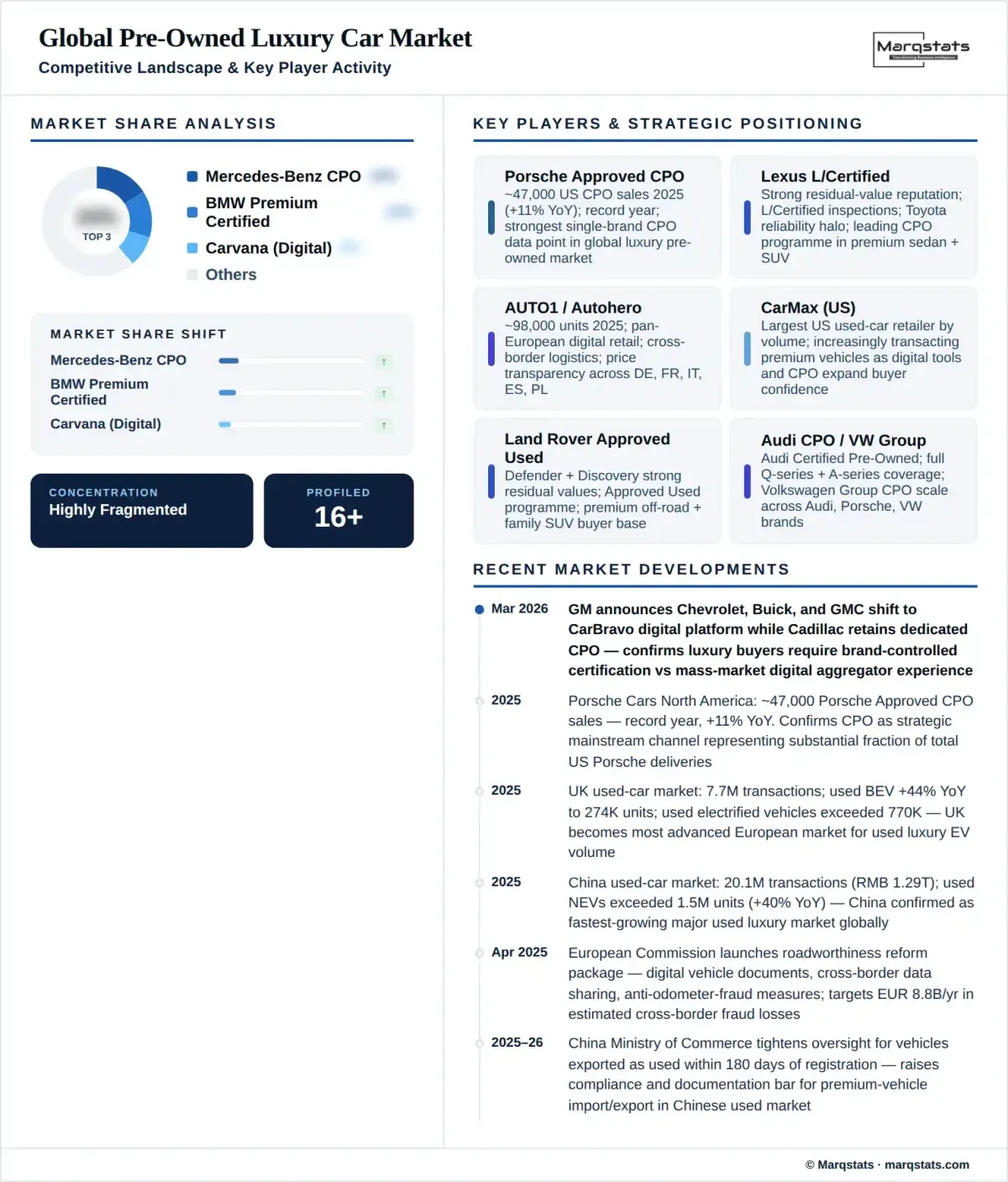
The pre-owned luxury car market's competitive landscape is best understood as three overlapping tiers: OEM-controlled CPO channels, large-scale digital retail platforms, and the dealer network ecosystem that connects inventory to buyers across both online and offline channels. Unlike most product markets, there is no single dominant player across all three tiers — the market is structurally fragmented by geography, brand, and channel, though consolidation is occurring in the digital retail platform layer.
Among OEM CPO channels, Porsche Approved is the most commercially transparent, with approximately 47,000 US sales in 2025 confirming it as a significant programme even by absolute automotive retail standards. Mercedes-Benz Certified Pre-Owned is the broadest luxury CPO programme by model range, covering the full AMG and standard lineup. BMW Premium Certified and Lexus L/Certified are similarly comprehensive. Cadillac's choice to maintain a dedicated CPO programme while GM's mainstream brands shift to CarBravo digital retail reflects the brand's judgement that luxury CPO buyers require manufacturer-controlled trust architecture rather than aggregator-platform experience. Among digital platforms, Carvana leads by disclosed US volume (approximately 583,000 retail units in 2025) though it is not luxury-only. AUTO1/Autohero leads European digital used-car retail at scale (approximately 98,000 Autohero vehicles in 2025). CarMax in the US — the largest individual used-car retailer by volume — increasingly transacts premium vehicles as CPO programmes and digital tools make premium used cars accessible to a broader buyer base. Independent assessments suggest the used luxury car market will see increasing consolidation in the digital platform layer through 2030, as capital requirements, technology investment, and logistics network cost create barriers to fragmented competition — while OEM CPO channels maintain their premium positioning through brand control and manufacturer-backed warranty.
Companies Covered
Companies covered in the report include:
Recent Market Activity
Table of Contents
Coverage & Segmentation
This report provides a comprehensive analysis of the global pre-owned luxury car market covering used premium and luxury passenger vehicles sold through OEM certified pre-owned programmes, franchise dealers, independent premium retailers, and digital marketplaces — across the 2021–2030 study period with 2025 as base year. A vehicle is classified within the luxury pre-owned scope when it carries a manufacturer's suggested retail price of approximately USD 40,000 or above at the time of original sale, or is sold under a manufacturer's CPO designation from a recognised luxury or premium brand. Vehicle coverage includes sedans, SUVs, coupes, convertibles, and sports cars from Mercedes-Benz, BMW, Audi, Porsche, Lexus, Land Rover, Jaguar, Cadillac, Volvo, Genesis, Bentley, Rolls-Royce, Ferrari, Lamborghini, Maserati, and equivalent luxury marques. Channel coverage spans OEM CPO programmes, authorised franchise dealerships, independent premium retailers, and digital automotive marketplaces. Geographic coverage spans North America (US primary, Canada secondary), Europe (Germany, UK, France, Spain, Belgium, Netherlands, other EU), China, Japan, and Asia-Pacific. The report covers CPO programme standards and inspection criteria, used luxury EV battery health transparency, digital retail platform market share, vehicle history and odometer verification infrastructure, resale value and depreciation trends, and regulatory consumer-protection frameworks. Primary research includes 40+ interviews with luxury OEM CPO programme managers, premium used-vehicle dealers, digital platform executives, used-car financing specialists, vehicle history platform operators, and luxury car buyers across North America, Europe, and China.