Market Snapshot
Key Takeaways
Market Overview & Analysis
Report Summary
The United Arab Emirates vehicle rental and leasing market comprises short-term self-drive rental, long-term operating and finance leasing, and premium chauffeur-driven vehicle hire for passenger cars and light commercial vehicles across the seven emirates. This study segments the market by service type, vehicle type, and end user, with a 2025 base year, historical coverage from 2021 to 2025, and forecasts to 2030. Market size is stated as total rental and lease revenue in United States dollars, covering fleet operators' core rental and lease income rather than ancillary revenue such as insurance products, fuel surcharges, or used-vehicle disposal, which Marqstats tracks as distinct revenue categories.
The UAE's resident population composition shapes this market's demand base in a way with few parallels elsewhere: expatriates make up the substantial majority of residents, and a meaningful share of this population rents or leases a vehicle for extended periods rather than purchasing, whether reflecting residency permit timelines, employer-provided mobility arrangements, or simple preference for avoiding vehicle ownership costs during a temporary or renewable-term residency. This creates a depth of individual long-term rental and leasing demand that markets with a more settled, ownership-oriented population typically do not generate to the same degree. Employer-provided vehicle allowances and company car arrangements common across the UAE's multinational corporate base further reinforce this dynamic, effectively routing a share of what would otherwise be personal vehicle ownership decisions through corporate leasing channels instead. Senior and mid-level expatriate professional roles across banking, consulting, and multinational corporate sectors most commonly include this benefit, concentrating a meaningful share of premium-segment corporate leasing demand within this specific employment category.
Market fragmentation is a defining structural feature: several hundred licensed rental and leasing operators compete across the UAE, spanning large multi-branch operators with fleets numbering in the thousands down to small single-location businesses serving a specific neighbourhood or customer segment. This fragmentation contrasts with the more consolidated, publicly listed operator structure found in Saudi Arabia's rental and leasing market, giving the UAE market a competitive dynamic shaped more by service differentiation and niche specialisation than by a small number of dominant national players. Long-established domestic operators including Diamond Lease and Fast Rent a Car, both operating since the mid-1990s, have nonetheless built substantial scale advantages over the smaller, more recently established competitors that make up the bulk of this fragmented operator base.
Market Dynamics
Key Drivers
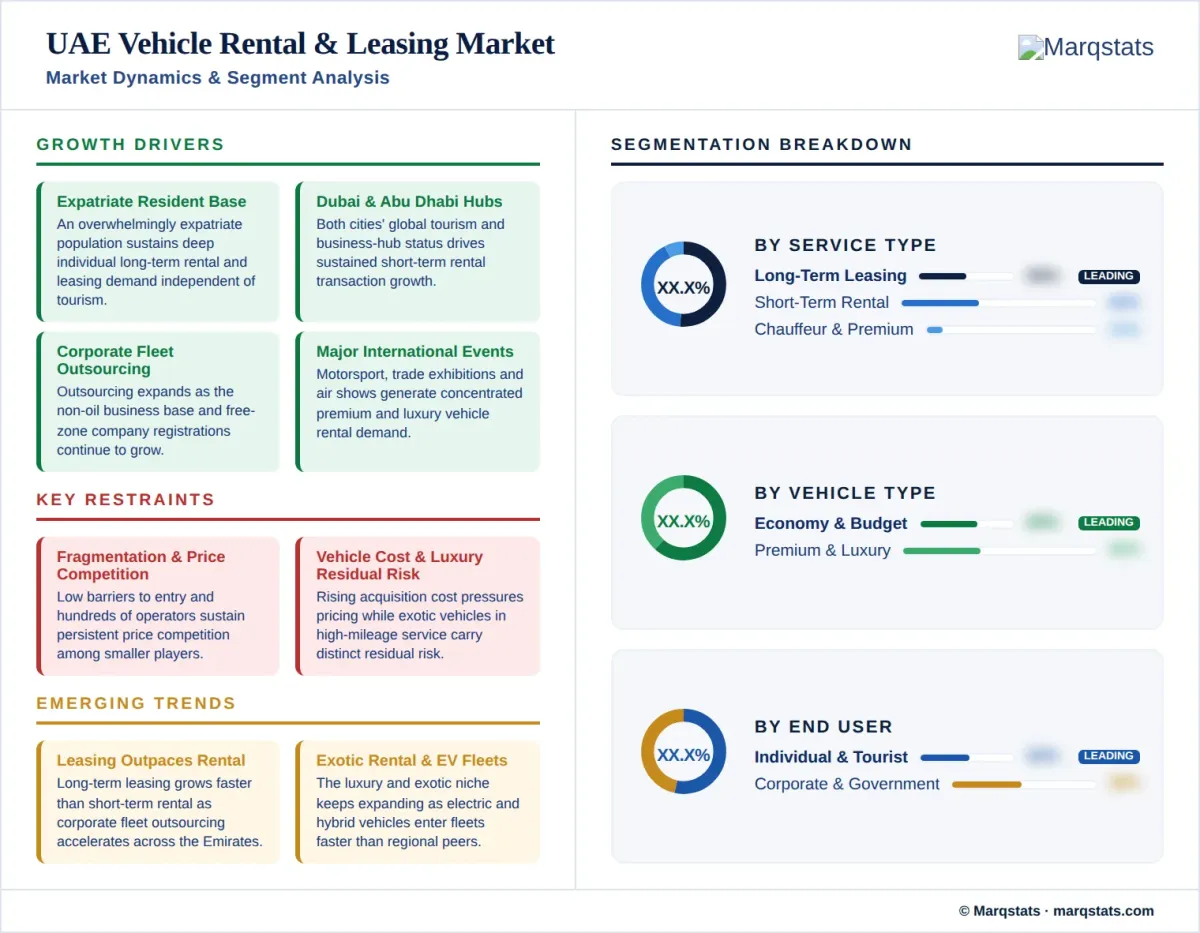
- A predominantly expatriate resident population sustains deep individual long-term rental and leasing demand independent of tourism cycles.
- Dubai and Abu Dhabi's continued positioning as global tourism and business hubs drives sustained short-term rental transaction growth.
- Corporate fleet outsourcing continues expanding as the UAE's non-oil business base and free-zone company registrations grow.
- Major international events, including motorsport, trade exhibitions, and air shows, generate concentrated premium and luxury vehicle rental demand.
- Expanding electric vehicle charging infrastructure and government sustainability targets are supporting fleet electrification investment.
Key Restraints
- Intense fragmentation and low barriers to entry sustain persistent price competition among smaller operators.
- Rising vehicle acquisition costs are pressuring fleet operator margins and long-term leasing contract pricing.
- Residual value risk for luxury and exotic vehicles used in high-mileage rental service adds a distinct cost consideration for operators serving this niche.
Key Trends
- Long-term leasing is growing faster than short-term rental as corporate fleet outsourcing accelerates across the Emirates.
- Premium and exotic vehicle rental continues expanding, tied to Dubai's status-conscious visitor economy and major international events.
- Online and mobile booking platforms continue capturing a growing share of transactions, reducing reliance on traditional branch and counter bookings.
- Electric and hybrid vehicles are entering rental and leasing fleets at an accelerating pace relative to other regional markets.
Market Segmentation
Short-term rental, covering daily and weekly self-drive rentals through airport and city branch locations, remains the higher-transaction-volume service type, closely tied to Dubai and Abu Dhabi's tourism and business travel flows and reinforced by major recurring international events held across the Emirates. Airport rental locations at Dubai International and Abu Dhabi International capture a substantial share of this segment's volume, reflecting the concentration of both leisure and business travel demand at these two primary international gateways.
Long-term leasing, spanning corporate operating leases and individual multi-month or multi-year rental arrangements common among the expatriate resident population, is growing faster than short-term rental, reflecting both expanding corporate fleet outsourcing and the depth of individual long-term vehicle access demand this market's population structure sustains. Individual long-term rental in particular represents a genuinely distinct sub-category within this service type, since it serves residents who prefer flexibility over the multi-year commitment a formal lease financing arrangement would require, while still needing the vehicle for periods far longer than a typical short-term rental.
Chauffeur-driven and premium vehicle hire, including limousine services for corporate travel, hospitality partnerships, and major event hospitality, represents a distinct, higher-value service type shaped by the UAE's concentration of luxury hospitality and business travel demand. Operators in this segment frequently maintain formal partnerships with luxury hotel chains and event organisers, positioning chauffeur services as an integrated part of a broader premium hospitality experience rather than a standalone transportation product.
Economy and budget vehicles hold the largest fleet share, providing essential mobility for price-sensitive tourists and the substantial resident expatriate population, with operators in this segment competing primarily on price and branch network convenience. Fleet turnover in this segment tends to run faster than in premium categories, reflecting both higher utilisation rates and operators' preference for keeping vehicles within a shorter age band to control maintenance cost and customer perception in this price-sensitive segment. Japanese and Korean vehicle brands hold a particularly strong position within this segment, reflecting their established reputation for reliability and lower total operating cost across the UAE's broader passenger vehicle market.
Premium vehicles, including luxury sedans and high-performance sport-utility vehicles, represent the fastest-growing vehicle-type segment, supported by both corporate executive leasing demand and Dubai's globally recognised exotic and luxury vehicle rental niche, where social-media-driven visibility and major event tie-ins sustain demand at price points well above standard rental rates. Extended electric luxury vehicle operating windows are also emerging within this segment specifically, as operators find that premium electric models from established luxury brands support longer profitable service life than comparable models did under conventional powertrains, encouraging continued fleet diversification toward electric options at the premium end of the market. Supercar and exotic vehicle rental represents a further, even more specialised sub-segment within this category, commanding daily rates a multiple of standard luxury vehicle rates and drawing a customer base distinct from either mainstream tourist or corporate executive renters.
Individual and tourist rental demand spans two distinct pools with different underlying drivers: visitor tourism tied to Dubai and Abu Dhabi's global travel and events calendar, and resident expatriate self-drive and long-term rental demand that runs steadily throughout the year independent of tourism seasonality. This second, resident-driven pool gives the UAE market a materially more stable underlying demand base than markets whose individual rental revenue depends predominantly on tourist visitation alone. New residents in particular represent a distinct sub-segment within this category, commonly renting during the initial months of relocation before deciding whether to lease longer-term or purchase a vehicle outright once their residency status and financial situation have stabilised.
Corporate and government accounts represent a substantial and growing share of market revenue, spanning direct fleet leasing contracts for both private-sector companies, including the UAE's large free-zone company base, and government and semi-government entities across the Emirates. Free-zone companies in particular represent a distinct and growing demand pool within this category, since many newly registered businesses in these zones favour leasing over vehicle purchase during their initial years of operation, when preserving working capital typically takes priority over asset ownership.
By Geography
Dubai
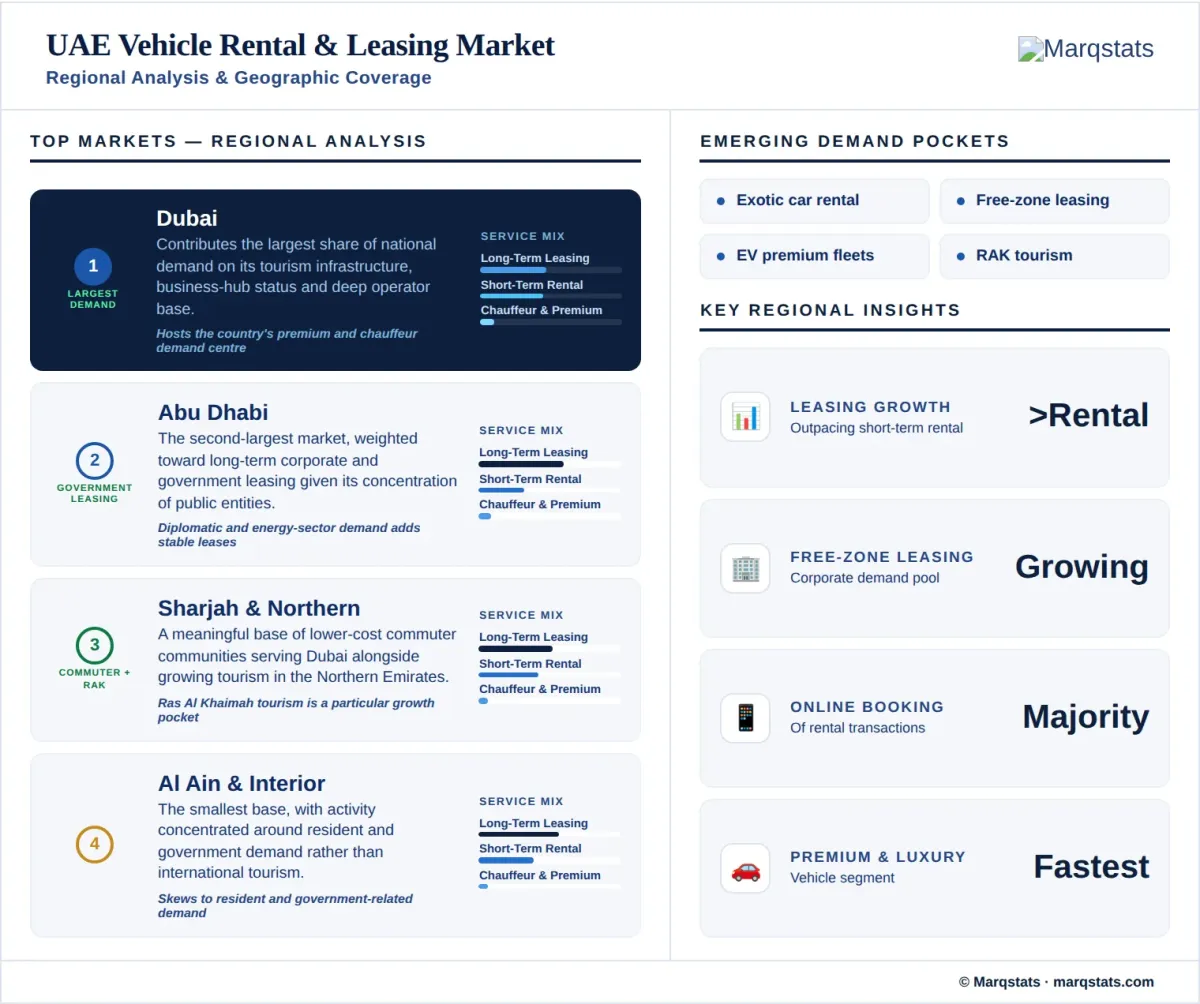
Dubai contributes the largest share of national demand, anchored by its tourism infrastructure, international business hub status, and concentration of both economy and luxury vehicle rental operators. The emirate's dense hospitality sector and recurring calendar of major international events sustain premium and chauffeur-driven service demand at a scale unmatched elsewhere in the country. Dubai International Airport's position as one of the world's busiest international gateways gives the emirate's airport rental segment a transaction volume disproportionate even to its substantial resident population and tourism footprint alone. Al Maktoum International Airport's continued development as a secondary and eventually primary gateway is expected to add a further airport-rental demand centre within the emirate over the course of this report's forecast period.
Abu Dhabi
Abu Dhabi represents the second-largest market, distinguished by its concentration of government and semi-government entities and corporate headquarters, giving the emirate a demand profile weighted more heavily toward long-term corporate and government leasing relative to Dubai's more tourism- and premium-rental-driven demand base. As the UAE capital, Abu Dhabi also hosts a substantial diplomatic and international-organisation presence that generates a further layer of stable, multi-year leasing demand distinct from private-sector corporate leasing. The emirate's significant sovereign wealth and energy-sector corporate presence further reinforces this stable, long-cycle leasing demand pattern.
Sharjah and Northern Emirates
Sharjah and the Northern Emirates, including Ajman, Ras Al Khaimah, Fujairah, and Umm Al Quwain, represent a smaller, meaningful demand base, shaped by lower-cost residential communities serving Dubai-area commuters alongside growing tourism development in several Northern Emirates specifically. Ras Al Khaimah's expanding tourism and hospitality sector has emerged as a particular growth pocket within this region, supporting incremental rental demand alongside the area's more established commuter-driven leasing base.
Al Ain and Interior Regions
Al Ain and the UAE's interior regions represent the smallest demand base of the areas covered in this study, with rental and leasing activity concentrated around the region's more limited corporate and tourism footprint relative to the coastal emirates. Vehicle rental and leasing activity in this region skews more heavily toward resident and government-related demand than the tourism-driven pattern found in Dubai and other coastal areas, reflecting Al Ain's more limited direct international tourism footprint.
How Competition Is Evolving
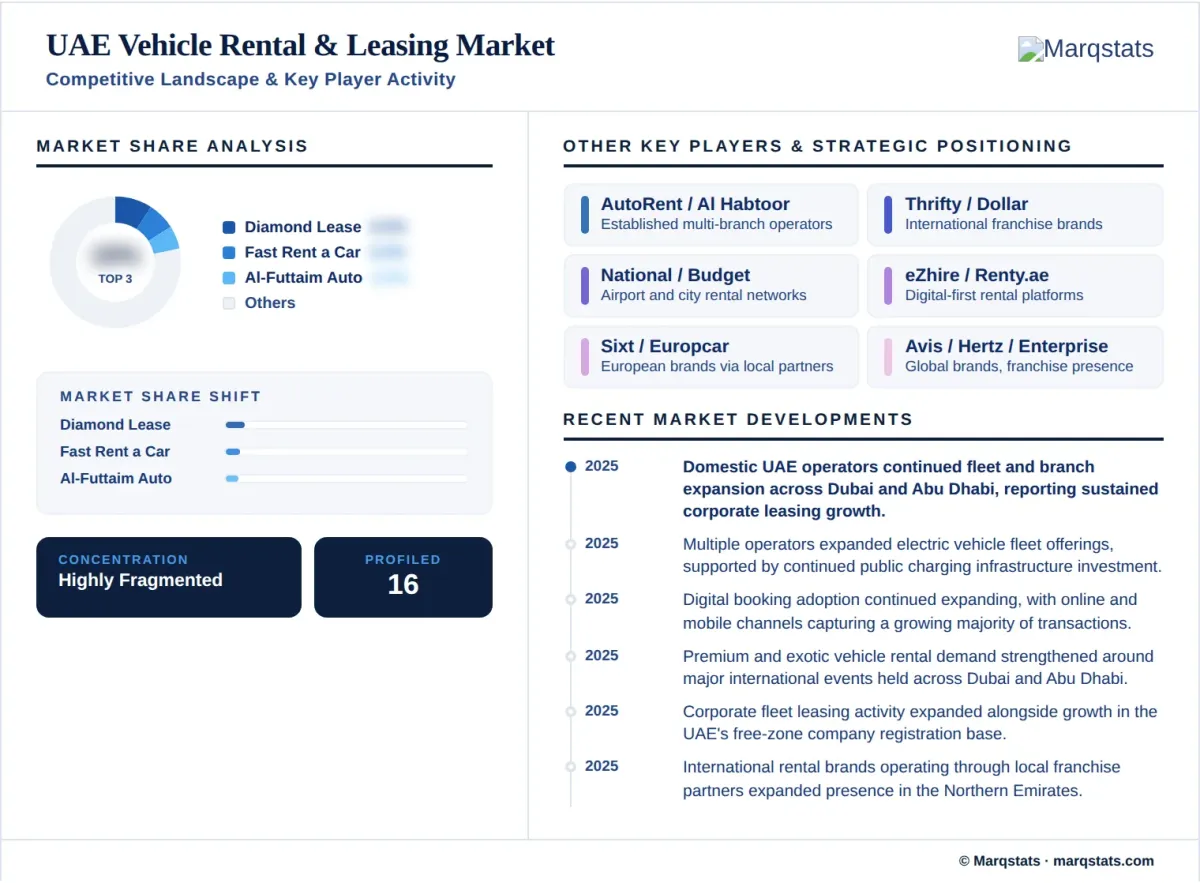
The market is highly fragmented, with several hundred licensed rental and leasing operators competing across the UAE, spanning large multi-branch operators with fleets numbering in the thousands down to small, single-location businesses. International rental brands operate through local franchise and joint-venture partners, competing alongside long-established domestic operators including Diamond Lease and Fast Rent a Car, both of which have built substantial fleets and multi-decade operating histories in the market. The three largest operators by combined market share still account for a comparatively modest total share relative to the more concentrated structure typical of mature rental markets elsewhere, underscoring the depth of this market's fragmentation.
Competitive strategy varies considerably by segment: economy and budget operators compete primarily on price, branch network coverage, and digital booking convenience, while premium and luxury segment operators compete on fleet exclusivity, brand partnerships, and service experience tied to the UAE's status-conscious visitor and resident base. Corporate leasing competition centers on account relationships, fleet-management technology, and the ability to service the UAE's large and diverse free-zone company base across multiple emirates simultaneously. Niche specialists focused specifically on the exotic and luxury rental segment, including platforms built around this specific customer base, compete on a fundamentally different basis than mainstream economy operators, illustrating how thoroughly segmented competitive dynamics have become across this fragmented market. Consolidation activity has been relatively limited across this market to date, consistent with a fragmented structure in which most operators remain independently owned rather than part of larger regional or international rental groups.
Companies Covered
The report profiles 16+ companies with full strategy and financials analysis, including:
Recent Market Activity
Table of Contents
Coverage & Segmentation
This report provides a comprehensive assessment of the United Arab Emirates vehicle rental and leasing market across a 2025 base year, historical data from 2021 to 2025, and forecasts spanning 2026 to 2030. Market size is stated as total rental and lease revenue in United States dollars. Segmentation covers three dimensions: service type, vehicle type, and end user, alongside regional analysis spanning Dubai, Abu Dhabi, Sharjah and the Northern Emirates, and Al Ain and the interior regions.
The scope includes short-term self-drive rental, long-term operating and finance leasing, and chauffeur-driven and premium vehicle hire for passenger cars and light commercial vehicles. The study excludes heavy commercial vehicle and equipment leasing, ride-hailing and taxi services, and peer-to-peer rental platforms, each of which Marqstats covers separately. Used-vehicle sales revenue generated from fleet disposal is similarly excluded from the core market figures, tracked as a distinct revenue stream separate from rental and lease income. Deeper regional detail beyond the four-area split covered here is available under customization, alongside deeper cuts by service type, vehicle class, or end-user segment.