Market Snapshot
Key Takeaways
Market Overview & Analysis
Report Summary
The Saudi Arabia vehicle rental and leasing market comprises short-term self-drive rental, long-term operating and finance leasing, and emerging subscription models for passenger cars and light commercial vehicles across the Kingdom. This study segments the market by service type, vehicle type, and end user, with a 2025 base year, historical coverage from 2021 to 2025, and forecasts to 2030. Market size is stated as total rental and lease revenue in United States dollars, covering both self-drive rental and corporate and government fleet leasing contracts. Used-vehicle sales revenue that rental operators generate from disposing of fleet vehicles at the end of their service life is tracked separately as a distinct revenue stream rather than folded into the core rental and lease figures presented here, consistent with how listed Saudi operators themselves report this activity.
Saudi Arabia's rental and leasing market differs from many regional peers in the depth of its domestically listed operator base: Theeb Rent a Car Company and other Saudi-founded operators have built substantial fleets and Kingdom-wide branch networks over three decades, giving the market a stronger domestic-operator presence relative to markets where international rental brands dominate through franchise arrangements alone. This domestic depth has also supported earlier and more extensive corporate leasing product development than in several neighbouring Gulf markets. Theeb's public listing on the Saudi Exchange since 2021 also gives this market an unusually transparent, publicly disclosed financial benchmark that many peer markets in the region lack, supporting more precise bottom-up market sizing than would otherwise be possible. This transparency extends to segment-level detail as well, with listed operators publicly disclosing revenue splits between rental, leasing, and used-vehicle sales activity that most private, unlisted regional peers do not make available.
Government and giga-project-linked demand represents a distinct driver largely absent from mature, private-sector-dominated rental markets: large-scale development programmes generate substantial vehicle leasing demand for both direct project use and the broader influx of contractors, consultants, and workers such projects draw into a region, giving fleet operators serving these programmes a demand source tied to national development spending rather than tourism or organic corporate growth alone. Operators with established government and large-project account relationships hold a structural advantage in capturing this demand, since public procurement and major project vendor qualification processes typically favour established, proven fleet suppliers over newer market entrants. This dynamic reinforces the competitive position of the Kingdom's longest-established domestic operators, who bring multi-decade government relationship history that newer entrants, whether domestic or international, cannot easily replicate in the short term.
Market Dynamics
Key Drivers
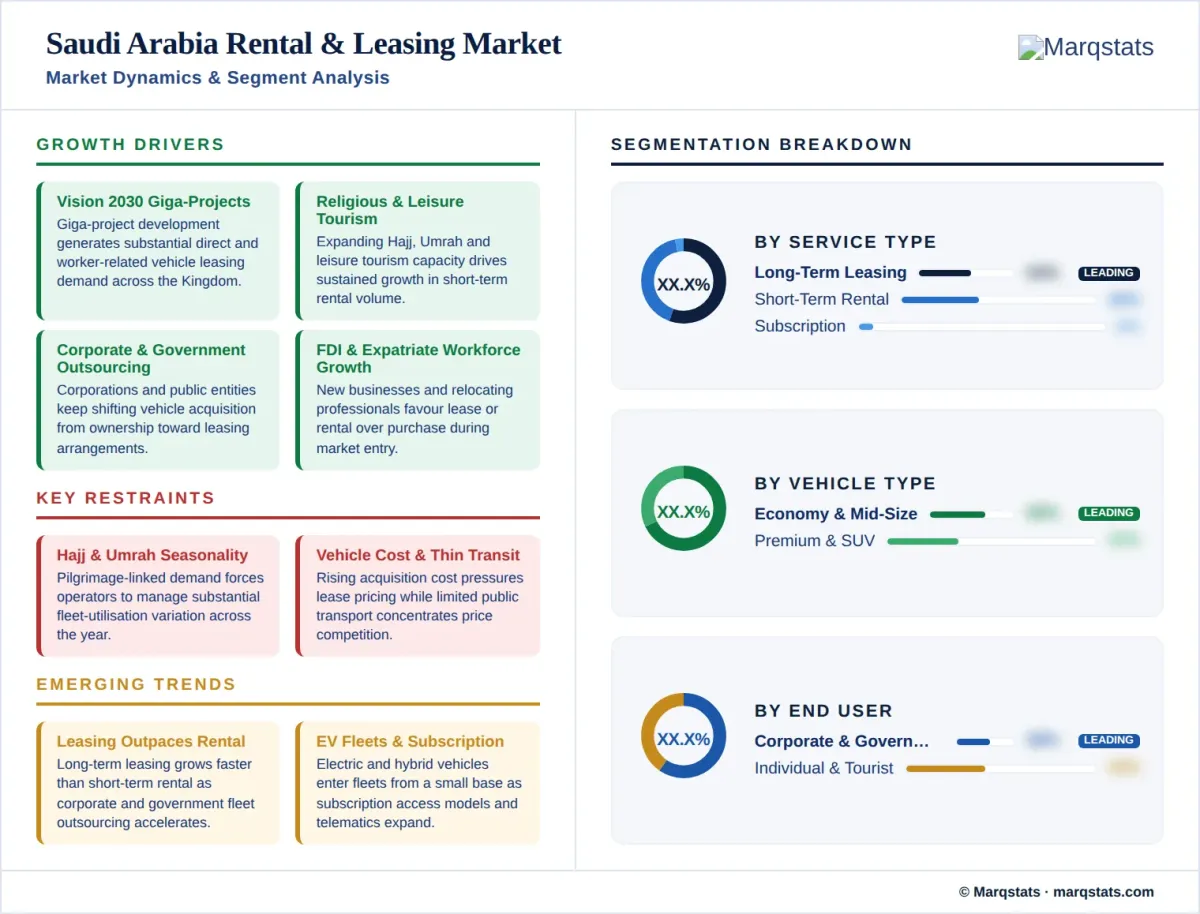
- Vision 2030 giga-project development is generating substantial direct and worker-related vehicle leasing demand.
- Expanding religious and leisure tourism capacity is driving sustained growth in short-term rental transaction volume.
- Corporate and government fleet outsourcing continues shifting vehicle acquisition from ownership toward leasing arrangements.
- Rising foreign direct investment and expatriate workforce growth are expanding both corporate leasing and individual rental demand.
- Online booking platform adoption is lowering transaction friction and expanding rental accessibility outside traditional branch locations.
Key Restraints
- Highly seasonal Hajj and Umrah-linked demand requires operators to manage substantial fleet utilisation variation across the year.
- Rising vehicle acquisition costs are pressuring fleet operator margins and long-term leasing contract pricing.
- Limited public transportation alternatives in several Kingdom regions concentrate competitive pressure on price-sensitive rental segments.
Key Trends
- Long-term leasing is outpacing short-term rental growth as corporate and government fleet outsourcing accelerates.
- Electric and hybrid vehicles are entering rental and leasing fleets, supported by national sustainability and diversification goals.
- Subscription-style vehicle access models are emerging as a distinct product alongside traditional rental and leasing contracts.
- Telematics and fleet-management technology adoption is expanding among operators seeking utilisation and maintenance efficiency gains.
Market Segmentation
Short-term rental, covering daily and weekly self-drive rentals through airport and city branch locations, remains the higher-transaction-volume service type, closely tied to religious tourism flows through Jeddah and Madinah alongside leisure and business travel through Riyadh's major airports. Demand within this service type shows the most pronounced seasonality of any segment covered in this report, with Hajj and Umrah periods generating rental volume multiples of quieter periods elsewhere in the Islamic calendar.
Long-term leasing, spanning corporate operating leases and government fleet contracts, is growing faster than short-term rental, reflecting the Kingdom's rapidly expanding non-oil corporate sector and public entities increasingly favouring predictable monthly fleet costs over direct vehicle ownership and the associated maintenance and disposal responsibilities. Multi-year contract terms typical of this service type give operators meaningfully more predictable revenue visibility than the short-term rental business provides, a distinction that shapes how operators balance fleet allocation between the two service types. Bundled maintenance and roadside assistance services are standard features of most leasing contracts in this market, reflecting corporate and government clients' preference for a single, predictable all-inclusive cost over managing vehicle upkeep separately.
Subscription-style vehicle access, bundling insurance, maintenance, and flexible-term access into a single monthly payment, represents a small, emerging service type, positioned between traditional short-term rental and long-term leasing for customers seeking flexibility without a multi-year commitment. Early adoption has concentrated among younger, urban professionals in Riyadh and Jeddah, a demographic profile consistent with subscription-model adoption patterns observed in other markets during this product category's early growth phase.
Economy and mid-size vehicles account for the majority of fleet composition across both rental and leasing segments, reflecting cost-conscious fleet procurement among corporate and government leasing clients and price-sensitive demand among tourist and resident self-drive renters alike. This vehicle class also carries the fastest fleet turnover of any category, given its concentration in high-volume tourist and short-term rental use, requiring operators to maintain a steady replacement cycle to keep fleet age and condition within acceptable limits. Japanese and Korean vehicle brands hold a particularly strong position within this vehicle class specifically, reflecting their established reputation for reliability and lower total cost of ownership across the Kingdom's broader passenger vehicle market.
Premium vehicles and sport-utility vehicles represent the fastest-growing vehicle-type segment, supported by rising corporate executive leasing demand and tourist preference for larger vehicles suited to family travel and the Kingdom's road and terrain conditions. Family and multi-generational travel groups, common among both domestic tourists and religious pilgrims, further reinforce demand for larger vehicle classes able to accommodate more passengers and luggage than a standard economy vehicle.
Corporate and government accounts represent the majority of market revenue, spanning direct fleet leasing contracts and the broader project-linked vehicle demand giga-project development and expanding non-oil business activity continue to generate across the Kingdom. This end-user category also anchors the majority of long-term leasing revenue specifically, given corporate and government entities' greater propensity toward multi-year contracts relative to individual and tourist renters.
Individual and tourist rental demand remains substantial and highly seasonal, concentrated around Hajj, Umrah, and national holiday periods, with resident expatriate and citizen self-drive rental representing a steadier, less seasonal component of this end-user category. Domestic tourism, supported by newly developed leisure destinations under national diversification programmes, is emerging as a further demand layer within this category, gradually diversifying rental demand beyond its historical religious-tourism concentration. Resident self-drive rental, used by both citizens and expatriates for temporary vehicle needs between vehicle ownership transitions or during vehicle maintenance periods, provides a more stable, less seasonally concentrated revenue base within this category than the pilgrim and tourist segments alone would offer.
By Geography
Riyadh
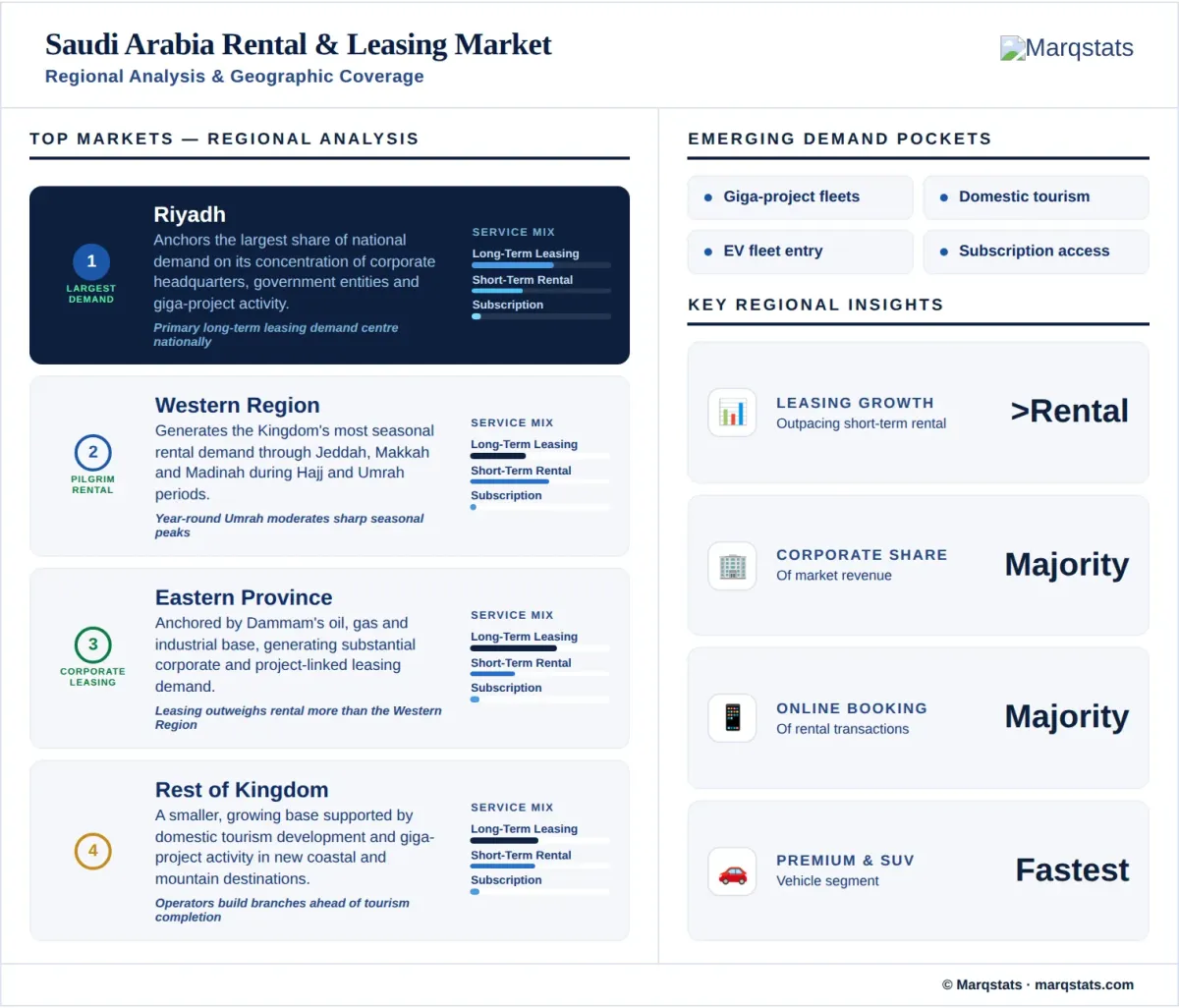
Riyadh anchors the largest share of national demand, reflecting its concentration of corporate headquarters, government entities, and giga-project activity, alongside substantial business travel volume through King Khalid International Airport. The capital's ongoing giga-project development, including large-scale urban and entertainment developments, is generating sustained corporate and project-linked leasing demand that operators expect to continue expanding through the remainder of this report's forecast period. The city's status as headquarters location for the large majority of major domestic and multinational corporations operating in the Kingdom further reinforces its position as the primary long-term leasing demand centre nationally.
Makkah and Madinah (Western Region)
The Western Region, encompassing Jeddah, Makkah, and Madinah, generates the Kingdom's most distinctly seasonal rental demand, driven by the concentrated influx of religious pilgrims during Hajj and Umrah periods that operators plan fleet allocation around specifically. Jeddah's role as the primary international gateway for pilgrims travelling to Makkah and Madinah gives the city's airport rental locations a transaction volume disproportionate to its resident population alone, a pattern distinct from typical airport-rental demand drivers elsewhere in the Kingdom. Umrah, performed year-round rather than confined to the fixed Hajj season, has become an increasingly important demand stabiliser for operators in this region, moderating the otherwise sharp seasonal peaks a Hajj-only demand pattern would produce.
Eastern Province
The Eastern Province, anchored by Dammam and the Kingdom's concentrated oil, gas, and industrial base, generates substantial corporate and project-linked leasing demand tied to the region's industrial activity and associated contractor and workforce presence. Long-term leasing represents a larger share of regional demand here than in the more tourism-weighted Western Region, reflecting the province's corporate and industrial rather than religious-tourism-driven demand base.
Rest of Kingdom
Remaining regions, including Asir, Tabuk, and other developing areas, represent a smaller, growing demand base, supported by domestic tourism development and giga-project activity including new coastal and mountain tourism destinations under development as part of national diversification plans. Fleet operator presence in these regions has historically trailed the three anchor regions, though several operators have begun establishing branch locations ahead of anticipated tourism infrastructure completion.
How Competition Is Evolving
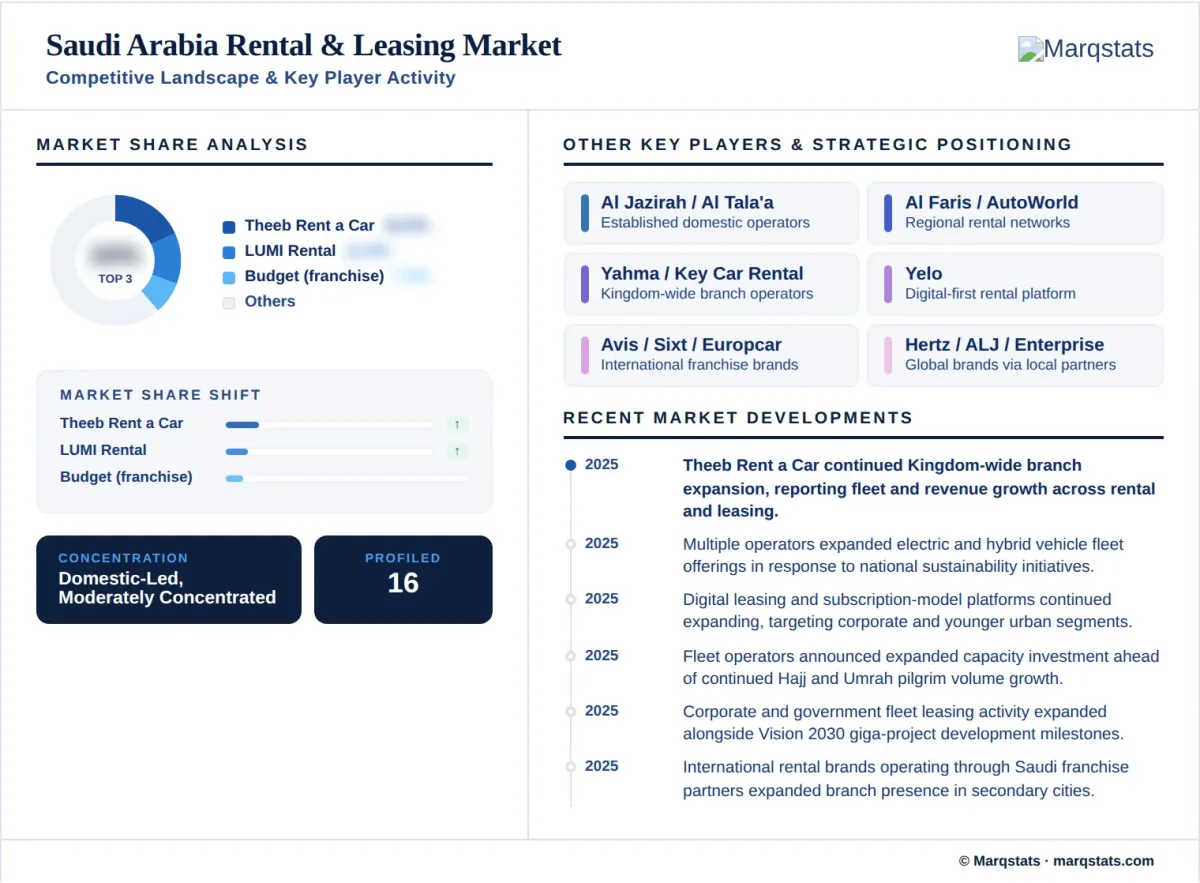
The market is moderately concentrated, with a small number of established domestic operators, led by publicly listed Theeb Rent a Car Company, competing alongside international rental brands operating through Saudi franchise partners and a broader group of smaller regional and independent operators. This structure gives Saudi Arabia a stronger domestic-operator competitive presence relative to several neighbouring Gulf markets where international franchise brands hold a more dominant position. Theeb's public listing has also given the broader market a visible growth benchmark, with the company's reported revenue and fleet expansion frequently referenced by industry participants and observers as an indicator of overall market health.
Competitive strategy centers on fleet scale and branch network coverage across the Kingdom's dispersed major cities and religious tourism centres, corporate and government account relationships for the long-term leasing segment, and increasingly, digital booking and fleet-management technology investment. Operators serving the religious tourism segment specifically must manage substantial seasonal fleet utilisation swings that operators focused primarily on corporate leasing do not face to the same degree. International brands operating through local franchise partners typically bring established global booking platforms and loyalty programmes, while domestic operators compete on Kingdom-wide branch density and longer-standing government and corporate account relationships built over decades of local operation. Fleet financing access is a further competitive differentiator, since operators with stronger banking relationships or, in Theeb's case, public capital market access can typically renew and expand fleets on more favourable terms than smaller, privately financed competitors.
Companies Covered
The report profiles 16+ companies with full strategy and financials analysis, including:
Recent Market Activity
Table of Contents
Coverage & Segmentation
This report provides a comprehensive assessment of the Saudi Arabia vehicle rental and leasing market across a 2025 base year, historical data from 2021 to 2025, and forecasts spanning 2026 to 2030. Market size is stated as total rental and lease revenue in United States dollars. Segmentation covers three dimensions: service type, vehicle type, and end user, alongside regional analysis spanning Riyadh, the Western Region, the Eastern Province, and the rest of the Kingdom.
The scope includes short-term self-drive rental, long-term operating and finance leasing, and subscription-style access models for passenger cars and light commercial vehicles. The study excludes heavy commercial vehicle and equipment leasing, ride-hailing and taxi services, and peer-to-peer rental platforms, each of which Marqstats covers separately. Used-vehicle sales revenue generated from fleet disposal is also excluded from the core market figures, tracked as a distinct revenue stream consistent with how the market's major operators report this activity separately from rental and lease income. Deeper regional detail beyond the four-area split covered here is available under customization, alongside deeper cuts by service type, vehicle class, or end-user segment.