Market Snapshot
Key Takeaways
Market Overview & Analysis
Report Summary
The Latin America vehicle rental and leasing market encompasses the provision of vehicles on short-term rental (daily/weekly), long-term operating lease, financial lease, subscription, and fleet management basis across passenger cars, light commercial vehicles, trucks, buses, and specialty commercial assets. The market serves leisure travellers, corporate fleets, ride-hailing and gig-economy drivers, logistics and e-commerce operators, and government agencies. The geographic scope covers Brazil, Mexico, Argentina, Colombia, Chile, and the rest of Latin America, with Brazil and Mexico constituting the two dominant country markets.
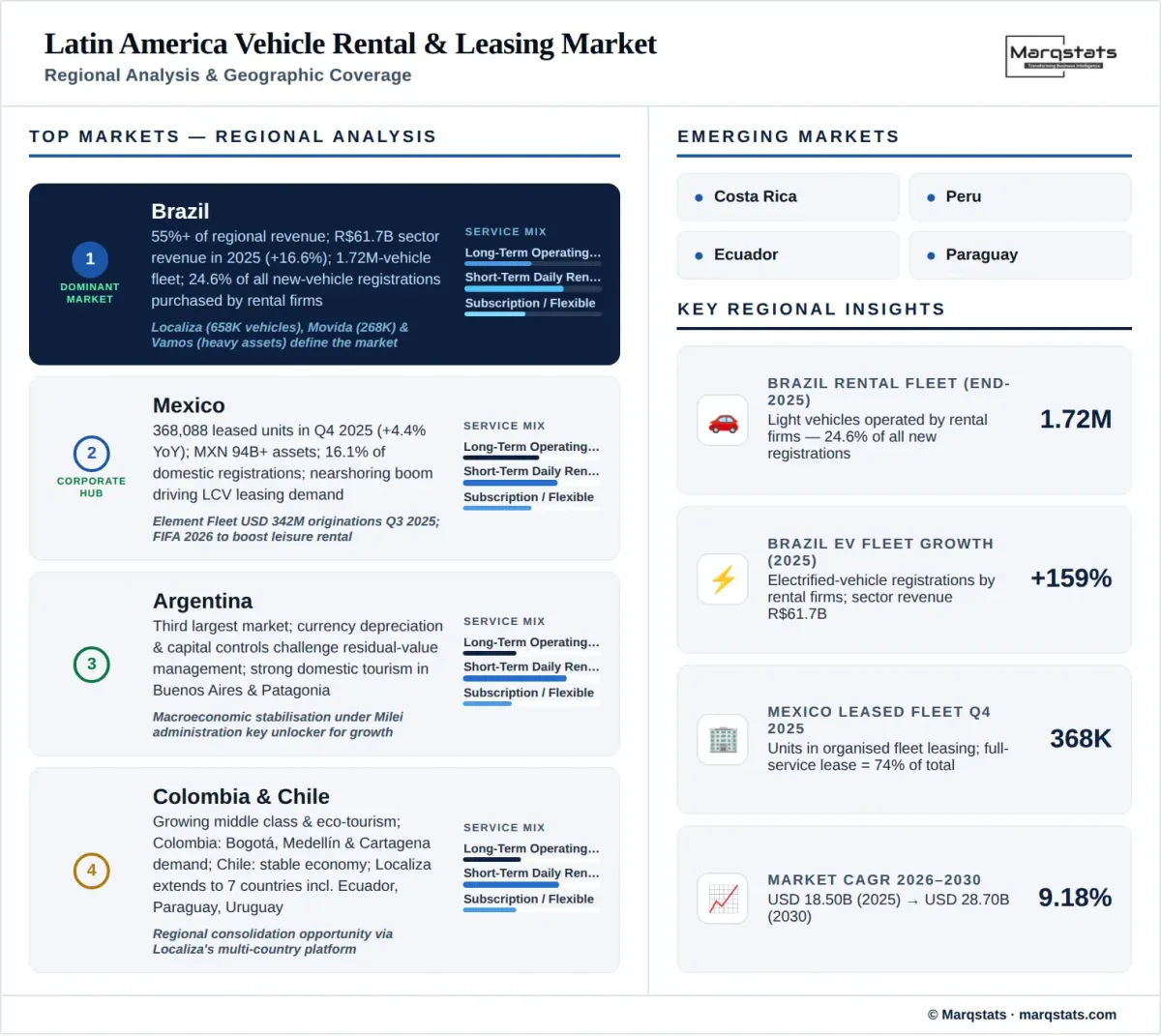
Brazil’s vehicle rental industry is the largest and most mature in the region. ABLA data shows that the country’s total rental fleet reached 1.72 million light vehicles at end-2025, with long-term rentals (contracts exceeding 30 days for corporations, government, and subscription services) accounting for 54% of the fleet and short-term rentals (daily/weekly for individuals and ride-hailing drivers) representing 46%. The sector purchased 628,970 new light vehicles during 2025, equivalent to 24.6% of all Brazilian light-vehicle registrations, making rental companies the single largest institutional buyer category in the Brazilian auto market. Employment in the sector surpassed 105,000 registered workers, and the number of active rental companies grew 19.2% to 31,487 businesses.
Mexico’s vehicle leasing market is the region’s second largest and the clearest benchmark for organised corporate fleet leasing. AMAVe data shows the fleet leasing sector grew 4.4% in Q4 2025 to 368,088 units, with full-service leasing commanding 74% of leased volumes, daily rental 11.6%, managed-only units 11.2%, and financial leasing 2.1%. Fleet purchases in Mexico reached 245,924 light vehicles in 2025, representing 16.1% of the domestic market, with AMAVe members accounting for 27.8% of those acquisitions. Specialised leasing represented 6.7% of new-light-vehicle financing with 13,389 units, and the sector’s total assets exceeded MXN 94 billion.
Market Dynamics
Key Drivers
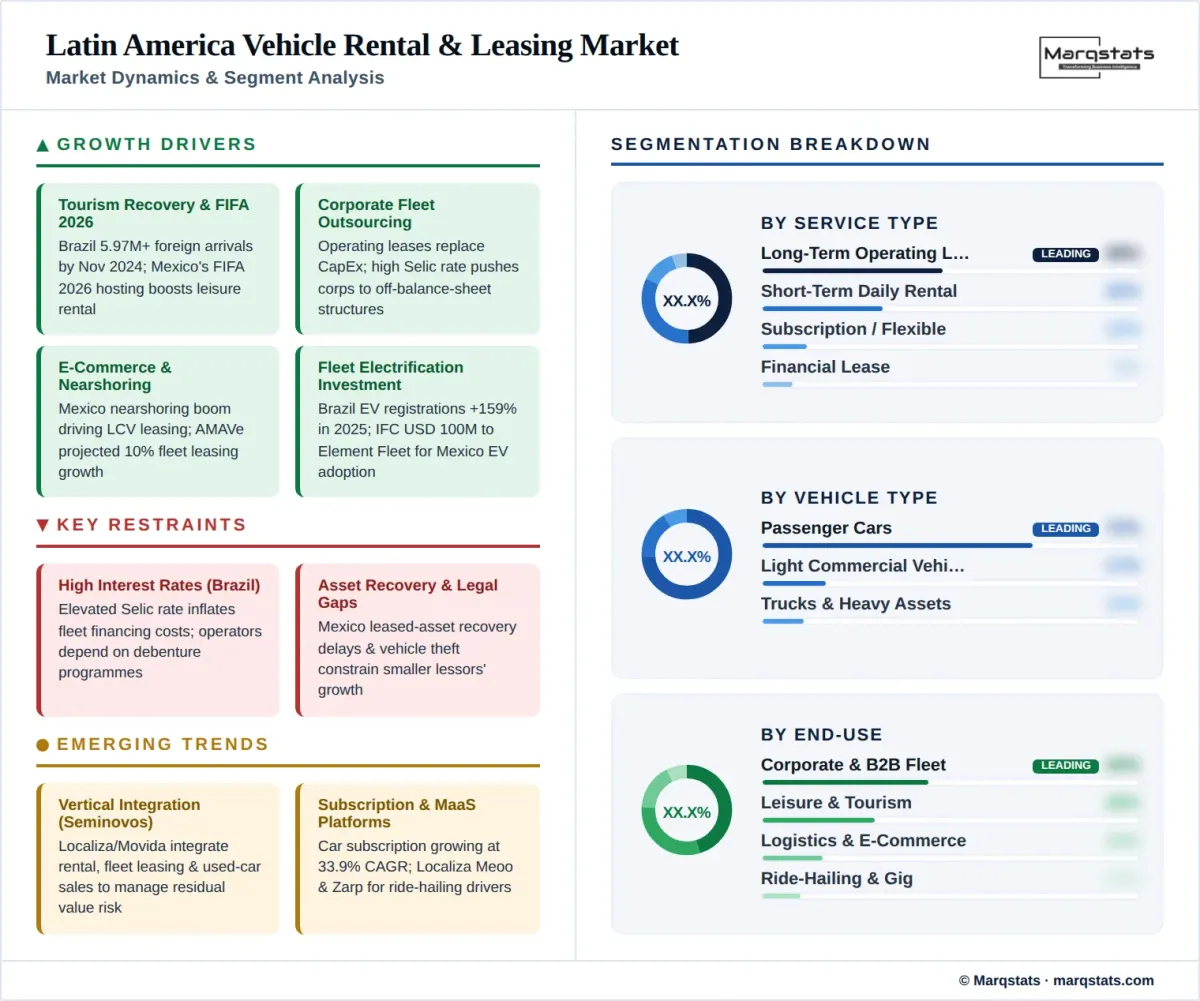
- Tourism recovery and government promotion programmes: Latin America’s tourism sector is in a robust recovery phase. Brazil’s foreign tourist arrivals surpassed 5.97 million by November 2024, already exceeding the full-year 2023 total, and the government’s “Plano Brasis” 2025–2027 strategy targets 8 million foreign visitors. Leisure travel represents 89.9% of total travel spend in Brazil, with average stays lengthening to 13.1 nights, directly increasing rental duration and revenue per transaction. Mexico expects a further tourism boost from the 2026 FIFA World Cup hosting rights.
- Corporate shift from asset ownership to fleet outsourcing: Corporations across Latin America are increasingly converting vehicle capital expenditure into operating lease arrangements, driven by high interest rates (Brazil’s Selic rate remained elevated through 2025), balance-sheet optimisation objectives, and the desire to transfer fleet management complexity to specialist providers. In Mexico, operating leases account for 68% of the total fleet leasing market by value. This structural trend is particularly pronounced in logistics, consumer goods distribution, and pharmaceutical sectors.
- E-commerce and last-mile logistics expansion: The rapid growth of e-commerce penetration across Latin America is driving sustained demand for commercial vehicle rental and leasing. Last-mile delivery fleets, quick-commerce operations, and cross-border logistics supporting Mexico’s nearshoring boom are creating incremental demand for light commercial vehicle and truck leasing. AMAVe projected 10% growth in fleet leasing for 2025, driven significantly by delivery and logistics sector demand.
- Digital transformation of booking and fleet management: Online booking platforms now control 65.9% of all vehicle rental reservations in Brazil, growing at a 7.25% CAGR. Mobile applications, telematics-enabled fleet management, and digital subscription services (such as Localiza’s Meoo platform) are reducing customer acquisition costs, improving fleet utilisation rates, and enabling new revenue models. Uber’s September 2024 launch of a rental feature in Mexico’s Yucatán region through MEX Rent-A-Car illustrates the convergence of ride-hailing and rental platforms.
- Fleet electrification creating new service revenue streams: Electrification has moved beyond pilot stage in both Brazil and Mexico. Brazilian rental firms increased electrified-vehicle registrations by 159% in 2025, building on a 108.5% increase in new electrified-vehicle purchases in 2024. In Mexico, hybrid and electric acquisitions by lessors rose 35.3% in 2025. IFC committed USD 100 million to Element Fleet Management in May 2025 specifically to accelerate EV adoption and charging solutions in Mexico, while TIP Mexico partnered with VEMO for end-to-end fleet electrification including EV selection, chargers, and charging-network access.
Key Restraints
- High interest rates and capital cost in Brazil: Brazil’s elevated Selic rate environment increases the cost of fleet financing for rental companies, compressing margins on long-term leases and requiring operators to maintain active capital-markets programmes. Localiza’s at least R․8.7 billion in 2025 debenture issuances and Movida’s R․2.9 billion reflect the continuous refinancing discipline required to sustain fleet growth in a high-rate environment.
- Asset recovery and legal-framework challenges in Mexico: AMAVe has publicly prioritised legal reforms to improve recovery of leased assets, and industry commentary throughout 2025–2026 identifies non-payment risk, vehicle theft, and judicial delays in asset recovery as key friction points constraining the growth of fleet leasing in Mexico. This legal uncertainty particularly affects smaller lessors with limited loss-absorption capacity.
- Used-vehicle residual value volatility: Latin American rental operators’ profitability is highly sensitive to residual values at defleeting. Currency depreciation against the US dollar, fluctuations in new-vehicle supply, and shifts in consumer demand for specific vehicle types can create unpredictable residual-value outcomes, particularly for operators holding large fleets of vehicles approaching end-of-cycle.
- Infrastructure gaps for EV fleet operations: Despite strong headline growth in electrified-vehicle adoption, the charging infrastructure across Latin America remains nascent outside major metropolitan areas. Range anxiety, charging-station availability on intercity routes, and electricity grid reliability in secondary cities limit the pace at which rental and leasing operators can convert their fleets to electric propulsion at scale.
Key Trends
- Vertically integrated rental-remarketing business models: Brazil’s leading operators—Localiza, Movida, and Unidas—run vertically integrated models combining short-term rental, long-term fleet leasing, and used-vehicle sales (Seminovos) channels. This integration helps manage residual-value risk, accelerates capital rotation, and creates a significant competitive moat. Localiza’s Seminovos division operates proprietary sales yards and reconditioning centres across Brazil.
- Capital-markets competition among scale players: The competitive dynamics in Brazil are increasingly driven by funding access and refinancing discipline. Localiza’s at least R․8.7 billion in 2025 debenture issuances, Movida’s four debenture tranches totalling R․2.9 billion, and TIP Mexico’s MXN 4 billion bond (rated AAA locally, 4.4x oversubscribed) demonstrate that the strongest competitors are those with the deepest balance sheets and lowest cost of capital.
- Subscription and flexible mobility services: Car subscription models are gaining traction across Latin America, valued at USD 342 million in 2025 and projected to grow at a 33.9% CAGR through 2033. Localiza’s Meoo subscription platform and its Zarp service for ride-hailing drivers represent new mobility-as-a-service revenue models that blur the boundary between traditional rental and vehicle ownership.
- Heavy commercial asset leasing professionalisation: The commercial vehicle leasing segment in Brazil is becoming increasingly structured, with Vamos (Simpar Group) positioned as the national market leader in heavy-vehicle leasing for trucks, machinery, mining, and agribusiness fleets. This professionalisation of heavy-asset leasing expands the total addressable market beyond passenger-car rental and corporate fleet outsourcing.
Market Segmentation
Short-term vehicle rental is the most visible and consumer-facing segment of the Latin American market, driven by leisure tourism, business travel, and ride-hailing driver demand. In Brazil, short-term rentals accounted for 46% of the total rental fleet (approximately 753,000 vehicles) at mid-2025, with airport locations generating the highest per-vehicle revenue. The segment benefits from the ongoing tourism recovery, rising foreign tourist arrivals, and the growing availability of online booking platforms. In Mexico, daily rental represents 11.6% of the organised leasing market by unit volume.
Long-term operating lease is the fastest-growing and highest-margin segment across the region. In Brazil, long-term contracts (exceeding 30 days) for corporate, government, and subscription customers account for 54% of the total rental fleet (approximately 884,000 vehicles). In Mexico, full-service leasing dominates with 74% of total leased units. The operating lease model is attractive to corporations because it transfers vehicle depreciation, maintenance, insurance, and remarketing risk to the lessor, converting capital expenditure into predictable operating expenditure.
Financial leasing, where the lessee assumes residual-value risk and typically acquires the vehicle at contract end, represents a smaller share of the market. In Mexico, financial leasing accounted for just 2.1% of total leased units in Q4 2025, as corporations increasingly prefer operating lease structures that provide greater flexibility and off-balance-sheet treatment. Financial leasing remains more prevalent for commercial vehicles and specialty equipment where end-of-lease purchase is economically advantageous.
Vehicle subscription services represent an emerging segment growing at approximately 33.9% CAGR across Latin America, from USD 342 million in 2025. These services offer consumers and small businesses monthly vehicle access with insurance, maintenance, and roadside assistance bundled into a single payment. Localiza’s Meoo platform and its Zarp offering for ride-hailing drivers are leading examples. The subscription model addresses consumer demand for flexibility without the commitment of vehicle ownership or traditional multi-year leases.
Passenger cars constitute the largest vehicle type by both fleet size and revenue. Economy cars are the dominant sub-segment by volume, serving price-sensitive leisure and urban commuter demand. However, executive and SUV categories are growing fastest as corporate fleet specifications and leisure traveller preferences shift toward larger, better-equipped vehicles. In Mexico, the most leased passenger-car brands in Q4 2025 were Nissan (25.5% share), GM (17.6%), Stellantis (8.8%), Volkswagen (7.8%), and Kia (7.8%).
Light commercial vehicle rental and leasing is expanding rapidly, driven by e-commerce logistics, last-mile delivery operations, and the conversion of corporate utility fleets to leased models. In Brazil, rental companies operate LCVs alongside passenger cars within their 1.72-million-unit fleet. The segment benefits from the growing professionalisation of urban logistics and the entry of quick-commerce operators requiring standardised, well-maintained delivery fleets.
The heavy commercial vehicle leasing segment is an important and increasingly structured niche, particularly in Brazil. Vamos (Simpar Group) leads this segment nationally, providing trucks, machinery, and specialty equipment on long-term lease to mining, agribusiness, construction, and logistics operators. In Mexico, AMAVe data shows that lessors acquired 5,130 heavy vehicles as client assets in 2025. The segment benefits from the capital intensity of heavy assets and fleet operators’ desire to convert fleet ownership into operating expenses.
By Geography
Brazil
Brazil is the undisputed leader of the Latin American vehicle rental and leasing market, accounting for over 55% of regional revenue. ABLA reported that the sector’s revenue reached a record R․61.7 billion in 2025, up 16.6% year-on-year, with rental companies operating a fleet of 1.72 million light vehicles. The industry purchased 628,970 new vehicles during the year, representing 24.6% of all Brazilian light-vehicle registrations. The competitive landscape is dominated by Localiza (658,000+ vehicles, 954 locations, 7 countries), Movida (268,000 vehicles), and Unidas, with heavy-asset specialist Vamos leading the commercial vehicle segment. The market is characterised by deep capital-markets integration, vertically integrated rental-remarketing models, and accelerating fleet electrification (159% growth in electrified-vehicle registrations in 2025).
Mexico
Mexico is the region’s second-largest market and the primary benchmark for organised corporate fleet leasing. AMAVe data shows the fleet leasing sector reached 368,088 units in Q4 2025 with total industry assets exceeding MXN 94 billion. Fleet purchases totalled 245,924 light vehicles (16.1% of the domestic market) and 5,130 heavy vehicles. The competitive landscape features international operators such as Element Fleet Management (record US342 million in Mexican originations in Q3 2025), TIP Mexico, and Ayvens. The market is shaped by the nearshoring trend driving manufacturing logistics demand, the FIFA 2026 World Cup creating anticipated tourism rental demand, and ongoing legal-framework reforms for leased-asset recovery.
Argentina
Argentina’s vehicle rental market faces unique challenges including persistent currency depreciation, capital controls, and macroeconomic volatility that complicate fleet financing and residual-value management. Nevertheless, the market benefits from a strong domestic tourism culture and growing demand for rental services in Buenos Aires and Patagonia. The market is significantly smaller than Brazil and Mexico but offers growth potential as macroeconomic conditions stabilise.
Colombia, Chile, and Rest of Latin America
Colombia and Chile represent emerging opportunities within the Latin American vehicle rental and leasing market. Colombia’s growing middle class, expanding domestic tourism, and e-commerce logistics are driving rental demand in Bogotá, Medellín, and Cartagena. Chile’s eco-tourism sector and relatively stable economic environment support steady growth in both leisure rental and corporate fleet leasing. Costa Rica is a notable niche market driven by international tourism. Localiza’s operations extend across seven countries including Ecuador, Paraguay, and Uruguay, providing a platform for regional consolidation.
How Competition Is Evolving
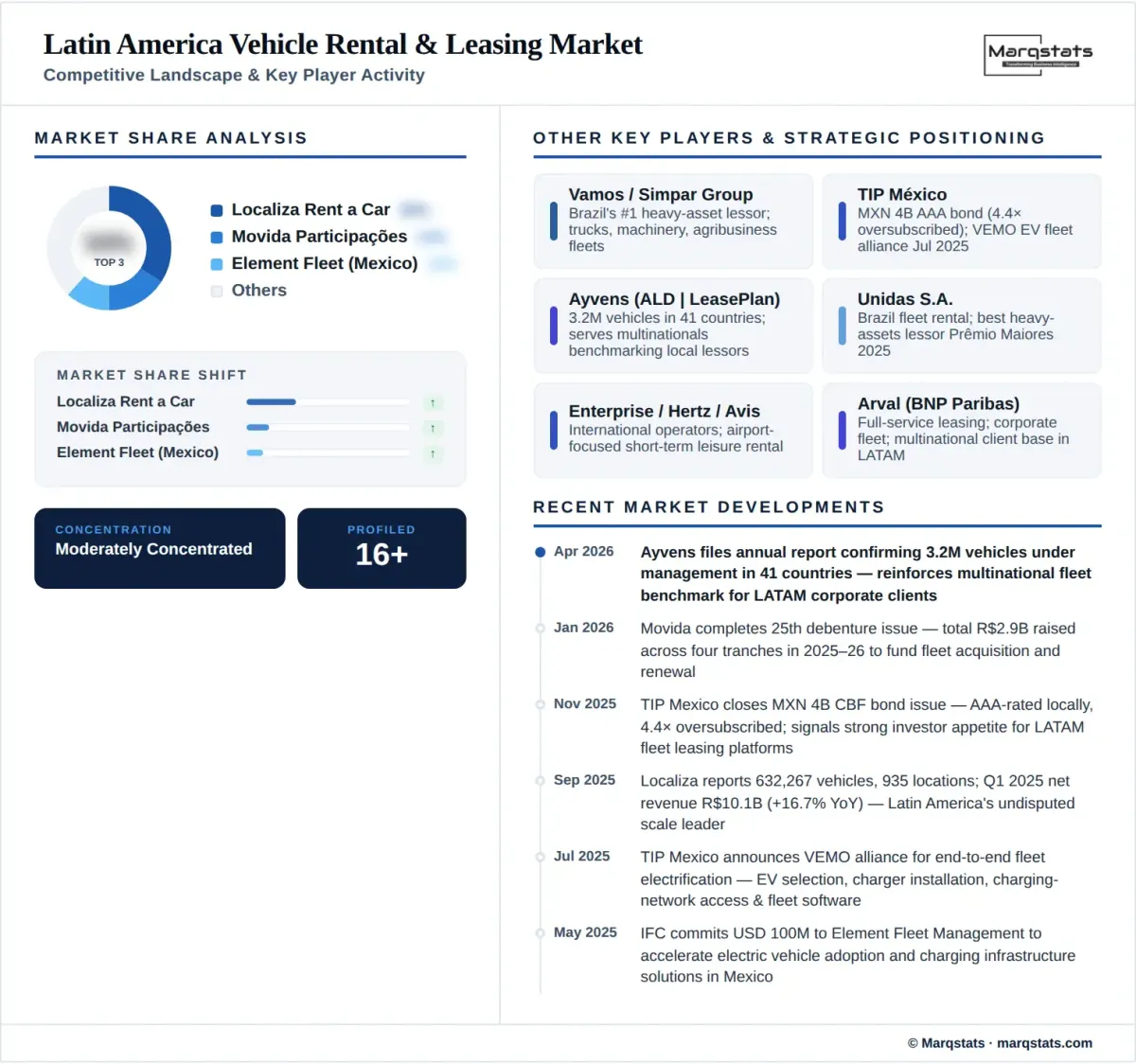
The Latin America vehicle rental and leasing market is moderately concentrated in Brazil, where Localiza, Movida, and Unidas collectively operate over 900,000 vehicles and dominate across daily rental, fleet leasing, and used-vehicle remarketing. Localiza’s December 2025 fleet of 658,000+ vehicles, 954 locations across 7 countries, and its Q1 2025 consolidated net revenue of R․10.1 billion (16.7% year-on-year growth) underscore its position as the region’s undisputed scale leader. Movida, with 268,000 vehicles and 261 RAC service points as of March 2025, competes through pricing aggressiveness and network density. Unidas remains a significant competitor across light and heavy fleet rental, having been recognised as the top heavy-assets lessor in the Prêmio Maiores & Melhores do Transporte 2025.
In Mexico, the competitive landscape is more fragmented and internationally oriented. Element Fleet Management, backed by IFC’s USD 100 million commitment for EV fleet financing, reported record Mexican originations of USD 342 million in Q3 2025. TIP Mexico has positioned itself at the intersection of fleet leasing and electrification through its July 2025 alliance with VEMO for end-to-end fleet electrification, and completed a MXN 4 billion bond issue in November 2025 (AAA-rated, 4.4x oversubscribed). Ayvens, with 3.2 million vehicles under management globally in 41 countries, serves multinational corporate clients benchmarking local suppliers against global full-service leasing platforms.
The competitive dynamics across the region are increasingly defined by three capabilities: balance-sheet strength and capital-markets access for fleet acquisition and renewal, used-vehicle remarketing and residual-value management efficiency, and the ability to deliver integrated mobility solutions encompassing EV fleet conversion, charging infrastructure, telematics, and subscription services. Companies that combine scale, funding depth, and technology-enabled service delivery are best positioned for market leadership.
Companies Covered
The report profiles 16++ companies with full strategy and financials analysis, including:
Recent Market Activity
Table of Contents
Coverage & Segmentation
This report provides a comprehensive analysis of the Latin America vehicle rental and leasing market covering the historical period 2021–2025 and forecast period 2026–2030, with 2025 as the base year. The study examines market size and growth in value (USD billion), segmented by service type (short-term rental, long-term operating lease, financial lease, subscription/flexible mobility), vehicle type (passenger cars, LCVs, trucks/heavy commercial vehicles), booking channel (online, offline), end use (leisure/tourism, corporate, logistics/e-commerce, government, ride-hailing), and geography (Brazil, Mexico, Argentina, Colombia, Chile, rest of Latin America). The competitive landscape profiles 16 leading operators with analysis of fleet size, market positioning, capital structure, technology initiatives, and recent strategic developments.
Primary research includes structured interviews with 40+ industry stakeholders spanning rental and leasing operators, OEM fleet sales divisions, fleet management technology providers, industry associations (ABLA, AMAVe), financial institutions, and EV charging infrastructure providers. Secondary research draws from ABLA and AMAVe data releases, company annual reports and securities filings (CVM/BMF Bovespa for Brazilian operators), ANFAVEA and AMDA production and sales data, central bank financing statistics, and trade publications. All market estimates represent Marqstats Intelligence proprietary calculations.