Market Snapshot
Key Takeaways
Market Overview & Analysis
Report Summary
The UAE Chinese vehicle after-sales service market covers the paid work and parts consumed by Chinese-brand vehicles operating in the Emirates: scheduled maintenance, mechanical repair, body and paint work, and the parts and accessories supplied through franchised and independent channels. Demand is a function of two variables only, the size of the vehicle population and the annual spend each vehicle generates, and both are moving quickly and in the same direction. Vehicle sales revenue, manufacturer-funded warranty recoveries and service performed on non-Chinese brands fall outside the boundary.
The parc is the youngest of any significant brand grouping in the country. Model-level tracking records the Chinese-brand cohort rising from 5,112 units in 2021 to 55,520 in 2025, a total of 130,718 vehicles across the period, with a modest pre-2021 tail from the brands that entered earliest. That cohort figure is a same-source indicator rather than a national registration statistic, since the tracking file does not capture every Chinese manufacturer consistently, and it is treated here as a lower bound on the population rather than as a share of the market.
A young parc is a small revenue pool per unit and a large one in aggregate only once it ages. Vehicles in their first three years consume scheduled servicing, consumables and occasional warranty work, much of it complimentary under current terms. Vehicles in their fourth year and beyond consume brakes, suspension components, tyres, batteries, air conditioning work and the accumulated repairs that make after-sales profitable. The entire commercial thesis of this market rests on the 2021 to 2025 cohort crossing that threshold between 2026 and 2030, which is precisely the forecast period.
Chinese-Brand Vehicle Population and Service Spend
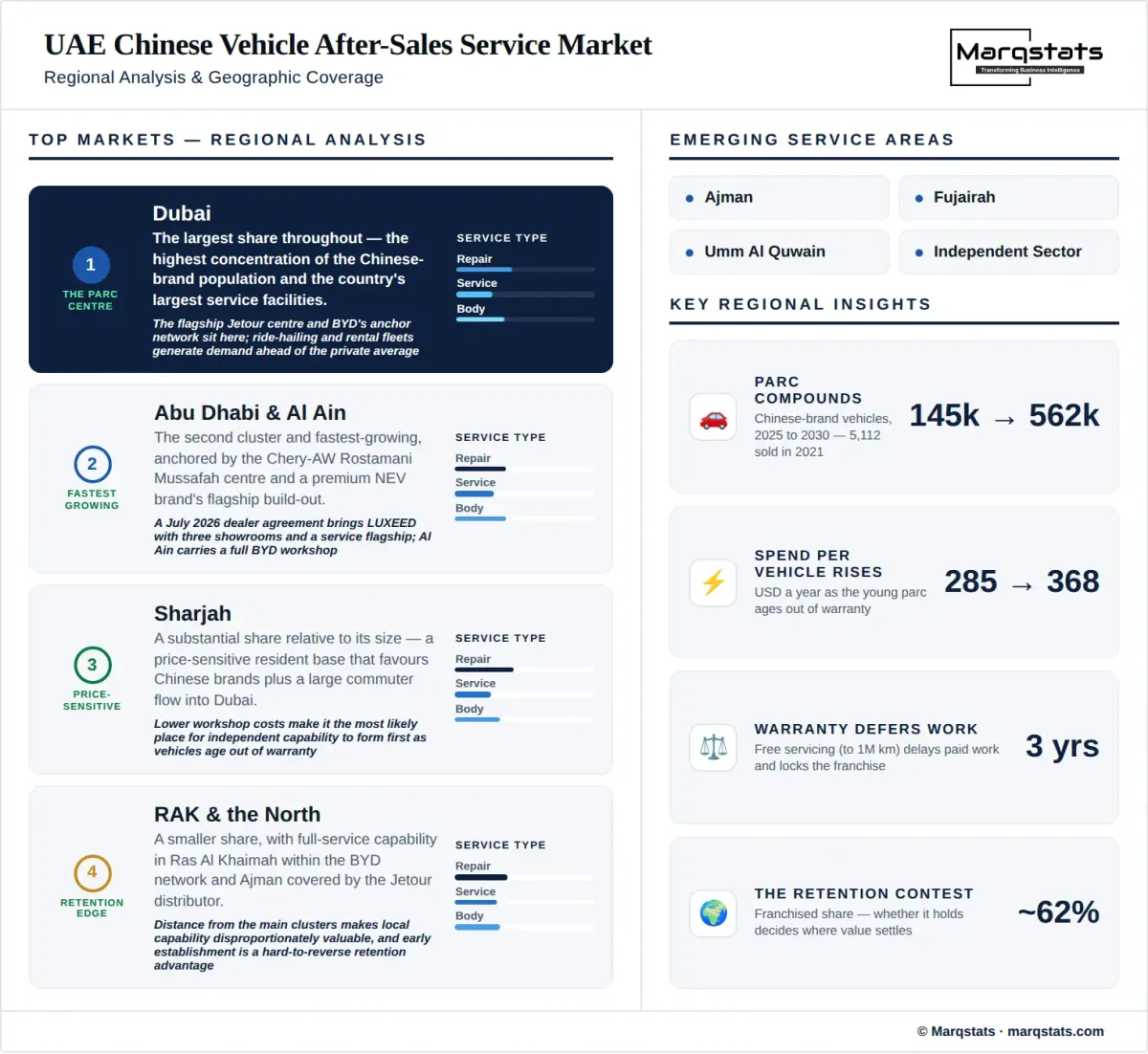
The Chinese-brand vehicle population rises from approximately 145,000 in 2025 to 562,000 by 2030, a 31.12% compound annual growth rate, reaching roughly 719,000 by 2031. The 2025 figure combines the tracked 2021 to 2025 cohort of 130,718 units with a modest pre-2021 tail from brands that entered the market earlier. Attrition is minimal in the early years because the population is young, and rises modestly from 2028 as the earliest cohorts reach resale and export age.
Annual service spend per vehicle rises from USD 285 to USD 368, a 5.24% annual increase, which is why revenue compounds at 38.00% against 31.12% growth in the population. The increase is an ageing effect rather than price inflation. A parc whose average age is under two years in 2025 reaches an average approaching four years by 2030, and spend per vehicle in the fourth and fifth years of ownership runs materially above the first and second. The seven-point gap between the two growth rates is the single most important number for anyone sizing workshop capacity, because it means revenue per bay rises even if no additional vehicles arrive.
Warranty terms are the reason the base-year spend figure is as low as it is, and they deserve explicit treatment rather than an assumption. Chinese brands have used warranty length as a market-entry instrument in the Emirates, with one distributor offering coverage to one million kilometres or ten years together with three years or 30,000 kilometres of complimentary servicing and continuous roadside assistance. Work performed under those terms is funded by the manufacturer and is excluded from this market. The practical effect is twofold: paid service is deferred by roughly three years from the point of sale, and the vehicle stays inside the franchised network during the period when an owner would otherwise establish a relationship with an independent workshop.
Estimates are modelled from the supplied model-level dataset rather than derived from published revenue. No participant reports Chinese-brand after-sales revenue separately, and broad Emirates aftermarket publications use definitions too varied to apportion reliably. The population figure is the stronger of the two assumptions; the spend-per-vehicle path is the weaker, and it is the input to which the forecast is most sensitive. Confidence is medium.
Market Dynamics
Key Drivers
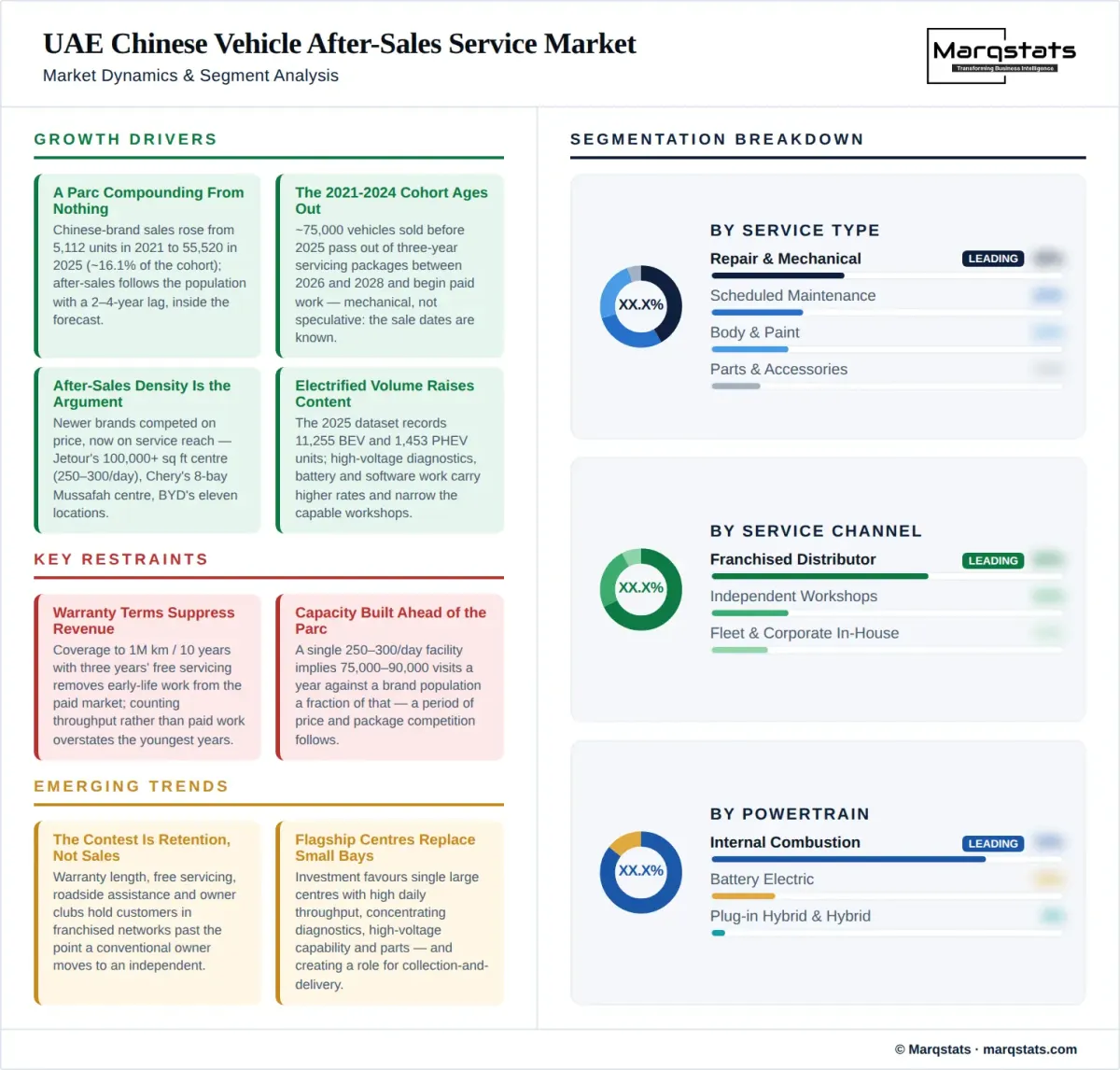
- A parc compounding from a negligible base. Chinese-brand sales rose from 5,112 units in 2021 to 55,520 in 2025 in the tracked dataset, an increase of more than ten times in four years, taking the grouping to roughly 16.1% of that same-source cohort. After-sales demand follows the population with a lag of two to four years, which places the largest volume increases of the sales history directly inside the forecast period rather than behind it.
- The 2021 to 2024 cohort ageing out of complimentary servicing. Roughly 75,000 vehicles sold before 2025 pass out of typical three-year servicing packages between 2026 and 2028 and begin generating paid work. That transition is mechanical rather than speculative: the vehicles exist, their sale dates are known, and the only uncertainty is which channel captures the work rather than whether the work occurs.
- After-sales density becoming the competitive argument. Newer Chinese brands competed initially on price and specification, and are now competing on service reach. A Jetour facility exceeding 100,000 square feet with capacity for 250 to 300 vehicles a day opened on Sheikh Zayed Road in May 2026 covering Dubai, Abu Dhabi, Al Ain and Ajman. Chery and AW Rostamani opened an eight-bay Mussafah centre in March 2025. BYD operates eleven locations including four dedicated after-sales centres across Dubai, Sharjah, Al Ain and Ras Al Khaimah.
- Electrified volume raising the technical content of a service visit. The tracked 2025 dataset records 11,255 battery electric and 1,453 plug-in hybrid units, and Chinese manufacturers supply a disproportionate share of that volume. High-voltage diagnostics, battery system work, thermal management and software-capable workshops carry higher labour rates and require certified technicians, which raises revenue per visit while narrowing the set of workshops able to perform it.
- Service infrastructure written into market entry rather than added later. A July 2026 dealer agreement between Chery Group's premium new-energy brand and an Abu Dhabi group included a three-sales-service-spares flagship facility and three showrooms within three years, and a May 2025 commercial-vehicle distribution agreement explicitly leveraged the distributor's existing storage and after-sales facilities. Entrants now arrive with service capacity as part of the proposition.
Key Restraints
- Warranty terms suppressing addressable revenue during the fastest growth years. Coverage extending to one million kilometres or ten years with three years of complimentary servicing removes a substantial share of early-life work from the paid market entirely. The revenue is real but it is funded by the manufacturer, and any estimate that counts workshop throughput rather than paid work will overstate this market materially in the years when the parc is youngest.
- Capacity built well ahead of the population it serves. A single facility rated at 250 to 300 vehicles a day represents on the order of 75,000 to 90,000 visits a year, against a brand population that is a fraction of that figure. Utilisation risk sits with distributors during the interval, and the pattern repeats across several brands, which points to a period of competition on service pricing and packages before the parc catches up.
- Independent workshop capability lagging the technology. Chinese electrified vehicles require high-voltage certification, manufacturer diagnostic access and model-specific tooling that the independent sector has largely not acquired. That protects franchised margins in the near term, but it also caps total market development, since a parc growing at 31% a year cannot be served entirely through distributor networks and unserved demand suppresses ownership costs only in theory.
- Parts availability and the absence of a mature local supply chain. Franchised networks depend on manufacturer parts channels with lead times measured against shipments from China, and the independent sector lacks an established alternative supply for models introduced within the past three years. Fill rate rather than labour capacity is the more likely constraint on service throughput during the forecast period.
Key Trends
- Flagship facilities replacing distributed small workshops. The investment pattern favours single large centres with high daily throughput over networks of small bays, exemplified by a facility above 100,000 square feet handling 250 to 300 vehicles a day. Large centres concentrate diagnostic equipment, high-voltage capability and parts inventory in one location, which suits a technically demanding parc but lengthens the customer journey and creates a role for collection and delivery services.
- Ownership packages extending the relationship beyond the warranty. Complimentary servicing periods, continuous roadside assistance and owner clubs are being used to hold customers inside franchised networks past the point where a conventional owner would move to an independent workshop. The economic purpose is to convert a warranty obligation into a retention mechanism, and its success determines how much of the ageing parc the independent sector ever sees.
- Commercial vehicle service entering alongside passenger brands. A May 2025 agreement gave exclusive Emirates distribution of a Chinese commercial-vehicle range covering internal combustion and electric vans, buses and specialised vehicles, with storage and after-sales facilities named as part of the arrangement. Commercial vehicles generate several times the annual service spend of a passenger car and operate on utilisation-driven maintenance cycles.
- Regional parts warehousing serving beyond the domestic market. A parts operation sited in the Emirates can supply both domestic service and onward distribution across the Gulf and into Africa, improving fill rate and working capital efficiency against a single-market warehouse. That logic sits behind the free-zone automotive cluster and makes parts capability a regional rather than a national investment decision.
Market Segmentation
Scheduled maintenance is the largest service type by visit count throughout and the smallest by revenue per visit, covering periodic servicing, fluid and filter replacement, inspection and consumables. Its share of paid revenue is suppressed in the early forecast years by complimentary servicing packages running to three years or 30,000 kilometres, and rises as the 2021 to 2024 cohorts pass beyond those terms.
Repair and mechanical work is the fastest-growing service type and the largest by value from the later forecast years, covering brakes, suspension, steering, cooling, air conditioning, electrical faults and high-voltage system work. Demand is a direct function of parc age, and a population whose average age moves from under two years to approaching four across the forecast enters exactly the window in which this work concentrates.
Body and paint work covers collision repair, panel replacement and refinishing, and its volume tracks the vehicle population rather than its age since accident frequency is largely independent of vehicle year. Revenue per job is high and parts intensity is the greatest of any service type, which makes panel availability for recently introduced models the binding constraint rather than workshop capacity.
Parts supply and accessories covers components sold across the counter and fitted outside a workshop visit, together with the accessory and personalisation work that Chinese brands support through their franchised networks. The segment grows with both parc size and independent-sector activity, and its development is the clearest single indicator of whether an independent service channel is forming around these brands.
Internal combustion vehicles account for the majority of the parc and of service revenue throughout the forecast, reflecting the composition of Chinese-brand sales into the Emirates across the tracked cohort. Service requirements are conventional and workshop capability is widely held, which makes this the segment where independent competition emerges first and where labour rates are most exposed.
Battery electric vehicles are the fastest-growing powertrain segment in service terms and carry the highest technical requirement, with the tracked 2025 dataset recording 11,255 units. Work concentrates on high-voltage diagnostics, battery system assessment, thermal management and software rather than on mechanical wear, and the certification and tooling requirements confine most of it to franchised networks well beyond the warranty period.
Plug-in hybrid and hybrid vehicles occupy an intermediate position, recorded at 1,453 units in the tracked 2025 dataset, and carry the broadest service requirement of the three since they combine a combustion powertrain with a high-voltage system. Revenue per vehicle is the highest of the three categories for that reason, and capability requirements are correspondingly demanding.
Franchised distributor workshops hold the dominant share throughout, an unusually high concentration explained by parc age, warranty terms and the technical requirements of electrified models. Every major facility investment identified in the market sits in this channel, and the ownership packages built around complimentary servicing and roadside assistance are designed specifically to defend it as the parc ages.
Independent workshops are the fastest-growing channel from a small base, entering as vehicles pass out of warranty and complimentary servicing from 2027 onward. Growth is constrained by diagnostic access, high-voltage certification and parts supply rather than by demand, and the pace at which those constraints ease determines how large the channel becomes rather than whether it forms at all.
Fleet and corporate in-house operations cover rental companies, ride-hailing fleets, government and corporate users that maintain vehicles internally or under negotiated contracts. Chinese brands have made substantial fleet sales in the Emirates and fleet vehicles accumulate distance several times faster than private ones, which pulls service demand forward and makes this channel disproportionate to its share of the parc.
Passenger cars and sport-utility vehicles account for the large majority of the Chinese-brand population and of service revenue, consistent with the composition of the tracked cohort led by JETOUR, MG, Geely, Haval and Changan. Annual spend per vehicle is the lowest of the three categories, and the segment's weight comes entirely from volume.
Light commercial vehicles cover vans and pickups used in delivery, trade and service applications, a segment Chinese manufacturers entered in the Emirates through distribution agreements covering internal combustion and electric ranges. Annual service spend runs several times the passenger car level because utilisation is higher and downtime carries a direct commercial cost, which supports contracted rather than transactional service relationships.
Buses and specialised vehicles are the smallest category by population and the highest by annual spend per unit, covering passenger transport and purpose-built applications supplied through commercial-vehicle distribution arrangements. Service requirements are specialised, the customer base is concentrated among a small number of operators, and contracts rather than workshop footfall determine the revenue.
By Geography
Dubai
Dubai holds the largest share throughout, combining the highest concentration of the Chinese-brand population with the country's largest service facilities. The flagship Jetour centre on Sheikh Zayed Road exceeds 100,000 square feet with capacity for 250 to 300 vehicles a day, and BYD's network anchors on the emirate before extending outward. Ride-hailing and rental fleet concentration adds high-utilisation vehicles that generate service demand well ahead of the private parc average.
Abu Dhabi and Al Ain
Abu Dhabi and Al Ain form the second cluster and the fastest-growing, anchored by the Chery and AW Rostamani service centre in Mussafah with its eight service and mechanical bays opened in March 2025, and by a July 2026 dealer agreement bringing a premium Chinese new-energy brand to the emirate with a three-sales-service-spares flagship and three showrooms planned within three years. Al Ain carries a full-service workshop within the BYD network.
Sharjah
Sharjah holds a substantial share relative to its size, serving both a resident population with strong price sensitivity that favours Chinese brands and a significant commuter flow into Dubai. Service capacity is present within the BYD network, and the emirate's lower workshop costs make it the most likely location for independent capability to develop first as vehicles age out of warranty.
Ras Al Khaimah and the Northern Emirates
Ras Al Khaimah and the northern emirates hold a smaller share, with full-service workshop capability established in Ras Al Khaimah within the BYD network and Ajman covered by the Jetour distributor's footprint. Distance from the principal service clusters makes local capability disproportionately valuable to owners here, and the brands that establish it early gain a retention advantage that is difficult to reverse.
Rest of the United Arab Emirates
The remaining areas hold a small share throughout. Service capacity follows population density and vehicle registration concentration, and the areas outside the established clusters are served through the nearest facility rather than through dedicated capability. Collection and delivery services, already offered around the Abu Dhabi centre, are the practical mechanism by which these owners are reached.
How Competition Is Evolving
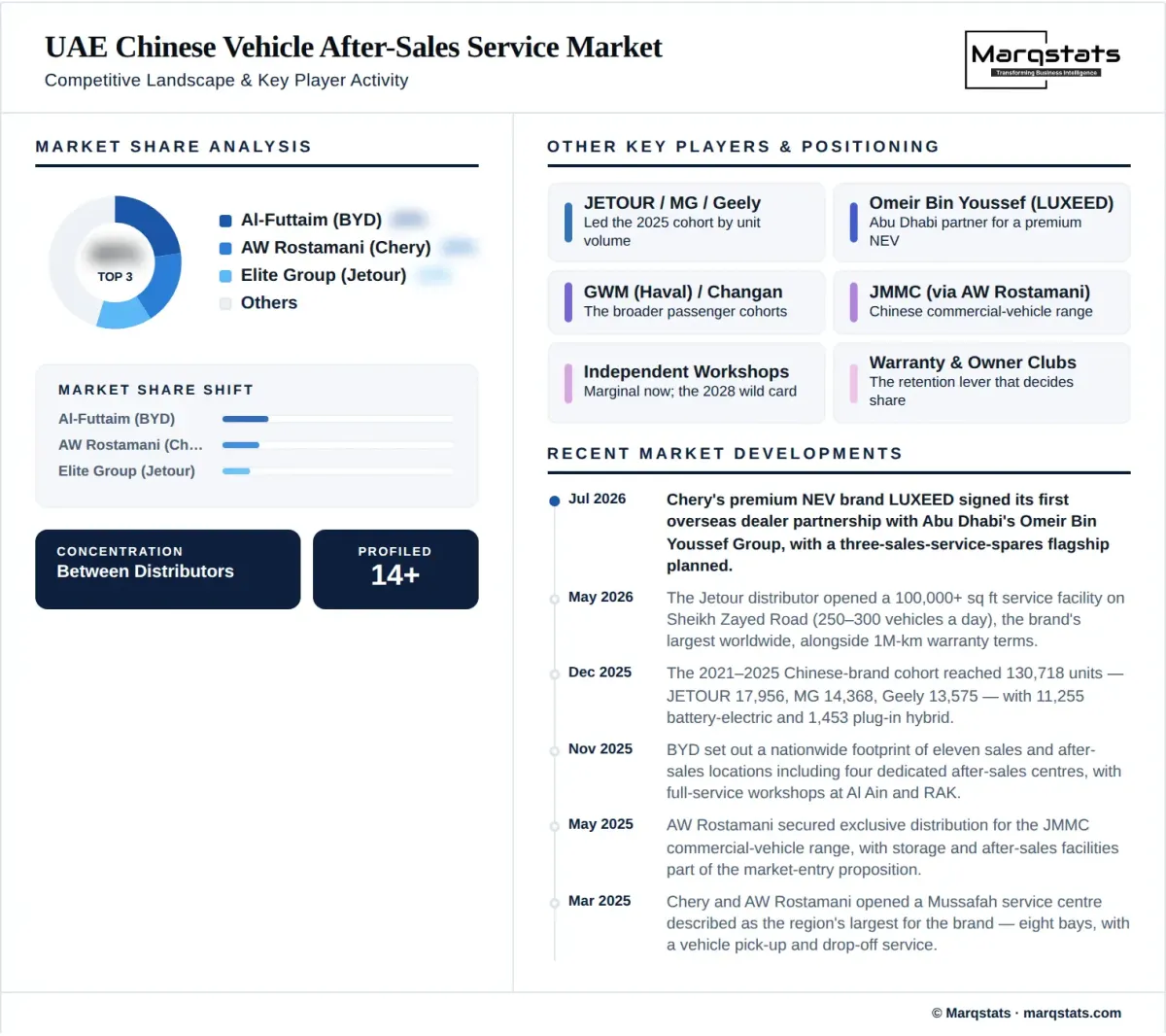
Competition runs between distributor groups rather than between manufacturers, which is the structural fact that shapes this market. Each Chinese brand operates through an exclusive Emirates distributor that owns the showrooms, the workshops, the parts inventory and the customer relationship, so a brand's after-sales strength in the country reflects its partner's investment capacity rather than the manufacturer's global standing. Al-Futtaim carries BYD, AW Rostamani carries Chery and a Chinese commercial-vehicle range, an Abu Dhabi group has taken a premium new-energy brand, and a separate group holds Jetour.
The competitive instrument of the moment is capacity, deployed ahead of demand. A facility above 100,000 square feet handling 250 to 300 vehicles a day, an eight-bay centre described as the region's largest for its brand, and an eleven-location network with four dedicated after-sales sites all represent commitments made against a parc that has not yet aged into the work they are built for. Distributors are buying position in a market whose revenue arrives two to four years after the vehicles do, and utilisation risk during the interval is the price of that position.
The contest that matters over the forecast period is retention rather than acquisition. Warranty terms reaching one million kilometres or ten years, complimentary servicing to three years or 30,000 kilometres, roadside assistance and owner clubs exist to hold customers inside franchised networks at the moment when a conventional owner would move to an independent workshop. If those instruments work, franchised share stays unusually high for a maturing parc and the independent sector remains marginal; if they do not, the fastest-growing channel from 2028 is one that currently barely exists. That question, rather than brand share, determines where the value in this market settles.
Companies Covered
The report profiles 16+ companies with full strategy and financials analysis, including:
Recent Market Activity
Table of Contents
Coverage & Segmentation
The study covers the United Arab Emirates with emirate-level detail for Dubai, Abu Dhabi and Al Ain, Sharjah, Ras Al Khaimah and the northern emirates, and the remaining areas. It measures annual paid after-sales service revenue generated by Chinese-brand vehicles in United States dollars, with the Chinese-brand vehicle population carried as the secondary unit. The base year is 2025, the historical period covers 2021 to 2025, and the forecast period runs from 2026 to 2030 with an indicative 2031 endpoint. Segmentation covers service type, powertrain, service channel and vehicle type.
Four boundaries define the market. Vehicle sales revenue is excluded; only work and parts consumed after delivery are counted. Manufacturer-funded warranty work and complimentary servicing are excluded because the customer pays nothing and the revenue accrues to the manufacturer rather than to the service market, which materially reduces the addressable pool in the early forecast years. Service on non-Chinese brands is excluded entirely. Fuel, insurance, registration and financing are excluded. The brand cohort used to build the population is a same-source tracking indicator that does not capture every Chinese manufacturer consistently, and it is treated as a lower bound on the parc rather than as a national market share.