Market Snapshot
Key Takeaways
Market Overview & Analysis
Report Summary
This analysis reads Kazakhstan's own fully worked sizing chain, regional distribution data, and named-scenario regulatory framework together as a single coherent picture rather than isolated data points, since the underlying research itself was structured to support exactly that kind of integrated reading.
Kazakhstan's EV maintenance market is measured across preventive servicing, running gear and suspension, high-voltage battery diagnostics, and electronics/software recovery, valued at USD 11.00 million (KZT 5.50 billion) in 2025. This figure is taken directly from the underlying research's own fully worked sizing chain, anchored to Bureau of National Statistics fleet registration data covering 22,500 active vehicles.
Structurally, this is a market shaped by a genuine grey-market dependency: over 75% of vehicles registered between 2022 and 2024 entered via parallel-import channels lacking factory warranty coverage, pushing recurring repair demand toward specialized independent workshops that have built Chinese-supply-chain-linked component sourcing to service these vehicles at a fraction of authorized-dealer pricing.
The analysis is built for four reader types making different decisions: an independent workshop operator weighing capital investment in high-voltage diagnostic and fire-suppression infrastructure ahead of a compliance deadline, an authorized dealer group deciding whether to extend warranty coverage to parallel-imported models, a component distributor evaluating regional inventory investment to cut Shenzhen-to-Almaty shipping lead times, and an investor tracking how EEC import policy and domestic CKD assembly shape this market's Conservative-to-Accelerated scenario range.
Why Repair Capacity Is Even More Concentrated Than the Fleet Itself
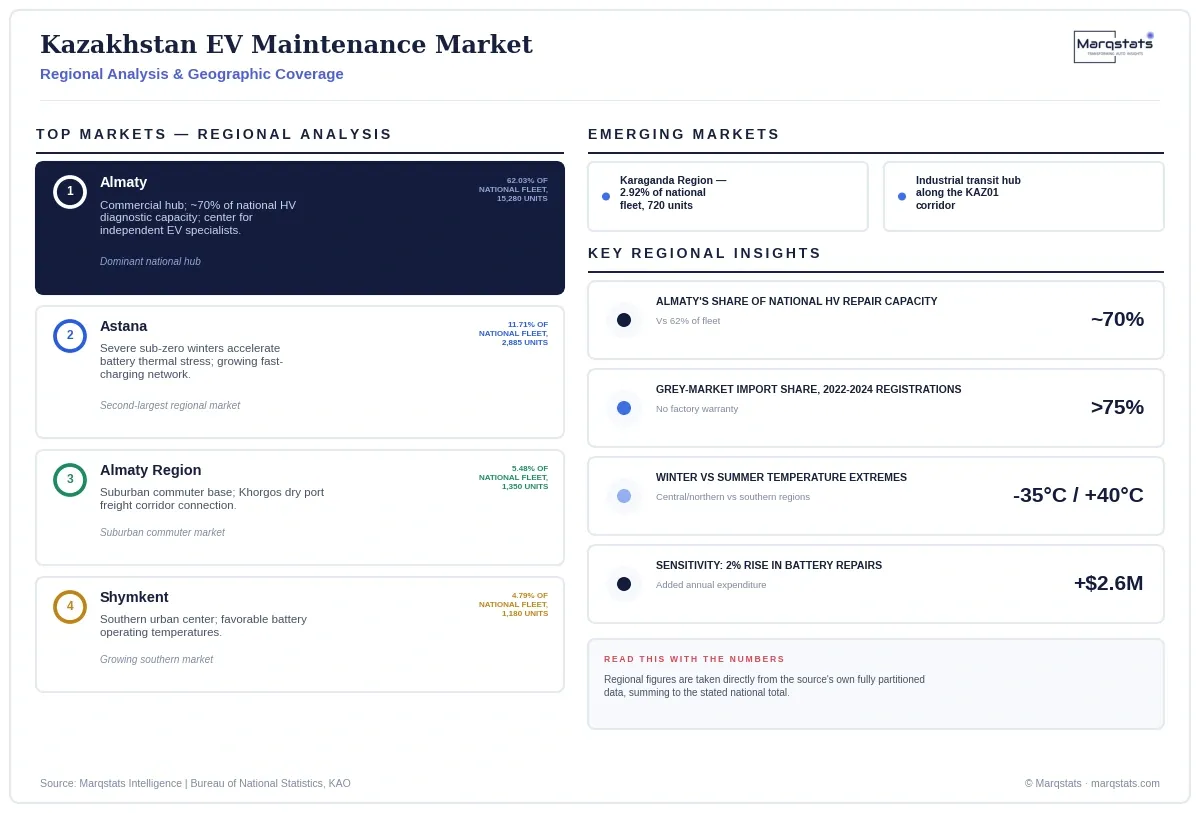
A market where 62% of vehicles sit in one city might reasonably expect a proportional concentration of repair infrastructure to follow. Kazakhstan's own data shows the concentration is actually worse than proportional: Almaty hosts 70% of the country's specialized high-voltage diagnostic and battery repair capacity, a larger share than its already-dominant fleet position.
For an owner in any of Kazakhstan's other 15 regions, a serious electrical fault doesn't mean finding a local specialist — it typically means a flatbed tow to Almaty or Astana. That's a genuinely different service reality than most markets in this coverage set, where regional service gaps are measured in longer wait times or higher labor rates, not in the physical absence of any qualified repair option within reach.
A Market Built Around Vehicles the Manufacturers Won't Officially Support
In most EV maintenance markets, the tension between authorized dealers and independent workshops is about pricing and convenience. In Kazakhstan, it's more fundamental: over three-quarters of the active fleet arrived through channels the manufacturers themselves won't warranty.
That's not a temporary gap independent workshops are filling opportunistically — it's the structural foundation the country's largest single service channel (47% of market value) is built on. ProVolta and similar operators haven't grown by competing with dealerships on the same vehicles; they've grown by servicing an entirely different population of vehicles dealerships have chosen not to touch. That's a genuinely durable position as long as parallel importing remains a meaningful share of new vehicle supply.
Market Dynamics
Key Drivers
- The absence of a standardized national high-voltage technician certification program, while a genuine restraint on service quality assurance, has also allowed independent workshops considerable flexibility to build internal safety protocols and training programs tailored specifically to the grey-market Chinese vehicle population they primarily service.
- Kazakhstan's own regional data shows Almaty's outsized concentration of both fleet and specialized repair capacity creating a genuine, durable competitive moat for workshops already established there, since any new entrant into peripheral regions would need to build high-voltage diagnostic capability essentially from scratch, without the supply chain and technician density Almaty operators already benefit from.
- Kazakhstan's own fully worked sizing chain shows running gear, suspension and brakes already the single largest service category at 36.00% of total value, a structural signal that heavy-chassis overhaul capability, not battery diagnostics alone, represents the most immediate revenue opportunity for workshops entering this market, given the region's harsh road conditions and heavier battery-laden curb weights.
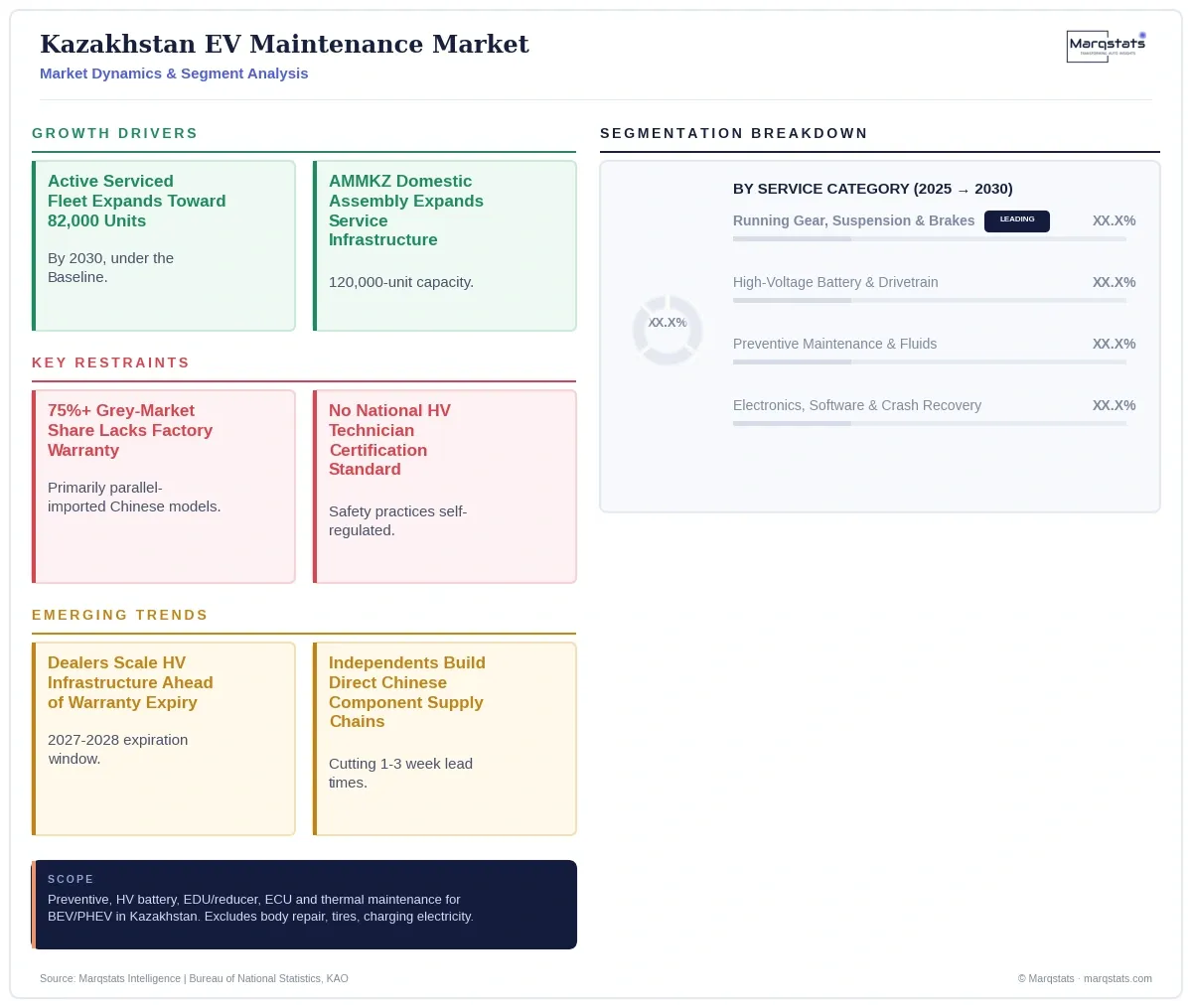
- Kazakhstan's active serviced fleet is expanding rapidly, from 22,500 units in 2025 toward a projected 82,000 units by 2030 under the Baseline Expansion Scenario, directly growing the addressable base for recurring EV aftermarket maintenance demand.
- Law No. 126-VIII, effective September 2024, established formal legal definitions for electric vehicles and charging infrastructure while reclassifying commercial charging electricity as non-household usage, formalizing the regulatory foundation the maintenance sector depends on.
- Astana Motors's AMMKZ multi-brand manufacturing facility, commissioned in September 2025 with 120,000-unit capacity, is expanding domestic CKD assembly and building dedicated high-voltage assembly and diagnostic infrastructure.
- KazAvtoZhol's deployment of 43 high-power DC fast chargers along the KAZ06, KAZ01 and A-1 highway corridors is enabling intercity EV travel, though repeated fast charging without active liquid thermal management accelerates cell degradation and downstream diagnostic demand.
- Independent workshops sourcing replacement cells and diagnostic software directly from Chinese supply networks are enabling component-level battery rebuilds at a fraction of whole-pack replacement costs, sustaining margins exceeding 50% on high-voltage repair work.
Key Restraints
- Kazakhstan's peripheral regions face a genuine structural service desert: fifteen regions combined hold just over 13% of the national fleet, with individual regions like Ulytau and Abai recording as few as 41 and 78 registered units respectively, offering little commercial incentive for dedicated local high-voltage repair investment.
- Kazakhstan's continental climate itself functions as a persistent structural cost driver rather than a one-time adjustment: repeated exposure to temperature extremes accelerates battery cell resistance divergence and suspension component wear continuously across the vehicle's operating life, meaning maintenance demand intensity does not taper the way it might in milder climates as vehicles age.
- This market's own three-scenario framework spans a genuinely wide 2030 range, from USD 36.25 million under the Conservative Growth Scenario to USD 71.61 million under the Accelerated Growth Scenario -- a disclosed spread reflecting real uncertainty in EEC import policy continuity and municipal zero-emission mandate adoption, not a narrow band around a single central estimate.
- Over 75% of vehicles registered between 2022 and 2024 entered via parallel-import channels lacking factory warranty coverage, structurally excluding a large share of the active fleet from authorized dealer service and concentrating repair risk within independent workshops.
- Kazakhstan has not yet established a standardized national certification program or occupational safety standard for high-voltage automotive technicians, leaving workshop safety practices self-regulated and creating a genuine technician quality and supply constraint as the fleet scales.
- Order No. 321's fire safety requirements — IP54-rated equipment, automated power disconnect systems, and Class D fire suppression — have introduced significant compliance costs for workshops undertaking high-voltage battery overhauls and pack disassembly.
- Component lead times of one to three weeks from Shenzhen or Guangzhou create genuine supply chain friction for independent workshops dependent on Chinese-sourced replacement cells, electronic control modules and specialized diagnostic software.
Key Trends
- Regional service capacity is beginning to diverge sharply between Almaty and Astana on one side and the remaining fifteen regions on the other, raising genuine open questions about whether mobile repair units or satellite diagnostic centers will emerge to serve peripheral regions, or whether flatbed tow dependency will simply persist as fleet growth continues.
- Fleet operators managing high-utilization commercial electric vehicles are increasingly negotiating dedicated maintenance contracts directly with specialized independent centers, given the documented cost advantage component-level battery rebuilds offer over whole-pack replacement pricing at authorized dealerships.
- Authorized dealership networks including Astana Motors and Orbis Auto are scaling high-voltage service infrastructure ahead of the 2027-2028 window when initial factory warranties on officially imported vehicles begin expiring in volume.
- Specialized independent workshops are building direct Chinese component supply relationships to reduce the one- to three-week Shenzhen and Guangzhou shipping lead times currently constraining rapid battery module turnaround.
- Component distributors are beginning to develop organized regional inventories for low-viscosity dielectric coolants, high-torque reduction gear lubricants, and specialized EV tires designed for heavier curb weights.
- Municipal governments in Almaty and Astana are evaluating zero-emission mandates for taxi and transit fleets, which would accelerate commercial vehicle utilization rates two to three times faster than private vehicle duty cycles.
Strategic Implications
- Component suppliers should also weight climate-specific inventory planning heavily, given how directly Kazakhstan's temperature extremes drive year-round demand for dielectric coolants and thermal management components regardless of season, unlike more temperate peer markets.
- Independent workshop operators should continue building direct Chinese component supply relationships and invest in IP54-compliant, fire-suppression-equipped high-voltage bays ahead of continued regulatory formalization, given how directly this positions them to retain the 47% to 48% channel share the underlying research shows them commanding.
- Authorized dealership networks should evaluate extending limited warranty or paid service coverage to parallel-imported models specifically to capture recurring revenue currently ceded entirely to independent workshops, particularly as domestic CKD assembly volumes rise.
- Component suppliers and logistics providers should prioritize establishing organized regional inventories in Almaty specifically, given its outsized concentration of both fleet and specialized repair capacity, to reduce the current one- to three-week import lead times constraining rapid battery module turnaround nationally.
- Investors and analysts should track EEC import duty exemption continuity nationwide and AMMKZ domestic assembly scale-up as the two clearest variables separating this market's Conservative and Accelerated scenarios, given how directly both feed the underlying research's own named trigger conditions.
Outlook
The underlying research presents three genuinely distinct trajectories diverging on named regulatory and commercial trigger conditions. This market's own forecast horizon reaches 2030 directly, requiring no Marqstats extrapolation.
Under the Baseline Expansion Scenario, import policies remain stable, domestic CKD assembly at AMMKZ expands steadily, and public fast-charging networks roll out along primary transit corridors; the active serviced fleet reaches 82,000 units by 2030, generating USD 50.84 million (KZT 25.42 billion) in total market value at a 35.82% CAGR.
Under the Accelerated Growth Scenario, municipal zero-emission taxi and transit mandates take effect in Almaty and Astana alongside state EV acquisition subsidies, driving high commercial fleet utilization; the active serviced fleet expands to 110,000 units by 2030, lifting total market value to USD 71.61 million (KZT 35.81 billion) at a 45.45% CAGR.
Under the Conservative Growth Scenario, EEC import duty exemptions expire, domestic recycling fees are reinstated, and customs oversight on parallel imports tightens; the active serviced fleet reaches only 58,000 units by 2030, with total market value reaching only USD 36.25 million (KZT 18.13 billion) at a 26.94% CAGR.
Market Segmentation
USD 3.96 million (36.0% share) in 2025, growing to USD 17.29 million (34.0% share) by 2030. Anchored by control arms, air suspension struts and regenerative brake overhaul from heavier curb weights.
USD 3.08 million (28.0% share) in 2025, growing to USD 16.78 million (33.0% share) by 2030. The fastest-growing category, anchored by diagnostic scanning, cell replacement and BMS/inverter rebuilds.
USD 2.64 million (24.0% share) in 2025, growing to USD 11.18 million (22.0% share) by 2030. Anchored by reducer lubrication, coolant flushes and microfiltration.
USD 1.32 million (12.0% share) in 2025, growing to USD 5.59 million (11.0% share) by 2030. Anchored by telematics adaptation, UI translation and crash interlock resets.
USD 8.03 million (73.0% share) in 2025, growing to USD 34.57 million (68.0% share) by 2030. Anchored by single/dual EDU platforms with low fluid volumes, led by Zeekr 001 and BYD Han.
USD 2.97 million (27.0% share) in 2025, growing to USD 16.27 million (32.0% share) by 2030. Growing share, requiring maintenance of both a complete HV system and an onboard combustion generator.
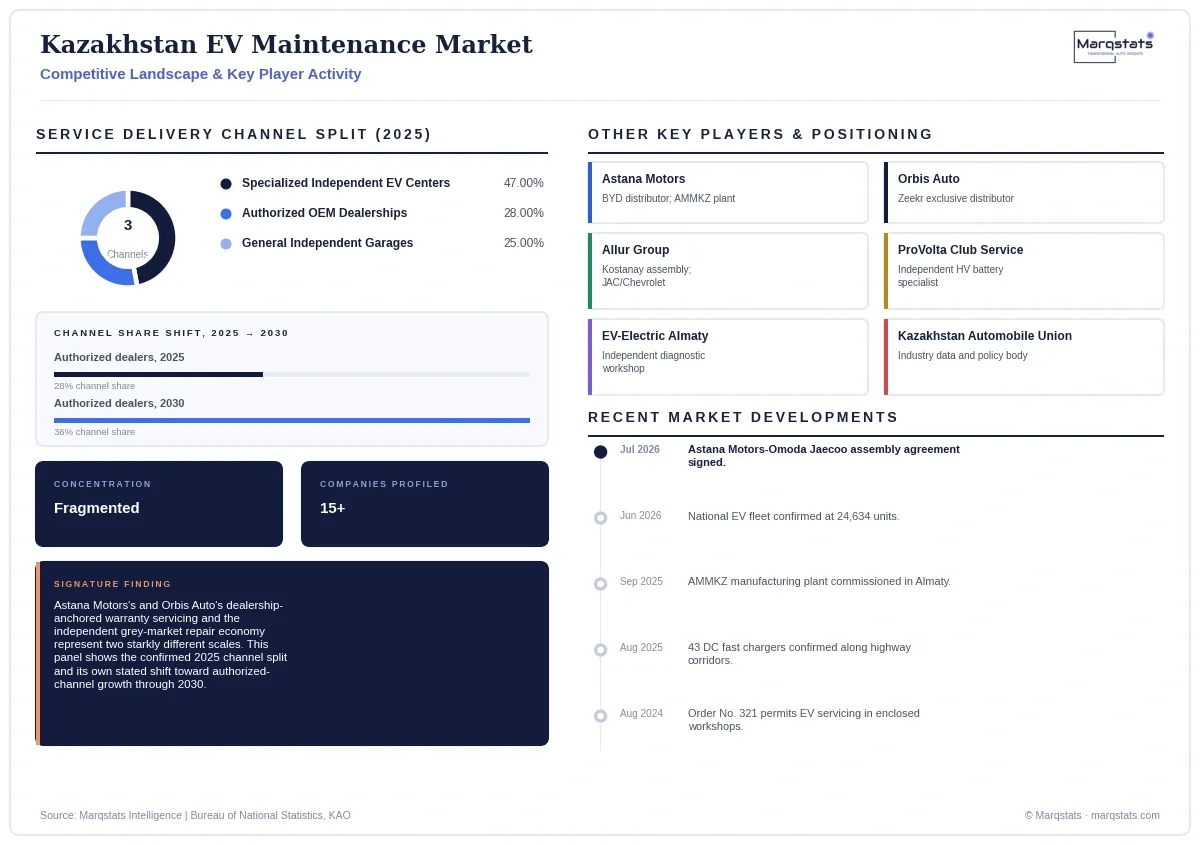
USD 5.17 million (47.0% share) in 2025, growing to USD 24.40 million (48.0% share) by 2030. The largest channel, led by ProVolta Club Service and EV-Electric Almaty.
USD 3.08 million (28.0% share) in 2025, growing to USD 18.30 million (36.0% share) by 2030. Anchored by Astana Motors (BYD) and Orbis Auto (Zeekr), enforcing closed warranty protocols.
USD 2.75 million (25.0% share) in 2025, growing to USD 8.13 million (16.0% share) by 2030. Declining share, constrained by lack of specialized high-voltage diagnostic tools.
By Geography
Almaty (City of Republican Significance)
62.03% of the national fleet (15,280 units), the dominant hub hosting roughly 70% of national high-voltage diagnostic capacity, supported by higher household incomes, concentrated charging networks and proximity to Chinese supply routes.
Astana (Capital City)
11.71% of the national fleet (2,885 units), where extreme sub-zero winter conditions reduce real-world driving range and accelerate auxiliary battery degradation, though specialized technician capacity lags behind Almaty.
Almaty Region (Surrounding Territory)
5.48% of the national fleet (1,350 units), a suburban commuter base connected to the Khorgos dry port cross-border freight corridor.
Shymkent (City of Republican Significance)
4.79% of the national fleet (1,180 units), a southern urban center with favorable battery operating temperatures and expanding service demand.
Karaganda Region
2.92% of the national fleet (720 units), an industrial transportation center along the KAZ01 arterial highway transit corridor.
Combined Remaining 15 Regions
13.07% of the national fleet (3,219 units), reflecting peripheral adoption and notable service deficits, with vehicles suffering major faults typically requiring flatbed transport to Almaty or Astana for repair.
How Competition Is Evolving
No single company in this market spans official OEM warranty-anchored dealership servicing, specialized independent high-voltage repair, and heavy commercial fleet maintenance simultaneously, leaving genuine competitive white space for any group capable of bridging Astana Motors's and Orbis Auto's dealership-anchored warranty servicing with the independent channels this market's own 75%+ grey-import share shows structurally underserved by authorized networks.
Competition spans official OEM distributor conglomerates, specialized independent EV centers, and general aftermarket garages. Astana Motors anchors the dominant authorized channel as BYD's official distributor and operator of the AMMKZ multi-brand manufacturing facility, while Orbis Auto holds exclusive authorized distribution and warranty service rights for ZEEKR Intelligent Technology, enforcing warranty policies that exclude parallel Chinese-market imports. Allur Group anchors domestic assembly through its Kostanay plant, distributing JAC and Chevrolet brands alongside an expanding EV service network.
On the independent side, ProVolta Club Service and EV-Electric Almaty anchor specialized multi-brand diagnostic and high-voltage battery repair capability, sourcing replacement cells and diagnostic software directly from Chinese supply networks. Eco-Service Kazakhstan is expanding from general electronics servicing into electric mobility diagnostics. Regulatory and standards oversight rests with the Kazakhstan Automobile Union (industry data and policy coordination), KazStandard (technical standards), the Ministry of Emergency Situations (fire safety), and KazAvtoZhol (highway charging infrastructure).
Companies Covered
The report profiles 15+ companies with full strategy and financials analysis, including:
Recent Market Activity
Table of Contents
Coverage & Segmentation
This report measures scheduled preventive mechanical servicing, high-voltage traction battery diagnostics, modular cell replacement and pack balancing, electric drive unit and reducer transmission servicing, ECU programming, telematics adaptation, thermal management and HVAC loop conditioning, and heavy-chassis running gear overhauls for BEV and PHEV/EREV vehicles in Kazakhstan, across a 2025 base year and a 2026 to 2030 forecast period, denominated in United States dollars at the pack's own stated benchmark rate of 500 KZT per USD. It excludes structural body repairs, external tire retail sales, and retail public charging electricity.
The analysis spans three segmentation dimensions — service category, powertrain architecture and service delivery channel — six regional geographies, and 15 profiled entities across OEM distributors, independent workshops and regulatory bodies. Fleet and registration figures trace to the Bureau of National Statistics and Kazakhstan Automobile Union; market value and all three segmentation dimensions trace directly to the underlying research's own fully worked sizing model, with both 2025 and 2030 figures directly source-stated throughout.