
Who Controls Spain's Two Separate Connected Car Markets?
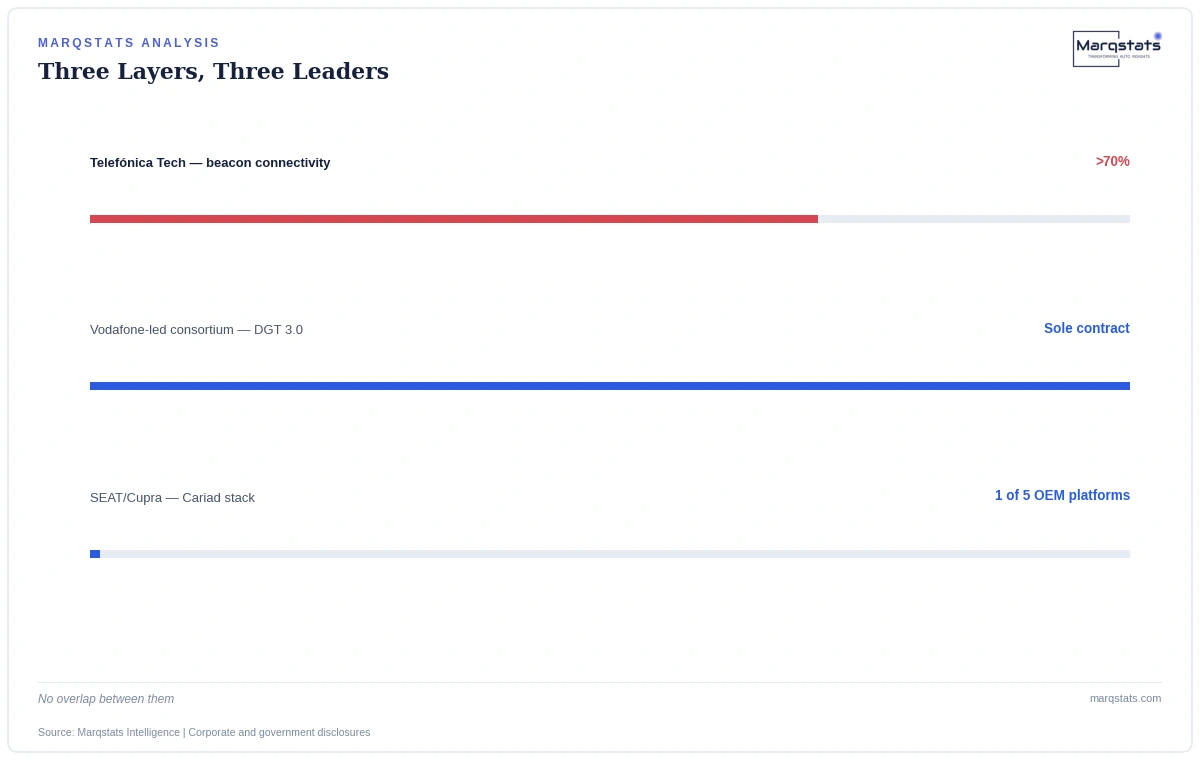
In brief: Spain's connected car market has no single dominant player, because it is not one market. Telefónica Tech controls the statutory beacon-connectivity layer with more than 70% share. A four-company consortium holds the entire DGT 3.0 national platform contract. And on the OEM side, five manufacturers run five different software architectures, with no company positioned across more than one of these three layers at once.
Layer One: The Beacon Connectivity Monopoly
Telefónica Tech S.A.U. provides cellular IoT connectivity for more than 70% of DGT-certified V-16 beacon models through its Kite IoT platform, a position confirmed in October 2025 and unchallenged since that confirmation. That dominance exists because of a structural advantage, not a purely technical one: certified beacon manufacturers such as Netun Solutions and Erum Vial need a connectivity partner capable of guaranteeing 12 years of prepaid NB-IoT and LTE-M service at a price point that keeps the retail device affordable, and Telefónica Tech's existing IoT device-management infrastructure made it the practical default choice before rivals could establish comparable coverage.
Layer Two: The DGT 3.0 Platform Consortium
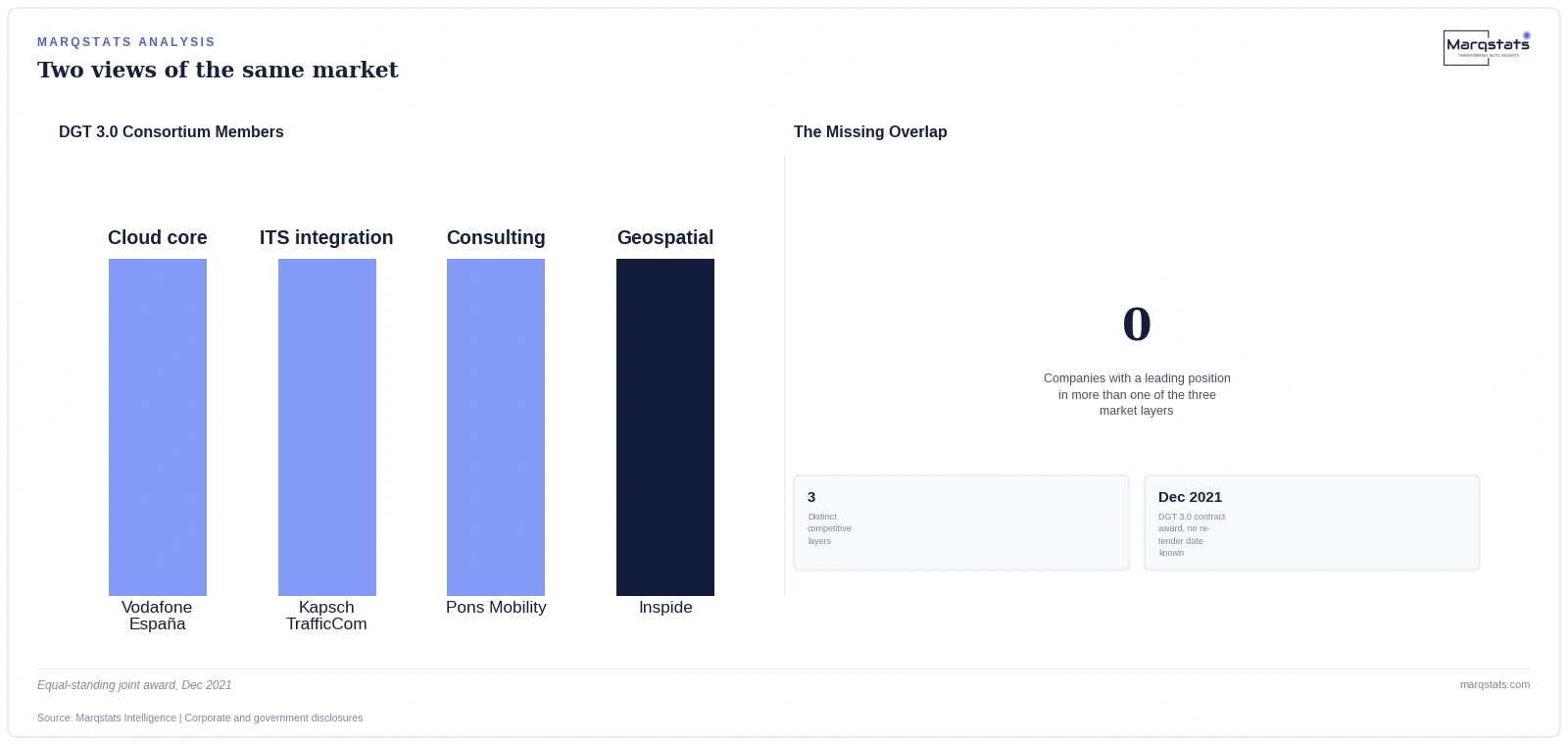
Vodafone España, Pons Mobility, Kapsch TrafficCom and Inspide jointly hold Spain's entire DGT 3.0 national platform contract under a public services award dating to December 2021. Vodafone manages the cloud architecture and data ingestion; Pons Mobility advises on regulatory and operational design; Kapsch TrafficCom integrates roadside sensors and traffic signalling; and Inspide provides geospatial analytics for incident mapping. No competing consortium has bid for any part of this contract since the original award, and no renewal or re-tender date has been publicly disclosed.
The Government Buyer Behind Layer Two
The DGT 3.0 award is worth examining on its own terms, because it is the one layer where the customer is the Spanish state rather than a company or a consumer. The Directorate-General for Traffic, under the Ministry of the Interior, structured the original December 2021 award as a single consolidated contract rather than splitting cloud infrastructure, consulting, roadside sensor integration and geospatial analytics across separate tenders — a decision that concentrated all four capabilities inside one consortium rather than creating four independent competitive markets. That structural choice, made once in 2021, is the reason a single grouping of companies still holds the entire platform five years later with no visible competitive pressure from any rival bidder.
Layer Three: Five OEMs, Five Incompatible Bets
SEAT and Cupra run Volkswagen Group's Cariad software stack. Stellantis is centralising its brands onto its own STLA Brain architecture, built with Qualcomm and Amazon. Renault has adopted Google's Android Automotive OS outright through OpenR Link, embedding Google Maps and Assistant natively rather than maintaining a proprietary alternative. Ford runs SYNC 4A with Google Cloud analytics. Mercedes-Benz runs its own MB.OS architecture on Microsoft Azure. None of these five approaches shares a common platform, a common cloud provider, or a common software partner with any other.
The company that connects most of Spain's roadside safety beacons has no presence at all in the software fight over who owns the driver's dashboard.
— Marqstats Analyst Team
Why No One Entity Spans All Three Layers
Each layer answers to a different buyer with a different procurement logic. The DGT 3.0 contract was awarded through a sovereign public-tender process that favours an established domestic telecom-and-systems-integrator consortium. Beacon connectivity is a retail hardware decision made by device manufacturers optimising for cost and coverage at the point of certification. OEM software platforms are decided at group level by automakers years before a Spanish-market vehicle ever ships, driven by global platform strategy rather than any Spain-specific consideration. Three different buyers, three different timelines, three different winners.
Why No One Entity Spans All Three Layers
Each layer answers to a different buyer with a different procurement logic. The DGT 3.0 contract was awarded through a sovereign public-tender process that favours an established domestic telecom-and-systems-integrator consortium. Beacon connectivity is a retail hardware decision made by device manufacturers optimising for cost and coverage at the point of certification. OEM software platforms are decided at group level by automakers years before a Spanish-market vehicle ever ships, driven by global platform strategy rather than any Spain-specific consideration. Three different buyers, three different timelines, three different winners.
Why Vodafone Didn't Extend Its Reach Into Beacons
The most obvious question this structure raises is why Vodafone España, already embedded inside the DGT 3.0 consortium as its cloud architecture partner, did not also become the dominant beacon-connectivity provider itself. The likely answer is timing and specialisation rather than any competitive failure. Vodafone's DGT 3.0 role was defined and contracted in December 2021, three years before the first V-16 beacons reached certification in July 2023, and its position was built around platform infrastructure and enterprise wholesale connectivity — not the retail-hardware, long-duration prepaid IoT device management that beacon connectivity actually requires. Telefónica Tech's Kite IoT platform was purpose-built for exactly that kind of device management, giving it a structural head start Vodafone's more enterprise-oriented infrastructure business was not positioned to contest.
What This Means for a New Entrant
A vendor evaluating Spain has to pick a layer, not a market. Competing for beacon connectivity means displacing Telefónica Tech's cost and coverage advantage on a commodity, long-duration contract type most competitors would find structurally unattractive. Competing for the DGT 3.0 contract means waiting for a re-tender with no announced date. Competing on OEM software means winning a design decision made at a manufacturer's global headquarters, not in Madrid. The three opportunities do not share a sales motion, a buyer, or a competitive set.
The practical implication is that a single go-to-market strategy cannot address more than one of these layers credibly. A telematics vendor pitching commercial fleet software, for instance, is competing in none of the three layers described here — it sits in a fourth, adjacent market built on top of whichever connectivity layer a given fleet's vehicles already carry, which is its own separate competitive question this piece has not attempted to answer.
Adjacent markets of this kind are common wherever a public-safety mandate creates a connectivity floor — the mandate itself rarely captures the full commercial value it enables, and the businesses built on top of it often end up larger than the mandate's own direct market.
A Fourth Layer, Adjacent But Distinct
Commercial fleet telematics software — the enterprise platforms fleet operators use for routing, fuel tracking and driver scorecards — sits on top of whichever connectivity layer a given vehicle already carries, rather than competing directly inside any of the three layers this piece has mapped. A fleet operator's telematics vendor typically consumes connectivity from an embedded TCU or a commercial-grade device, then builds a software product on top of the data feed. That makes fleet software a genuine fourth market, with its own competitive dynamics, its own buyers, and its own vendors — Free2move among them for shared-mobility fleets specifically — layered above, not inside, the beacon, platform and OEM structure described here in detail.
A Named Comparison Worth Watching
The closest parallel to Spain's DGT 3.0 consortium structure in European road-safety infrastructure is the model several Nordic transport authorities have used for national ITS platforms: a single, long-term consortium contract rather than a competitive multi-vendor marketplace. The trade-off is the same in each case. A single consortium delivers coordination and accountability advantages a fragmented multi-vendor tender would struggle to match, at the cost of exactly the competitive pressure that might otherwise drive down the platform's long-run cost to the state. Spain's version of that trade-off has now run for five years with no public evaluation of whether the consolidated approach delivered better value than a competitive alternative would have.
Outlook: One Trigger, Not Three
This market does not support a three-scenario outlook. The single evidenced trigger is a DGT 3.0 contract re-tender: the original December 2021 award carries no publicly disclosed term length, so whether the Vodafone-led consortium's position is contestable depends entirely on a re-tender date neither this pack nor any public source has confirmed. Until that date is known, the platform layer's competitive structure should reasonably be treated as fixed for now.