
Does Spain's 'Connected Vehicles' Number Include the V-16 Beacon Fleet?
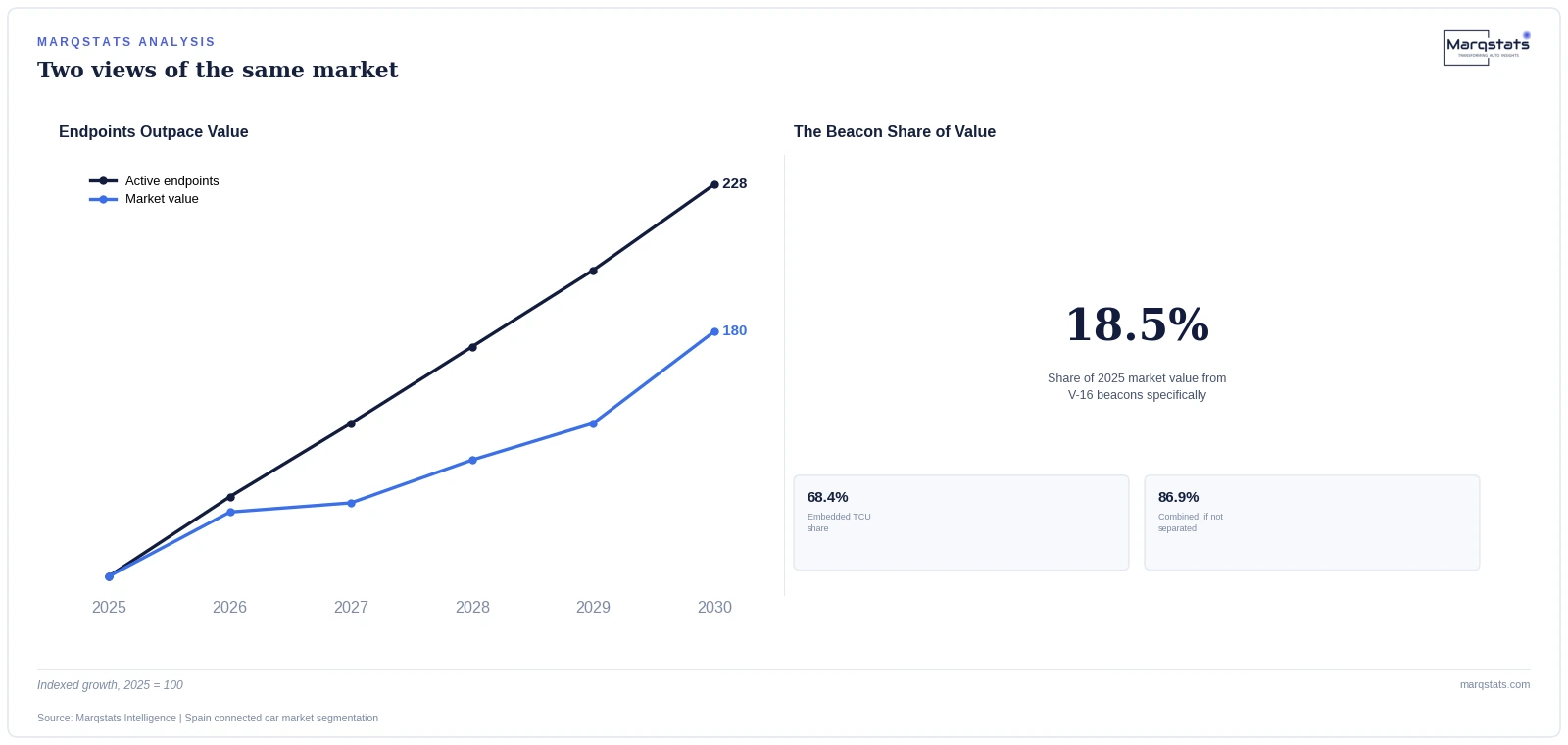
Yes, and that inclusion is doing most of the work. Spain's active connected-vehicle and endpoint count reaches an estimated 20.1 million by 2030, but 18.5% of the market's 2025 value — and a much larger share of the unit count — comes from autonomous V-16 hazard beacons, self-powered devices bolted to a car's roof that have no connection to the vehicle's own electronics at all. Read the headline number as an embedded-telematics count and it overstates how connected Spain's cars actually are, in the sense most readers assume.
Two Completely Different Technologies, One Statistic
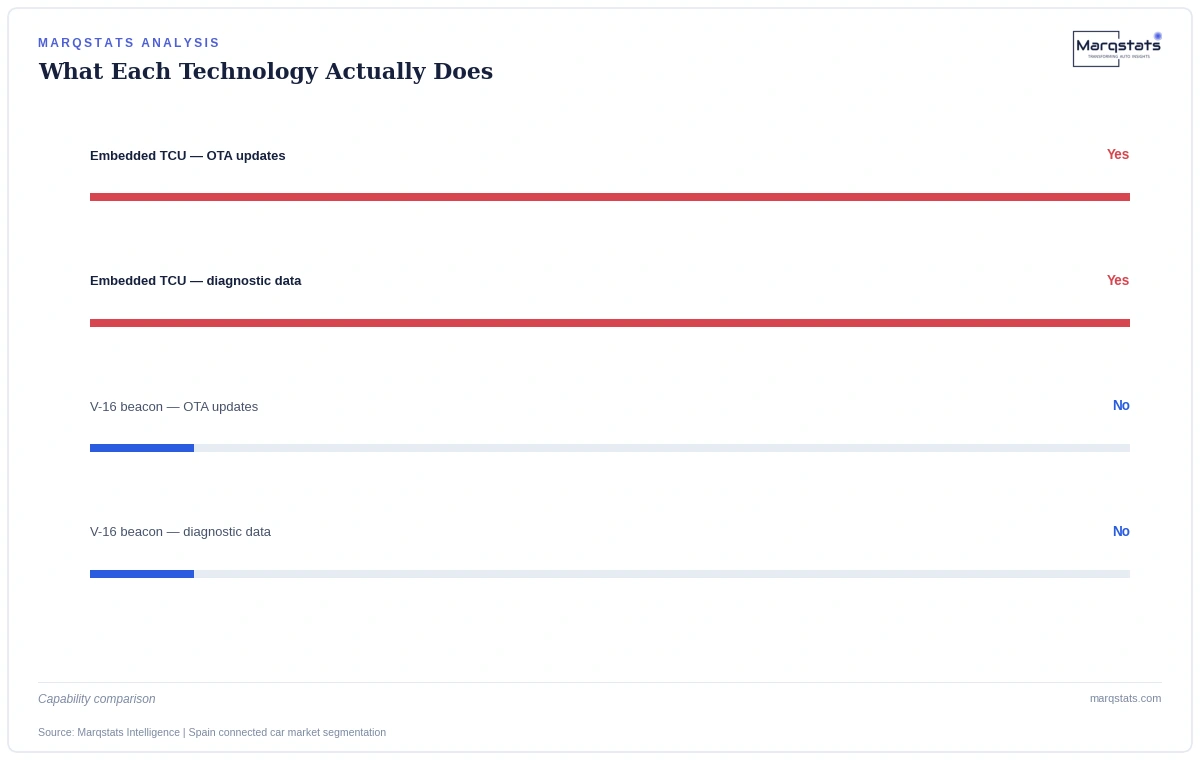
An embedded telematics control unit is built into a vehicle at the factory, draws power from the car's own electrical system, and maintains a persistent link to the manufacturer's cloud platform — it can push an over-the-air software update, report a real-time diagnostic fault, or feed usage data into an insurance underwriting model. A V-16 beacon does none of that. It is a battery-powered, roof-mounted device with its own GNSS module and NB-IoT or LTE-M transceiver, legally required since 1 January 2026, that transmits the vehicle's location to the DGT 3.0 platform only when a driver manually activates it after a breakdown or accident.
The two devices share a regulatory category — both count as part of Spain's "connected vehicle" ecosystem — and nothing else. A beacon-only vehicle cannot receive a software update, cannot report a diagnostic code, and generates no data an insurer, fleet manager or OEM can build a product on. It is a connected endpoint in the narrowest possible sense: a device that can report one thing, one time, on manual activation.
Why the Distinction Changes the Growth Story
Active connected endpoints in Spain are projected to grow at 17.91% a year through 2030, comfortably outpacing the market's 12.51% value CAGR over the same period. That gap is not a modelling inconsistency — it is the beacon mandate's direct effect. Millions of vehicles that will never receive an embedded telematics upgrade are being added to the connected count at a beacon's price point, not an OEM telematics system's, which mechanically pulls unit growth ahead of revenue growth.
The Historical Reason Spain Built It This Way
Spain did not set out to build a two-technology connected-vehicle statistic. Regulation (EU) 2015/758 made embedded eCall modems mandatory on new vehicle type-approvals from March 2018, and that requirement, plus the EU's General Safety Regulation II from July 2024, already guarantees that every new car sold in Spain arrives with full embedded connectivity. The V-16 beacon mandate solves a completely different problem: what to do about the 82.9% of the passenger fleet that is more than five years old and will not be replaced by a new, fully connected vehicle for years, if not decades. Real Decreto 159/2021 does not touch the old car's electronics at all — it regulates the roadside warning device the driver carries, sidestepping the embedded-hardware problem entirely.
That is a genuinely clever piece of policy design, and it is also exactly why the resulting statistic is so easy to misread. Two regulations solving two different problems on two different timelines produced one combined connected-vehicle number, and nothing about the number itself signals that it is answering two questions at once.
What a Beacon-Inflated Number Gets Wrong
A telecommunications operator sizing an addressable market for premium 5G services, an insurer modelling usage-based underwriting penetration, or an OEM forecasting subscription revenue all need the embedded-telematics figure specifically — 68.4% of 2025 value, not the 86.9% that embedded TCUs and beacons combined represent. Applying the combined figure to any of those use cases overstates the addressable base by the beacon share entirely, because a beacon generates none of the revenue those business cases depend on.
The error compounds when the combined figure is used to forecast forward rather than just to describe the present. Because beacon endpoints grow faster than embedded endpoints through 2030, a model that fails to separate the two will not just be wrong about 2025 — it will be increasingly wrong every year through the forecast window, as the beacon share of the combined total keeps rising.
The Counter-Case: Why the Combined Number Still Matters
For exactly one use case, the combined figure is the right one: DGT 3.0's own safety-telemetry reach. The platform's purpose is incident detection and roadside hazard broadcasting, and a beacon serves that function identically to an embedded TCU — both report a location when something goes wrong. For a road-safety policy analyst measuring national incident-reporting coverage, the combined 20.1 million-endpoint figure is exactly the right number to use. It is only wrong when applied to a commercial question the beacon layer was never built to answer.
A Named Comparison: How Other EU States Handle the Same Problem
Spain is not the only EU member state wrestling with an aging fleet that outpaces organic embedded-telematics replacement, but its beacon-based solution is unusual. Germany and France have not adopted an equivalent connected-hazard-device mandate, relying instead on the same eCall and GSR II requirements that apply to new vehicles across the bloc — which means their connectivity statistics, unlike Spain's, are not inflated by a second, unrelated device category. A reader comparing Spain's connected-vehicle penetration rate against a neighbouring market without accounting for this difference will conclude Spain is far more connected than it actually is on an embedded-telematics basis, when the true difference is regulatory design, not technology adoption.
That comparison cuts both ways for a market-entry decision. A vendor reading Spain's headline figure as evidence of unusually high embedded-telematics adoption would be entering on a mistaken premise; a vendor who understands the beacon layer specifically may instead see a genuine opportunity most competitors are mispricing in the same direction.
What This Means for a Sizing or Sourcing Model
Anyone building a Spain connectivity model should ask, first, which of the two technologies a given "connected vehicle" figure actually counts, because the answer changes the addressable market by roughly a fifth. The full architecture-level segmentation this reconciliation draws on is set out in the Marqstats analysis linked below.
Related reportSpain Connected Car Market Size, Share & Forecast 2026 – 2030