Market Snapshot
Middle bar: base-year value × (1 + CAGR), rounded to two decimals. This is a calculated illustration, not a separately researched annual estimate.
The South Korea electric commercial vehicle market is estimated at USD 1,998.2 million in 2025 and is projected to reach USD 3,377.1 million by 2030, at a CAGR of 11.07%. Battery-electric commercial registrations rise from 28,000 units a year to 45,850, a 10.37% CAGR, with the one-tonne light truck class carrying 83.9% of volume. Medium and heavy electric trucks grow fastest at 32.68% from a small base.
Market size and forecast figures are generated using Marqstats' proprietary estimation framework, updated as of September 2026.
This report counts new battery-electric commercial vehicles registered in South Korea — one-tonne class light trucks and vans, medium and heavy trucks, and electric buses. Passenger cars are excluded. Hydrogen fuel-cell vehicles are excluded from the market series and characterised only as context, though South Korea operates the world's largest fuel-cell bus fleet and the two technologies compete directly for the same public procurement budgets.
South Korea has the highest light commercial vehicle electrification rate in the OECD, and it was built on a subsidy that is now being used as an industrial weapon. From 1 July 2026 a manufacturer scoring regime replaced open eligibility: makers must reach a threshold across technological capability, supply-chain contribution, environmental compliance, after-sales sustainability and safety management. BYD was the only battery-electric manufacturer to fail it. The commercial segment was gated harder than passenger cars — nine electric commercial vehicle makers qualified while seven electric truck and van makers failed — which makes this the strictest market-access test in any market this series covers.
Key Takeaways
Market Overview & Analysis
Report Summary
This report sizes the South Korea electric commercial vehicle market — battery-electric one-tonne light trucks and vans, medium and heavy trucks, and buses registered in the country. Korea's position is unusual: it electrified the light commercial segment faster and further than any other advanced economy, not through mandates but through a per-unit subsidy on the one-tonne class large enough to close the purchase-price gap outright, applied to a vehicle category that dominates domestic goods movement.
That subsidy has now become industrial policy. From 1 July 2026, manufacturers must score against a five-part assessment covering technological capability, supply-chain contribution, environmental compliance, after-sales service sustainability and safety management, reaching a minimum threshold to qualify. BYD was the only battery-electric manufacturer to fail, losing eligibility from that date, though applications filed by 30 June retained transitional protection. A parallel requirement obliges manufacturers to hold a dedicated electric vehicle fire insurance policy — a direct response to battery fire incidents in Korean underground car parks.
The commercial segment absorbed the sharper edge of that regime. Nine electric commercial vehicle manufacturers qualified, while seven electric truck and van makers failed the assessment and eight minibus suppliers passed. The forecast reflects the resulting discontinuity: 2026 registrations fall 5.9% while market value rises 2.0%, because the reset stripped out low-priced imported volume while medium and heavy trucks — the highest-value, fastest-growing class — continued converting. From 2027 the market resumes compounding, but on a narrower and more domestically anchored supplier base than it had in 2025.
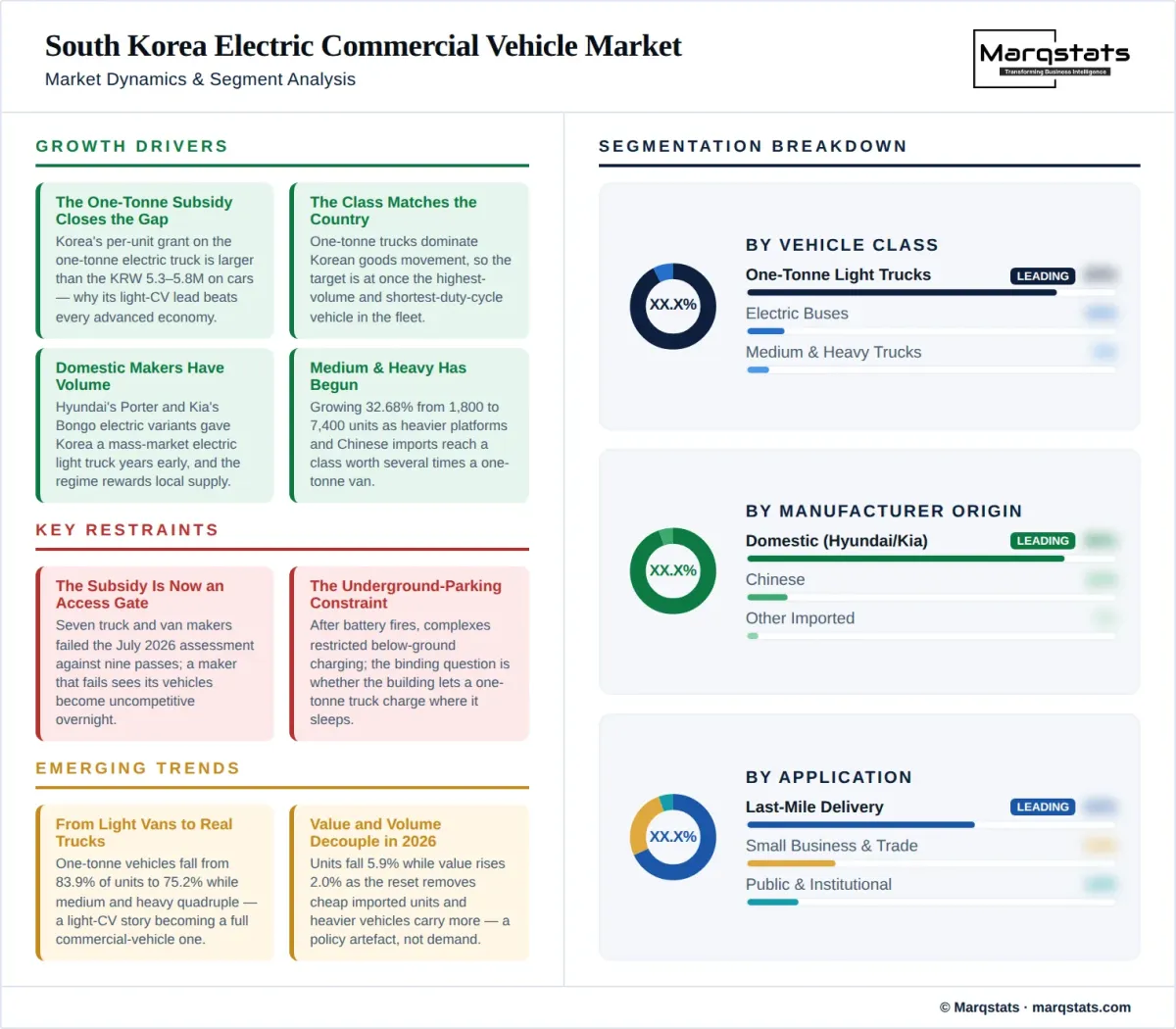
Charging policy is quietly reshaping the market from a direction unrelated to vehicles. After battery fires in underground car parks, several Korean municipalities and apartment complexes restricted electric vehicle charging or parking below ground, and the July 2026 fire insurance requirement extends that concern to the subsidy regime itself. For a one-tonne truck operator whose vehicle parks in a residential complex overnight, the constraint is not range or price but whether the building allows the vehicle to charge where it sleeps. This is the most Korea-specific restraint in the market and it is invisible in registration data.
Market Dynamics
Key Drivers
The one-tonne subsidy closes the price gap outright. Korea's per-unit grant on the one-tonne electric truck class is materially larger than the KRW 5.3 to 5.8 million available on passenger cars, which is why light commercial electrification here leads every other advanced economy.
The vehicle class matches the country. One-tonne trucks dominate Korean goods movement — dense cities, short delivery radii and a small-business economy built on them — so the electrification target is simultaneously the highest-volume and the shortest-duty-cycle vehicle in the fleet.
Domestic manufacturers have volume products in market. Hyundai's Porter and Kia's Bongo electric variants gave Korea a mass-market electric light truck years before comparable markets had one, and the subsidy regime now explicitly rewards local supply-chain contribution.
Medium and heavy conversion has begun in earnest, growing at 32.68% from 1,800 units in 2025 to 7,400 by 2030, as Hyundai's heavier electric platforms and Chinese imports reach a class that carries several times the unit value of a one-tonne van.
Public procurement anchors the bus line. Electric and fuel-cell buses compete for the same municipal budgets, and city fleet renewal keeps the bus segment growing steadily at 7.91% regardless of the subsidy turbulence affecting trucks.
Key Restraints
The subsidy is now a market-access gate, not an incentive. Seven electric truck and van manufacturers failed the July 2026 assessment against nine commercial vehicle passes, and a manufacturer that fails is not merely disadvantaged — its vehicles become uncompetitive overnight.
Eligibility can be withdrawn annually. The scoring regime is reassessed rather than granted permanently, so fleet buyers face a residual-value and service-continuity risk that did not exist under open eligibility, and that risk falls hardest on imported brands.
The one-tonne class is approaching its own ceiling. At 83.9% of volume and after four years of heavy subsidy, the highest-propensity buyers have largely converted, which is why the light truck line grows at only 7.98% against the medium and heavy segment's 32.68%.
Battery fire regulation adds cost and complexity. From July 2026 manufacturers must carry dedicated electric vehicle fire insurance to stay eligible, following underground car park incidents that also prompted charging restrictions in Korean apartment complexes.
Key Trends
The market is shifting from light vans to real trucks. One-tonne vehicles fall from 83.9% of units to 75.2% while medium and heavy trucks quadruple, moving Korea from a light commercial electrification story to a full commercial vehicle one.
Value and volume decouple in the policy year: 2026 units fall 5.9% while value rises 2.0%, as the subsidy reset removes cheap imported units and heavier vehicles carry a larger share of the total.
Chinese share grows despite the exclusions, from 11% of units to 17% at 20.41%, because the regime targets named manufacturers on assessment scores rather than applying a blanket origin rule — compliant Chinese makers gain from a competitor's removal.
Public and institutional demand outgrows commercial demand, at 16.06% against 9.64% for last-mile logistics, as municipal fleet renewal proves less sensitive to subsidy turbulence than private operator purchasing.
Market Segmentation
The volume core at 83.9% of 2025 registrations, easing to 75.2% by 2030 while growing at 7.98% — the slowest class. Hyundai's Porter and Kia's Bongo electric variants dominate, and the class carries Korea's largest per-unit commercial subsidy. Its deceleration reflects saturation of the highest-propensity buyers rather than any loss of policy support.
The fastest-growing class at 32.68%, from 1,800 units in 2025 to 7,400 by 2030. Each vehicle carries several times the value of a one-tonne van, so this segment drives value growth ahead of unit growth. Conversion is concentrated in regional distribution and port drayage duty cycles where daily range is predictable and depot charging is feasible.
Steady at 7.91%, from 2,700 units to 3,950. Municipal fleet renewal drives the line, and it is the segment where battery-electric competes most directly against hydrogen — South Korea operates the world's largest fuel-cell bus fleet, and the two technologies contest the same city procurement budgets.
Hyundai, Kia and Korean commercial vehicle builders hold 86% of 2025 registrations, easing to 79% by 2030 at 8.51%. The July 2026 assessment explicitly rewards local supply-chain contribution, research investment and service network density — criteria domestic makers meet by construction — so their share erosion is gradual and policy-cushioned.
The fastest-growing origin at 20.41%, rising from 11% of registrations to 17% by 2030 despite BYD's exclusion. The regime removes named manufacturers that fail an assessment rather than barring Chinese vehicles as a class, so compliant Chinese truck and van makers absorb the volume a failed competitor leaves behind.
European, Japanese and other imported commercial vehicles hold 3% of registrations rising to 4% at 16.90%. The segment concentrates in specialist medium and heavy applications where domestic platforms do not compete, and its growth tracks the medium and heavy class rather than the market as a whole.
The dominant application at 62% of 2025 registrations, easing to 60% at 9.64%. Korea's parcel and food delivery economy runs on one-tonne trucks operating short urban radii — the duty cycle that made this the world's leading light commercial electrification market.
Independent traders, construction subcontractors and market vendors hold 24% of registrations, easing to 22% at 8.46%. These buyers are the most subsidy-sensitive in the market and the most exposed to eligibility changes, since a withdrawn subsidy moves the purchase decision immediately.
The fastest-growing application at 16.06%, from 14% of registrations to 18%. Municipal bus fleets, government service vehicles and institutional logistics buy on multi-year budgets that absorb policy turbulence, which is why this line outgrows private commercial demand across the forecast.
By Geography
Seoul Capital Area
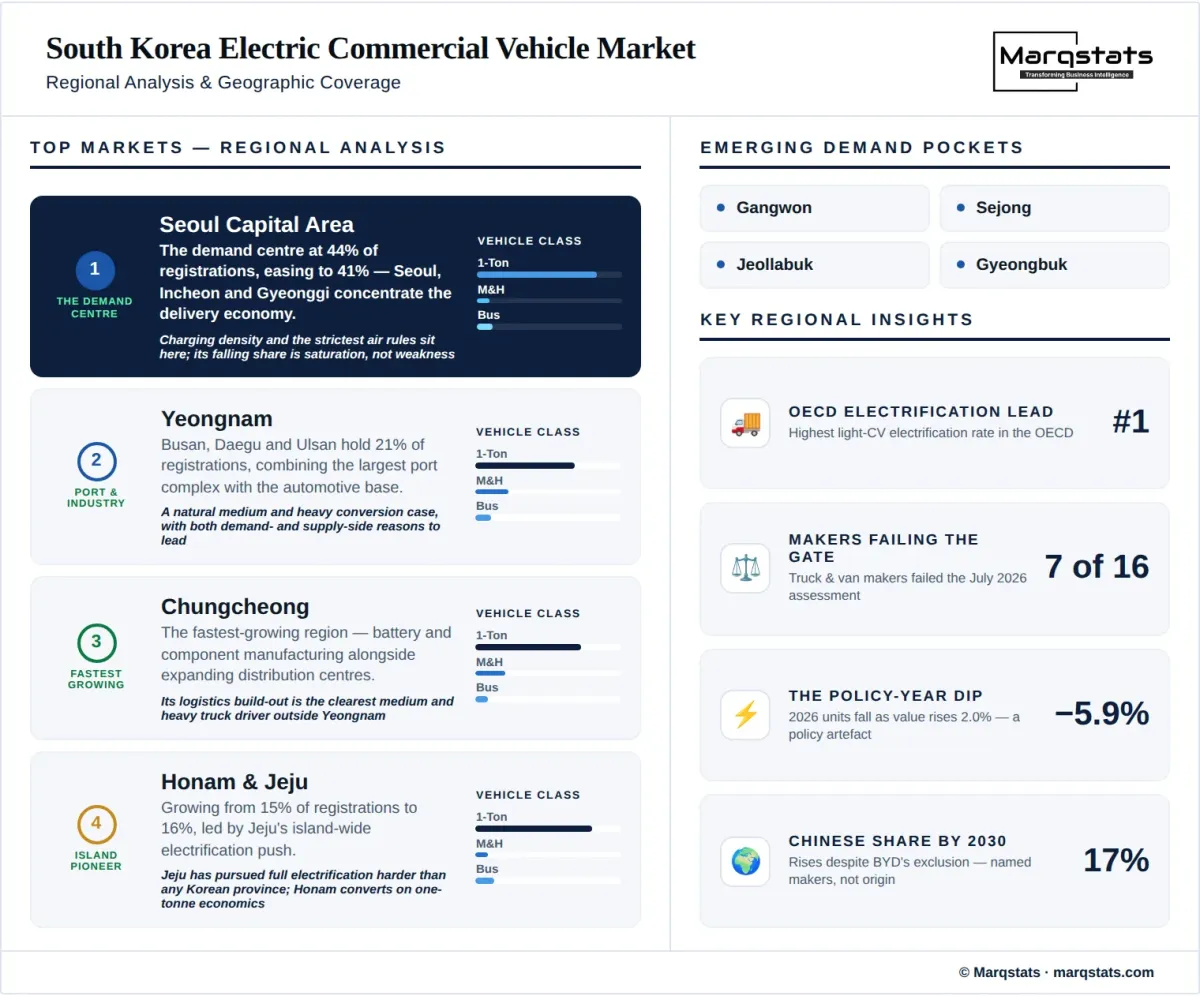
The demand centre at 44% of 2025 registrations, easing to 41% by 2030 at 8.82%. Seoul, Incheon and Gyeonggi concentrate Korea's delivery economy, its charging density and its strictest air quality measures, and the region's declining share reflects earlier saturation rather than weakening demand.
Yeongnam
Busan, Daegu and Ulsan hold 21% of registrations rising to 22% at 11.40%. The region combines Korea's largest port complex — a natural medium and heavy truck conversion case — with the country's automotive manufacturing base, giving it both demand and supply-side reasons to lead the non-capital regions.
Honam and Jeju
Growing at 11.80% from 15% of registrations to 16%. Jeju has pursued island-wide electrification more aggressively than any Korean province, and Honam's agricultural and food logistics fleets convert on the same one-tonne economics that drive the national market.
Chungcheong
The fastest-growing region at 12.01%, from 13% of registrations to 14%. The province hosts battery and component manufacturing alongside expanding distribution centres serving the capital region, and its logistics build-out is the clearest driver of medium and heavy truck demand outside Yeongnam.
Gangwon and Other
Steady at 7% of registrations, growing at 10.37% in line with the market. Mountainous terrain, cold winters and thinner charging coverage make Gangwon the least favourable Korean geography for electric commercial vehicles, and its stable share reflects fleet replacement rather than new adoption.
How Competition Is Evolving
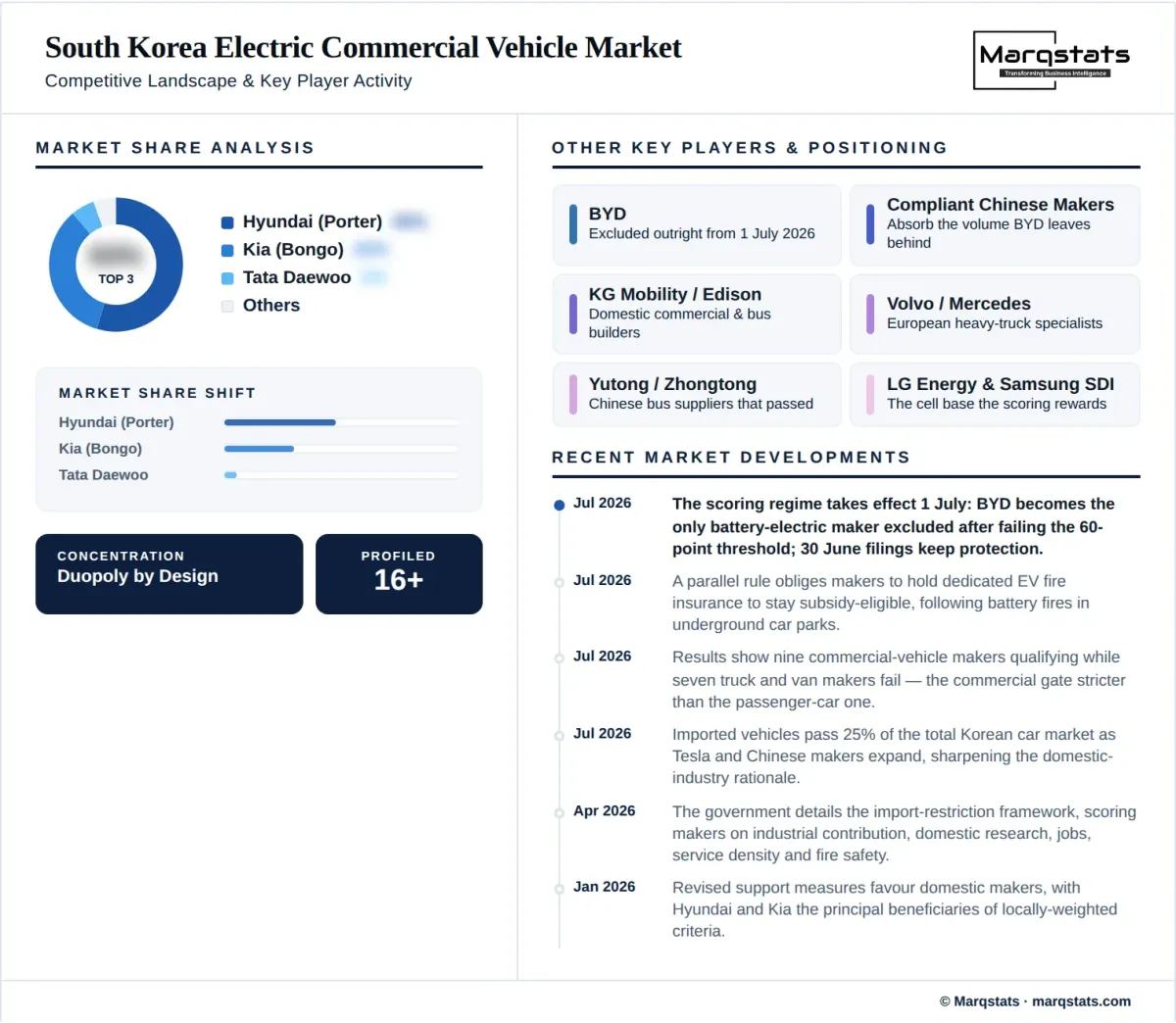
South Korea's electric commercial vehicle market is highly concentrated and has just become more so by design. Hyundai Motor Company and Kia Corporation dominate through the Porter and Bongo electric one-tonne platforms, which between them define the volume segment — no other market in this series has a single vehicle class this dominant or two manufacturers this entrenched within it. The July 2026 assessment regime, which scores manufacturers on local supply-chain contribution, domestic research investment and service network density, systematically advantages that position.
The import contest has been reshaped rather than closed. BYD's exclusion from 1 July 2026 removed the most aggressive price competitor in the light commercial segment, but seven electric truck and van manufacturers failed the same assessment while nine commercial vehicle makers passed — the winners include Chinese manufacturers that met the threshold, which is why Chinese origin share still rises to 17% by 2030. The regime rewards manufacturers willing to invest in Korean service networks and supplier relationships, and the Chinese makers that did so now face a materially weaker field.
Battery supply is the other domestic advantage the assessment regime encodes. LG Energy Solution and Samsung SDI are global cell suppliers headquartered in Korea, and a scoring system that credits supply-chain contribution and technology transfer rewards manufacturers building on that base. For an importer, matching a domestic maker's score means investing in Korean suppliers, service networks and research presence — a commitment few will make for a commercial vehicle segment this size, which is precisely the outcome the policy was designed to produce.
The heavier classes are where the competitive structure is still open. Medium and heavy electric trucks grow at 32.68% from a base small enough that no manufacturer holds a defensible position, and the segment's higher unit values make it the strategic prize. Hyundai's heavier electric platforms compete against Chinese imports and specialist European builders, with Tata Daewoo holding an established Korean commercial vehicle position. In buses, the competition is technological as much as commercial: Korea's fuel-cell bus fleet is the world's largest, and every municipal tender is a contest between two zero-emission architectures rather than between manufacturers alone.
Companies Covered
Companies covered in the report include:
Recent Market Activity
Table of Contents
Coverage & Segmentation
This study covers new battery-electric commercial vehicles registered in South Korea across 2021 to 2030, measured at vehicle value in US dollars. Segmentation runs across three vehicle classes, three manufacturer-origin groups, three applications and five regional markets. Passenger cars are excluded throughout. Hydrogen fuel-cell vehicles are excluded from the market series: South Korea operates the world's largest fuel-cell bus fleet, and that fleet competes with battery-electric buses for identical municipal budgets, but counting both in one series would conflate two distinct procurement markets.
One caliber distinction governs the forecast's most striking figure. The 2026 decline is a units decline, not a value decline: registrations fall 5.9% while market value rises 2.0%, because the subsidy reset removed low-priced imported volume while higher-value medium and heavy trucks continued converting. Quoting 2026 as a market contraction without specifying units is therefore incorrect. The one-tonne class share is likewise a unit share — at 83.9% of units it represents a materially smaller share of value, since a medium or heavy truck carries several times its price.
Prices are stated at vehicle level in US dollars and vary by an order of magnitude across the three classes: a one-tonne electric truck sits near USD 38,500 in 2025 against roughly USD 165,000 for a medium or heavy truck and USD 295,000 for a city bus. Blended figures are therefore not meaningful for this market and the report does not publish one — the value series is built class by class. Won-denominated subsidy figures are converted at prevailing rates and the underlying grants are set annually, so any total-cost comparison should work from the current year schedule rather than from this report's dollar conversions.