Market Snapshot
Key Takeaways
Market Overview & Analysis
Report Summary
The Japan electric kei commercial vehicle market covers battery electric vehicles conforming to Japan’s kei regulatory category (660cc maximum, 3.4m × 1.48m × 2.0m, 47 kW) that are designed, registered, and sold for commercial, cargo, delivery, and work applications. This encompasses electric kei vans (Honda N-VAN e, Mitsubishi Minicab EV, Nissan Clipper EV, Toyota Pixis Van BEV, Daihatsu e-Hijet Cargo, Suzuki e EVERY), passenger-commercial dual-purpose variants (Daihatsu e-Atrai), and the emerging electric kei truck (keitora) segment. Passenger-only kei BEVs (Nissan Sakura, Honda N-ONE e) are excluded. The study covers battery specifications, charging architecture, fleet deployment patterns, subsidy and tax frameworks, and the nascent battery circularity ecosystem specific to commercial kei EVs.
This market is strategically important for three reasons. First, Toyota confirmed in September 2025 that kei commercial vehicles account for about 60% of Japan’s total commercial vehicle fleet—meaning the electrification trajectory of this segment will substantially determine Japan’s overall commercial-fleet decarbonisation rate. Second, electric kei commercial vehicles serve Japan’s most carbon-intensive last-mile logistics and local delivery networks, where short daily routes, depot charging, and high utilization rates create the strongest economic case for electrification. Third, the segment is transitioning from single-OEM early entry (Mitsubishi Minicab EV) to alliance-coordinated multi-OEM deployment (Toyota/Daihatsu/Suzuki/CJPT), which accelerates standardisation, component sharing, and infrastructure readiness.
The product landscape now offers genuine commercial viability. Electric kei van range has progressed from 180 km WLTC (Minicab EV) through 245 km (N-VAN e) to 257 km (Pixis Van/e-Hijet/e EVERY), with DC fast charging reaching 80% in 30–50 minutes depending on model. Battery capacity has stepped up from 20 kWh first-generation packs to 36.6 kWh in the Toyota/Daihatsu/Suzuki generation. These specifications support real-world delivery and field-service duty cycles where daily routes of 100–200 km can be covered on a single charge with overnight AC replenishment. The simultaneous launch of multiple models across alliance partners in early 2026—Toyota Pixis Van BEV in February, Daihatsu e-Hijet Cargo and e-Atrai in February, Suzuki e EVERY in March—demonstrates coordinated supply-side commitment that reduces fleet-operator risk.
Market Dynamics
Key Drivers
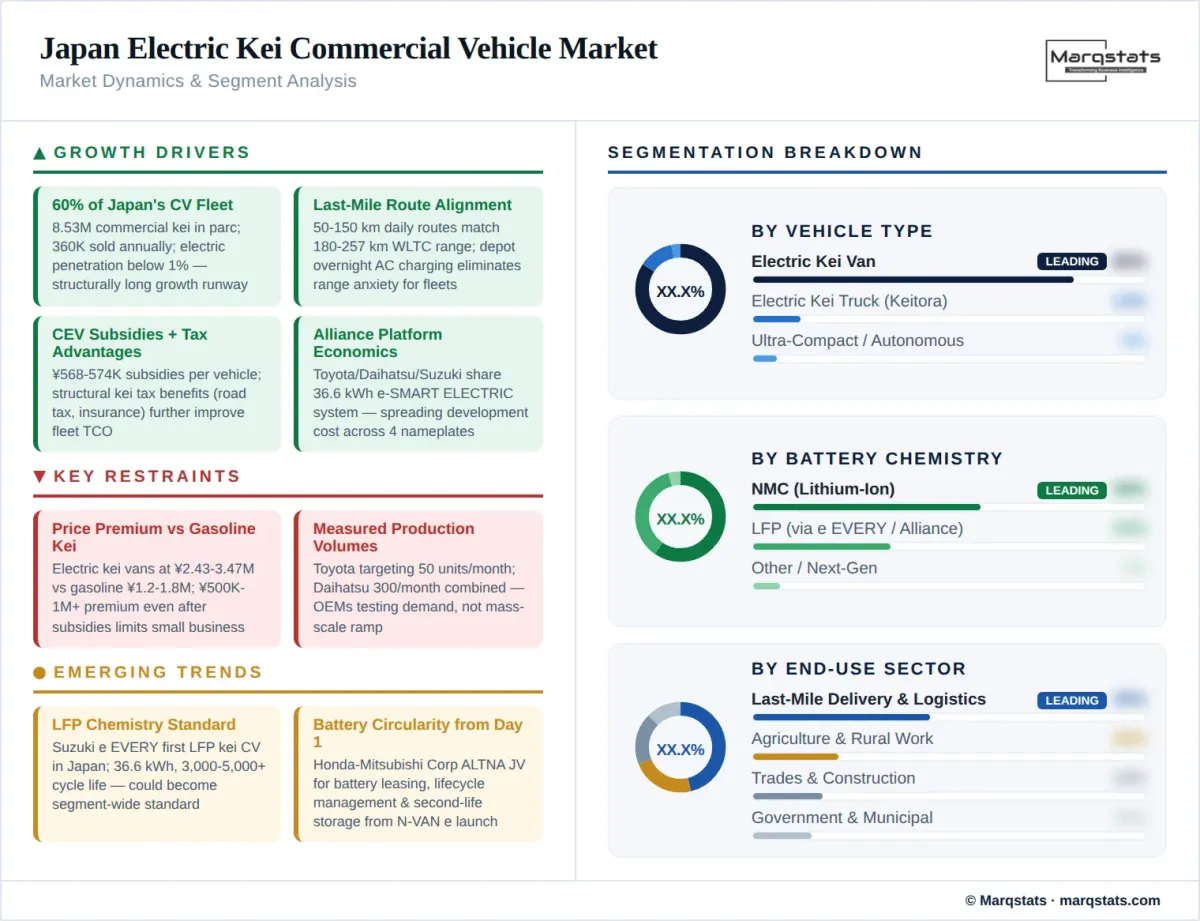
- Kei commercial vehicles at 60% of Japan’s commercial fleet creating massive electrification base: With 8.53 million commercial/cargo kei vehicles in the inspected parc and 360,000 sold annually, the addressable market is enormous. Even 5% electric penetration would translate to approximately 18,000 electric kei commercial vehicles sold annually and 425,000 in the fleet. Every percentage point of penetration creates recurring demand for batteries, charging infrastructure, and fleet management services. Japan’s carbon neutrality 2050 target for commercial vehicle electrification makes this transition a policy imperative, not just a commercial opportunity.
- Last-mile logistics and delivery use cases aligning perfectly with kei EV range: Toyota, Daihatsu, Suzuki, and Honda all frame their electric kei commercial vehicles around delivery, local work use, and efficient last-mile logistics. Typical commercial kei routes of 50–150 km daily align well with the 180–257 km WLTC range now available. Agriculture, construction, maintenance, trades, and local government represent additional use cases where kei commercial vehicles serve as multi-purpose work tools. Japan Post, Yamato Transport, and delivery fleets have evaluated or deployed electric kei vans in trial operations.
- CEV subsidies and structural tax advantages reducing fleet TCO: The current CEV subsidy list provides ¥574,000 for the Honda N-VAN e and Nissan Clipper EV, and ¥568,000 for the Mitsubishi Minicab EV. Electric mini-vehicles qualify for a 75% reduction under Japan’s environmental performance tax framework (April 2023 to March 2026). Annual private-use mini-vehicle tax remains at ¥10,800. Combined with lower energy costs (home/depot AC charging versus gasoline) and reduced maintenance requirements, TCO advantages offset the ¥500,000–1,000,000 upfront premium versus gasoline kei vans for operators with sufficient daily utilization.
- Alliance-coordinated multi-OEM deployment reducing adoption risk: The simultaneous launch of Toyota Pixis Van BEV, Daihatsu e-Hijet Cargo, Daihatsu e-Atrai, and Suzuki e EVERY between February and March 2026—all sharing a jointly developed BEV system with 36.6 kWh battery and 257 km range—demonstrates unprecedented OEM coordination in the kei segment. CJPT (Commercial Japan Partnership Technologies) is involved in planning around efficient logistics. This alliance approach standardises components, shares development costs, and provides fleet operators with multiple dealer-network access points for the same underlying platform.
- Work functionality beyond zero-emission compliance driving purchase decisions: Electric kei commercial vehicles increasingly compete on work-tool utility rather than pure EV branding. Mitsubishi’s Minicab EV highlights 1,500W external power output for jobsite tools and equipment. Toyota and Daihatsu emphasise external power supply and V2H (vehicle-to-home) compatibility as standard features. Honda’s N-VAN e adds vehicle-to-load flexibility and business-lifestyle dual use. In disaster-prone Japan, the ability to serve as an emergency power source adds practical value that directly influences commercial purchasing decisions—particularly for local government, utility, and emergency-response fleets.
Key Restraints
- Upfront pricing premium versus gasoline kei vans constraining small-business adoption: Electric kei commercial vans are priced at ¥2.43–3.47 million versus approximately ¥1.2–1.8 million for equivalent gasoline models. Even after CEV subsidies of ¥568,000–¥574,000, the effective premium of ¥500,000–1,000,000+ limits adoption among price-sensitive small businesses, sole proprietors, and agricultural operators who comprise a significant share of kei commercial vehicle buyers. Without fleet-level utilization to capture TCO benefits, the sticker-price barrier remains the single largest restraint.
- Production volumes still in early measured deployment rather than mass-scale: Toyota’s official launch material sets a base monthly sales volume of just 50 units for the Pixis Van BEV. Daihatsu targets 300 units per month combined for the e-Hijet Cargo and e-Atrai. This confirms OEMs are testing demand, fleet use cases, and channel readiness rather than pursuing aggressive volume ramp-up. Until production scales, component costs and economies of scale will remain suboptimal, constraining price competitiveness versus gasoline incumbents.
- Charging infrastructure gaps at depots, shops, and rural worksites: While Japan targets 150,000 charging connectors by 2030 (including 30,000 public quick chargers), most electric kei commercial vehicles will primarily charge at operator depots, shops, or worksites using overnight AC charging. Many small businesses and agricultural operations lack the electrical infrastructure for even standard 200V outlets at their operational bases. METI’s recent review of CEV Infrastructure Subsidies, including the new ¥50,000 subsidy for single-family home outlet installation and the creation of an “over 150 kW” quick charger category, addresses urban gaps but rural worksites remain underserved.
- Electric kei truck (keitora) segment lagging van electrification: While electric kei vans have progressed rapidly with six models now available, the electric kei truck (keitora) segment remains nascent. Keitora are essential for agriculture, construction, and rural logistics across Japan’s regional economies, but the open-bed truck format creates different battery packaging, weather exposure, and payload challenges versus enclosed vans. Electrification of the keitora segment is anticipated but trails the van segment by 2–3 years in product development.
Key Trends
- LFP chemistry entering commercial kei segment via Suzuki e EVERY: Suzuki’s e EVERY explicitly uses LFP chemistry in its 36.6 kWh battery—the first confirmed LFP deployment in a Japanese kei commercial vehicle. LFP’s superior thermal stability, longer cycle life (3,000–5,000+ cycles versus NMC’s 1,500–2,000), and lower cost per kWh align with commercial duty cycles requiring daily deep discharges and depot charging. If LFP proves successful in the e EVERY, it could become the standard chemistry across the commercial kei segment, further reducing battery costs and improving fleet economics.
- Battery circularity and lifecycle models emerging from Day 1: Honda and Mitsubishi Corporation established ALTNA in June 2024 to support battery leasing, lifetime management, and second-life stationary storage use starting with the N-VAN e. Honda’s N-VAN e Value Plan / Circular Lease Plan is specifically designed so batteries can be recovered and reused after vehicle end-of-life. This shifts the commercial kei EV market from a simple vehicle-sale model toward a battery-lifecycle and TCO-optimisation model from the outset—a notable contrast to passenger EV markets where circularity was retrofitted after initial sales.
- Alliance-led platform standardisation as competitive moat: The Toyota/Suzuki/Daihatsu/CJPT alliance represents a fundamentally different competitive model from single-OEM product launches. By jointly developing the e-SMART ELECTRIC BEV system, sharing the 36.6 kWh platform and eAxle architecture, and coordinating launch timing across three brands, the alliance achieves component-cost reductions, standardised charging specifications, and cross-dealer service availability that no single manufacturer could replicate independently. This positions the alliance against potential foreign entrants including BYD, whose RACCO kei EV prototype was unveiled at JMS 2025 for planned summer 2026 launch.
- METI charging policy evolving toward commercial-fleet support: Japan’s CEV Infrastructure Subsidy review announced in February 2026 established a new “over 150 kW” quick charger segment for dealers, convenience stores, and commercial facilities, and assigned higher budget priority to these installations. While primarily targeting larger EVs, improved quick-charger density at commercial locations benefits kei commercial fleets needing mid-day opportunity charging on multi-stop delivery routes. The new single-family home outlet subsidy (¥50,000) also supports sole-proprietor kei van operators who charge at home.
Market Segmentation
Electric kei vans represent the core of the Japan electric kei commercial vehicle market, with six models now available from five OEMs. Honda’s N-VAN e (launched October 2024) offers 245 km WLTC range with 80% charge in 30 minutes on 50 kW DC, priced at ¥2.44–2.92 million. The Mitsubishi Minicab EV provides 180 km WLTC range with 80% charge in 42 minutes, priced at ¥2.43–2.49 million, targeting logistics and government customers. The Nissan Clipper EV is a closely related rebadge of the Minicab EV. The Toyota/Daihatsu/Suzuki alliance trio—Pixis Van BEV (¥3.146 million), e-Hijet Cargo (¥3.146 million), e-Atrai (¥3.465 million for dual-purpose variant), and e EVERY (¥3.146 million)—all share the 36.6 kWh platform with 257 km range and maximum 350 kg payload. All vans feature external power supply and V2H capability as standard. Daihatsu achieved mixed-model production with gasoline vehicles on existing lines at its Oita (Nakatsu) Plant without introducing dedicated BEV equipment, demonstrating a capital-efficient manufacturing approach.
The electric kei truck segment remains at an early development stage but represents a strategically important future growth vector. Keitora are foundational to Japanese agriculture, construction, forestry, and rural logistics—use cases where electrification offers noise reduction, zero local emissions, and operational simplicity advantages. However, open-bed truck configurations create battery packaging, weather protection, and payload-weight-trade-off challenges that are more complex than enclosed-van electrification. HW Electro’s ELEMO-K represents a niche early entrant in the ultra-compact commercial EV space. Industry expectations point to keitora electrification trailing van electrification by 2–3 years, with the first mainstream electric keitora models anticipated from the Toyota/Daihatsu/Suzuki alliance in the 2027–2028 timeframe.
The Mitsubishi Minicab EV and Nissan Clipper EV use a 20 kWh lithium-ion NMC battery delivering 180 km WLTC range. This first-generation specification prioritises cost and dimensional efficiency within kei constraints, with full overnight charging on a standard 200V home/depot outlet. The 180 km range covers the vast majority of daily commercial kei routes but limits the vehicle to single-shift operations without mid-day charging.
The Toyota Pixis Van BEV, Daihatsu e-Hijet Cargo/e-Atrai, and Suzuki e EVERY all use a 36.6 kWh battery delivering 257 km WLTC range—an 83% capacity increase and 43% range improvement over the first-generation platform. Suzuki confirms LFP chemistry for the e EVERY, offering superior thermal stability and cycle life for commercial duty cycles. The eAxle architecture integrates motor, inverter, and transaxle, delivering torque exceeding a turbocharged kei engine while maintaining work-van usability. DC fast charging reaches 80% in approximately 50 minutes. This specification supports multi-shift or extended-route operations.
Honda’s N-VAN e uses an undisclosed-capacity battery delivering 245 km WLTC range with a class-leading 80% charge time of approximately 30 minutes on 50 kW DC. The N-VAN e battery system is integrated with ALTNA’s circular lease model, designed for recovery and stationary reuse after vehicle end-of-life. This positions the N-VAN e’s battery as both a vehicle power source and a lifecycle asset in Honda’s broader battery circularity strategy.
The primary application driving near-term electric kei commercial vehicle adoption. E-commerce growth in Japan, combined with driver shortages and urban delivery densification, creates strong demand for compact, electric last-mile vehicles. Daily routes of 50–150 km with fixed depot charging align perfectly with current electric kei van range. Japan Post, Yamato Transport, and other logistics operators have evaluated electric kei vans for urban delivery networks. CJPT’s involvement in planning efficient logistics for the Toyota/Daihatsu/Suzuki alliance specifically targets this application.
Kei commercial vehicles serve as multi-purpose work tools across Japan’s regional economies—transporting tools, materials, and produce in farming communities, construction sites, and trades operations. Electrification offers silent operation for noise-sensitive areas, zero local emissions for enclosed worksites, and external power supply for tools and equipment. However, rural charging infrastructure gaps, payload sensitivity, and the need for keitora (open-bed truck) formats constrain adoption in these applications relative to urban delivery.
Municipal government and utility fleets represent early adopters for electric kei commercial vehicles. V2H (vehicle-to-home) and external power supply capabilities are particularly valued for disaster preparedness in earthquake- and typhoon-prone Japan. Mitsubishi’s 1,500W external power output and Toyota/Daihatsu’s V2H compatibility position electric kei vans as mobile emergency power units alongside their transport function. Subsidised procurement for government fleets accelerates adoption in this application.
By Geography
Greater Tokyo Metropolitan Area
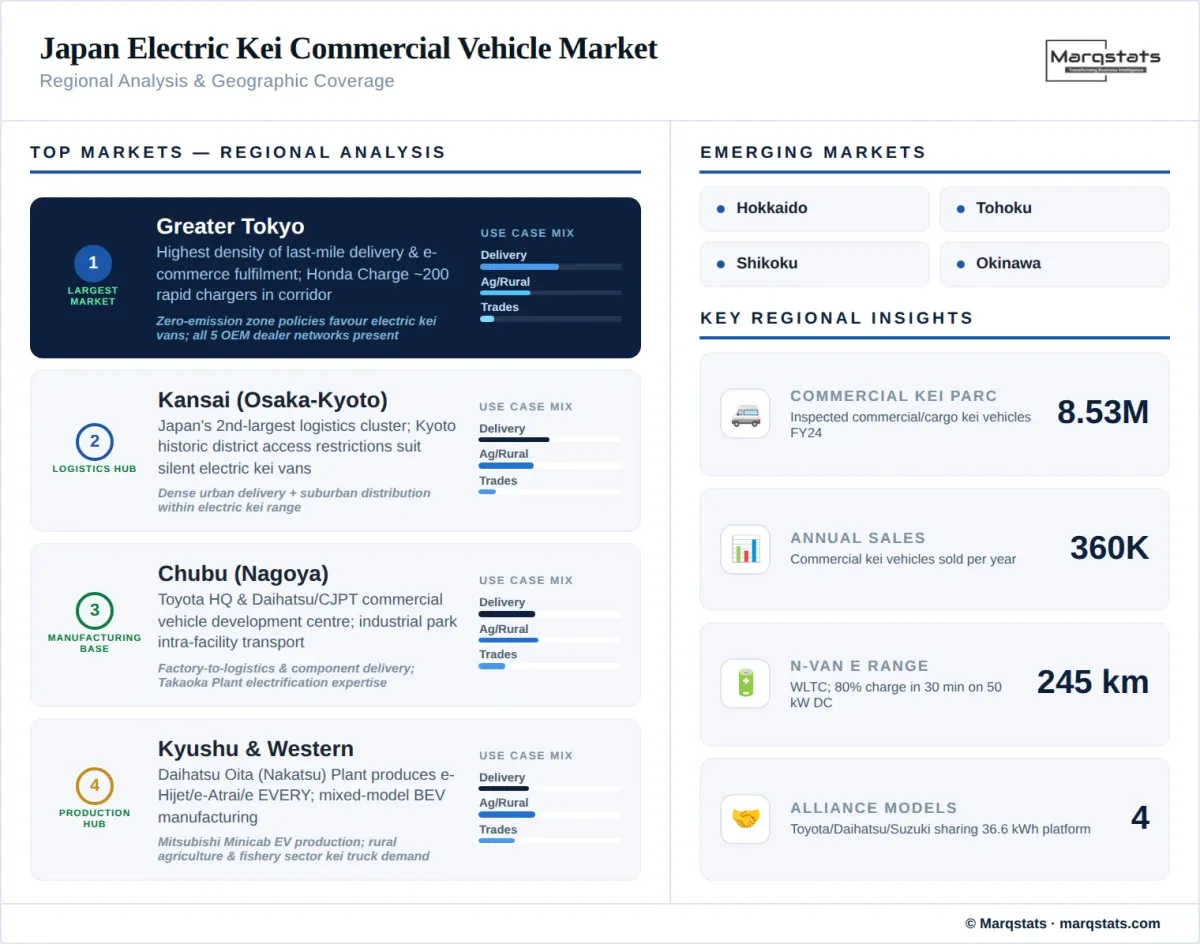
Japan’s largest concentration of last-mile delivery operations, with the highest density of e-commerce fulfilment centres and delivery routes. Honda’s “Honda Charge” network provides approximately 200 rapid chargers concentrated in the Tokyo-Osaka corridor. Urban congestion, noise restrictions, and zero-emission zones in commercial districts favour electric kei vans for daytime delivery. The region’s established dealer networks for all five kei OEMs ensure ready service infrastructure.
Kansai Region (Osaka, Kyoto, Kobe)
Japan’s second-largest logistics hub with high e-commerce penetration and dense urban delivery requirements. Kyoto’s historic district access restrictions make silent, compact electric kei vans an operationally advantageous solution. Regional logistics operators serve both urban dense-delivery and suburban distribution routes within electric kei van range.
Chubu Region (Nagoya, Toyota City)
Manufacturing heartland housing Toyota’s headquarters and the Toyota/Daihatsu/CJPT commercial vehicle development base. The Chubu region’s industrial parks, component suppliers, and factory-to-logistics use cases create demand for electric kei vans in intra-facility transport and short-haul component delivery. Toyota’s Takaoka Plant, which produces the RAV4 PHEV, serves as a reference manufacturing facility for electrified vehicle production expertise applicable to the Pixis Van BEV programme.
Kyushu and Western Japan
Daihatsu Motor Kyushu’s Oita (Nakatsu) Plant No. 1 produces the e-Hijet Cargo and e-Atrai on mixed-model lines with gasoline vehicles—a capital-efficient production approach particularly important for the commercial kei segment’s measured rollout phase. Kyushu’s agricultural communities and regional logistics networks represent key demand centres for electric kei vans and future keitora. Daihatsu demonstrated a mobile microgrid system using two mini-commercial EVs in November 2025, showcasing community-energy integration potential.
Hokkaido and Northern Japan
Cold-climate operations present the most demanding conditions for electric kei commercial vehicle batteries, with sub-zero temperatures reducing range by 20–30% and increasing cabin heating energy demand. Depot charging in heated facilities partially mitigates this constraint. Snow-country delivery and agricultural operations are essential kei commercial use cases where electrification viability depends on cold-weather battery management optimisation. Isuzu’s collaboration with ANA for electric cargo trucks at New Chitose Airport provides cold-climate operational data applicable to the broader commercial kei segment.
Rural and Regional Japan
Japan’s rural prefectures represent both the largest installed base of kei commercial vehicles—particularly keitora for farming, forestry, and construction—and the most challenging environment for electric adoption due to limited charging infrastructure, longer inter-town distances, and price-sensitive operators. However, Japan’s aging rural workforce increasingly values electric vehicles’ operational simplicity, quiet operation, and low maintenance requirements. The new ¥50,000 METI subsidy for single-family home outlet installation directly supports rural sole-proprietor operators who would charge electric kei vans at home overnight.
How Competition Is Evolving
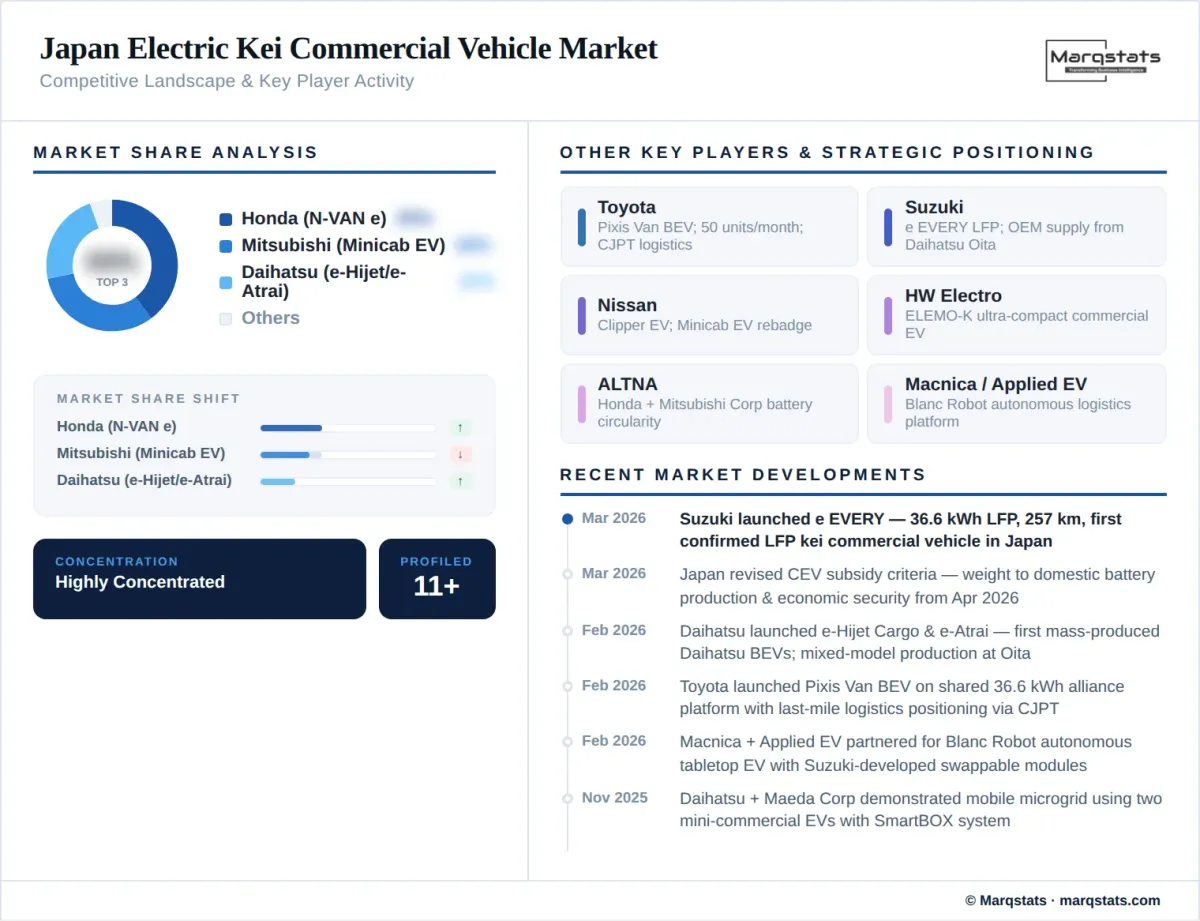
The Japan electric kei commercial vehicle market is defined by domestic incumbents operating through two distinct competitive structures. The first is Honda, which entered independently with the N-VAN e in October 2024, offering the broadest positioning (business + lifestyle), the fastest DC charging (80% in 30 minutes on 50 kW), and the only battery-circularity model (ALTNA partnership with Mitsubishi Corporation). The second is the Toyota/Daihatsu/Suzuki/CJPT alliance, which launched a coordinated three-brand product wave in February–March 2026 using a jointly developed BEV system with shared 36.6 kWh battery, eAxle, and platform architecture. This alliance approach achieves component standardisation, cost sharing, and multi-dealer-network coverage that no single manufacturer could replicate.
Mitsubishi Motors and Nissan occupy the first-mover position through the Minicab EV and Clipper EV respectively, offering the segment’s lowest entry pricing (¥2.43–2.49 million) and established fleet relationships with logistics operators and government customers. However, the 180 km range and 20 kWh battery of the first-generation platform faces increasing competitive pressure from the 257 km/36.6 kWh second-generation alliance products.
The potential foreign disruptor is BYD, which unveiled the RACCO kei EV prototype at JMS 2025 (October 2025) as its first EV designed exclusively for Japan’s kei standards. While RACCO targets the passenger kei segment, BYD’s T35 light-duty electric truck (250 km range, ~¥8 million including bodywork) demonstrates commercial-vehicle ambition in Japan. However, Japan’s March 2026 revision of CEV subsidy criteria—adding weight to domestic battery production and economic security—could disadvantage imported electric kei vehicles for subsidy eligibility. HW Electro’s ELEMO-K represents a niche domestic entrant in ultra-compact commercial EVs. Macnica’s partnership with Applied EV for the Suzuki-developed “Blanc Robot” autonomous tabletop EV platform targets industrial logistics and last-mile delivery, adding an autonomous-driving dimension to electric kei commercial vehicle evolution.
Companies Covered
The report profiles 11+ companies with full strategy and financials analysis, including:
Recent Market Activity
Table of Contents
Coverage & Segmentation
This report provides a comprehensive analysis of the Japan electric kei commercial vehicle market covering the historical period (2021–2025) and forecast period (2026–2030), with 2025 as the base year. The study examines market size in USD and JPY, unit volume forecasts, growth trends, competitive dynamics, and segment-level analysis across vehicle type (kei vans, kei trucks/keitora), battery specification (20 kWh NMC, 36.6 kWh LFP), application (last-mile delivery, agriculture/construction, government/utility), and regional geography. Company profiling covers all active OEMs (Honda, Mitsubishi, Nissan, Daihatsu, Toyota, Suzuki), alliance structures (CJPT, ALTNA), niche entrants (HW Electro, Macnica/Applied EV), and potential foreign entrant (BYD). Policy analysis covers CEV subsidies, environmental performance tax reductions, METI 2035 electrification targets, and charging infrastructure policy.
Research methodology combines bottom-up unit sales modelling from Keikenkyo registration and fleet inspection data, JAMA production statistics, and OEM sales disclosures, validated against CEV subsidy registration records and Japanese automotive press coverage. Primary research includes interactions with kei commercial vehicle OEMs, fleet operators, logistics companies, and charging infrastructure providers. The Marqstats Japan Electric Kei Car Market report provides complementary intelligence covering the passenger kei EV segment.