Market Snapshot
Key Takeaways
Market Overview & Analysis
Report Summary
The global electric and hybrid boat and ship market comprises battery-electric and hybrid-electric marine vessels spanning passenger and car ferries, inland and coastal cargo boats, harbor workboats and tugs, offshore service vessels, and recreational boats and yachts. This study segments the market by vessel type, propulsion, and power class, with a 2025 base year, historical coverage from 2021 to 2025, and forecasts to 2030. Market size is stated as vessel and retrofit system sales revenue in United States dollars, covering both newbuild vessels and retrofit conversion of existing vessels to hybrid or electric propulsion.
Vessel electrification economics differ markedly by route length and duty cycle, which is why ferries operating short, fixed, high-frequency routes have led adoption: a vessel that returns to the same dock multiple times daily can charge between crossings, making battery-electric propulsion viable in a way it is not yet for longer open-ocean voyages. This same logic explains why hybrid propulsion, which retains a diesel engine or fuel cell for range extension, currently outweighs fully electric propulsion across the market as a whole, even as fully electric vessels dominate the specific short-route ferry segment where the economics are most favourable. Route predictability matters as much as route length in this calculation: a ferry running the identical crossing dozens of times daily is a far more tractable electrification target than a workboat or offshore vessel whose duty cycle varies day to day, which is part of why ferries have electrified fastest even relative to other short-range vessel categories.
Battery cost decline is the single most important enabling trend across every vessel category, since marine battery packs represent the largest incremental cost of electrifying a vessel relative to a conventional diesel equivalent. As battery costs have fallen, vessel operators have been able to specify larger battery packs supporting longer routes and larger vessels, a trend reflected in a new generation of electric ferries substantially larger and longer-range than the first-generation vessels that pioneered the category roughly a decade ago. Marine battery systems differ from automotive equivalents in duty cycle and safety certification requirements, since a vessel battery must sustain continuous high-power draw over multi-hour crossings and meet maritime classification society standards distinct from automotive safety regulation, meaning marine battery suppliers cannot simply repurpose automotive battery packs without substantial re-engineering.
Market Dynamics
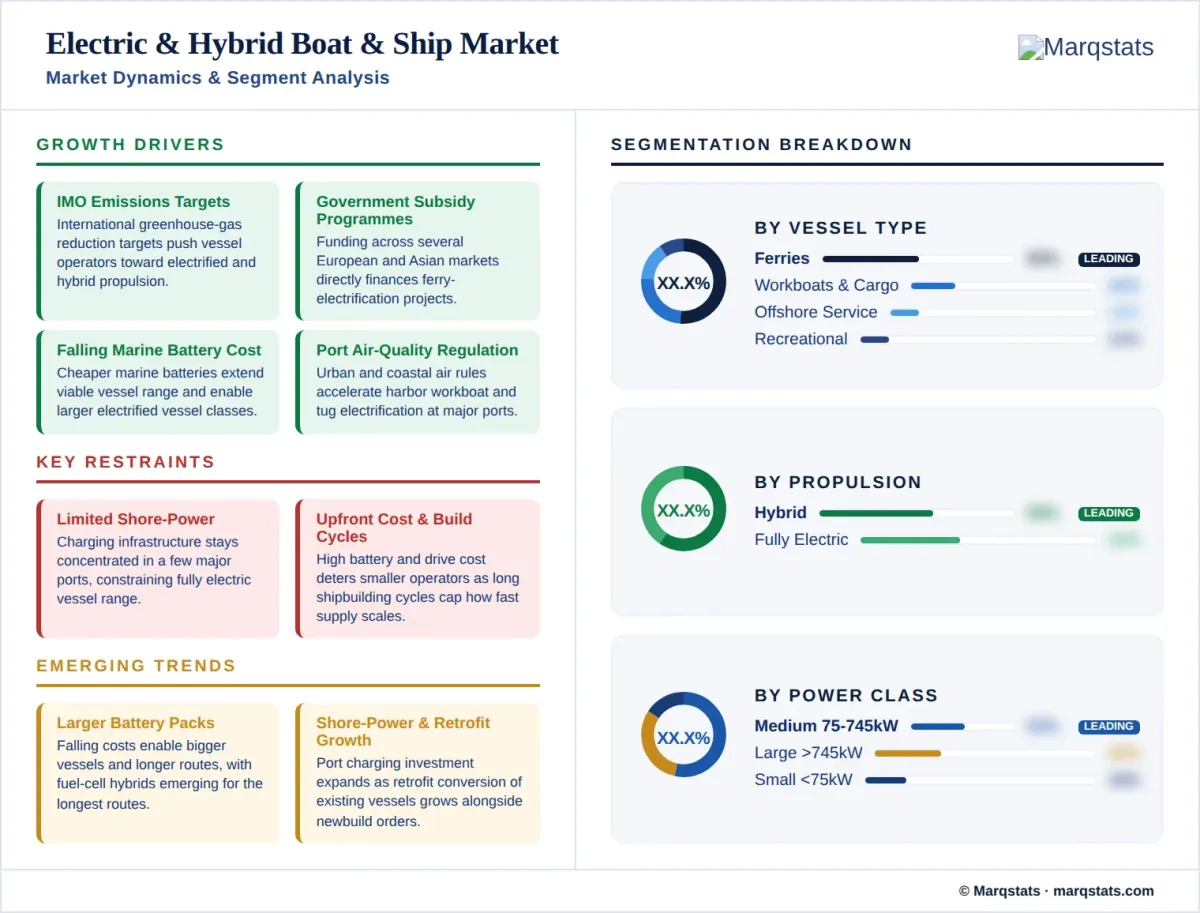
Key Drivers
- International Maritime Organization greenhouse gas reduction targets are pushing operators toward electrified and hybrid propulsion.
- Rising public and consumer awareness of maritime emissions is adding reputational pressure alongside direct regulatory requirements.
- Government subsidy programmes in several European and Asian markets are directly funding ferry electrification projects.
- Falling marine battery costs are extending viable vessel range and enabling larger electrified vessel classes.
- Urban and coastal air-quality regulation is accelerating harbor workboat and tug electrification in major ports.
- Rising diesel fuel costs are improving the total-cost-of-ownership case for hybrid and electric propulsion on suitable routes.
Key Restraints
- Shore-power charging infrastructure remains concentrated in a limited number of major ports, constraining fully electric vessel range.
- High upfront battery and electric-drive system cost remains a barrier for smaller commercial and recreational vessel operators.
- Long shipbuilding cycle times mean vessel-market growth remains steady rather than able to scale abruptly with demand.
Key Trends
- Marine battery pack sizes are increasing as costs decline, enabling larger vessels and longer routes per charge.
- Hydrogen fuel cell hybrid configurations are emerging for longer-range routes beyond current battery-only viability.
- Shore-power and battery-swap infrastructure investment is expanding at major ports to support growing electrified fleets.
- Retrofit conversion of existing vessels to hybrid propulsion is growing alongside newbuild electric vessel orders.
Market Segmentation
Passenger and car ferries account for roughly half of all electric and hybrid vessel orders, the largest single vessel-type category, reflecting their well-suited short, fixed-route duty cycles and the concentration of government electrification subsidy programmes on public passenger transport. Within this category, urban and short-crossing ferries have electrified fastest, while longer inter-island and cross-strait routes more commonly specify hybrid propulsion to retain range flexibility beyond current battery-only limits.
Inland and coastal cargo vessels and harbor workboats, including tugs and patrol vessels, represent a growing category as port authorities and municipal fleets electrify vessels operating within defined, shore-power-accessible service areas. Harbor tugs in particular spend a substantial share of operating time at low-power standby rather than full-power towing, a duty cycle that suits hybrid propulsion especially well since the diesel engine can be sized for peak towing power while the electric system handles standby and manoeuvring efficiently.
Offshore service vessels, supporting oil, gas, and offshore wind operations, are increasingly specified with hybrid propulsion to reduce fuel consumption during dynamic positioning and standby operations, where diesel engines historically ran inefficiently at partial load. Growing offshore wind construction and maintenance activity is emerging as a distinct demand driver for this vessel category, since offshore wind service vessels typically spend extended periods at low-power station-keeping duty that hybrid propulsion handles more efficiently than a conventional diesel-only configuration.
Recreational boats and yachts represent a distinct demand pool driven by consumer preference for quieter, lower-maintenance propulsion rather than the regulatory and subsidy drivers dominant in commercial vessel categories, with adoption concentrated in smaller vessel classes suited to shorter recreational use patterns. Premium electric boat and yacht manufacturers have also begun positioning electrification as a performance and design differentiator rather than purely an environmental choice, emphasising the instant torque and low-vibration characteristics electric propulsion shares with electric automobiles.
Fully electric propulsion dominates the short-route ferry segment specifically, where fixed schedules and frequent dock returns make battery-only operation practical, yet represents a smaller share of the market overall given range limitations on longer routes and vessel types. Fully electric vessel range has expanded materially as battery costs have declined, with the newest generation of electric ferries capable of routes considerably longer than the short crossings that defined the category’s first commercial deployments.
Hybrid propulsion, combining an electric motor with a diesel engine or fuel cell, represents the larger share of current market value, offering the fuel savings and emissions reduction of electric operation where practical while retaining diesel or fuel-cell range extension for longer voyages or higher-power demands. Hydrogen fuel cell hybrid configurations remain an earlier-stage sub-category within hybrid propulsion, offering longer potential range than battery-only systems but facing more limited bunkering infrastructure than either diesel or shore-power charging currently provide.
Small power-class vessels, concentrated in recreational boats and small harbor craft, represent the highest unit count of any power class, though individually lower value than larger commercial vessels. This class has benefited earliest from consumer electric-motor technology originally developed for automotive and general electric-mobility applications, since suppliers can draw on established consumer-electronics-scale battery and motor supply chains rather than developing marine-specific components from scratch.
Medium power-class vessels, spanning most ferries and mid-sized workboats, represent the largest revenue category, reflecting the concentration of ferry electrification demand within this power range. This class captures the bulk of the well-documented short-crossing ferry deployments that have driven market growth to date, making it the power class with the most mature supply chain and installed operating experience. Component standardisation is furthest advanced within this power range, with several propulsion suppliers now offering semi-standardised packages rather than the fully bespoke engineering more common at the largest and smallest power classes.
Large power-class vessels, including bigger ferries, offshore service vessels, and larger cargo vessels, represent a smaller, fast-growing category as battery technology matures sufficiently to support higher-power, longer-range electrified and hybrid vessels. This class is where hybrid propulsion currently holds its strongest advantage over fully electric alternatives, since battery weight and volume at this power scale still compete directly with a vessel's cargo or passenger capacity in ways smaller vessel classes do not face to the same degree. Growth in this power class is the segment most closely watched by industry participants, since it represents the frontier where battery-electric technology must prove itself before larger ocean-going vessel categories become commercially viable candidates for electrification.
By Geography
Europe
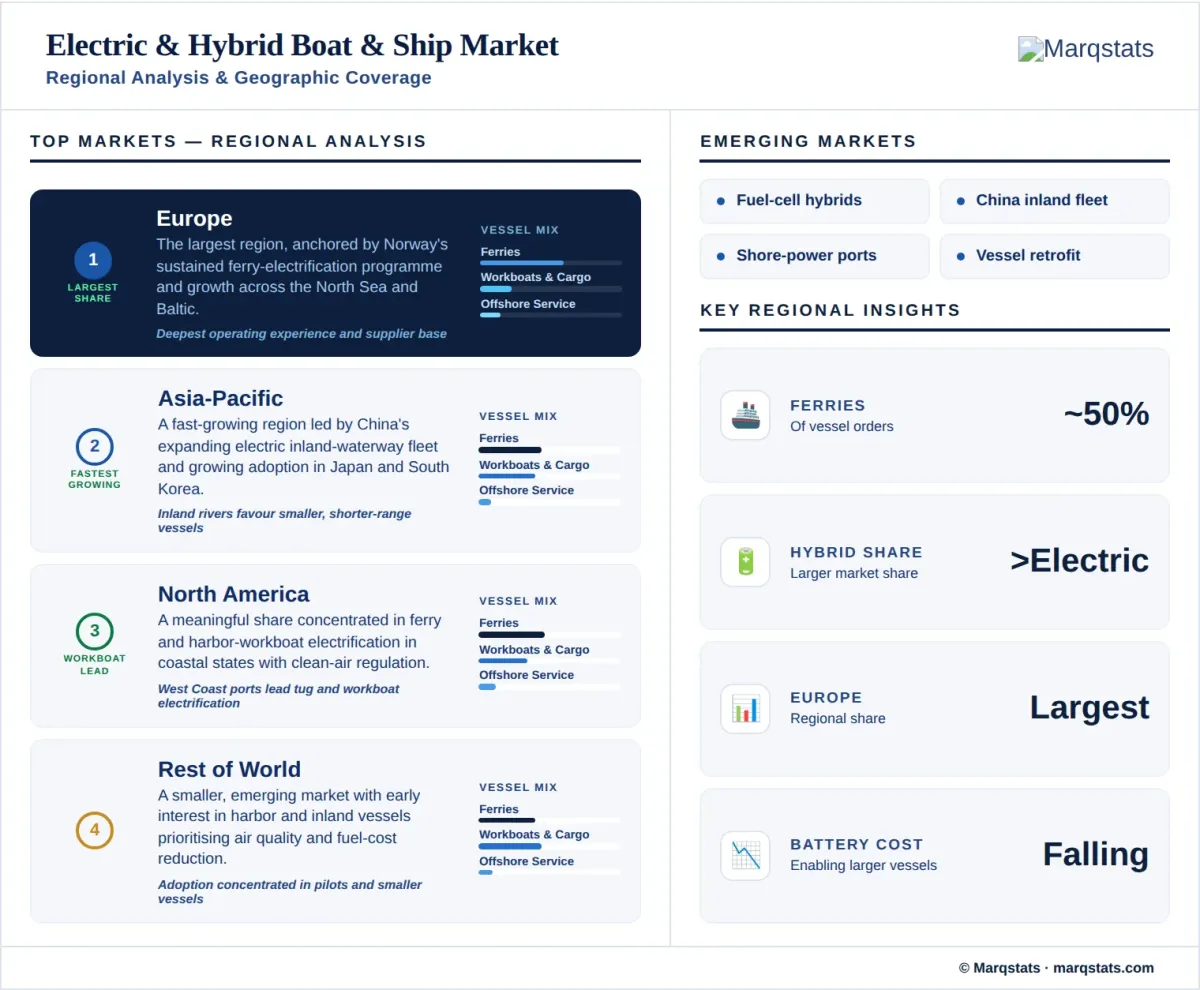
Europe holds the largest regional share, anchored by Norway's early and sustained ferry-electrification programme alongside growing adoption across Germany, the Netherlands, and other North Sea and Baltic markets. The region combines strong government subsidy support with a dense concentration of major marine battery and propulsion technology suppliers. Norway's decade-long ferry-electrification programme in particular has produced the deepest operating-experience base of any national market, giving Norwegian shipyards and technology suppliers a meaningful export advantage as other markets begin their own electrification programmes.
Asia-Pacific
Asia-Pacific is a fast-growing region, led by China's expanding fleet of electric inland waterway vessels and growing adoption in Japan and South Korea, supported by domestic shipbuilding capacity and government clean-transport initiatives. China's inland waterway network, extensive and heavily trafficked, provides a distinct demand pattern from the ocean-facing ferry routes that have driven European adoption, favouring smaller, shorter-range electric cargo and passenger vessels operating on rivers and canals.
North America
North America represents a meaningful share of global deployment, concentrated in ferry and harbor workboat electrification in coastal states with supportive clean-air regulation, alongside a growing recreational electric boat segment. West Coast ports in particular have emerged as an early adoption centre for harbor workboat and tug electrification, driven by some of the strictest port-emissions regulation in the region.
Rest of World
Latin America, the Middle East, and Africa represent a smaller, emerging market, with early-stage interest concentrated in harbor and inland waterway vessels in markets prioritising urban air quality and fuel-cost reduction over longer-term decarbonisation targets. Adoption in these regions has so far concentrated in pilot projects and smaller vessel classes rather than the fleet-scale electrification programmes seen in Europe and parts of Asia, reflecting both more limited subsidy availability and earlier-stage shore-power infrastructure.
How Competition Is Evolving
The market is fragmented across distinct competitive layers: propulsion and battery system suppliers who provide the electric drivetrain and energy storage technology, and shipyards who integrate that technology into complete vessels. This two-layer structure means a shipyard's electrification capability depends heavily on its propulsion-system supplier relationships, similar in structure to how automotive Tier-1 suppliers relate to vehicle assemblers. Unlike the automotive analogy, however, marine propulsion and battery suppliers typically serve a much smaller number of large, bespoke vessel orders rather than high-volume standardised production, meaning individual project wins carry disproportionate revenue significance for suppliers in this market.
Competitive strategy among propulsion and battery suppliers centers on energy density, safety certification, and marine-specific battery management system capability, since marine battery requirements differ materially from automotive or stationary storage applications in duty cycle and safety certification standards. Among shipyards, competitive strategy centers on accumulated project experience, since each new vessel class and route profile typically requires bespoke engineering rather than a fully standardised product, giving shipyards with a longer track record of delivered electric vessels a meaningful advantage in winning subsequent orders. Partnerships between shipyards and propulsion suppliers increasingly extend across multiple vessel orders rather than being negotiated fresh for each project, reflecting the value both sides place on the engineering knowledge accumulated through a working relationship. National and regional shipbuilding policy also shapes competitive positioning meaningfully, since several governments actively favour domestic shipyards for publicly funded ferry programmes, giving locally established yards a structural advantage over foreign competitors for that specific demand pool even where technical capability is comparable.
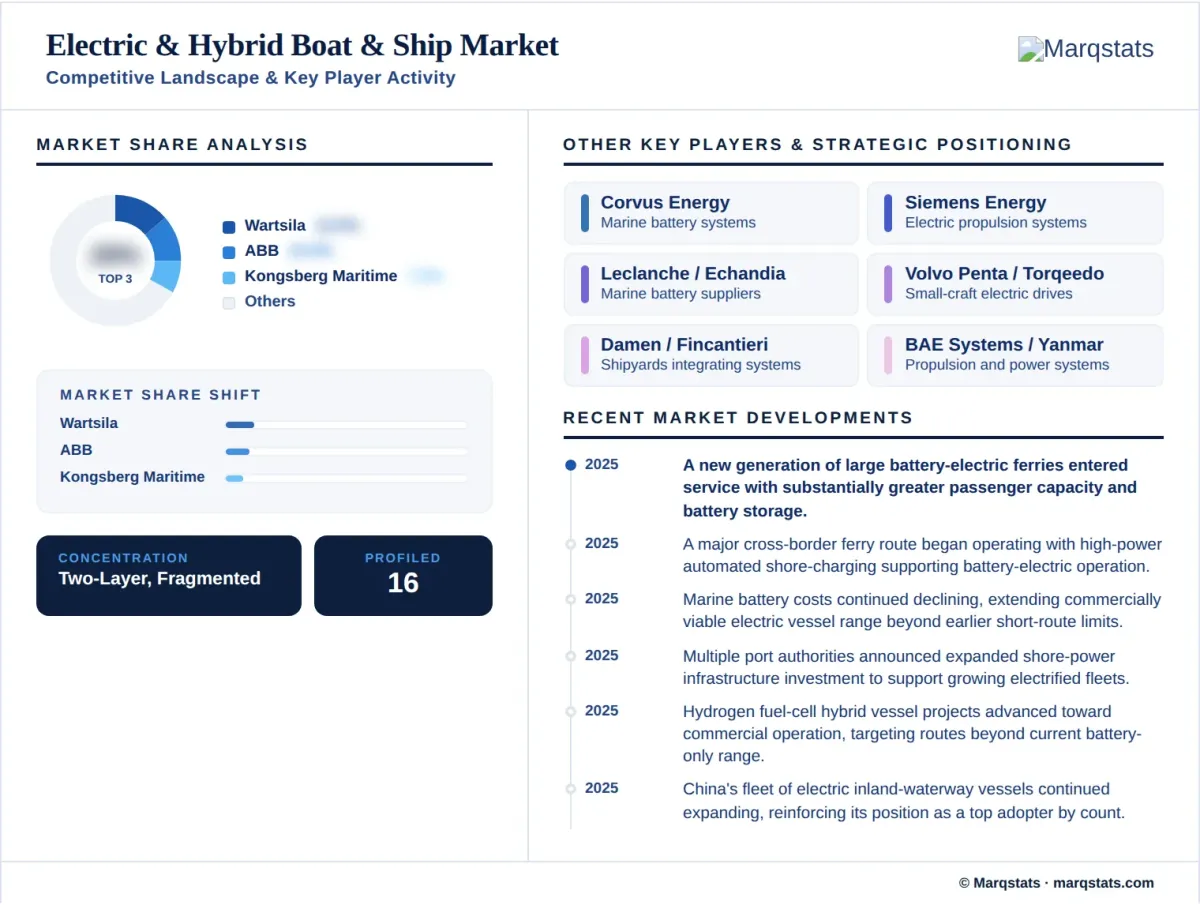
Companies Covered
The report profiles 16+ companies with full strategy and financials analysis, including:
Recent Market Activity
Table of Contents
Coverage & Segmentation
This report provides a comprehensive assessment of the global electric and hybrid boat and ship market across a 2025 base year, historical data from 2021 to 2025, and forecasts spanning 2026 to 2030. Market size is stated as vessel and retrofit system sales revenue in United States dollars. Segmentation covers three dimensions: vessel type, propulsion, and power class, alongside regional analysis spanning Europe, Asia-Pacific, North America, and the rest of world.
The scope covers fully electric and hybrid-electric marine vessels across ferries, inland and coastal cargo boats, harbor workboats, offshore service vessels, and recreational boats and yachts, including both newbuild vessels and retrofit conversion of existing vessels. The study excludes conventional diesel-only vessels, LNG and methanol-fuelled ships, and non-motorized sail vessels, each of which follows a different technology adoption and regulatory pathway than electrified propulsion. Large ocean-going container ships and cruise vessels are also excluded from the core scope, since battery-electric and hybrid propulsion at that scale remains largely at the pilot and demonstration stage rather than representing a meaningful commercial revenue category today; Marqstats will expand coverage to this vessel class as commercial deployment matures. Country-level detail beyond the four-region split covered here is available under customization, alongside deeper cuts by vessel type, propulsion, or power class.